Nano Banana 2.1 Is in Google Flow—But Not the API Yet (2026)
Nano Banana 2.1 is appearing in Google Flow, but Google has not documented an API model ID, price, or release notes. What is confirmed, what is reported, and what to use now.
The awkward part is that Nano Banana 2.1 seems to be selectable before it is documentable. On October 5, a TestingCatalog post showed a Google Flow picker containing “Nano Banana 2.1.” On October 6, Google’s own Gemini API model list still names Nano Banana 2, Nano Banana 2 Lite, and Nano Banana Pro—nothing called 2.1.
That leaves developers in an annoying but familiar gap: there is enough evidence to know the label is real on at least one consumer-facing surface, but not enough to name an endpoint, estimate a bill, or ship a production dependency. We checked the Flow reporting, Google’s API catalog, pricing and release notes, plus the SandBase catalog on 2026-10-06 around 00:00 UTC. The practical answer is simple: watch 2.1 in Flow if you have access, but build on an API model that has a documented ID today.
Key takeaway
- Nano Banana 2.1 is reported to be visible in Google Flow as of October 5, 2026; Google has not issued a matching announcement, API model ID, price, or feature list.
- Google’s API docs list
gemini-3.1-flash-image(Nano Banana 2),gemini-3.1-flash-lite-image(Nano Banana 2 Lite), andgemini-3-pro-image(Nano Banana Pro), not a 2.1 route.- Our SandBase checks returned HTTP 404 for five plausible 2.1/2.5 IDs. Its currently callable Nano Banana 2, Lite, and Pro routes all completed our small image test.
- Do not transfer Nano Banana 2’s resolution, search-grounding, price, or quality claims to 2.1. They are not specifications for an undocumented successor.
Status board: what is confirmed, reported, and unknown
A model name in a product picker is useful evidence. It is not an API contract. Here is the cleanest way to separate the two.
| Item | Current state on 2026-10-06 | Evidence level | What it lets you do |
|---|---|---|---|
| “Nano Banana 2.1” label in Google Flow | Reported visible | Reported; screenshot-backed third-party reporting | Look for it in Flow if you have access |
| Google Flow picker also showed 2, Lite, and Pro | Reported visible | Reported | Establishes the label is in the same product family UI |
| Gemini API ID for 2.1 | Not documented | Confirmed absence from Google’s current model list | Do not hard-code an ID |
| Pricing / rate limits / terms | Not documented | Confirmed absence from pricing and model pages reviewed | Do not estimate production cost |
| Feature changes over Nano Banana 2 | Not documented | Unknown | Do not call screenshots a benchmark |
| SandBase route for candidate 2.1 IDs | Not available | Direct catalog probe | Use an existing route instead |
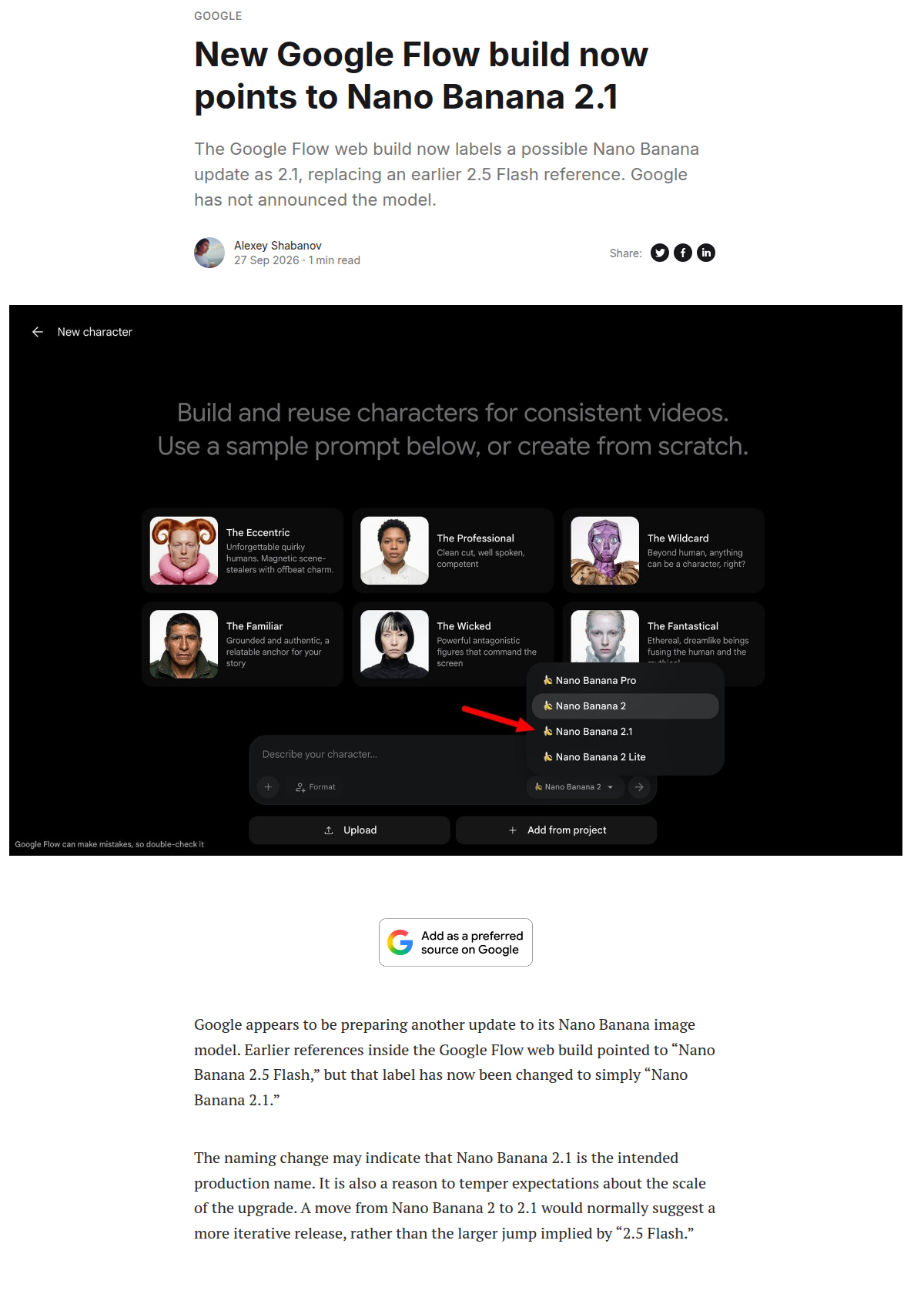 Caption: TestingCatalog’s September 27 report shows a Flow model picker with the 2.1 label. It is third-party evidence of a UI build, not a Google release note (captured 2026-10-06).
The sequence matters. TestingCatalog reported on September 27 that an earlier “Nano Banana 2.5 Flash” reference in a Flow web build had become “Nano Banana 2.1.” On October 5, its X account posted a screenshot saying 2.1 appeared available in Flow, while explicitly questioning whether requests reached a new model. Those reports are enough to justify a release-watch post. They are not enough to claim a general release.
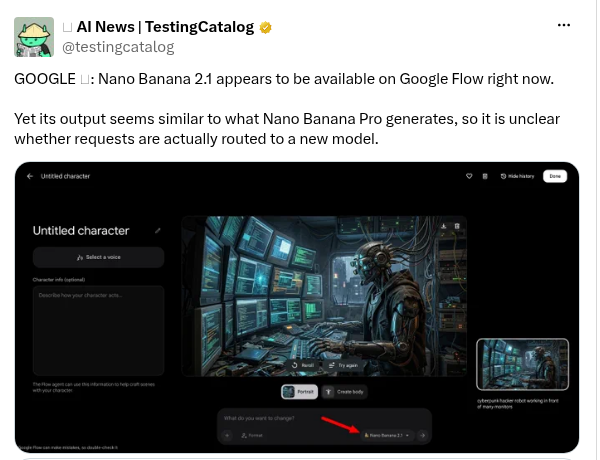 Caption: The October 5 X post is more recent than the web-build report, but it still treats the underlying route as uncertain. A visible label does not identify the serving checkpoint (captured 2026-10-06).
That distinction is the whole story. A UI rollout can be regional, account-gated, or wired to a fallback. Until Google publishes the model name and pricing, any claim that 2.1 is faster, better at text, or equivalent to Pro is an observation about an individual output—not a model specification.
What Google officially lists today
Google’s model catalog is the source of truth for a Gemini API integration. Its Gemini 3 table lists three current image-family endpoints:
| Marketing name | Documented Gemini API endpoint | Google’s positioning | Paid output price at listed size |
|---|---|---|---|
| Nano Banana 2 | gemini-3.1-flash-image | Speed and high-throughput image generation/editing | $0.067 per 1K-resolution image |
| Nano Banana 2 Lite | gemini-3.1-flash-lite-image | Lowest-cost, low-latency image generation/editing | $0.0336 per 1K-resolution image |
| Nano Banana Pro | gemini-3-pro-image | Studio-quality design, complex layouts and text | $0.134 per 1K/2K-resolution image |
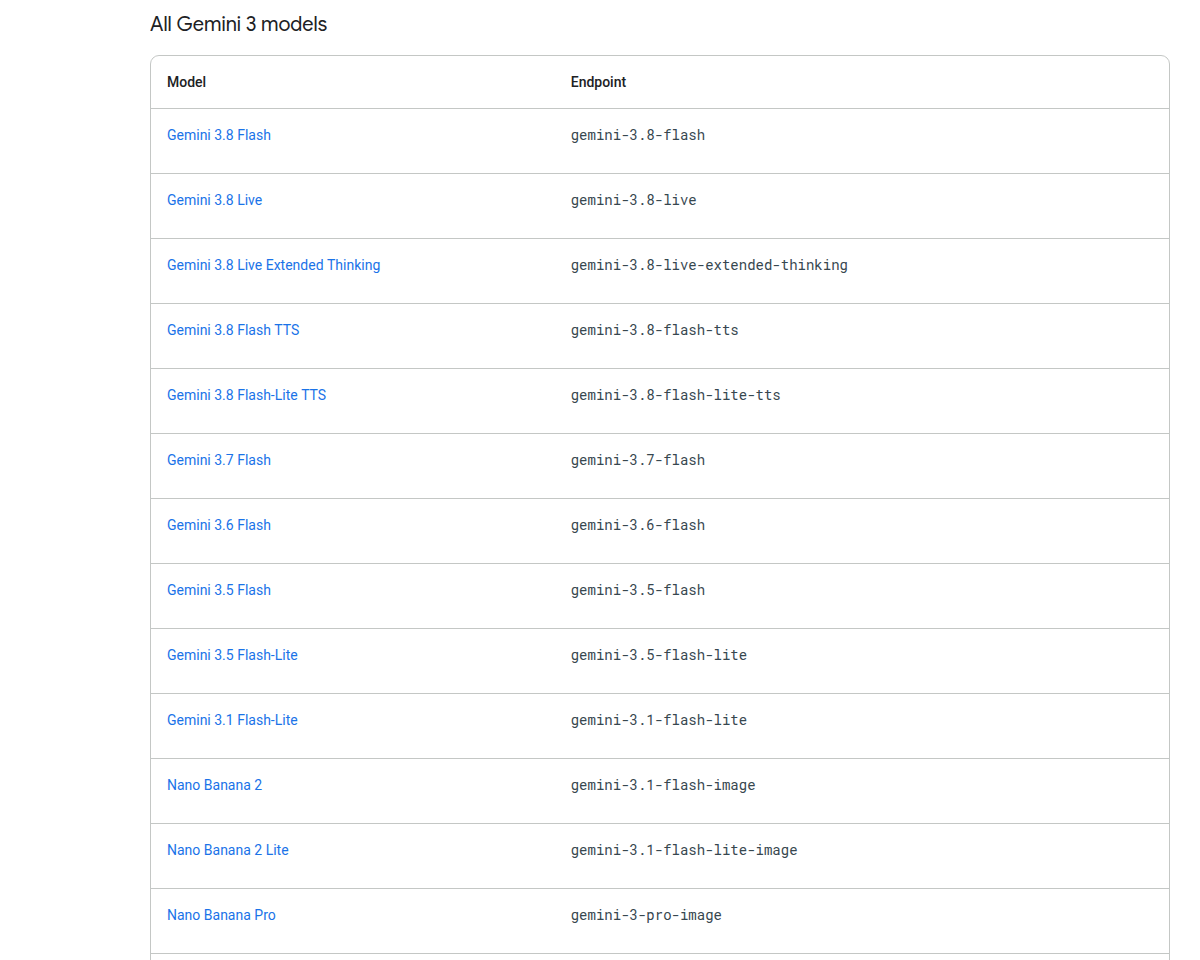 Caption: Google’s Gemini API catalog lists the three documented Nano Banana-family image endpoints. The capture contains no Nano Banana 2.1 entry (captured 2026-10-06).
The dollar amounts above are Google’s current paid-tier equivalents from the Gemini API pricing page, not predictions for 2.1. Nano Banana 2 also has listed 0.5K, 2K, and 4K rates; Pro has a listed 4K option. Lite’s documented image output is 1K. The details are worth reading before you attach a per-image budget to an agent workflow.
Google’s release notes put the current family on a useful timeline:
| Date | Official event | Why it matters now |
|---|---|---|
| 2026-02-26 | Nano Banana 2 preview announced | Start of the 3.1 Flash Image line |
| 2026-05-28 | Nano Banana 2 and Nano Banana Pro GA endpoints announced | These are the stable API models to integrate |
| 2026-06-30 | Nano Banana 2 Lite GA announced | The lower-cost official option |
| 2026-10-06 | No 2.1 entry in current release notes/model list | No public API launch has been documented |
This is a conservative reading, deliberately. Google may announce a route tomorrow; the page will need updating when it does. At the time checked, though, the named 2.1 UI report and the documented API surface have not converged.
We tried the models you can call now
We made one 1K, square image with each current SandBase route for two prompts, six runs in total. No retries. One asked for ten children in distinct raincoats, each holding up 1 through 10 fingers; the other requested four exact menu lines. These are deliberately narrow probes, not a benchmark.
All six calls completed. On the first prompt, Nano Banana 2 Lite was the closest to the requested sequence by our visual count: 8 of 10 children matched the intended finger count; Nano Banana 2 matched 4, and Pro matched 1. On the menu prompt, all three rendered all four requested lines and prices, but all three also added unrequested shop signage. In other words: the Lite result happened to win this particular counting test, but one generation per condition cannot establish a general quality ranking.
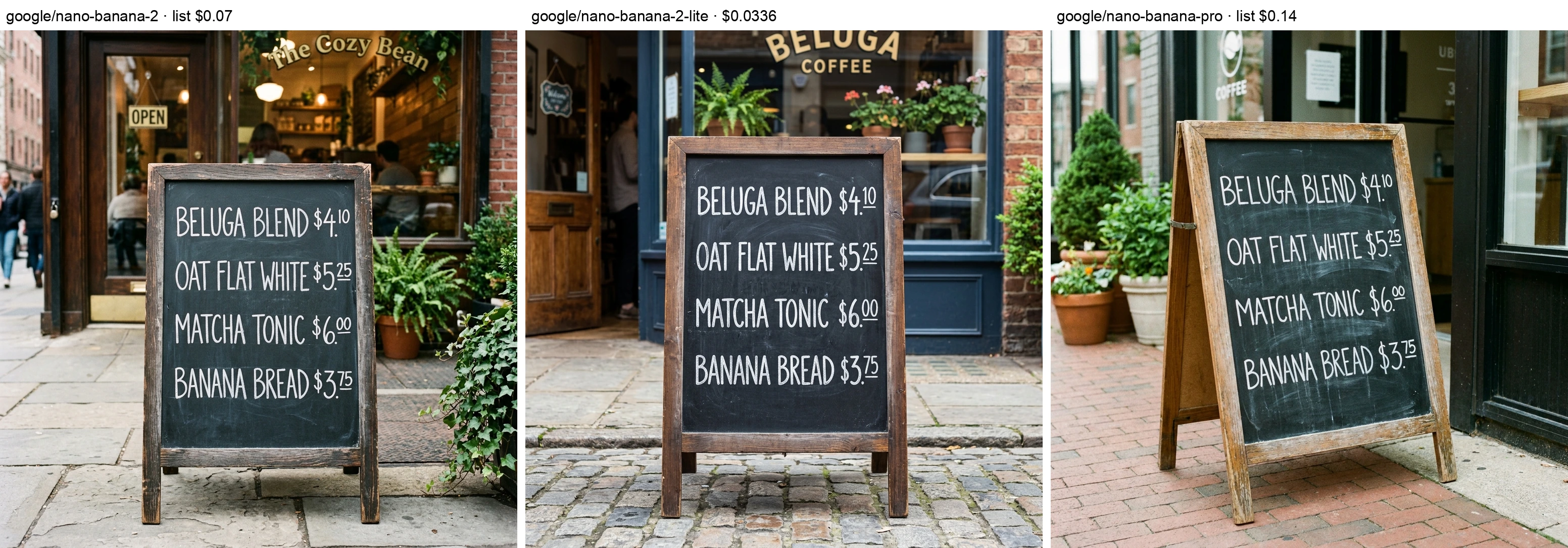 Caption: Our one-run text-rendering check: all three outputs preserve the four requested menu lines, while each adds unrequested surrounding text. These are single samples, not a comparative score (run 2026-10-06).
| Route tested on SandBase | Runs | Settled per-run cost we observed | Wall-clock range | Result |
|---|---|---|---|---|
google/nano-banana-2-lite | 2 | $0.0336 | 15.4–19.4 s | Both completed |
google/nano-banana-2 | 2 | $0.0455 | 19.3–19.7 s | Both completed |
google/nano-banana-pro | 2 | $0.0910 | 23.2–27.4 s | Both completed |
The SandBase prices are the settled costs for these exact 1K runs, not a promise of Google direct-API pricing or latency. The cost order held in this tiny sample: Lite, then 2, then Pro. The article’s existing Images 2.5 vs Nano Banana 2 comparison has a different creative-test question if you need more context; neither post proves what 2.1 will do.
We also queried five plausible SandBase IDs—google/nano-banana-2.1, google/nano-banana-2-1, google/nano-banana-2.5, google/nano-banana-2.5-flash, and google/gemini-3.2-flash-image. Every request returned HTTP 404 {"error":"model not found"}. That is only a catalog observation. It does not prove Google lacks an internal route, and it should not be used to infer a future SandBase ID.
What should a production team do?
The safe choice depends on whether you are actually shipping or just exploring Flow.
| Your situation | Use now | Reconsider when |
|---|---|---|
| You need cheap, high-volume 1K images | Nano Banana 2 Lite | Google documents a 2.1 API ID and price, then you can run a controlled comparison |
| You need 0.5K/2K/4K choices or image search/grounding options documented for the Flash model | Nano Banana 2 | A release note names a replacement and documents equivalent controls |
| You need the published Pro resolution/layout option | Nano Banana Pro | 2.1 has official specs and you have tested your own prompts |
| You have Flow access and want to explore | Nano Banana 2.1 in Flow, if the picker offers it | Treat outputs as exploratory; do not use them as API evidence |
| You are writing a production adapter | A versioned, documented model ID | A public contract covers an exact 2.1 route |
The implementation detail that saves trouble later is not a clever prompt. It is keeping the model name in a deploy-time configuration value and recording the exact model, resolution, aspect ratio, seed (when supplied), input assets, and output URL for your approval set. When 2.1 becomes callable, test that saved set before changing the default.
On SandBase, the three current models are available as google/nano-banana-2, google/nano-banana-2-lite, and google/nano-banana-pro. The provider supplies the image model; SandBase provides the route and catalog surface. Neither fact turns an undocumented Flow label into a production API.
What we still do not know
There is no confirmed answer yet for the questions developers actually need answered: the 2.1 API ID; availability by region, plan, or account; image resolutions; input modes; rate limits; price; whether it replaces or routes to an existing checkpoint; and whether it changes text, character consistency, editing, or latency.
The right trigger for an update is a primary artifact: a Google release note, Gemini/Vertex AI model page, pricing row, or public API route. We will update this canonical slug when one appears. Until then, the absence of a contract is more actionable than speculative feature lists.
FAQ
Is Nano Banana 2.1 released?
It is reported to be appearing in the Google Flow picker as of October 5, 2026. Google has not published a corresponding API model ID, pricing entry, or release note as of the October 6 check. So it is visible on a reported product surface, but not publicly documented as an API model.
What is the Nano Banana 2.1 API model name?
Unknown. Google’s current model list includes gemini-3.1-flash-image, gemini-3.1-flash-lite-image, and gemini-3-pro-image; it does not list a 2.1 endpoint.
Is Nano Banana 2.1 better than Nano Banana Pro?
There is no reliable public basis for that claim. A third-party post said the Flow output looked similar to Pro and explicitly questioned whether it was a new underlying route. One screenshot cannot establish quality, speed, or routing.
Can I use Nano Banana 2.1 through SandBase?
Not at the time of our check. Five plausible 2.1/2.5 route names returned 404. Use the listed Nano Banana 2, Lite, or Pro routes until a real model ID is registered.
Which current model should I choose?
Start with Lite for cheap 1K volume, Nano Banana 2 when you need its documented resolution/options, and Pro when the published Pro capabilities match your job. Validate against your own prompt set rather than treating our six images as a ranking.
Sources and scope
Reviewed 2026-10-06 around 00:00 UTC: Google Gemini API model catalog, pricing, release notes, Google DeepMind Nano Banana family page, TestingCatalog’s September 27 Flow-build report, and TestingCatalog’s October 5 Flow post.
Our six SandBase generations and five route probes were run once per stated condition. They establish what those routes returned at that moment—not a model benchmark, an upstream identity, or a prediction about Nano Banana 2.1.