Gemini 4 Argon vs Claude Opus 5.5 vs GPT-6 Astra: Which to Use
Gemini 4 Argon vs Claude Opus 5.5 vs GPT-6 Astra: where Google's own table says Argon wins and loses, the independent Artificial Analysis view, prices, and our 24-call same-prompt test with per-call cost.
We sent the same four prompts to Gemini 4 Argon, Claude Opus 5.5 and GPT-6 Astra on SandBase, twice each. All three got the logic puzzle, the code trace and the purchase-order maths right. The only two failures in 24 calls had nothing to do with intelligence: given a JSON Schema through response_format, Opus replied “No schema actually came through with your message” and returned prose plus a fenced block instead of JSON.
That’s the real shape of the Gemini 4 Argon vs Claude Opus 5.5 question in October 2026. On small, checkable tasks the three flagships are hard to tell apart. What separates them is the kind of job, the price per task (not per token), how strictly they follow an output contract, and where the benchmarks say each is weak. This post is for developers picking one of the three for a specific workload. For Argon’s full independent ranking, see our Gemini 4 Argon benchmark leaderboard.
Key takeaway
- In Google’s model-card table, Argon leads Opus 5.5 and GPT-6 Astra on knowledge-work agents (Vals Index 68.9, Harvey Legal Agent 19.6) and long context (GraphWalks 256k–1M 84.2), but trails on FrontierSWE v2, Terminal-bench 4.0, PostTrainBench, Terminal-Bench Science and OSWorld-2.0. All Google-reported.
- Artificial Analysis (Intelligence Index v4.3, data as of 2026-10-12) scores Gemini 4 Argon (High) 52.6, level with GPT-6 Astra (Max) at 52.7 and behind Claude Opus 5.5 (Max) at 57.6. AA has no coding, agentic or speed numbers for Argon yet.
- SandBase list prices per million tokens: Argon $4 / $20, Opus 5.5 $4 / $20, GPT-6 Astra $10 / $50. Google sells Argon direct at an introductory $2 / $10 until Nov 30, 2026.
- Our 24-call test (2026-10-14 UTC): Argon 8/8 for $0.148 billed, Astra 8/8 for $0.170, Opus 6/8 for $0.203. Opus’s two misses were the
response_formatruns; with the schema pasted into the prompt it passed both.- Astra costs 2.5x more per token but wrote a third of the tokens on the logic puzzle, so it billed the least of the three on that task (with its 10% discount; at list price Opus 5.5 edges it).
The three models at a glance
Prices come from GET /v1/models/<id> on 2026-10-14 UTC (google/gemini-4-argon, anthropic/claude-opus-5.5, openai/gpt-6-astra); context and max output from the SandBase model pages the same day.
| Gemini 4 Argon | Claude Opus 5.5 | GPT-6 Astra | |
|---|---|---|---|
| SandBase list price (in / out per 1M) | $4 / $20 | $4 / $20 | $10 / $50 (under 272K prompt tokens) |
| Discount shown that day | none | 5% off | 10% off |
| Cached input read | 0.05x | 0.05x | 0.1x |
| Context / max output on SandBase | 1M / 65.5K | 1M / 128K | 1.1M / 128K |
| AA Intelligence Index v4.3 | 52.6 (High) | 57.6 (Max), 53.6 (High) | 52.7 (Max), 49.6 (Medium) |
| AA coding / agentic index | not measured | not measured | 76.9 / 51.0 (Max) |
| Leads in Google’s table | knowledge-work agents, long context, long video | Terminal-bench 4.0, PostTrainBench | FrontierSWE v2, Terminal-Bench Science, OSWorld-2.0 |
| Our test (8 calls each) | 8/8, $0.148 | 6/8, $0.203 | 8/8, $0.170 |
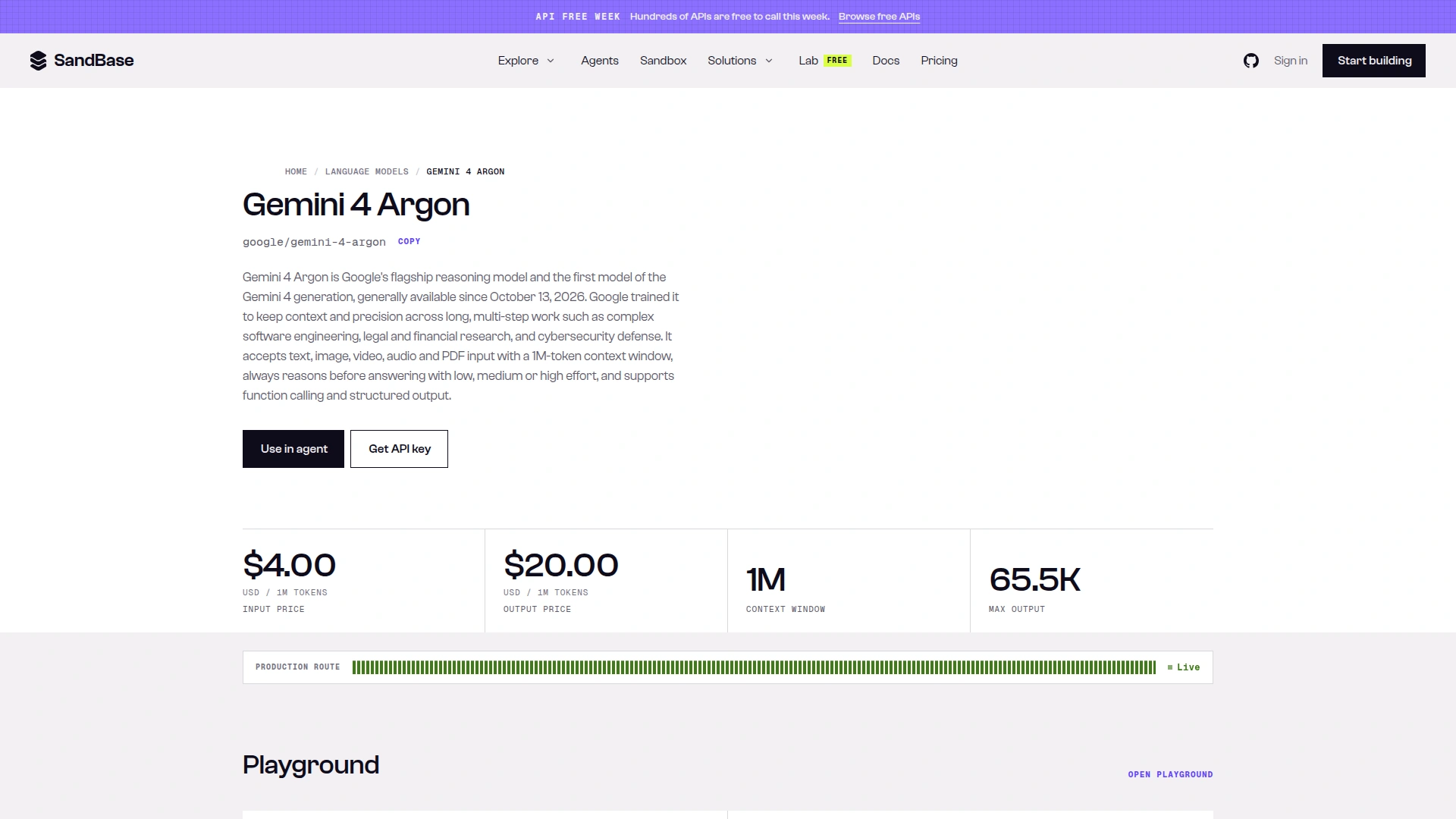
Caption: The Gemini 4 Argon page on SandBase lists $4 / $20 per million tokens and a 65.5K max output, the price and cap behind every Argon number in this post (captured 2026-10-14 UTC).
To be plain about it: $4 / $20 is Google’s post-introductory standard rate. Through Nov 30, 2026, Google charges $2 / $10 direct, so on SandBase you pay twice Google’s current direct price for Argon. Our Gemini 4 Argon pricing guide covers what changes on Dec 1.
Where Google says Argon wins, and where it doesn’t
Google’s model card (published 13 Oct 2026) compares Argon with GPT-6 Astra, Claude Fable 5.1 and Claude Opus 5.5. These are the rows that matter for our three; Fable is left out. Every number is Google-reported and unreproduced by us.
| Benchmark (what it tests) | Argon | GPT-6 Astra | Opus 5.5 | Leader |
|---|---|---|---|---|
| Vals Index (professional tasks) | 68.9 | 63.1 | 67.0 | Argon |
| AutomationBench (workflow automation) | 51.3 | 41.4 | 42.5 | Argon |
| Vals Finance Agent v2 | 65.4 | 53.5 | 58.6 | Argon |
| Harvey Legal Agent | 19.6 | 5.4 | 3.8 | Argon |
| GraphWalks 256k–1M (long context) | 84.2 | 71.8 | 66.8 | Argon |
| LVBench (long video) | 91.7 | 87.5 | 83.7 | Argon |
| DeepSWE v1.1 (long-horizon coding) | 77.9 | 74.1 | 74.2 | Argon |
| FrontierSWE v2 (hard coding) | 55.0 | 65.5 | 62.3 | Astra |
| Terminal-Bench Science 0.1 | 57.6 | 68.1 | 63.3 | Astra |
| OSWorld-2.0 offline (computer use) | 69.2 | 72.6 | — | Astra |
| Terminal-bench 4.0 (terminal agents) | 57.4 | 58.2 | 66.4 | Opus |
| PostTrainBench (ML engineering) | 45.3 | 44.3 | 49.3 | Opus |
The pattern is clearer than the headline. Argon’s wins cluster in document-heavy, multi-step knowledge work and very long inputs. Its losses cluster in hands-on engineering: a terminal, a hard repo, a desktop. Harvey Legal Agent (19.6 against 5.4 and 3.8) is the biggest relative lead in the table, and the one I’d most want reproduced by someone else before betting a legal workflow on it. We dig into that in Gemini 4 Argon for legal and finance work.
What the independent leaderboard adds
Vendor tables choose their benchmarks. Artificial Analysis runs one suite on everyone, and we use its free-tier data. On Intelligence Index v4.3 (data as of 2026-10-12; 687 scored rows, each a model × effort setting), Gemini 4 Argon (High) ranks #8. The configurations that matter here:
| AA configuration | Intelligence Index | AA cost per index task |
|---|---|---|
| Claude Opus 5.5 (Max, Default Fallback) | 57.6 | $5.98 |
| Claude Opus 5.5 (High, Default Fallback) | 53.6 | $1.82 |
| GPT-6 Astra (Max) | 52.7 | $3.26 |
| Gemini 4 Argon (High) | 52.6 | $1.99 at $2 / $10 |
| GPT-6 Astra (Medium) | 49.6 | $1.54 |
Two caveats. AA priced Argon at Google’s $2 / $10 intro rate; at SandBase’s $4 / $20 the same tokens cost about twice as much, roughly $4 per task, above Opus 5.5 High. And AA hasn’t measured Argon’s coding or agentic index, exactly where Google’s own table shows it trailing. Argon’s AA legal index (60.0) beats Opus 5.5 High (59.0) and Astra Max (58.5) but not Opus 5.5 Max (63.3). AA’s methodology explains the composite.
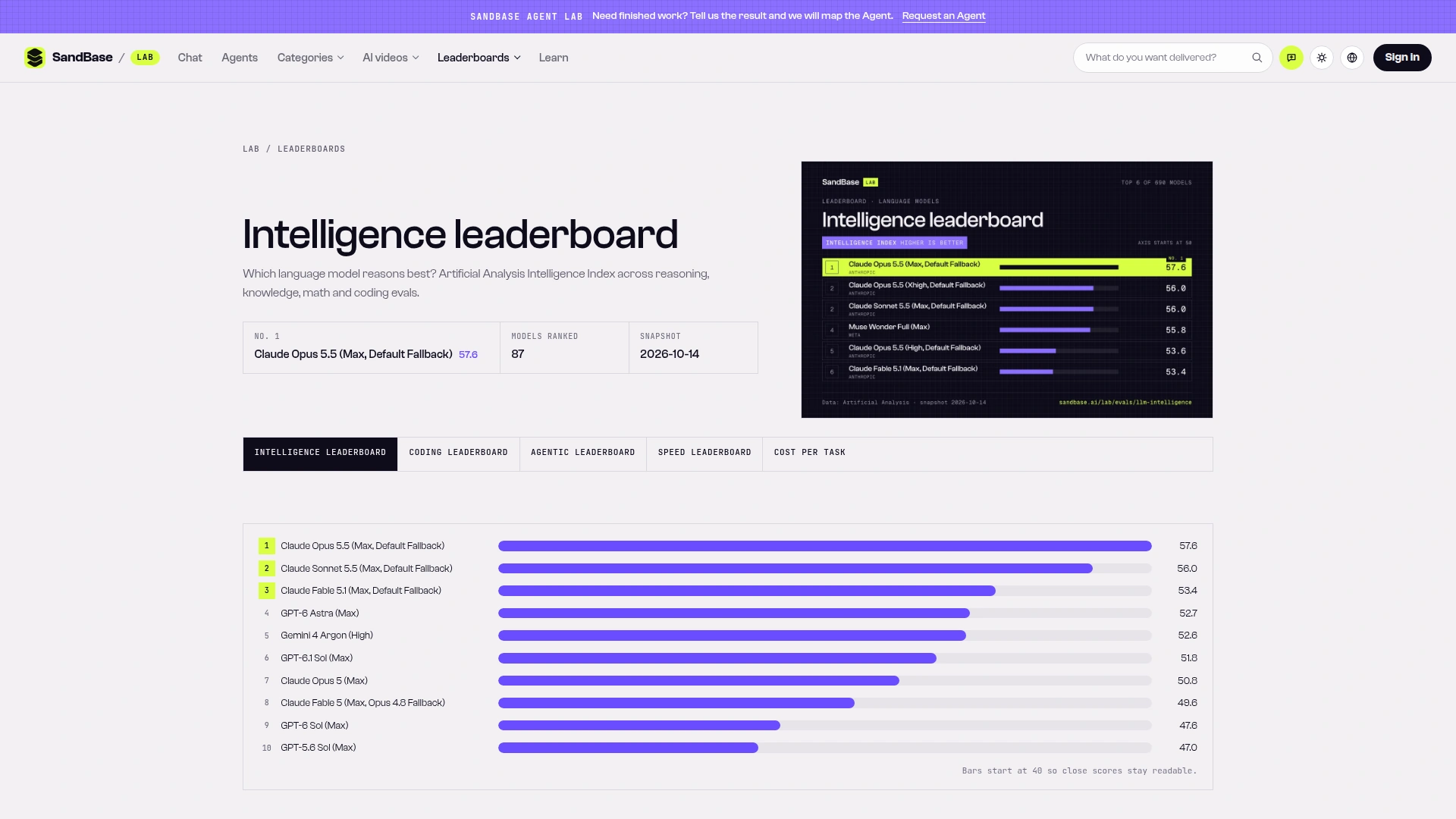
Caption: The SandBase Lab intelligence leaderboard (Artificial Analysis data) ranks models in the SandBase catalog: Gemini 4 Argon (High) is 5th of 87 at 52.6, a tenth behind GPT-6 Astra (Max). That rank is within SandBase’s catalog, not all AA rows (captured 2026-10-14 UTC; Lab snapshot dated 2026-10-14).
The Lab evals page has coding, agentic, speed and cost tabs too; Argon is absent from the ones AA hasn’t measured.
Our same-prompt test
Benchmarks describe averages. I wanted to see what one developer’s request looks like on each model: tokens, seconds, cents, and whether the reply is usable without cleanup. Scope up front: four short prompts, two runs each, 24 calls. Enough to spot behaviour, not to rank intelligence.
Every call went to SandBase’s OpenAI-compatible Chat Completions endpoint, POST https://api.sandbase.ai/v1/chat/completions, between 18:30 and 18:37 UTC on 2026-10-14, with max_tokens: 16000 and nothing else. So default effort: Astra’s SandBase schema defaults reasoning_effort to medium; the Argon and Opus schemas expose no effort parameter. Cost is the billed cost field from GET /v1/tasks/<completion id>/cost.
| Task | What it checks | Expected answer |
|---|---|---|
logic | Nine-constraint courier puzzle, then S = Σ parcel × hour; uniqueness checked by brute force | Ada 1@9, Ben 5@11, Cy 3@13, Dee 4@12, Eli 2@10, S = 171 |
extract | Purchase-order email to JSON via strict response_format: json_schema: dozens, per-hundred pricing, a cancelled line, a quantity amendment, a line-only 15% discount, 8.25% tax on goods only | 4 SKUs, subtotal 254.05, tax 20.96, total 293.01 |
extract_inline | Same email, schema pasted into the prompt, no response_format (added after run 1) | same |
code | Predict one printed Python line: mutable default argument, lazy generator, floor division, banker’s rounding | 100 [101, 104, 109] 109 -4 6 [1, 2] |
The logic prompt ends with a fixed ANSWER: {...} line that the grader parses and compares value by value. The extraction grader parses the reply as JSON and checks SKUs, quantities, line totals, subtotal, tax, shipping and total to the cent.
Results: same answers, different bills
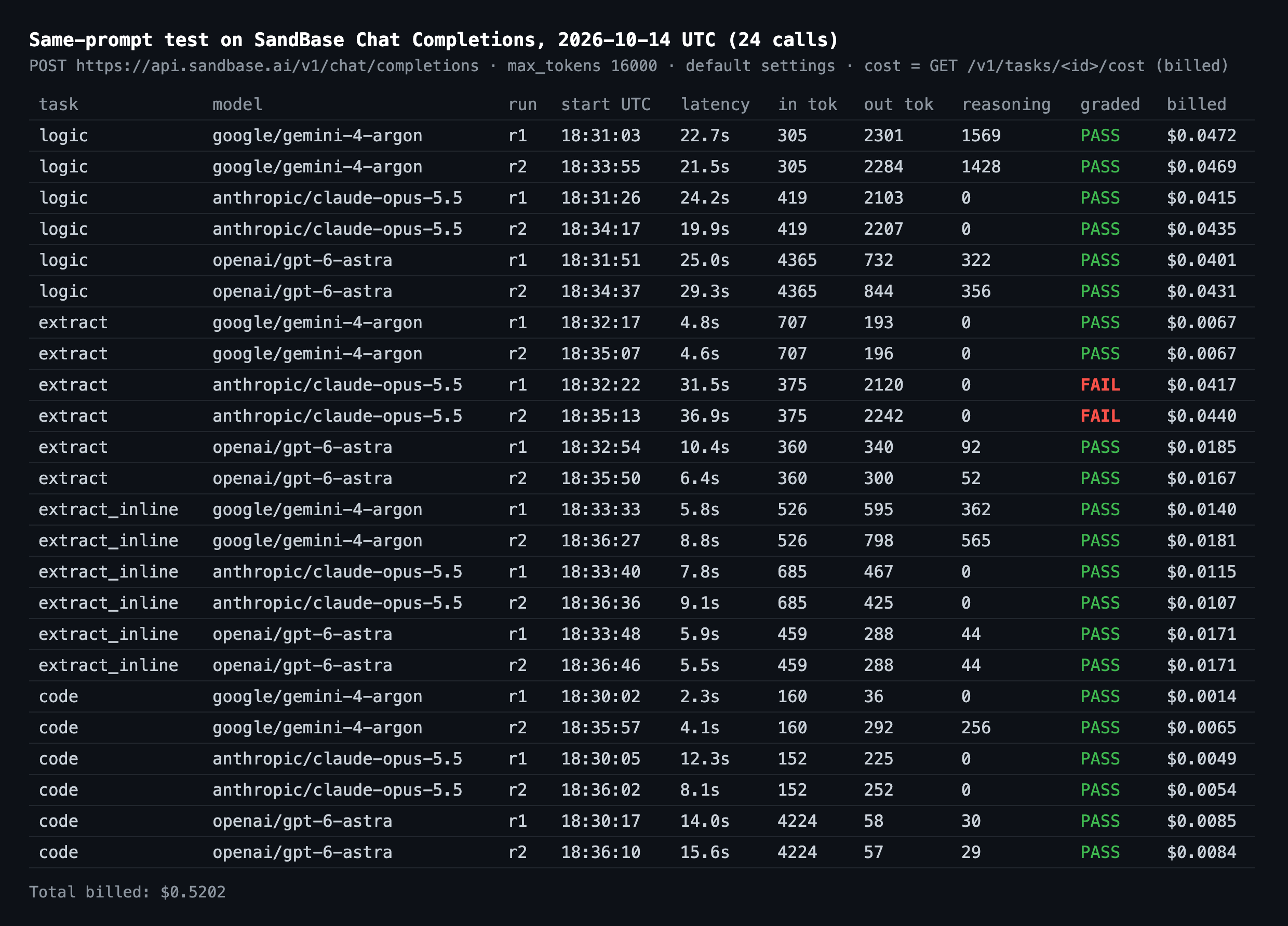
Caption: All 24 calls, rendered from our saved run records: every answer passed except Claude Opus 5.5’s two response_format runs, and the whole test billed $0.52 via /v1/tasks/<id>/cost (run 2026-10-14 UTC).
Means over two runs (pass, output tokens, latency, billed cost):
| Task | Gemini 4 Argon | Claude Opus 5.5 | GPT-6 Astra |
|---|---|---|---|
| logic | 2/2, 2,293, 22.1 s, $0.047 | 2/2, 2,155, 22.0 s, $0.043 | 2/2, 788, 27.2 s, $0.042 |
| extract | 2/2, 195, 4.7 s, $0.0067 | 0/2, 2,181, 34.2 s, $0.043 | 2/2, 320, 8.4 s, $0.018 |
| extract_inline | 2/2, 697, 7.3 s, $0.016 | 2/2, 446, 8.4 s, $0.011 | 2/2, 288, 5.7 s, $0.017 |
| code | 2/2, 164, 3.2 s, $0.0039 | 2/2, 239, 10.2 s, $0.0051 | 2/2, 58, 14.8 s, $0.0085 |
Opus 5.5 didn’t get, or didn’t honour, response_format on this route. Both extract runs opened by saying no schema had arrived, then invented field names (order_number, customer, lines) and wrapped the JSON in a code fence with bullet notes. The maths inside was right, down to $293.01, though it labelled the supplier as customer. With the schema in the prompt, Opus returned clean, matching JSON twice and was the cheapest on that task. Its SandBase schema does list response_format, so I’d treat this as route behaviour to check, not a model limit. We didn’t test Anthropic’s API direct.
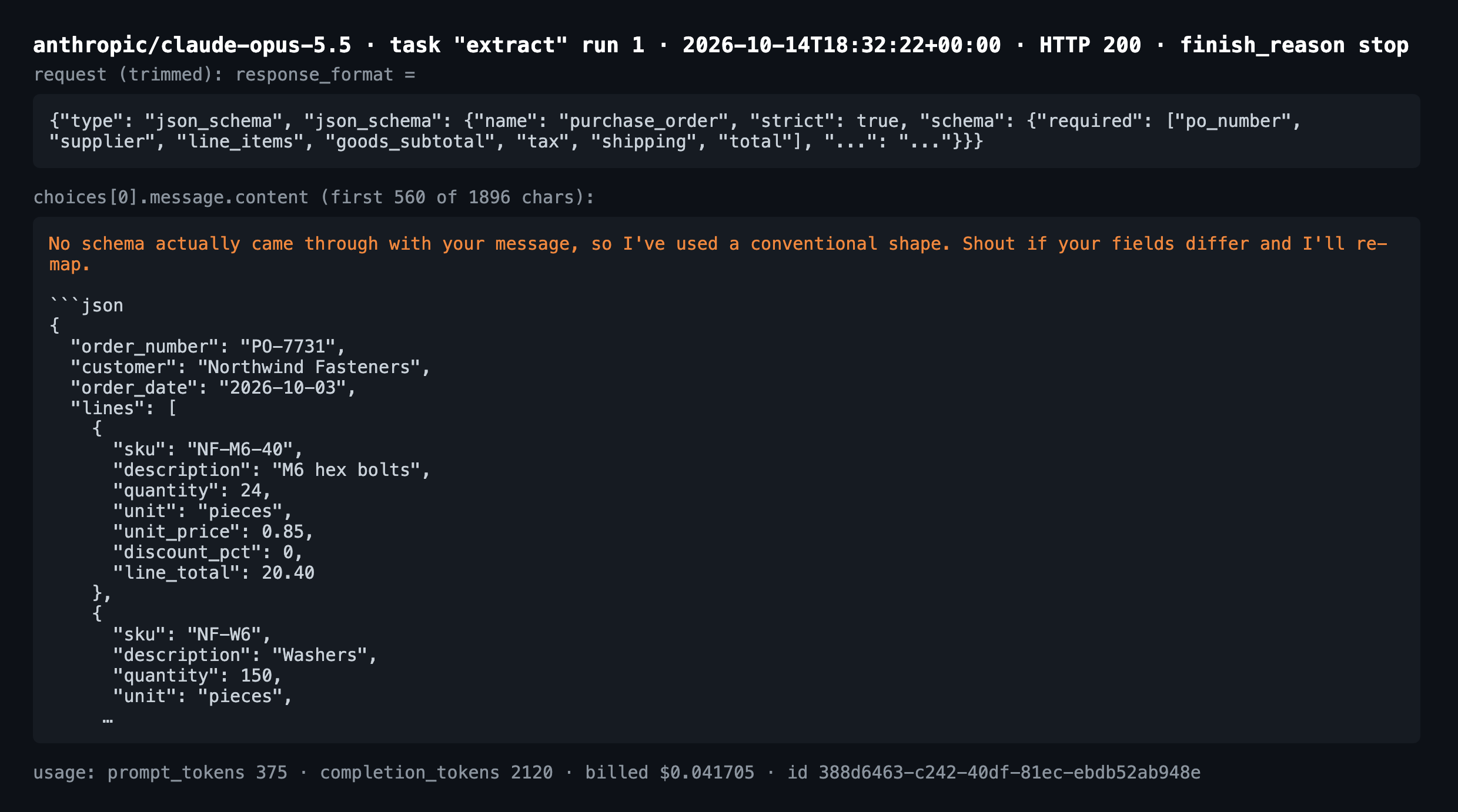
Caption: Opus 5.5’s first extract reply: the request carried a strict json_schema, yet the model said none came through and used its own field names; 2,120 output tokens, $0.0417 billed (run 2026-10-14 18:32 UTC).
Astra’s per-token premium shrank per task. On the puzzle Astra wrote 732 and 844 output tokens against about 2,300 for Argon and 2,100 to 2,200 for Opus. At 2.5x the output price it still billed the least there, though only thanks to its 10% discount; at list price Opus 5.5 is slightly cheaper on this task (see the projection below).
Argon was fastest on short calls: 2.3 to 4.8 seconds for the code trace and response_format extraction, against 6 to 16 seconds for Astra and 8 to 37 for Opus. On the puzzle all three took 20 to 29 seconds. Single wall-clock timings from one client, so a hint, not a latency benchmark.
Reasoning token counts aren’t comparable. SandBase describes Argon as always reasoning, yet reasoning_tokens was 0 on three of eight Argon calls and 256 to 1,569 on the rest. Opus returned a reasoning_content field on several calls while reporting reasoning_tokens: 0, so its output counts probably include that thinking text.
Astra’s prompt count jumped on two tasks. The 150-token code prompt was reported as 4,224 prompt tokens, 3,968 of them cached; the puzzle showed the same overhead, the extraction prompts didn’t. We don’t know why. Billed at the 0.1x cache rate it added under a cent per call, but a cold cache would make it visible.
Honestly, these tasks were too easy to separate the models on correctness. What they did expose is format compliance, token appetite and latency, which decide your bill and your parsing code every day.
What a task costs on each model
Our measured token averages at list price (ignoring current discounts), scaled to 10,000 calls:
| 10,000 calls of… | Argon ($4 / $20) | Opus 5.5 ($4 / $20) | GPT-6 Astra ($10 / $50) |
|---|---|---|---|
| logic puzzle | ~$471 | ~$448 | ~$462 (with cache) |
| strict JSON extraction | ~$67 (response_format) | ~$117 (schema in prompt) | ~$196 (response_format) |
| short code answer | ~$39 | ~$54 | ~$94 (with cache) |
These are projections, not quotes. Reasoning-heavy prompts swing between runs: Argon’s code trace cost 4.8x more on the second identical call (292 vs 36 output tokens). Measure your own prompts; /v1/tasks/<id>/cost makes that one request per call.
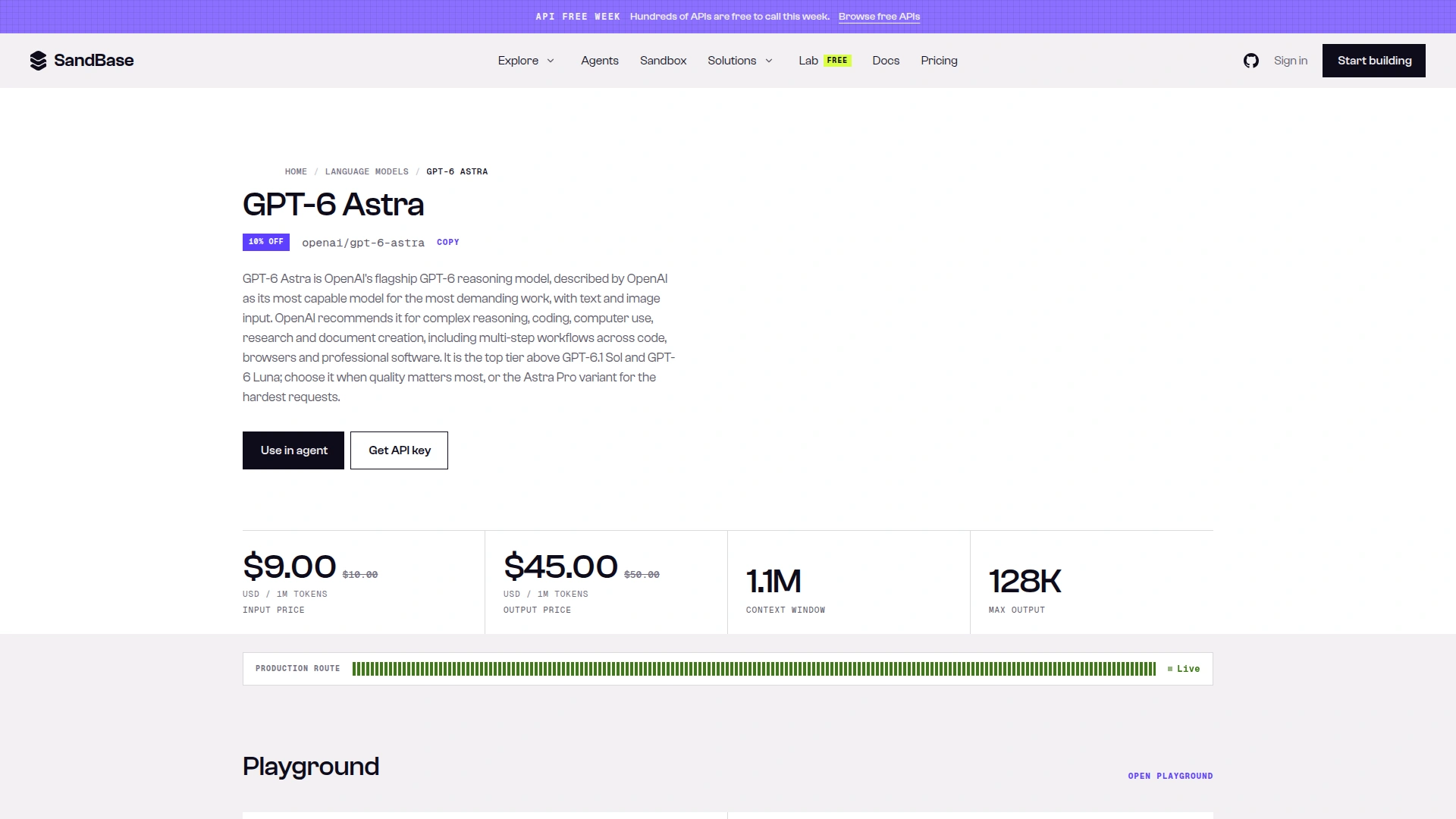
Caption: GPT-6 Astra on SandBase lists $10 / $50 per million tokens, shown at 10% off that day ($9 / $45), with a 128K max output; the cost endpoint applied the same 10% to every Astra call (captured 2026-10-14 UTC).
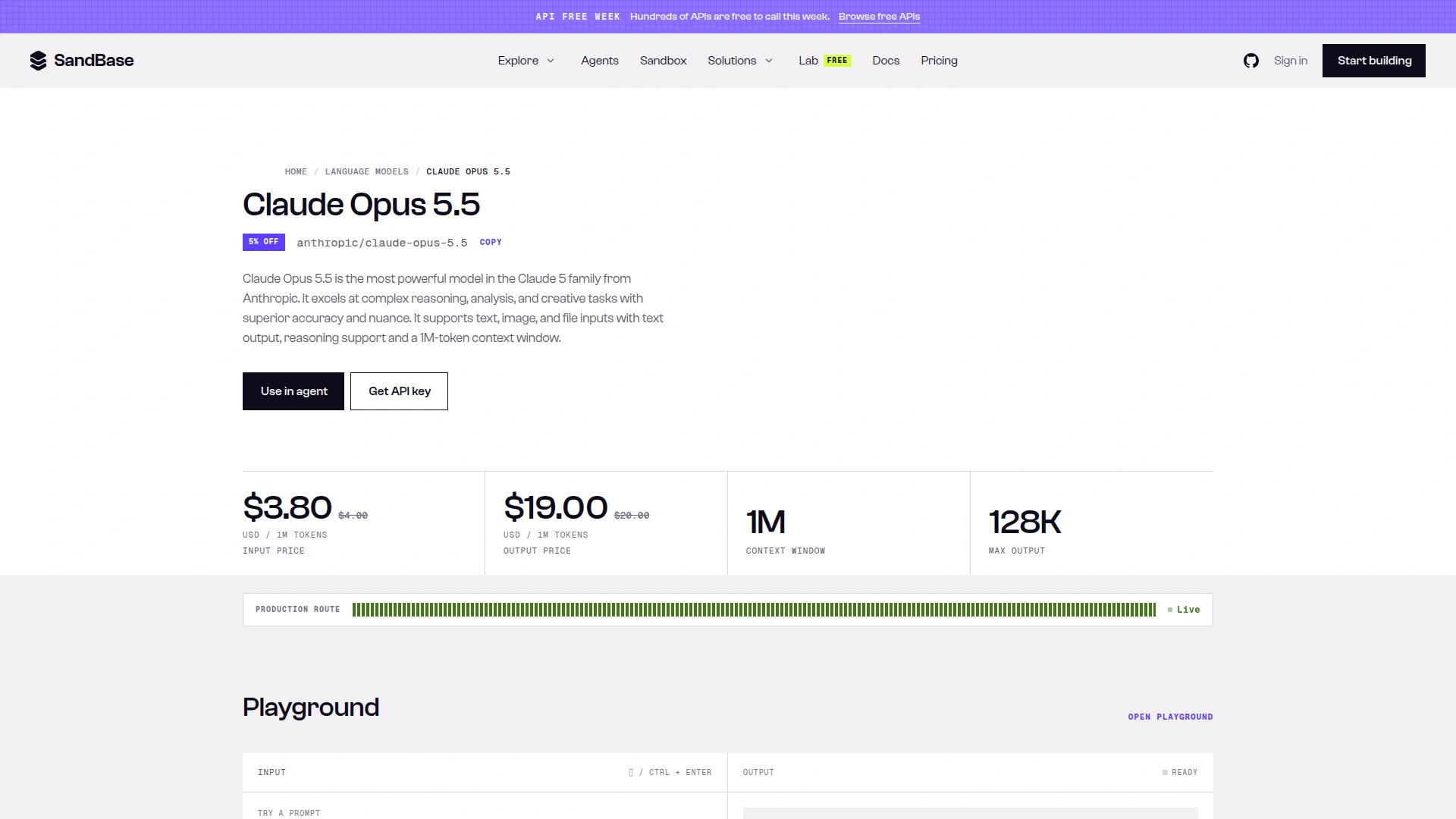
Caption: Claude Opus 5.5 lists at the same $4 / $20 as Argon, shown at 5% off on test day, with nearly twice Argon’s max output on SandBase (128K vs 65.5K) (captured 2026-10-14 UTC).
Choose X when
| Choose | When the job is… | Evidence | Watch out for |
|---|---|---|---|
| Gemini 4 Argon | Multi-step knowledge work over long documents: legal, finance, research | Leads Google’s Vals, Harvey Legal, Finance Agent rows; GraphWalks 256k–1M 84.2; AA legal 60.0 | Google-reported; AA coding/agentic unmeasured; 65.5K max output on SandBase |
| Gemini 4 Argon | High-volume strict-schema extraction | 2/2 with response_format, 4.7 s, $0.0067 per call | 2x Google’s direct intro price until Nov 30 |
| Claude Opus 5.5 | Terminal-driven agents, ML engineering | Leads Terminal-bench 4.0 (66.4), PostTrainBench (49.3) | Put the schema in the prompt; response_format was ignored in our runs |
| Claude Opus 5.5 | Highest composite score, budget for Max effort | AA 57.6 (Max) | $5.98 per AA task at Max; High is 53.6 at $1.82 |
| GPT-6 Astra | Hard software engineering, computer use, scientific terminal work | Leads FrontierSWE v2, OSWorld-2.0, Terminal-Bench Science; AA coding 76.9 (Max) | 2.5x per-token price; slowest on our code trace |
| GPT-6 Astra | Reasoning where answer length dominates cost | ~1/3 the output tokens on our puzzle; billed least there (with discount) | ~4K unexplained cached prompt tokens on some calls |
Still undecided? Run your top three prompts against all three. On SandBase they share one endpoint and request shape, so switching is one string. Start from the Argon model page; our Argon Python tutorial covers streaming, tools and response_format.
FAQ
Is Gemini 4 Argon better than Claude Opus 5.5?
On Google’s table, yes for knowledge-work agents and long context, no for terminal agents and ML engineering. On Artificial Analysis v4.3, Opus 5.5 (Max) scores 57.6 against Argon (High)‘s 52.6. In our small test Argon solved all eight calls and Opus six; Argon’s eight calls billed $0.148 against $0.203 and had the lower median latency, though Opus was slightly cheaper on the logic puzzle.
Gemini 4 Argon vs GPT-6 Astra: which is cheaper?
Per token, Argon ($4 / $20 against $10 / $50 on SandBase). Per task, it depends on output length: Astra was cheaper on our logic puzzle because it wrote a third of the tokens; Argon was cheaper on extraction and the code trace.
Does Claude Opus 5.5 support structured output on SandBase?
Its schema lists response_format, but in our two strict json_schema runs on 2026-10-14 Opus said no schema reached it. Pasting the schema into the prompt worked 2/2. Validate the JSON in code either way.
Which is best for coding?
Google’s table puts Astra ahead on FrontierSWE v2 and Opus 5.5 ahead on Terminal-bench 4.0; Argon leads DeepSWE v1.1 and Vibe Code Bench (91.9 vs 89.6 and 90.3). AA has a coding index for Astra (76.9 at Max), none yet for Argon or Opus 5.5.
Limitations
Four prompts, two runs each, default settings, one client, one 7-minute window: this measures behaviour, not capability. Latency is single-client wall-clock. The Opus response_format result is specific to the SandBase route on 2026-10-14. Google’s numbers are Google-reported; AA data is v4.3 as of 2026-10-12 at named effort settings, while our calls used defaults. Prices and discounts were checked 2026-10-14 UTC and will change, starting with Google’s intro rate on Nov 30. For how Argon got here, see our pre-GA Argon access note.