Wan 3.0 Is 35% Off on SandBase: Price, Features, and Real Tests
Wan 3.0 is 35% off on SandBase. See the real 5-second and 30-second cost, what Alibaba's video model does, API inputs, tests, and limits.
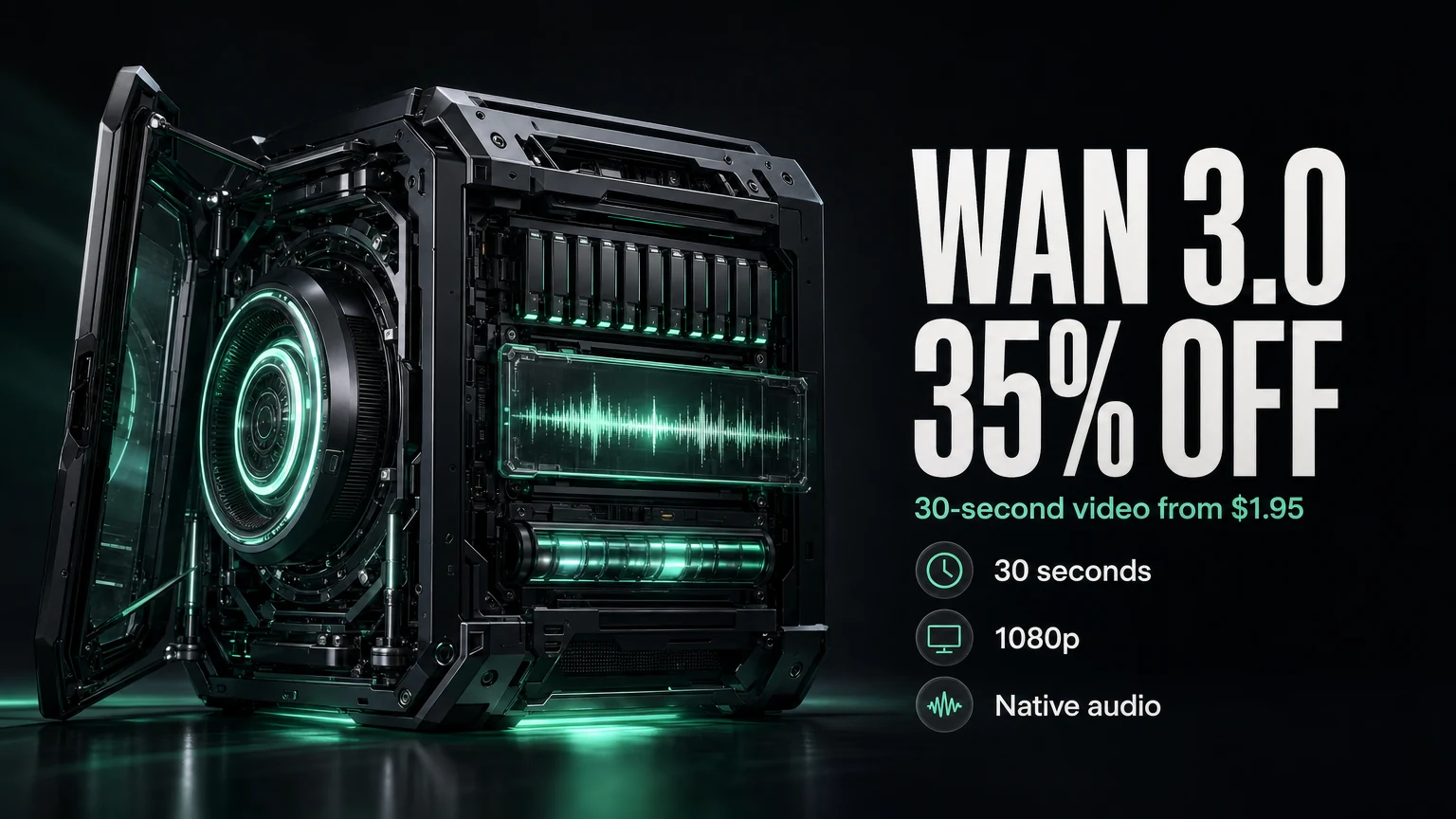
The interesting number on the SandBase homepage is not the crossed-out $0.50. It is $1.95: what our 30-second Wan 3.0 clip actually cost after the current discount. That is long enough for a miniature scene with a beginning, a hand-off, and an exit—not merely a five-second motion test.
This guide explains the Wan 3.0 35% discount, what Alibaba’s model can actually generate, and where its low price comes with a trade-off. It is for developers choosing a video API for ads, product clips, storyboards, or agent workflows. Prices and promotion status were checked on October 28, 2026; temporary discounts can change.
Key takeaway
- SandBase currently shows 35% off across the Wan 3.0 family. The default 5-second, 720p text-to-video call is $0.325 instead of $0.50.
- Pricing scales by duration and resolution. At the promotion rate, 30 seconds costs $1.95 at 720p or $3.90 at 1080p; list prices are $3 and $6.
- Wan 3.0 generates 2–30 second clips at 480p, 720p, or 1080p, at 30 fps, with optional native audio. Alibaba also offers image, reference, edit, extend, and faster Prime modes.
- In our tests, Wan delivered a clean 30-second single take and strong object continuity. It followed a timed script more loosely than Kling 4.0 and took longer to finish.
- Treat the discount as a good time to test, not a permanent production assumption. Budget against list price, then count the promotion as upside.
What the 35% Wan 3.0 discount means
SandBase writes the offer as 35% OFF. In Chinese retail language, the equivalent phrase means you pay 65% of the standard amount. It does not mean “65% off.”
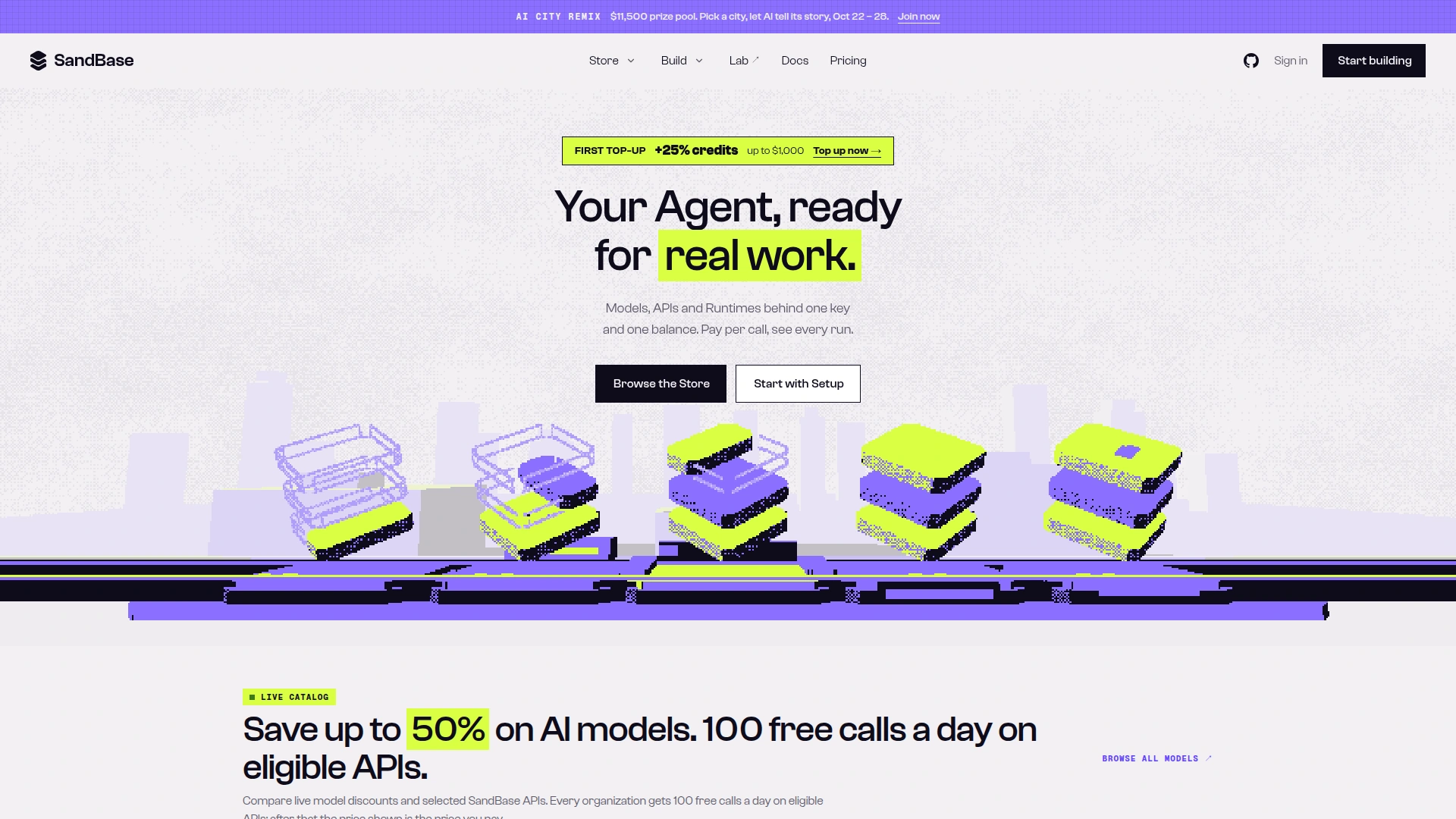 SandBase homepage, captured October 28, 2026. Wan 3.0 endpoints show 35% OFF. The text-to-video default is $0.325 per call against a crossed-out $0.50. The page’s “save up to 50%” headline refers to the whole catalog, not Wan specifically.
The “per call” number is the default configuration, not a flat fee for every video. Wan is billed by generated seconds and resolution. Using the current 35% reduction:
| Output | List price / second | Current price / second | 5 seconds | 30 seconds |
|---|---|---|---|---|
| 480p | $0.05 | $0.0325 | $0.1625 | $0.975 |
| 720p | $0.10 | $0.065 | $0.325 | $1.95 |
| 1080p | $0.20 | $0.13 | $0.65 | $3.90 |
The arithmetic is simple: seconds × resolution rate × 0.65. Audio can be enabled without changing these rates on the SandBase schema we checked. Reference inputs do not turn the request into token billing; duration and resolution still dominate the cost.
This matters when comparing providers. Alibaba’s own international launch promotion offered 30% off Standard through September 24, 2026, and that offer has ended. The 35% shown here is a SandBase catalog promotion checked on October 28. They are separate offers with separate dates.
What Wan 3.0 is
Wan 3.0 Text to Video on SandBase is Alibaba Cloud’s hosted video-generation model. Alibaba opened the API generally on August 24, 2026 after an earlier beta. Its main change over the preceding Wan video generation model is native generation up to 30 seconds—twice the previous 15-second ceiling—plus a single “omni” input system for text, images, video, audio, documents, and web pages.
Alibaba describes five production modes: text-to-video, image-to-video, reference-to-video, video editing, and extension. SandBase exposes those as separate endpoints, along with Prime variants tuned for faster inference.
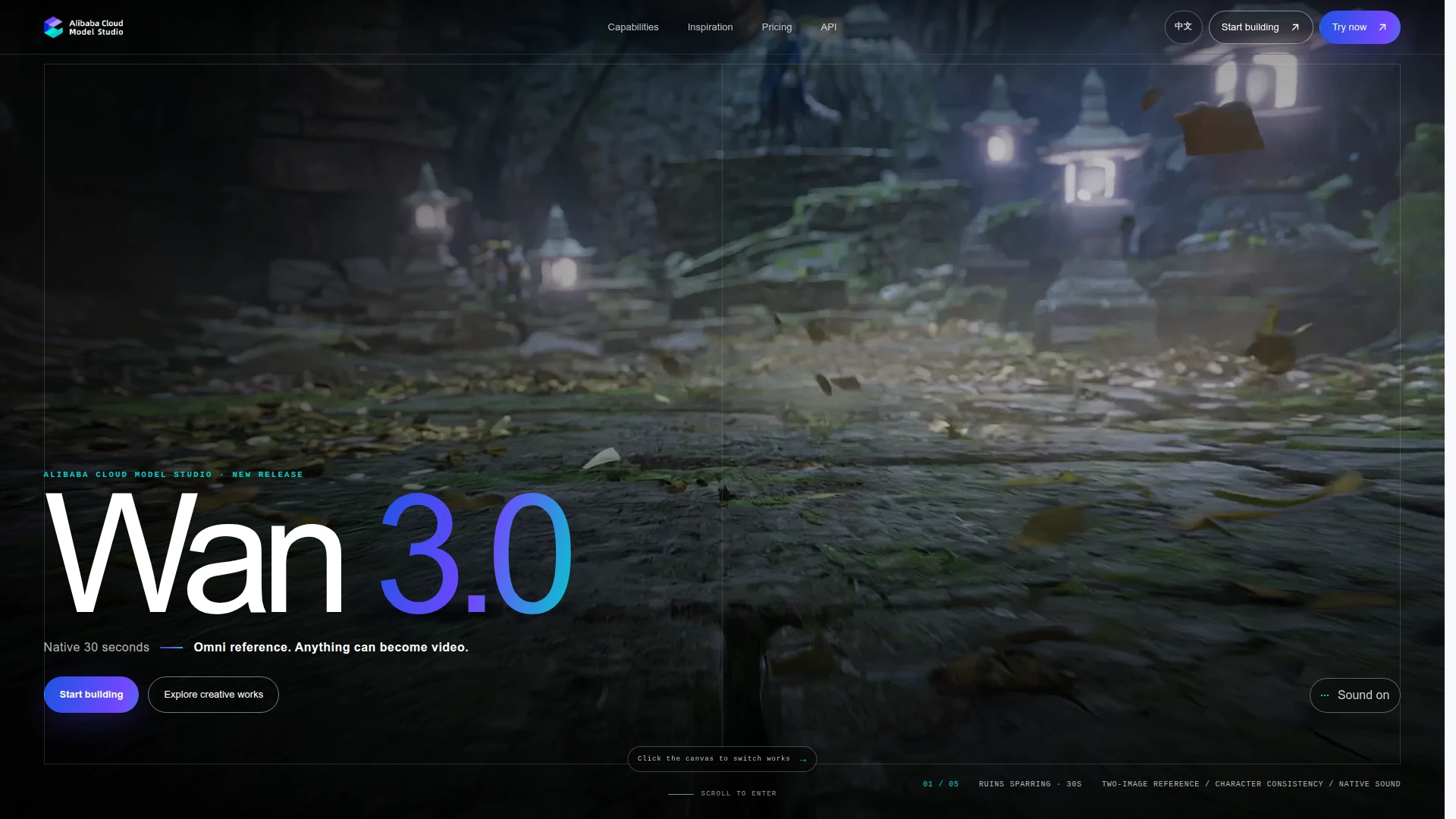 Alibaba Cloud’s official Wan 3.0 release page, captured October 28, 2026. The provider claims native 30-second storytelling, 1080p output, and audio-video generation. These are provider specifications; output quality still depends on the prompt and seed.
The practical spec sheet
| Field | Wan 3.0 Standard on SandBase |
|---|---|
| Provider | Alibaba Cloud |
| Release | Beta August 7, API generally available August 24, 2026 |
| Modalities in | Text; endpoint-dependent image, video, audio, and references |
| Output | Video, optional native audio |
| Duration | 2–30 seconds, or auto |
| Resolution | 480p, 720p, 1080p |
| Frame rate | 30 fps in Alibaba’s API documentation and our outputs |
| Aspect ratios | 16:9, 9:16, 1:1, 4:3, 3:4, 21:9 |
| Controls | Seed, audio toggle; first/last frame and reference controls on matching endpoints |
| Self-hosting | No Wan 3.0 weights or self-hosting license published as of October 28 |
That last row is easy to miss. Alibaba maintains a public Wan 3.0 repository with documentation and demos, but it has not released Wan 3.0 model weights. The hosted API is not the same thing as an open-weight release. Wan 2.2 remains the latest downloadable Wan generation listed in Alibaba’s open repositories at the time of writing.
What is genuinely new
One request can carry a complete 30-second beat sheet
Thirty seconds changes the kind of prompt worth writing. A five-second prompt can describe one action. A 30-second prompt can specify four timed beats, a continuous camera path, and a destination.
Alibaba says Wan can generate the full duration in one pass rather than stitching short clips. Our test supports the narrow version of that claim: ffmpeg’s scene detector found zero cuts in one 30.00-second output. It opened at a night-market wok, moved behind the cook, handed a bowl to a woman in green, and followed her into the crowd.
 Frames from our Wan 3.0 30-second, 720p call on October 23, 2026. The hand-off occurs around 22.5–24 seconds. This strip is re-published from our own test evidence for the same-prompt model comparison, not an Alibaba demo.
The catch was timing. The prompt asked the camera to move behind the cook during seconds 8–16 and complete the hand-off during 16–24. Wan reached both near the end of their windows. Kling 4.0 hit the same beats earlier and more precisely, but cost $4.71 against Wan’s $1.95 in that run. Wan is the budget long-take choice, not automatically the best director.
Reference material is broader than a start image
Alibaba’s direct API accepts up to 20 reference assets: up to 10 images, five videos, and five audio files. Documents and web pages can also be used through Alibaba’s “omni creation” surface. That makes Wan 3.0 more interesting for product and character work than a plain text-to-video endpoint.
The SandBase catalog separates the workflows so the schema remains explicit:
alibaba/wan/3.0/text-to-videofor a prompt-only clip;alibaba/wan/3.0/image-to-videofor a first frame or first/last frame;alibaba/wan/3.0/reference-to-videofor identity and style references;alibaba/wan/3.0/video-editfor instruction-based edits;alibaba/wan/3.0/video-extendfor continuation;- the same routes under
/prime/when latency matters more than price.
Do not assume every control from Alibaba’s consumer interface maps one-to-one to every API route. Inspect the endpoint schema before building a form around it.
Audio is generated with the picture
Wan can create dialogue, ambient sound, music, and effects in the same generation. On SandBase, generate_audio is a switch and does not change the displayed Standard rate. That is useful for social drafts and previs, but “has an audio track” does not prove lip sync, clean speech, or licensing suitability. We disabled audio in the comparison run, so we are not grading it here.
What our earlier tests say about quality
We have run Wan 3.0 in two bounded tests, both through SandBase.
In an eight-model product-clip benchmark, Wan tied Gemini Omni Flash at 23/24 on three prompts. It kept a robot vacuum moving behind chair legs and out the other side without reversing or teleporting. The 5-second job cost $0.50 before this promotion and took a 147-second median across three runs. One oddity: a request marked 720p returned a 1920×1080 file.
In the later action and long-take comparison, a 5-second Wan clip cost $0.325 under the 35% promotion and completed in 175 seconds. It produced the requested skateboard ollie but kept a side-tracking camera instead of the requested half orbit. The 30-second output cost $1.95 and took 854 seconds—over 14 minutes.
Those six short clips and one long take are evidence, not a leaderboard. They suggest good continuity and low cost, while camera choreography and queue time deserve a test with your own prompts. They do not establish a universal win rate, audio quality, or reliability under production load.
Wan 3.0 versus the alternatives
| Model | Longest single request | 720p list price / sec | What stood out in our tests | Trade-off |
|---|---|---|---|---|
| Wan 3.0 | 30 s | $0.10 ($0.065 promo) | Cheapest long take; good object continuity | Loose beat timing; slow 30 s job |
| Kling 4.0 | 30 s | $0.157 | Best camera orbit and timed choreography in our run | Higher cost; slow 5 s job |
| Seedance 2.5 | 30 s | $0.36 | Draft-to-final workflow | Much higher 1080p price |
| Veo 3.1 | 8 s | $0.20 without audio | Fastest in our action run; 4K option | Cannot make a 30 s clip in one request |
Choose Wan when the shot benefits from 15–30 seconds of continuity and you can tolerate a slower queue. Choose Kling when precise camera movement and timed beats matter more than cost. Choose Seedance when the draft-to-final workflow saves expensive rerolls. Choose Veo for short shots where response time or 4K is the deciding constraint.
A minimal SandBase request
SandBase uses one asynchronous route across video providers. Submit the job, keep the returned run ID, and poll it until the provider finishes:
curl https://api.sandbase.ai/v1/run \
  -H "Authorization: Bearer $SANDBASE_API_KEY" \
  -H "Content-Type: application/json" \
  -d '{
    "model": "alibaba/wan/3.0/text-to-video",
    "prompt": "One continuous handheld take through a night market...",
    "duration": 5,
    "resolution": "720p",
    "aspect_ratio": "16:9",
    "generate_audio": true
  }'
The submission response contains an ID. Poll GET /v1/run/{id} and read the finished media URL from outputs[0].url. Save the run ID alongside the prompt, seed, settings, elapsed time, and charge. Without that record, a later “the model got worse” report is impossible to audit.
Who should use the discount
The promotion is most useful for three workloads:
- A prompt evaluation set. At $0.325 per 5-second 720p clip, 20 prompts cost $6.50 before rerolls. That is enough to test products, people, text, motion, and failure cases without pretending one showcase clip represents the model.
- Long-take storyboards. Ten 30-second 720p drafts cost $19.50 at the current rate versus $30 list. Use them to validate pacing before paying for 1080p finals.
- Reference-workflow prototypes. Test image, reference, and edit endpoints under the same key, then decide which controls your production UI actually needs.
Do not switch only because of the badge if your product needs sub-minute turnaround. Our 30-second call took 14 minutes. Prime exists for faster inference, but its discounted base is $0.455 for the same default call versus $0.325 Standard. Measure the latency gap on your account before paying it on every request.
FAQ
Is Wan 3.0 65% off?
No. It is 35% off, which means you pay 65% of list price.
How much is a 30-second Wan 3.0 video?
On SandBase under the promotion checked October 28, 2026: $0.975 at 480p, $1.95 at 720p, or $3.90 at 1080p. List prices are $1.50, $3, and $6.
Does Wan 3.0 generate audio?
Yes. Alibaba documents native dialogue, music, ambient sound, and effects. SandBase exposes an audio toggle on the text-to-video endpoint.
Can Wan 3.0 run locally?
Not from official Wan 3.0 weights as of October 28, 2026; Alibaba has not published them. Use a hosted API, or choose an earlier open-weight Wan release for self-hosting.
Is the discount permanent?
No end date is stated on the SandBase homepage. It is a live catalog promotion, so recheck the model page before budgeting or publishing a price.
Bottom line
Wan 3.0’s best argument is unusually concrete: a 30-second, 720p single take cost us $1.95 under the current 35% discount. The model kept the take continuous and completed the story, but it ran late on the middle beats and took more than 14 minutes to return. Use the promotion to test your own prompt set on Wan 3.0; keep list price and measured latency in the production budget.