MAGI-2 vs Gemini Omni Flash 1.2: 30 Seconds at $0.08 vs 15 Seconds at $0.105
MAGI-2 vs Gemini Omni Flash 1.2 on 27 Nov 2026: 4–30 seconds at a 1080p list of $0.08/s versus 3–15 seconds at $0.105/s, with official 1080p described as upscaled at about $0.104/s. Not a quality test.
The decision here is how long a 1080p clip can be, and which number is a SandBase list versus an official token footnote. On 27 November 2026, Asia/Shanghai, MAGI-2 on SandBase accepts an integer duration from 4 to 30 seconds at 1080p only, and its Billing sentence includes native audio in the $0.08-per-second price. Gemini Omni Flash 1.2’s live SandBase text-to-video card accepts 3 to 15 seconds. At 1080p the list is $0.105 per second. The JSON-LD Offer of 0.56 USD per run is the 8-second default at 720p, not a 1080p quote. Official Gemini API docs, fetched the same day, call 1080p output “upscaled,” and a pricing footnote gives an effective “$0.104/s for 1080p with upsampling.” That official figure is not the SandBase $0.105 list, and this page does not merge them. No generation was purchased.
Use MAGI-2 when you need a 1080p file longer than 15 seconds, or when you want the only list rate to include audio at $0.08 per second. Use the Omni Flash 1.2 SandBase card when a 3-to-15-second clip is enough and you will keep the 720p Offer and the 1080p list in separate columns, with the official “upscaled” label in the same paragraph. Neither choice is a quality ranking. The already-live MAGI-2 vs Veo 3.1 post pointed at this card and said it was not that comparison; this page is the comparison, and it does not remake the Veo Preview shutdown, Fast, Lite, or video-extend story. MAGI-2’s field list is the launch note.
Key takeaway
- MAGI-2, checked 27 November 2026:
sandai/magi-2/text-to-videoand the two sibling ids. 1080p only. Duration integer 4–30, default 5. Formula(params.duration ?? 5) * 0.08. Badge 0. JSON-LD Offer 0.4 USD per run; billing table 5s (default) $0.40. Playground estimate$0.4, not$0.40. Native audio is included in the price; the formula has no audio term. Official Sand.ai: 0.08 USD/s. Failed runs are not billed, on today’s Billing sentence. Skill-page Facts<dl>is empty; this page does not invent a Facts-line “From $0.40.”- Omni Flash 1.2 SandBase id
google/gemini-omni-flash/1.2/text-to-videoreturned HTTP 200, badge 0, JSON-LD Offer 0.56. Duration integer 3–15, default 8. Default resolution 720p. 1080p list $0.105/s. The 8-second 720p list cell is $0.56, which matches the Offer. The 8-second 1080p list cell is $0.84. The 15-second 1080p list cell is $1.57 (15 × 0.105 = 1.575; the card prints $1.57). Failed runs are not charged. The T2V, I2V, and R2V cards have nogenerate_audiofield.- Official Gemini API model id
gemini-omni-1.2-flash, generally available on the paid tier. Paid-tier video output is $12.00 per 1M tokens. The official footnote equates that to approximately $0.07/s at 720p and “$0.104/s for 1080p with upsampling.” Official docs label1080pas “1080p output (upscaled).” Official unset duration defaults to 10 seconds; the SandBase default is 8. This page does not convert tokens into a SandBase $/s, and it does not “correct” $0.105 to $0.104.- The path
/models/google/gemini-omni-1.2-flashis still 404. Do not merge the older unversioned cardgoogle/gemini-omni-flash/text-to-video(Offer 1.04, $0.13 per output second, duration 3–10) with the 1.2 family. Edit is a fourth live card with source-plus-output billing; it is not the subject of this comparison.
Two 1080p clocks, two list rates
Open the MAGI-2 text-to-video card and the duration field is an integer from 4 to 30, default 5. Resolution is an enum of one value, 1080p. Billing: “$0.08 per second of output video, with native audio included in the price. Resolution is fixed at 1080p. Failed runs are not billed.” The table prints 4s $0.32, 5s (default) $0.40, 10s $0.80, and 30s $2.40. A 15-second MAGI-2 1080p list total is $1.20. The MAGI-2 collection page shows the same numbers under the headers “Per second,” “5 sec,” “10 sec,” and “30 sec” — $0.08, $0.40, $0.80, and $2.40 — for text-to-video, image-to-video, and reference-to-video. Official Sand.ai pricing remains “Model magi-2 / Resolution 1080p / Pricing 0.08 USD/s.” Official duration on POST /v2/generations is required; SandBase still defaults to 5 if the field is omitted.
Open the Omni Flash 1.2 text-to-video card and the duration field is an integer from 3 to 15, default 8. Resolution is 360p / 720p / 1080p / 4k, default 720p. Billing: “You pay for output seconds: $0.023 at 360p, $0.07 at 720p, $0.105 at 1080p, and $0.21 at 4K.” Omni cannot accept 30 on this card. Official docs say setting a duration over 15 seconds returns an invalid argument error. A 15-second Omni 1080p list total is the $1.57 cell on the card table, next to MAGI-2’s $1.20 for the same length. That is a list-to-list observation, not a quality claim.
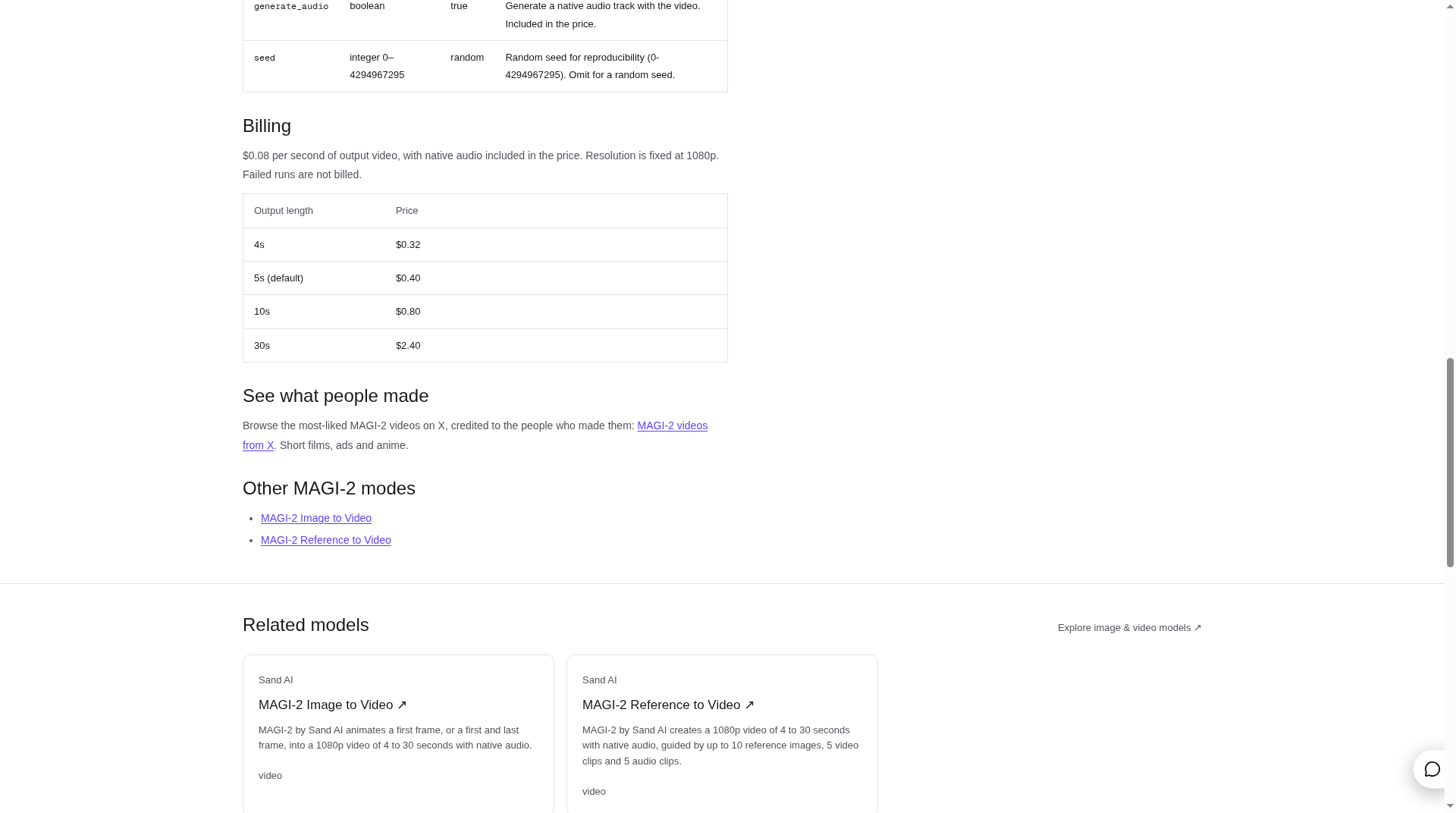
Checked the Billing section on MAGI-2 text-to-video, 27 November 2026, Asia/Shanghai. Visible: “$0.08 per second of output video, with native audio included in the price. Resolution is fixed at 1080p. Failed runs are not billed.” Table: 4s $0.32; 5s (default) $0.40; 10s $0.80; 30s $2.40. The Fields row for generate_audio (default true, “Included in the price.”) is at the top of this frame. There is no Facts-line “From $0.40,” and no playground estimate, in this crop. Related MAGI-2 Image to Video and Reference to Video cards appear below the table.
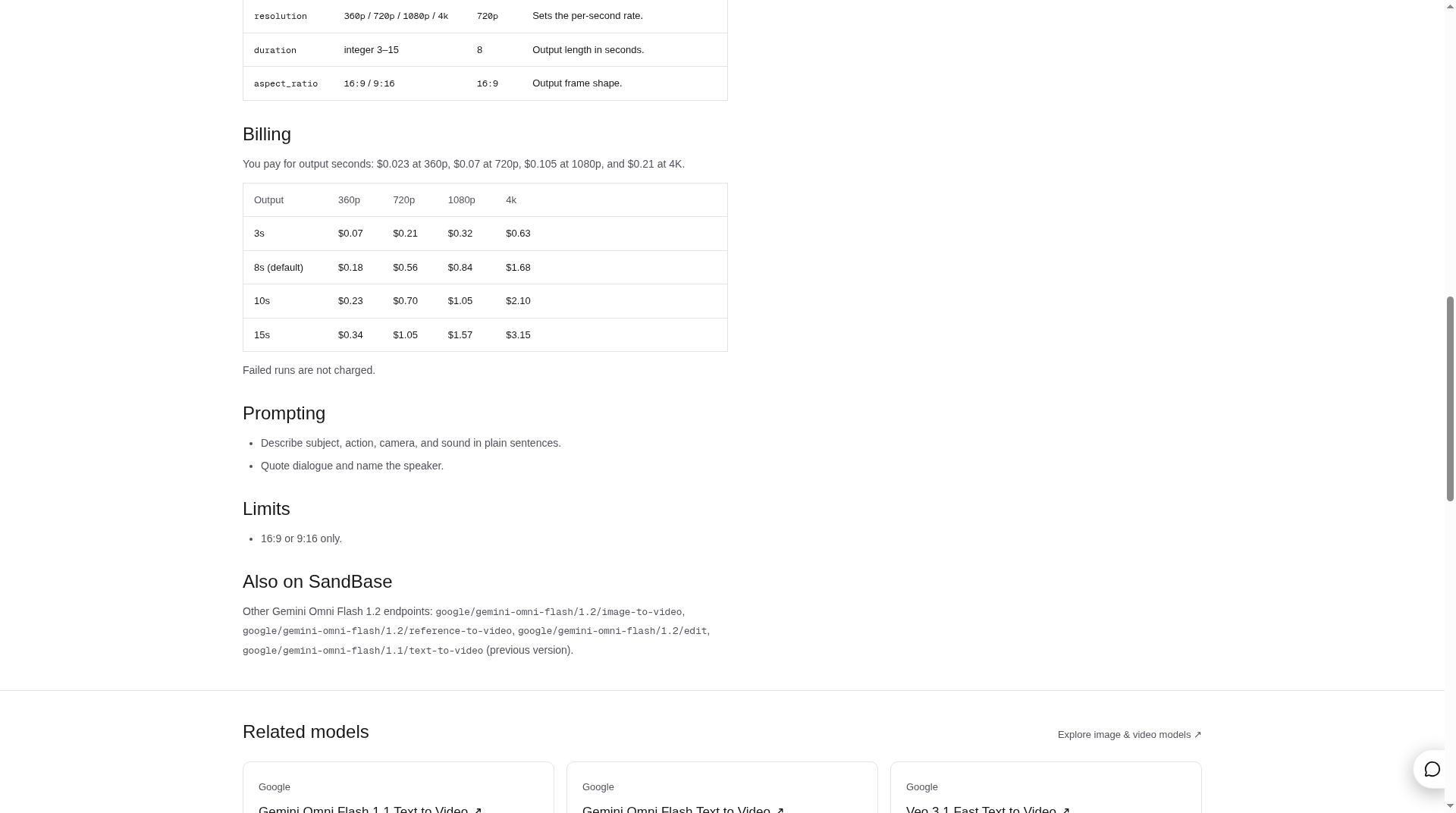
Checked the Billing section on Gemini Omni Flash 1.2 text-to-video, 27 November 2026, Asia/Shanghai. Visible: “You pay for output seconds: $0.023 at 360p, $0.07 at 720p, $0.105 at 1080p, and $0.21 at 4K.” The table includes 8s (default) $0.56 at 720p and $0.84 at 1080p, and 15s $1.57 at 1080p, plus “Failed runs are not charged.” The $0.56 cell is the 8-second 720p default, not a 1080p price. Fields at the top of this frame show duration 3–15, default 8. No playground estimate is in this crop.
The Offer is not the 1080p quote
MAGI-2’s JSON-LD Offer is 0.4 USD per run, which matches the 5-second default on the billing table ($0.40) and the playground estimate printed as $0.4. The Sand AI vendor catalog still prints “From $0.4 per run” on the three MAGI-2 cards. Those wordings stay in their own columns; this page does not invent a skill-page Facts line, because that <dl> was empty in today’s HTML.
Omni 1.2’s Offer of 0.56 is the 8-second 720p cell ($0.07 × 8). Default resolution is 720p, so the hero follows the default, not the 1080p row. An 8-second 1080p list is $0.84. A 15-second 1080p list is $1.57. Treating $0.56 as a 1080p price would understate the 1080p row.
Audio is described, but there is no silent coefficient on the 1.2 cards
MAGI-2 has generate_audio, default true, with the note “Included in the price.” The formula has no audio term. Official Sand.ai generateAudio also defaults to true.
Omni 1.2 text-to-video, image-to-video, and reference-to-video have no generate_audio field. The text-to-video hero says “3–15 second clips with synchronized audio.” Official AI Studio docs say the model generates “synchronized video and native audio up to 15 seconds long,” and official pricing describes “up to 15 seconds of video generation and editing with native audio.” This page quotes those sentences and does not import Veo 3.1’s $0.40 / $0.20 with-audio and without-audio split onto Omni. Whether a SandBase Omni call actually returns an audio track was not tested; no generation was purchased.
Official units stay official: $12.00 per 1M tokens, and 1080p is labeled upscaled
Official paid-tier pricing for gemini-omni-1.2-flash, in the Gemini Developer API pricing HTML fetched this run, is $1.50 per 1M tokens for input (text / image / video) and $9.00 (text) / $12.00 (video) for output, “generally available to developers on the paid tier.” The footnote:
Billing is based on total output token consumption, calculated at a rate of 5,792 tokens per second of 720p video. Under Standard pricing ($12.00 per 1M tokens), this equates to an effective price of approximately $0.07 per second (~$0.70 for a 10s clip, ~$1.04 for a 15s clip; $0.023/s for 360p at 1,931 tokens/s; $0.104/s for 1080p with upsampling at 8,688 tokens/s; and $0.209/s for 4K with upsampling at 17,376 tokens/s).
This page does not turn that footnote into a SandBase list, and it does not “correct” the card’s $0.105 to $0.104. The official output-resolution table on the Omni docs page is: 360p; 720p “720p output resolution (default)”; 1080p “1080p output (upscaled)”; 4k “4K output (upscaled).” Do not call official 1080p “native 1080p.” The official Google product blog dated 5 November 2026 states the update “dropped the price 30% from Gemini Omni 1.1 making it available at $0.07 per second for 720p video.” Effective 3 December 2026, official docs say requests to gemini-omni-1.1-flash route to 1.2 and are billed at 1.2 rates.
Official docs also say that if you do not set a duration, the model defaults to 10 seconds. The SandBase 1.2 cards default to 8. Those defaults stay in separate columns.
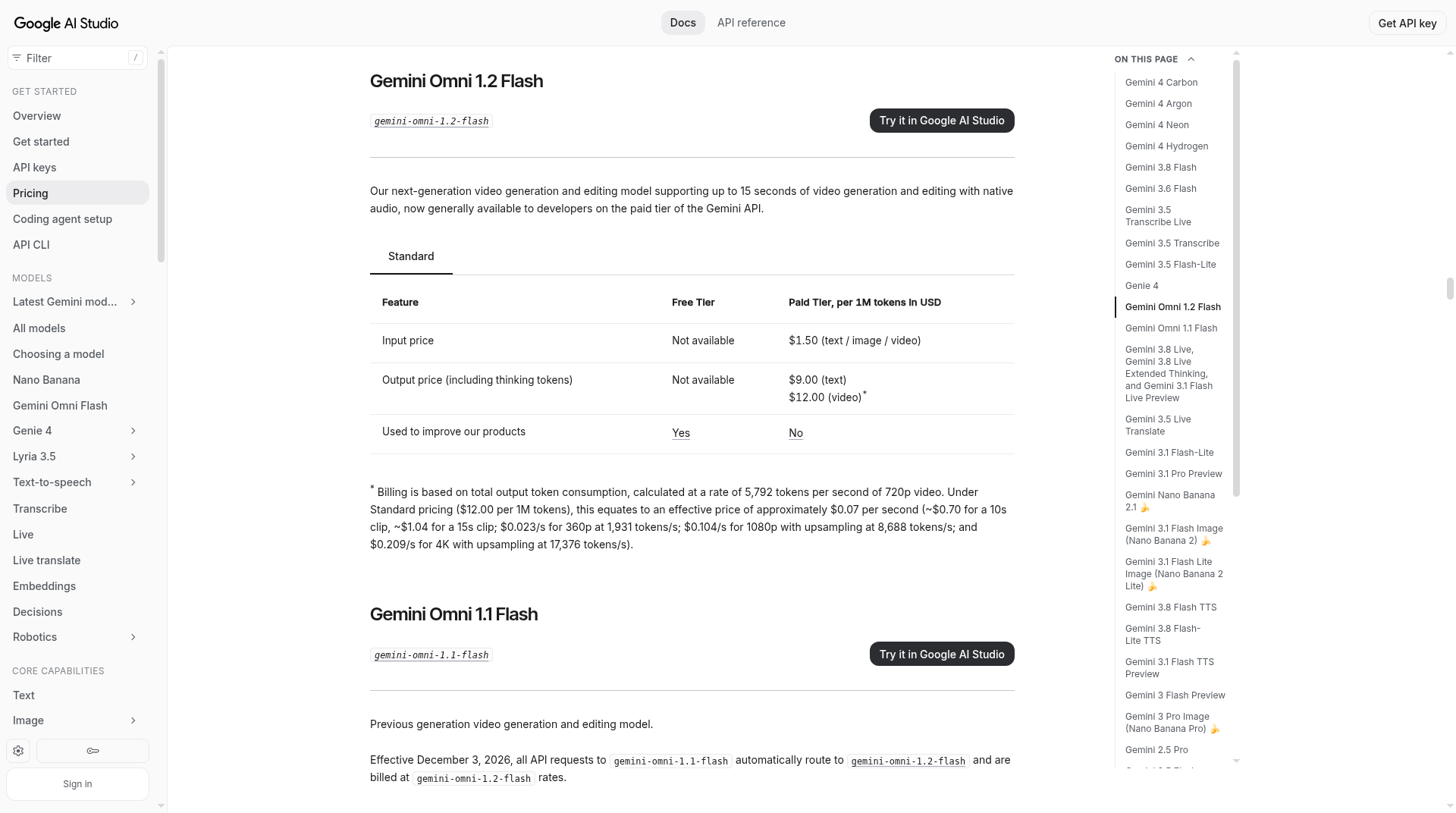
Checked Google AI Studio’s official pricing page, 27 November 2026, Asia/Shanghai, after the Gemini Omni 1.2 Flash section had painted. Visible: paid-tier output “$12.00 (video)” per 1M tokens, and the footnote that under Standard pricing this equals approximately $0.07 per second of 720p video and “$0.104/s for 1080p with upsampling.” This is official token math, not the SandBase $0.105 list rate. A title-only shell would not have been sufficient evidence.*
Last frame, and reference caps that are not a remake of the live Top
Both image-to-video cards have an optional last frame. MAGI-2 I2V requires image (first frame, under 30 MB) and accepts optional end_image. Duration remains 4–30; the MAGI-2 card does not state a shorter cap when a last frame is set.
Omni 1.2 I2V also requires a first image and accepts optional end_image. The Fields note says “Caps duration at 10 seconds.” Limits: “With end_image, duration is capped at 10 seconds.” Official Omni docs say first-and-last-frame interpolation supports durations from 3 to 10 seconds. Official docs also describe per-turn video extension of 3 to 10 seconds, “up to 30 seconds total for extended videos,” on the official Interactions API. That official extension path is not the SandBase 1.2 duration enum, which remains 3–15, and it is not a 30-second request on the SandBase card.
Reference-to-video is a third live id on both sides. MAGI-2 accepts up to 10 images, 5 videos (2–30 seconds each, 30 seconds combined), and 5 audio clips (2–30 seconds each, 30 seconds combined). The formula still multiplies output duration only. Omni 1.2 accepts up to 10 images and 3 videos, with the note “Google recommends short motion clips of up to 3 seconds.” Caps and billing for MAGI-2 against Wan, Kling, and Seedance are already in reference-to-video APIs; this page does not remake that table. First-and-last-frame request shape for the models in that other set is image-to-video APIs.
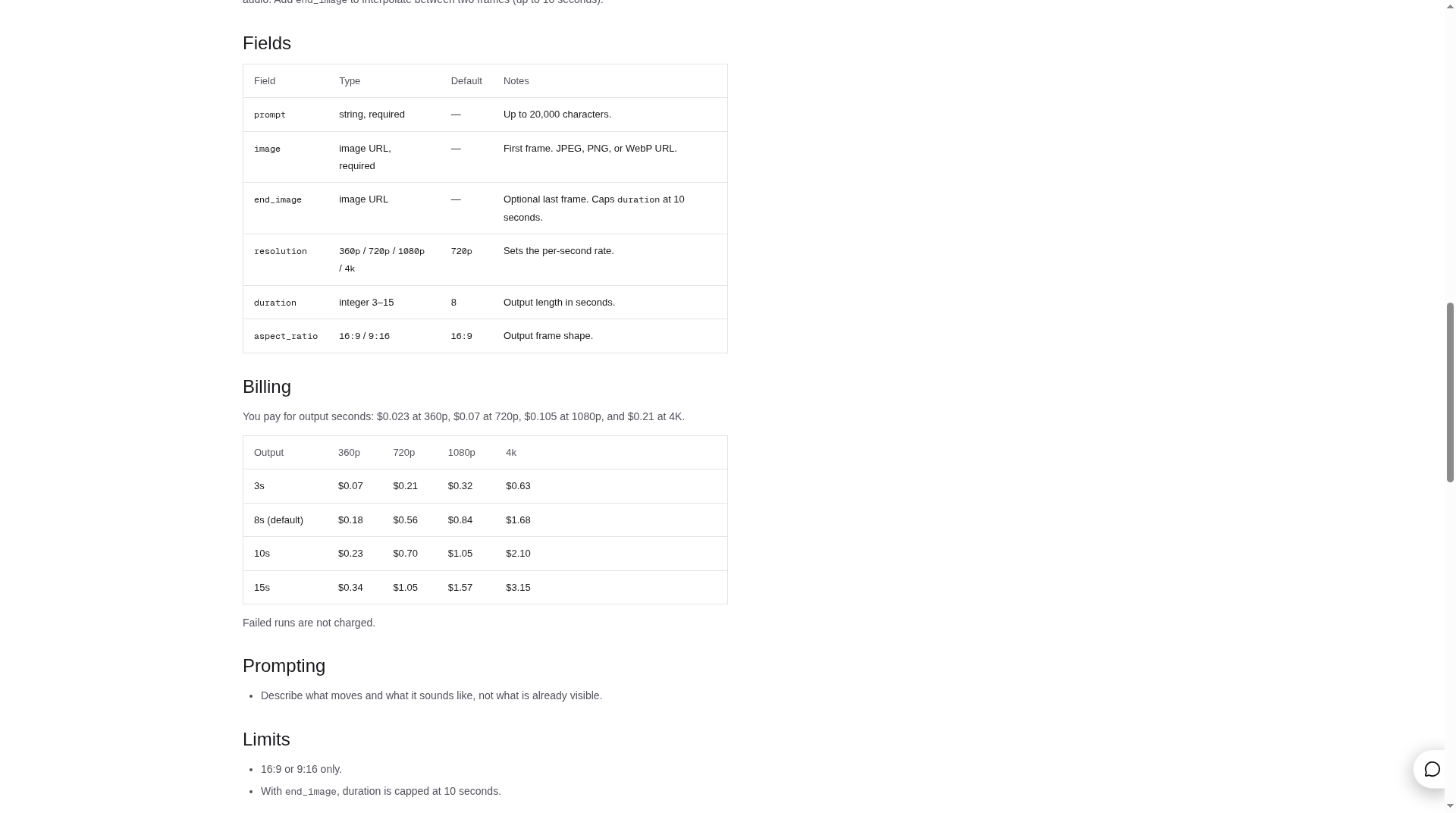
Checked Fields and Limits on Gemini Omni Flash 1.2 image-to-video, 27 November 2026, Asia/Shanghai. The end_image note says “Caps duration at 10 seconds.” Limits also states: “With end_image, duration is capped at 10 seconds.” The same frame shows duration as integer 3–15, default 8. The Billing table is also in this crop; this figure is about the end-image cap, not a second pricing table.
Start an Omni 1.2 last-frame request on the image-to-video card. The MAGI-2 equivalent is MAGI-2 image-to-video.
Ids: use the live 1.2 family, not the 404 path
The live family is google/gemini-omni-flash/1.2/*. Text-to-video, image-to-video, and reference-to-video all returned HTTP 200 this run, all with Offer 0.56, badge 0, and the same output-second list. The path /models/google/gemini-omni-1.2-flash is still 404, as is its text-to-video subpath. An older unversioned card, google/gemini-omni-flash/text-to-video, is also live: Billing is “You pay $0.13 per output second,” duration 3–10, default 8, Offer 1.04. Do not merge that card with 1.2.
Gemini Omni Flash 1.2 Edit is a fourth live card. Billing counts the source and the output: $0.02 per source second plus an output rate ($0.126 at 1080p among the printed tiers), with a 3-second minimum on the output. Offer 0.832. Mention only; it is not this launch comparison.
The Veo migration context — Preview ids shut down on 22 October 2026, Omni recommended as a Gemini API target — is already written in MAGI-2 vs Veo 3.1. Clip-length ceilings, including Omni as a 15-second sibling, are video clip length.
When the clock decides
Choose MAGI-2 when the promised file is 1080p, the length is between 4 and 30 seconds, and audio should not change the coefficient. Start on the MAGI-2 text-to-video card. A 30-second clip is $2.40 on that expression, badge 0, official Sand.ai 0.08 USD/s.
Choose Omni Flash 1.2 when 3 to 15 seconds is the length you can actually request, and you will quote the 1080p list of $0.105/s separately from the $0.56 Offer and from the official $0.104/s upsampling footnote. Open the Omni Flash 1.2 text-to-video card. Keep official 1080p labeled upscaled. Neither column is a quality score.
FAQ
Is this the same article as MAGI-2 vs Veo 3.1?
No. That live post already said it was not a MAGI-2 versus Omni launch comparison. This page compares MAGI-2 with the live google/gemini-omni-flash/1.2/* cards. It does not remake the Veo Preview shutdown, Fast, Lite, or video-extend sections.
Does turning audio off change Omni 1.2’s SandBase bill?
The 1.2 text-to-video, image-to-video, and reference-to-video cards have no generate_audio control. Official docs and the card hero describe native or synchronized audio. This page does not import Veo’s with-audio / without-audio coefficients, and it did not run a job to inspect the output track.
Can Omni Flash 1.2 do 30 seconds on SandBase?
Not on these cards. The duration field is 3–15. Official docs reject a duration over 15 seconds as an invalid argument. Official per-turn extension, described as up to 30 seconds total on the official Interactions API, is not the SandBase duration enum. MAGI-2 accepts 30 as a native integer at 1080p, list $2.40.
Is official 1080p the same thing as the SandBase 1080p list of $0.105/s?
No. Official docs label 1080p as upscaled and quote about $0.104/s from token math at $12.00 per 1M video-output tokens. SandBase prints $0.105/s in the Billing sentence and table. This page reports both and does not convert tokens into a SandBase rate.
Were these prices measured by running jobs?
No. They are card payloads, Billing tables, JSON-LD Offers, and official vendor pages fetched 27 November 2026, Asia/Shanghai. MAGI-2 Billing says failed runs are not billed. Omni 1.2 Billing says failed runs are not charged.
What to open
If the clip must be longer than 15 seconds at 1080p with a single coefficient, open the MAGI-2 text-to-video card. If 3 to 15 seconds is enough and you will keep the 720p Offer, the 1080p list, and the official upscaled footnote in view, open the Omni Flash 1.2 text-to-video card. For a last-frame request, use the matching image-to-video card and remember Omni’s 10-second cap when end_image is set. The MAGI-2 request shape is the launch note.
SandBase cards, Sand.ai pricing, and official Gemini / Google pages checked 27 November 2026, Asia/Shanghai. No generation was run. This page has no quality score.
Related reading
Found this useful? Share it