MAGI-2 vs Luma Ray 3.2: 4–30 Seconds with Audio vs 5 or 10, Officially in Credits
MAGI-2 vs Luma Ray 3.2 on 27 Nov 2026: 4–30 seconds with audio included at $0.08/s versus SandBase 5 or 10 seconds at a 1080p list of $2.00 / $4.00, next to official Luma credits. Not a quality test.
The decision here is how many durations you can actually request, and whether the other column is dollars or credits. On 27 November 2026, Asia/Shanghai, MAGI-2 on SandBase accepts an integer duration from 4 to 30 seconds at 1080p only, and its Billing sentence includes native audio in the $0.08-per-second price. Luma Ray 3.2’s SandBase text-to-video card accepts only 5 or 10 seconds. At 1080p the list is $2.00 for 5 seconds and $4.00 for 10 seconds — the card says “10 seconds costs double.” The JSON-LD Offer of 1 USD per run is the 5-second default at 720p, not a 1080p quote. Official Luma pages fetched the same day price T2V/I2V in credits, not dollars: 1080p SDR is 400 credits for 5 seconds and 1,200 credits for 10 seconds, so official 10-second credits are three times the 5-second price, not double. This page reports both multipliers and does not convert credits into dollars. Official Luma FAQ text says text-to-video and image-to-video have no natively-generated audio. No generation was purchased.
Use MAGI-2 when you need a length other than 5 or 10 seconds, a 1080p-only list of $0.08 per second, or audio included in that price. Use the Luma Ray 3.2 SandBase card when 5 or 10 seconds is the length you can actually request, and you will keep the SandBase dollar table, the $1 Offer, and the official credit table in separate columns. Neither choice is a quality ranking. MAGI-2’s field list is the launch note. Clip-length ceilings for other 1080p models already compared in this cluster are video clip length.
Key takeaway
- MAGI-2, checked 27 November 2026:
sandai/magi-2/text-to-videoand the two sibling ids. 1080p only. Duration integer 4–30, default 5. Formula(params.duration ?? 5) * 0.08. Badge 0. JSON-LD Offer 0.4 USD per run; billing table 5s (default) $0.40, 10s $0.80, 30s $2.40. Playground estimate$0.4. Native audio is included in the price. Official Sand.ai: 0.08 USD/s. Failed runs are not billed, on today’s Billing sentence.- Luma Ray 3.2 SandBase id
luma/ray/3.2/text-to-videoreturned HTTP 200, badge 0, JSON-LD Offer 1. Duration enum 5 or 10, default 5. Default resolution 720p. Billing: “$0.50 per 5-second clip at 540p, $1.00 at 720p, $2.00 at 1080p; 10 seconds costs double.” Table: 5s $0.50 / $1.00 / $2.00; 10s $1.00 / $2.00 / $4.00. Playground estimate$1. Failed runs are not charged. The text-to-video Fields table has nogenerate_audiofield. Limits: “Clips are 5 or 10 seconds.” Image-to-video is a second live card at the same list.- Official Luma, https://lumalabs.ai/api and https://lumalabs.ai/ray: T2V/I2V priced in credits. API page: “Prices are in credits,” “Prices shown are SDR output,” T2V/I2V (5s) 20 / 50 / 100 / 400 at 360p / 540p / 720p / 1080p, T2V/I2V (10s) 60 / 150 / 300 / 1,200. The Ray page prints the same 1080p figures as “400 credits” and “1200 credits” (no comma). HDR is 2× SDR; HDR + EXR is 3× SDR. No official USD list appeared on those pages this run. Official 10-second credits are 3× the 5-second credits; SandBase 10-second dollars are 2×. This page converts neither.
- Official Ray FAQ JSON-LD, question “Do generations have native audio?”: “text2video and image2video: No, there’s no natively-generated audio, so voiceover, music, and sound effects are added as a separate step. Modify Video and Reframe will preserve your original audio.” Official V2V lengths up to 20 seconds are a different task, not the SandBase text-to-video card. The Luma vendor page lists only T2V and I2V; there is no SandBase Luma R2V card.
4–30 seconds versus 5 or 10
Open the MAGI-2 text-to-video card and you can request any integer from 4 to 30, default 5, at 1080p only. A 5-second list is $0.40, a 10-second list is $0.80, and a 30-second list is $2.40. MAGI-2 can also do 4, 6, 8, or 15 seconds; Luma’s SandBase enum cannot.
Open the Luma Ray 3.2 text-to-video card and duration is only 5 or 10, default 5. Resolution is 540p / 720p / 1080p, default 720p. MAGI-2 has no resolution ladder on these cards.
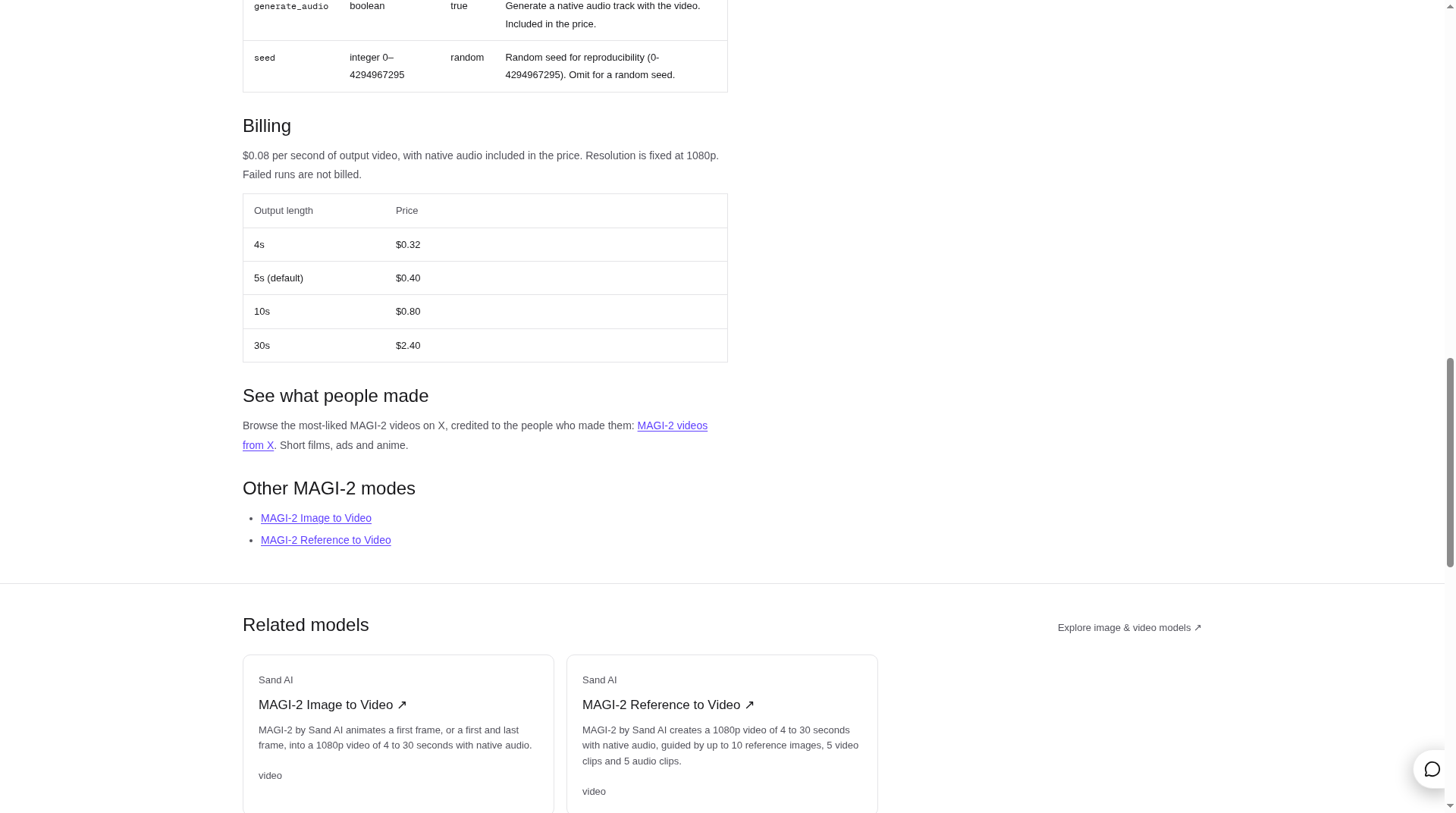
Checked the Billing section on MAGI-2 text-to-video, 27 November 2026, Asia/Shanghai. Visible: “$0.08 per second of output video, with native audio included in the price. Resolution is fixed at 1080p. Failed runs are not billed.” Table: 4s $0.32; 5s (default) $0.40; 10s $0.80; 30s $2.40. The Fields row for generate_audio (default true, “Included in the price.”) is at the top of this frame. There is no Facts-line “From $0.40,” and no playground estimate, in this crop. Related MAGI-2 Image to Video and Reference to Video cards appear below the table.
SandBase dollars, and an Offer that is not 1080p
Luma Billing is quoted here as printed: “$0.50 per 5-second clip at 540p, $1.00 at 720p, $2.00 at 1080p; 10 seconds costs double.” The table matches that sentence. The JSON-LD Offer of 1, and the playground estimate printed as $1, follow the 5-second 720p default, not the 1080p row. A 5-second 1080p list is $2.00. A 10-second 1080p list is $4.00. MAGI-2’s 10-second 1080p list is $0.80, not $4.00. That is a list-to-list observation, not a quality claim.
The Luma Ray 3.2 image-to-video card uses the same 5-second and 10-second list. Its Billing sentence also states: “HDR doubles and HDR with EXR export triples the 720p/1080p price.” The I2V table adds a “5s HDR” row: $0.50 at 540p, $2.00 at 720p, $4.00 at 1080p — 540p stays $0.50, which matches the Fields note that HDR is “16-bit HDR output (720p and 1080p).”
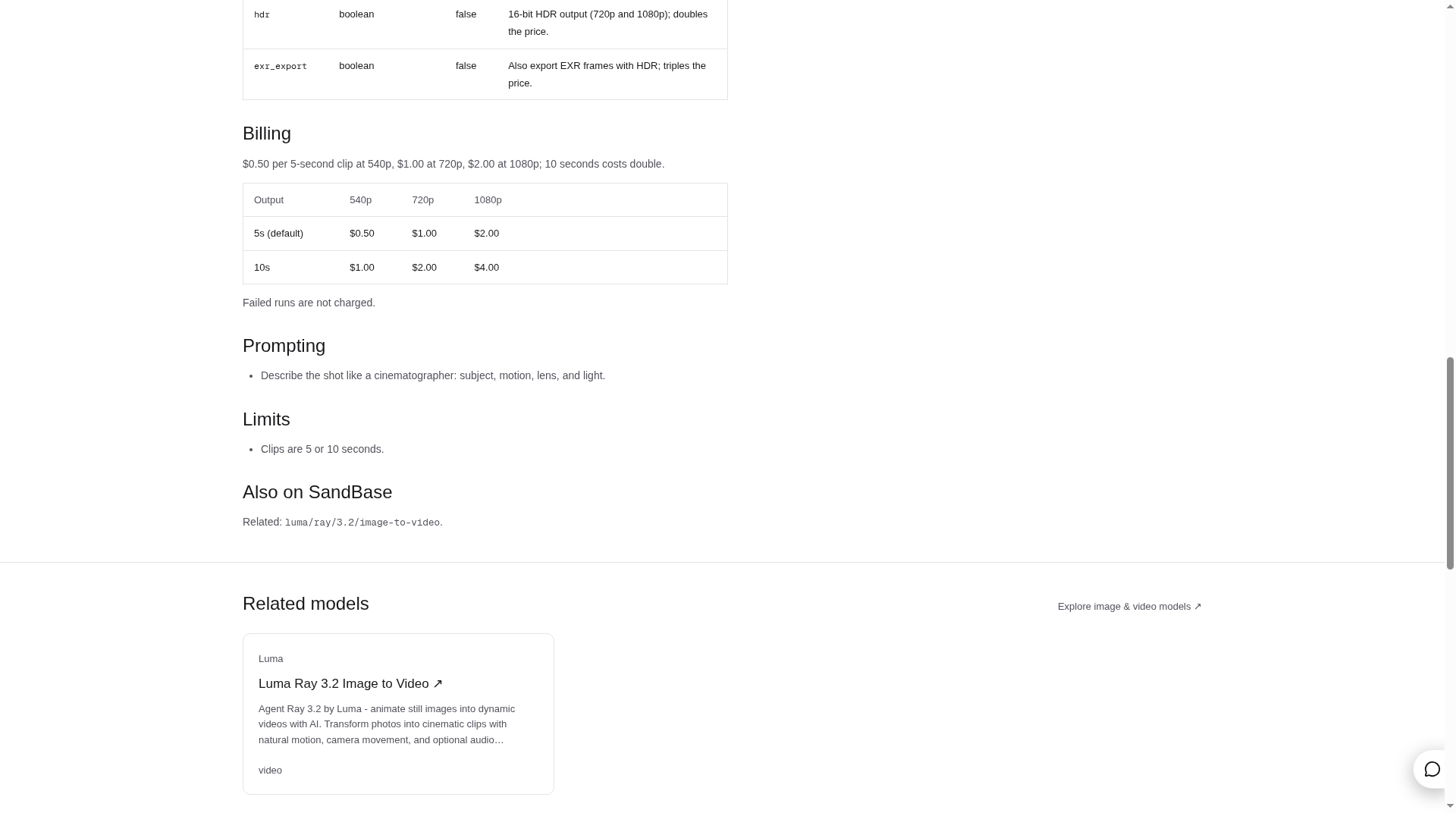
Checked the Billing section on Luma Ray 3.2 text-to-video, 27 November 2026, Asia/Shanghai. Visible: “$0.50 per 5-second clip at 540p, $1.00 at 720p, $2.00 at 1080p; 10 seconds costs double.” Table: 5s (default) $2.00 at 1080p; 10s $4.00 at 1080p. “Failed runs are not charged.” Limits in the same frame: “Clips are 5 or 10 seconds.” No playground or Offer $1 is in this crop. A related Luma Ray 3.2 Image to Video card at the bottom is truncated and is not this text-to-video Billing paragraph.
Official credits stay in credits
The official Luma API page, https://lumalabs.ai/api, prints a table headed “Task 360p 540p 720p 1080p” and the rows “T2V/I2V (5s) 20 50 100 400” and “T2V/I2V (10s) 60 150 300 1,200.” Immediately under the table: “Prices are in credits. Prices shown are SDR output. HDR output is 2× SDR pricing. HDR + EXR output is 3× SDR pricing.” Visible text on that page this run had no USD ($ or “USD”) in the document. The official Ray page, https://lumalabs.ai/ray, prints the same 1080p figures as “400 credits” and “1200 credits,” with a “360p (Draft)” column header, and “HDR: 2× SDR credits / HDR + EXR: 3× SDR credits.”
Official 10-second 1080p credits (1,200, or 1200 on the Ray page) are three times official 5-second 1080p credits (400). SandBase 10-second 1080p dollars ($4.00) are two times SandBase 5-second 1080p dollars ($2.00). The Luma SandBase formula fetched this run also encodes the double: ((params.duration ?? 5) == 10 ? 2 : 1) * …. This page reports both multipliers and does not invent an official $/s from a third-party dollars-per-credit figure.
Official V2V rows on the same credit table (5s and 10s) and the marketing line “V2V at up to 20 seconds” are a different task. They are not the SandBase text-to-video duration enum.
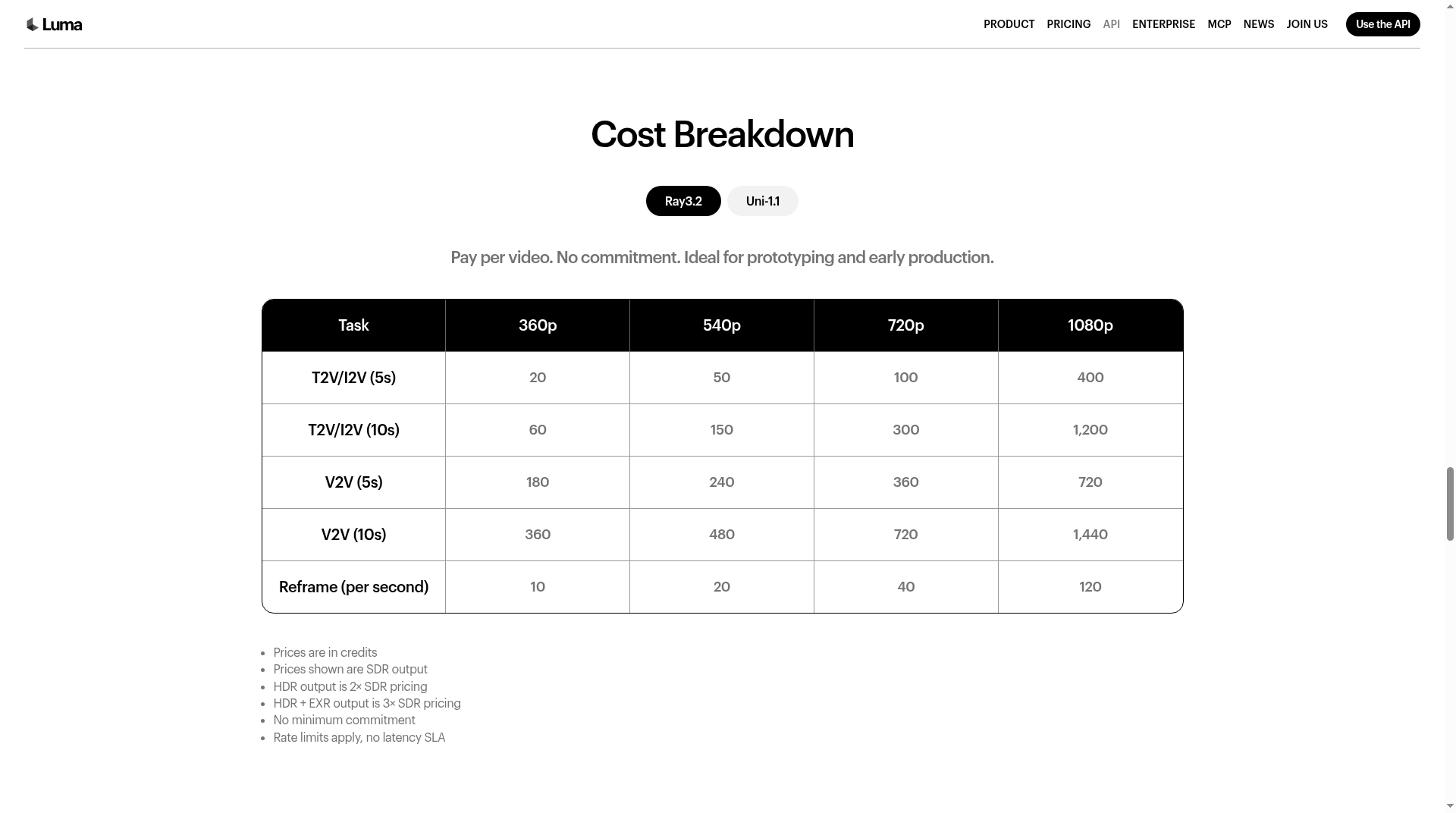
Checked the official Luma API pricing page, 27 November 2026, Asia/Shanghai, with the Ray3.2 tab selected. Visible: “Prices are in credits.” “Prices shown are SDR output.” The T2V/I2V (5s) row is 400 credits at 1080p; T2V/I2V (10s) is 1,200 at 1080p. Footnotes also state HDR output is 2× SDR pricing and HDR + EXR is 3×. Official 10-second T2V/I2V is 3× the 5-second credit price, not 2×. This table is in credits, not dollars, and is not converted here. V2V and Reframe rows appear in the same official table; they are not the SandBase text-to-video card.
Audio: included on MAGI-2, officially absent on Luma T2V/I2V
MAGI-2’s generate_audio defaults to true, “Included in the price.” Official Sand.ai generateAudio also defaults to true.
The SandBase Luma text-to-video Fields table has no generate_audio field. Official Ray FAQ JSON-LD, fetched from lumalabs.ai/ray this run, answers “Do generations have native audio?” with: “text2video and image2video: No, there’s no natively-generated audio, so voiceover, music, and sound effects are added as a separate step. Modify Video and Reframe will preserve your original audio.” This page does not claim that Luma text-to-video has native audio.
The SandBase Luma image-to-video Fields table also has no generate_audio field. The I2V hero copy on that card includes the phrase “optional audio generation.” Official FAQ text still says image2video has no natively-generated audio. This page quotes both sentences and does not treat the hero phrase as a priced audio SKU.
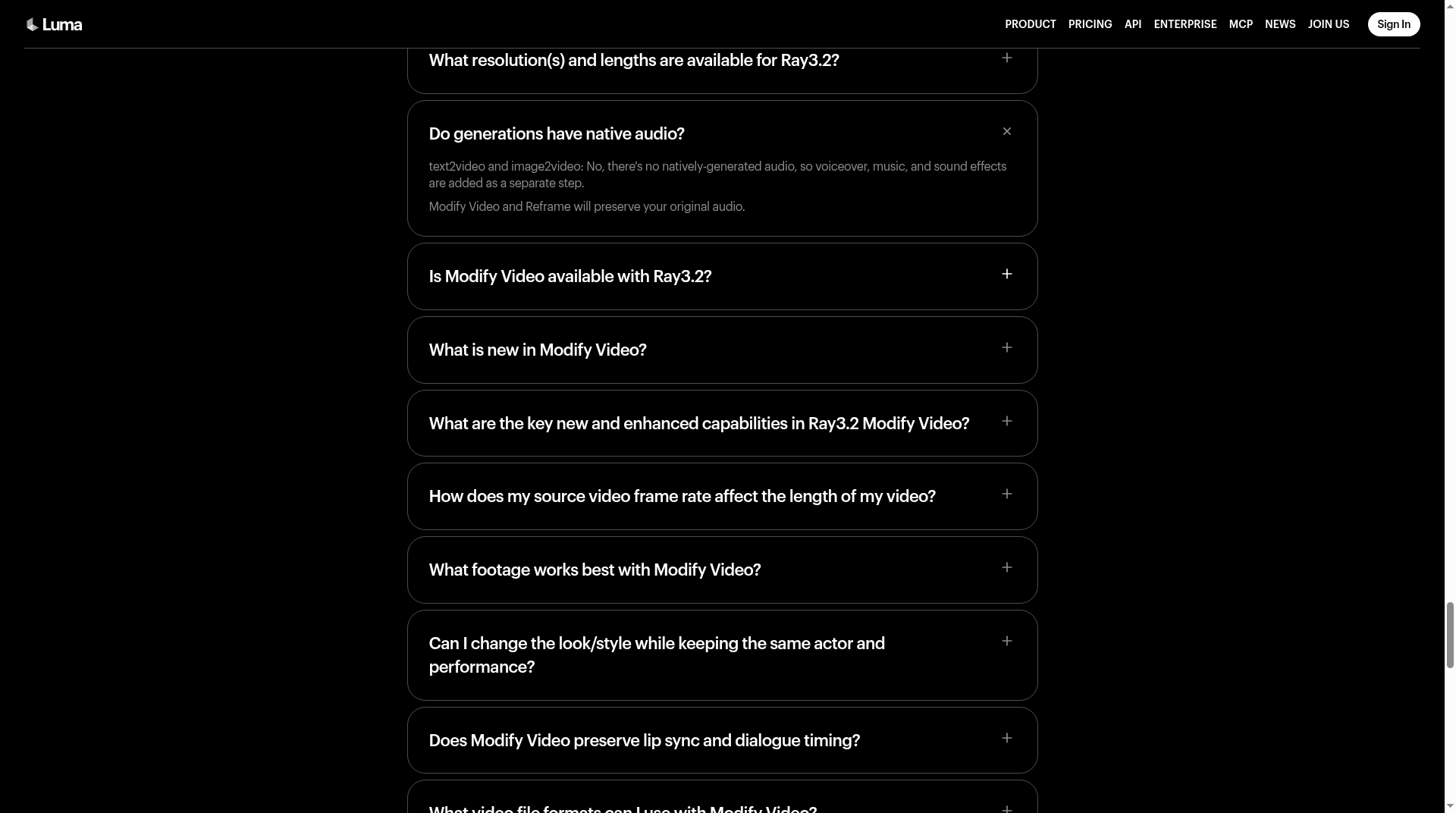
Checked the official Luma Ray FAQ, 27 November 2026, Asia/Shanghai, with the accordion “Do generations have native audio?” expanded. The answer visible in this crop: “text2video and image2video: No, there’s no natively-generated audio, so voiceover, music, and sound effects are added as a separate step.” This is official FAQ text, not a SandBase field.
HDR add-ons, in two columns
On the SandBase Luma cards, hdr “doubles the price” and exr_export “triples the price,” limited in the Fields notes to 720p and 1080p for HDR. Official Luma prices HDR at 2× SDR credits and HDR + EXR at 3× SDR credits. Quote the card in dollars and the official page in credits; do not multiply 400 credits into $2.00 or any other invented official dollar figure.
Failed runs: stated on the SandBase card, not on the official pricing pages this run
SandBase Luma Billing ends with “Failed runs are not charged.” MAGI-2 Billing says “Failed runs are not billed.” Official Luma pricing pages opened this run did not state a refund or “failed runs are not charged” rule in the visible pricing text. Mentions of “failed” on those pages were troubleshooting FAQs (for example, “Failed to download video,” “Generation failed”), not a billing-refund sentence. This page does not invent an official refund rule.
When length and units decide
Choose MAGI-2 when the length is any integer from 4 to 30, the file is 1080p, and audio is included in the only list rate. Start on the MAGI-2 text-to-video card. A 10-second clip is $0.80 on that expression; a 30-second clip is $2.40.
Choose Luma Ray 3.2 when 5 or 10 seconds is enough, and you will quote SandBase $2.00 / $4.00 at 1080p separately from official 400 / 1,200 credits, without converting one into the other. Open the Luma Ray 3.2 text-to-video card. For stills, use the image-to-video card and keep the official no-native-audio sentence next to the hero copy. Neither column is a quality score.
FAQ
Why are official 10-second credits 3× the 5-second price, while SandBase 10 seconds “costs double”?
Both statements were on the pages fetched 27 November 2026. Official 1080p SDR is 400 credits for 5 seconds and 1,200 credits for 10 seconds. SandBase 1080p is $2.00 for 5 seconds and $4.00 for 10 seconds. This page reports both and does not convert credits to dollars, or dollars to credits.
Is MAGI-2’s 10-second 1080p list $4.00?
No. MAGI-2’s 10-second 1080p list is $0.80. $4.00 is Luma Ray 3.2’s SandBase 10-second 1080p list cell.
Does Luma text-to-video include native audio?
Official FAQ text says text2video and image2video have no natively-generated audio. The SandBase text-to-video Fields table has no generate_audio control. This page does not claim native audio for that card.
Were these prices measured by running jobs?
No. They are card payloads, Billing tables, JSON-LD Offers, and official Luma pages. Official pricing pages this run did not state a failed-run refund rule. SandBase Luma Billing says failed runs are not charged.
What to open
If the clip must be a length other than 5 or 10 seconds, or you want audio included in a 1080p $0.08-per-second list, open the MAGI-2 text-to-video card. If 5 or 10 seconds is the length you can request and you will keep dollars and credits in separate columns, open the Luma Ray 3.2 text-to-video card. The MAGI-2 request shape is the launch note.
SandBase cards, Sand.ai pricing, and official Luma pages checked 27 November 2026, Asia/Shanghai. No generation was run. This page has no quality score.
Related reading
Found this useful? Share it