Kling 4.0 Flash vs Kling 4.0: 720p and 20s vs 1080p and 30s
Kling 4.0 Flash is 720p and 3–20s at $0.094/s. Kling 4.0 adds 1080p, 30s, end frame, and voice IDs. SandBase rates match official prices on both tiers.
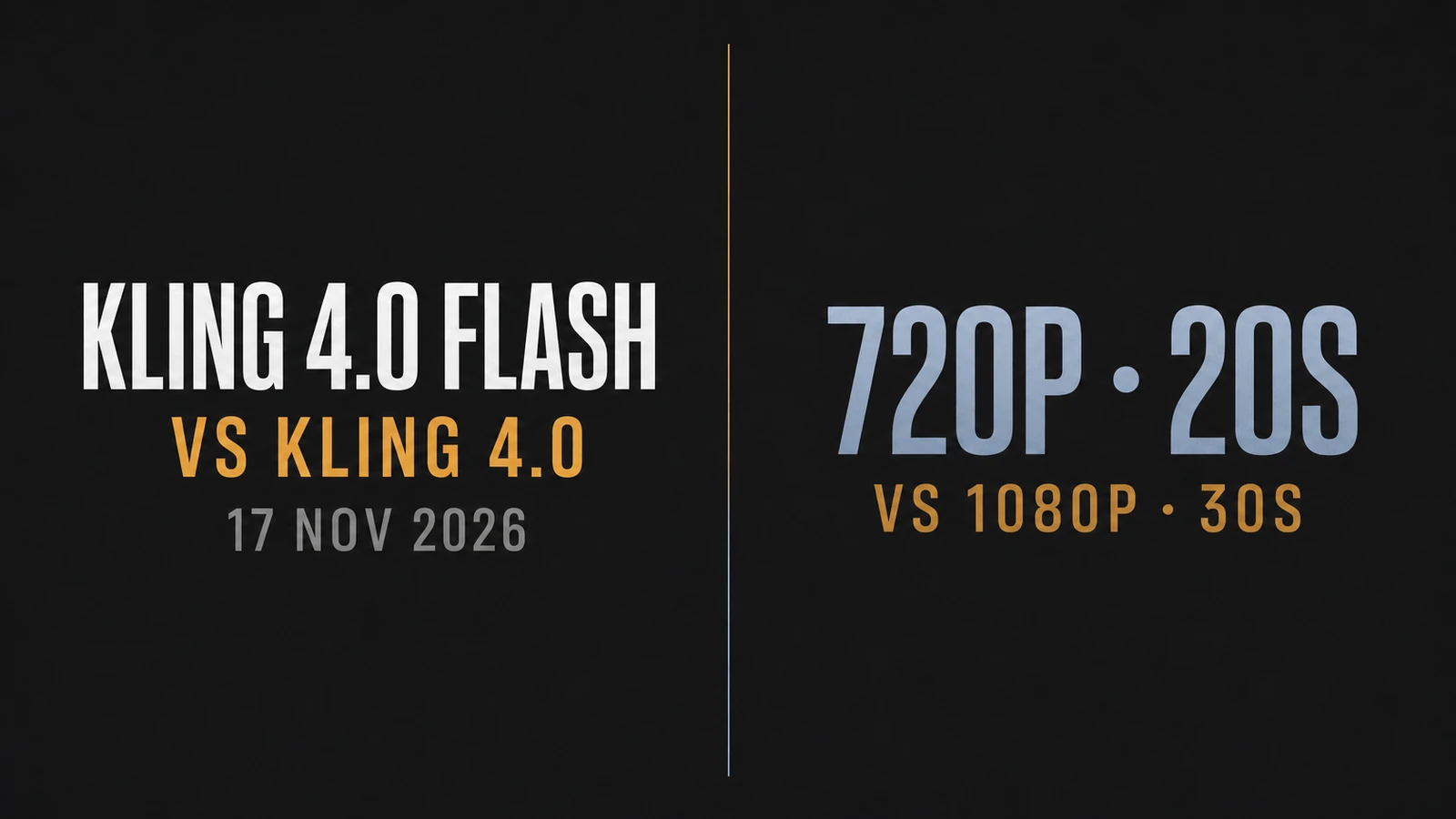
Kling 4.0 Flash is not “the same model, cheaper, with no tradeoff.” Official docs and the live SandBase cards both cap Flash at 720p and 20 seconds. Kling 4.0, which SandBase displays as Kling V4, adds 1080p, 30 seconds, an end frame, and custom voice IDs. The per-second rates on both tiers match the official pricing page. The choice is which cap you can live with.
This comparison is for someone picking a model ID today, not for a quality leaderboard. The 23 October same-prompt test ran the non-Flash model. How to call Flash is in the Flash how-to. Cards were read on 17 November 2026, Asia/Shanghai.
Key takeaway
- Flash: 720p only, 3–20 seconds, no
end_image, novoice_ids. No-input rate $0.094/s. SandBase hero From $0.47 for the default 5-second call.- Kling 4.0 / V4: 720p or 1080p (default 1080p), 3–30 seconds. No-input rates $0.157/s at 720p and $0.235/s at 1080p. Hero From $1.18, which rounds the printed 5-second 1080p row of $1.175.
- End frame is
end_imageonkwaivgi/kling-video/v4/image-to-video. Custom voices are up to twovoice_idsonkwaivgi/kling-video/v4/reference-to-video, and they are not combinable withvideos.- Official 14 November
4:3and3:4ratios for text-to-video and omni apply to both tiers. SandBase text-to-video enums on both cards are still16:9/9:16/1:1/21:9. Acceptance of the new ratios was not tested.- Official 4K is marked “-” for both tiers. The 28 October changelog says “10-bit 4K coming soon” for Kling 4.0. That is not a SandBase resolution today.
The decision table
Official name on the left is Kling 4.0 Flash. Official name on the right is Kling 4.0. SandBase prints Kling V4 Flash and Kling V4. Use the official spelling in a spec, and the SandBase ID in the request.
| Kling 4.0 Flash | Kling 4.0 / V4 | |
|---|---|---|
| Resolution | 720p only. Official 1080P and 4K are “-” | 720p or 1080p, default 1080p. Official 4K is “-”. Changelog, 28 Oct 2026: “10-bit 4K coming soon.” |
| Duration | 3–20s | 3–30s |
| End frame | No. Flash image-to-video is start frame only | Yes. end_image on kwaivgi/kling-video/v4/image-to-video |
voice_ids | No. The Flash reference card points at the non-Flash reference card | Yes, up to 2, on kwaivgi/kling-video/v4/reference-to-video. Not combinable with videos |
| SandBase text-to-video aspect ratios | 16:9 / 9:16 / 1:1 / 21:9 | Same four enums |
| No-input rate | $0.094/s at 720p | $0.157/s at 720p, $0.235/s at 1080p |
| With-input rate | $0.063/s | $0.094/s at 720p, $0.141/s at 1080p |
Create a custom voice on the live create-voice card. The non-Flash reference README also prints a /model/.../create-voice path, which redirects to that /models/ URL. Link the /models/ card.
The rates in the last two rows are both the official pricing-page figures and the figures printed on the SandBase cards checked 17 November 2026. They are not a SandBase discount against Kling’s own list.
What 5 seconds and 10 seconds cost
Prefer rows the cards actually print. Where a useful comparison is arithmetic from a stated per-second rate, it is labeled as arithmetic.
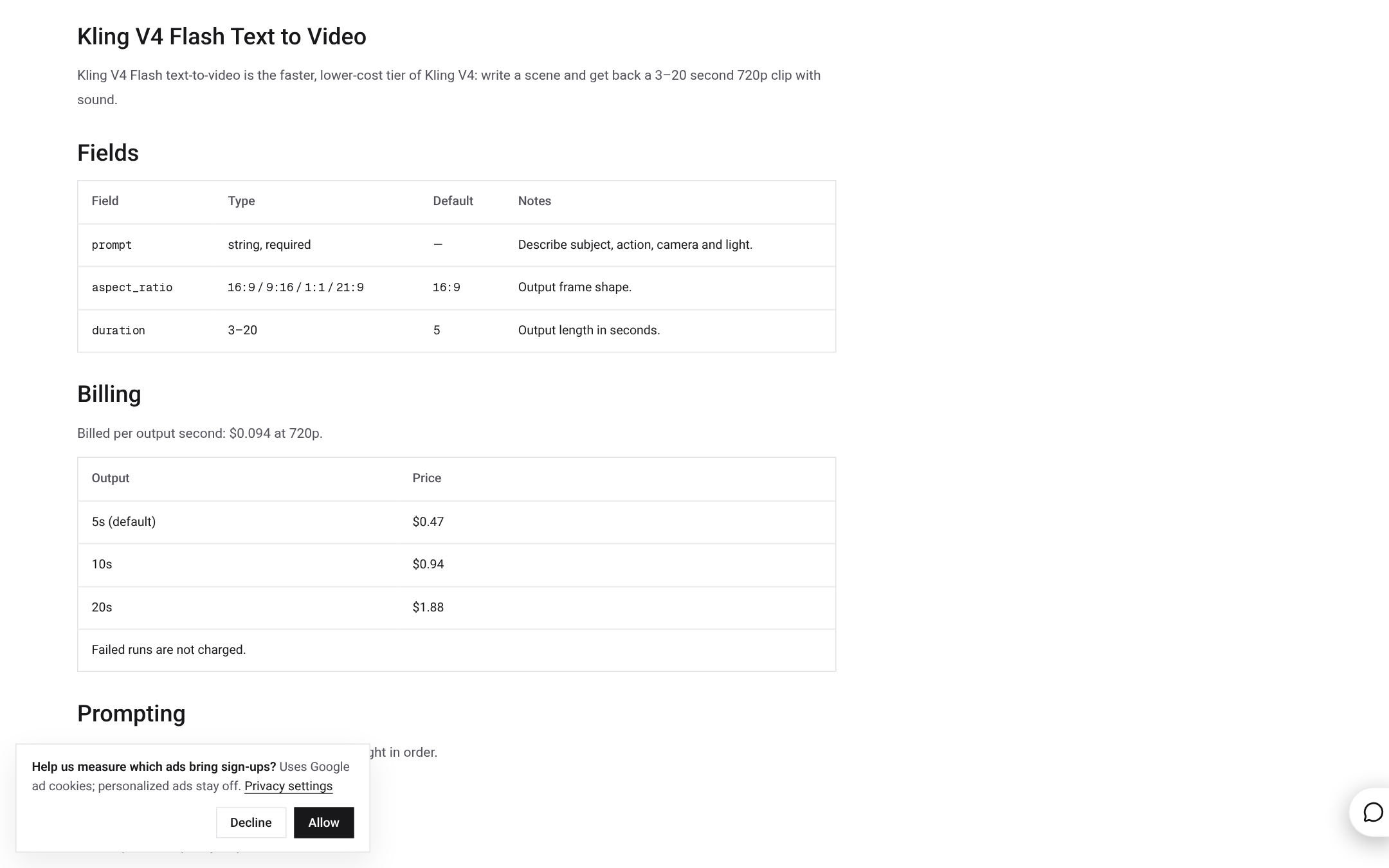
Live SandBase card for kwaivgi/kling-video/v4/flash/text-to-video, captured 17 November 2026, Asia/Shanghai. The README bills $0.094 per output second at 720p and prints 5s (default) $0.47, 10s $0.94, and 20s $1.88. Duration is 3–20 seconds. These SandBase rates match official no-input $0.094/s. (A site cookie prompt is visible at the lower left and does not cover the billing table.)
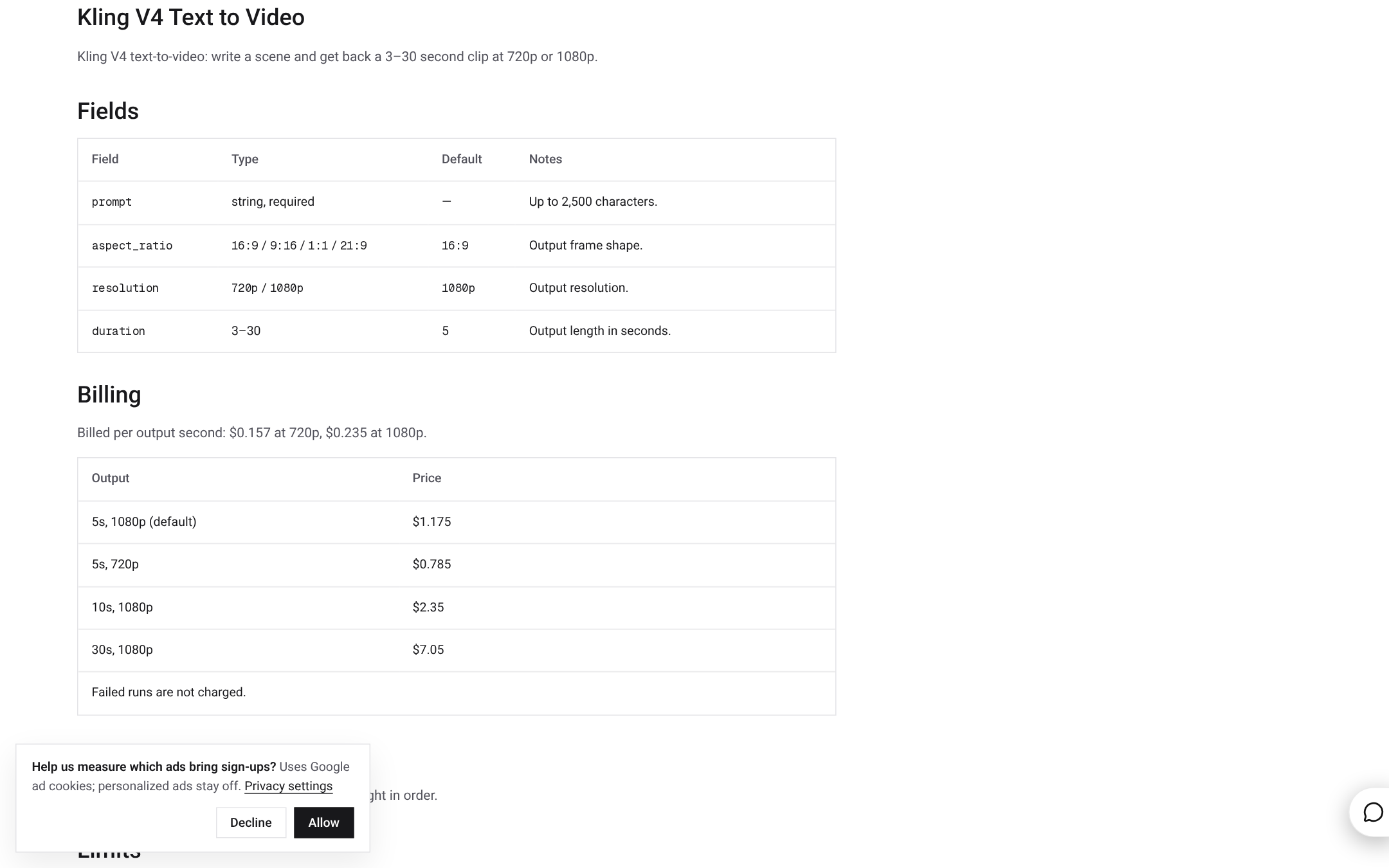
Live SandBase card for kwaivgi/kling-video/v4/text-to-video, captured 17 November 2026, Asia/Shanghai. Resolution enums are 720p / 1080p (default 1080p). Duration is 3–30 seconds. Printed rates: $0.157/s at 720p, $0.235/s at 1080p. Table rows include 5s 1080p (default) $1.175 (the card hero rounds this to From $1.18), 5s 720p $0.785, 10s 1080p $2.35, and 30s 1080p $7.05. These are SandBase figures and match official no-input rates.
Text, image, and images-only reference use the no-input rate.
| Output | Flash 720p (printed) | V4 720p | V4 1080p (default) |
|---|---|---|---|
| 5s | $0.47 | $0.785 (printed) | $1.175 printed; hero From $1.18 |
| 10s | $0.94 (printed) | $1.57 is 10 × $0.157. The V4 text-to-video table does not print a 10s 720p row | $2.35 (printed) |
| Longest printed row | 20s $1.88. 30s is not offered | — | 30s $7.05 (printed) |
A default Flash call is $0.47. A default V4 call, because the default resolution is 1080p, is $1.175 on the table and From $1.18 on the hero. Leaving resolution off on V4 is how a “5-second test” lands on the higher rate. At 10 seconds the printed comparison is Flash 720p $0.94 against V4 1080p $2.35. The $1.57 figure is the 720p rate times 10. It is not a row the V4 card prints, so do not quote it as a catalog line.
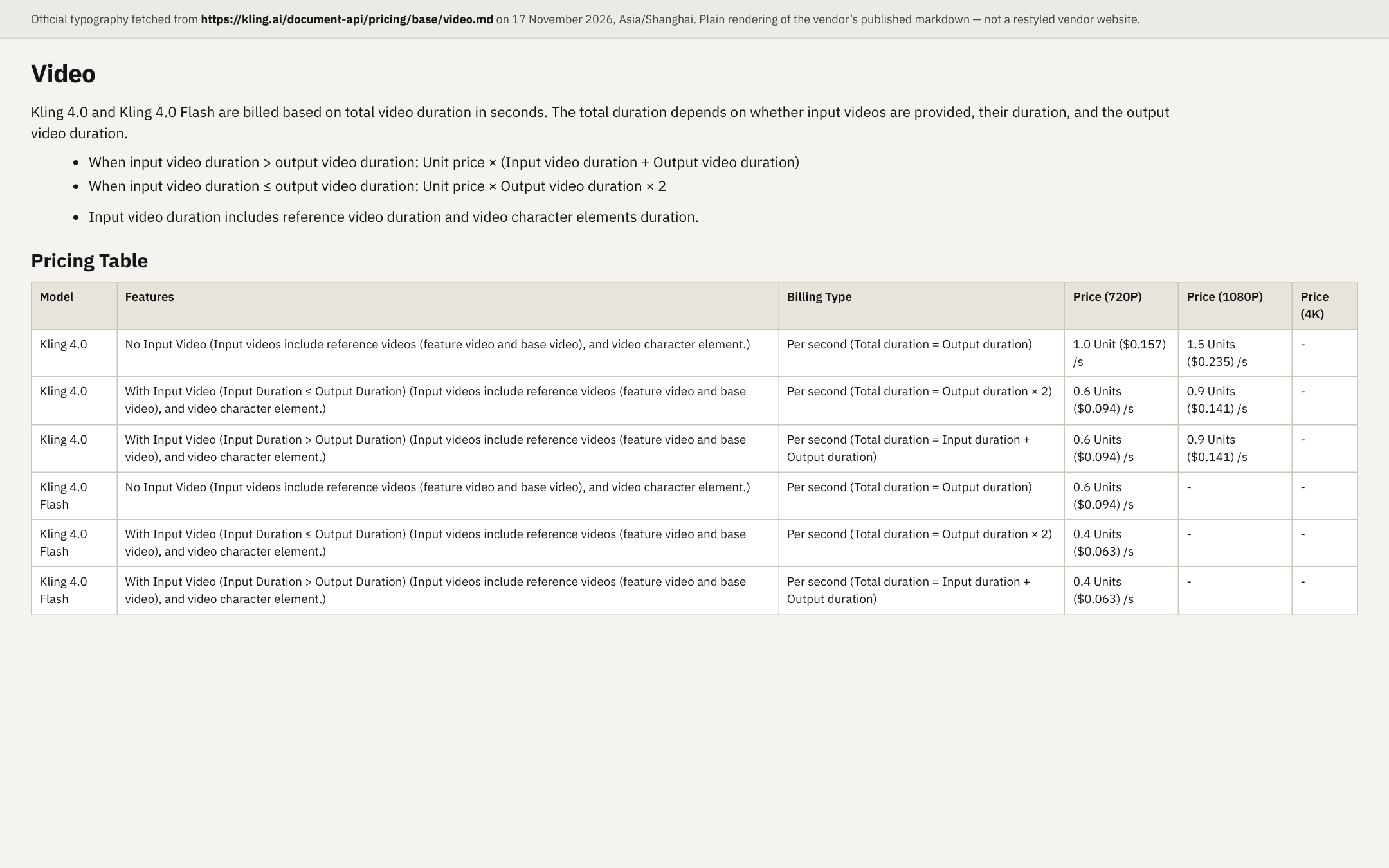
Official typography fetched from https://kling.ai/document-api/pricing/base/video.md on 17 November 2026, Asia/Shanghai, plain rendering of the vendor’s published markdown. Official Kling 4.0 Flash, no input video, is 0.6 Units ($0.094)/s at 720P; 1080P and 4K columns are “-”. With input, official Flash is 0.4 Units ($0.063)/s. These are official rates, not a SandBase price table (SandBase matches them on the live Flash cards).
Video edit bills both sides. Flash printed rows, at $0.063/s on input plus output: 5s $0.63, 10s $1.26, 20s $2.52 (hero From $2.52). The V4 video-edit card’s printed rows include 6s 1080p $1.692, 10s 720p $1.88, and 30s 1080p $8.46 (hero From $8.46). V4 edit rates are $0.094/s at 720p and $0.141/s at 1080p, again on input plus output. A 20-second Flash edit at $2.52 is still far under a 30-second 1080p V4 edit at $8.46, and it is also a shorter, lower-resolution file. Compare the clip you will actually keep.
Where the feature gap actually is
Resolution and duration are the obvious caps. Two fields matter just as much if the shot has a locked ending or a specific voice.
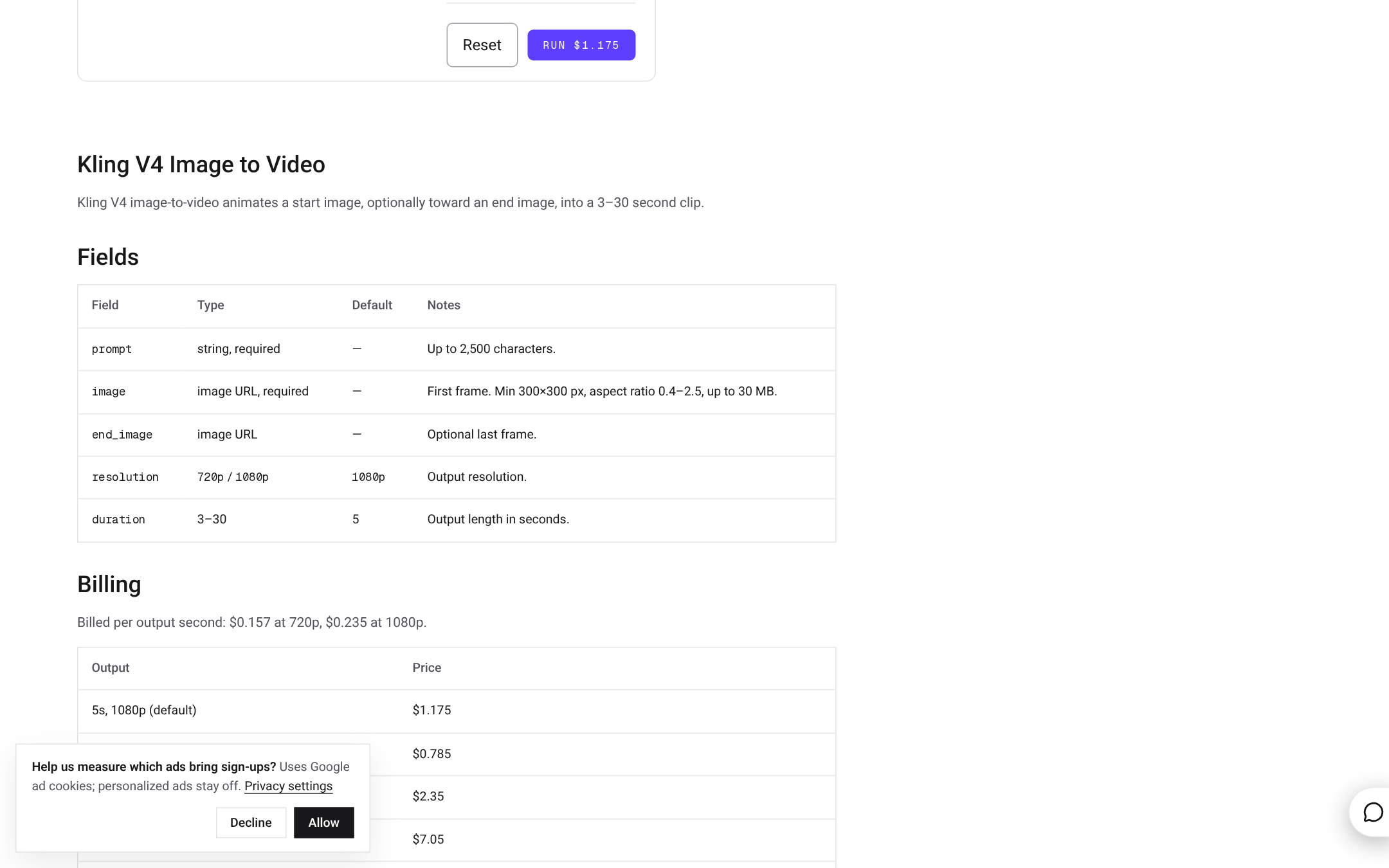
Live SandBase card for kwaivgi/kling-video/v4/image-to-video, captured 17 November 2026, Asia/Shanghai. The fields table includes optional end_image (“Optional last frame”). Duration is 3–30 seconds; default resolution is 1080p. The playground Run control shows $1.175. Flash image-to-video does not offer end_image.
Flash image-to-video tells you, on its own README, to use kwaivgi/kling-video/v4/image-to-video for an end frame. That non-Flash card is the one in the shot above. The playground estimate of $1.175 is the default 5-second 1080p generation price, the same number the text-to-video table prints and the hero rounds to From $1.18.
voice_ids stop at the same boundary. The Flash reference card says custom voices are only on kwaivgi/kling-video/v4/reference-to-video. That card allows up to two voice IDs, and it says they are not combinable with videos. If the job is “this voice, plus a reference clip,” the schema does not offer both on one request. Create the voice on the create-voice card first, then decide whether the request carries voices or reference videos.
Aspect ratio is the open item. Official docs, as of the 14 November 2026 changelog entry, accept 4:3 and 3:4 on text-to-video and omni-video for both Kling 4.0 and Kling 4.0 Flash. Both SandBase text-to-video cards still enumerate 16:9, 9:16, 1:1, and 21:9. This check did not POST the new ratios. Do not write a client that assumes SandBase has caught up until the card enum says so.
Official 4K is not a silent extra on either SandBase tier. The pricing page marks 4K as “-” for Flash and for Kling 4.0. The 28 October changelog’s “10-bit 4K coming soon” is a vendor future tense for Kling 4.0, not a resolution value on the V4 card.
When Flash is the rational default
Use Kling 4.0 Flash text-to-video when all of these are true: 720p is the delivery resolution, the clip is 20 seconds or shorter, you do not need a last frame, and you do not need voice_ids. In that box the SandBase price matches the official Flash price, and the default 5-second call is $0.47 instead of $1.175.
Leave Flash as soon as one of those is false. A 1080p master, a 21-to-30-second shot, a locked last frame, or a custom voice is a Kling 4.0 request. Start at the V4 text-to-video card, and set resolution on purpose so the 1080p default is a choice. The request shape for Flash, including the stale hub card you should not budget from, is the how-to.
The October posts remain the record of the non-Flash launch and of one same-prompt run: what shipped, the API guide, and the comparison with Seedance 2.5, Veo 3.1, and Wan 3.0. Seedance 2.5 Flash is a separate listing, with its own price label: Seedance 2.5 Flash on SandBase.
Confirmed versus unknown
| Confirmed on 17 Nov 2026 | Do not invent |
|---|---|
| Flash is 720p and 3–20s on official docs and on the four SandBase cards | Flash at 1080p, 30s, with end_image, or with voice_ids |
| Official and SandBase no-input rates: Flash $0.094/s; V4 $0.157/s at 720p and $0.235/s at 1080p | A SandBase discount that the Flash or V4 heroes do not print |
| V4 hero From $1.18 rounds the printed $1.175 | A printed V4 10s 720p catalog row of $1.57 |
end_image and voice_ids are on the named non-Flash cards | SandBase acceptance of official 4:3 / 3:4 |
| Official 4K column is “-” for both tiers | A live SandBase 4K enum, or a shipped date for “10-bit 4K coming soon” |
The hub card at kwaivgi/kling-video/v4 still says the public API has not opened. That sentence is stale. It is not a finding about either tier’s endpoint cards.
FAQ
Is Flash just Kling 4.0 at a lower rate?
No. The lower rate comes with a lower cap: 720p and 20 seconds, no end frame, no voice IDs. Kling 4.0’s default SandBase call is 1080p. Compare a 5-second Flash clip at $0.47 with a 5-second V4 1080p clip at $1.175, and you are also comparing the file.
Which card has the end frame?
kwaivgi/kling-video/v4/image-to-video. Flash image-to-video does not list end_image.
Can I send 4:3?
Official text-to-video and omni-video for both tiers accept 4:3 and 3:4 as of 14 November 2026. The SandBase text-to-video enums checked the same week do not list them. Untested on SandBase. Do not ship a client that depends on the official changelog alone.
Do SandBase prices match official Kling prices?
On these two tiers, the per-second rates above match the official video pricing page. Flash is not a marked-up or marked-down copy of Kling’s own Flash rate on the cards checked 17 November 2026.
What to open
Try Kling 4.0 Flash when the caps fit. Open Kling V4 text-to-video when they do not, and create a key only after the model ID matches the resolution you will actually deliver.
Official pricing markdown and the live SandBase Flash and V4 cards, checked 17 November 2026, Asia/Shanghai. Official per-endpoint HTML was a JS shell and was not used as a spec source.
Related reading
- Kling 4.0 Flash Is on SandBase: 720p, 20 Seconds, and What It Costs
- Kling 4.0 Launch: What Shipped, What Didn’t, and the $18B Question
- Kling 4.0 API: Four Endpoints, Real Costs, and the Gaps
- Kling 4.0 vs Seedance 2.5 vs Veo 3.1 vs Wan 3.0: Same Prompt
- Seedance 2.5 Flash Is on SandBase: 480p/720p, 30 Seconds, No Draft Mode
Found this useful? Share it