Kling 4.0 vs Seedance 2.5 vs Veo 3.1 vs Wan 3.0: Same Prompt
Kling 4.0 vs Seedance 2.5, Veo 3.1, Wan 3.0 and Kling 3.0 Pro on one action prompt and a 30-second single-take prompt: billed cost, wait time, camera moves, audio, and limits.
Only one of the five models actually swung the camera around the skater. The prompt asked for “a half orbit” during the jump, which is exactly the kind of complex camera work Kuaishou says Kling 4.0 improves. Kling 4.0 did it. It was also the slowest model to answer, by a wide margin.
This is a Kling 4.0 vs Seedance 2.5 comparison, with Veo 3.1, Wan 3.0 and Kling 3.0 Pro in the same run. It covers the two things launch-week readers keep asking: is Kling 4.0 better at fast motion, and is the 30-second single take worth paying for? We ran one action prompt on all five models and one 30-second “no cuts” prompt on the two models in this group that can do 30 seconds at 720p for a reasonable price. Everything went through SandBase on 2026-10-23 (UTC). It is for teams picking a video model for an agent or a content pipeline, not for anyone looking for a leaderboard.
Key takeaway
- On the action prompt, Kling 4.0 was the only model whose camera visibly orbited the rider. Kling 3.0 Pro, Seedance 2.5 and Wan 3.0 all landed an ollie but kept a tracking or frontal camera. Veo 3.1 rode along the curb instead of jumping it.
- Kling 4.0 took 339 s for a 5 s clip. Veo 3.1 took 51 s. The other three took 148–175 s.
- Billed price per second at 720p that day: Wan 3.0 $0.065 (35% promo), Kling 3.0 Pro $0.078 (1080p, 30% promo), Kling 4.0 $0.157, Veo 3.1 $0.20, Seedance 2.5 $0.288 (20% promo).
- In one 30-second single take, both Kling 4.0 and Wan 3.0 stayed cut-free (zero cuts detected). Kling hit all four timed beats, with the camera circle arriving slightly early. Wan got behind the cook only at about 14–16 s and handed over the bowl at about 22.5–24 s, both at the tail end of their windows. Kling cost $4.71, Wan $1.95.
- Scope: one clip per model per prompt, one session, judged from sampled frames. A single seed can flip any of these readings.
How we ran it
Every request used POST https://api.sandbase.ai/v1/run, polled GET /v1/run/{id} every 5 s, downloaded outputs[0].url straight away, probed the file with ffprobe, and read the charge from GET /v1/tasks/{id}/cost. The harness is a single Python file. The Kling 4.0 API guide shows a trimmed version.
We sent 720p and 16:9 wherever the schema allows it, and 5 seconds wherever the model allows it. Veo 3.1 only offers 4, 6 or 8 s, so it ran at 4 s. Kling 3.0 Pro has no resolution field and always returns 1080p. We turned generate_audio off on every model that has the switch, so nobody paid for sound we weren’t scoring. Kling 4.0 has no such switch on SandBase, and its clips came back with a stereo track anyway.
Prompt 1 (action, 287 characters): a skateboarder in a yellow jacket carving down a coastal road at sunset. The camera tracks alongside, then swings around in a half orbit as she ollies over a low curb and lands. Hair and jacket whip in the wind, and the ocean is on the right.
Prompt 2 (long take, 30 s): one continuous handheld take at a night-market wok stall, with four timed beats. 0–8 s flames and noodle toss; 8–16 s the camera circles behind the cook to reveal a queue; 16–24 s he hands a bowl to a woman in a green coat; 24–30 s the camera follows the bowl into the crowd.
Spec sheet: what each API lets you ask for
The schemas differ more than the marketing does. Here they are as sandbase_inspect returned them on 2026-10-23.
| Model (SandBase ID) | Duration | Resolution | Aspect ratios | Audio control | Notable extras |
|---|---|---|---|---|---|
Kling 4.0 kwaivgi/kling-video/v4/text-to-video | 3–30 s | 720p, 1080p | 16:9, 9:16, 1:1, 21:9 | none (track always present in our runs) | separate image, reference and edit endpoints |
Kling 3.0 Pro kwaivgi/kling-video/v3/pro/text-to-video | 3–15 s | 1080p only | 16:9, 9:16, 1:1 | generate_audio | multi_prompt multi-shot |
Seedance 2.5 bytedance/seedance/2.5/text-to-video | 4–30 s or auto | 480p, 720p, 1080p | 6 incl. 4:3, 3:4, 21:9 | generate_audio (same price) | 480p draft → draft_id 1080p re-render, seed |
Wan 3.0 alibaba/wan/3.0/text-to-video | 2–30 s or auto | 480p, 720p, 1080p | 6 incl. 21:9 | generate_audio (same price) | seed |
Veo 3.1 google/veo3.1/text-to-video | 4, 6, 8 s | 720p, 1080p, 4K | 16:9, 9:16 | generate_audio (off halves the 720p/1080p price) | negative_prompt, seed |
List price per second at 1080p (no audio where that’s optional): Kling 4.0 $0.235, Kling 3.0 Pro $0.112, Seedance 2.5 $0.90, Wan 3.0 $0.20, Veo 3.1 $0.20. A 30-second 1080p clip therefore lists at $7.05 on Kling 4.0, $6.00 on Wan 3.0 and $27.00 on Seedance 2.5. Veo 3.1 and Kling 3.0 Pro can’t produce 30 seconds in one request at all.
Seedance 2.5 is the outlier on price, and its draft mode is the reason to pay it. You can render a 480p draft at $0.18/s, then turn the keeper into 1080p with draft_id without re-rolling the shot. None of the others have an equivalent on SandBase.
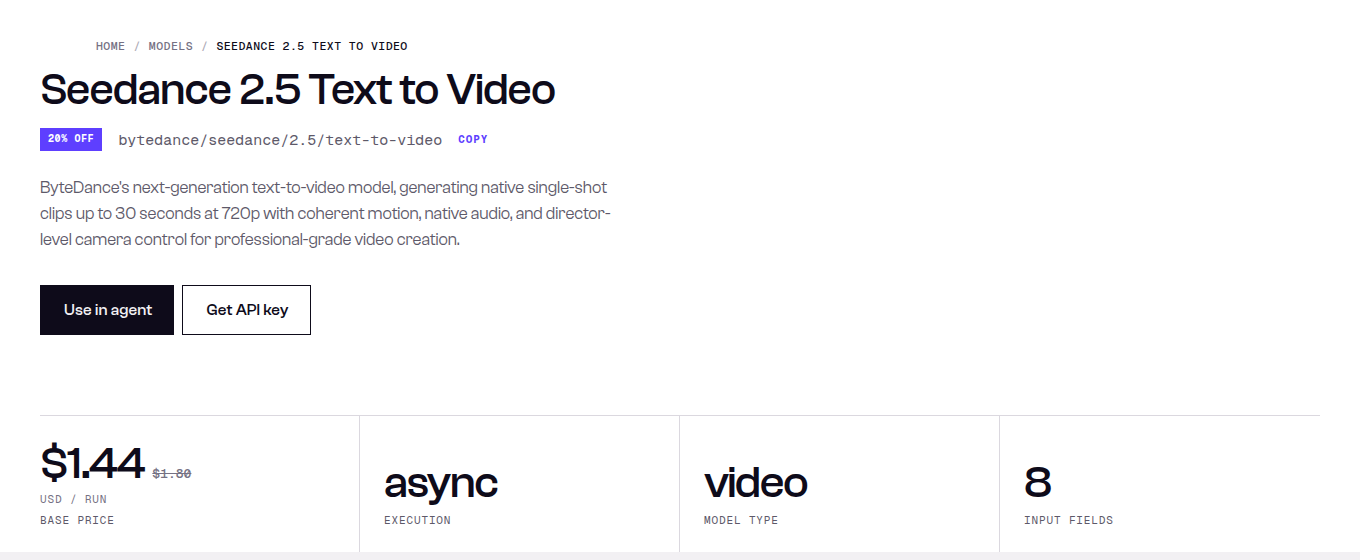 SandBase catalog, 2026-10-23: Seedance 2.5 showed 20% off, $1.44 against $1.80 for the default 5 s 720p run. Our Seedance clip was billed exactly $1.44.
Promotions moved the real bill a lot in this run, so we checked every model page. Seedance 2.5 showed 20% off, Wan 3.0 35% off and Kling 3.0 Pro 30% off. Kling 4.0 and Veo 3.1 showed no discount. Those badges are temporary. The list prices above are the ones to budget against.
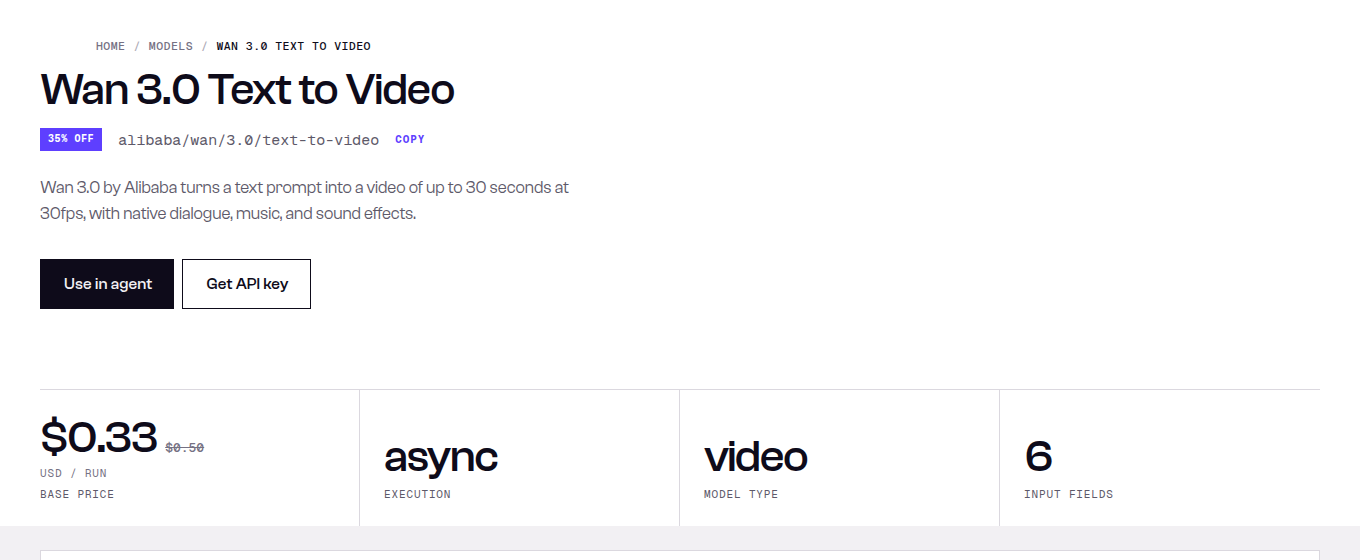 Wan 3.0 on the same day: 35% off, $0.33 instead of $0.50. Our 5 s Wan clip was billed $0.325 and the 30 s take $1.95, both consistent with the discount.
Prompt 1: fast motion and a camera orbit
| Model | Sent | Billed | Billed / s | Wait | Output (ffprobe) |
|---|---|---|---|---|---|
| Kling 4.0 | 5 s, 720p | $0.785 | $0.157 | 339 s | 1280×720, 24 fps, 5.04 s, stereo audio |
| Kling 3.0 Pro | 5 s, audio off | $0.392 | $0.078 | 148 s | 1920×1080, 24 fps, 5.04 s, no audio |
| Seedance 2.5 | 5 s, 720p, audio off | $1.44 | $0.288 | 149 s | 1280×720, 24 fps, 5.04 s, no audio |
| Wan 3.0 | 5 s, 720p, audio off | $0.325 | $0.065 | 175 s | 1280×720, 30 fps, 5.00 s, no audio |
| Veo 3.1 | 4 s, 720p, audio off | $0.80 | $0.20 | 51 s | 1280×720, 24 fps, 4.00 s, no audio |
All five submissions completed on the first try. ffmpeg’s scene detector (scdet, threshold 12) found no cuts in any of them.
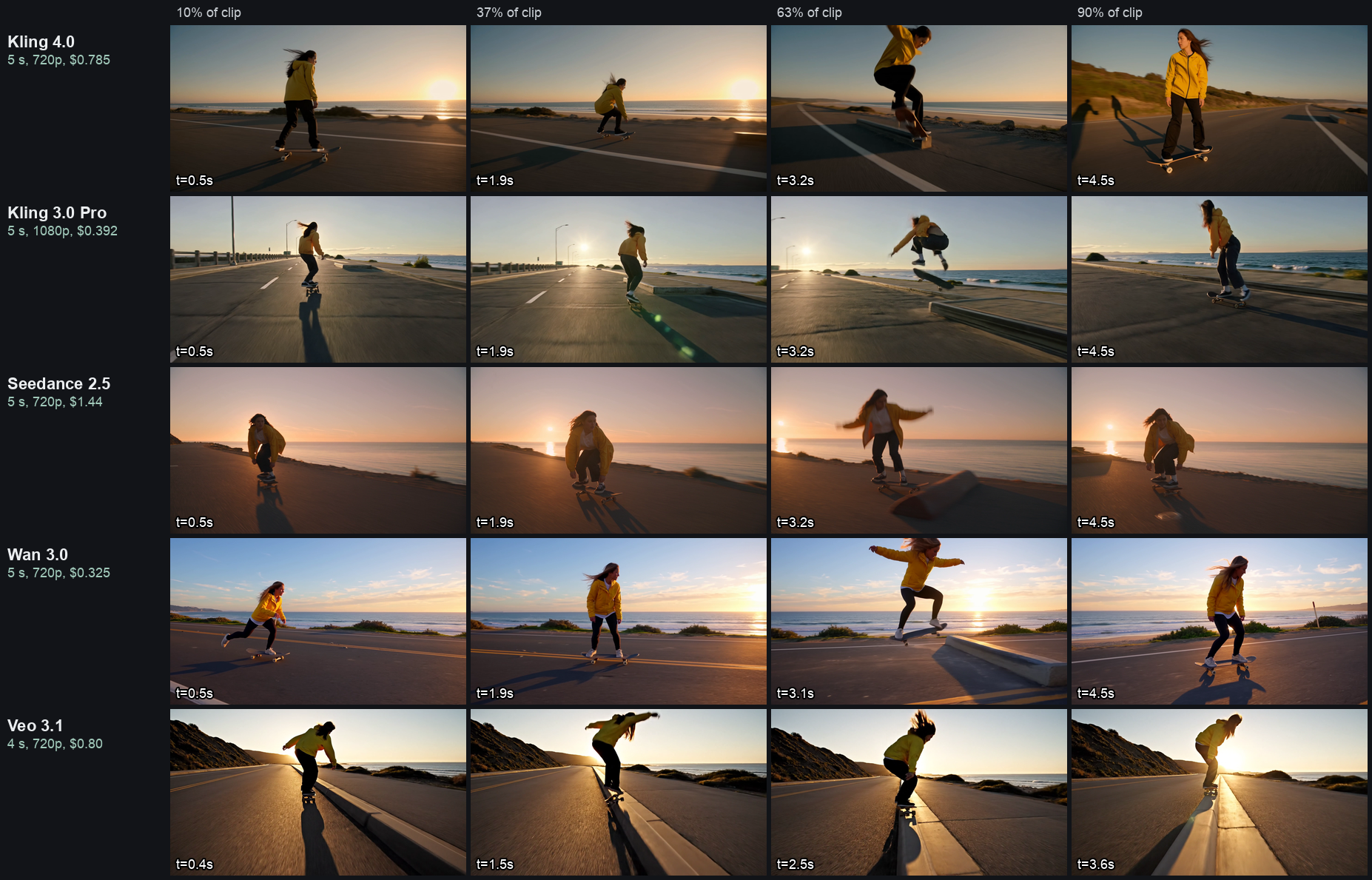 Our outputs for Prompt 1, 2026-10-23. Only the Kling 4.0 row changes viewpoint enough to show an orbit: the last frame looks back at the rider with the hillside behind her.
We read the four sampled frames above, plus eight more per clip from 30–86% for Seedance, Veo and Kling 3.0 Pro, where the jump wasn’t obvious in the grid. Here is what each clip did with the two hard asks, the ollie and the orbit:
| Model | Ollie over the curb | Camera half orbit | Other notes |
|---|---|---|---|
| Kling 4.0 | yes, clean at ~3.2 s | yes. The viewpoint swings from behind-left to facing her | two unexplained human shadows enter at left near the end |
| Kling 3.0 Pro | yes, board well clear of the ledge | no. The camera stays behind and to the side | green lens-flare blob at ~1.9 s |
| Seedance 2.5 | yes, late (~3.5 s), board kicked out well below her feet | no. Frontal camera, the rider stays centered in frame | heavy motion blur on arms during the jump |
| Wan 3.0 | yes, clean, curb clearly visible | no. Side tracking shot | light reads more late afternoon than sunset |
| Veo 3.1 | no. She hops onto the curb and rides along it | no. Follow cam from behind | the most cinematic backlight of the five |
Kling 4.0’s orbit is the result we went in looking for, and it showed up. It is also one seed. Kling 3.0 Pro produced a higher jump at half of Kling 4.0’s billed price, at 1080p. If your shots are mostly “subject moves, camera follows”, the upgrade case for Kling 4.0 over 3.0 isn’t proven by this clip. If your shots need the camera to move around the action, it’s the only one here that did.
Veo 3.1 finished in under a sixth of Kling 4.0’s time. For an agent that shows a user a preview and waits on the reply, 51 seconds against 339 is a different product. Veo didn’t follow the action beat, though. It turned “ollie over a low curb” into a curb ride. That’s a prompt-adherence miss, not a quality one.
Prompt 2: a 30-second single take
Thirty seconds in one pass is the headline Kling 4.0 feature. Seedance 2.5 and Wan 3.0 also accept 30 s. We ran Kling 4.0 and Wan 3.0 at 720p. We skipped Seedance 2.5, whose 30 s 720p clip lists at $10.80 ($8.64 with that day’s promo). That’s a budget choice, not a judgment, and it leaves the most-asked matchup in this space untested at 30 seconds.
| Model | Billed | Wait | Output | Cuts detected | Audio |
|---|---|---|---|---|---|
| Kling 4.0 | $4.71 | ~498 s | 30.04 s, 1280×720, 24 fps | 0 | stereo, mean −23 dB |
| Wan 3.0 | $1.95 | 854 s | 30.00 s, 1280×720, 30 fps | 0 | off (requested) |
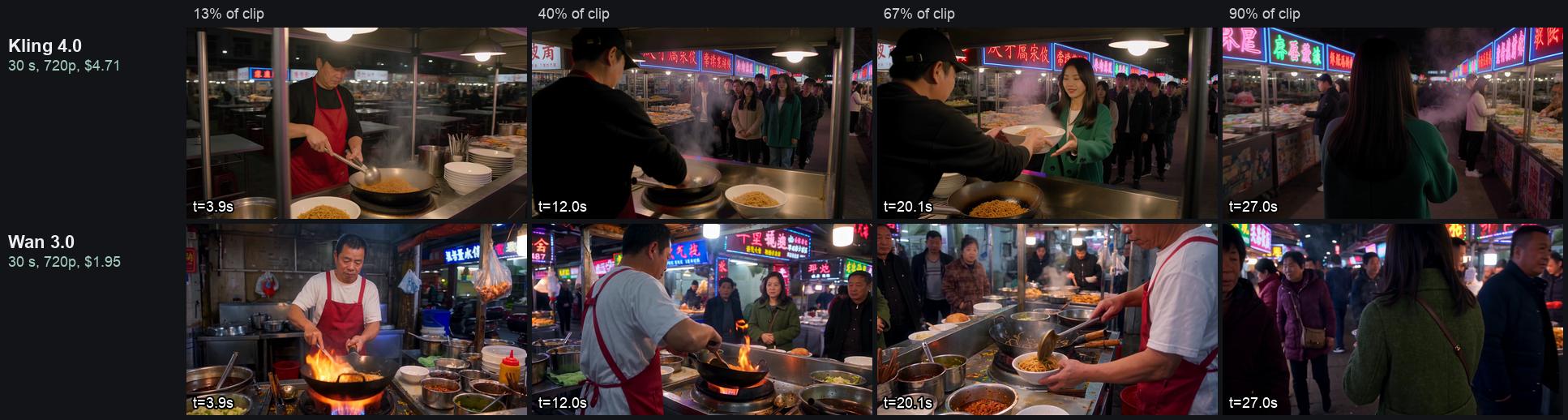 Our 30 s outputs, 2026-10-23. Kling 4.0 (top) is behind the cook at 12 s and mid hand-off at 20 s, as scripted. Wan 3.0 (bottom) is still side-on at 12 s and plating at 20 s.
Beat by beat:
- 0–8 s, flames and toss. Both clips open on the right cook, apron and wok, with flames and tossed noodles. Kling’s biggest flare comes at about 1 s. Wan keeps visible flames under the wok through most of the first 15 s.
- 8–16 s, circle behind the cook. Kling’s camera moves from the front to behind his shoulder by about 7–9 s and holds there, with the queue under neon signs in front of him. Wan is still side-on at 12 s, swings behind him only around 14–16 s, then drifts back to a side angle. Its “queue” is a few customers standing at the counter.
- 16–24 s, hand-off to the green coat. Kling is mid hand-off at 20 s. In Wan the cook is still plating at 20 s, and the bowl passes to the woman between about 22.5 and 24 s, by our extra frame checks. That’s at the very end of the window, but inside it.
- 24–30 s, follow the bowl into the crowd. Both end following the woman in green from behind into the crowd. Kling turns to follow her from about 23 s, Wan from about 27 s. In both, the bowl is visible around 25 s and then hidden in front of her, so “follow the bowl” is only loosely met by either.
Both kept one continuous shot, which is the real test of a “single take” claim. Both drew neon signs in mostly pseudo-Chinese that a Chinese reader will spot as nonsense immediately. Kling followed the timeline more faithfully. Wan hit the middle beats late, at 41% of Kling’s billed cost, and took 1.7× as long to deliver.
One measurement caveat: Kling’s 30 s wait is approximate. Our first poller crashed on a TLS error mid-job. We resumed it from the logged run ID, and we timed from the shared launch timestamp, not from a per-job submission log.
Which model when
- Choose Kling 4.0 when the camera has to move around the action, or when one take must hit several timed beats across 15–30 s. Budget minutes per clip and strip the audio if you don’t want it.
- Choose Kling 3.0 Pro for follow-cam action at 1080p when 15 s is enough. It cost half of Kling 4.0 per second in this run and has explicit multi-shot.
- Choose Seedance 2.5 when you’ll iterate on drafts. The 480p draft → 1080p
draft_idflow is unique here. Its list price at 1080p ($0.90/s) is the steepest by far. - Choose Wan 3.0 for long takes on a budget. It’s the cheapest 30-second option here at both 720p and 1080p list. Accept looser timing.
- Choose Veo 3.1 when latency matters or you need 4K. It returned roughly 3–7× sooner than the rest in our run, but it’s capped at 8 s.
For prompts beyond action and long takes, such as product text, pours and object permanence, our earlier eight-model video API benchmark is the better reference. Kling 4.0 wasn’t out yet when we ran it.
What this test doesn’t show
Five clips and two long takes can’t rank models. We didn’t test image-to-video or reference inputs across models, 1080p, audio quality, dialogue, lip sync or text rendering, and we didn’t re-roll anything. Kling 4.0’s announced keyframe and multi-shot controls aren’t on its SandBase schema yet, so the comparison above is Kling 4.0 prompted the hard way. Several launch-week Kling 4.0 vs Seedance 2.5 comparisons online used Kling 4.0 Flash, not the full model. Check which tier a clip came from before you weigh it.
FAQ
Is Kling 4.0 better than Seedance 2.5? In our single action clip, Kling 4.0 followed the camera-orbit instruction and Seedance 2.5 didn’t, while both landed the jump. Seedance has draft mode, more aspect ratios and an audio toggle. One clip doesn’t settle quality, so run your own prompts on both.
Which is cheapest for 30-second video? At list prices on SandBase on 2026-10-23: Wan 3.0 ($3.00 at 720p, $6.00 at 1080p), then Kling 4.0 ($4.71 / $7.05), then Seedance 2.5 ($10.80 / $27.00). Promotions changed the real bills that day.
Why was Kling 4.0 so slow? We can’t see inside the provider queue. All we can report is 339 s for a 5 s clip and about 498 s for 30 s, in one launch-week session. Re-measure before you design timeouts around it.
Does Kling 4.0 generate audio? Yes. Every clip we made had a stereo track with real sound, and there’s no off switch in the SandBase schema.
Bottom line
Kling 4.0 was the only model in this run that did the hard camera move, and it was the most faithful to a timed 30-second script. It was also the slowest model and mid-priced. Wan 3.0 is the budget long-take option, Veo 3.1 the fast one, Seedance 2.5 the draft-friendly premium option, and Kling 3.0 Pro still the value pick for shorter follow-cam action. Try the same prompt yourself on Kling 4.0, Seedance 2.5, Wan 3.0 and Veo 3.1 with one key, and keep the clip IDs so you can compare like with like.