Kling 4.0 Launch: What Shipped, What Didn't, and the $18B Question
Kling 4.0 release explained: the Sep 28 to Oct 21 rollout, which features shipped versus 'coming soon', how the API compares to the app, the 30-second race with Seedance and Wan, and Kling AI's $18B valuation.
Read Kuaishou’s Kling 4.0 press release slowly and one verb stands out. Kling 4.0 “supports” 10-bit HDR. Two lines later, it “will also support” 4K, 1080p and 21:9. That tense shift is the whole launch in miniature. Some of what was announced is live today, and some is a roadmap with a date attached to the brand rather than to the feature.
This piece sorts the Kling 4.0 release into what actually shipped, what is still pending, and what is only reported, as of 2026-10-23. It also looks at why the launch moved a stock and a valuation story, not just a model leaderboard. It is for builders and product leads who saw a week of “Kling 4.0 is here” posts and need to know what they can use today, through which surface, and at what price.
Key takeaway
- Timeline: announced 2026-09-28 (Flash early access), full launch for all users on 2026-10-15, official API reported live 2026-10-21. Four Kling 4.0 endpoints appeared on the SandBase catalog the same day.
- Confirmed in our own API calls: 3–30 s single-pass clips, 720p/1080p, 21:9, start/end frames, up to 10 reference images plus 5 reference videos, video editing, and an always-on stereo audio track.
- Not available through the API we tested: 10 keyframes, multi-shot, “elements” with voices, 10-bit HDR and 4K. At the Oct 15 launch, third-party reporting listed HDR, 2-minute extension and the developer API as “coming soon”.
- Thirty seconds is no longer unique. On SandBase, Seedance 2.5 and Wan 3.0 also generate 30-second clips. Kling’s distinct pitch is control, and most of that control isn’t in the API yet.
- Money: Kling AI raised about $3B at an $18B post-money valuation (per Kuaishou’s filing, as reported by 36Kr). On Oct 13, Kuaishou’s whole market cap was about $15.6B. Kling’s 2025 revenue of about ¥1.1B was under 1% of Kuaishou’s.
The rollout, date by date
The launch came in three steps, and many posts mixed them up. A “Kling 4.0” clip from late September was almost certainly Kling 4.0 Flash, or an invited preview.
| Date (2026) | What happened | Source |
|---|---|---|
| Sep 28 | Kling 4.0 announced. Early access begins. Kling 4.0 Flash opens to Ultra Yearly subscribers | Kling AI blog (search snippet; the page renders client-side) |
| Sep 30 | Kuaishou names Yu Yue director and CEO of Kling AI, citing the listing timeline | 36Kr, citing Kuaishou’s announcement |
| Early Oct | Director Kim Sung-soo presents the short Worm Train at Busan. He says he remade key shots on Kling 4.0 Preview after Kling 3.0 couldn’t sell the weight of the impacts | 36Kr |
| Oct 15 | Full launch for all users. Creation page redesigned. MCP and CLI access mentioned | Kuaishou press release, kie.ai launch analysis, 36Kr |
| Oct 16 | Press release on GlobeNewswire. Kuaishou shares open up more than 5%, back above HK$30, then give back gains | Press release, 36Kr |
| Oct 21 | Kling 4.0 API launches with gradual global access. Integrations named at Meitu, iQiyi and Tencent products. Four Kling V4 endpoints listed on SandBase | Longbridge / Wallstreetcn, TokenPost, SandBase catalog |
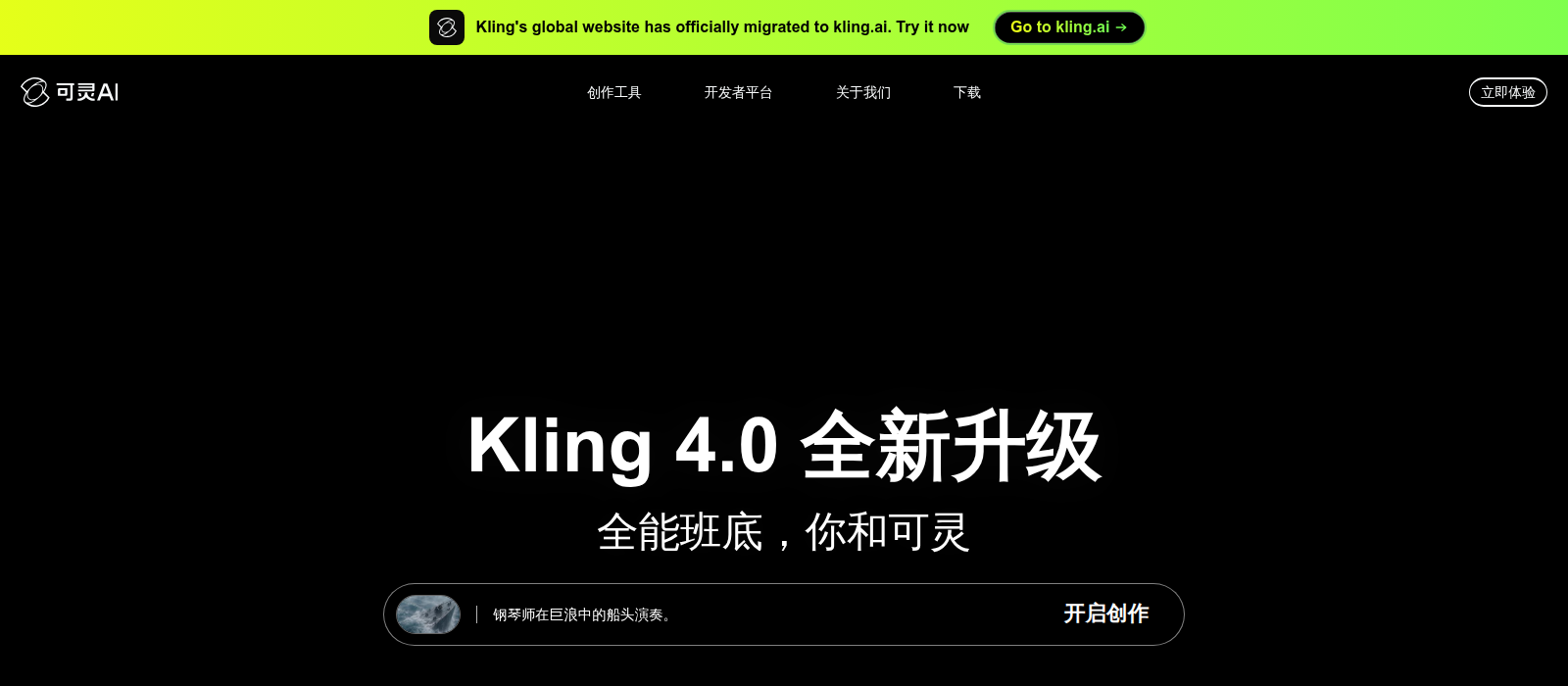 The Kling AI site on 2026-10-23. The old 4.0 blog URL now redirects to a Chinese-language hero reading “Kling 4.0, all-new upgrade”, and a banner says the global site has moved to kling.ai. The nav includes a developer platform link.
The blog URL Kling used for the September announcement now lands on that homepage hero. That’s why we cite its search-indexed text instead of quoting the page.
What Kuaishou says Kling 4.0 does
The press release groups the upgrade under realism, control and professional quality. Paraphrased, the concrete claims are:
- steadier large-scale motion and complex camera work, including tracking and orbit shots;
- native single-pass generation of up to 30 seconds, for long takes and continuous scenes;
- Omni Reference, combining up to 15 reference assets with up to 10 keyframe inputs;
- output of up to 10-bit HDR, with 4K, 1080p and 21:9 described as formats Kling 4.0 “will also support”.
No system card, benchmark table or architecture detail came with it. The launch analysis from kie.ai, an API reseller that sells Kling access itself, noted the same absence and flagged HDR, a 2-minute video extension and the developer API as still “coming soon” on Oct 15. It also reported consumer pricing of 15 credits per second at 1080p and 10 at 720p, which works out to 450 credits for a 30-second 1080p clip. That number comes from third-party testers, not a published Kling rate card.
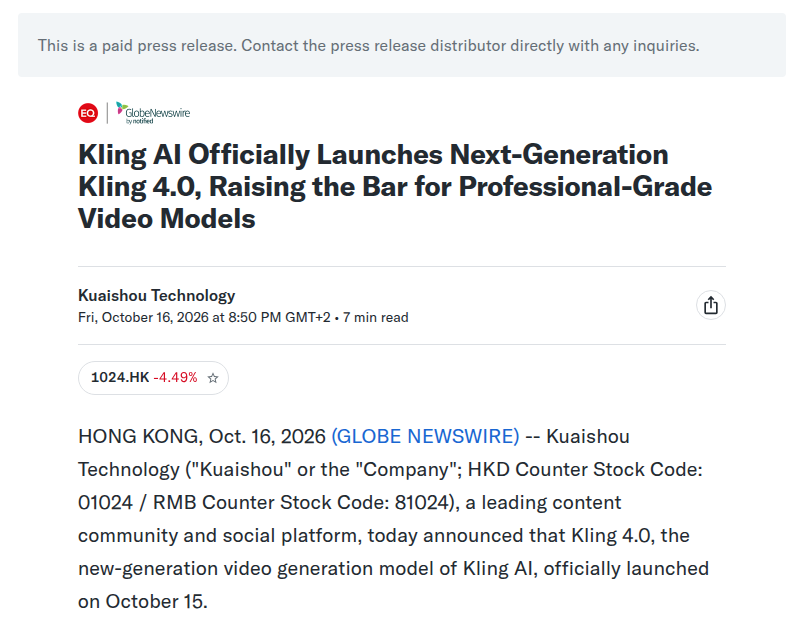 Kuaishou’s release as syndicated on Yahoo Finance, captured 2026-10-23. It dates the full launch to October 15. Yahoo labels it a paid press release, so it’s Kuaishou’s own claim, not independent verification.
Shipped, pending, or only reported
This is the table we wish someone had published on Oct 15. The right-hand column comes from our own calls to the four Kling 4.0 endpoints on SandBase on 2026-10-23. Details and costs are in the Kling 4.0 API guide.
| Capability | Kuaishou / Kling claim | Through the API we tested (SandBase, Oct 23) |
|---|---|---|
| 30 s in one pass | yes | yes. We got a 30.04 s clip with zero detected cuts, $4.71 at 720p |
| Large motion, orbit shots | yes | seen once. The only model of five whose camera orbited in our action prompt |
| 21:9 | ”will also support” | yes, aspect_ratio: 21:9 is in the schema (we ran 16:9) |
| 1080p | ”will also support” | yes, and it’s the default |
| 4K | ”will also support” | no. 720p/1080p only. kie.ai notes 4K already existed in Kling 3.0, and SandBase lists separate Kling O3 4K endpoints |
| 10-bit HDR | ”supports up to” | no field. Our files are 8-bit yuv420p H.264 |
| 10 keyframes | yes | no. Start frame and optional end frame only |
| Omni Reference, 15 assets | yes | partial. Up to 10 images and 5 videos. No “elements” or voices |
| Native audio | stereo, lip sync (per fal’s page) | always on. Stereo AAC with real sound, no toggle |
| Video editing | yes (fal’s page) | yes, and it held composition well in our one test |
That’s not a scandal. Staged rollouts are normal, and an API usually trails the consumer app. But the gap matters if you’re scoping a project in launch week. The features that make Kling 4.0 a director’s tool, keyframes and elements, are exactly the ones an agent can’t call yet. What an agent can call today is a capable 30-second generator with good camera instincts and a slow queue. Our first 5-second text-to-video call took 339 s.
The 30-second race is already crowded
“30 seconds in a single pass” reads like a moat in a press release. In the SandBase catalog on the same day, it’s table stakes: Seedance 2.5 accepts 4–30 s and Wan 3.0 accepts 2–30 s. Wan 3.0 lists cheaper per second than Kling 4.0 at both 720p and 1080p. Seedance 2.5 lists higher at both.
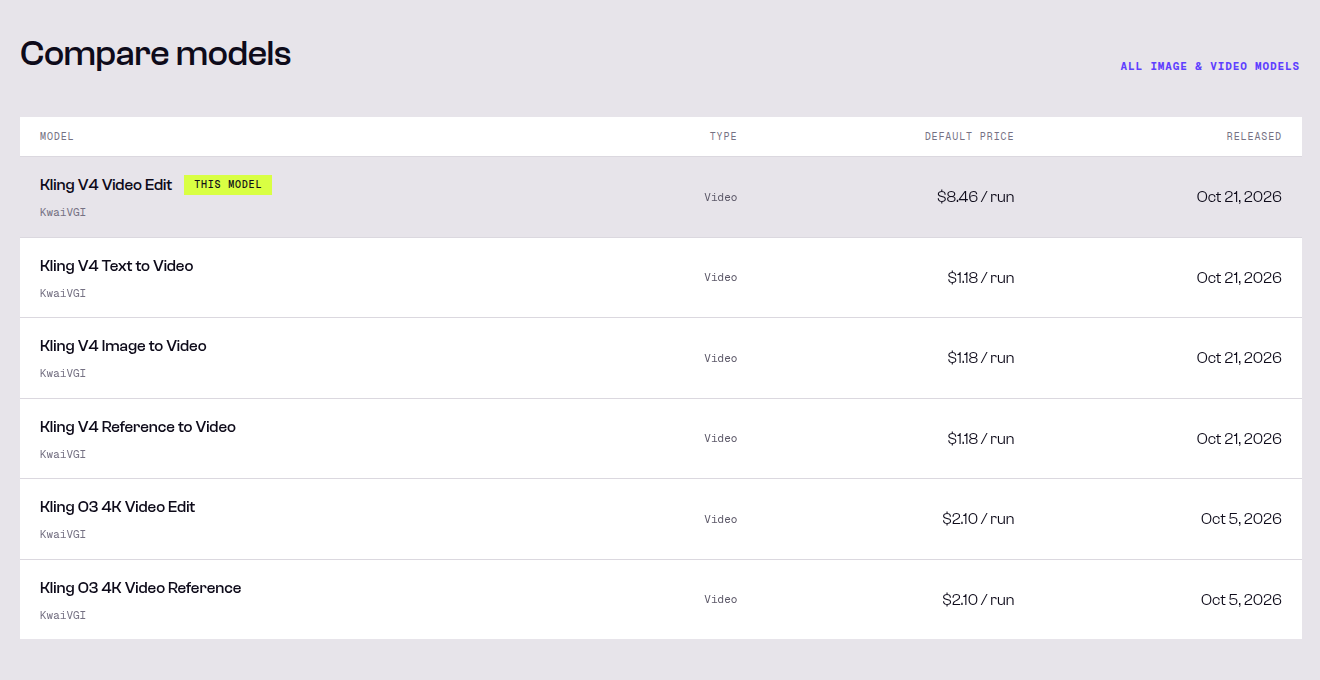 SandBase catalog, 2026-10-23: the four Kling V4 endpoints all show a release date of October 21, the same day the official API was reported live. The Kling O3 4K endpoints below them date from October 5.
So where does Kling 4.0 actually differ? In our same-prompt comparison, on one 30-second night-market script, Kling hit four timed beats in order and Wan 3.0 ran a few seconds behind. On one action clip, Kling was the only model that orbited the camera. Both results are single seeds, and both point the same way as Kuaishou’s own pitch: motion and directing, not length.
The community comparisons support that reading, with caveats. The kie.ai roundup cites one side-by-side that found Kling stronger in motion and impact and Seedance 2.5 more stable overall. It also notes that the most controlled public A/B used Kling 4.0 Flash, and that several early-access demos were tagged as sponsored. Weight launch-week clips accordingly.
The $18B question
The part of this launch that trended outside AI circles wasn’t a clip. It was a valuation gap.
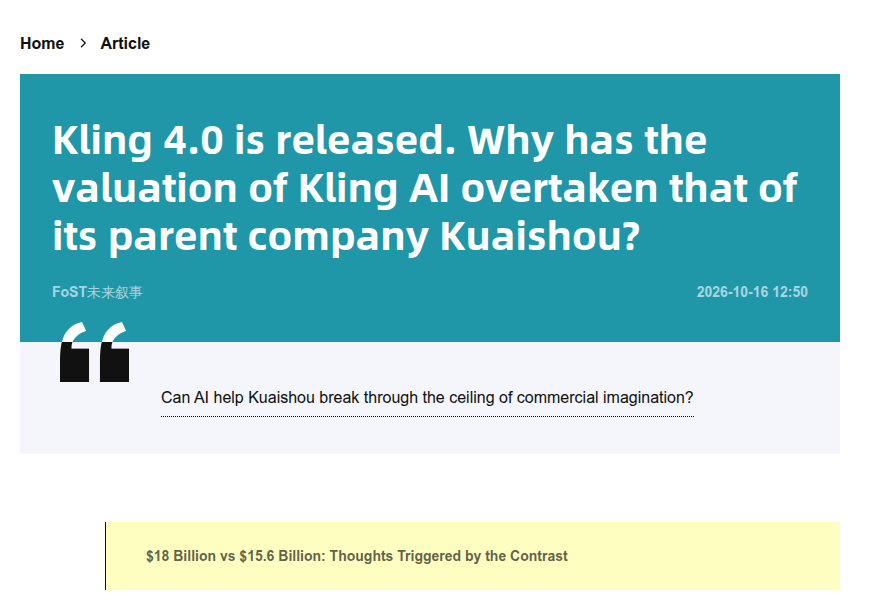 36Kr Europe, 2026-10-16, captured 2026-10-23: the $18 billion vs $15.6 billion framing that circulated after the launch. The figures below come from this article and the Kuaishou filings it cites.
According to 36Kr’s analysis:
- Kuaishou announced in July that Kling had finalized about $3 billion of external capital at an $18 billion post-money valuation, a record single round for a video-model company. Investors include Tencent (about 1.12% for roughly ¥1.36B), Baidu, Alibaba Cloud and several state-backed funds. More money from the national AI industry fund was added on Aug 31.
- On Oct 13, Kuaishou stock hit a record low of HK$28.5, a market cap of about HK$122.7B, or roughly $15.6B. That is less than the private valuation of a business it controls.
- Kling’s 2025 revenue was about ¥1.1B, under 1% of Kuaishou’s ¥142.8B, and Kling is still loss-making. Kuaishou’s CEO has said growth comes from enterprise API calls plus paid creator subscriptions.
- Bloomberg reported Kling is working with CICC, Goldman Sachs and UBS toward a listing as early as next year. Terms aren’t set.
Two cautions before you repeat that headline. A primary-round post-money valuation and a public market cap aren’t the same kind of number. 36Kr says so itself: they’re “not completely comparable”. The comparison also leaves out what Kuaishou actually retains in Kling. We aren’t offering a view on either stock. This is context for why a model launch was covered as a capital-markets event.
For builders, the useful signal is in the revenue line. Kling’s business case leans on API calls. That makes the pace at which keyframes, elements and HDR reach the API more than a feature request. It’s how the valuation story gets tested.
What to watch next
- API schema changes. Keyframes and multi-shot are the first fields worth checking for. On SandBase,
sandbase_inspect kwaivgi/kling-video/v4/text-to-videoshows the current inputs. - HDR and 4K shipping dates. Both were in the launch copy. Neither is in the API today.
- Latency. Launch-week queues are often slow. Re-time a 5-second clip in a few weeks before you set agent timeouts.
- Flash on the API. A 720p, 20-second Flash tier would be the natural draft tier, and Kling 4.0 has no draft mode on SandBase right now.
- Kling’s listing filing, if it comes. It would be the first audited view of API revenue.
FAQ
When was Kling 4.0 released? It was announced on Sep 28, 2026 (with Flash early access), launched for all users on Oct 15, and its API was reported live on Oct 21.
Is the Kling 4.0 API available? Reporting says the official API is opening gradually from Oct 21. On SandBase, four Kling 4.0 endpoints (text, image, reference, edit) were callable on Oct 23 with one SandBase key.
Does Kling 4.0 support 4K and HDR? Kuaishou announced both. Neither was available through the API we tested, which offers 720p and 1080p in 8-bit.
Why is Kling AI valued above Kuaishou? It isn’t a like-for-like comparison. A $18B private post-money valuation was set in July. Kuaishou’s public market cap fell to about $15.6B on Oct 13. Investors are pricing Kling’s growth and scarcity. Its 2025 revenue was under 1% of Kuaishou’s.
Bottom line
Kling 4.0 shipped a real 30-second generator with good camera instincts, and an API arrived within a week of the full launch. The headline creative controls, plus HDR and 4K, are still mostly announcements as far as an agent is concerned. If you’re building today, test the Kling 4.0 endpoints on SandBase for what they do now, compare against Seedance 2.5 and Wan 3.0 on your own prompts, and treat the rest of the launch copy as a roadmap.