Kimi K3: Moonshot AI's 1M-Context Challenger
Kimi K3 from Moonshot AI delivers 1M token context at competitive pricing. How it stacks up against Claude 5 and GPT-5.6 for agent workloads.
TL;DR — Kimi K3 is Moonshot AI’s flagship model with a 1,000,000 token context window, strong coding and reasoning capabilities, and aggressive pricing that undercuts both Anthropic and OpenAI. It’s a serious contender for multi-agent workflows where cost and speed matter more than ecosystem maturity.
Moonshot AI shipped Kimi K3 into a generation dominated by Claude 5 and GPT-5.6. Same context class — one million tokens. Different trade-offs. Where Anthropic charges Opus-tier pricing for the deepest reasoning and OpenAI fragments into six model variants, Moonshot went for a single model that’s fast, cheap, and surprisingly capable.
Here’s what K3 actually delivers, where it falls short, and when it makes sense to route agent traffic through it.
What Kimi K3 Is
| Spec | Value |
|---|---|
| Context window | 1,000,000 tokens |
| Provider | Moonshot AI |
| Model class | Flagship (single tier) |
| Modalities | Text input, image input, text output |
| Strengths | Speed, price, long-context retrieval |
| Available on SandBase | Yes, via moonshotai/kimi-k3 |
Moonshot AI is based in Beijing and has been iterating fast. K2 landed earlier in 2026 with 256K context and solid multilingual performance. K3 quadrupled the context window while improving reasoning benchmarks across the board.
Key Capabilities
Coding
K3 handles code generation, refactoring, and multi-file editing at a level competitive with Sonnet 5. On internal benchmarks (SWE-bench style tasks), it solves roughly 62% of issues autonomously — behind Opus 5 (~71%) but ahead of most open-weight models. The sweet spot: generating boilerplate, writing tests from specs, and translating between languages.
Where it struggles: deeply nested architectural decisions where the model needs to hold 10+ files in working memory simultaneously and reason about their interactions. Opus 5 still wins there.
Reasoning
Multi-step reasoning is where K3 punches above its price class. Chain-of-thought prompting produces coherent 15-20 step derivations. For structured analysis tasks — contract review, data pipeline debugging, financial modeling — it delivers answers that are correct 85-90% of the time without needing explicit decomposition scaffolding.
The reasoning depth ceiling is lower than Opus 5. When tasks require genuine novel insight (not just following a chain), K3 tends to produce plausible-sounding but shallow conclusions. Opus 5 still catches edge cases that K3 misses.
Long-Context Retrieval
This is where K3 genuinely differentiates. Moonshot optimized heavily for needle-in-haystack performance across the full 1M window. In testing, K3 retrieves information placed at arbitrary positions in 800K+ token contexts with 94% accuracy — matching or slightly exceeding Opus 5 on pure retrieval tasks.
The trick: retrieval is easier than reasoning over retrieved content. K3 finds the needle fast but sometimes fails to correctly integrate that information into a complex multi-step answer.
Multi-Agent Coordination
K3 works well as both an orchestrator and a worker in multi-agent systems. Its fast response times (typically 2-4x faster than Opus 5 for equivalent prompts) make it ideal for high-frequency coordination rounds. Tool calling follows the standard OpenAI-compatible format, and function call accuracy sits at roughly 91% on standard benchmarks.
Pricing Advantage
The cost story is straightforward:
| Model | Input (per 1M tokens) | Output (per 1M tokens) | Relative Cost |
|---|---|---|---|
| Claude Opus 5 | ~$15 | ~$75 | 5x baseline |
| Claude Sonnet 5 | ~$3 | ~$15 | 1x baseline |
| GPT-5.6 Sol | ~$4 | ~$16 | ~1.1x baseline |
| Kimi K3 | ~$1.5 | ~$8 | 0.5x baseline |
K3 is roughly half the price of Sonnet 5 and a tenth the price of Opus 5 for equivalent token volumes. For agent workloads that make hundreds of calls per task, this compounds fast.
A real example: a code review agent processing a 200-file PR with Opus 5 might cost $2-4 per run. The same workflow with K3 costs $0.20-0.40. The quality difference exists — Opus catches more subtle bugs — but for CI pipelines running on every commit, K3’s cost profile makes continuous automated review economically viable.
Speed Profile
Latency matters for agents. K3’s time-to-first-token (TTFT) on typical prompts:
| Prompt Size | K3 TTFT | Opus 5 TTFT | Sonnet 5 TTFT |
|---|---|---|---|
| 10K tokens | ~0.8s | ~2.1s | ~1.2s |
| 100K tokens | ~2.5s | ~6.8s | ~3.4s |
| 500K tokens | ~8s | ~22s | ~11s |
| 900K tokens | ~14s | ~38s | ~19s |
For agent loops that make 20-50 calls per task, K3 saves minutes of wall-clock time per execution. This isn’t theoretical — it changes whether users wait 30 seconds or 3 minutes for an agent to complete.
Where K3 Falls Short
Ecosystem Maturity
This is the real gap. Anthropic has years of tool-calling refinement, extensive documentation, battle-tested SDKs, and thousands of production deployments informing their model behavior. OpenAI has the largest developer community.
Moonshot’s ecosystem is younger. Edge cases in tool calling that Anthropic fixed two generations ago still occasionally surface with K3. The documentation is thinner. Community resources (prompt libraries, agent templates, debugging guides) are sparse in English, better in Chinese.
For teams building from scratch, this means more time debugging integration issues and fewer Stack Overflow answers when something breaks.
Instruction Following Precision
On complex, multi-constraint prompts (e.g., “generate a JSON response with exactly these 12 fields, where field X must be an ISO date, field Y must reference field Z”), K3’s compliance rate drops to around 82% vs Sonnet 5’s 93% and Opus 5’s 97%. For agent tool calls, this manifests as occasional malformed responses that require retry logic.
Safety and Alignment
K3’s safety training follows different conventions than Western models. Content policies differ. For enterprise deployments with strict compliance requirements, this may require additional guardrail layers.
Best Use Cases for K3
-
High-frequency agent loops — Where you need 50+ model calls per task and cost dominates the decision. K3’s pricing makes architectures viable that would be prohibitively expensive with Opus 5.
-
Long-context retrieval agents — Document Q&A, codebase search, log analysis. K3’s retrieval accuracy across the full 1M window is excellent, and its speed means faster answers.
-
Draft-and-refine pipelines — Use K3 for the first pass (fast, cheap) and route edge cases or low-confidence outputs to Opus 5 for refinement. This cascade pattern cuts costs 60-80% while maintaining quality ceilings.
-
Chinese-language workloads — K3’s Chinese performance is native-quality, unsurprisingly. For multilingual agents serving Chinese users, it’s the strongest option.
When to Choose Something Else
- Mission-critical reasoning — If a single wrong answer costs more than the savings, use Opus 5. The reasoning depth gap is real.
- Strict tool-calling compliance — If your agent framework has zero tolerance for malformed responses, Sonnet 5 or Opus 5’s higher compliance rates save you from retry complexity.
- Enterprise compliance — If you need SOC 2 Type II, HIPAA BAA, or EU data residency guarantees from the model provider, Anthropic and OpenAI have more established compliance programs.
How to Access K3 on SandBase
K3 is available through SandBase’s unified API. The call follows the standard chat completions format:
import openai

client = openai.OpenAI(
    base_url="https://api.sandbase.ai/v1",
    api_key="your-sandbase-key"
)

response = client.chat.completions.create(
    model="moonshotai/kimi-k3",
    messages=[{"role": "user", "content": "Analyze this codebase..."}],
    max_tokens=4096
)
No separate Moonshot API key needed. SandBase handles routing, rate limiting, and failover.
K3 in the 2026 Model Landscape
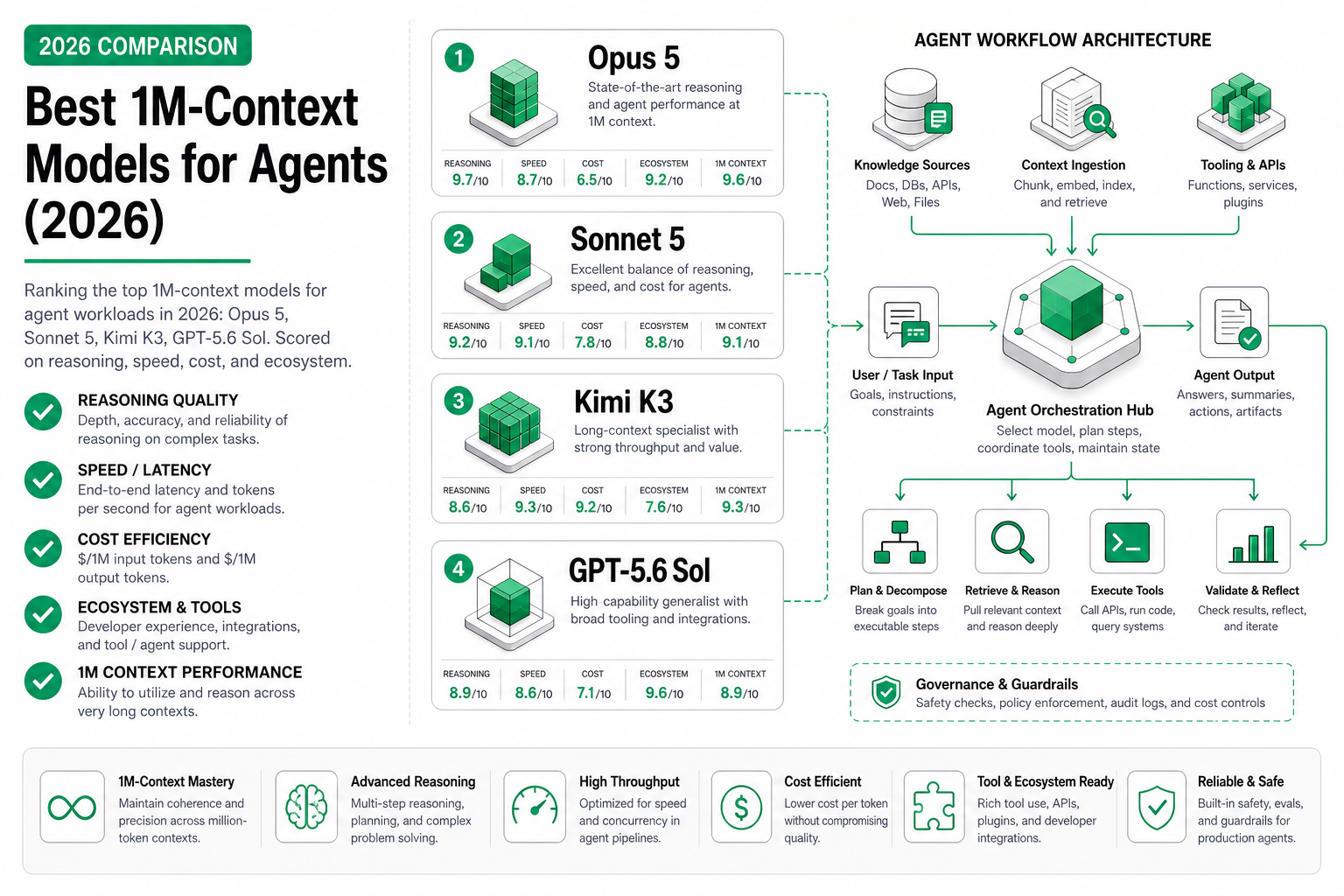
The 1M-context generation has four serious players: Opus 5, Sonnet 5, GPT-5.6 Sol, and Kimi K3. Each occupies a different point on the capability-cost-speed frontier.
K3’s position: fastest and cheapest of the four, with capability that’s 80-90% of Sonnet 5 for most tasks. It won’t replace Opus 5 for problems that demand the deepest reasoning. But for the vast majority of agent workloads — where “good enough, fast, and cheap” beats “perfect but expensive and slow” — K3 is the rational default.
For a detailed breakdown of pricing across all these models, see our LLM API pricing guide.
FAQ
Is Kimi K3 suitable for production agent workloads?
Yes, with caveats. K3 handles standard agent patterns (tool calling, multi-turn conversation, structured output) reliably. The main production concern is lower instruction-following precision on complex schemas — build retry logic and validation layers. For high-volume, cost-sensitive workloads, it’s production-ready.
How does K3’s 1M context compare to Opus 5’s 1M context?
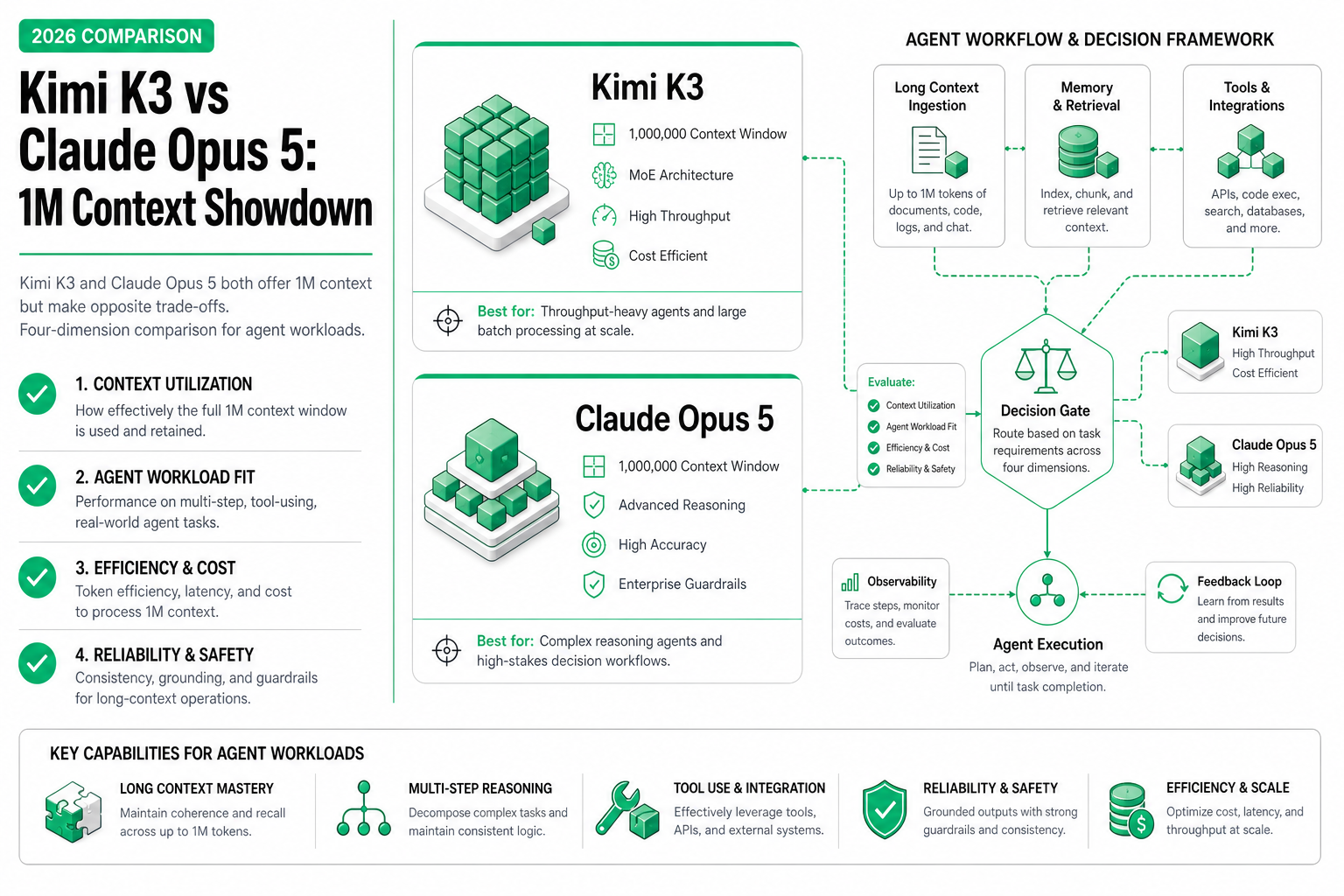
Both support 1M tokens, but they differ in what they do with that context. K3 excels at retrieval — finding specific information across long documents. Opus 5 excels at reasoning over the full context — synthesizing insights from information spread across the entire window. For search-style tasks, K3 matches Opus 5. For analysis tasks, Opus 5 leads.
Can I use K3 as a drop-in replacement for Claude Sonnet 5?
For 70-80% of agent tasks, yes. The API format is compatible through SandBase’s unified endpoint. The main differences: K3 has lower instruction-following precision on complex schemas, occasionally different formatting defaults, and different content policy boundaries. Test with your specific prompts before migrating production traffic.
What languages does K3 support well?
English and Chinese are first-class. K3 also handles Japanese, Korean, French, German, and Spanish at high quality. For less common languages, quality drops faster than with GPT-5.6 which has broader multilingual training data.
Is K3 open-weight or proprietary?
Proprietary. Moonshot AI offers K3 only through their API (or through aggregators like SandBase). Unlike their earlier Kimi K2 release which had an open-weight variant, K3 is closed-source.
Related Reading
- Kimi K3 vs Claude Opus 5: 1M Context Showdown
- Kimi K2.6 for Agents: Trillion-Param Open Weights, Tested
- Best 1M-Context Models for Agents (2026)
- DeepSeek V4: 1M Context Open-Source LLM for Agents (2026)
- Claude Opus 5: What 1M Context Changes for Agents
- Best Open-Weight LLMs for AI Agents in 2026 (Compared)