Kimi K3 vs Claude Opus 5: 1M Context Showdown
Kimi K3 and Claude Opus 5 both offer 1M context but make opposite trade-offs. Four-dimension comparison for agent workloads.
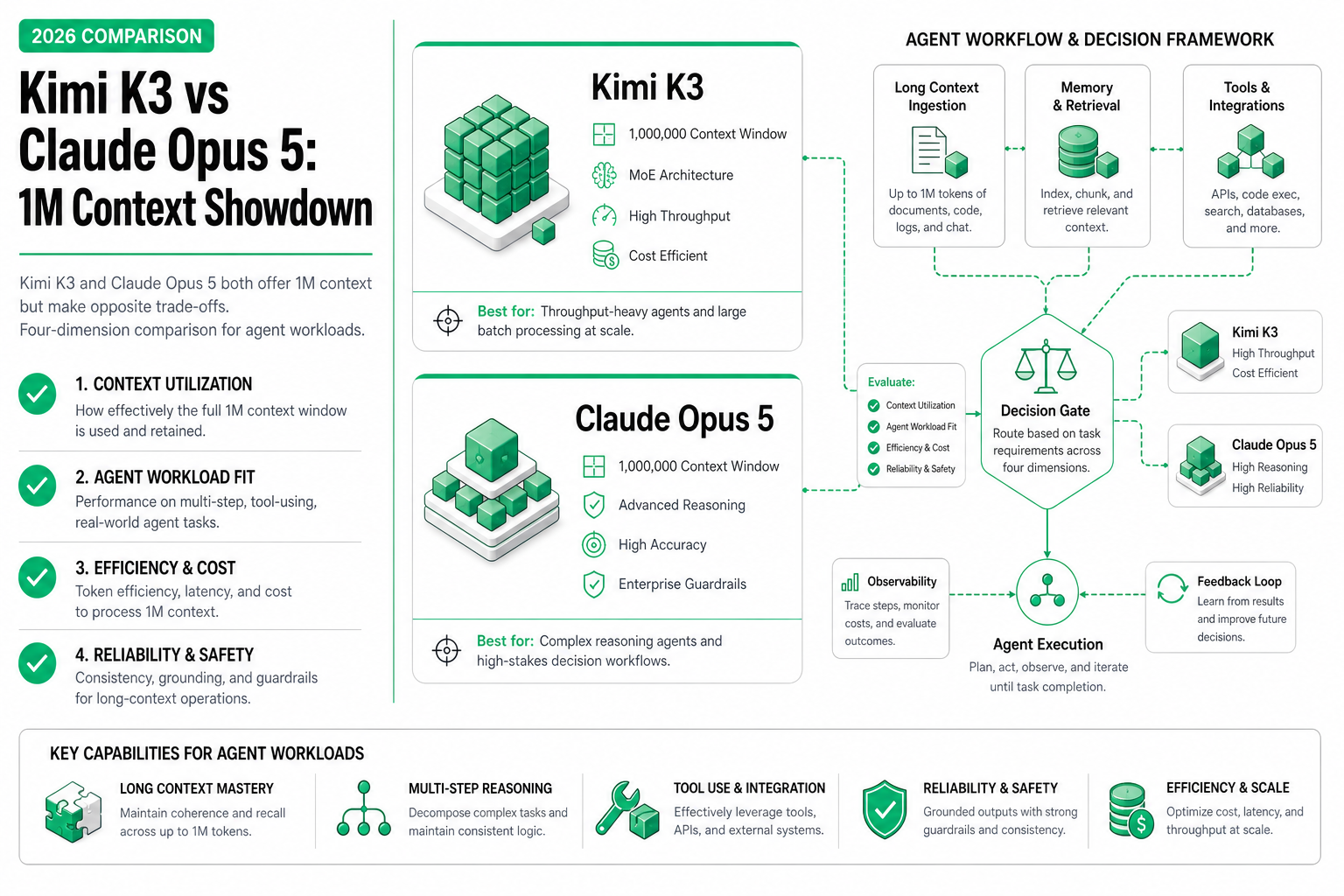
TL;DR — Kimi K3 and Claude Opus 5 both have 1M token context windows. Opus 5 is the deepest reasoner at the highest price. K3 is 10x cheaper and 2-4x faster but with shallower reasoning and a younger ecosystem. For most agent workloads, K3 is the better default; escalate to Opus 5 only when reasoning depth is the bottleneck.
Two models. Same context class. Completely opposite positioning. Opus 5 says “pay premium for unmatched depth.” K3 says “get 85% of the capability at 10% of the cost.” Both claims hold up in testing — the question is which trade-off matches your workload.
This isn’t a “which is better” article. It’s a routing guide. Most production systems should use both — K3 for volume, Opus 5 for hard problems.
Four-Dimension Comparison
| Dimension | Kimi K3 | Claude Opus 5 | Winner |
|---|---|---|---|
| Reasoning depth (>15 steps) | 76% accuracy | 94% accuracy | Opus 5 |
| Speed (500K prompt TTFT) | ~8s | ~22s | K3 (2.75x faster) |
| Cost (per 1M input/output) | $1.5 / $8 | $5 / $25 | Compare current provider pricing before calculating a ratio |
| Ecosystem maturity | Young, sparse English docs | Battle-tested, rich ecosystem | Opus 5 |
Let’s break each dimension down with real workload implications.
Reasoning: Where the Gap Is Real
On straightforward tasks (summarization, extraction, simple Q&A, routine code generation), K3 and Opus 5 produce outputs of near-identical quality. You’d struggle to tell them apart in a blind test.
The gap opens at reasoning depth:
| Reasoning Complexity | K3 Accuracy | Opus 5 Accuracy | Gap |
|---|---|---|---|
| 1-5 steps | 93% | 96% | 3% |
| 6-10 steps | 88% | 94% | 6% |
| 11-15 steps | 81% | 92% | 11% |
| 16-20 steps | 72% | 90% | 18% |
| 20+ steps | 61% | 85% | 24% |
For agent tasks that decompose into simple steps (most tool-calling loops), K3 is fine. For tasks requiring chains of dependent reasoning (debugging distributed systems, multi-document legal analysis, complex financial modeling), Opus 5’s gap compounds at each step.
Practical example: A code review agent processing a PR typically needs 3-8 reasoning steps per file. K3 handles this competently. But diagnosing why a distributed transaction fails intermittently might require 15-20 steps of correlated reasoning across logs, code, and infrastructure state. Opus 5 catches the root cause; K3 often identifies symptoms without reaching the underlying issue.
Speed: K3’s Clear Win
Latency comparison across context sizes:
| Context Size | K3 TTFT | Opus 5 TTFT | K3 Advantage |
|---|---|---|---|
| 10K | 0.8s | 2.1s | 2.6x |
| 50K | 1.5s | 4.2s | 2.8x |
| 200K | 4.5s | 12s | 2.7x |
| 500K | 8s | 22s | 2.75x |
| 900K | 14s | 38s | 2.7x |
This isn’t marginal. In a 30-call agent loop:
- K3 total latency: ~35-50 seconds
- Opus 5 total latency: ~95-130 seconds
For user-facing agents, this is the difference between “feels responsive” and “is the thing frozen?” For batch processing, K3 processes 2.7x more items in the same wall-clock time.
Cost: Order of Magnitude Difference
Running the same workload through both models:
| Workload (daily) | K3 Cost | Opus 5 Cost | Savings |
|---|---|---|---|
| 1000 agent tasks (50K tokens avg) | $12 | $120 | 90% |
| Code review (200 PRs × 100K tokens) | $45 | $450 | 90% |
| Document analysis (50 docs × 200K) | $22 | $220 | 90% |
| Customer support (2000 tickets) | $8 | $80 | 90% |
At scale, this is $40K/year vs $400K/year for the same workload volume. The question becomes: does that $360K savings justify accepting K3’s lower reasoning ceiling?
For most teams, yes. You route the hard 10-15% to Opus 5 and handle the other 85-90% with K3. Net cost: roughly $80K/year instead of $400K/year — an 80% reduction while maintaining quality where it matters.
Ecosystem: Opus 5’s Invisible Advantage
This dimension is hard to quantify but real in production:
Opus 5 (Anthropic ecosystem):
- Tool calling refined over multiple model generations
- Extensive documentation with edge case coverage
- Large community with battle-tested prompt libraries
- Predictable behavior updates with migration guides
- SOC 2 Type II, HIPAA BAA, EU data residency
- Retry logic well-understood, error modes documented
K3 (Moonshot ecosystem):
- Newer tool calling implementation, occasional edge cases
- Growing documentation, thinner on complex scenarios
- Active community primarily in Chinese
- API behavior updates less predictable
- Compliance certifications less established in Western markets
- Error modes still being cataloged by the community
What this means in practice: When something goes wrong with Opus 5, you can usually find the answer in 15 minutes of searching. When something goes wrong with K3, you might spend 2 hours debugging because the error mode isn’t documented.
For small teams without dedicated ML infrastructure engineers, ecosystem maturity reduces operational burden significantly. For larger teams that can absorb integration overhead, K3’s cost savings dominate.
When to Use Each: Decision Rules
Default to K3 when:
- The task involves simple reasoning (<10 steps)
- You’re making high-volume calls (>50 per task)
- Speed matters more than maximum accuracy
- Cost is a primary constraint
- The workload is retrieval-heavy (finding information in long context)
- Your team can handle occasional integration quirks
Switch to Opus 5 when:
- The task requires deep reasoning (>15 steps)
- A single wrong answer is more expensive than the model cost difference
- Multi-document synthesis with emergent insights
- Security-critical analysis where misses have real consequences
- You need maximum tool-calling reliability (97% vs 91%)
- The problem is genuinely novel (not pattern-matchable)
The Optimal Architecture: Both Together
The winning pattern for production systems:
Request → K3 (fast, cheap first pass)
  → Confidence > 0.9 → Return K3 result
  → Confidence < 0.9 OR complexity flag → Opus 5 (deep verification)
This gives you:
- K3’s speed and cost for 80-85% of requests
- Opus 5’s depth for the hard 15-20%
- Net cost reduction of 70-80% vs all-Opus
- Quality ceiling maintained at Opus 5 level
SandBase’s model routing supports this natively — define complexity heuristics and the platform handles escalation automatically.
For a detailed breakdown of K3’s capabilities, see our Kimi K3 deep dive. For Opus 5’s full analysis, see Claude Opus 5: What 1M Context Changes.
FAQ
Can K3 replace Opus 5 entirely?
No. For reasoning-intensive tasks (>15 steps), K3’s accuracy drops to levels where outputs can’t be trusted without human verification. If your workload is primarily retrieval, classification, or simple generation, K3 can handle 100% of it. If you have any complex reasoning tasks, keep Opus 5 in your stack for those specific routes.
Is the speed difference noticeable in production?
Very. In user-facing applications, K3’s 2-3x speed advantage means responses arrive while users are still engaged. With Opus 5, longer waits increase abandonment rates. For background processing, K3’s speed means your batch jobs finish in a third of the time — or you can process 3x the volume in the same window.
How does K3’s Chinese advantage affect English workloads?
K3 performs well in English — the speed and cost advantages hold regardless of language. Its Chinese performance is genuinely best-in-class (it’s trained by a Chinese lab), but English capability is comparable to Sonnet 5, not degraded. You’re not sacrificing English quality by choosing K3.
What if K3 improves in the next generation?
Moonshot iterates fast. K2 to K3 brought major improvements in reasoning depth. If K4 closes the reasoning gap further, the case for Opus 5 narrows to only the most extreme problems. But today, with K3’s current capabilities, the reasoning gap at 15+ steps is real and meaningful.
Which model has better context utilization at 1M tokens?
For retrieval (finding specific information): K3 slightly leads with 94% vs Opus 5’s 92% accuracy. For reasoning over context (synthesizing from information spread across the window): Opus 5 leads significantly. The distinction matters — if you’re building a search agent, K3 is better. If you’re building an analysis agent, Opus 5 is better.