Gemini 4 Carbon Is Now Available: What's Confirmed, What's Still Gated, and What Changed
Gemini 4 Carbon is publicly available as of 11 Nov 2026. Official ID gemini-4-carbon. Google intro is $2/$10 through 30 Nov. SandBase lists it at $4/$20.
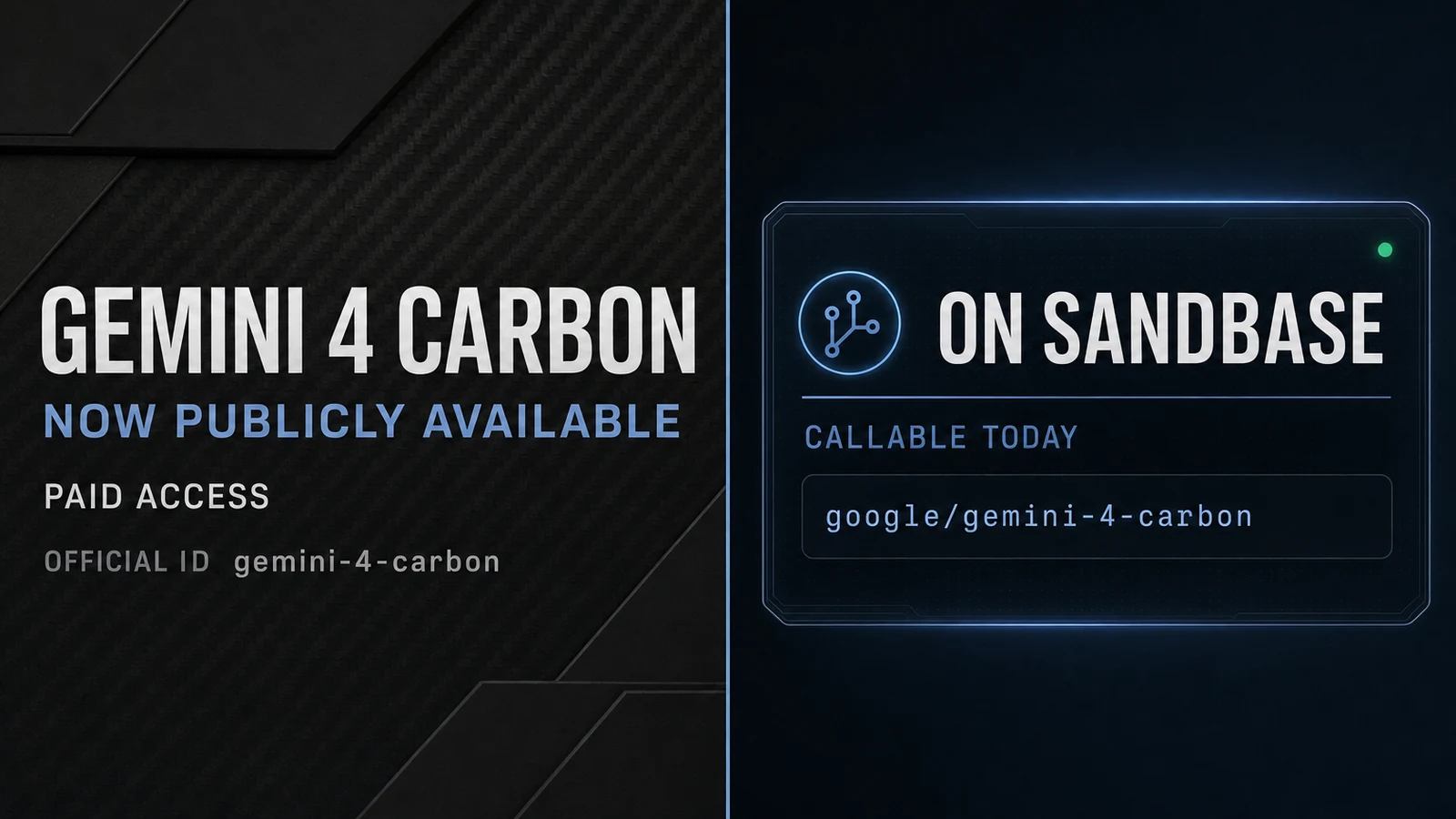
Gemini 4 Carbon is Google’s strongest Gemini 4 model, and paying developers can call the public ID as of 11 November 2026, Asia/Shanghai. The product name has spaces. The public API ID is gemini-4-carbon. It is not on Google’s free tier. Consumer access is Google AI Ultra, not every Gemini app login.
The part that still trips a budget is the clock and the price. Google’s now-available post is datePublished 2026-11-10T16:00:00+00:00, which is 11 November 2026 at 00:00 in Asia/Shanghai. Google’s Developer API Standard intro is $2 per million input tokens and $10 per million output tokens through 30 November 2026, then $4 / $20. Gemini 4 Carbon on SandBase displays $4 / $20 / $0.20 cache read, with no intro discount on the hero. Those are two bills. Do not treat the intro as the SandBase price.
Use the public model for the limit cases Google names: complex multi-step coding and debugging, and open-ended scientific work, when you can pay for more tokens than Argon. Keep Gemini 4 Argon for most software engineering and knowledge work. The Fairwind cyber SKU is a different ID and is still allowlisted.
Key takeaway
- Public paid launch: 10 November 2026, 16:00 UTC, which is 11 November 2026, 00:00 Asia/Shanghai. The 28 October UTC announcement (29 October 01:00 Asia/Shanghai) was Fairwind-only, not this launch.
- Official name: Gemini 4 Carbon. Public API ID:
gemini-4-carbon. Cyber / Fairwind ID:gemini-4-carbon-cyber-permissive. Do not title it Gemini 4 Pro, Gemini 4 Flash, or Gemini-4-Carbon.- Not on the free tier. Paid Gemini API, Google AI Ultra for the consumer surfaces, a scientist application track, and Fairwind for “Carbon for cyber.”
- Same official per-token intro as Argon, and the same 1,048,576-token unified window. Google says Carbon spends more thinking tokens than Argon on hard tasks. Unit price is not task price.
- SandBase model ID
google/gemini-4-carbon, endpointPOST /v1/chat/completions, hero $4 / $20 / $0.20 per million, 1M context, 65.5K max output, hero inputs Text, image, audio. Standard RPM is unpublished. An official Google or DeepMind X launch post was not fetched for this note.
Two dates, not one launch
On 29 October 2026 this blog treated Carbon as announced and not generally callable. That was right for that morning. It is not right today. The 29 October explainer still holds the defensive benchmark framing. Its “no public model ID” sentences are corrected on that page and replaced here.
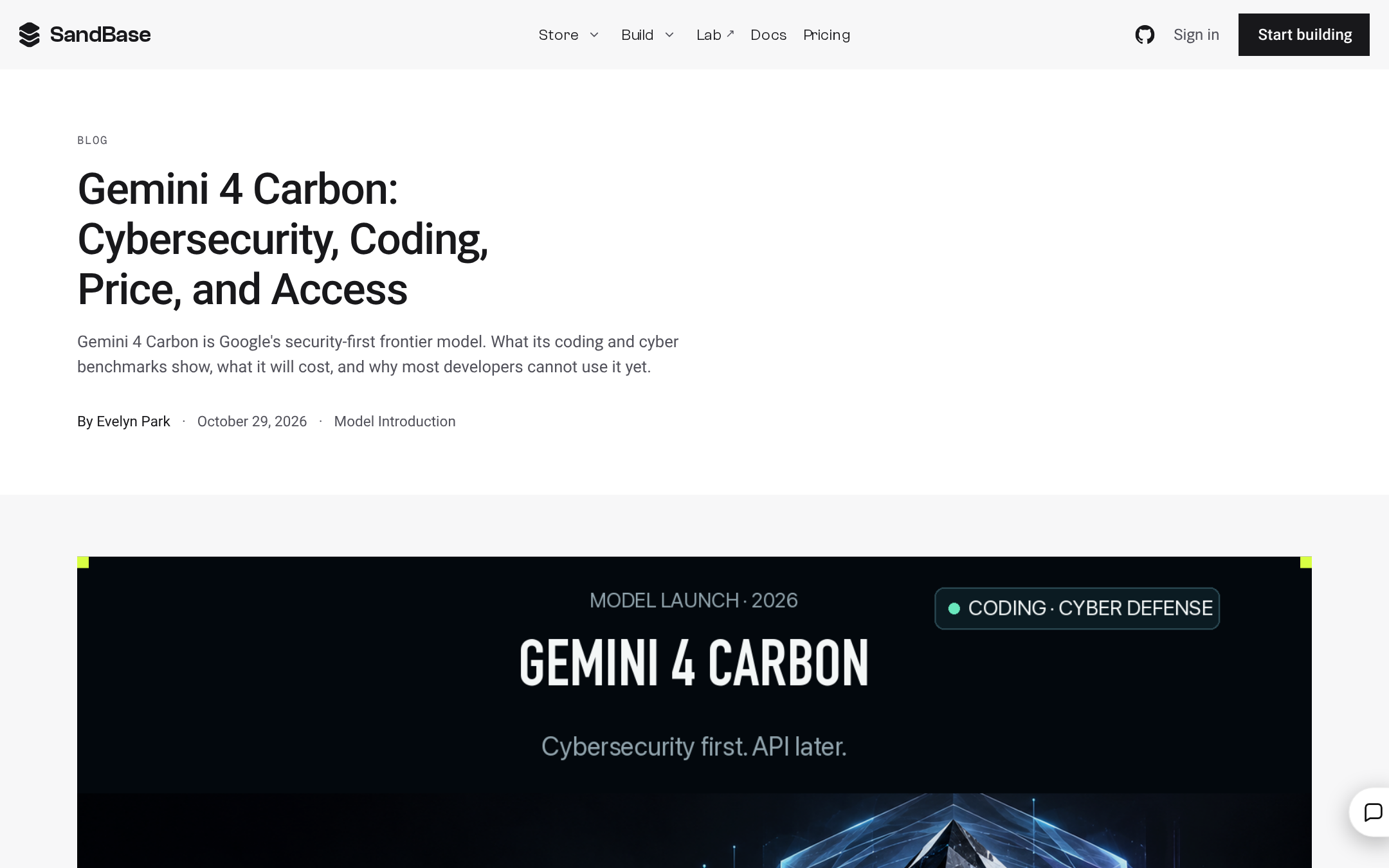
The 29 Oct 2026 SandBase post, captured as a “what we wrote then” callout. That framing is now outdated: a public API ID and paid access exist, and the model is listed on SandBase.
| Clock | What it was | What it was not |
|---|---|---|
| 28 Oct 2026, 17:00 UTC (29 Oct 2026, 01:00 Asia/Shanghai) | Introducing Gemini 4 Carbon. Fairwind cyber-defender access starting that week. Public surfaces “as soon as possible.” | A general developer or consumer launch |
| 10 Nov 2026, 16:00 UTC (11 Nov 2026, 00:00 Asia/Shanghai) | Gemini 4 Carbon is now available. Paid Gemini API, enterprises, scientists, and Google AI Ultra. Companion developers post, same datePublished. | Free tier, or every consumer plan |
| DeepMind card, “Published 10 November 2026” | Model card and the PDF | A SandBase measurement |
SandBase catalog published_at 2026-11-10T16:07:51Z | 11 Nov 2026, 00:07:51 Asia/Shanghai. Card rechecked HTTP 200 at 12:48–12:49 Asia/Shanghai the same day | Proof that Google’s $2 / $10 intro is what SandBase bills |
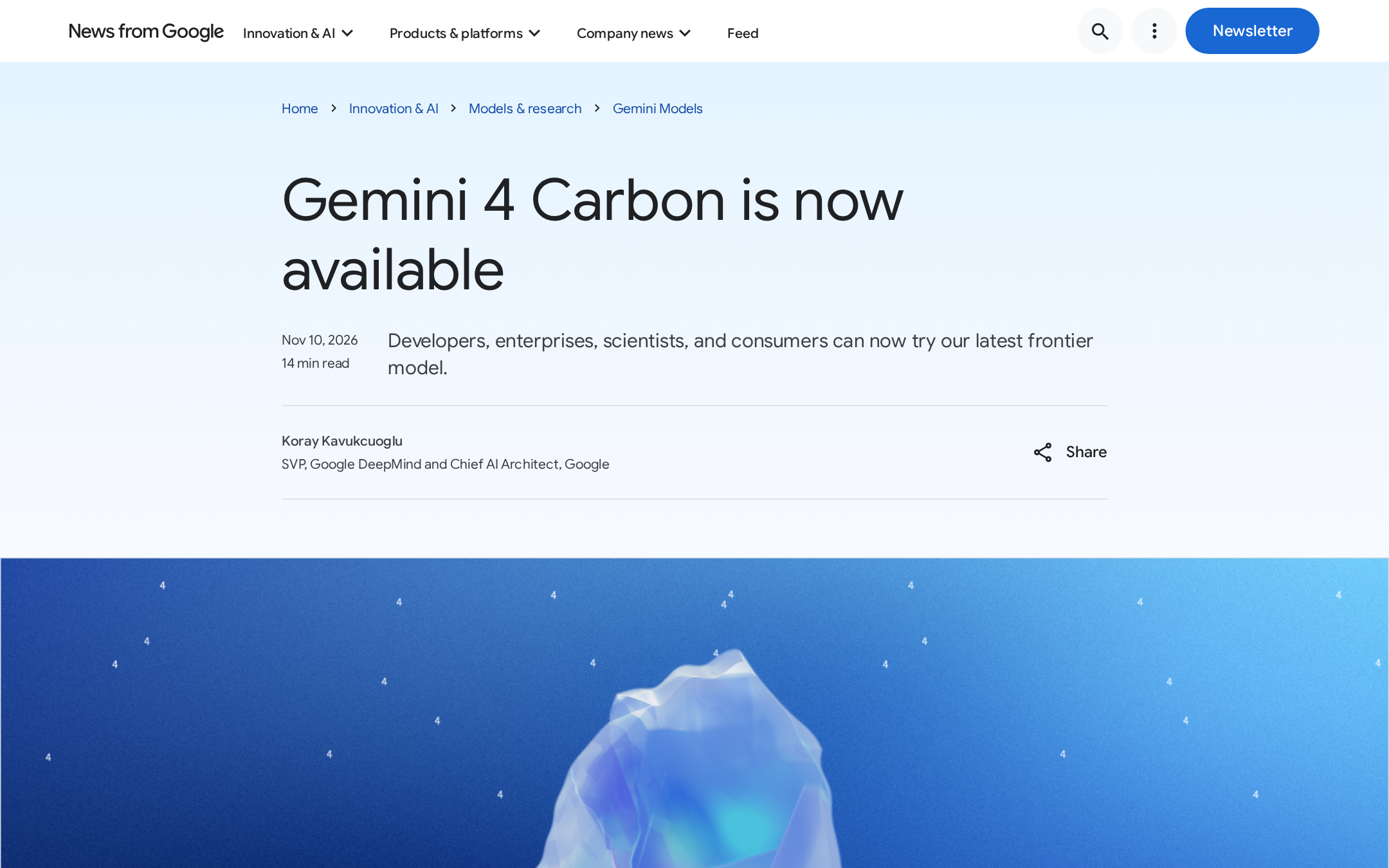
Google’s now-available post, dated Nov 10, 2026 (published 11 Nov 2026 00:00 Asia/Shanghai). Source: blog.google.
The on-page date says Nov 10, 2026. That matches the UTC calendar day of datePublished. If you are reading from China, Korea, or anywhere on UTC+8, the public post crossed midnight into 11 November. I am using the Asia/Shanghai clock for “today” in this note, and I am not going to pretend the English date stamp is a different event.
SandBase’s own card copy says “released on November 10, 2026.” That is the same UTC date. It is not a second launch.
The name, and the ID that is not the name
Google’s models index lists two Gemini 4 API IDs: gemini-4-carbon and gemini-4-argon. There is no official gemini-4, gemini-4-flash, or gemini-4-pro in that table. The marketing name is Gemini 4 Carbon, with spaces. The string gemini-4-carbon is the model code, also shown as the stable version.
The AI Studio model page calls it “our most capable reasoning model, built for complex software engineering, mathematical and scientific problem solving, high factual accuracy, autonomous multi-step agents, and long decode up to 1M tokens.” The DeepMind model card says Gemini 4 Carbon is based on Gemini 4 Argon. Argon itself went public on 14 October 2026, 00:00 Asia/Shanghai (datePublished 2026-10-13T16:00:00+00:00). Background on that rollout is the Argon access note.
The second ID is the one to keep out of a normal client. Gemini Enterprise Agent Platform documents gemini-4-carbon-cyber-permissive (“Gemini 4 Carbon for cyber”) as allowlist / Fairwind only, default thinking level HIGH, computer use not supported, regions global and us only. The public model is a different row. Cyber benchmark leads in the model card are Fairwind-access results. Quoting 88.2% on SEC-bench Pro as if you will see it on google/gemini-4-carbon is the mix-up this page is trying to stop.
Who can use it, and who cannot
Google’s getting-started list on the now-available post, retrieved 11 November 2026:
- Developers. Gemini API paid tier in AI Studio and Android Studio. Google AI Ultra subscribers can also try it in Google Antigravity and AI Studio.
- Enterprises. Gemini for business, via the API or the model dropdown, Google Antigravity, or CodeMender.
- Everyday users. Gemini app and AI Mode in Search, if you are a Google AI Ultra subscriber. Not every consumer plan.
- Scientists and researchers. Apply for Argon and Carbon in Antigravity’s highest usage tier, free of charge for 6 months, onboarded on a rolling basis, subject to eligibility, capacity, and selection.
- Cybersecurity defenders. Apply to the Fairwind Program for Carbon for cyber, rolling. That is the gated SKU, not the public ID.
The pricing page is blunt: “Gemini 4 Carbon is not available on the Free tier.” Every token is billed, including thinking tokens and, when you use grounding, internal tool instructions and function declarations.
Agent Platform adds another gate, in Google’s words: available to verified enterprise customers in select regions, to protect reliability, capacity, and security. Public Carbon regions listed there: global, us, eu. The old cloud.google.com/vertex-ai/.../4-carbon URL redirects to that Agent Platform page. Launch stage on that page: GA, release date November 10, 2026. A guessed Cloud Blog URL for a “now on Google Cloud” post returned a Google 404 during research. It is not a source.
Antigravity /swarm is a preview that turns one prompt into a coordinated team of agents. It is an Antigravity product surface. It is not a SandBase feature, and this note does not document a SandBase swarm parameter.
What changed versus Argon
Google’s own split, from the now-available post: “Argon remains the ideal choice for the majority of software engineering and knowledge work, while Carbon is built for tasks that test the limits of a model’s intelligence like complex, multi-step coding and debugging and open-ended scientific research and discovery — using more tokens than Argon to explore thoroughly, reason deeply, and run extended verification loops.”
I would route from that sentence, not from the leaderboard headline. Same per-token intro price, more tokens on the hard turn, is a more expensive task. The routing note puts Argon, GPT-6 Astra, and Claude Opus 5.5 next to this card. The try-today note is the SandBase call.
| Topic | Public Gemini 4 Carbon | Versus Argon, from Google’s docs |
|---|---|---|
| Context | Unified input plus output window of 1,048,576 tokens | Same 1M pattern. “What’s new” says long decode up to 1M tokens, minus input |
| Default synchronous output | 65,536 tokens | SandBase’s hero prints this as 65.5K. Do not assume the SandBase card exposes the 1M long-decode path |
| Thinking | low, medium (default on gemini-4-carbon), high. thinking_budget or thinking_level="MINIMAL" returns HTTP 400 on Agent Platform | Carbon spends more thinking tokens per turn than Argon on complex tasks. Argon is the lower token spend |
| Inputs, Google docs | Text, image, video, audio, PDF. Output is text | SandBase hero chips are Text, image, audio. The card body and .md also say video and PDF. There is no hero video chip |
| Knowledge cutoff | March 2026, model card and the Cloud page | Published. The 29 October post was right to say it was unpublished then |
| Caching | Implicit only, 4,096-token minimum. Explicit cachedContents is not supported. Cached input is 95% off the input price | Same restriction family as Argon |
| Sampling | Custom temperature, top_p, and top_k are ignored. Agent Platform defaults are fixed: temperature 1.0, topP 0.95, topK 64 | Migration note from Gemini 3: remove these parameters |
| Not supported | Audio generation, image generation, Live API | Computer use is documented for public Carbon and not for the cyber SKU |
| Tools Google lists | Code execution, function calling, file search, Search and Maps grounding, structured outputs, URL context, agentic video understanding (defaults to static), Batch, Flex, Priority | These are Google API capabilities. The SandBase card documents chat, vision, audio input, reasoning, structured output, and function calling. I am not copying the rest into a SandBase payload |
The now-available post also says Carbon is number one on CursorBench 4.0, Perplexity WANDR, and Zapier AutomationBench “at more than 2X lower cost per task compared to the next best external model.” That is Google’s marketing sentence. It is not a SandBase measurement, and I did not rerun those benches.
Selected scores from the DeepMind model card table, results “as of October 2026,” Google-reported only:
| Benchmark | Carbon | Argon |
|---|---|---|
| AA Index v5.0 | 59 | 50 |
| Terminal-Bench 4.0 (AA) | 65.2% | 57.1% |
| GraphWalks 256k–1M BFS F1 | 96.2% | 84.2% |
| SEC-bench Pro | 88.2% | 83.4% |
| ExploitGym | 54.8% | 42.0% |
| CWE-bench | 71.0% | 68.0% |
SEC-bench Pro, ExploitGym, and CWE-bench are the rows the model card ties to Fairwind access. They are names of defensive benchmarks, not a procedure. This page does not describe how to reproduce an exploit. Gray Swan indirect prompt injection at 0% attack success, and 92% on a 375-task agentic honesty benchmark versus 70% for Argon, are also Google’s numbers from the now-available post. A zero in one harness is not a claim that prompt injection is solved.
Official DeepMind model card landing page, published 10 November 2026. Source: deepmind.google.
Google’s price, which is not the SandBase hero
Developer API source: pricing, section #gemini-4-carbon, fetched 11 November 2026. Introductory window through 30 November 2026. Standard rates from 1 December 2026. Output prices include thinking tokens.
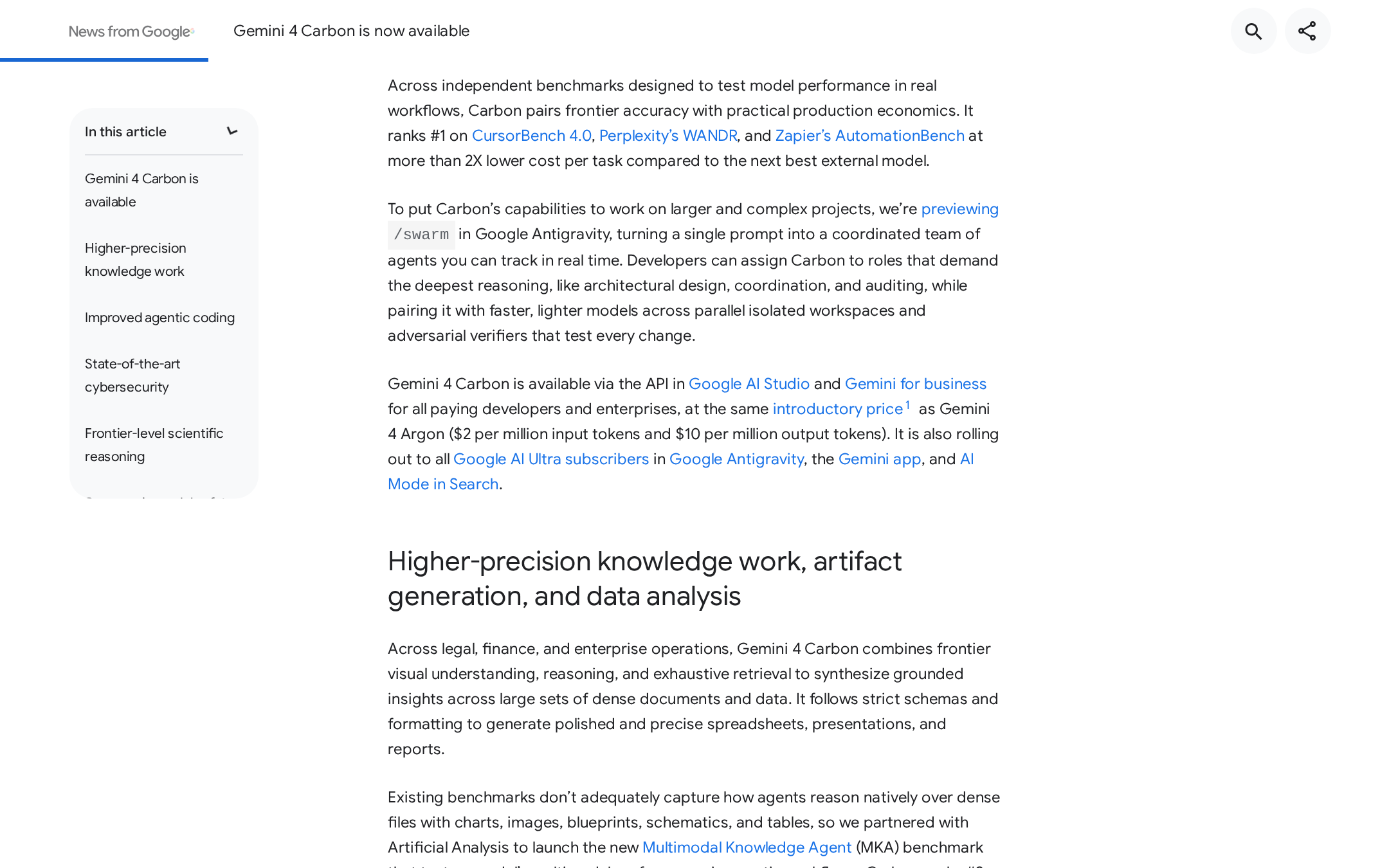
Official body copy for the Google Developer API introductory unit price ($2 / $10). This is Google’s list, not the SandBase card price. Source: the same now-available post.
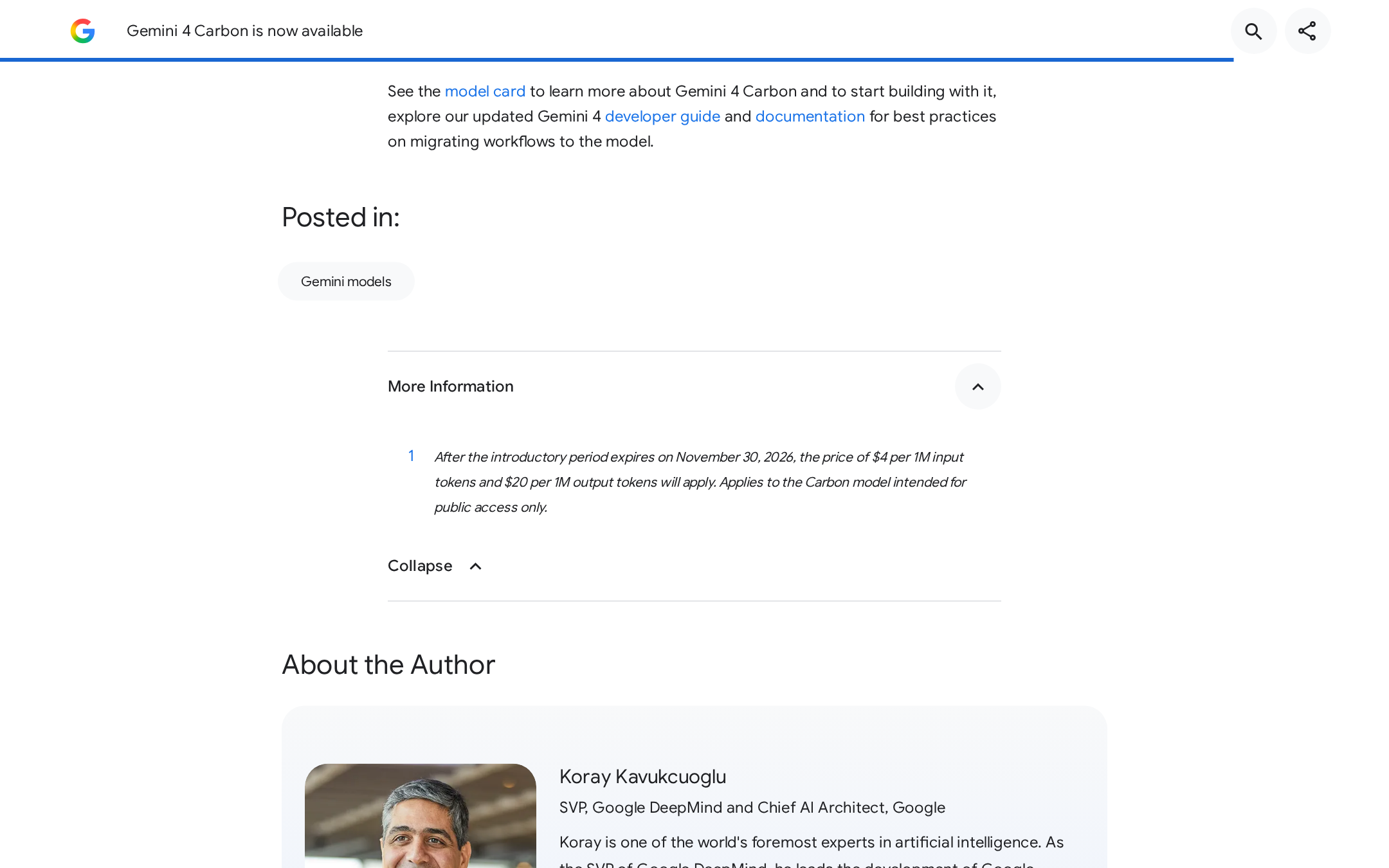
Official footnote 1, expanded from the “More Information” accordion on the now-available post. Source: blog.google.
The footnote is specific: after 30 November 2026, $4 per 1M input and $20 per 1M output “will apply. Applies to the Carbon model intended for public access only.” The cyber SKU is outside that sentence.
| Developer API tier | Input / 1M | Output / 1M (includes thinking) | Cached input / 1M | From 1 Dec 2026, input / output / cached |
|---|---|---|---|---|
| Standard, through 30 Nov 2026 | $2.00 | $10.00 | $0.10 | $4.00 / $20.00 / $0.20 |
| Batch, through 30 Nov 2026 | $1.00 | $5.00 | $0.05 | $2.00 / $10.00 / $0.10 |
| Flex, through 30 Nov 2026 | $1.00 | $5.00 | $0.05 | $2.00 / $10.00 / $0.10 |
| Priority, through 30 Nov 2026 | $3.60 | $18.00 | $0.18 | $7.20 / $36.00 / $0.36 |
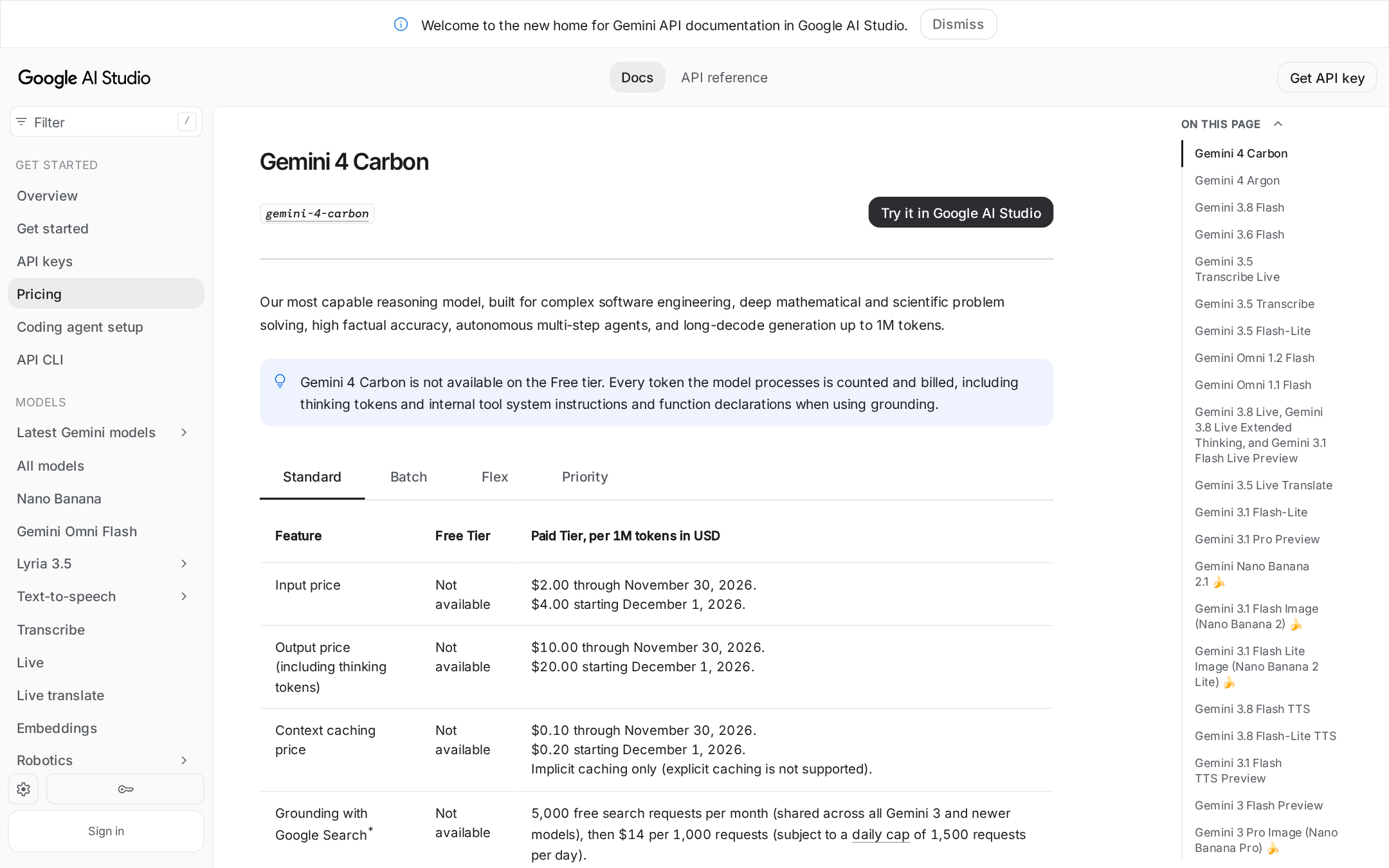
Live Gemini Developer API Standard table for Gemini 4 Carbon, captured from aistudio.google.com/docs/pricing#gemini-4-carbon. Official intro unit prices, not SandBase’s card.
The screenshot is the Standard tab. Batch, Flex, and Priority are from the same official pricing page on 11 November 2026, not from that one crop. Argon’s Standard, Batch, Flex, and Priority unit prices match Carbon on that page. Argon also has an invite-only Contributor tab that was not in the Carbon section this turn.
Cached input at 95% off is $0.10 while input is $2, and $0.20 while input is $4. That arithmetic matches the table. It is still implicit caching only.
Grounding, on the Standard and Priority tabs: 5,000 free Google Search requests per month, shared across Gemini 3 and newer models, then $14 per 1,000 requests, daily cap 1,500. Google Maps: 5,000 free per month, shared, then $14 per 1,000 queries. “Used to improve our products: No” on these paid tabs.
A worked example, arithmetic only, not a measured Carbon job. 100,000 uncached input tokens and 10,000 output tokens:
- Google Standard intro: $0.20 input + $0.10 output = $0.30
- Google Standard from 1 December, and the SandBase hero rate: $0.40 input + $0.20 output = $0.60
If the 10,000 output tokens include thinking, you do not add thinking again. If a real agent turn thinks for far more than 10,000 tokens, this example understates the bill. That is the trap in “same price as Argon.”
Agent Platform has its own price page. Tab labels did not survive HTML parsing cleanly during research, and this package does not include a crop of those rows, so I am not publishing inferred Global versus non-global blocks as if I had confirmed the tab names. Use the Developer API table above for the public unit prices, and read the Cloud page before you budget a non-global enterprise deployment. A footnote there says promotional credits do not apply to Gemini 4 Argon Cyber Permissive or Gemini 4 Carbon Cyber Permissive.
What SandBase lists today
Rechecked 11 November 2026, 12:48–12:49 Asia/Shanghai, then again while writing (HTML and the card markdown).
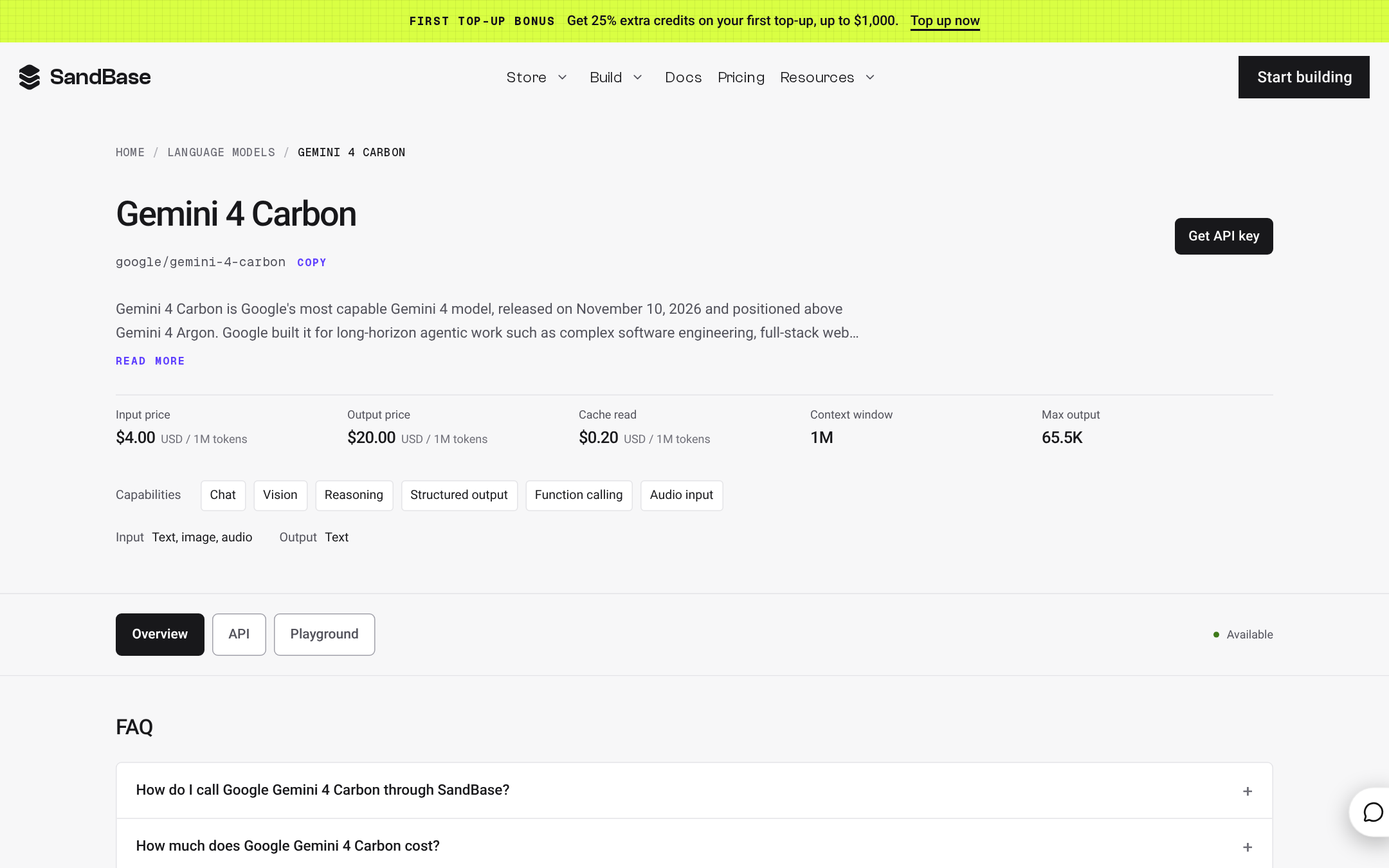
Live SandBase card at /models/google/gemini-4-carbon (HTTP 200). Hero list is $4 / $20 / $0.20 per 1M with no discount. Do not treat Google’s $2 / $10 intro as the SandBase price.
| SandBase fact | On the card |
|---|---|
| Model ID | google/gemini-4-carbon |
| Endpoint | POST https://api.sandbase.ai/v1/chat/completions |
| Hero price | $4.00 input, $20.00 output, $0.20 cache read, per 1M. No discount badge |
| Context / max output | 1M / 65.5K |
| Hero input chips | Text, image, audio. Hero output: Text |
Body and .md | Also say text, image, video, audio, and PDF. Capabilities listed on the hero include chat, vision, reasoning, structured output, function calling, and audio input |
| Request example | model, messages, max_tokens. The string thinking_level does not appear in the card HTML |
The FAQ matches the hero: “$4 per 1M input tokens and $20 per 1M output tokens, billed per request from your SandBase balance. Discounts, when available, are shown in the pricing on this page.” None are shown. An October Argon pricing post on this blog still describes a 50% SandBase discount at $2 / $10. The Argon card opened 11 November 2026 shows $4 / $20 / $0.20 and no discount badge, same unit prices as Carbon. Budget from the card you are about to call, not from that older post. The Argon pricing guide is the history of the discount, not today’s hero.
/v1/run is the media route. This is a language model. Do not send Carbon there.
For a cheaper Google loop that is already on SandBase, Gemini 3.8 Flash showed a 15% badge on 11 November 2026: hero $1.27 / $6.38 against a struck list of $1.50 / $7.50, cache read $0.13 against $0.15, 1M context, 65.5K max output. It is a different generation. It is the right diversion when Carbon’s token spend is the problem and Argon is still more model than the task needs.
Confirmed, and still unknown
| Item | Status on 11 Nov 2026 |
|---|---|
| Public name, public ID, model card, 1M window, 65,536 default output, March 2026 cutoff, intro end date 30 Nov 2026 | Confirmed, Google first-party |
| Paid launch versus free tier versus Ultra versus Fairwind | Confirmed. Free tier: no. Ultra: consumer yes. Fairwind: separate SKU |
| SandBase listing, ID, endpoint, hero $4 / $20 / $0.20 | Confirmed on the live card. Not Google’s intro price |
| Standard RPM, TPM, and RPD as a fixed public table | Unknown. Rate limits say they depend on usage tier and are viewed in AI Studio. “Specified rate limits are not guaranteed.” |
| Spend-based cap per 10 minutes | Confirmed as a cap, not a throughput promise: Tier 1 $10, Tier 2 $200, Tier 3 $200. Priority inference is 0.3x the standard limit. Carbon is not on the free tier, so there is no free-tier cap to quote |
| Batch enqueued tokens | Confirmed: Tier 1 5,000,000; Tier 2 500,000,000; Tier 3 1,000,000,000. Concurrent batch requests 100. Input file 2 GB. Storage 20 GB. Same figures as Argon |
| Official Google or DeepMind X launch post | Unknown. Web search during research did not return a post we fetched. This note does not claim Google did or did not tweet |
| SandBase eval of Carbon versus Argon on your repo | Unknown. One tiny chat completion is in the try-today note. It is not a coding benchmark |
| Cyber SKU on SandBase | Not listed. Do not invent /models/google/gemini-4-carbon-cyber-permissive |
FAQ
Is Gemini 4 Carbon available?
Yes, as a paid public model, as of 11 November 2026, 00:00 Asia/Shanghai. It is not on the Gemini API free tier. The Gemini app and AI Mode in Search require Google AI Ultra. Fairwind “Carbon for cyber” is still an application.
What is the API model ID?
gemini-4-carbon on Google’s Developer API. google/gemini-4-carbon on SandBase. gemini-4-carbon-cyber-permissive is the allowlisted cyber ID, not a drop-in replacement.
How much does it cost?
On Google’s Developer API Standard tier, $2 / $10 per million through 30 November 2026, then $4 / $20. Cached input is $0.10 then $0.20. On SandBase, the card opened 11 November 2026 shows $4 / $20 / $0.20 with no discount. SandBase is not billing the intro.
Is the context window 1M tokens?
Google documents a unified 1,048,576-token window, and up to 1,048,576 output tokens with long decode, minus input. The SandBase hero shows 1M context and 65.5K max output. Plan SandBase requests against 65.5K unless a later card says otherwise.
Did Google announce it on X?
Not established here. No official X post was fetched for this piece. Absence from one search is not proof that no post exists.
Where to go next
The limit-case route, the daily Gemini 4 route, and the cheaper loop are three different cards: Gemini 4 Carbon, Gemini 4 Argon, and Gemini 3.8 Flash.
Read how to route Carbon against Argon, Astra, and Opus 5.5 before you change a production default. Read the call you can make today before you invent request fields. The October comparison of Argon with Opus 5.5 and Astra is here. Its prices are from October. Use today’s cards.
Sources checked 11 November 2026, Asia/Shanghai: Google’s now-available post, the 28 October introducing post, the developers post, AI Studio model and pricing pages, the DeepMind model card, the Agent Platform model page, Fairwind, and the live SandBase card plus its markdown. Press coverage was not used for names, IDs, or prices.
For newer execution and preview choices, see Gemini 4 Hydrogen and Qwen4-Max-Preview access limits. These are separate models with different access conditions.
Found this useful? Share it