Gemini 4 Hydrogen: Pricing, Agent Workflows, and When to Switch
Gemini 4 Hydrogen is available. Read the official pricing, the Carbon/Hydrogen workflow split, and a practical evaluation plan before switching.
A coding agent can spend most of its time executing an already sensible plan: reading files, making a narrow edit, running tests, and explaining a failure. Paying for the deepest reasoning on every step is a choice worth revisiting. Gemini 4 Hydrogen, announced by Google on November 12, 2026, targets this execution-heavy work. It is worth evaluating as an everyday worker, but the announcement alone does not justify replacing a model that already passes your production tests.
Key takeaway
- Google has officially released Gemini 4 Hydrogen; this is no longer a release-watch topic.
- Official input/output pricing is $1.50/$7.50 per million tokens, with flat rates across the 1M-token context window.
- Google positions Hydrogen for fast coding and agent execution, including cooperation with Carbon and Argon.
- SandBase catalog checks on November 13 did not find an exact Hydrogen listing. Official availability and SandBase availability are separate.
This is a document-based launch analysis, not a hands-on benchmark. Sources were checked on November 13, 2026; no latency or task-success measurements below are presented as our own.
What changed with Hydrogen?
The Google launch announcement makes the product distinction useful: Hydrogen is meant for rapid execution, while Carbon and Argon remain options for difficult, extended reasoning. Google also introduces an Orchestrator in Antigravity that switches models within a session. Those are provider descriptions, not evidence that the same orchestration exists in every API client.
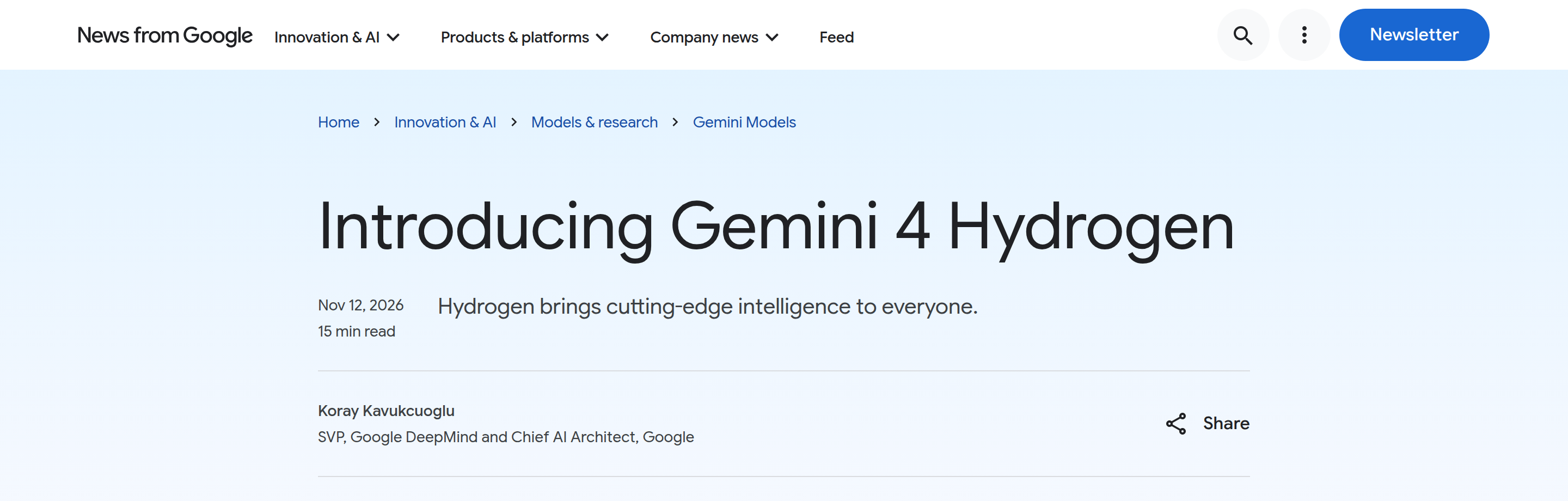 Google’s announcement, captured November 13: evidence of the named release and its positioning, not an independent performance test.
The architectural implication for an application is straightforward. A planner can produce a bounded task with an explicit completion condition, and an execution model can carry it out. The application still owns the handoff. A model name does not automatically provide shared state, conflict resolution, or a trustworthy verification step.
For example, ask a worker to repair one pagination bug and return the modified files, tests run, and remaining uncertainty. Do not hand it an ambiguous instruction to “finish the migration” and then measure only how quickly it stops. A faster answer to the wrong task is not a useful efficiency gain.
The specifications that matter first
| Item | Officially documented position |
|---|---|
| Provider | Google DeepMind |
| Announcement | November 12, 2026 |
| Context | 1 million tokens |
| Thinking levels | Low, medium, high by default, and xhigh |
| Availability | Gemini API and AI Studio, plus Google’s announced product rollouts |
| Weights | This review did not identify a downloadable open-weight release |
| SandBase route | Exact Hydrogen listing not found in the November 13 catalog check |
The Gemini family page puts Hydrogen alongside Carbon and Argon. That helps establish the family relationship. It does not mean the models have interchangeable limits or identical behavior under the same prompt.
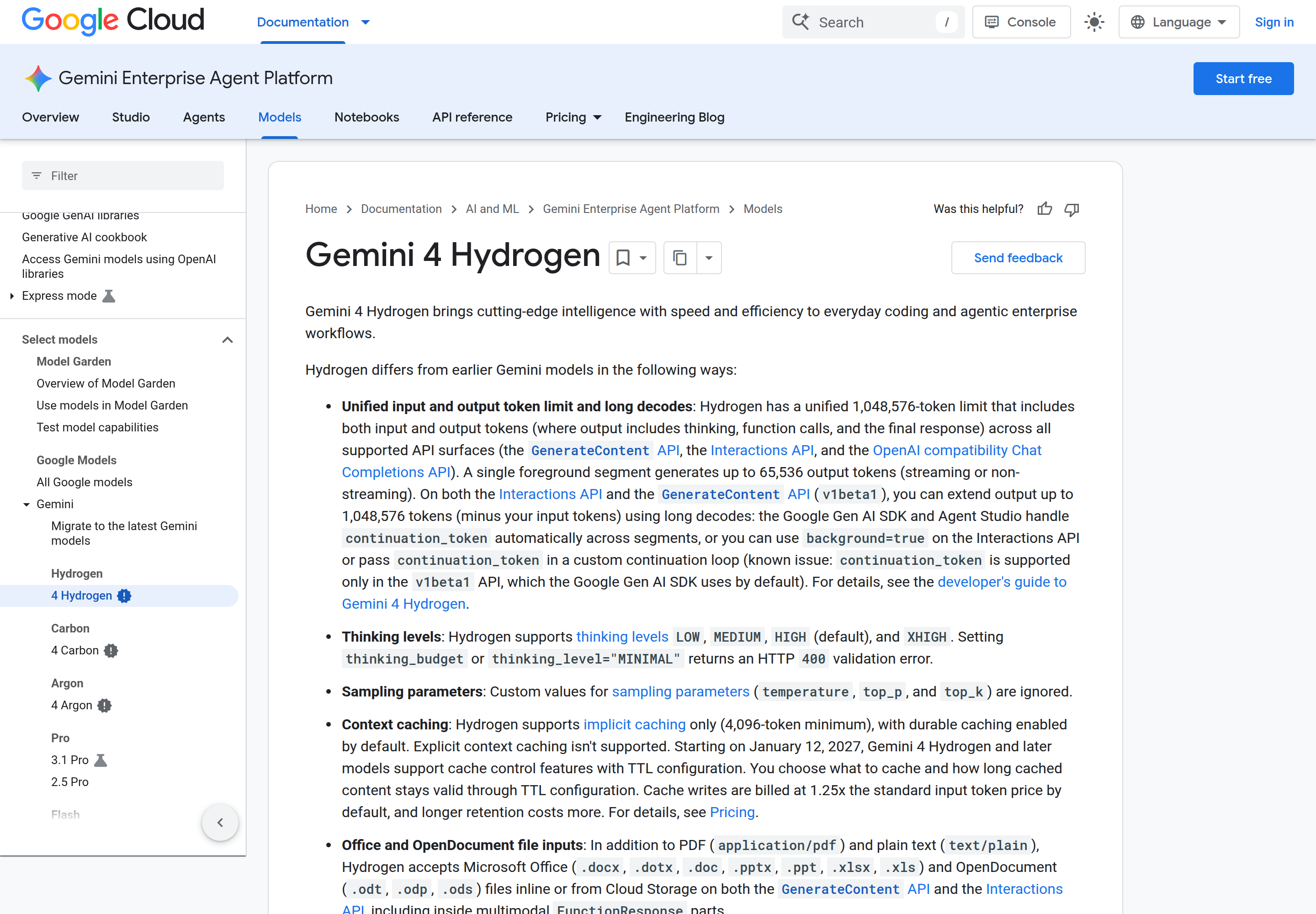 Google Cloud’s model documentation, captured November 13. It is the source for the request and output limits discussed below.
Keep the context limit separate from the size of a useful prompt. A million-token allowance makes some repository or document tasks possible, but irrelevant history still makes an experiment harder to diagnose. Start with the files and constraints needed for the task; increase context only when the omitted evidence explains a failure.
Migration limits worth checking before the first experiment
The Google Cloud model reference identifies gemini-4-hydrogen and describes a unified 1,048,576-token input/output budget. It includes thinking and function calls. Do not interpret the headline window as a million input tokens plus an independent million-token answer allowance.
Ordinary foreground output segments stop at 65,536 tokens on the documented surface. Longer generation requires the continuation handling described there. An application producing a large document must handle partial progress and completion explicitly rather than treating a single response as an unlimited artifact container.
The same reference documents text, image, audio, and video input with text output. It also warns against copying older controls blindly: thinking_budget and MINIMAL are invalid, while custom temperature, top-p, and top-k values are ignored. Supported interfaces include GenerateContent, Interactions, and Chat Completions compatibility; Live API and tuning are not supported.
These differences give the migration test concrete targets. Confirm the adapter sends supported thinking settings, records the actual stop reason, and correctly handles a long response. If a control is ignored, changing it is not a meaningful experimental variable. Keep the exact service surface in the test report, because account access and client behavior are separate from the base model’s documented capabilities.
Pricing: calculate a workload, not just a token rate
Google’s published rates are $1.50 input and $7.50 output per million tokens. Those are Google’s rates, not a quote for a SandBase Hydrogen route.
Consider a hypothetical request with 50,000 billable input tokens and 5,000 billable output tokens, with no cache or other charges:
50,000 / 1,000,000 × $1.50 + 5,000 / 1,000,000 × $7.50 = $0.1125
That is arithmetic, not a measured average coding-task cost. A task may need multiple requests, retries, tool services, and review. The final visible answer may also be shorter than the billable output reported by the service. Use actual usage records when reconciling invoices.
| Budget component | What to record |
|---|---|
| Model calls | Billable input/output for every attempt |
| Tools | Search, execution, storage, and other service charges |
| Recovery | Failed attempts and retry volume |
| Review | Human corrections needed before accepting the result |
A model with a lower token rate can still be more expensive per accepted change if it loops, repeats searches, or produces patches requiring substantial repair. The important denominator is a completed task that meets the same acceptance criteria.
Hydrogen, Carbon, or the model you already use?
| Situation | Sensible starting point | What could change the decision |
|---|---|---|
| Repeated, bounded coding steps | Evaluate Hydrogen | Tool errors or excessive retries |
| A difficult architectural decision | Retain the proven reasoning model | Hydrogen passes the same decision review |
| Existing Flash-based workflow | Replay representative tasks on Hydrogen | Regression in schema or tool behavior |
| Need a confirmed SandBase route today | Inspect the current Carbon listing | An exact Hydrogen card and documented route appear |
This table is an evaluation recommendation, not a measured model ranking. For the existing family context, read our Carbon release and access guide.
On SandBase, the currently relevant destination is the Gemini 4 Carbon model card. Carbon is a different model; its price and endpoint details must not be presented as Hydrogen’s.
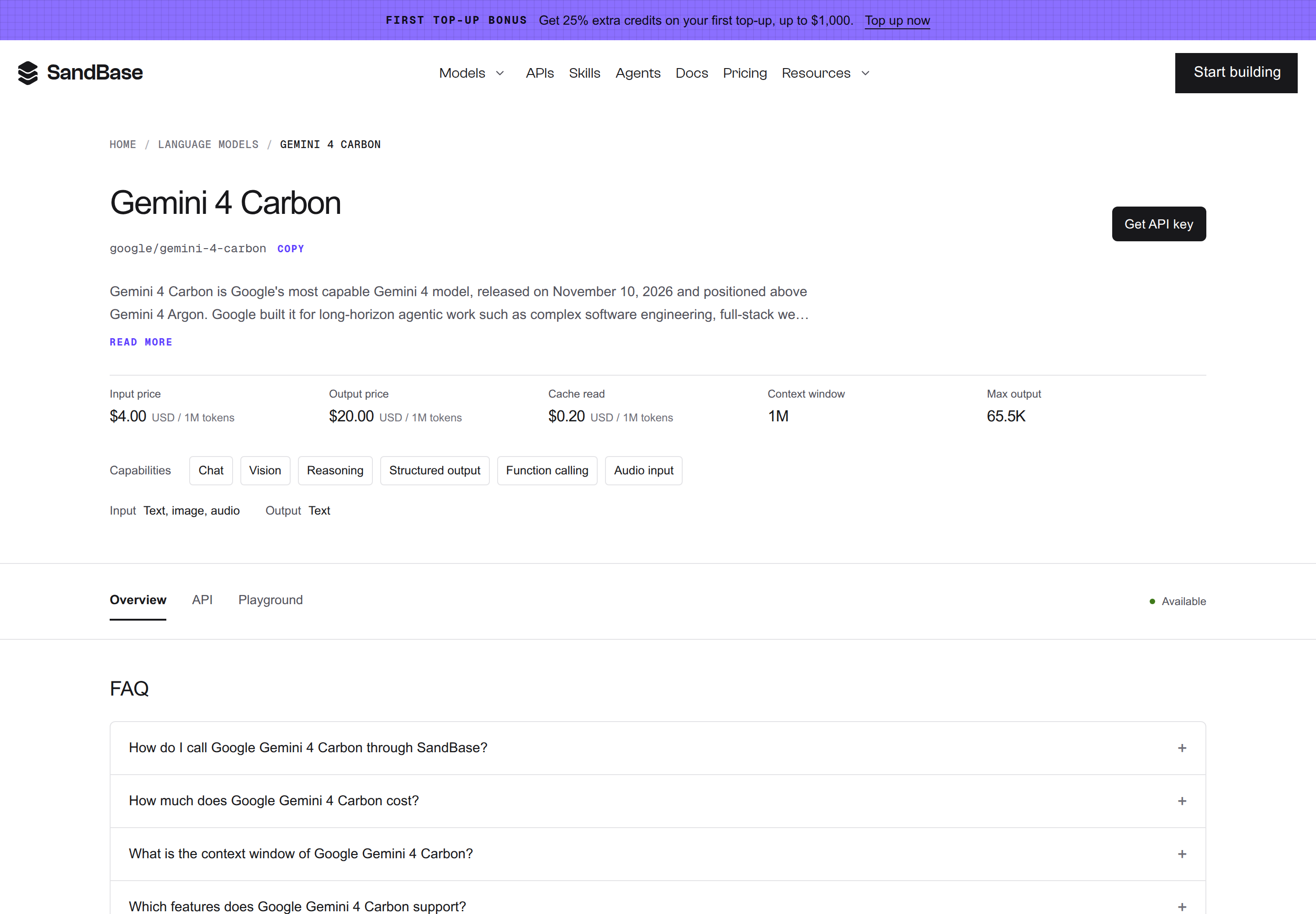 The Carbon card captured November 13 is an existing alternative. It does not demonstrate Hydrogen availability or validate a Hydrogen request.
A small migration experiment that can answer a real question
Pick a set of recent tasks before looking at model outputs. Include an easy edit, a regression that requires reading several files, a task with a failed tool call, and a request where the correct answer is to report missing information. Keep prompts, repository state, tool permissions, and acceptance checks constant.
For each run, save the proposed patch, test output, tool trace, elapsed time, and usage. Review correctness without using the model name as a cue. A concise answer should not score higher merely because it is pleasant to read; the patch must solve the original problem and avoid unrelated changes.
Then inspect the failure pattern. If Hydrogen succeeds on bounded edits but struggles with ambiguous requirements, route the former first. If it consistently forgets constraints after a tool failure, improving the recovery protocol may matter more than increasing reasoning effort. Treat these as hypotheses to test, not known Hydrogen defects.
Roll out by task class rather than by changing one global model constant. Keep a fallback that receives the original request and relevant trace, not just the failed worker’s confident summary. Do not let a retry repeat an external write simply because the model failed to acknowledge its success.
How to access it now
Use Google’s official announcement and linked developer entry points to reach AI Studio and the Gemini API. Confirm account access and the current model identifier in those surfaces before copying an older Gemini request.
This article intentionally supplies no fabricated SandBase Hydrogen curl command. The November 13 discovery check found no exact listing; a successful Carbon request would not prove otherwise. Once a Hydrogen card is available, verify its protocol, model string, price, and a real response before changing an application’s route.
FAQ
Is Hydrogen officially released?
Yes. Google’s announcement is dated November 12, 2026. Access still depends on the product surface and account conditions described by Google.
Does it replace Carbon?
Google positions the models for different work. Test Hydrogen on execution-heavy tasks and retain Carbon where your own acceptance results justify it.
Is the 1M context window a reason to send everything?
No. An input limit is a capacity boundary, not evidence that irrelevant context improves a result. Measure with a realistic information-selection strategy.
Can I call Hydrogen through SandBase today?
An exact listing was not found in the November 13 catalog check. Use Google’s access path for Hydrogen and the verified Carbon card only when Carbon is the model you intend to run.
Next step: choose one repeated workflow and compare cost per accepted result before changing the default model.
Found this useful? Share it