Gemini 4 Carbon vs Argon vs GPT-6 Astra vs Claude Opus 5.5: How to Route Work You Can Actually Call
Gemini 4 Carbon vs Argon vs GPT-6 Astra vs Claude Opus 5.5 on live SandBase cards. Carbon is callable at $4/$20, not Google's $2/$10 intro.
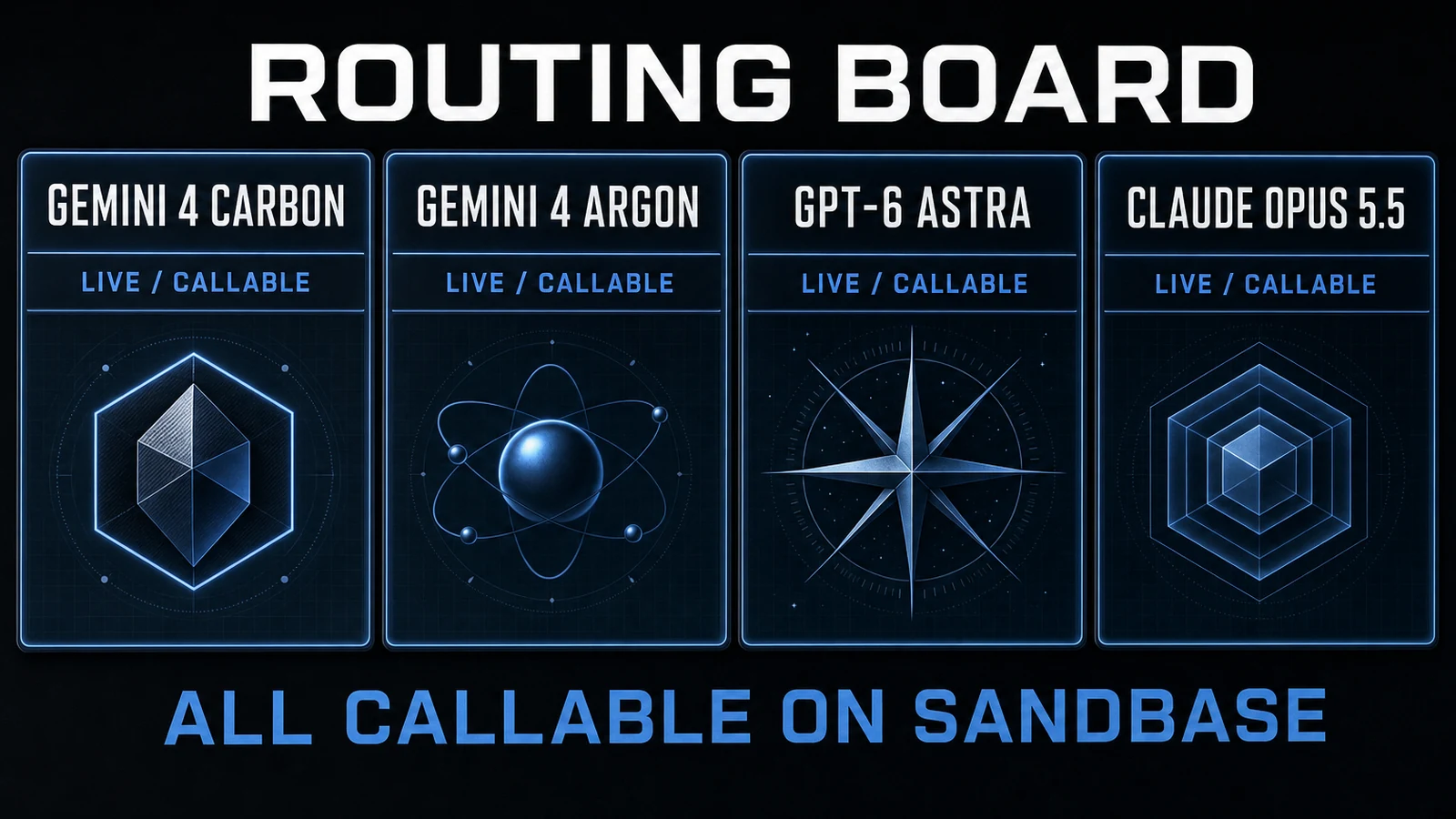
Quick verdict: Keep daily software engineering and knowledge work on Gemini 4 Argon. Send the limit case to Gemini 4 Carbon, and budget more tokens, not a cheaper unit price. Use Claude Opus 5.5 when you want the struck $4 / $20 list at the discounted hero. Use GPT-6 Astra when the job is already an OpenAI flagship call and the $9 / $45 hero is acceptable.
All four are callable on SandBase on 11 November 2026. That is the change from this morning’s research note, which still had Carbon on a 404. Gemini 4 Carbon is google/gemini-4-carbon. The hero is $4.00 input / $20.00 output / $0.20 cache read per million tokens, with no discount badge. Google’s Developer API Standard intro is still $2 / $10 through 30 November 2026. SandBase is not selling that intro.
This is a routing guide. I did not run the same coding task on all four models for this page. The benchmark table below is Google’s, from the DeepMind model card, results as of October 2026. The prices are from SandBase heroes opened 11 November 2026.
Key takeaway
- Google’s line: Argon for most software engineering and knowledge work; Carbon for tasks that test the limit, using more tokens than Argon to explore, reason, and verify.
- SandBase heroes, per million tokens: Carbon $4 / $20, no discount. Argon $4 / $20, no discount. GPT-6 Astra $9 / $45, 10% off a struck $10 / $50. Claude Opus 5.5 $3.40 / $17, 15% off a struck $4 / $20.
- Same SandBase unit price for Carbon and Argon does not mean the same bill. Google says Carbon spends more thinking tokens on complex tasks. Thinking is billed as output on Google’s price page.
- DeepMind’s comparison column is Claude Fable 5.1, not Fable 5.2. Claude Fable 5.2 is a live adjacent card at $8 / $40. Do not paste 5.1’s cells onto 5.2.
- Fairwind cyber scores stay on the allowlisted SKU. They are not a reason to point production traffic at
google/gemini-4-carbonand expect SEC-bench Pro.
What you can call today
The 11 November availability note has the launch clocks, the free-tier exclusion, and the full Google price table. The call itself uses /v1/chat/completions. An October head-to-head of Argon, Opus 5.5, and Astra, including a 24-call same-prompt test, is still the measured one. Its discount lines are from October. Do not copy them onto today’s heroes.
| Gemini 4 Carbon | Gemini 4 Argon | GPT-6 Astra | Claude Opus 5.5 | |
|---|---|---|---|---|
| SandBase ID | google/gemini-4-carbon | google/gemini-4-argon | openai/gpt-6-astra | anthropic/claude-opus-5.5 |
| Hero input / output | $4.00 / $20.00 | $4.00 / $20.00 | $9.00 / $45.00 | $3.40 / $17.00 |
| Struck list, if shown | No discount badge | No discount badge | $10.00 / $50.00 (10% off) | $4.00 / $20.00 (15% off) |
| Hero cache read | $0.20 | $0.20 | $0.90, struck $1.00 | $0.17, struck $0.20 |
| Hero cache write | Not on this hero | Not on this hero | $11.25, struck $12.50 | $4.25, struck $5.00 |
| Context / max output | 1M / 65.5K | 1M / 65.5K | 1.1M / 128K | 1M / 128K |
| Hero input chips | Text, image, audio | Text, image, audio | Text, image | Text, image |
| Callable on SandBase | Yes | Yes | Yes | Yes |
Cache figures are the hero rows on the same cards, opened 11 November 2026. I am not substituting a separate billing table. Opus’s hero cache-write line is a single struck pair, $4.25 against $5.00. I did not split that into a 5-minute and a 1-hour write price.
Google’s official Carbon intro ($2 / $10 through 30 November, then $4 / $20, cached input 95% off) applies to Google’s Developer API for the public model. It does not rewrite the SandBase heroes above. An older Argon pricing post still describes SandBase at $2 / $10 through 30 November. The Argon card opened today does not show that discount.
Carbon versus Argon, in Google’s words
“Argon remains the ideal choice for the majority of software engineering and knowledge work, while Carbon is built for tasks that test the limits of a model’s intelligence like complex, multi-step coding and debugging and open-ended scientific research and discovery — using more tokens than Argon to explore thoroughly, reason deeply, and run extended verification loops.”
That sentence is the route. Carbon is based on Argon. The official per-token intro matches. The 1,048,576-token unified window matches. What’s new in Carbon, on Google’s docs, is more thinking on the hard turn, plus the long-horizon, science, and cyber claims. Default thinking on the public ID is medium (low and high are the other documented levels). The SandBase card HTML, checked 11 November 2026, does not contain thinking_level. Do not add that field on SandBase because Google documents it.
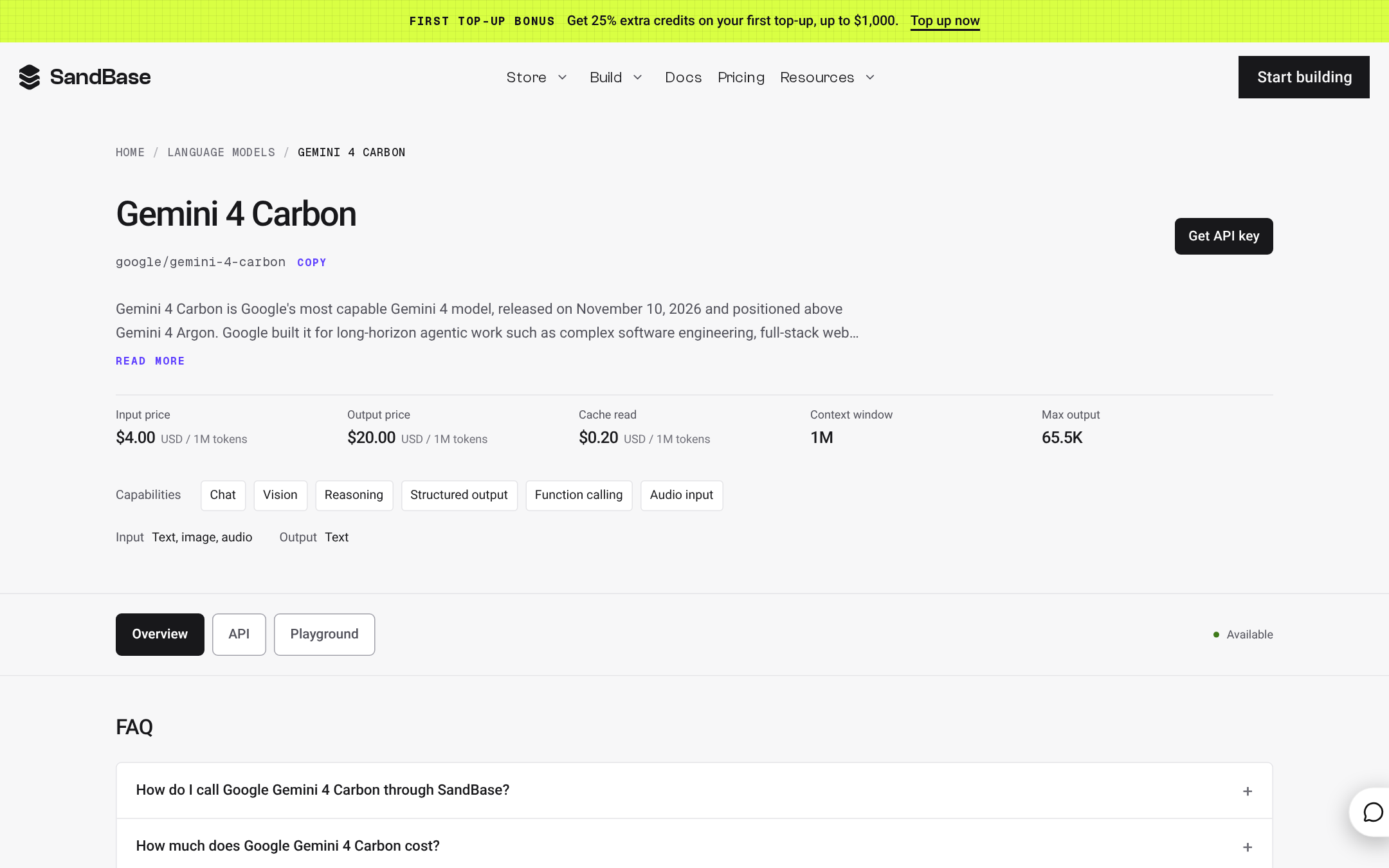
Same live Carbon card as in the release post. SandBase hero price is $4 / $20 / $0.20 per 1M, with no discount shown.
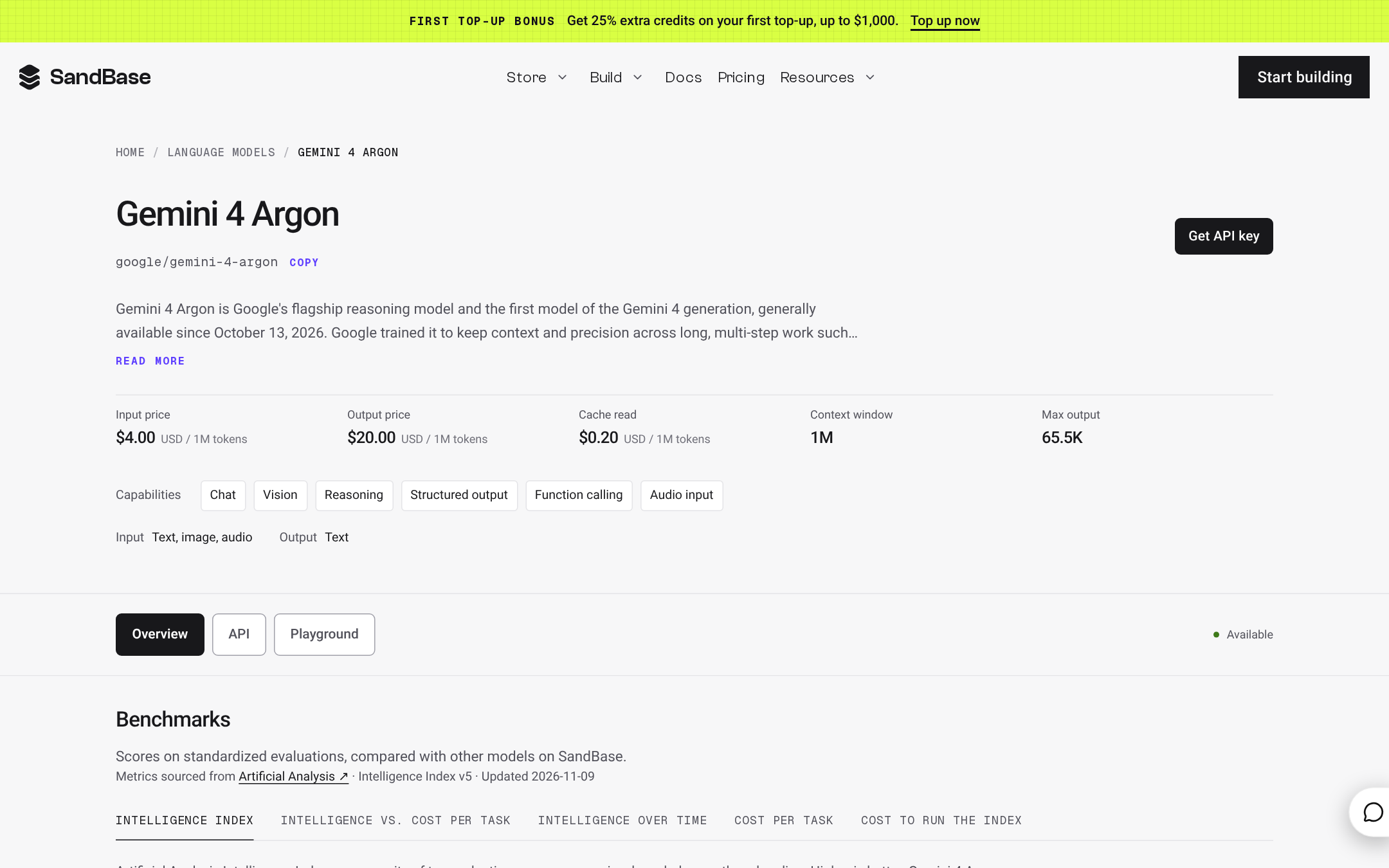
Live SandBase Gemini 4 Argon card. Unit prices match Carbon on this catalog: $4 / $20 / $0.20 per 1M, no discount.
On SandBase, switching the string from google/gemini-4-argon to google/gemini-4-carbon does not change the hero unit price. It changes which model you pay that rate to, and, if Google’s token warning holds, how many output tokens you buy. A 100,000-token uncached input and 10,000-token output is $0.60 at the card rate for either ID: $0.40 plus $0.20. The same mix is $0.30 at Google’s Standard intro, which SandBase is not billing. If Carbon’s hard turn emits 40,000 output tokens instead of 10,000, the card bill is $0.40 input plus $0.80 output, $1.20, before you have changed the input. That is the whole comparison between these two Google IDs on this catalog.
SandBase heroes both cap the visible max output at 65.5K. Google’s long decode, up to 1M minus input, is a Google API feature. I am not claiming the SandBase card exposes it.
Hero chips on both cards are Text, image, audio, output Text. Carbon’s card body and markdown also mention video and PDF. There is no hero video chip. Do not tell a client that the chip row and the body sentence are the same control.
Where Astra and Opus sit on price
GPT-6 Astra is the OpenAI flagship on this board. Hero $9 / $45 is 10% off the struck $10 / $50. Context on the hero is 1.1M, max output 128K, inputs Text and image. Per million input tokens, the hero is 2.25 times Carbon’s $4. Per million output tokens, $45 is 2.25 times $20. A task where Astra writes far fewer tokens can still cost less. I do not have that measurement for Carbon. The October same-prompt note saw Astra write fewer tokens on one logic puzzle. That was not a Carbon run, and it was not this week’s price badge. Treat it as a reason to measure, not as a forecast.
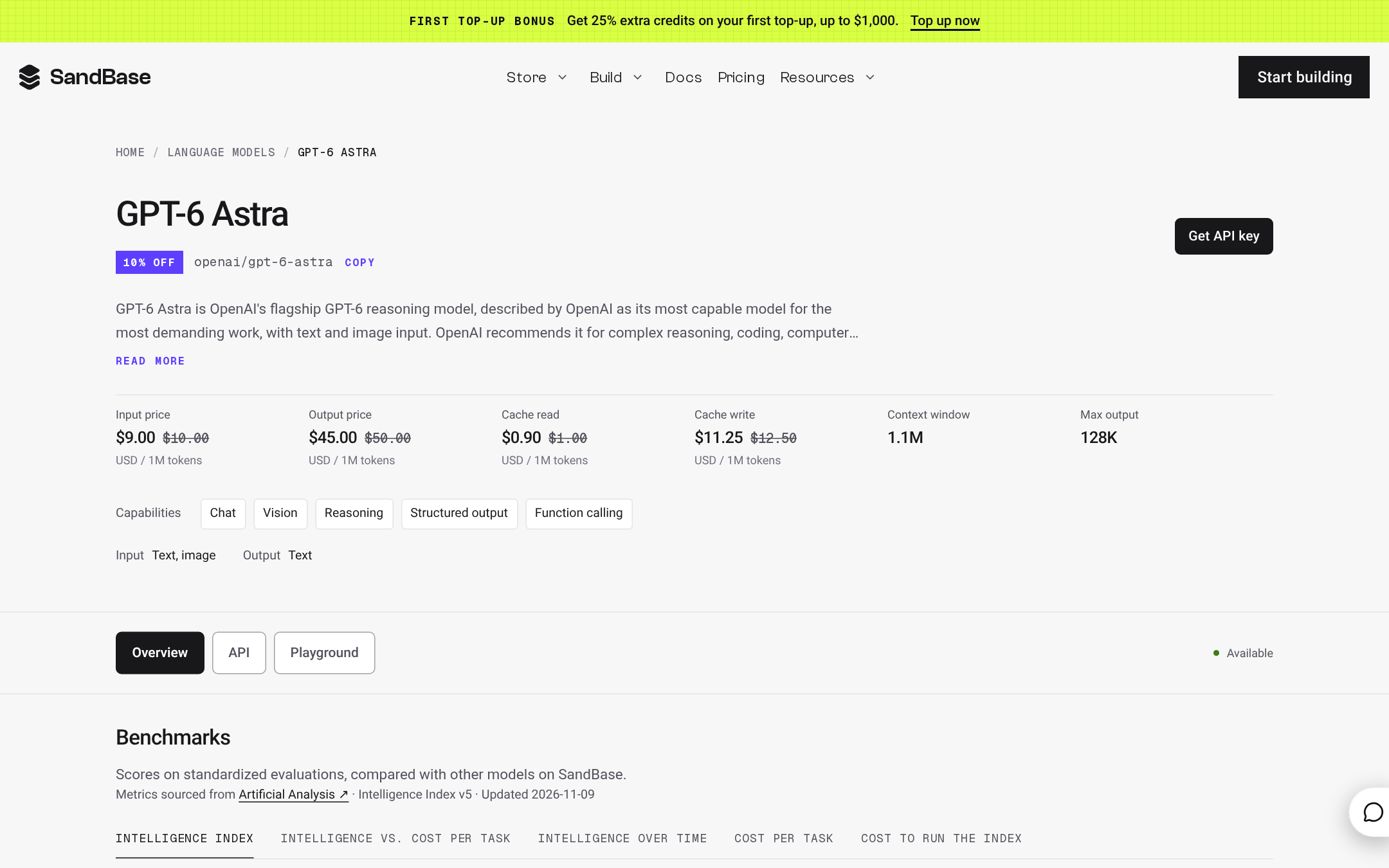
Live SandBase GPT-6 Astra card. Hero is $9 / $45 (10% off the $10 / $50 list).
Claude Opus 5.5 is the uncomfortable one for a “Carbon is the expensive Gemini” story. The hero is $3.40 / $17, 15% off a struck list of $4 / $20. The struck list matches Carbon’s SandBase unit price. The price you would actually be billed, if the badge holds, is lower than Carbon’s hero. Context 1M, max output 128K, inputs Text and image. Opus can take a longer single completion than Carbon’s 65.5K SandBase cap. That is a routing fact from the two heroes, not a quality claim.
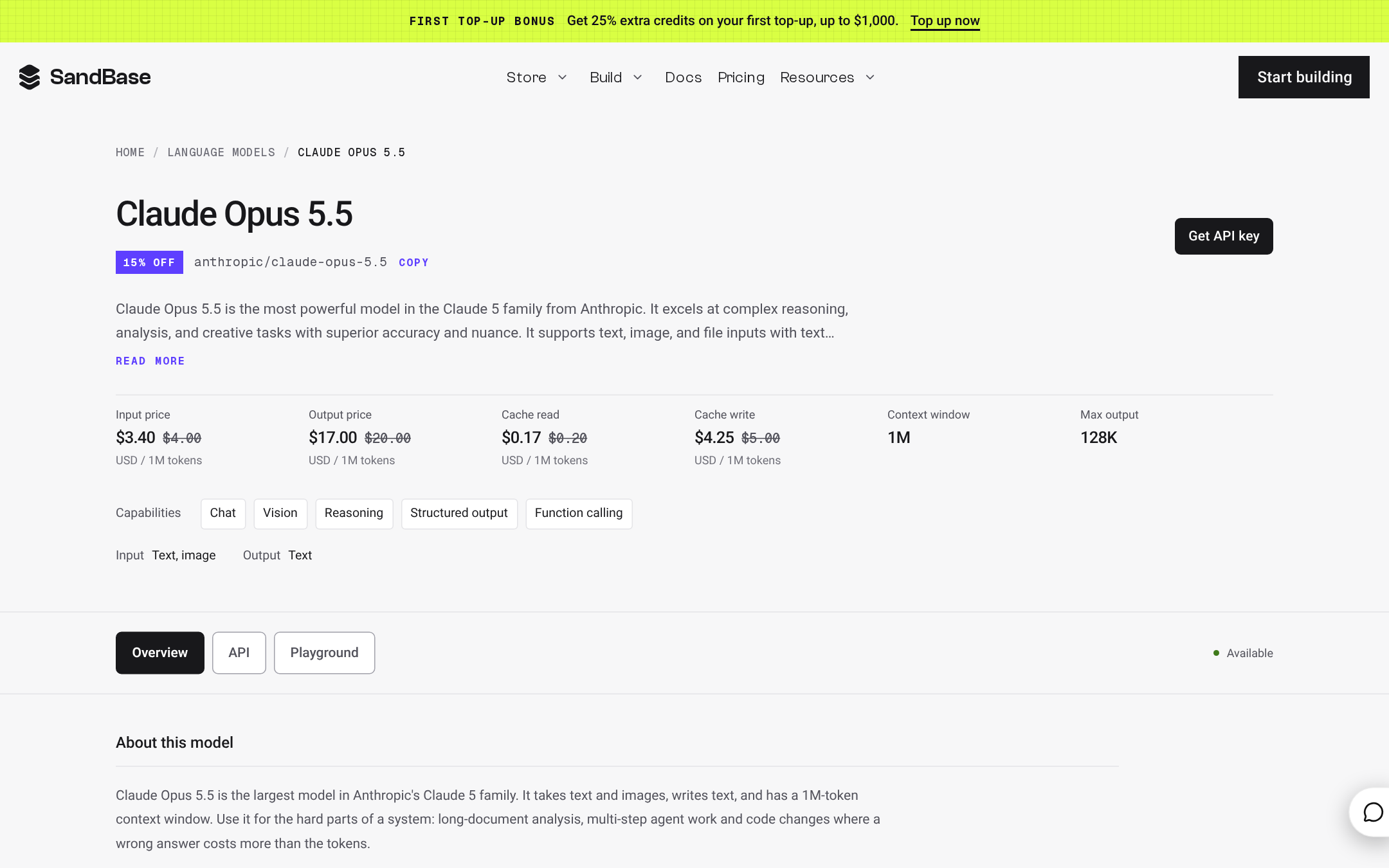
Live SandBase Claude Opus 5.5 card. Hero is $3.40 / $17 (15% off). The struck list $4 / $20 is visible in the same hero row; no separate billing table was required.
Work the same 100,000 input and 10,000 output tokens at the heroes, uncached, arithmetic only:
| Card | Input | Output | Total |
|---|---|---|---|
| Carbon or Argon at $4 / $20 | $0.40 | $0.20 | $0.60 |
| Opus 5.5 at $3.40 / $17 | $0.34 | $0.17 | $0.51 |
| Astra at $9 / $45 | $0.90 | $0.45 | $1.35 |
| Google Carbon Standard intro, not SandBase | $0.20 | $0.10 | $0.30 |
If your output is mostly thinking tokens, the output column dominates and Argon-versus-Carbon stops being a price decision. It becomes a token-volume decision at the same rate.
Gemini 3.8 Flash is the cheap Google loop beside this board, not a fourth flagship. On 11 November 2026 the hero was 15% off: $1.27 / $6.38 against $1.50 / $7.50, cache read $0.13 against $0.15, 1M / 65.5K. The same token mix is about $0.191. Use it when the task is a retry loop, not when you came here for Carbon’s limit case.
Google’s table, labeled as Google’s
DeepMind model card for Gemini 4 Carbon, results as of October 2026. These are not SandBase runs. The cybersecurity rows reflect Fairwind access, per that card. Empty cells are empty in the source table, not zeroes.
| Benchmark | Carbon | Argon | GPT-6 Astra | Claude Opus 5.5 | Claude Fable 5.1 |
|---|---|---|---|---|---|
| AA Index v5.0 | 59 | 50 | 57 | 58 | 49 |
| Terminal-Bench 4.0 (AA) | 65.2% | 57.1% | 59.1% | 59.6% | 52.0% |
| GraphWalks 256k–1M BFS F1 | 96.2% | 84.2% | 71.8% | 66.8% | 65.0% |
| SEC-bench Pro | 88.2% | 83.4% | 85.4% | — | — |
| ExploitGym | 54.8% | 42.0% | 42.4% | 34.5% | — |
| CWE-bench | 71.0% | 68.0% | 68.0% | 67.0% | 58.0% |
Read the columns that match a model you can name. Carbon leads this Google table on the rows shown, including against Argon. Opus 5.5 is close on AA Index v5.0 (58 versus 59) and behind on GraphWalks. Astra is ahead of Argon on AA Index and Terminal-Bench 4.0 in this table, and behind Carbon. None of that authorizes a sentence like “Carbon is 9 points smarter than Argon on your monorepo.”
Claude Fable 5.1 is the last column. Claude Fable 5.2 is a later model. Its SandBase hero on 11 November 2026 is $8 input / $40 output, cache read $0.20, cache write $10, no discount badge, 1M context, 128K max output, ID anthropic/claude-fable-5.2. Google’s Fable 5.1 cells are not Fable 5.2’s scores. If you need a Fable route, open the 5.2 card and keep this table’s last column out of that dashboard.
The now-available post’s “number one, at more than 2X lower cost per task” line on CursorBench, WANDR, and AutomationBench is a Google marketing claim. It is not in the table above, and it is not a SandBase cost study. Official Standard RPM for Carbon is still unpublished.
How to route
| Send it here | When | What you give up |
|---|---|---|
google/gemini-4-argon | Most coding, documents, and agent loops you already run on Gemini 4 | Google’s own table has Carbon ahead on the limit-case rows |
google/gemini-4-carbon | Multi-step debugging or open-ended science where Argon already stalled, and you can raise the output budget | Same SandBase unit price, more tokens, 65.5K max output on the card, not the free tier, not the cyber SKU |
anthropic/claude-opus-5.5 | You want a flagship at a hero below $4 / $20, or you need up to 128K output | You leave Google’s Carbon claims behind. October’s schema misses are a different post |
openai/gpt-6-astra | The stack is already OpenAI and the $9 / $45 hero fits | Highest hero unit price on this board |
google/gemini-3.8-flash | Cheap retries and long loops that do not need a Gemini 4 limit model | Not Carbon, not Argon |
| Neither Carbon nor the cyber ID | You wanted Fairwind benchmark behavior, or a free tier | Cyber stays allowlisted. Public Carbon is paid |
I would not flip a healthy Argon route to Carbon because the model card says 59 versus 50. I would flip a single job that has already failed on Argon, with a higher max_tokens and a test that can tell a good patch from a long one. The string change is real. The undocumented fields are not. The try-today note shows the one Carbon call this package actually ran: a short arithmetic reply, not a repository.
FAQ
Which is cheaper, Carbon or Argon?
On SandBase, the heroes match: $4 / $20 / $0.20, no discount, 11 November 2026. Google’s intro is $2 / $10 for both through 30 November, on Google’s API, not on these cards. Carbon is the one Google expects to use more tokens.
Which is better for coding?
On Google’s October 2026 table, Carbon leads Argon, Astra, and Opus 5.5 on Terminal-Bench 4.0. That is Google-reported. We did not reproduce it. For work you can ship this week, start on Argon unless the task is the limit case in Google’s sentence.
Can I call all four with one SandBase key?
Yes. The IDs above were on live cards on 11 November 2026. Carbon’s documented route is POST /v1/chat/completions. You still pay each model’s hero. One key is not one price.
Is Fable 5.2 in Google’s Carbon table?
No. The column is Claude Fable 5.1. Fable 5.2 is a separate SandBase card at $8 / $40.
Does SandBase include Google’s $2 / $10 intro?
Not on the Carbon or Argon heroes opened for this note. Both show $4 / $20 and no discount badge.
Cards opened 11 November 2026, Asia/Shanghai. Google’s split and the benchmark table are from the now-available post and the DeepMind Gemini 4 Carbon model card, results as of October 2026. The 29 October SandBase explainer is updated in place and linked from the availability note.
For the worker side of a multi-model workflow, compare Muse Ember’s pricing threshold with Inkling 2 Small’s open-weight deployment requirements. These guides cover execution and hosting decisions rather than a new frontier-model ranking.
Found this useful? Share it