Claude Haiku 5.5: API Pricing, Context, and Limits
Claude Haiku 5.5 explained: tiered pricing, 1M context, adaptive thinking, benchmarks, API usage, and the workloads where Sonnet still wins.
The surprising part of Claude Haiku 5.5 is not that Anthropic made its small model faster. It is that the price now changes at 100,000 input tokens. A short classification call costs $0.10 per million input tokens and $0.50 per million output tokens; a long prompt costs five times more. That makes Haiku 5.5 an unusually cheap routing and subagent model, but only if your workload stays on the right side of the meter.
Claude Haiku 5.5 is Anthropic’s October 7, 2026 small model for developers running high-volume classification, extraction, summarization, browser work and focused subagents. It supports text and image input, adaptive thinking, a 1M-token context window and 128K normal maximum output. This guide separates Anthropic’s launch claims from one small live SandBase call and explains when Sonnet 5.5 remains the safer choice.
Claude Haiku 5.5: Key takeaway
- Haiku 5.5 costs $0.10 input and $0.50 output per million tokens for prompts up to 100K; both prices rise 5× above 100K.
- It has a 1M context window, 128K normal maximum output, image input and adaptive thinking with
mediumas the default effort. - Anthropic reports large gains over Haiku 4.5, including 39.2% on Terminal-Bench 4.0 versus 0.0%, but Sonnet 5.5 still leads at 70.6%.
- In our single October 26 SandBase classification call, it correctly routed an SSO failure to
technical, using 93 input and 52 output tokens. - Use it for narrow, repeated decisions and subagent work. Keep Sonnet or Opus for difficult repository-scale coding and ambiguous long-horizon tasks.
What Anthropic released
Claude Haiku 5.5 succeeds Haiku 4.5 and is available on the Claude API, AWS, Google Cloud and Microsoft Azure. Anthropic calls it its fastest model at standard speed, while noting that Opus Fast Mode can be quicker. It is proprietary: there are no downloadable weights or self-hosting license.
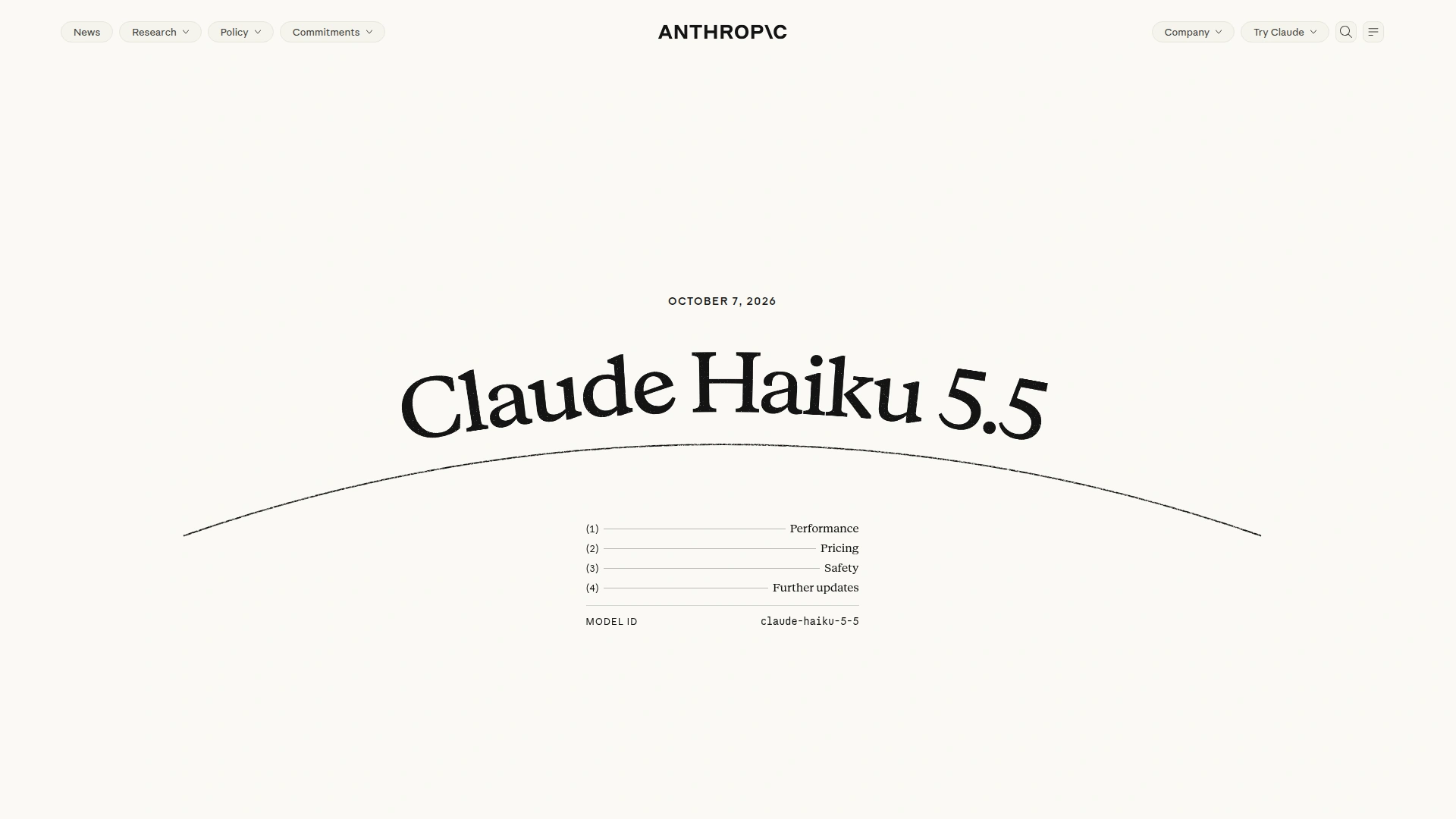 Anthropic’s October 7 launch page positions Haiku 5.5 for high-volume work and publishes the comparison table used below. Captured October 26, 2026.
The model is more than a cheaper checkpoint. It adds adaptive thinking to the Haiku line, accepts a 1M context by default, and uses Anthropic’s newer tokenizer. Anthropic says the same text counts as roughly 30% more tokens than on Haiku 4.5. That tokenizer change is why a 90% lower list price on short prompts becomes an estimated 75% lower cost per task rather than a simple 90% saving.
| Specification | Claude Haiku 5.5 |
|---|---|
| Release date | October 7, 2026 |
| Claude API model ID | claude-haiku-5-5 |
| SandBase model ID | anthropic/claude-haiku-5.5 |
| Input / output | Text and images → text |
| Context window | 1,000,000 tokens |
| Maximum output | 128K; 300K in Message Batches beta |
| Thinking | Adaptive; default effort medium |
| Reliable knowledge cutoff | June 2026 |
| Weights / license | Closed, API access only |
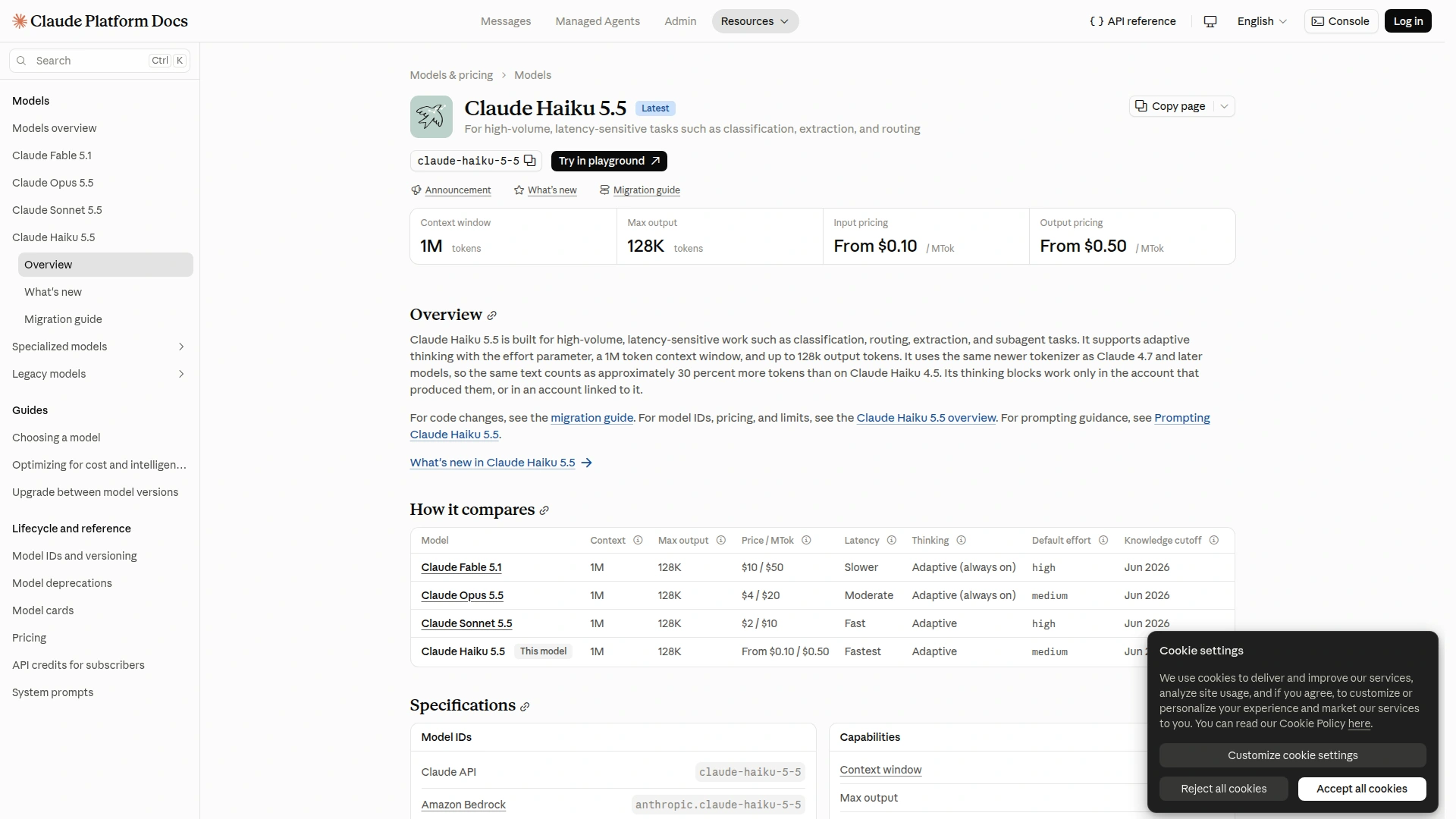 Claude Platform’s model overview records the production limits and starting prices. Captured October 26, 2026.
The 100K pricing boundary matters
Anthropic’s price is per million tokens, but input length selects the tier for the whole request.
| Haiku 5.5 price per 1M tokens | Prompt ≤100K | Prompt >100K |
|---|---|---|
| Input | $0.10 | $0.50 |
| Output | $0.50 | $2.50 |
| 5-minute cache write | $0.125 | $0.625 |
| 1-hour cache write | $0.20 | $1.00 |
| Cache read | $0.01 | $0.05 |
A routine request with 10,000 input tokens and 1,000 output tokens costs about $0.0015: $0.001 input plus $0.0005 output. A 120,000-token request with 4,000 output tokens costs about $0.07 at the long tier: $0.06 input plus $0.01 output. Crossing 100K turns a 12× larger prompt into a roughly 47× larger bill.
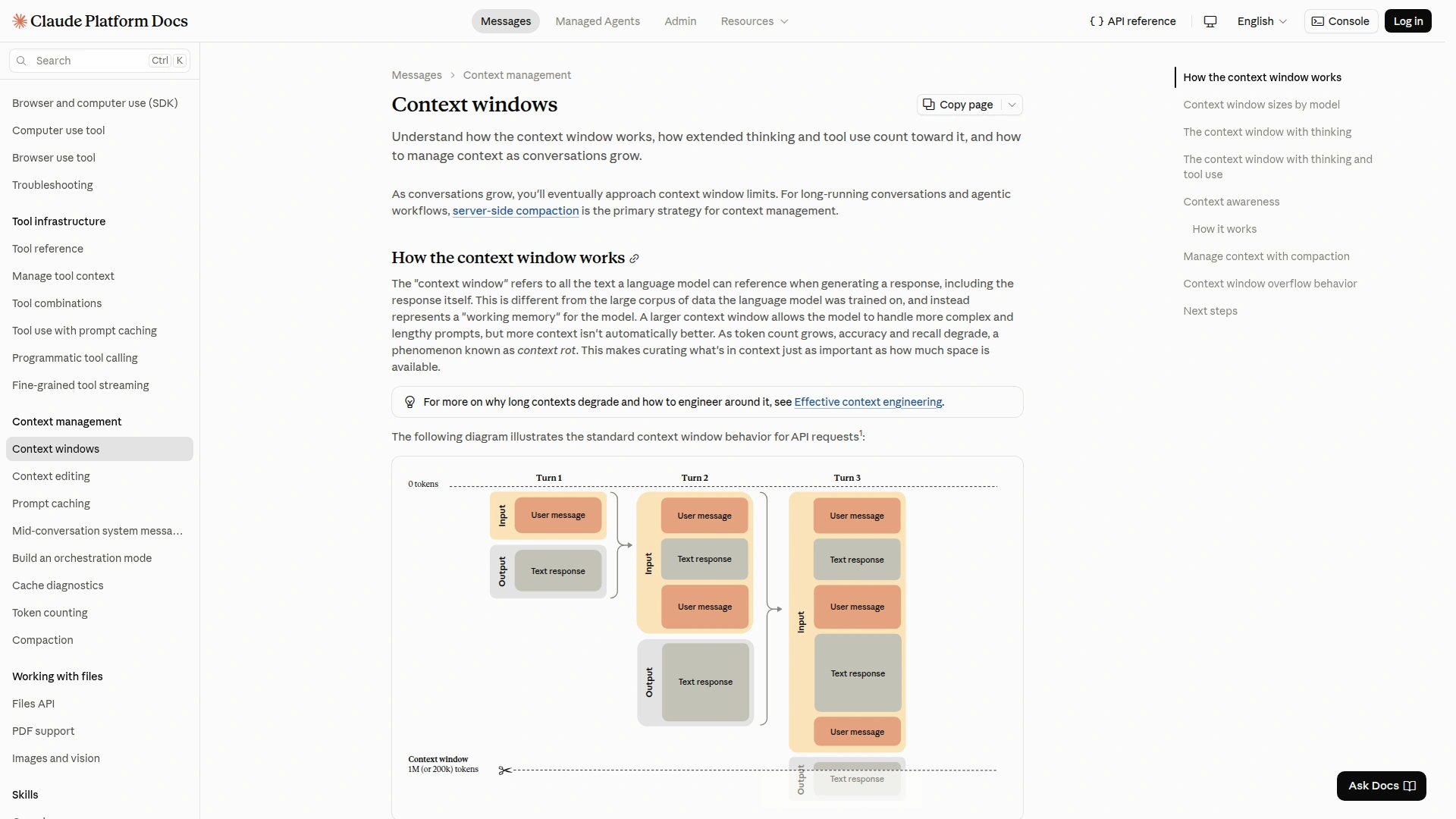 Anthropic’s context documentation calls out Haiku 5.5 as the exception: prompts over 100K use higher rates even though 1M context is available by default. Captured October 26, 2026.
This is where I would pause before replacing a cheaper router. A 1M window describes what fits, not what stays cheap. Summarize or retrieve before sending a long history, and inspect cache accounting separately from uncached input.
Benchmarks: much stronger Haiku, still not Sonnet
The launch table is vendor-reported, so it is useful as a directional comparison rather than an independent verdict.
| Anthropic-reported benchmark | Haiku 5.5 | Haiku 4.5 | GPT-6 Luna | Sonnet 5.5 |
|---|---|---|---|---|
| OSWorld 2.1 offline subset | 72.4% | 15.7% | 48.9% | 83.9% |
| HLE, no tools | 45.9% | 10.2% | — | 56.9% |
| Terminal-Bench 4.0 | 39.2% | 0.0% | 16.4% | 70.6% |
| FrontierCode 1.1 Main | 46.4% | — | 42.4% | 52.1% |
Haiku 5.5 is not merely a classifier according to these results. It beats GPT-6 Luna in Anthropic’s cited computer-use and coding tests. Yet the Terminal-Bench gap to Sonnet is large enough to shape routing: use Haiku as the sidekick that searches, summarizes and checks; let Sonnet handle the branch where the work becomes open-ended.
One live classification check
We sent one support ticket through SandBase: “After enabling SSO, three teammates can no longer sign in, but invoices are fine.” We asked for billing, technical, or account. Haiku returned technical and explained that the failure was authentication-related. The call used 93 input tokens and 52 output tokens.
That is a smoke test, not an accuracy benchmark. It verifies the route, model ID and response shape on October 26. It does not establish a production error rate or latency distribution.
curl https://api.sandbase.ai/v1/chat/completions \
  -H "Authorization: Bearer $SANDBASE_API_KEY" \
  -H "Content-Type: application/json" \
  -d '{
    "model": "anthropic/claude-haiku-5.5",
    "max_tokens": 300,
    "messages": [{
      "role": "user",
      "content": "Classify this ticket as billing, technical, or account. Return only the label and one short reason: After enabling SSO, three teammates can no longer sign in, but invoices are fine."
    }]
  }'
SandBase routes this request to Anthropic’s model; it does not train or own Claude. The model page lists the short-prompt rates, 1M context and 128K output limit.
Haiku 5.5 vs the alternatives
| Model | List price, input/output | Best fit | Main trade-off |
|---|---|---|---|
| Haiku 5.5, ≤100K | $0.10 / $0.50 | Routing, extraction, compact subagents | 5× tier above 100K |
| Haiku 4.5 | $1 / $5 | Frozen legacy workloads | Far weaker in Anthropic’s new table |
| Sonnet 5.5 | $2 / $10 | Harder coding and long-horizon agents | 20× Haiku’s short-prompt token price |
| GPT-6 Luna | Check current route | Low-cost general assistance | Lower than Haiku on Anthropic’s cited tests |
If your application already has a reliable Haiku 4.5 prompt suite, migrate and re-evaluate token counts before using the price headline in a budget. For broader model routing, our GPT-5.6 tier guide shows why a cheap tier needs explicit workload boundaries, and the cost dashboard guide covers per-route budgeting.
Limits to design around
- Adaptive thinking is on by default. Anthropic says to omit
temperature,top_pandtop_kfor Haiku 5.5. - Long prompts cost more and are not automatically more accurate. Retrieval still matters.
- Thinking blocks are account-bound; do not assume they can be replayed across unrelated accounts.
- The model outputs text. Image input does not make it an image generator.
- Anthropic’s strongest launch numbers come from Anthropic’s harnesses. Validate your own queue labels, languages and error costs.
FAQ
How much does Claude Haiku 5.5 cost?
Up to 100K input tokens, $0.10 per million input tokens and $0.50 per million output tokens. Above 100K, $0.50 and $2.50 respectively. Batch input and output receive a 50% discount on Anthropic’s API.
What is the context window?
One million tokens, with 128K normal maximum output. The Message Batches beta can reach 300K output with Anthropic’s documented beta header.
Is Haiku 5.5 better than Sonnet 5.5?
It is dramatically cheaper for short prompts and is a strong fit for focused repeated tasks. Sonnet remains substantially better on Anthropic’s Terminal-Bench and OSWorld results, so it is the safer choice for harder agent work.
Is Claude Haiku 5.5 open-weight?
No. Anthropic provides it through hosted APIs and cloud partners; it does not publish downloadable weights.
Haiku 5.5 is the most compelling when you treat it as a narrow, high-volume worker rather than a universal replacement. Keep prompts below 100K when possible, set a clear escalation path, and verify the current SandBase route and pricing before moving traffic.