TypeSafe Jev 1.14: A Decision Model, Not a Chatbot
Jev 1.14 explained: typed decisions, $0.042/M input pricing, probabilities, multilingual gains, experimental images, and the SandBase decisions API.
Jev 1.14 looks like an LLM in a model catalog, but sending it a chat prompt is the wrong abstraction. It does not write an answer. You send application state plus typed questions; it returns a choice, score, probability, or bounding box that ordinary code can threshold. In our first call, an undocumented shortcut failed. Replacing an options array with Jev’s required criteria map produced a valid typed decision.
TypeSafe released Jev 1.14 on October 14, 2026 as the second public version of its “System One” decision model. It costs $0.042 per million input tokens and zero metered output cost. The stable text path targets routing, scoring and classification; image input, bounding boxes and 262K long context are opt-in experimental features that TypeSafe explicitly says are too jagged for production.
Jev 1.14: Key takeaway
- Jev returns predefined typed values rather than prose:
choice,score,noulprobability, and an experimentalbox. - It costs $0.042 per million input tokens; outputs are free to meter on TypeSafe and SandBase’s current listing.
- Default limits are 64K per request and 32K per question; a danger-zone header raises both to 262K upstream.
- Our October 26 SandBase call routed an SSO incident to
technicalwith probability 1.0 and judged urgency at 0.63. - Use it inside deterministic workflows. Do not use it when the product needs explanations, generated text, multi-turn conversation, audio, or video.
What is a System One model?
Jev 1.14 is TypeSafe AI’s proprietary decision model. TypeSafe describes the interface as “state, question, decision, action”: your program supplies a record or document, declares focused questions and allowed answer shapes, then uses the probabilities in normal if statements.
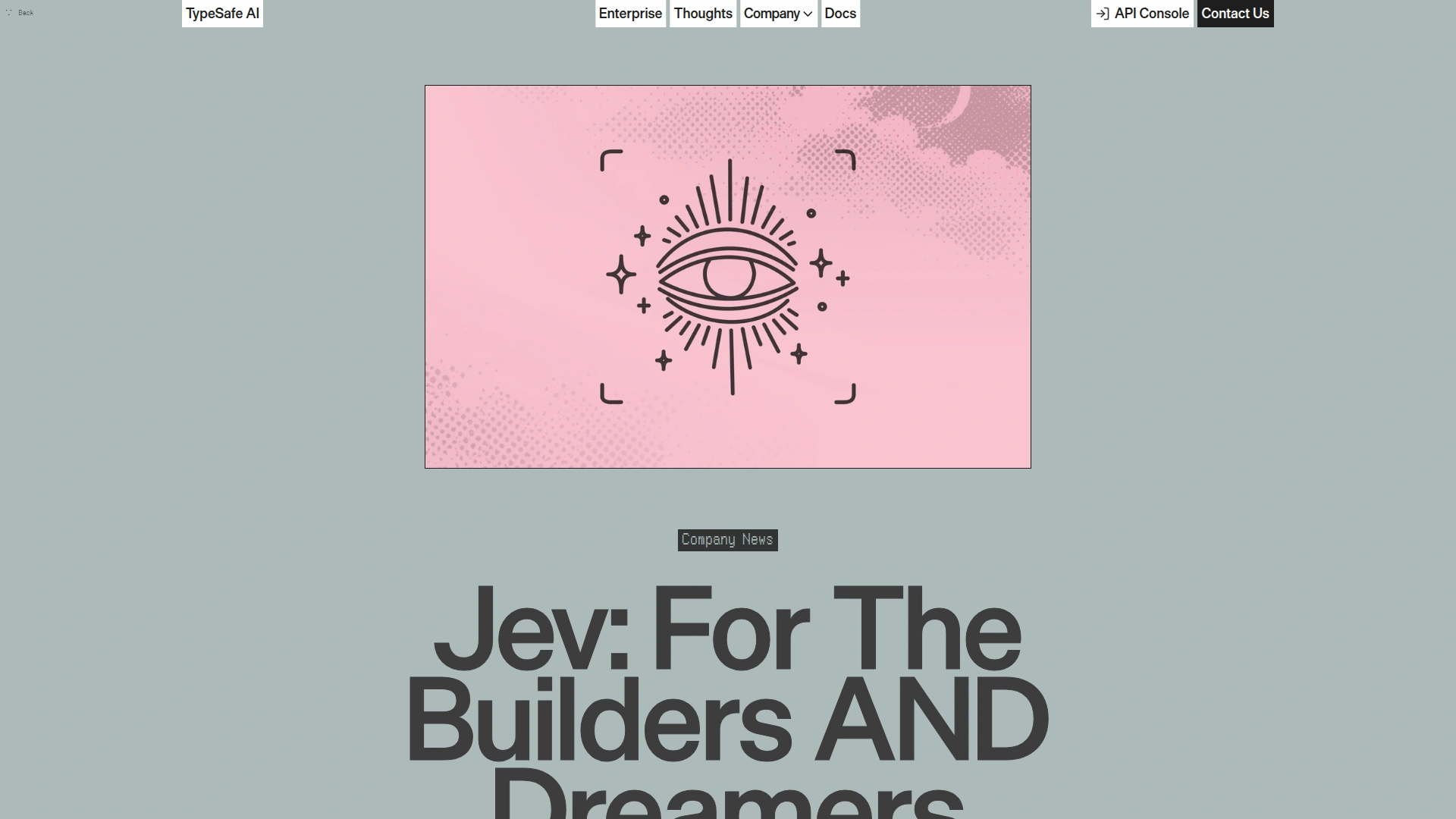 TypeSafe’s October 14 release post separates small model improvements from experimental “danger zone” capabilities. Captured October 26, 2026.
The distinction from JSON mode is important. An LLM in JSON mode still generates a token sequence and may need validation or retries. Jev’s public contract constrains the answer to the question type. That prevents a type error; it does not make every judgment correct. A confidently wrong label is still wrong, so confidence thresholds and representative evaluation data remain necessary.
| Specification | Jev 1.14 |
|---|---|
| Provider / release | TypeSafe AI / October 14, 2026 |
| SandBase model ID | typesafe/jev-1.14 |
| Upstream model ID | jev-1.14.0 |
| Stable input | Text state as string, object or array |
| Stable outputs | Choice, Score, Noul |
| Experimental | Images, Box, 262K long context |
| Default context | 64K per request; 32K per question |
| Price | $0.042/M input; output free |
| Weights / license | Proprietary hosted model |
Four question types, four jobs
choice selects one item from a criteria map and returns a full probability distribution. score locates an answer on a declared rubric. noul returns a probability for a yes/no proposition. box, new in 1.14, returns normalized bounding-box coordinates plus confidence and is marked experimental.
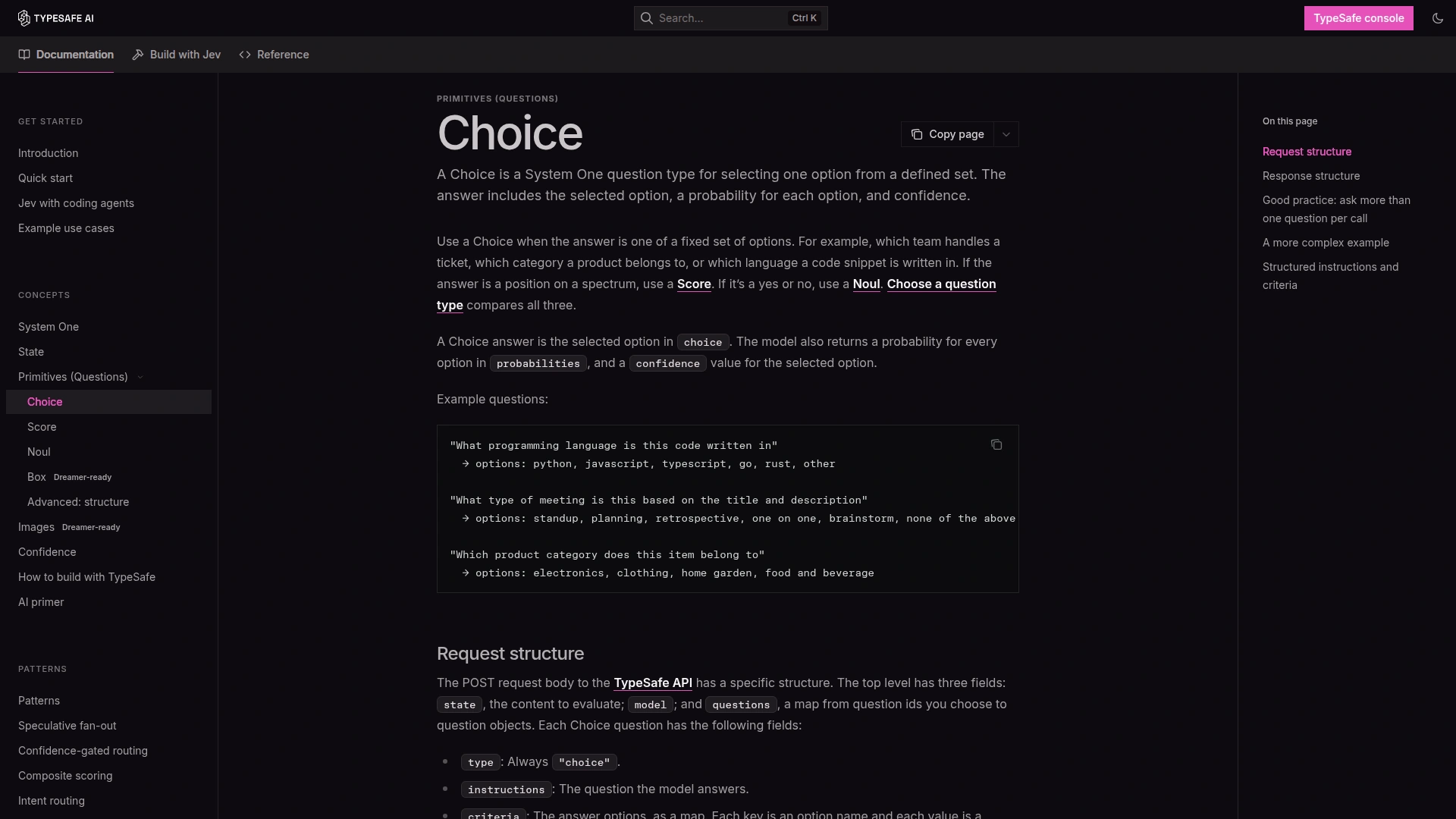 TypeSafe’s Choice reference: each candidate is a key in
criteria, with a description that separates it from neighboring labels. Captured October 26, 2026.
The API lets you ask several independent questions about one state in parallel. That is useful for a support ticket: choose the queue, estimate urgency, score sentiment and decide whether human review is needed in one request. It is not a reasoning chain. Questions cannot depend on answers to other questions inside the same call; conditional logic stays in code.
The request shape that actually worked
Our first attempt passed options: ["billing", "technical", "account"]. SandBase returned HTTP 400 with a generic validation message. TypeSafe’s documentation requires a criteria object whose keys are the allowed values and whose values describe their boundaries.
curl https://api.sandbase.ai/v1/decisions \
  -H "Authorization: Bearer $SANDBASE_API_KEY" \
  -H "Content-Type: application/json" \
  -d '{
    "model": "typesafe/jev-1.14",
    "state": {"ticket": "After enabling SSO, three teammates can no longer sign in, but invoices are fine."},
    "questions": {
      "queue": {
        "type": "choice",
        "instructions": "Which team should handle this ticket?",
        "criteria": {
          "billing": "Charges, invoices, and payment problems",
          "technical": "Product configuration and authentication failures",
          "account": "Profile or subscription administration"
        }
      },
      "urgent": {
        "type": "noul",
        "instructions": "Does this ticket need urgent attention?"
      }
    }
  }'
The result chose technical with 1.0 probability and returned urgent: 0.63. Usage was 371 input and 55 output tokens; the current SandBase formula charges only input, about $0.000016 before settlement rounding.
{
  "answers": {
    "queue": {
      "type": "choice",
      "choice": "technical",
      "confidence": 1,
      "probabilities": {"account": 0, "billing": 0, "technical": 1}
    },
    "urgent": {"type": "noul", "noul": 0.63}
  },
  "usage": {"input_tokens": 371, "output_tokens": 55}
}
One obvious warning: a probability is not an instruction. Our application might auto-route queue at confidence above 0.8 but ask a person to assess urgency when noul sits between 0.4 and 0.8. Those thresholds are product policy, not facts supplied by Jev.
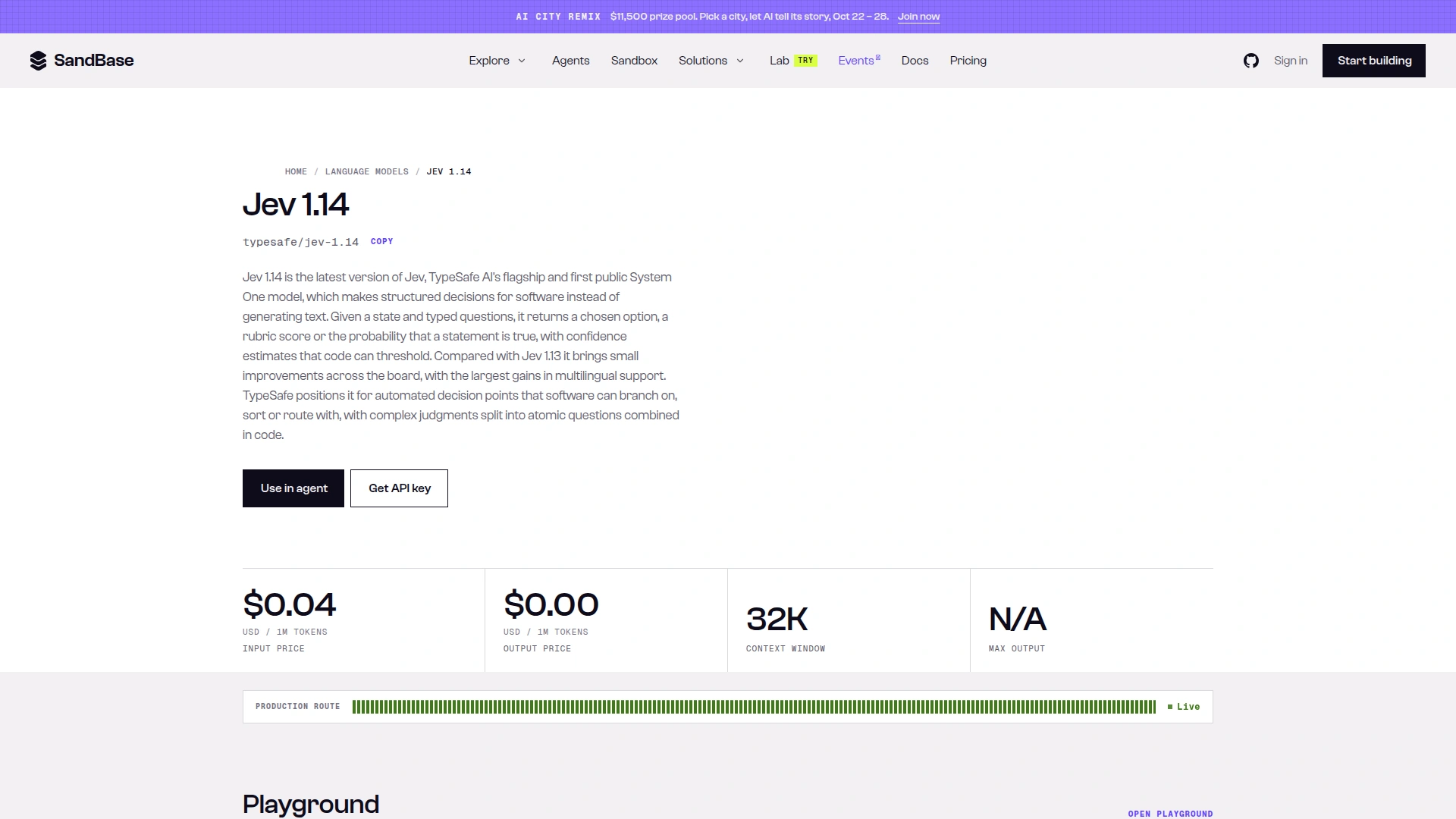 SandBase lists
typesafe/jev-1.14 as a live decision model at roughly $0.04/M input and $0 output, with a 32K per-question context display. Captured October 26, 2026.
SandBase passes the native decision body through its /v1/decisions surface and rewrites the public model ID in the response. It routes access to TypeSafe’s model; it does not train Jev.
Pricing and the real unit of cost
At $0.042/M input tokens, one 371-token request is $0.000015582 by formula. A million similar requests would consume 371 million input tokens, about $15.58 before any platform rounding or plan effects. Asking five questions about the same state in one call avoids resending that state five times, though each question still contributes instructions and criteria to the request budget.
| Approach | Output | Best for | Main cost/risk |
|---|---|---|---|
| Jev 1.14 | Typed probabilities | Routing, moderation, ranking, gates | No prose; must tune thresholds |
| Small chat LLM + JSON schema | Generated JSON | Extraction plus explanation | Parsing/retry and output-token cost |
| Rules engine | Deterministic branch | Stable explicit policies | Brittle around fuzzy language |
| Human review | Judgment and explanation | High-stakes ambiguity | Slow and expensive |
The best design is often a cascade: explicit rule first, Jev for the fuzzy middle, human or a larger model when confidence falls into a review band. For a broader look at model routing, see five agent design patterns and our production guardrails guide.
What changed in 1.14
TypeSafe describes small improvements across the board, with the largest expected gain in multilingual support. Its docs still say English is strongest and tell teams to test CJK workloads themselves. This is a meaningful limitation for Chinese support queues; the release claim is not a substitute for a Chinese-language eval set.
The visible feature additions are opt-in:
- Images can be referenced through an
assetsmap. boxreturns one normalized rectangle and confidence.TypeSafe-Danger-Zone-Long-Context: trueraises both context limits to 262K.
TypeSafe says these paths have too much jaggedness for it to vouch for production. SandBase’s current public schema exposes state and questions; do not assume upstream danger-zone headers or image assets pass through unless the exact route documents them and a dated call verifies them.
Where Jev fits—and where it does not
Good fits include ticket routing, lead qualification, content moderation, alert severity, document clause flags and agent action selection. All have a finite answer space and code that can react differently at different confidence levels.
Do not pick Jev for customer-facing prose, code generation, summaries, conversational memory or explanations. It cannot replace the generative step. It also does not eliminate evaluation: TypeSafe itself advises decomposing broad judgments into atomic questions, and longer context can reduce reliability.
FAQ
Is Jev 1.14 an LLM?
It is an AI model for natural-language judgment, but it is not a chat or text-generation model. It returns typed decisions and probabilities.
How much does Jev 1.14 cost?
TypeSafe and SandBase currently list $0.042 per million input tokens and no metered output-token price.
What is a Noul?
A Noul is TypeSafe’s yes/no question type. The answer is a probability from 0 to 1 rather than a generated “yes” or “no”.
Can Jev 1.14 read images?
TypeSafe offers experimental image input and a new Box type behind danger-zone controls. The provider warns that these capabilities are not production-ready; verify support on the route you use.
Should I use jev-latest or pin 1.14?
Pin a version when your thresholds depend on stable probability behavior. Moving aliases can change answers without a code change.
Jev 1.14 is useful precisely because it refuses to be a chatbot. Define the state, write criteria that separate neighboring choices, and keep the final authority in code. Start with the Jev 1.14 model page, then test thresholds on your own labeled cases before automating a consequential branch.