Claude Opus 5.5 API: 50% Off on SandBase, Pricing and Limits
Claude Opus 5.5 API guide: SandBase's current 50% discount, $2/$10 effective pricing, 1M context, 128K output, benchmarks, migration traps, and code.

The number that changes the Opus 5.5 decision is not a benchmark score. It is $2 per million input tokens and $10 per million output tokens: the current price on SandBase after a 50% discount. That is half Anthropic’s $4/$20 list price and the same effective token price as Claude Sonnet 5.5’s list rate.
That does not make Opus the automatic default. Its reasoning is always on, hidden thinking tokens still count toward output cost, and a migration from Opus 5 can break on forced tool choice or old thinking settings. The discount makes evaluation cheaper; it does not remove the need to evaluate.
Key takeaway
- Anthropic released Claude Opus 5.5 on September 22, 2026 for long-running agentic coding and knowledge work.
- Anthropic lists it at $4/M input and $20/M output. The SandBase Claude Opus 5.5 page currently shows 50% off: $2/M input, $10/M output, $0.10/M cache reads, and $2.50/M five-minute cache writes.
- It supports 1M context, 128K synchronous output, text and image input, tool calling, structured output, and always-on adaptive thinking.
- Switch from Opus 5 when agent quality matters and your integration can handle the API changes. Do not switch blindly for simple, latency-sensitive, or tightly budgeted calls.
- One live code-review check returned the correct edge cases and fix, but one prompt is evidence of route availability—not a benchmark.
What is Claude Opus 5.5?
Claude Opus 5.5 is Anthropic’s current Opus model for long-running coding agents and professional knowledge work. Anthropic calls it the first model in the Claude 5.5 family. It is proprietary: Anthropic has not released model weights or an open-source license.
The Claude API ID is claude-opus-5-5. On SandBase it is anthropic/claude-opus-5.5, available through both the OpenAI-compatible Chat Completions route and the Anthropic-compatible Messages route.
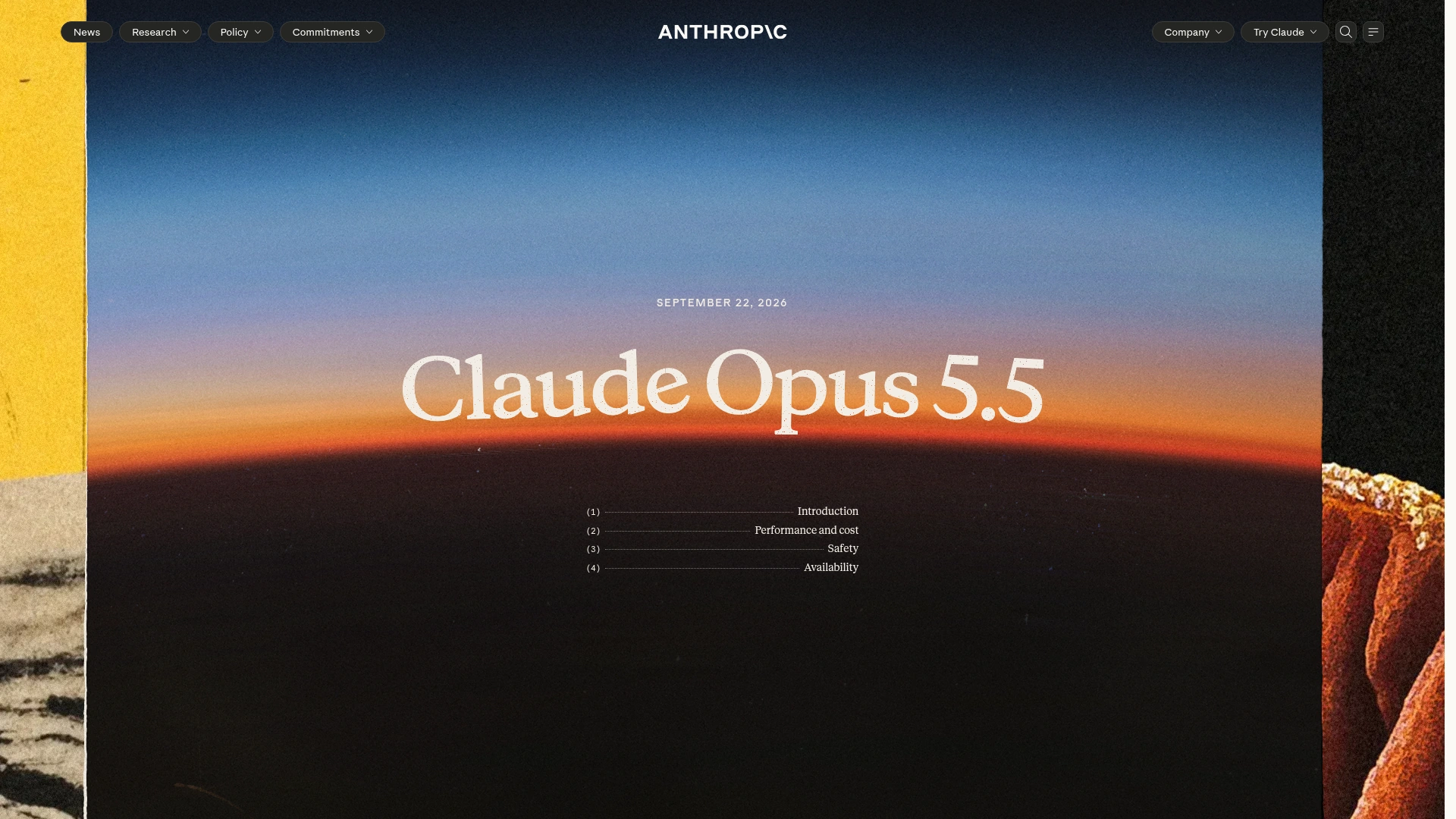 Anthropic’s launch page, captured October 27, 2026. It establishes the model name and September 22 release date; performance claims below remain Anthropic-reported unless marked as our test.
What actually changed from Opus 5
Lower list price, lower cache-read price
Opus 5.5 costs $4/$20 per million input/output tokens at Anthropic, down 20% from Opus 5’s $5/$25. Anthropic says the new model costs 40% less on typical workloads because it also uses fewer tokens per task. That 40% is an Anthropic workload estimate, not a universal discount.
Cache reads fell further: $0.20/M, 60% below Opus 5’s $0.50/M. For agents that repeatedly reuse a large system prompt, repository map, or policy bundle, this can matter more than the headline input rate.
Always-on adaptive thinking
Opus 5.5 does not accept thinking: {"type": "disabled"} or a manual extended-thinking budget. Use adaptive thinking and control depth with output_config.effort; the default is medium. Thinking tokens count toward max_tokens and are billed as output even when their text is omitted.
This next detail is easy to miss: code that assumes content[0] is always a text block can fail. Anthropic recommends selecting response blocks by type and passing thinking blocks back unchanged in tool loops.
Tool-use migrations can return 400s
Forced tool choice with any or a named tool is not supported by Opus 5.5 on Anthropic’s API. Use auto plus strict tool definitions. Anthropic also documents a newer computer-use tool version and a changed treatment of progress text between tools. Read the migration guide before changing a production model ID.
Faster output and stronger vendor-reported results
Anthropic reports output generation more than 30% faster than Opus 5. Its release table gives Opus 5.5 66.4% on Terminal-Bench 4.0 versus 52.3% for Opus 5, and 54.4% versus 48.0% on FrontierCode v1.1. These are vendor-reported results with stated harnesses and error bars; they are not SandBase latency measurements and we did not reproduce them.
Claude Opus 5.5 specifications
| Specification | Value |
|---|---|
| Provider | Anthropic |
| Release date | September 22, 2026 |
| Claude API ID | claude-opus-5-5 |
| SandBase model ID | anthropic/claude-opus-5.5 |
| Context window | 1,000,000 tokens |
| Maximum output | 128,000 tokens; 300K in Batch API beta on Anthropic |
| Input → output | Text and images → text |
| Thinking | Adaptive, always on; default effort medium |
| Tool calling / structured output | Supported on SandBase; forced named tool choice is an Anthropic migration caveat |
| Knowledge / training cutoff | June 2026 |
| Weights / license | Proprietary; weights not released |
| SandBase routes | /v1/chat/completions and /v1/messages |
The 1M window is capacity, not a reason to send an entire repository every turn. Cached, filtered working sets are usually cheaper and easier to debug. A request can also hit file, image, or request-size limits before it reaches the token ceiling.
Benchmarks: useful direction, not a routing policy
The SandBase model page currently displays Artificial Analysis Intelligence Index v4.3. The measured configuration, Claude Opus 5.5 (Max, Default Fallback), scores 57.6 and ranks first among 87 SandBase catalog models included in that view. The same chart shows Sonnet 5.5 at 56.0, GPT-6 Astra at 52.7, Gemini 4 Argon at 52.6, and Opus 5 at 50.8.
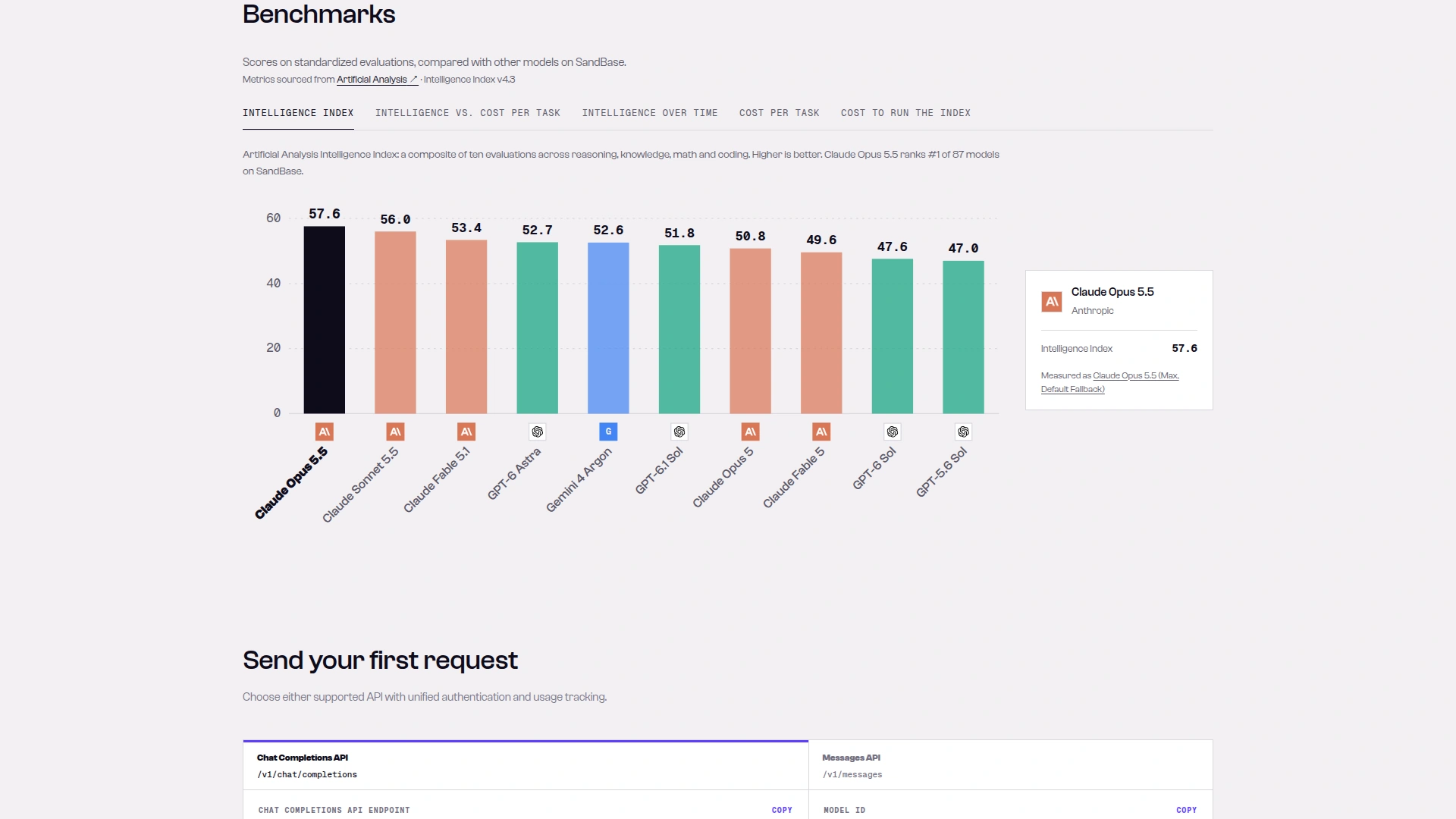 SandBase model-page benchmark view, captured October 27, 2026. Artificial Analysis Intelligence Index v4.3 measures a Max configuration; it does not predict performance at every effort level or on your own agent harness.
That configuration qualifier matters. A Max score should not be presented as the result of the default medium setting. For a production decision, keep the model, effort, tools, prompt, retries, and acceptance tests fixed, then compare task completion and total cost.
Claude Opus 5.5 pricing: Anthropic list vs SandBase 50% off
| Token type | Anthropic list | SandBase current price | SandBase discount |
|---|---|---|---|
| Input | $4.00/M | $2.00/M | 50% |
| Output | $20.00/M | $10.00/M | 50% |
| Cache read | $0.20/M | $0.10/M | 50% |
| 5-minute cache write | $5.00/M | $2.50/M | 50% |
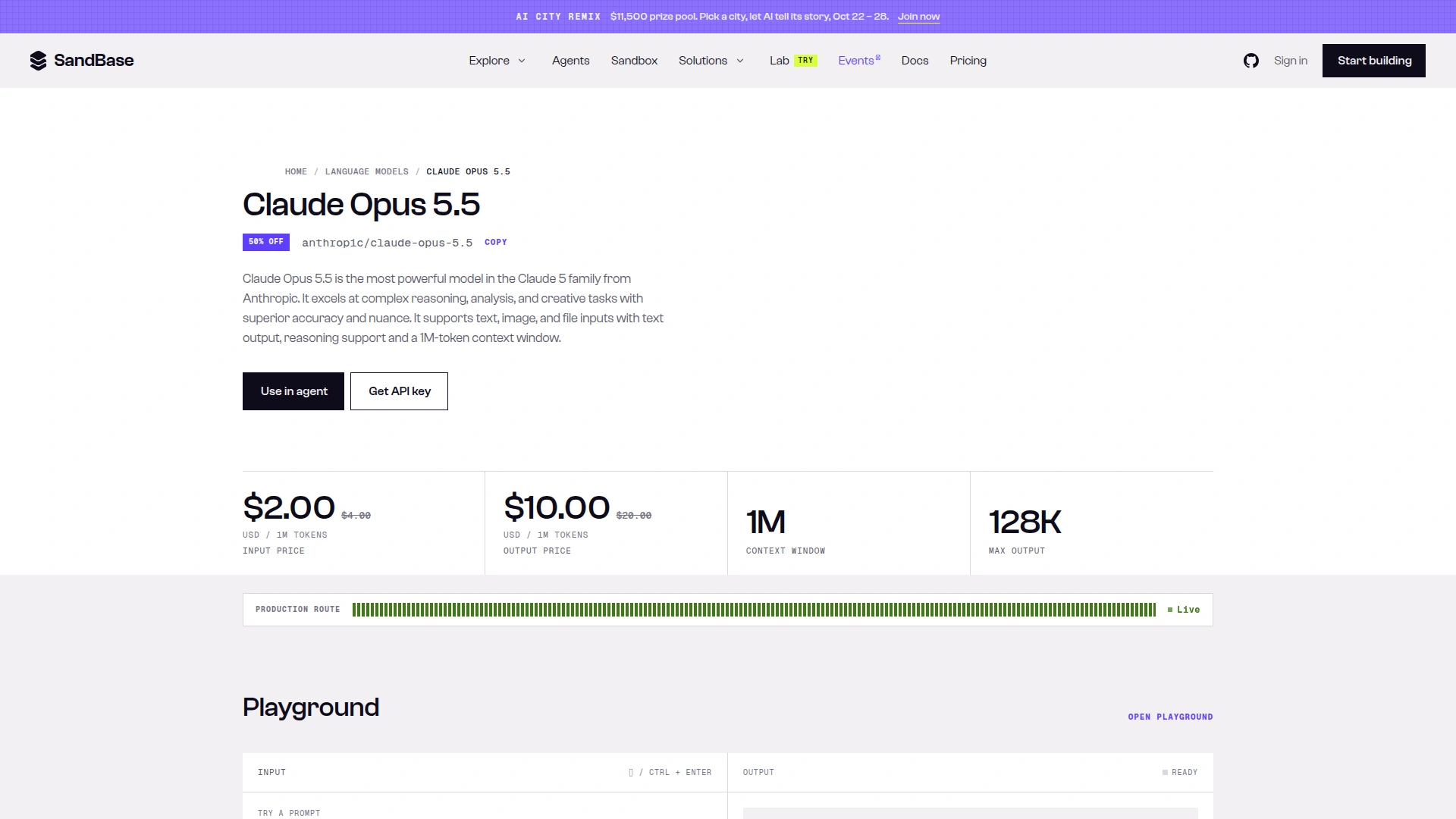 SandBase model page, captured October 27, 2026. The page showed 50% off and a live production route. Promotions can change, so treat the linked model page—not this paragraph—as the current price at purchase time.
A 100K-input, 5K-output call costs $0.25 at the displayed SandBase rate: $0.20 input plus $0.05 output. At Anthropic list price, the same uncached token mix is $0.50. If 90K of that input is a cache hit, the SandBase arithmetic becomes $0.02 uncached input + $0.009 cache read + $0.05 output = $0.079.
The catch is always-on thinking. Actual output billing can exceed the visible prose length, so estimate from API usage records rather than counting characters in the final answer.
A small live check: correct diagnosis, $0.008062 billed
We sent one deterministic code-review prompt through SandBase on October 27, 2026. The function always added one to an integer division. Opus 5.5 correctly identified exact multiples—including zero—as the failing class, explained the phantom trailing page, and supplied integer ceiling division. It also separated a product-policy choice (“always show one empty page”) from the arithmetic fix.
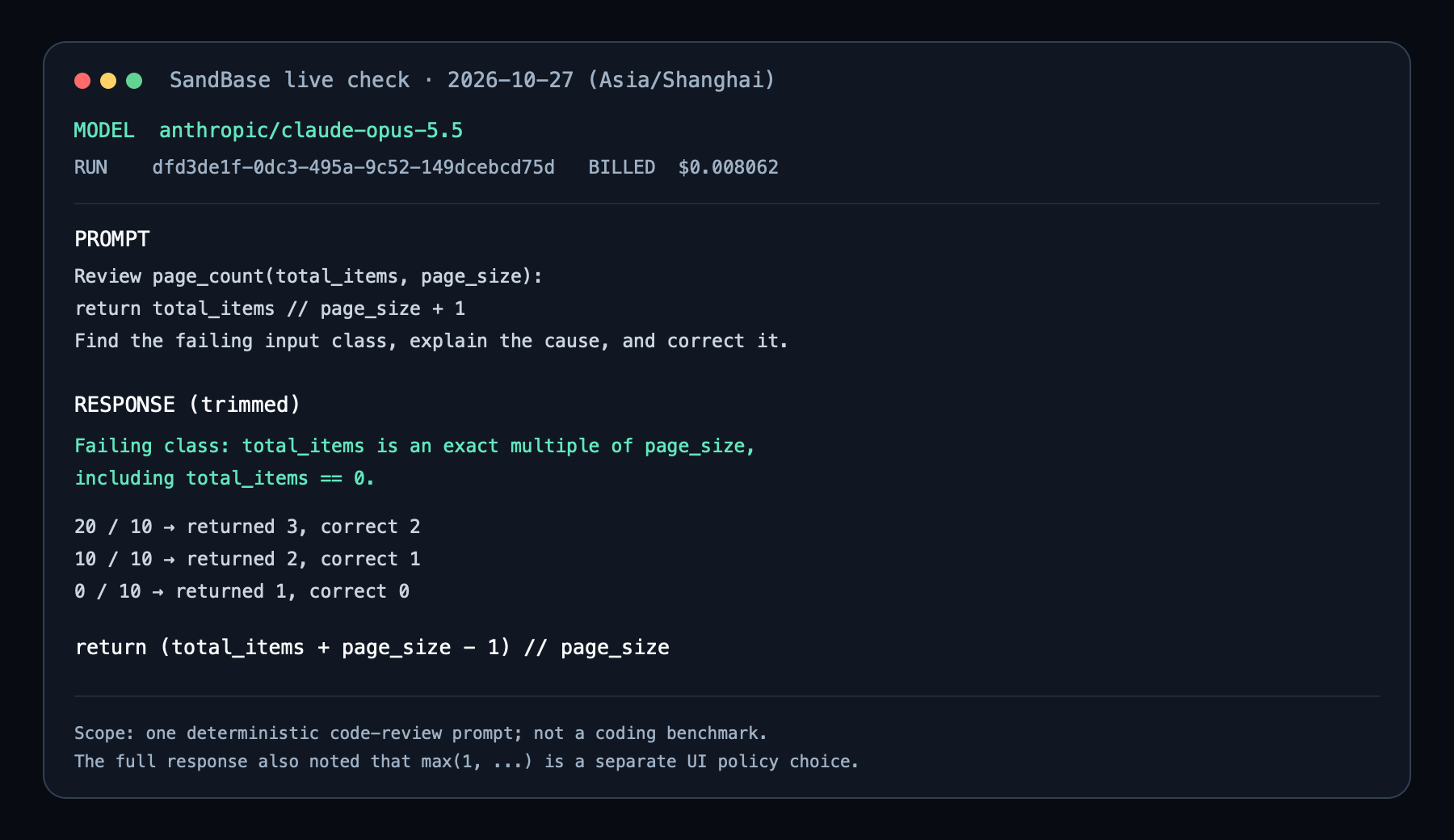 One SandBase run (
dfd3de1f-0dc3-495a-9c52-149dcebcd75d), billed $0.008062. This verifies route availability and one response; it is not evidence that Opus 5.5 will beat another model on coding.
The useful observation was not that it solved an easy off-by-one bug. Several models would. It was that the answer preserved the total_items == 0 edge case and did not silently turn a UI convention into a mathematical requirement.
Opus 5.5 vs alternatives
| Model | List input/output | Context | Best fit | Main trade-off |
|---|---|---|---|---|
| Claude Opus 5.5 | $4/$20; currently $2/$10 on SandBase | 1M | Long-running coding agents, high-value knowledge work | Thinking cannot be disabled; migration changes |
| Claude Sonnet 5.5 | $2/$10 | 1M | Faster general production work | Lower ceiling on Anthropic’s published agentic tests |
| Claude Opus 5 | $5/$25 | 1M | Existing integrations not yet migrated | Higher price and weaker release scores |
| Gemini 4 Argon | $4/$20 list | 1M | Google-centric workflows and its own benchmark strengths | Different API behavior; test format compliance |
Choose Opus 5.5 when a failed or incomplete task costs more than the extra reasoning tokens. Choose Sonnet 5.5 when latency and throughput dominate. If you need a wider comparison, our Opus 5.5 vs Gemini 4 Argon vs GPT-6 Astra test records 24 same-prompt calls and their costs.
How to call Claude Opus 5.5 on SandBase
The OpenAI-compatible route is the shortest path for an existing Chat Completions client:
curl --fail-with-body --silent \
  -X POST "https://api.sandbase.ai/v1/chat/completions" \
  -H "Authorization: Bearer $SANDBASE_API_KEY" \
  -H "Content-Type: application/json" \
  -d '{
    "model": "anthropic/claude-opus-5.5",
    "messages": [
      {"role": "user", "content": "Review this migration plan and name the riskiest assumption."}
    ],
    "max_tokens": 4096
  }'
SandBase also exposes /v1/messages for Anthropic-compatible clients. Check the live schema before assuming every Anthropic-native parameter is mapped identically. In particular, our earlier comparison found a route-specific structured-output failure in two calls; put the schema in the prompt and validate the returned JSON until your own integration proves otherwise.
Best uses—and where not to use it
Good starting workloads are multi-file code migrations, long agent loops with expensive failure, technical investigations, and professional documents that receive expert review. Prompt caching is especially relevant when a large stable prefix is reused across many turns.
Do not default to Opus 5.5 for classification, short extraction, low-latency autocomplete, or high-volume tasks already passing on a cheaper model. Do not migrate by changing only the model string if your code disables thinking, forces a named tool, reads the first content block as text, or discards thinking blocks in a tool loop.
Scope of our testing is narrow: one new live prompt plus previously published same-prompt runs. We did not independently test Anthropic’s 30% speed claim, 300K Batch output beta, computer use, or long-duration autonomy for this article.
FAQ
How much does Claude Opus 5.5 cost?
Anthropic lists $4/M input and $20/M output. SandBase showed 50% off—$2/M and $10/M—when checked on October 27, 2026. Verify the live model page because promotional pricing can change.
What is the Claude Opus 5.5 context window?
One million tokens, with up to 128K synchronous output. Anthropic documents a 300K Batch API output beta.
Can I turn thinking off?
No. Adaptive thinking is always on. Use the effort control to trade reasoning depth, latency, and cost.
Is Claude Opus 5.5 open source?
No. It is a proprietary Anthropic model; model weights have not been released.
Should I replace Sonnet 5.5 with Opus 5.5?
Only for task classes where your evaluation shows enough improvement to justify latency and reasoning-token cost. The current SandBase discount removes the base token-price gap, but it does not guarantee equal cost per completed task.
Bottom line
Opus 5.5 is easier to justify at SandBase’s current $2/$10 price, especially for cached, long-running agent work. The decision still belongs in an evaluation harness: migrate the API assumptions first, then compare completed work—not leaderboard headlines or visible answer length.
Start with the Claude Opus 5.5 model page. For the previous generation’s price and controls, see our Claude Opus 5 guide.