Fable 5.2 vs Opus 5.5 vs GPT-6 Astra: Cost and Routing
Fable 5.2 vs Opus 5.5 vs GPT-6 Astra on list price and Anthropic's benches. SandBase lists Fable 5.2 at $8/$40. Start on Opus unless the job already missed.
Three flagships, three bills. SandBase lists all three this morning, including the new Fable, at the card’s $8 / $40 with no discount on that row.
The question I keep getting is which string to put in the agent config now that Claude Fable 5.2 exists. Anthropic’s answer, on the models overview I opened 10 November 2026, is still Opus 5.5 for most work. Fable 5.2 is the escalation. GPT-6 Astra is a different vendor’s flagship, at a higher list price than either Claude id, with a different cutoff and a long-context surcharge Fable’s card does not have.
None of that is a license to paste Anthropic’s benchmark column into a dashboard and call it a ranking. Those cells are Anthropic’s measurements, including the GPT-6 Astra column. I did not re-run them. The release note has the launch facts. This page is the routing choice.
Key takeaway
- At list price, Fable 5.2 is $8 / $40 per million tokens, Opus 5.5 is $4 / $20, and GPT-6 Astra is $10 / $50 under 272K input tokens. Above that, Astra’s whole request is $20 / $75.
- Anthropic says start on Opus 5.5. Use Fable 5.2 when the job is long-horizon agentic work or when Opus at higher effort still misses. Their table has Fable ahead on most shared rows, and not on all of them.
- GPT-6 Astra, on that same Anthropic table, beats Opus on FrontierSWE v2 (65.5% vs 62.3%) and trails Fable 5.2 (69.9%). On AA-Briefcase Elo, Opus 5.5 leads Fable (1800 vs 1785).
- SandBase lists Fable 5.2, Opus 5.5, and GPT-6 Astra. On 10 November 2026 the Fable 5.2 card showed $8 / $40, cache read $0.20, cache write $10, with no discount on that price row. The id is
anthropic/claude-fable-5.2.- Fable 5.1 at $10 / $50 list is still listed, and its SandBase card still shows a discount. It is not a stand-in score for 5.2.
Where these three already live
Read the launch before the table. Fable 5.2, what shipped separates the rate card from the anecdotes. Effort, fast mode, and today’s curl is the migration, not another ranking.
Older pages still matter, and they are about older models. Opus 5.5 pricing is the daily-driver bill. Opus 5 is the generation before that. Fable 5.1 versus Mythos access is why a Fable key is not a research-program key. GPT-6 Astra vs Fable 5.1 on one 3D task is a same-prompt test we actually ran. It is not a 5.2 result. Astra, Opus 5.5, and Gemini 4 Argon is the previous three-way, from before this launch.
The leak that said “Fable 5.5” is still a leak log. It did not predict this price.
Confirmed vs unknown
| Item | Status on 10 November 2026 |
|---|---|
| Fable 5.2 list $8 / $40, fast mode $16 / $80, 1M context, 128K output, cutoff Jun 2026 | Confirmed on Anthropic’s overview and announcement |
Opus 5.5 list $4 / $20, default effort medium | Confirmed on the same overview |
| GPT-6 Astra list $10 / $50, cached input $1, cache write $12.50, 1,050,000 context, 128,000 max output, cutoff 30 April 2026 | Confirmed on OpenAI’s model page. Prompts over 272K input tokens are 2× input and 1.5× output for the whole request |
| Astra fast mode | Price only. OpenAI says fast mode is 2× the applicable rates. I am not quoting a speed multiplier, because that page did not give one |
| Anthropic benchmark cells, including the Astra column | Vendor results. Effort notes in the table below. Not an independent run |
| SandBase prices for Opus 5.5, Fable 5.1, and GPT-6 Astra | Confirmed as displayed that morning. Those three cards include a discount. They are not the list rates |
| SandBase Fable 5.2 | Present. HTTP 200. Displayed $8 / $40, cache read $0.20, cache write $10, 1M context, 128K output, Available. No discount on that price row |
| A same-prompt bake-off of 5.2 vs Astra run for this article | Not done |
The bill, before anyone quotes a bench
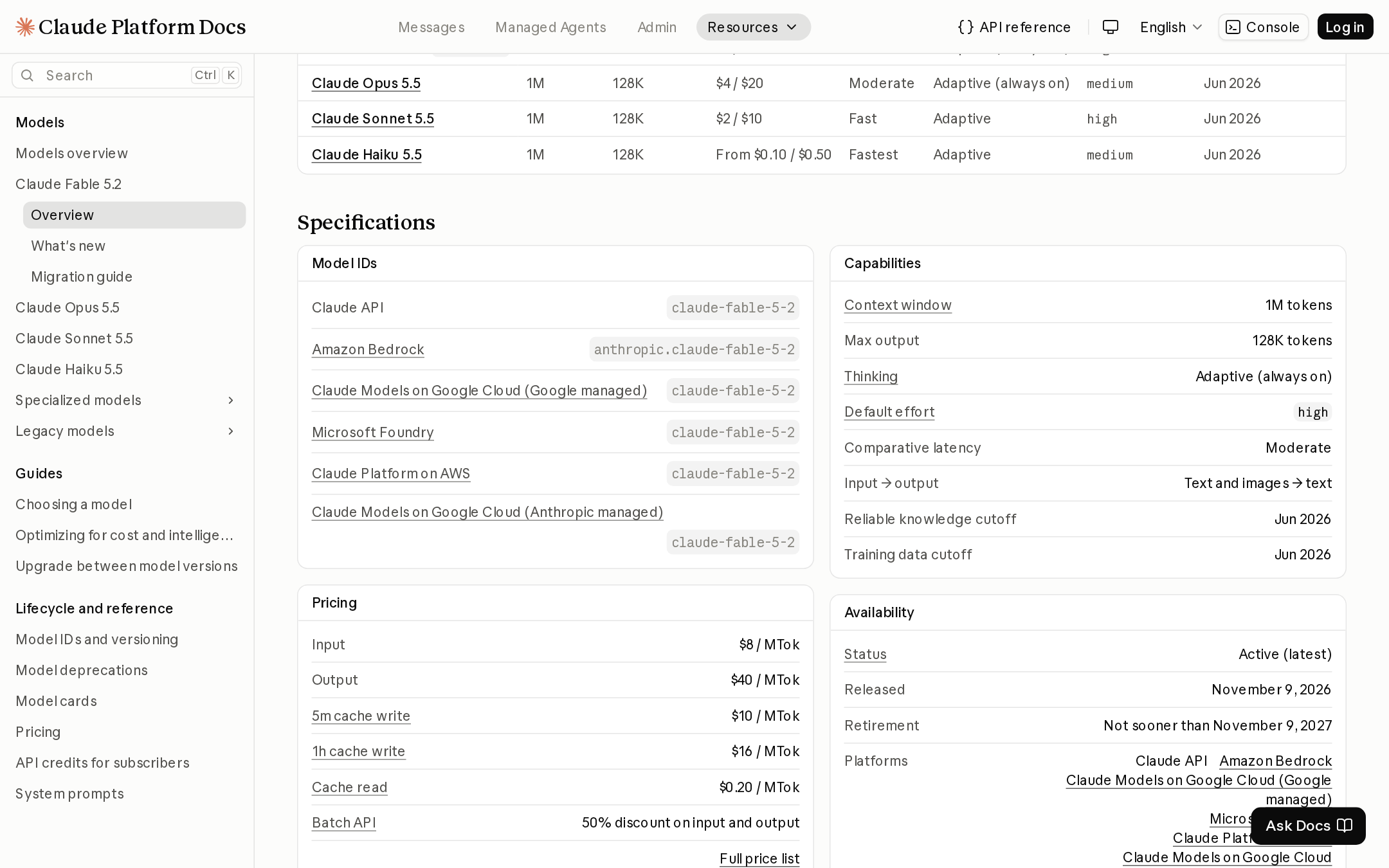
Anthropic’s models overview, captured 10 November 2026. The page says to start with Claude Opus 5.5 for most workloads and use Claude Fable 5.2 for demanding reasoning and long-horizon agentic work. Fable 5.2 is $8 / $40 per million tokens. Opus 5.5 is $4 / $20. Default effort is high on Fable and medium on Opus.
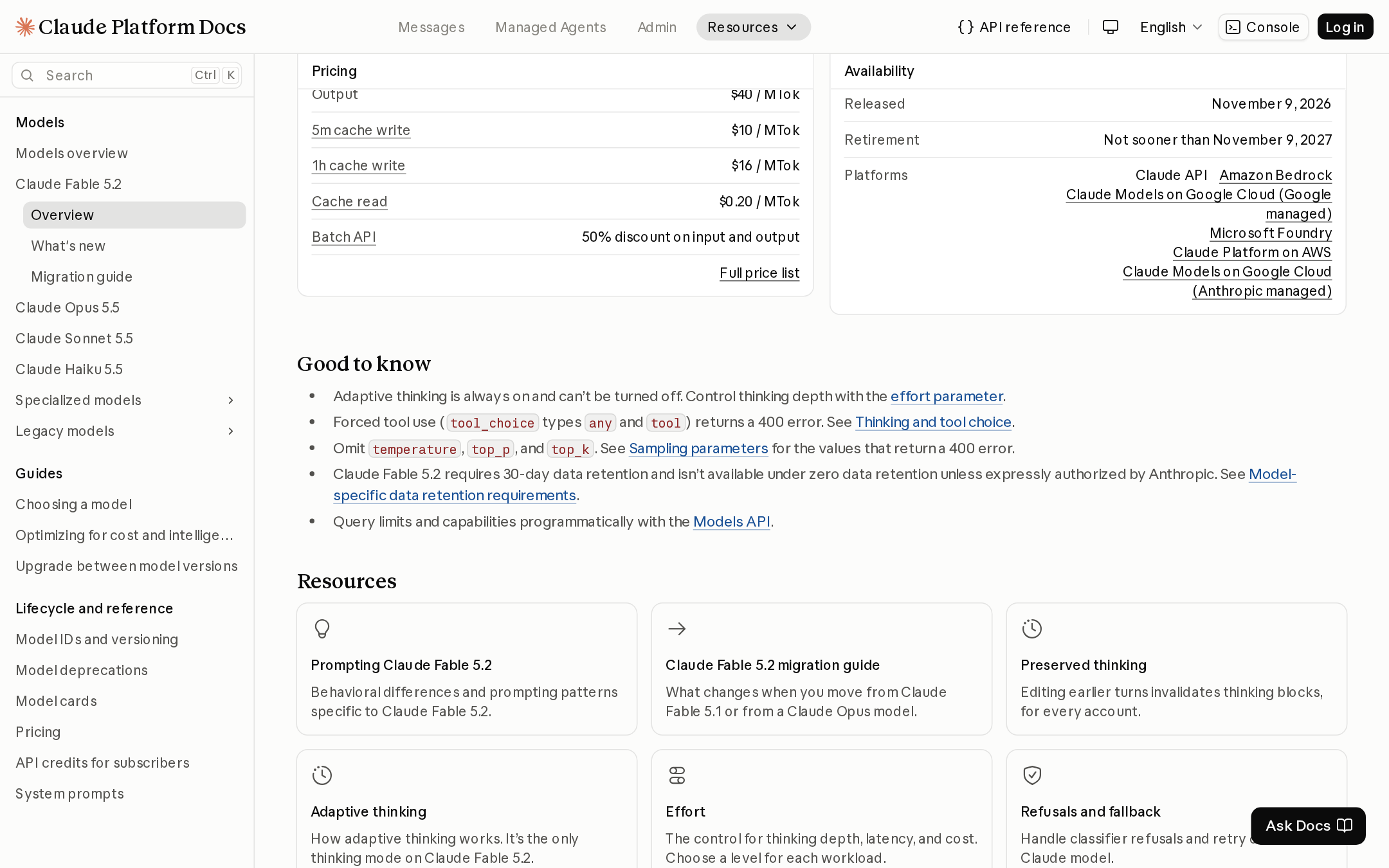
Fable 5.2 pricing and ids, same capture. Cache read $0.20, five-minute cache write $10, one-hour cache write $16, batch 50% off. Released November 9, 2026. Model ids include claude-fable-5-2 and Bedrock anthropic.claude-fable-5-2.
List price for a short request, 100,000 input tokens and 20,000 output tokens, no cache. Astra is under the 272K cliff, so the short rate applies.
| Route | Input / output per million | This request |
|---|---|---|
| Opus 5.5 | $4 / $20 | $0.80 |
| Fable 5.2 | $8 / $40 | $1.60 |
| Fable 5.2 fast mode | $16 / $80 | $3.20 |
| Fable 5.1 | $10 / $50 | $2.00 |
| GPT-6 Astra | $10 / $50 | $2.00 |
| GPT-6 Astra fast mode | $20 / $100 | $4.00 |
Opus is half of Fable 5.2 on this sketch, and Fable 5.2 is 20% under Fable 5.1. Astra matches Fable 5.1’s list rate until the prompt crosses 272K input tokens. Past that cliff, OpenAI prices the entire Astra request at $20 input and $75 output per million. Fable 5.2’s published card has one context rate. A 400K-token agent prefix is where the Astra bill stops looking like $10 and the Fable bill stays $8. I am describing the rate cards, not a traced session.
Cache changes the story if the prefix is stable. Fable 5.2 cache reads are $0.20 per million. Astra cached input is $1 per million on the short tier, and $2 once the request is in the long tier. A loop that rereads a large repo can erase Astra’s “same $10 sticker” feeling, or Fable’s, depending on the hit rate. No hit rate is assumed here.
SandBase’s displayed prices the same morning were not the list rates:
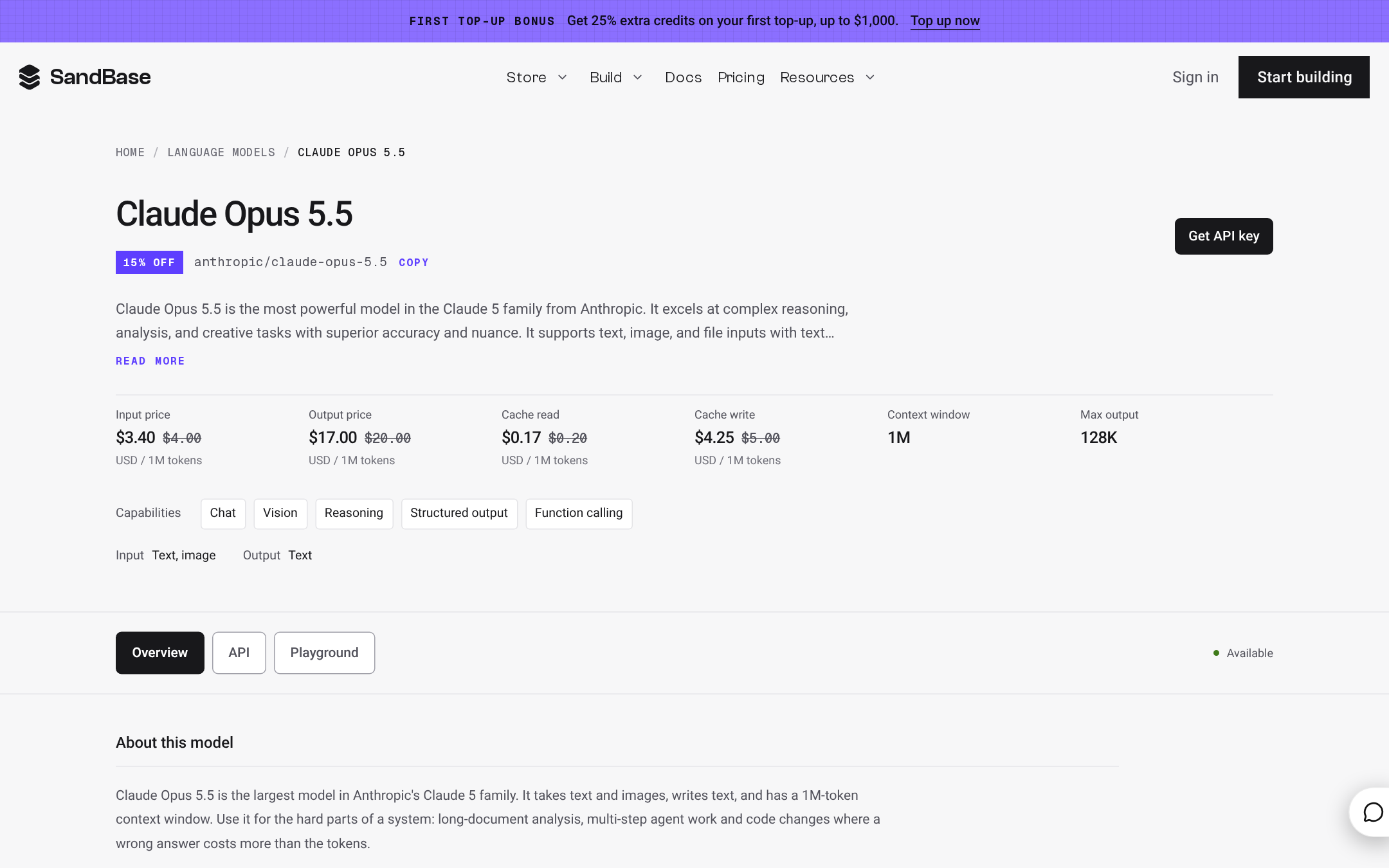
Opus 5.5 on SandBase, 10 November 2026. Id anthropic/claude-opus-5.5. Displayed $3.40 input and $17 output, against list $4 and $20, with a 15% off badge. 1M context, 128K max output, status Available.
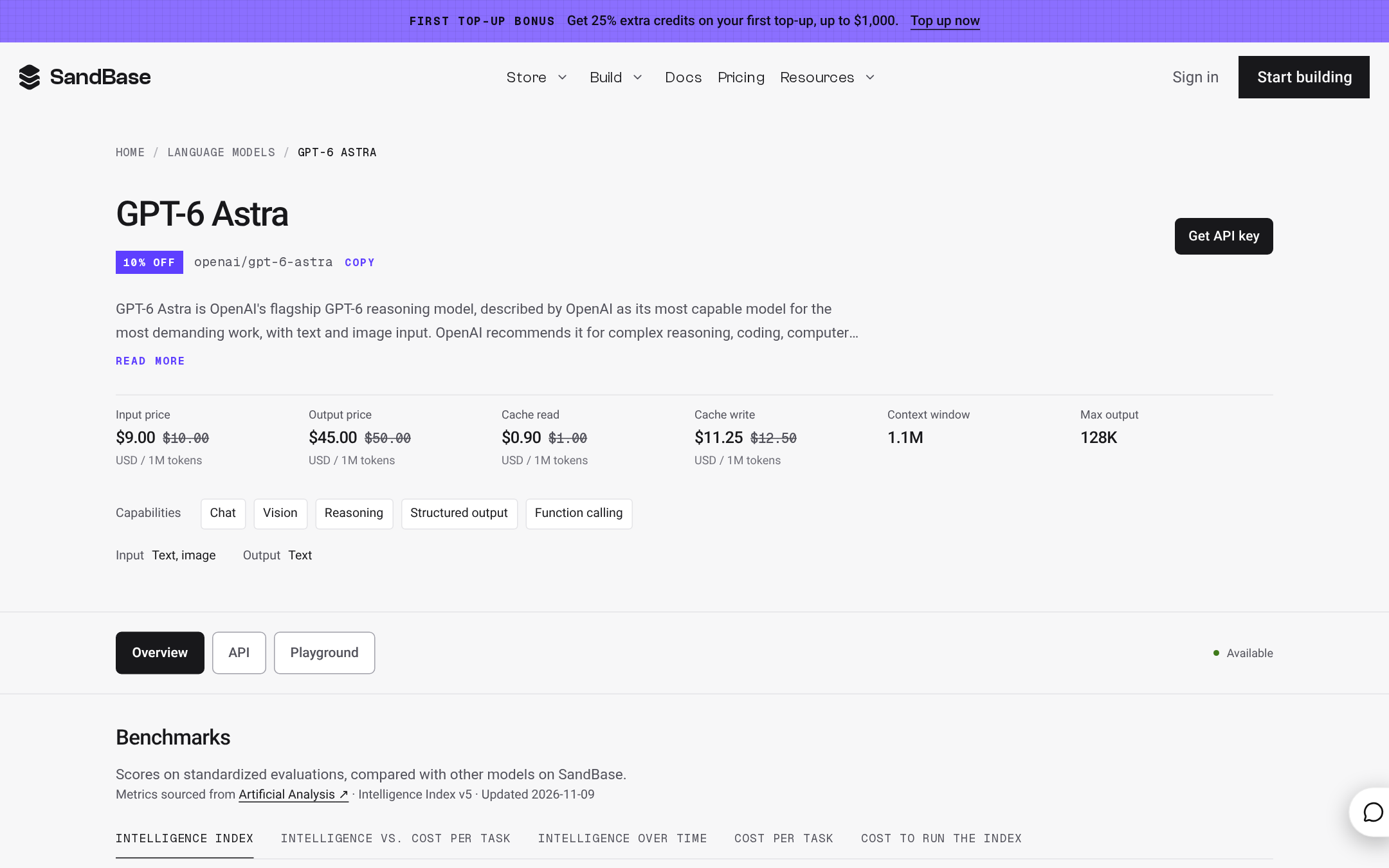
GPT-6 Astra on SandBase, same morning. Id openai/gpt-6-astra. Displayed $9 input and $45 output, against list $10 and $50, 10% off. The card labels context 1.1M and max output 128K. OpenAI’s model page says 1,050,000 context tokens and a maximum input of 922,000. I am quoting both, not averaging them.
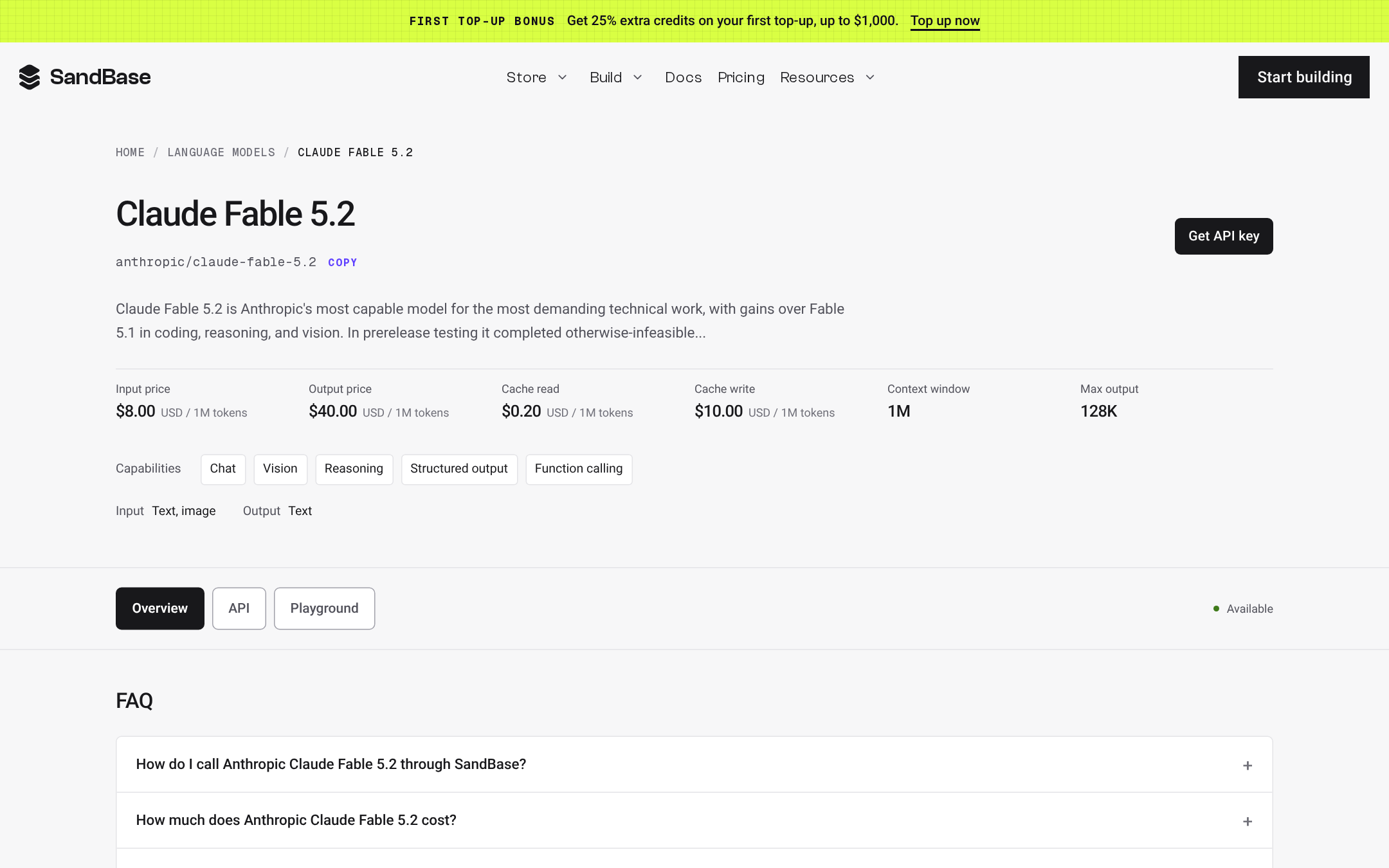
Fable 5.2 on SandBase, 10 November 2026. Id anthropic/claude-fable-5.2. Displayed $8.00 input and $40.00 output per million tokens, cache read $0.20, cache write $10.00, context 1M, max output 128K, status Available. The price row does not show a discount. Same capture as the release note.
Fable 5.1’s card, also in that release note, showed $8.50 / $42.50 against $10 / $50. That 15% badge is 5.1’s. I am not copying it onto 5.2.
On those displayed rates, the same 100k / 20k sketch is about $0.68 on Opus 5.5, $1.60 on Fable 5.2, $1.70 on Fable 5.1, and $1.80 on Astra. The 5.2 figure matches list price because the card shows no discount. Arithmetic on the cards, not an invoice. The discounted badges move. The Opus 5.5 pricing note has already had to be read against a live card for that reason.
Anthropic’s table, labeled as theirs
The announcement’s benchmark table compares Fable 5.2, Fable 5.1, Opus 5.5, GPT-6 Astra, and Gemini 4 Carbon. Anthropic says scores for the Claude columns use safeguards unless noted, and that cells are each model’s highest available effort unless the cell says otherwise. A few rows are internal (RoboDojo) or use tasks that are not shared across labs (CyScenarioBench). I am leaving CyScenarioBench out of the decision. Unique tasks per lab are not a ranking.
| Eval, as named by Anthropic | Fable 5.2 | Fable 5.1 | Opus 5.5 | GPT-6 Astra |
|---|---|---|---|---|
| FrontierCode 2.0 | 49.1% Xhigh | 32.4% Xhigh | 45.5% | 42.8% |
| FrontierSWE v2 | 69.9% | 56.3% | 62.3% | 65.5% |
| AutomationBench | 51.4% | 31.4% | 42.5% | 41.4% |
| Terminal-Bench-Science 0.1 | 74.6% (Mythos 75.3%) | 52.6% | 58.7% | 68.1% |
| WANDR, relaxed | 82.1% | 68.7% | 72.3% | — |
| OSWorld 2.1, partial offline | 89.3% | 83.5% | 87.2% | 79.5% |
| RoboDojo Sim, internal | 64.9% | 27.6% | 39.4% | 29.8% |
| HLE with tools | 74.2% | 65.6% | 67.7% | 57.2% |
| Chartography, no tools | 73.4% | 44.8% | 64.4% | 71.0% |
| AA-Briefcase rubric / Elo | 66.1% / 1785 | 61.5% / 1669 | 61.2% / 1800 | 52.0% / 1569 |
Two footnotes from the prose, not from my runs. At High effort, Anthropic says Fable 5.2 scores about 45.3% on FrontierCode 2.0, next to Opus 5.5’s 45.5%, at roughly half the cost per task, and ahead of Astra’s 42.8% at about the same cost. At Xhigh it reaches 49.1%. Gemini 4 Carbon leads AutomationBench in their table at 53.9%, above Fable’s 51.4%. Chartography at Medium effort is given as 66.4% for Fable, above Opus at Max (64.4%), which is a different cell from the 73.4% headline.
I paused on the Elo cell. If you only read “almost all capabilities,” you miss that Opus 5.5’s Briefcase Elo is higher. Knowledge-work taste and agentic coding are not the same axis. Astra’s empty cells are empty on the page. I am not filling them.
Fable 5.1’s column is the honest baseline for anyone still on that id. The jump they print, from 32.4% to 49.1% on FrontierCode at Xhigh, or 56.3% to 69.9% on FrontierSWE, is large. It is also their harness. The 3D game test remains the pattern for a check you control: one task, saved output, a bill. It does not transfer to 5.2.
Quick routing
| You are doing this | Call | Do not call |
|---|---|---|
| Ordinary coding, review, most agent loops | Opus 5.5 | Fable 5.2 as the default. It is twice the list price |
| A long job Opus already failed at higher effort | Fable 5.2, id anthropic/claude-fable-5.2. Set effort on the Claude API; the SandBase card does not list that field | A silent swap. On the Claude API, default effort moves from medium to high |
| You already measured Fable 5.1 and want that baseline | Fable 5.1 | Treating 5.1 scores as 5.2, or sending the hyphenated claude-fable-5-2 to SandBase |
| OpenAI tools, computer use, or a Responses-API stack you already run | GPT-6 Astra | A Claude bench as proof Astra will win your repo |
| Cyber or life-sciences work that needs the unsafeguarded variant | Mythos, if your org is verified | Mythos on SandBase. It is not a public card, and Fable’s safeguards are the point of the public id |
| A prompt already over ~272K tokens, cost-sensitive | Price Fable’s flat $8 against Astra’s long-context $20 before you pick | Assuming Astra stays at $10 |
Sonnet 5.5 at $2 / $10 is the step down Anthropic names, not a fourth flagship. I am not scoring it here. If the task is short and already passes, none of these three is the thrifty choice.
Try today on SandBase
API status, 10 November 2026: Fable 5.2’s SandBase id is anthropic/claude-fable-5.2. Opus is anthropic/claude-opus-5.5. Fable 5.1 is anthropic/claude-fable-5.1. Astra is openai/gpt-6-astra. The hyphenated claude-fable-5-2 is the Claude API id, not the SandBase string.
curl --fail-with-body --silent \
  -X POST "https://api.sandbase.ai/v1/chat/completions" \
  -H "Authorization: Bearer $SANDBASE_API_KEY" \
  -H "Content-Type: application/json" \
  -d '{
    "model": "anthropic/claude-fable-5.2",
    "messages": [
      {"role": "user", "content": "Route this task: daily code review, or a multi-hour migration that already failed once. Reply with the model id you would call and the one check that would change your mind."}
    ],
    "max_tokens": 2048
  }'
Swap the model to anthropic/claude-opus-5.5, anthropic/claude-fable-5.1, or openai/gpt-6-astra and keep the prompt. That is a comparison you can pay for. It will not reproduce FrontierCode. The agentic post explains why effort and speed stay off this curl: the SandBase card’s Chat Completions schema does not list them, and I have not confirmed a live call forwards those Claude API fields.
FAQ
Is Fable 5.2 better than Opus 5.5?
On Anthropic’s table, usually, at the effort they used, and not on every cell. Opus leads Briefcase Elo. At High effort they describe FrontierCode as roughly a tie, with Fable cheaper per task on that eval. “Better” without the task is how teams blow the budget. Start on Opus unless you already know the miss.
Is Fable 5.2 better than GPT-6 Astra?
On the columns Anthropic published, Fable 5.2 is ahead on the shared rows in the table above, except where Astra’s cell is blank. That is a vendor comparison. OpenAI’s price, context cliff, and April 2026 cutoff are separate facts. Both are callable on SandBase.
Why not just stay on Fable 5.1?
You can. It is still listed. Anthropic’s list price for 5.2 is 20% lower, and the SandBase 5.2 card shows $8 / $40 with no discount, against 5.1’s displayed $8.50 / $42.50. Their table also shows large gaps versus 5.1 on coding and science rows. Those gaps are not your repo until you measure them. The 5.1 science and pricing note is the behavior you have, not the behavior 5.2 claims.
Does fast mode change the ranking?
It changes the bill. Fable fast is $16 / $80. Astra fast, on OpenAI’s page, is 2× standard, so $20 / $100 under 272K. I do not have a paired speed number for Astra. Pay for fast mode when generation is the wait, not when tools are.
Which one is on SandBase?
Fable 5.2, Opus 5.5, Fable 5.1, and GPT-6 Astra returned HTTP 200 on 10 November 2026. Fable 5.5 is not one of those calls.
Related reading
- What Fable 5.2 shipped, and what is still unknown.
- How to set effort, and which id to curl today.
- Opus 5.5 pricing and the earlier Astra / Opus / Argon comparison.
- The 5.5 leak timeline, so the old rumor does not get mixed into this price.
The call I would make
Daily config stays on Opus 5.5. A job that has already failed there, and that can tolerate Fable’s 30-day retention and the loss of forced tool choice, is the Fable 5.2 candidate. On SandBase that string is anthropic/claude-fable-5.2. Astra is the right argument when the stack is already OpenAI’s, or when you have measured it, not when a competitor’s table looks convenient.
Sign in and open Claude Fable 5.2. If the task is ordinary review, run it on Opus 5.5 first. Escalate only after that miss is real.
Prices and bench cells retrieved 10 November 2026 (Asia/Shanghai) from Anthropic’s announcement, Fable 5.2 overview, models overview, migration guide, OpenAI’s GPT-6 Astra model page, and the SandBase cards linked above. Benchmarks are Anthropic’s.