Fable 5.1 vs Mythos 5.1: Pricing, Limits and Access
SandBase compares Fable 5.1 and Mythos 5.1 access, API pricing, fallback and retention. Learn why a Fable API account does not grant Mythos research permissions.
Key takeaway
- Fable 5.1 has public API access; Mythos 5.1 requires separate eligibility and approval. Having a paid Claude account is not evidence of Mythos access.
- Life-science access is an invite-only beta. Applying to the cyber program does not currently grant immediate Mythos API access.
- Claude Security uses Mythos 5.1, but product access does not authorize arbitrary calls to the underlying model.
- The two share an underlying model; safeguards, approved uses, and data terms are part of the comparison.
If you already use the Fable API and want to switch to Mythos, the first question is not which model ID to enter. It is whether your organization has been approved for that use. This SandBase comparison checks the access terms for developers planning code-review or research integrations. Anthropic’s Mythos page, checked September 9, limits direct model access to a set of approved US organizations. SandBase’s public Fable listing is not evidence that it offers a Mythos research route.
For ordinary code review or document analysis, evaluate Fable first. For restricted biology or cyber research, check the relevant program’s current terms before committing a project to Mythos. A public price or a successful Fable request is not proof of access.
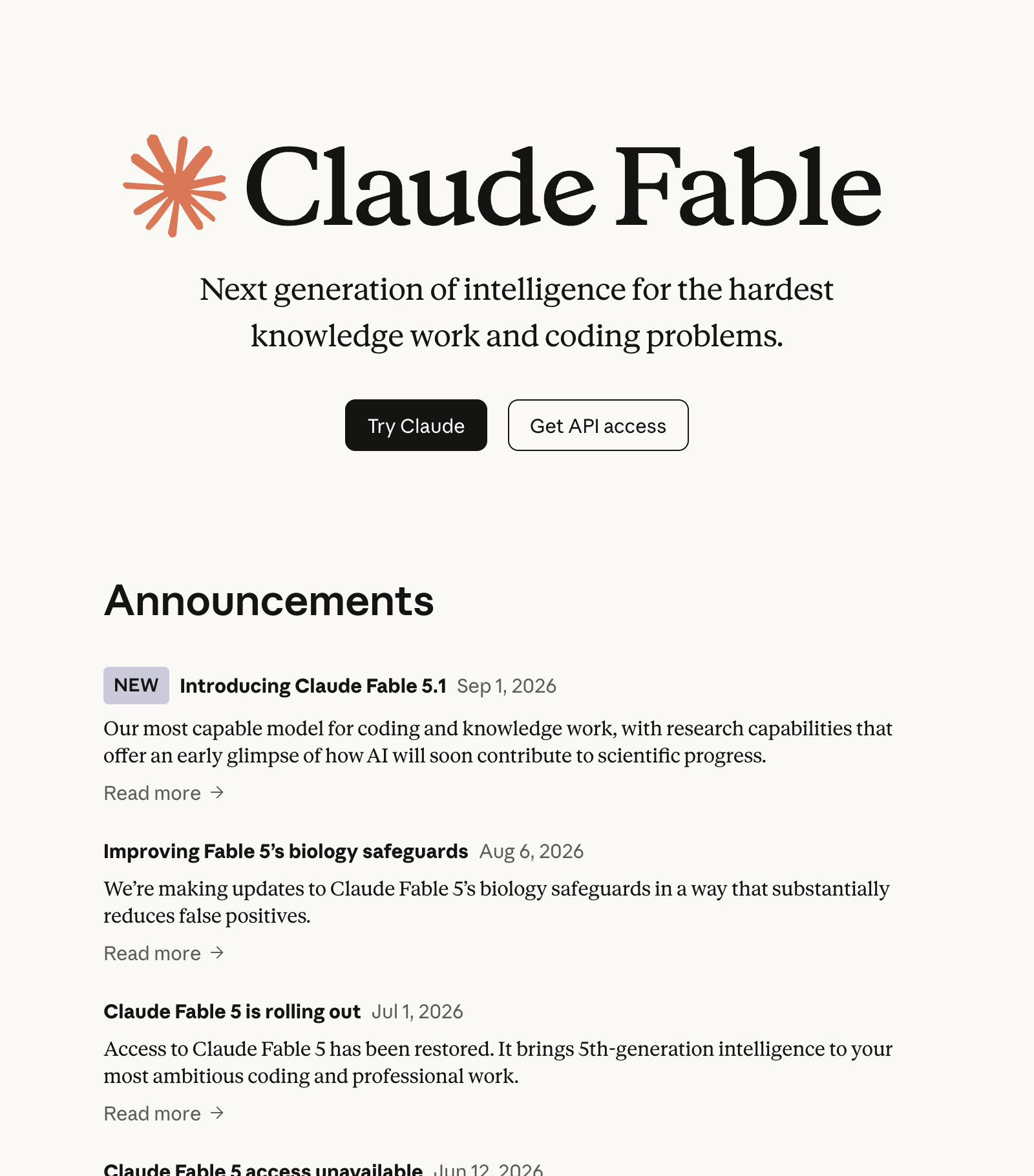 Anthropic presents Fable as the generally available surface for demanding coding and knowledge work.
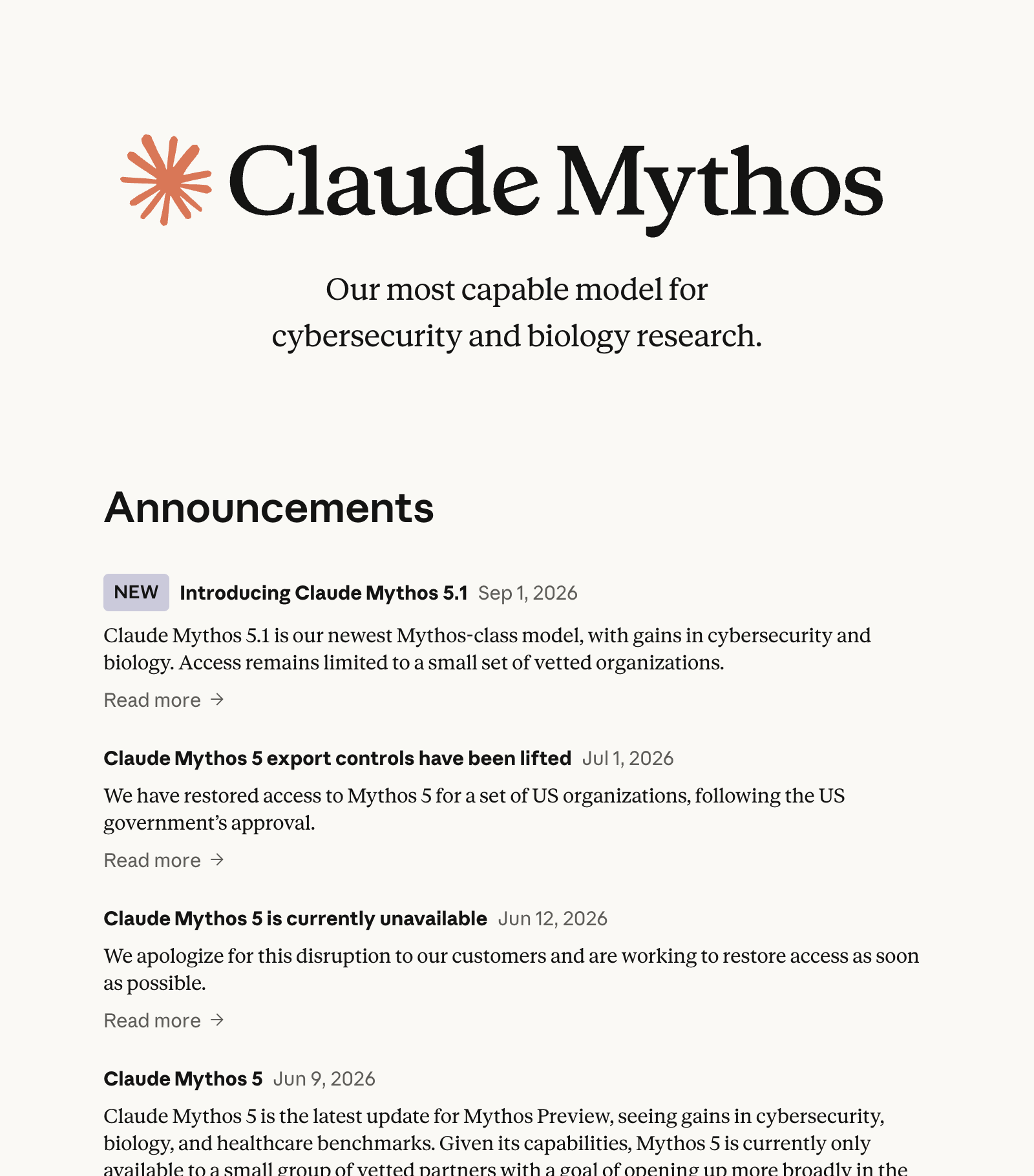 The Mythos page explicitly positions the model for cybersecurity and biology research and describes restricted availability.
 Anthropic’s safeguards announcement shows that access policy is part of the product boundary, not a hidden implementation detail.
Same core, different operating envelope
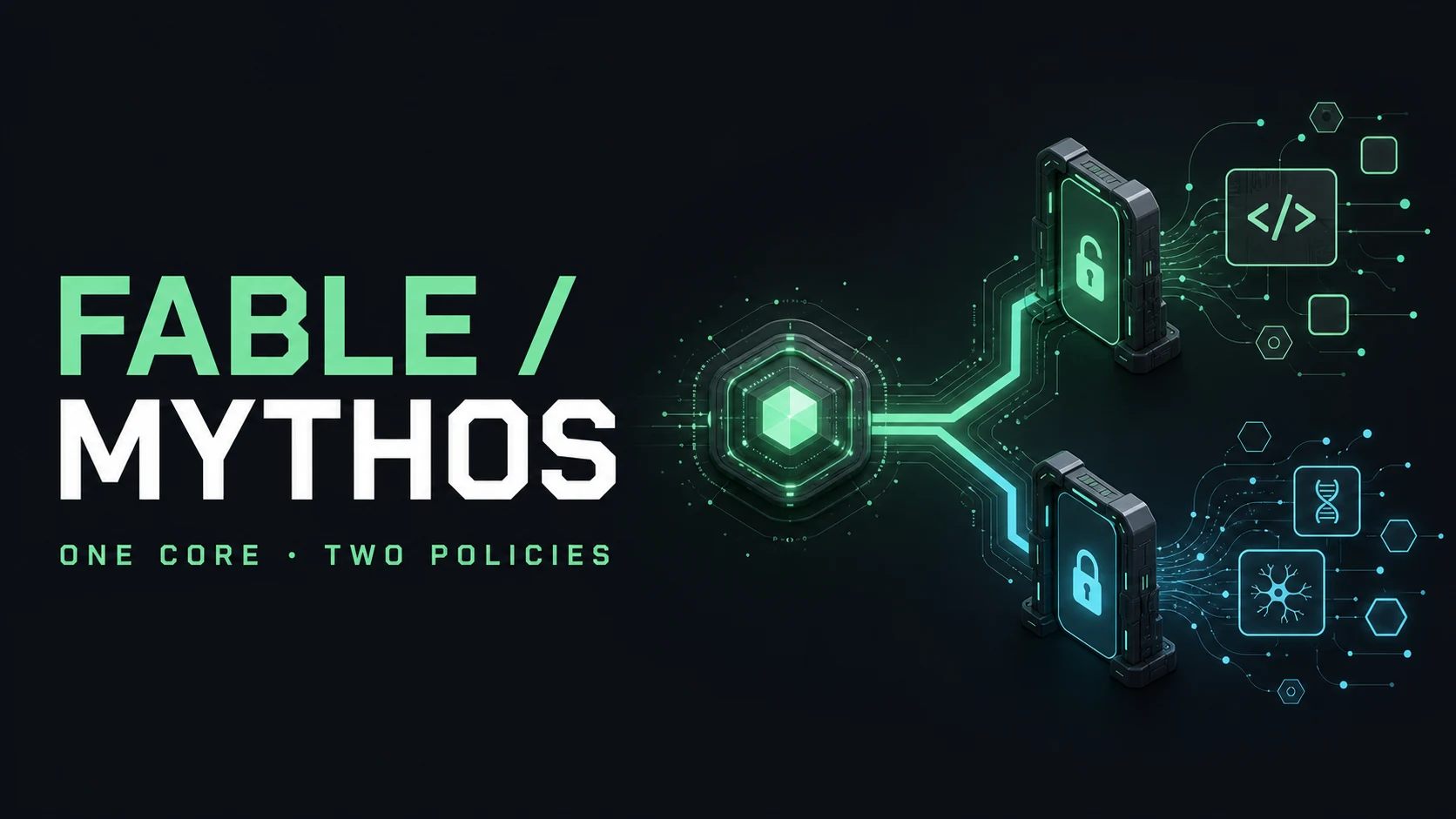
Anthropic says Fable 5.1 and Mythos 5.1 share the same underlying model. Fable is the broadly available surface for long-running coding, knowledge work, vision, and agent tasks. Mythos is the restricted surface for advanced cybersecurity and biology research.
That means the difference is not equivalent to choosing a larger model from a conventional catalog. It is closer to choosing a capability policy around the same model:
| Surface | Access | High-risk behavior | Best fit |
|---|---|---|---|
| Fable 5.1 | Pro, Max, Team, Enterprise, API and cloud marketplaces | Safeguards may block or route requests to Opus | Long-running software and knowledge work |
| Mythos 5.1 | Vetted organizations through trusted-access programs | Reduced safeguards for approved defensive and research work | Cyberdefense and life-science research |
Fable is not “Mythos with fewer tokens.” Anthropic’s Fable page says most Claude applications route flagged cybersecurity requests to Opus 4.8 and biology requests to Opus 5; direct API customers must configure the Fallback API. A third-party Fable listing does not establish that service’s fallback configuration. The requested model and the model that answers may differ, but do not infer a switch from the response’s writing style.
What Fable users can expect
Fable 5.1 is positioned for tasks that run for hours: codebase-wide changes, code review, browser work, asynchronous agents, and multi-stage analysis. The product page emphasizes planning, tool use, recovery after failure, verification, and status updates.
For a developer, the practical contract is not “the model never refuses.” It is “the model can complete more ordinary work without supervision, while selected domains remain policy-controlled.” Cybersecurity is the clearest example: Fable can identify vulnerabilities in source code, but Anthropic says it still blocks penetration testing, exploit generation, and binary-based vulnerability scanning.
The same pattern applies to biology. Benign educational and health questions may be allowed more often than in earlier Fable releases, but dual-use biology and chemistry requests can still fall back to an Opus model.
Who can access Mythos 5.1? Three routes with different permissions
As checked on September 9, 2026, the Mythos product page and release announcement distinguish three routes:
| Route | Status described in the checked announcement | What it does not establish |
|---|---|---|
| Life Sciences Verification Program (LSVP) | Invite-only beta for professional life-science research | That any lab can self-enroll or use Mythos immediately |
| Cyber Verification Program (CVP) | Applications open for certain Opus and Sonnet models; Mythos to be added later | That submitting or obtaining a CVP application outcome already includes Mythos |
| Claude Security | A code-security product already using Mythos 5.1 | Permission to send arbitrary research tasks through the underlying model API |
Start from the official Mythos page for current program links and eligibility updates. Before planning an integration, confirm three things in your invitation, approval, or contract:
- The authorized organization and users: do not assume one person’s account approval covers an entire team.
- The exact product, version, and allowed work: Claude Security access and Mythos model access are different; an older Mythos approval does not itself establish 5.1 availability.
- The access channel and data terms: confirm the offered API or product, retention arrangements, and restrictions before sending research data.
These are planning checks, not an official application-form checklist. The checked materials do not establish an approval deadline or guarantee acceptance. If your organization or country is outside the stated scope, do not plan around a presumed exception.
The restricted tier does not turn a model into an autonomous laboratory or a universal penetration tester. Access is a governance decision, not a blanket removal of every control. Teams still need their own review, audit logs, sandboxing, approval gates, and domain experts.
That boundary is especially important for API design. Do not silently retry a Fable request against a more privileged endpoint. Treat fallback as a typed outcome, record which model actually answered, and make the user-facing capability clear.
Fable request -> Fable response, safeguard refusal, or configured fallback
Mythos research request -> separate approved access channel required
If your application reports only model=fable-5-1, operators will miss a meaningful difference between a direct answer and a fallback. Record the requested model and any effective-model, fallback, or error information actually returned. Mark undisclosed internal models and policy classifications as unknown rather than inventing telemetry.
Pricing is not the whole comparison
Anthropic lists Fable 5.1 at $10 per million input tokens and $50 per million output tokens, with cache reads at $0.25 per million tokens. Mythos starts at the same input/output rates. Both official product pages require 30-day safety-monitoring retention by default; this is not unique to Mythos.
The Fable page separately describes Enterprise Frontier Safeguards (EFS): eligible enterprises can store data in their own cloud infrastructure, with human review performed by the customer by default. Until EFS is available, eligible customers can use Fable 5.1 with zero data retention. Do not automatically extend this Fable exception to Mythos; check its contract and program terms separately.
For a long-running agent, effective cost depends on more than the headline token price. Count retries, fallback calls, tool invocations, context caching, and human review. A cheaper request that needs repeated supervision may be more expensive than a slower successful run.
How to choose
Choose Fable 5.1 when the task is ambitious but ordinary: repository work, research synthesis, document analysis, browser automation, or an unattended coding session. Build around explicit checkpoints and verification even when the model is marketed as long-running.
Pursue Mythos access only when your work genuinely needs reduced safeguards for approved cybersecurity or life-science research. Prepare an access justification, an audit plan, data-handling controls, and a human review path before treating the model as production infrastructure.
The important launch story is therefore not “Anthropic released a secret supermodel.” It is that capability and access policy are now being shipped as two tightly related products. For builders, the policy layer is part of the model contract.
Fable, Mythos, and Opus: a practical comparison
| Question | Fable 5.1 | Mythos 5.1 | Opus fallback |
|---|---|---|---|
| Can a normal API customer request it? | Yes | No, trusted access required | Depends on the application and route |
| Main role | Long-running coding and knowledge work | Approved cyber and biology research | Safer handling of flagged requests |
| Vulnerability work | Source-level identification with limits | Reduced safeguards for vetted defenders | May answer a routed request under its own policy |
| Biology work | Benign help; dual-use requests may route away | Research access for approved life-science teams | Fallback for safeguarded biology requests |
This comparison also explains why benchmark tables need footnotes. Anthropic notes that Fable’s production safeguards were enabled during evaluation. A score can reflect the model’s reasoning ability, the policy intervention, or the fallback behavior. Comparing a direct Mythos result with a safeguarded Fable result as if they were identical products is not a clean experiment.
FAQ
Does a paid Claude subscription or Fable API key unlock Mythos?
No. Neither establishes Mythos eligibility. Check the program-specific approval and the exact model or product it covers; a public price is not permission to call the model.
Does applying to CVP give me Mythos 5.1 now?
Not according to the checked launch announcement: CVP currently covers certain Opus and Sonnet models, with Mythos to be added later. Application, acceptance into a program, and access to a particular version are separate questions.
Is Mythos 5.1 a larger model than Fable 5.1?
Not according to Anthropic’s product pages. They describe the two as the same underlying model with different safeguards and access policies. The useful distinction is capability exposure, not a published parameter-count difference.
Will a Fable request always be answered by Fable?
No. Flagged cybersecurity and biology requests may be routed to another Claude model. Record fallback information when exposed; the requested identifier alone does not prove which internal model answered.
Why can a code-review request trigger fallback?
The public Fable surface is intentionally restricted. Anthropic says it can identify vulnerabilities in source code, while penetration testing, exploit generation, and binary-based scanning remain blocked. Dual-use biology and chemistry can also trigger safeguards.
Does the lower cache-read price make every workload cheaper?
No. Anthropic estimates lower costs for typical and highly agentic workloads, but your total depends on retries, tool calls, output length, fallbacks, and human review. Measure accepted-task cost rather than token price alone.
Access comes before a cost comparison
Use the Fable 5.1 pricing example to separate cache-read savings from a task’s total. But first establish which model your organization may use: a lower advertised price does not make a restricted route available.
Where to start an integration
For ordinary coding or document work, the Claude Fable 5.1 entry on SandBase lists anthropic/claude-fable-5.1. The September 9 catalog check confirms the entry and request schema, not access for every account or any Mythos entitlement. Use the model page to confirm the selected endpoint and price; use Anthropic’s program pages for Mythos eligibility. A Fable request cannot bypass that approval process.
For a broader migration decision, read the Fable 5.1 capabilities and pricing review. For multi-hour tasks, use the Fable acceptance and recovery checklist.
Sources checked September 9, 2026: Claude Fable, Claude Mythos, the Fable 5.1 / Mythos 5.1 release, and SandBase’s Fable model entry. Further reading: Enterprise Frontier Safeguards. This is a terms comparison, not a report of obtaining Mythos access or testing its restricted capabilities.