Claude Fable 5.1: Coding, Research and API Pricing
SandBase explains Claude Fable 5.1 coding results, API IDs and cache pricing, with a worked cost example and a separate Astra comparison using actual request bills.
Key takeaway
Claude Fable 5.1 is Anthropic’s model for writing and revising code, analyzing documents, and carrying out multi-step work with tools. If you maintain a coding agent and are considering a switch, start with two questions: will it finish your existing tasks, and what will those completed tasks cost? Anthropic’s September 1 release improves reported performance and cuts cache-read pricing. It does not make every task 75% cheaper.
This SandBase review separates Anthropic’s published results from a worked pricing example and our September 7 Astra–Fable game test. The game test has actual request bills and startup failures; the science cases below remain vendor reports, not our experiments.
- Fable 5.1 is available through Claude products and the API, with official ID
claude-fable-5-1. - Input and output remain $10/$50 per million tokens. Cache reads fall from $1 to $0.25 per million.
- Mythos 5.1 shares the underlying model but has restricted research access; it is not a mode every Fable customer can select.
- The benchmarks and customer cases below are vendor disclosures, not experiments independently reproduced for this article.
Fable 5.1 coding and knowledge-work benchmarks
Terminal-Bench-Science 0.1 tests work in scientific terminal environments. Anthropic reports 52.6% for Fable 5.1, against 24.7% for Fable 5 and 22.4% for GPT-5.6 Sol in its setup. These are task scores under specified conditions, not the probability of solving any scientific problem.
On Terminal-Bench 4.0, Fable 5.1 scores 55.8%, Fable 5 scores 42.0%, and Mythos 5.1 scores 60.9%. Anthropic attributes the difference between the two 5.1 products to safeguard interventions, not to a larger underlying model.
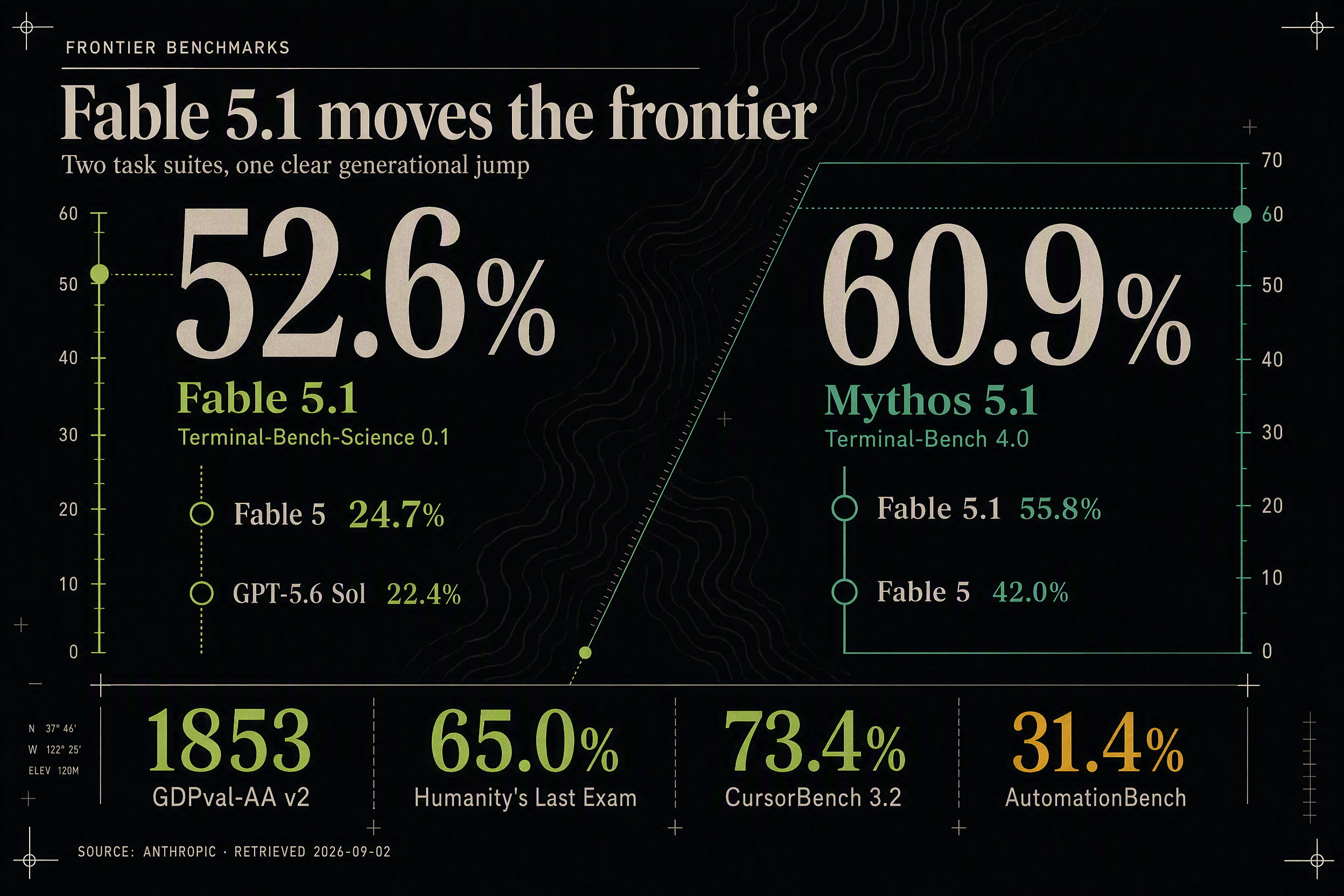
Figure: A GPT Image 2 infographic of Anthropic’s reported data, not an official chart. Graphic positions are not to scale; use the numeric labels and official table and footnotes. Percentage benchmarks and GDPval-AA points use different units.
GDPval-AA v2, a knowledge-work evaluation, is reported at 1,853. Humanity’s Last Exam is 65.0% with tools and 60.9% without them. Do not mix those configurations. The science-terminal evaluation has a reported standard error of approximately ±3.5–4.5 percentage points; Fable was evaluated with production safeguards, including fallback behavior on some tasks.
Fable 5.1 API pricing: what changed, and what did not
A cache read reuses previously processed input, such as background documents repeated across a multi-turn job. It is billed differently from new input, generated output, and cache writes. See the separate cache read and write pricing explanation for that distinction.
| Per million tokens | Fable 5 | Fable 5.1 |
|---|---|---|
| New input | $10 | $10 |
| Output | $50 | $50 |
| Cache reads | $1 | $0.25 |
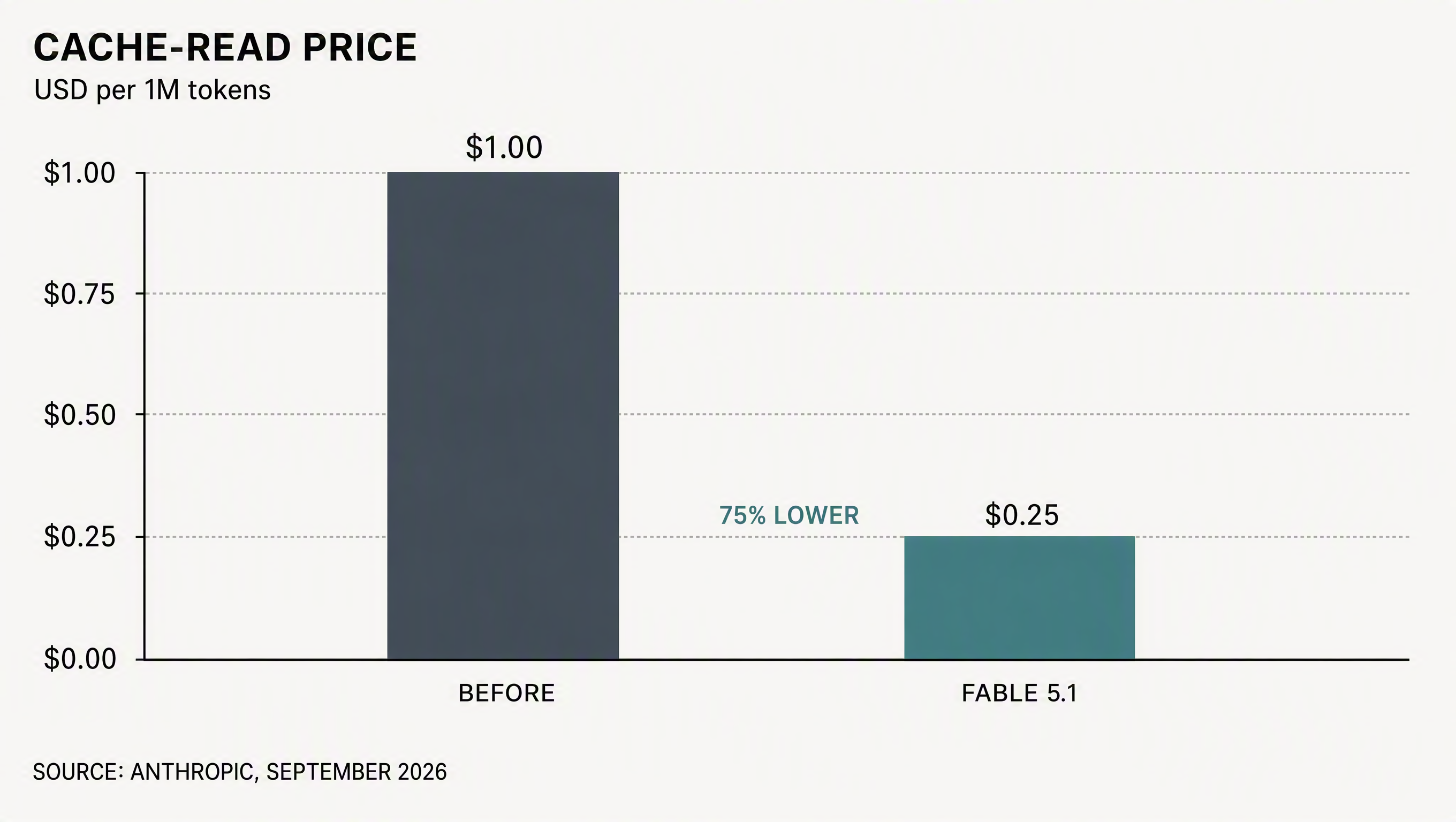
Figure: A visualization of official pricing. The 75% figure applies to cache-read unit prices; approximately 25% and up to 45% refer to estimated workload savings.
A fixed-usage example: $12 becomes $11.25, not $3
Consider a hypothetical task with 100,000 new input tokens, 200,000 output tokens, and one million tokens read from an existing cache. Hold usage constant and apply the official list prices:
| Included usage | Fable 5 | Fable 5.1 |
|---|---|---|
| 100,000 new input tokens | $1.00 | $1.00 |
| 200,000 output tokens | $10.00 | $10.00 |
| 1,000,000 cache-read tokens | $1.00 | $0.25 |
| Subtotal | $12.00 | $11.25 |
The saving is $0.75, or 6.25% of this subtotal. This is arithmetic, not a measured run or a complete invoice: it excludes creating the cache, tools, taxes, and service-specific charges. Different token counts change the result. At the stated output rate, an extra 20,000 output tokens would add $1—more than the cache-read saving in this example.
Anthropic’s approximately 25% typical-workload and up-to-45% highly agentic savings are a separate estimate. They use four weeks of actual August 2026 usage at default effort, not the hypothetical example above, and are not guarantees for each request.
What to check in your own usage
Compare new input, cache writes, cache reads, output, and retries for the same accepted task. Repeating a document does not itself prove a billed cache hit; use the cache-read usage reported by the service when available. If that detail is not exposed, mark the cache saving as unverified instead of applying 75% to all input.
Which Fable 5.1 model ID should you use?
Anthropic’s direct API uses claude-fable-5-1. The Claude Fable 5.1 model page on SandBase, checked September 9, lists anthropic/claude-fable-5.1. These identify access to Anthropic’s model through different services; SandBase is the API access platform, not the model’s developer.
The SandBase page currently lists $10 input, $50 output, and $0.25 cache reads per million tokens. It shows Messages API details as well as a Chat Completions example. Use the parameters for the endpoint you select; do not combine the two request formats. This update checked the catalog and schema, not a new inference run or every account’s access.
Matching list prices do not make the worked example an actual SandBase bill. For recorded charges, open the Astra vs Fable 3D game test. For approval and retention terms, use the separate Fable vs Mythos access comparison; a Fable listing does not establish Mythos access.
Research: maps, binders, and GPU computation need different checks
Venus mapping is a reconstruction, not a new observation
Fable 5.1 used historical NASA Magellan radar imagery and an existing map to train a neural network, producing elevation data for about one-third of Venus. Anthropic reports detail at 2–3 km instead of 10–20 km, with height estimates up to 25% more accurate.
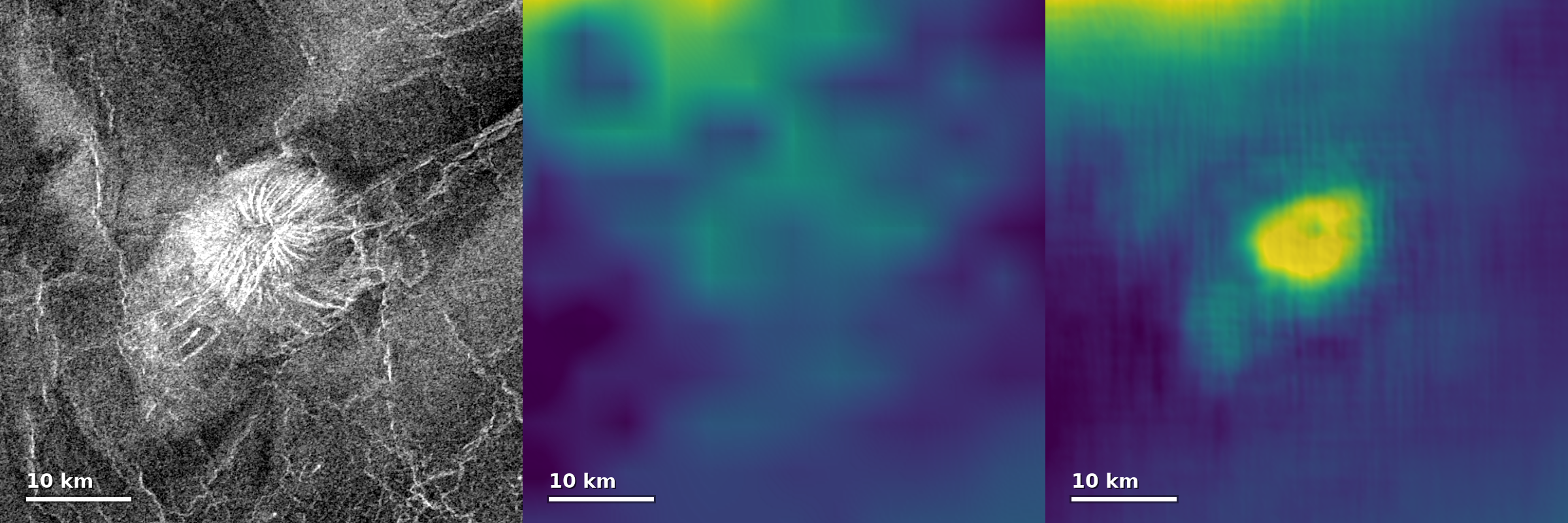
Figure: Official same-region views show Magellan radar, legacy altimetry, and a new digital elevation model. The 300 m DEM label describes a grid scale, not proof of independently resolved 300 m terrain detail.
Protein-design hits are not approved drugs
Mythos 5.1 used open-source design and folding tools, with candidates tested by two external organizations. Anthropic reports nearly 50% viable binders across 12 targets. On three targets, binding affinities exceeded the compared competition’s best designs by about tenfold. Neither result establishes drug efficacy, toxicity, or clinical success.
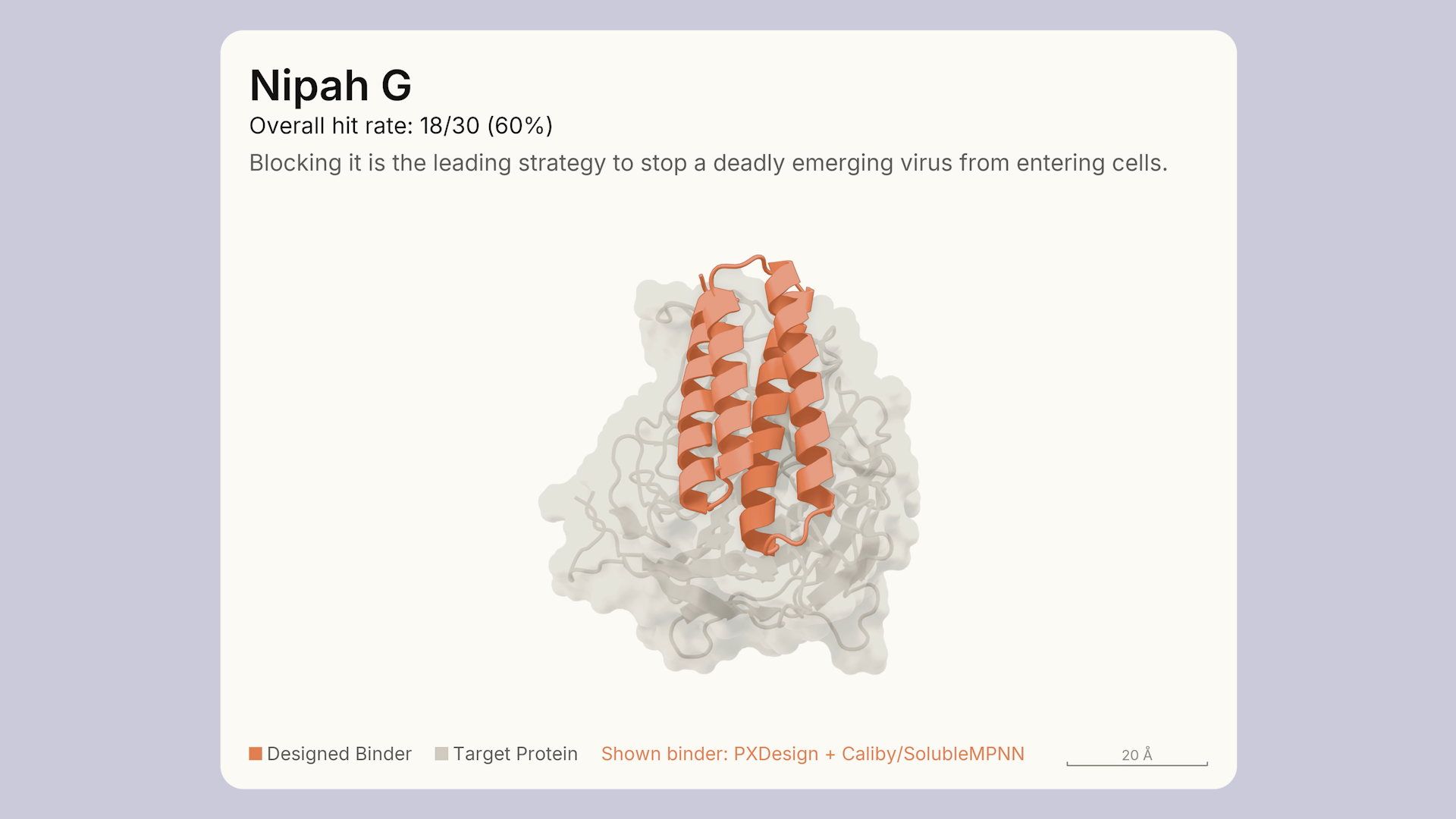
Figure: The official Nipah G example is labeled 18/30 (60%). Its sample denominator must not replace the aggregate hit rate across 12 targets discussed in the release.
GPU kernels: peak speed and whole-job savings differ
A GPU kernel is a program that performs a computation on the graphics processor. Mythos 5.1 rewrote kernels and cached intermediate results for seven open models. Anthropic reports approximately 1.4–2.5× speedups on an H100 with matching outputs. For an Evo 2 40B analysis of three million variants, estimated GPU cost falls from $18,000 to $8,000 at cloud list prices. Not every model runs 2.5× faster, and this is not an invoice from our own test.
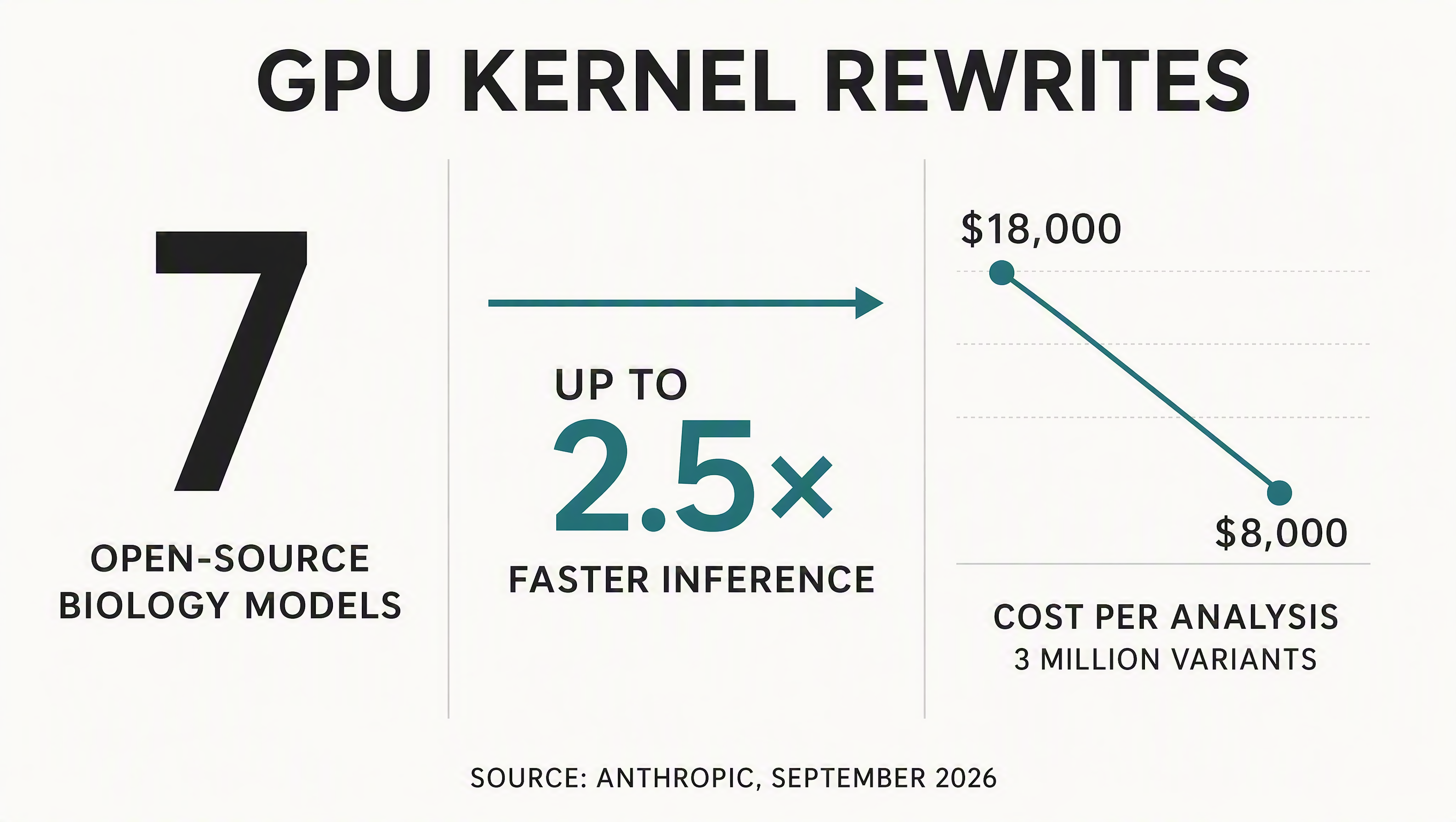
Figure: A visualization of reported case-study figures. The 2.5× value is the maximum tested speedup; $18,000 to $8,000 is an estimated GPU cost for a specified analysis.
The research case breakdown examines what must be verified before reproducing these results.
Long-running coding: inspect the tests as well as the demo
The official table lists 73.4% on CursorBench 3.2.0 and 31.4% on AutomationBench. The latter’s Fable 5 baseline is 17.1%, so “substantial improvement” is more accurate than “doubled.”
A Millennium customer account describes a crash occurring about once in a million runs, unexplained for four to five years. Fable 5.1 disassembled an external vendor library and compared it with a core dump to identify the issue. This is a reason to test cross-dependency debugging, not a promise that the model will resolve every incident in your repository.
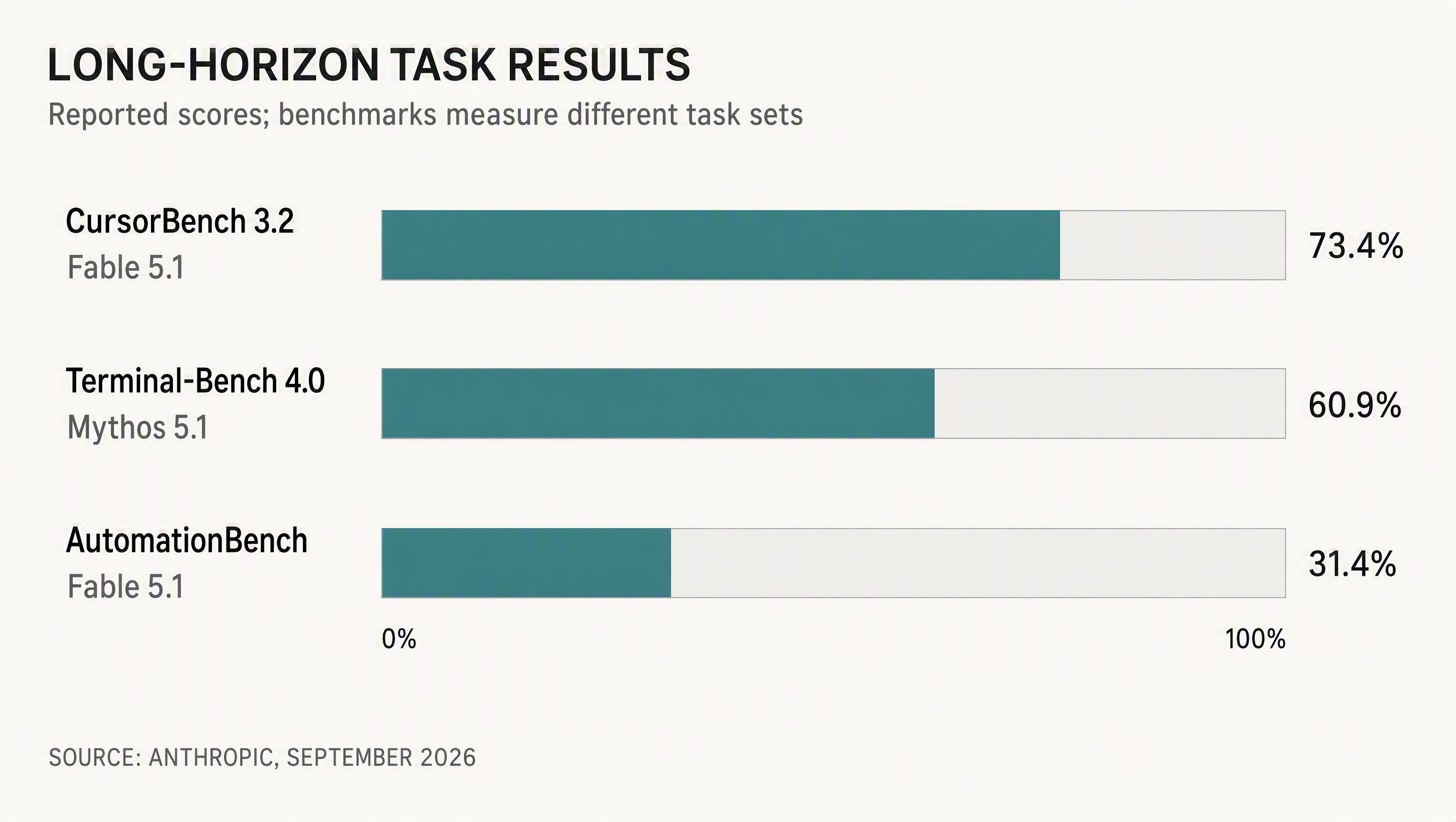
Figure: A visualization of three official results. The 60.9% Terminal-Bench 4.0 score belongs to Mythos 5.1; the other two values are for Fable 5.1.
A house walkthrough can show visual and spatial consistency. It cannot establish that any generated design is buildable or that every run succeeds on its first attempt. A migration evaluation should preserve prompts, tools, patches, failed tests, and human corrections alongside attractive outputs.
Video: A walkthrough of the same house’s rooms and courtyard, showing material and lighting continuity. The footage is not a construction-approval result.
Safety and access: fewer refusals do not remove restrictions
Anthropic reports approximately 60% fewer cyber safeguard interventions per Claude Code session relative to Fable 5’s previous safeguards, and permits source-code vulnerability identification. This is not a 60% reduction measured across every API application. Penetration testing, exploit generation, and binary scanning can still trigger blocks or fallback. Finding a vulnerability does not grant permission to attack a system.
Mythos’s life-sciences program is an invite-only beta. The Cyber Verification Program announcement says Mythos access will be added later. Claude Security already uses Mythos 5.1, but using that product is not unrestricted model API access. See the Fable vs Mythos eligibility and retention comparison.
Anti-distillation changes can affect custom clients too. The release says new accounts cannot freely edit prior context while retaining the corresponding earlier thinking transcript. Existing accounts were not affected by that initial change, with broader application planned for future models. This restricts a capability-extraction technique; it does not mean every multi-turn edit is prohibited.
Frequently asked questions
What are the Fable 5.1 API ID and prices?
The official ID is claude-fable-5-1. Input and output cost $10/$50 per million tokens; cache reads cost $0.25 per million. A third-party platform can use a different route name or price, so verify both before calling it.
Does the 75% reduction apply to a Claude or ChatGPT subscription?
No. It is Fable 5.1’s usage-based cache-read price reduction, not a subscription discount or a cut to every part of a task’s bill.
If my task has no cache hits, does this price cut help?
The cache-read price change saves nothing on that task. Fable 5.1 could still change the amount of work or tokens needed, but that requires a same-task comparison; it does not follow from the 75% figure.
Why do Fable and Mythos have different benchmark scores?
They share an underlying model, but safeguards and fallback behavior affect some tasks. Compare versions, configurations, and safety footnotes together.
Can the public Fable API reproduce every Mythos research case?
That is not established. Mythos research access requires additional approval, and the cases depend on tools, data, and external experiments, not just a model identifier.
Choose a real task before migrating
Keep the current model as a baseline and test a task that previously required human rework. Compare accepted results and total cost. The same-task Astra / Fable test and long-running acceptance checklist offer concrete starting points. Those results should decide a migration, not an isolated “75%.”
Sources checked September 9, 2026: Anthropic’s release, Fable product page, Mythos product page, and SandBase’s Fable 5.1 model entry. Original publication: September 2. This update clarifies API routes, pricing and the distinction between reported benchmarks and SandBase’s separate test; it adds no new benchmark run.