WorkBuddy for Long-Running Projects: From Expert Routing to Verified Delivery
A practical architecture for using WorkBuddy’s specialists and project spaces on multi-step tasks without losing provenance or control.
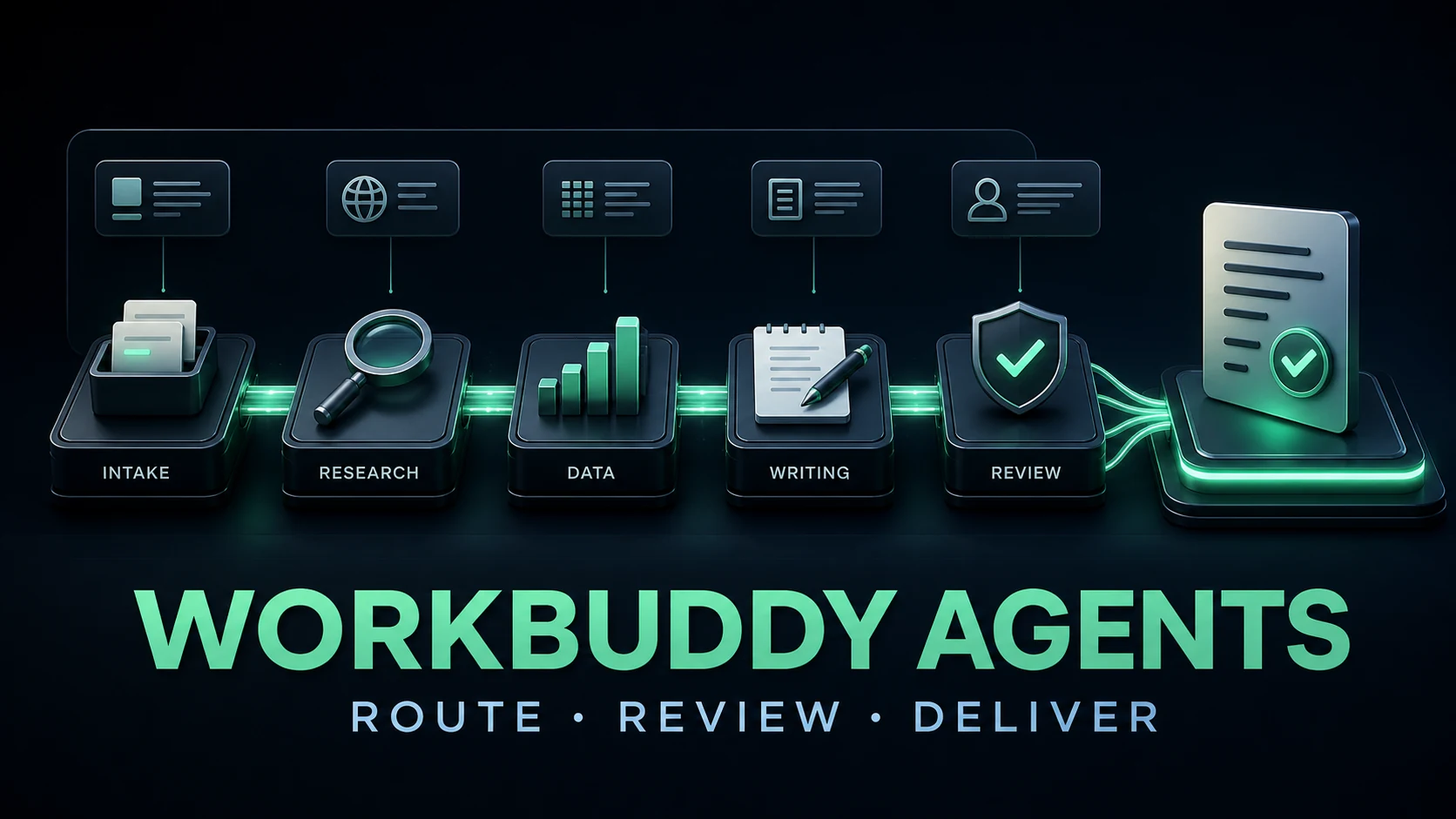
Key takeaway
WorkBuddy’s multi-expert promise is useful only when the handoffs are explicit. For a long-running project, define ownership, preserve intermediate artifacts, set budgets, and require an acceptance gate before the system reports completion.
WorkBuddy’s official pages describe 100+ domain specialists, parallel collaboration, project spaces, MCP, Skills, and direct delivery of files and reports. That sounds like a virtual department. In practice, the engineering challenge is orchestration: which specialist acts, what context it receives, how its result is checked, and what happens when two outputs disagree.
A project should have a state machine
Do not model a long task as one giant prompt. Use explicit states:
intake -> plan -> specialist work -> review -> revision -> deliveryEvery transition should produce an artifact: scope, plan, source ledger, analysis, draft, review comments, final file, and unresolved-issues list. If a session fails, the next run should resume from the last accepted artifact rather than guessing what happened in a hidden context window.
 The product page anchors the project-space and delivery claims.
 A WorkBuddy surface is useful for long-context trials, but context length is not the same as project memory or provenance.
 The official page supports the multi-expert and broad-workflow positioning.
Where parallel experts help
Parallelism makes sense when work can be split cleanly. A research task might assign one specialist to source collection, another to data checks, and a third to an executive summary. A product launch might split competitive research, pricing analysis, and release notes.
Parallelism is dangerous when every specialist shares the same unverified assumption. Five outputs that rely on the same bad source are not five confirmations. Store source URLs, retrieval dates, input hashes, and decision criteria with each result. A reviewer should be able to reject one branch without losing the others.
Budget the entire transaction
The cost of a project includes model calls, tool compute, retries, file conversion, human review, and the cost of a wrong side effect. Track:
| Metric | Why it matters |
|---|---|
| Accepted-task cost | Measures delivery, not token volume |
| Recovery loops | Shows how often the workflow gets unstuck |
| Human interventions | Measures supervision burden |
| Artifact rework | Exposes polished but unusable output |
| Time to clean hand-off | Connects automation to team velocity |
Comparison: one expert, multi-expert, or a custom pipeline?
| Pattern | Best at | Failure mode |
|---|---|---|
| One WorkBuddy expert | Fast bounded deliverables | Context overload or shallow review |
| Multiple WorkBuddy experts | Role-separated research and production | Correlated mistakes and unclear ownership |
| Custom orchestrator | Stable, auditable production process | Higher engineering and maintenance cost |
Use the simplest pattern that preserves an acceptance boundary. Multi-agent is not automatically better than one well-instrumented run.
Give every run a durable record
A useful project record is small enough to inspect and complete enough to resume. Store the objective, input snapshot, owner of each transition, source list, tool calls, output paths, acceptance result, and unresolved questions. A run log can use a simple event shape:
2026-09-05T09:10Z | research | owner=source-specialist | status=accepted | artifact=sources.md
2026-09-05T09:42Z | analysis | owner=data-specialist | status=needs-review | artifact=analysis.csv
When specialists disagree, do not ask a final writer to silently average the answers. Preserve both claims, identify the evidence that would distinguish them, and route that question to a named reviewer. The final artifact should say what was decided and what remains uncertain.
For rollout, begin with one team and a bounded deliverable. Measure accepted-task cost, human interventions, rework, and recovery time for two weeks. Only then add parallel experts or write-capable connectors.
Separate context from state
Long context is useful for reading a large source set, but it should not be the only memory of a project. Put authoritative state in named files: scope.md, sources.csv, decisions.md, review.md, and an artifact directory. Each file should have an owner and a last-accepted version. A new run can then load the relevant state without trusting a hidden conversation to remember which assumptions survived review.
A practical review gate asks five questions: Is the scope unchanged? Can every important claim be traced to a source or computation? Are conflicts explicitly resolved? Does the output satisfy the acceptance checks? Can another person reproduce the artifact? If any answer is no, the status should remain “needs review,” even when the prose looks finished.
This is also where cost control becomes real. Parallel specialists consume tokens, tool time, and reviewer attention. Route cheap, deterministic checks first; reserve broad research or write-capable actions for the transitions that need them. A useful multi-agent system is therefore not the one with the most agents, but the one that makes uncertainty and ownership visible.
One useful operating pattern is a “checkpoint contract.” Before a specialist starts, define the input snapshot, output path, acceptance test, maximum retries, and escalation owner. At the checkpoint, the reviewer can accept, reject with a reason, or return the work with a narrower question. This keeps a failed branch from contaminating the next stage and makes retries comparable.
For a research deliverable, for example, the source specialist can own sources.csv, the analyst can own analysis.csv, and the writer can own draft.md. A reviewer accepts each file independently. If a source later changes, rerun the analyst and writer transitions from the affected checkpoint instead of restarting every expert. That is the difference between a long conversation and a resumable project.
The same checkpoint model gives managers a useful stopping rule. If a branch exceeds its retry budget or cannot produce a traceable artifact, escalate it to a human rather than adding another specialist. More agents can increase the surface area for disagreement, credential exposure, and duplicated work. A small, explicit stop condition is often the most valuable part of the orchestration design.
It also gives the team a clean escalation path: preserve the branch, attach the evidence, and ask a human to decide whether the scope or the assumption should change.
FAQ
Does more than one specialist mean better accuracy?
No. It improves coverage when roles are genuinely independent. If all agents share the same source and assumptions, parallelism can amplify the same error.
How should a project resume after interruption?
Resume from the last accepted artifact and replay only the unfinished transition. Keep the original prompt, files, tool results, and decision log available for audit.
Can WorkBuddy operate as an unattended employee?
Only for bounded, reversible work with scoped credentials and monitoring. Require human approval for external messages, financial actions, deletion, deployment, and sensitive exports.
What is the difference between a Skill and an MCP tool?
An MCP tool exposes an external capability or data source. A Skill is a reusable procedure or instruction set. A reliable workflow often uses both: the Skill defines how to work, while MCP provides the controlled action.
Sources: Tencent Cloud WorkBuddy, WorkBuddy official page, and WorkBuddy long-context evidence.