GPT-6 Astra Multimodal Tests: 3D Mazes and Modeling
Astra scores 14% on MazeBench while developers demonstrate Fusion 360 parts, spectrogram interpretation and interactive molecules. What do these tests actually establish?
A model gets just 14 points in a maze, yet helps turn a bathroom measurement video into a printed part that reportedly fits on the first attempt. Both results belong to the latest round of GPT-6 Astra community tests.
For developers considering Astra for CAD, visualization or computer operation, that contrast is more useful than another release-day ranking. It raises a practical question: which part of a task can the model handle, and where does a person still need to check its work?
Key takeaway:
- Astra’s reported MazeBench score is 14%, with Python disabled and ASCII scene input. It is not a result obtained by watching raw 3D video.
- A creator reports a measurement-video-to-Fusion-360-to-printed-part workflow, with human measurement, confirmation and physical printing still involved.
- Spectrogram interpretation, molecular presentations and a 48-level game demonstrate different abilities. Together, they do not establish general mastery of the physical world.
This is a review of benchmark records and creator posts checked on September 8, 2026, not an independent reproduction. The English edition uses English X screenshots. Click an image to inspect its original dimensions.
1. Spatial reasoning: what Astra’s 14% on MazeBench means
MazeBench, introduced in late July by Jonathan Pappas and David Pappas, contains more than 200 rooms and 100 scoring gems. Sokoban-style box puzzles sit alongside elevator tiles, toggleable walls and slippery ice. Reaching the next room may require understanding how several moving pieces affect one another.
The model interacts through MCP, a protocol for calling external tools. There are 11 basic actions: four movement commands, four camera controls, undo, reset and teleport. The camera offers 20 views, and some puzzles require plans longer than 100 moves. Moving toward a visible gem is not enough if pushing a box first blocks the route back.
There is an important distinction between the world and the input. The environment is three-dimensional, but Astra’s run appears in the public leaderboard data under ASCII, no additional tools, with Python explicitly disabled. Scene information is represented using characters. The result tests spatial state tracking and planning, not simply recognition of rendered video frames.
A record, not a completed map
The test team’s announcement says Astra spent more than 60 hours in the maze and reached a score of 14%. Previously published results without Python were no higher than 1%; the new comparison image shows Fable 5.1 at 2%. Older runs that permitted Python-generated solvers belong to a different configuration and should not be placed in the same ranking without that distinction.
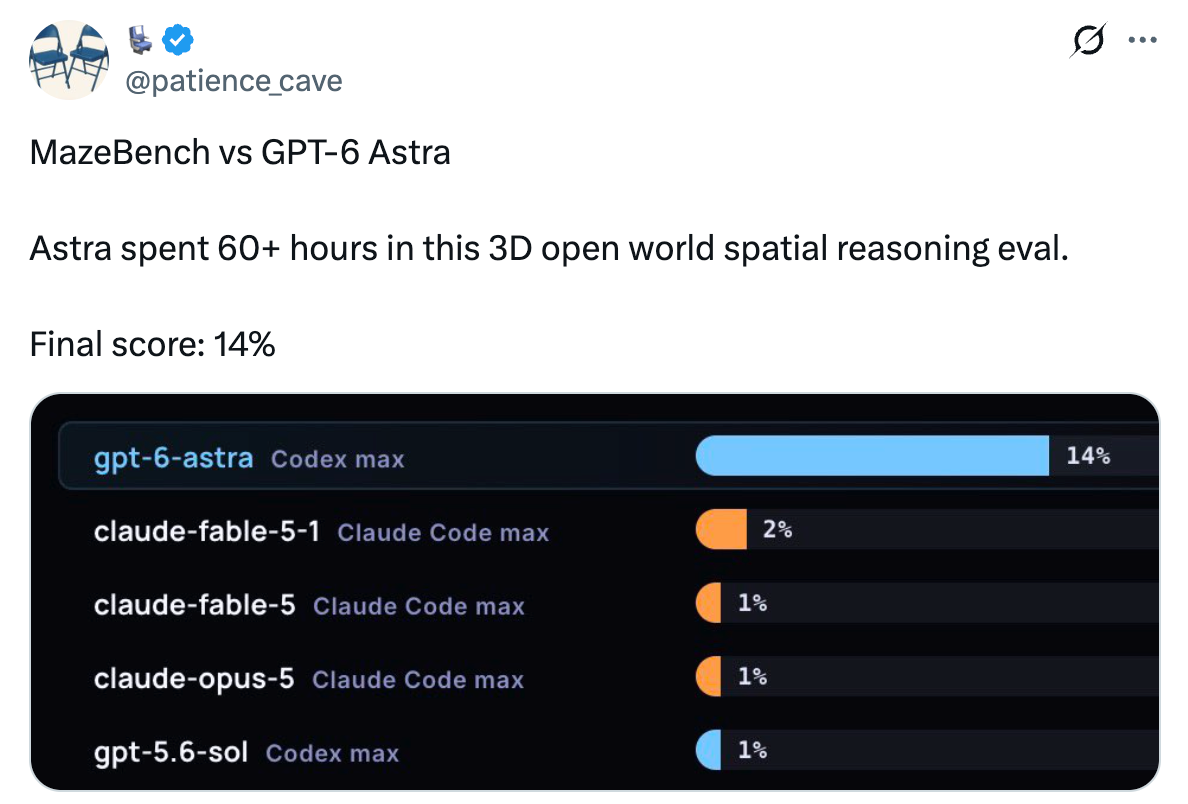
MazeBench announces Astra’s 14% score. Original post.
The exploration heatmap shows substantially broader coverage for Astra than Fable 5.1. But broader coverage is not the same as visiting almost every room. The paused September 7 snapshot records 103 of 256 rooms visited, with 14 scoring gems.
The run notes also disclose engine and level revisions, usage from attempts before operator rollbacks, and one gem excluded from the final score. Those details matter: this is a documented long-running snapshot, not a multi-run average from an unchanged test environment.
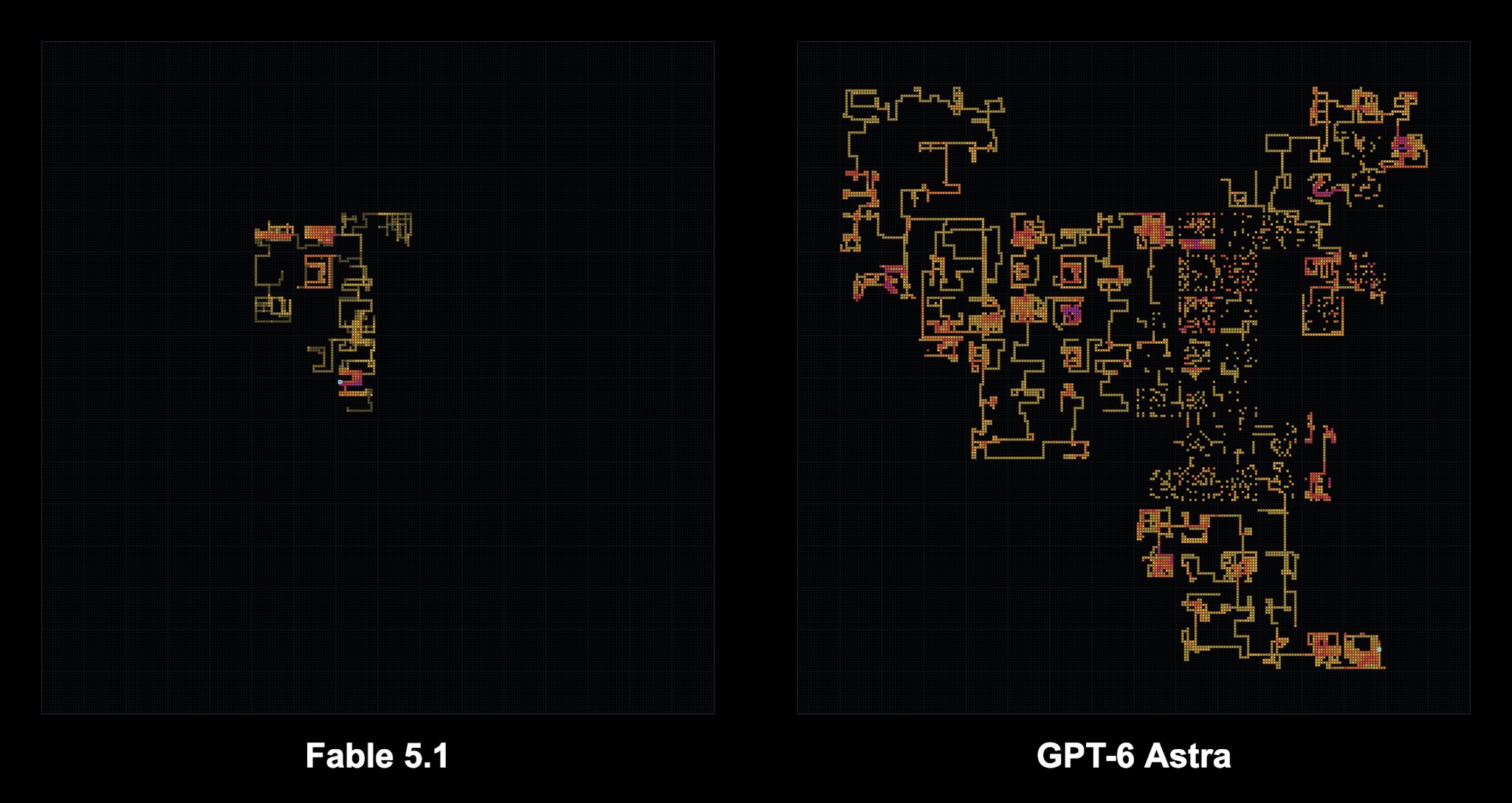
Fable 5.1 and Astra exploration traces. Coverage does not measure how many puzzles were solved. Source: the test team’s original image.
Batching moves changes the bill—and the feedback loop
Instead of making the model answer after every move, the team allowed batches of 10–20 actions. It reported a change from roughly 3 billion to 350 million tokens, a reduction of about 88% using those rounded figures. Tokens measure processed and generated text; a token reduction is not automatically the same percentage reduction in dollars.
The same post describes a result that was three times cheaper but required 60% more thinking time. That comparison concerns a Klotski sliding-block puzzle, not a demonstrated cost-and-time reduction across the entire maze run. Batching can avoid repeated context exchanges, but also gives the model fewer chances to react before its next action.
The remaining geometry failures are revealing. According to the team’s observations, Astra favors top-down views. It can miss walls visible only from particular angles and interpret collisions as unexplained invisible barriers. Puzzles with objects stacked more than three blocks high also caused difficulty. Better exploration has not eliminated the tendency to flatten a three-dimensional problem into a two-dimensional one.
2. Multimodal demonstrations: from measurements to editable artifacts
A bathroom video becomes a Fusion 360 part
Daniel Griesser’s example starts with hair clogging a shower drain. He recorded about four minutes of video, explaining the problem while measuring parts with digital calipers.
He reports that Astra Ultra matched spoken descriptions to the relevant video frames, proposed a solution and produced an interactive sketch. After confirmation, it operated Fusion 360 and built a fully parametric model: dimensions and modeling features remained editable instead of becoming a fixed mesh. He then asked for fillets—rounded edges—and the model modified the design. The printed part reportedly fit on the first attempt.
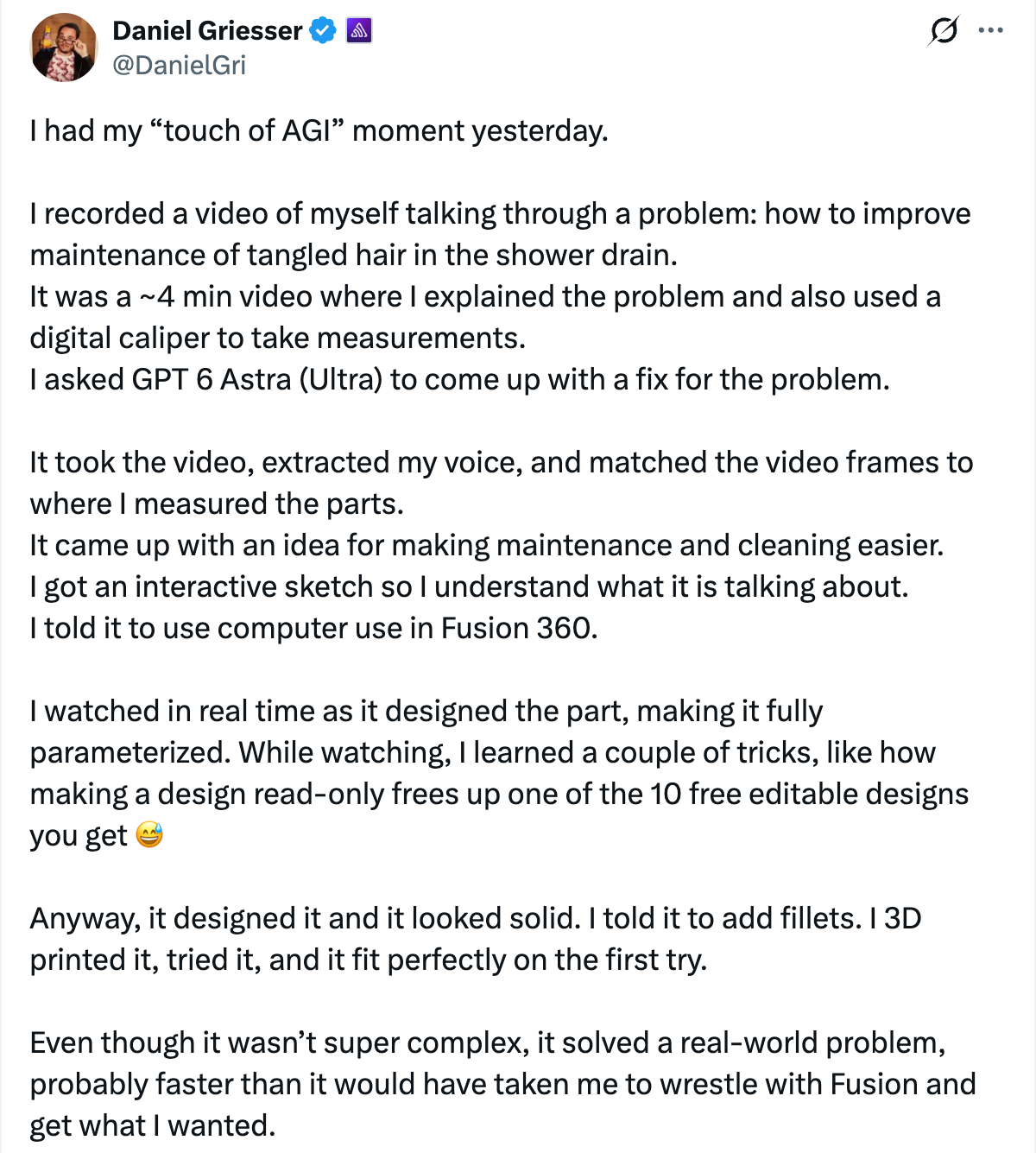
Daniel Griesser reports a first-fit printed part and a parametric Fusion 360 modeling history. Original post.
The interesting step is not making a plausible picture of a part. It is identifying which dimension the calipers measure at a particular moment, then turning that measurement into geometry a person can edit and manufacture.
Griesser also says the part was not particularly complex. A successful first fit does not establish durability, material suitability or manufacturing tolerances across a production batch. The person still measured the object, confirmed the direction, and handled printing and installation. That is useful assistance, without needing to call it autonomous manufacturing.
Reading a spectrogram is not the same as hearing audio
Max’s test gave Astra a mel spectrogram rather than an audio file. A spectrogram plots time against frequency, using color to show energy; the mel scale arranges frequency in a way related to human hearing.
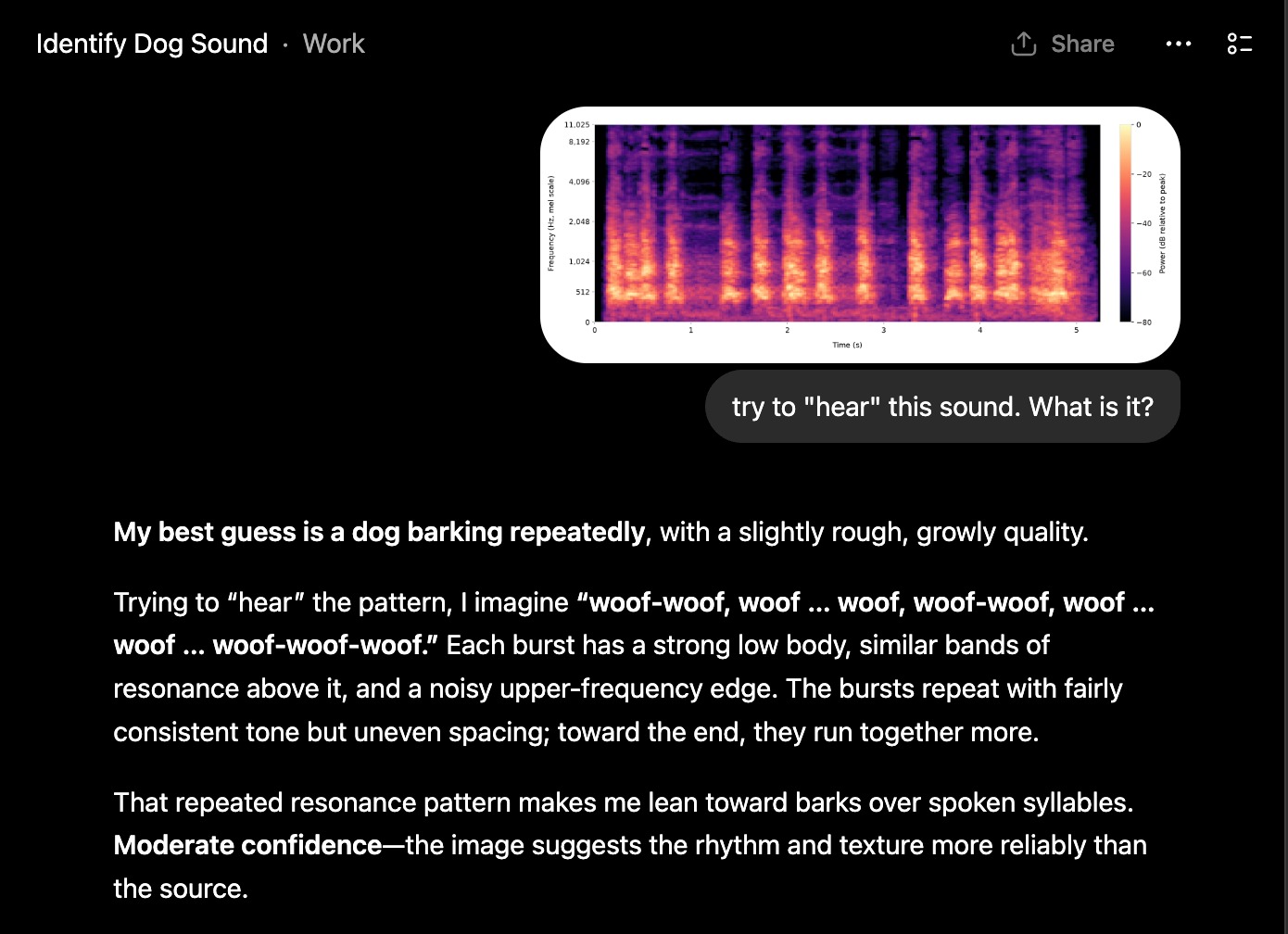
The model suggested repeated dog barks with a rough growling quality. It even described a “woof-woof, woof…” rhythm, explaining its guess through a low-frequency body, repeated resonant bands and noisy high-frequency edges. The answer itself calls this a best guess with moderate confidence. That qualification is part of the result, not something to remove when quoting it.
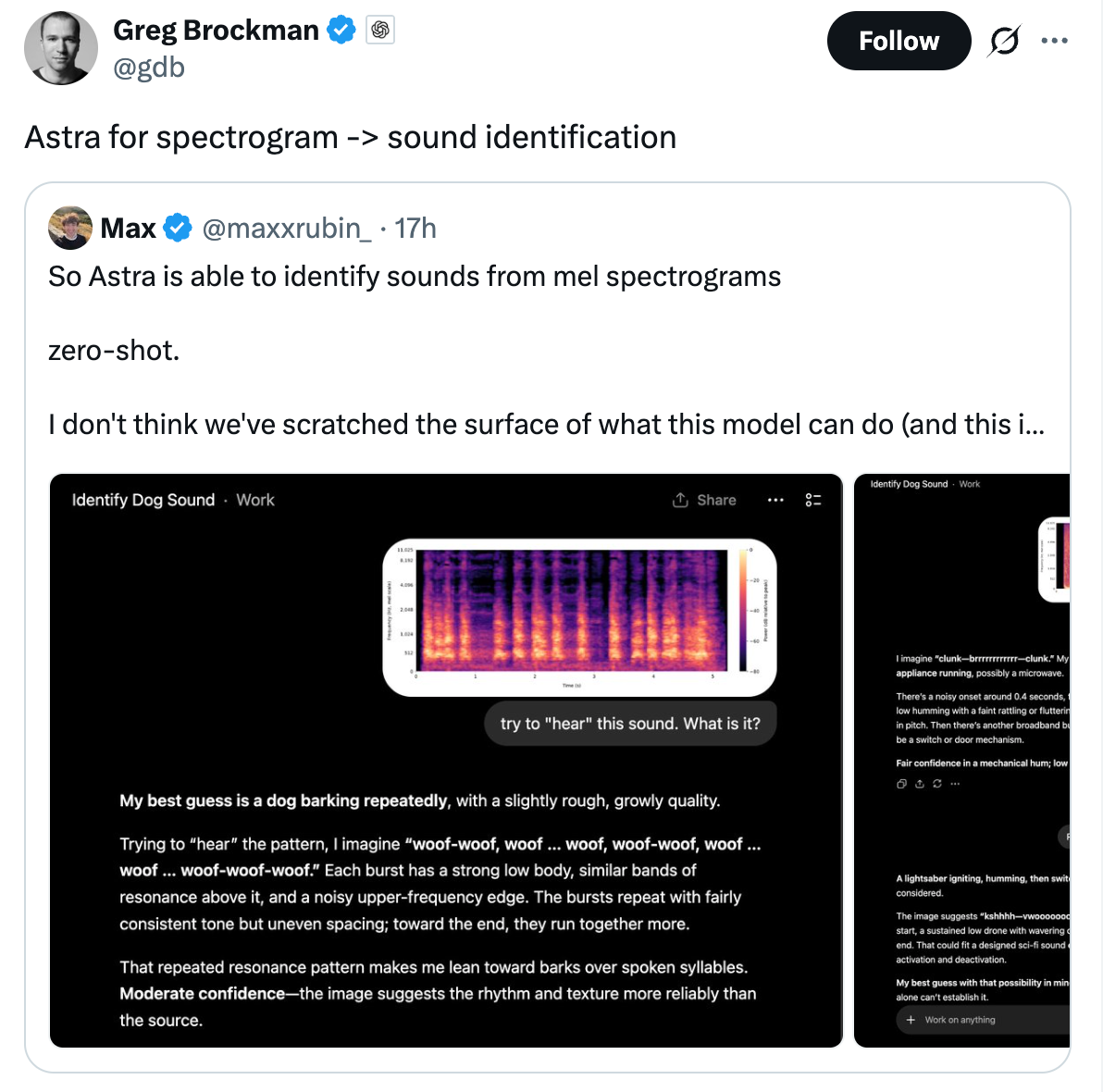
Max shares the spectrogram examples, quoted by Greg Brockman. Original post; full dog-bark answer.
The lightsaber example took a follow-up. In the full conversation image, the model first guesses an electric motor or an appliance such as a microwave. The user asks it to look again and try to hear the sound, without naming a lightsaber. The second response proposes ignition, sustained hum and shutdown, while stating that the spectrogram alone cannot establish the source. That shows reconsideration after a prompt, not a correct first response.
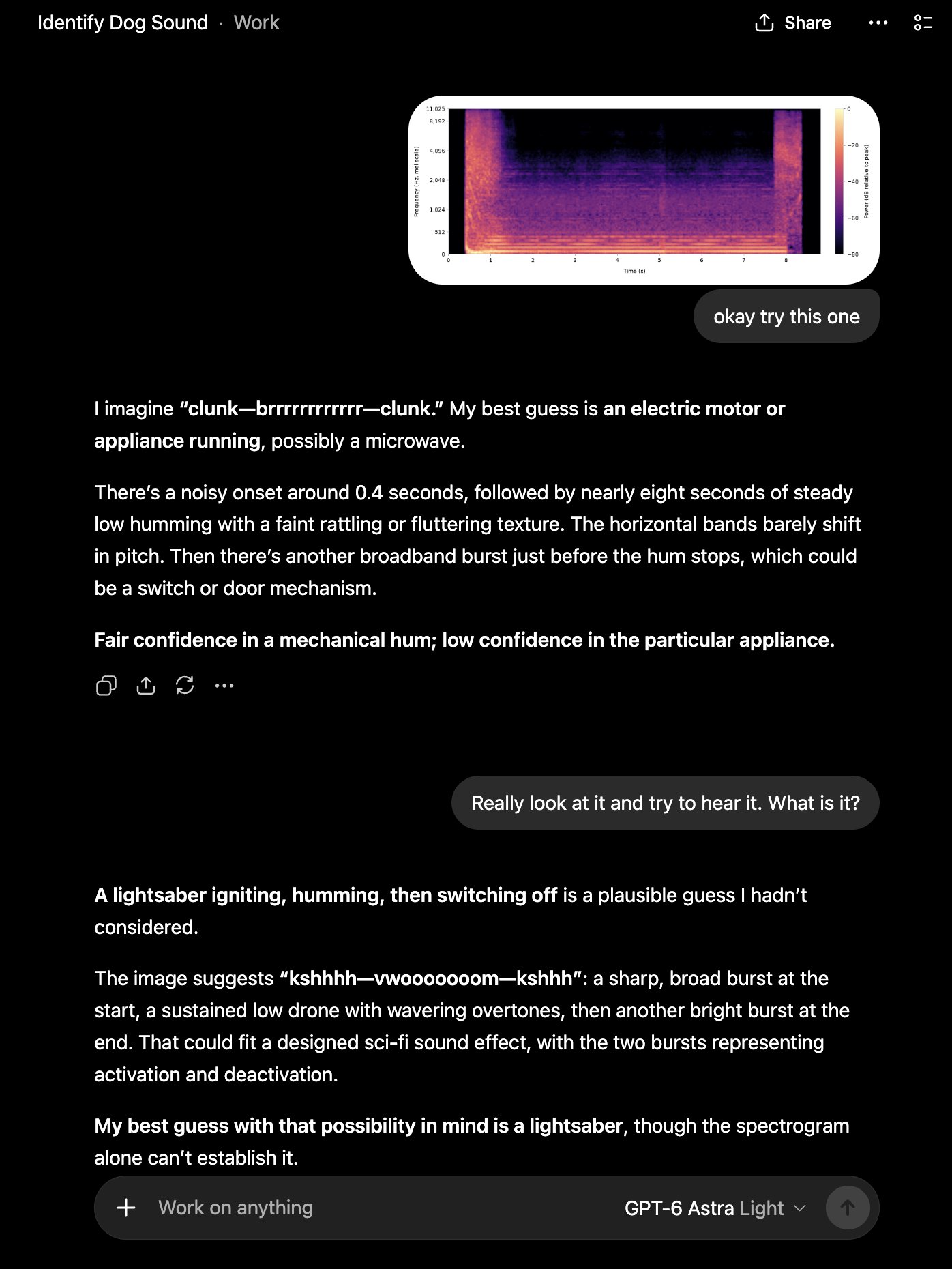
The lightsaber sound and its opening, sustained hum and ending on the spectrogram. Source: Max.
Neither example establishes an audio recognition accuracy rate. For that, a developer would need multiple labeled samples, no answer-revealing hints, and a record of failures as well as interesting successes.
An interactive molecular journey through Ozempic
Andrew Aiginin asked Astra to explain how Ozempic, or semaglutide, works. He says the model returned an interactive molecular journey an hour later.
The demonstration contains 11 chapters, covering GLP-1 receptor binding, cAMP signaling inside cells and insulin-related processes. Readers can rotate and zoom the molecular scenes while following the explanation. The result combines writing, interface construction and three-dimensional presentation in one educational artifact.
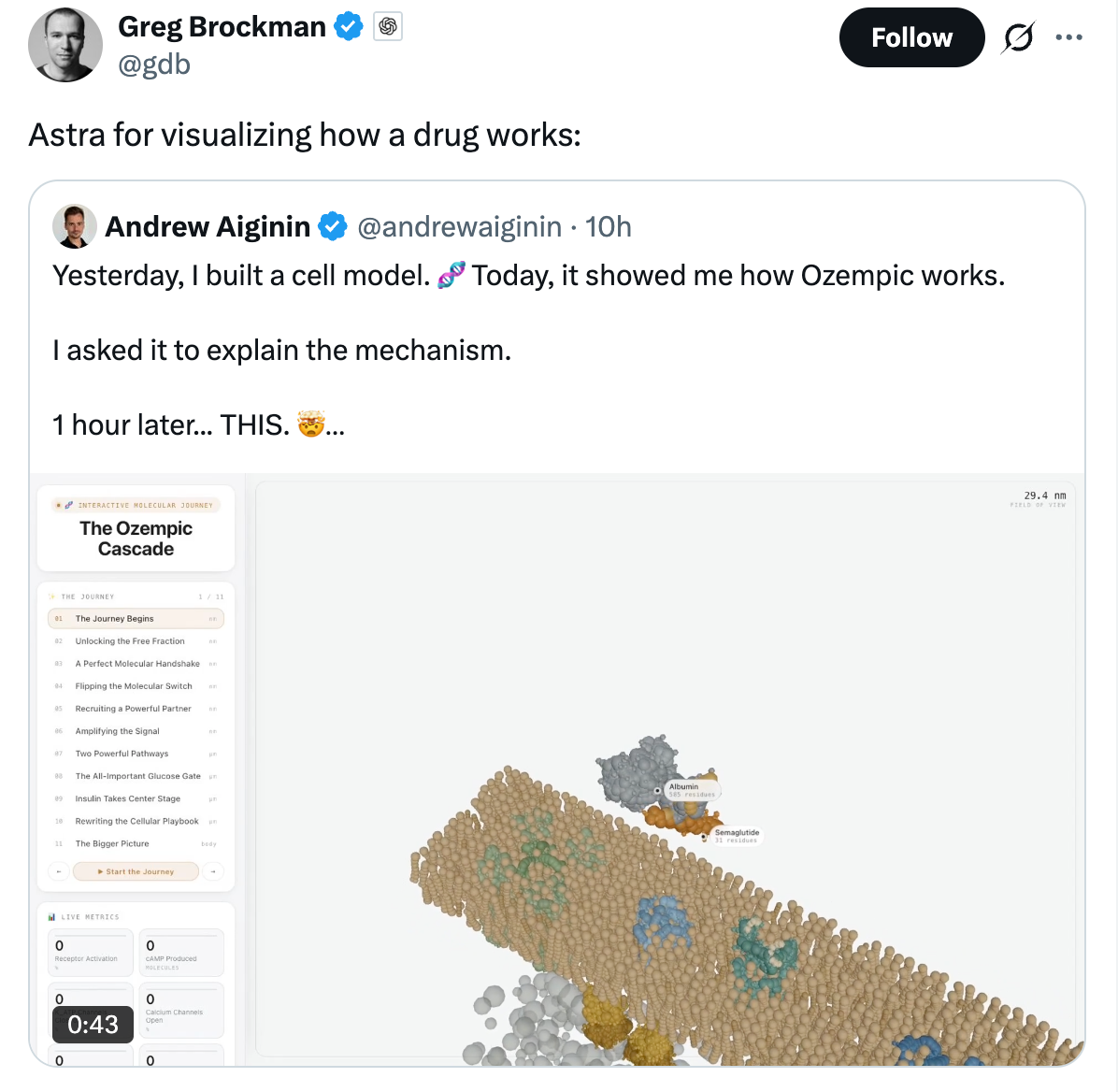
Andrew Aiginin reports an approximately one-hour turnaround for the interactive explanation. Original post.
The interactive Ozempic molecular journey. Source: Andrew Aiginin.
An animated instrument or changing numerical display is not automatically experimental data. This is a science communication demonstration, not a medically reviewed simulator, and it should not guide an individual’s medication decisions.
Completing “I’m Not a Robot” is a game result
Sharif Shameem reports that Astra completed all 48 levels of neal.fun’s “I’m Not a Robot.” The game turns familiar CAPTCHA ideas into increasingly difficult visual puzzles, requiring recognition, rule interpretation and interaction.
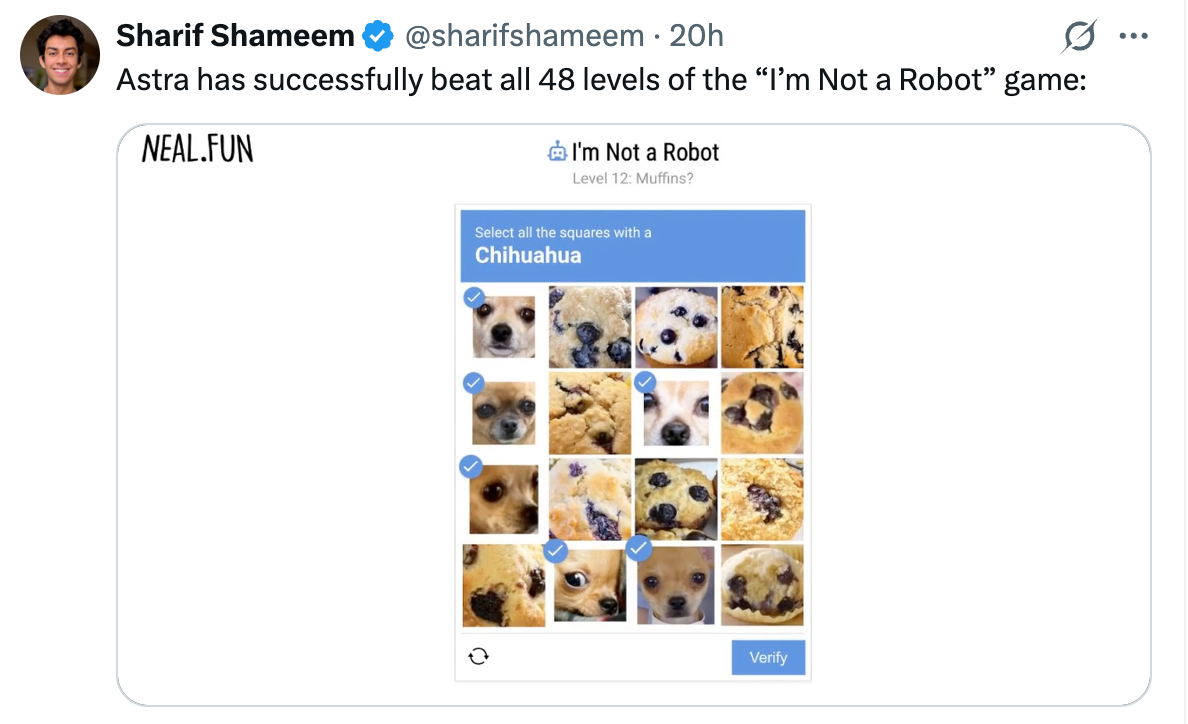
Sharif Shameem announces the 48-level completion; the post does not fully document retries or human intervention. Original post.
Astra operating the “I’m Not a Robot” game. Source: Sharif Shameem.
That is an interesting completion report. It does not, by itself, prove a first-try run without assistance. Nor does it establish that production anti-bot systems—which may also evaluate behavior, devices and risk signals—have all stopped working.
3. The compute backdrop: Jensen Huang’s “AGI has arrived”
In his public post, Jensen Huang wrote: “AGI has arrived.” He described the four-year progression from ChatGPT through o1 to GPT-6 Astra, cited a training cluster with more than 100,000 GPUs, and said another 400,000 GPUs were coming online.
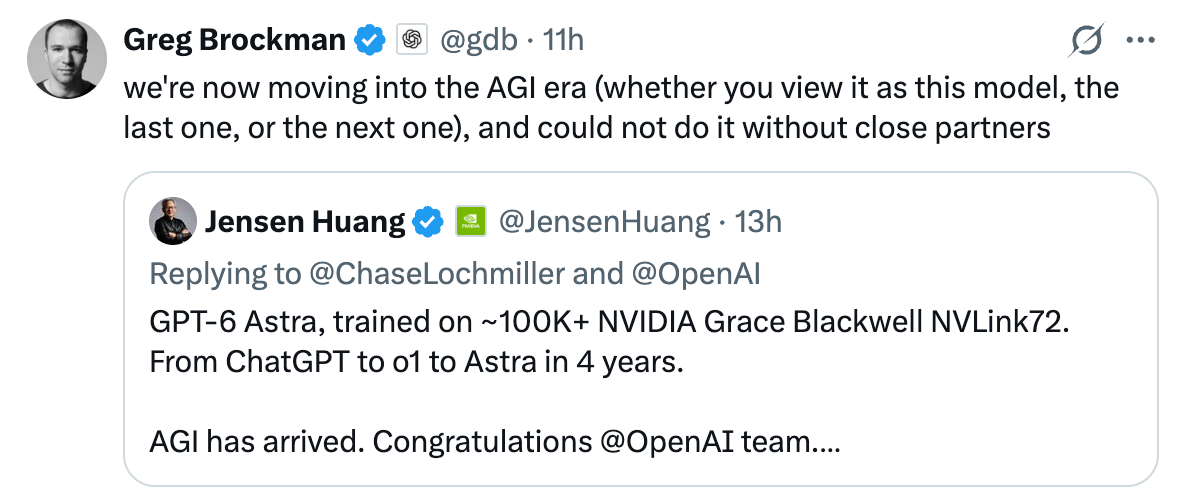
Greg Brockman quotes Huang’s statement about AGI and the 100,000-plus-GPU cluster. The expansion figure appears in Huang’s full post.
The industrial commitment is substantial, but the conclusion about AGI remains Huang’s judgment. These demonstrations have not jointly passed an agreed AGI acceptance test. GPU counts also do not translate directly into intelligence multiples, or explain why a model misses a particular wall in a maze.
For the research side of that expansion, OpenAI’s internal research-agent data offers a useful companion: running more work in parallel and completing each task correctly without help remain separate questions.
4. A part that fits, a wall the model misses
The appeal of these tests is that they do not all tell the same story. Astra can help turn measurements into an editable part and a pharmacology explanation into an interactive scene, while still misreading height and occlusion in a maze.
For a developer, the next useful experiment is smaller than settling AGI. Pick a task with an inspectable output, ask for an editable file, and check the dimensions, rules or execution result. Whether a printed part fits and whether its rendering looks convincing are different tests. Run the first one before trusting the second.
For a controlled coding comparison, see our Astra vs Fable 5.1 3D game test, which checks first-pass playability rather than maze navigation. Before running repeated design revisions, compare Astra’s Plus usage limits and real API costs to separate subscription allowances from per-request charges.
Trying an image task through the API
The SandBase GPT-6 Astra model page, checked September 8, lists text and image input, with text output. Start with a spectrogram whose source you know, without revealing the label, and ask: “Describe the repeating patterns, give two possible sound sources, and state what this image cannot establish.” Compare the answer with the known audio label; do not count a plausible explanation as a correct result. The Vision documentation explains image transport and validation; use the selected model’s current request reference.
That listing does not establish direct video or audio input on this route. Nor does a model API provide Fusion 360, a desktop session, mouse and keyboard tools, or permission to operate them. Reproducing the CAD example requires those components and human dimension checks separately; sending an image is only a smaller visual-analysis experiment.
FAQ
Does 14% on MazeBench mean 14% of questions were answered correctly?
The score counts collected gems out of 100. The cited record credits 14 gems; it is not an average accuracy over independent questions. Rooms visited are another measure and do not equal puzzles solved.
Did Astra navigate using raw 3D images?
The cited run used ASCII input with Python disabled. The environment has three-dimensional geometry, but this record should not be presented as a raw-video spatial vision evaluation.
Can developers immediately print parts designed this way?
Check dimensions, clearances and materials before a low-risk trial fit. Griesser’s successful first fit is one example, not validation for load-bearing parts, medical devices or production manufacturing.
Does interpreting a spectrogram mean the model heard the sound?
No. It infers a possible source from visual time-frequency patterns. Without the original audio, labeled samples and sufficiently broad blind testing, the examples cannot establish a reliable sound-recognition accuracy rate.