Best OpenAI API Alternatives (2026)
Compare OpenAI API alternatives for direct model access, OpenAI-compatible migration, self-hosting, routing, image and video APIs.
TL;DR — Choose Anthropic or Google Gemini for direct access to another frontier-model provider. Choose SandBase when one OpenAI-compatible setup must cover multiple LLM providers plus image, video, and tool APIs. Choose OpenRouter for a managed multi-provider LLM marketplace, LiteLLM for a self-hosted proxy, or Portkey for gateway observability and policy controls. “OpenAI-compatible” reduces migration work, but it does not make model behavior or every API feature identical.
What is the best alternative to the OpenAI API?
The best alternative depends on what you are replacing:
- The model — you want a different quality, latency, context, or safety profile.
- The vendor relationship — you need another billing, data, regional, or support arrangement.
- The API contract — you want to keep the OpenAI SDK while changing the backend.
- The gateway — you want routing, fallbacks, budgets, and observability across providers.
- The capability surface — your application also needs image, video, audio, search, or data APIs.
Anthropic and Google are model providers; OpenRouter and SandBase are managed multi-provider services; LiteLLM is software you operate; Portkey is primarily an AI gateway and control layer.
Quick comparison
| Alternative | Operating model | OpenAI SDK path | Best for | Main trade-off |
|---|---|---|---|---|
| Anthropic | Direct model provider | Compatibility helper | Claude-native features and direct vendor access | Native Messages API differs from OpenAI |
| Google Gemini | Direct model provider | Yes | Gemini models and Google-native capabilities | Compatibility does not expose every native feature |
| SandBase | Managed model and tool API | Yes | LLMs plus image, video, audio, and callable APIs | Not a self-hosted gateway |
| OpenRouter | Managed LLM marketplace | Yes | Broad hosted LLM choice and unified billing | Adds a managed routing and billing layer |
| LiteLLM | Self-hosted open-source proxy | Yes | BYOK, infrastructure control, custom routing | You own operations and reliability |
| Portkey | Managed or self-hostable gateway | Yes | Observability, guardrails, budgets, and routing | More control-plane configuration |
Prices, model catalogs, limits, and retention policies change frequently. Verify current documentation before moving production traffic.
1. Anthropic: best direct alternative for Claude
Anthropic is the most direct OpenAI alternative when the application specifically benefits from Claude models and the team wants a first-party provider relationship. Its native Messages API has its own request structure and feature semantics. Anthropic also documents an OpenAI SDK compatibility option, but compatibility is a migration aid rather than proof that every OpenAI feature maps one-to-one.
Choose Anthropic when Claude is the primary target, first-party features matter, and the team is willing to test or adopt the native Messages API.
2. Google Gemini: best for Google-native models and tools
Google documents an OpenAI-compatible Gemini endpoint that can be used by changing the API key, base URL, and model in OpenAI SDK code. Google recommends its native Gemini API when an application is not already constrained to OpenAI libraries.
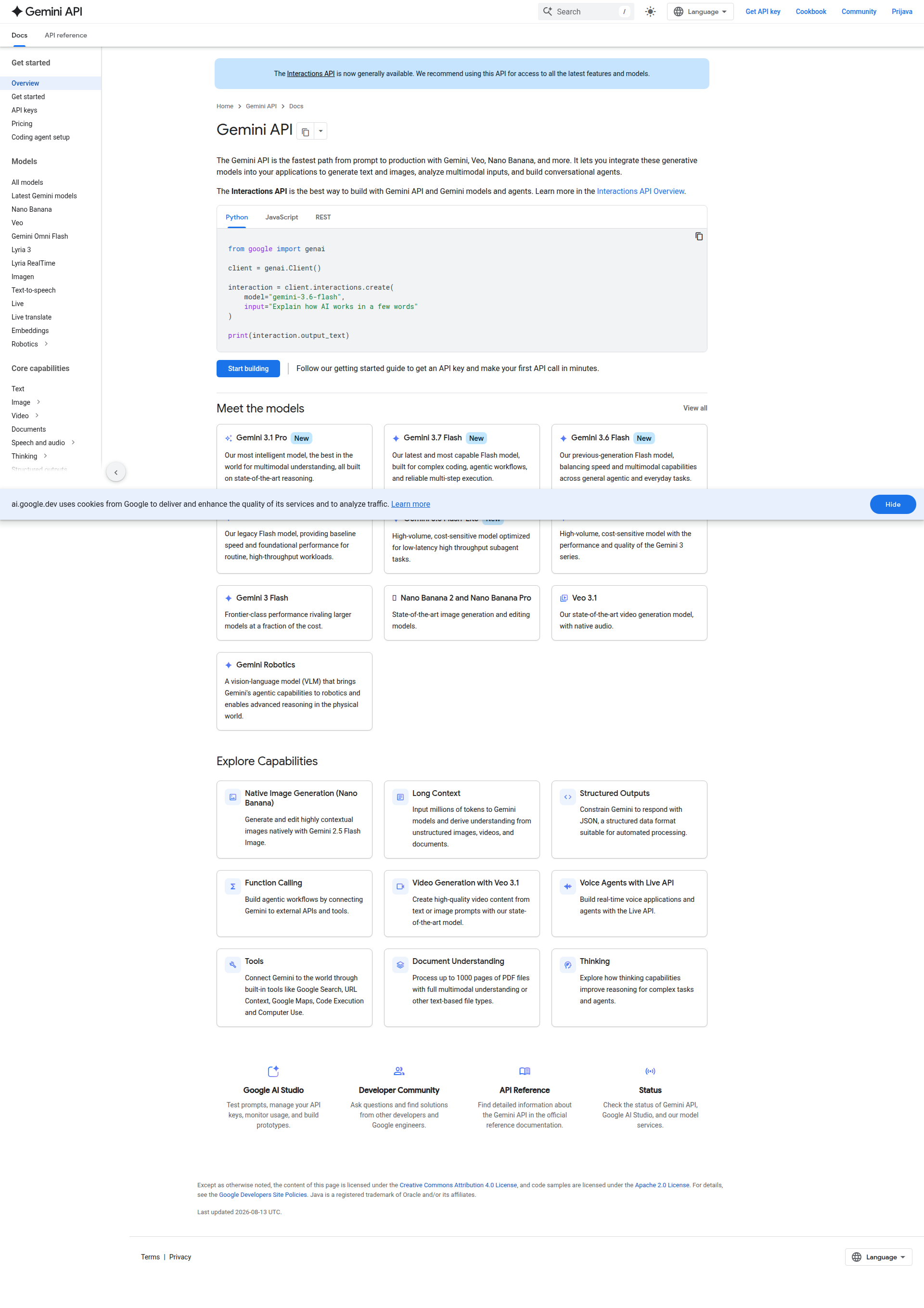 Google AI Studio, captured in August 2026. Compatibility can reduce SDK changes, but native controls still belong to the Gemini API surface.
That distinction matters. Google’s compatibility documentation notes that a normalized schema can introduce translation work and may not expose advanced native features in the same way. Use compatibility for low-friction migration; use the native SDK when Gemini-specific files, grounding, tools, or other platform features are central.
3. SandBase: best unified alternative for models and APIs
SandBase is designed for applications that need more than another chat-completions vendor. One account can expose LLM, embedding, image, video, audio, moderation, and real-world API surfaces. Its LLM gateway accepts OpenAI-compatible Chat Completions requests:
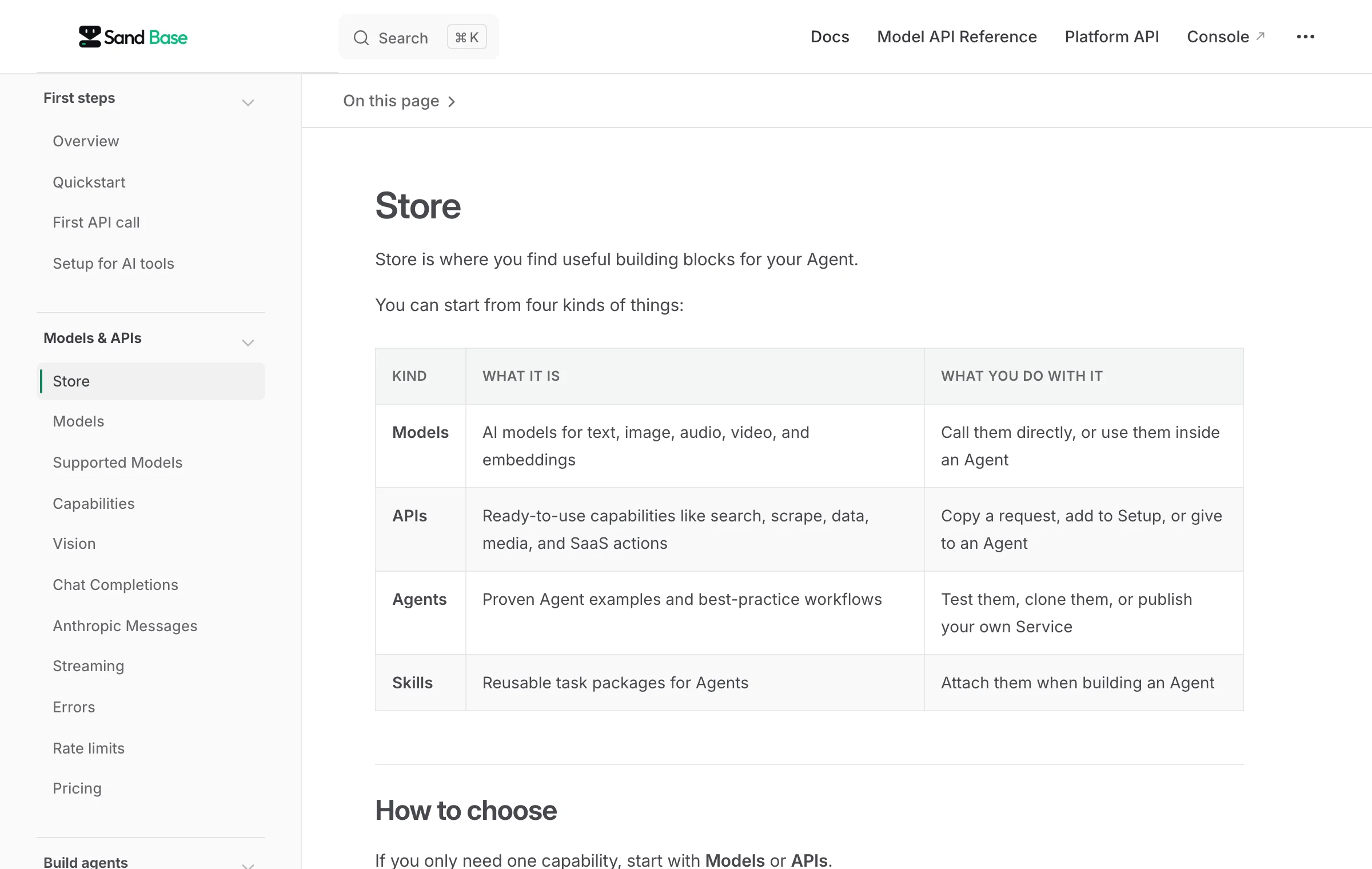 SandBase Store documentation, captured August 23, 2026. Model inference and callable external APIs are presented as separate capability surfaces.
import os
from openai import OpenAI

client = OpenAI(
    api_key=os.environ["SANDBASE_API_KEY"],
    base_url="https://api.sandbase.ai/v1",
)

response = client.chat.completions.create(
    model="YOUR_MODEL_ID",
    messages=[{"role": "user", "content": "Draft a launch brief."}],
)

print(response.choices[0].message.content)
Select a current model ID from the SandBase model catalog. The first API call guide covers authentication, streaming, and response handling.
Choose SandBase when an agent needs LLMs plus image or video generation, a workflow also calls search or data APIs, or one setup should work across coding agents through CLI, Skills, or MCP. If policy requires the gateway and upstream credentials to remain inside your infrastructure, choose a self-hosted proxy.
4. OpenRouter: best managed LLM marketplace
OpenRouter is a strong alternative when the primary requirement is broad hosted LLM access behind one API and one billing relationship. It can route across providers and apply preferences around price, availability, fallbacks, parameter support, and data handling.
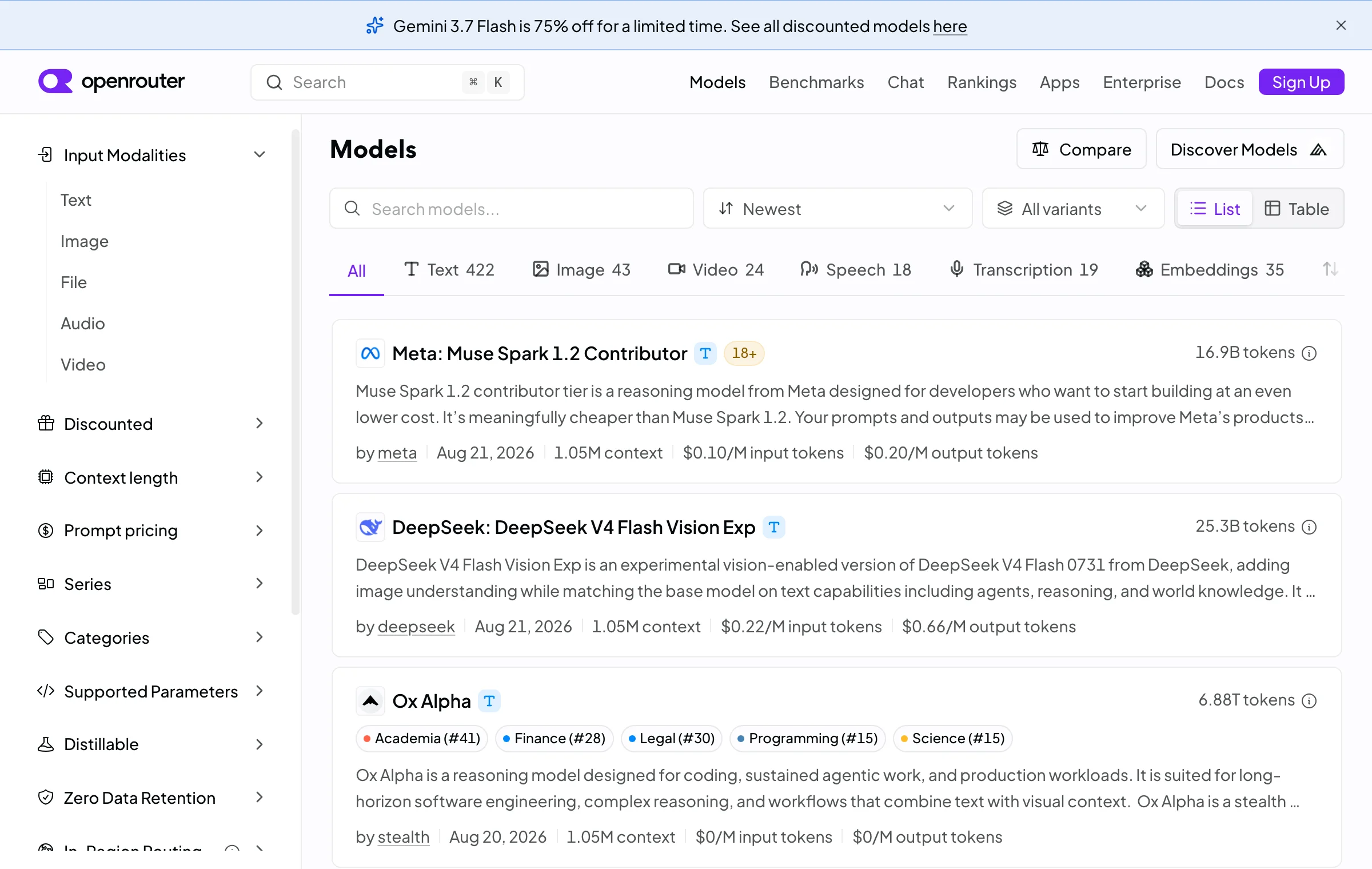 OpenRouter model catalog, captured August 23, 2026. Catalog contents are live data and may change after publication.
Choose OpenRouter when model choice is broad but mostly LLM-focused, and operating a gateway is not a good use of engineering time. Compare it with broader and self-hosted options in the OpenRouter alternatives guide.
5. LiteLLM: best self-hosted OpenAI-compatible proxy
LiteLLM is open-source gateway software. You deploy it, supply provider credentials, configure routing and budgets, and expose a normalized endpoint. This is the clearest option when the real requirement is control of the gateway and data plane rather than another managed vendor.
The trade-off is operational ownership: deployment, state, upgrades, provider changes, telemetry, and failure behavior. Read LiteLLM vs OpenRouter for the build-versus-buy decision.
6. Portkey: best for observability and policy controls
Portkey combines a universal gateway with routing, budgets, request-level observability, and input/output guardrails. It is useful when the problem has progressed from “call another model” to “govern model traffic across teams and tenants.” For a small prototype that only needs a base URL switch, the additional policy layer may be unnecessary.
OpenAI-compatible does not mean identical
Changing base_url is a useful first test, not a complete migration plan. Providers can differ in:
- streaming events and partial failures;
- tool calls and structured-output support;
- reasoning fields and token accounting;
- image, audio, file, batch, and realtime endpoints;
- context limits, caching, and truncation;
- error codes, retries, and rate-limit semantics;
- retention and data-control options.
Even OpenAI documents that model behavior can change between snapshots and recommends pinned versions plus evals where consistency matters. Schema compatibility cannot remove model-behavior differences.
Production migration checklist
- Inventory every endpoint and parameter the application uses.
- Separate required OpenAI-specific features from generic chat behavior.
- Build an eval set from real prompts, tools, and structured outputs.
- Compare quality, time to first token, total latency, and cost.
- Exercise rate limits, timeouts, malformed tool calls, and interrupted streams.
- Verify logging, retention, regional processing, and deletion requirements.
- Add provider-neutral request IDs and cost telemetry.
- Shadow production traffic before switching user-visible responses.
- Roll out by tenant or percentage and keep a tested rollback route.
- Review invoices and errors after the first billing cycle.
FAQ
Can I use the OpenAI Python SDK with another provider?
Yes, when that provider exposes a compatible endpoint. Usually you change the API key, base URL, and model. Test every feature your application uses because compatibility levels vary.
What is the best open-source OpenAI API alternative?
If you mean a self-hosted multi-provider gateway, LiteLLM is a common fit. If you mean self-hosting model inference, that is a separate decision involving engines such as vLLM or SGLang plus hardware and operations.
Which alternative is best for image and video APIs?
SandBase is the most direct option in this comparison when one managed setup must cover LLM, image, and video models alongside callable APIs. Verify the exact model schema and current price before implementation.
Should I replace OpenAI completely?
Not necessarily. Many teams keep OpenAI as one route and add alternatives for resilience, cost, specialization, or policy requirements. A gateway makes gradual diversification safer than a one-time rewrite.