Best OpenRouter Alternatives (2026)
Compare OpenRouter alternatives for one LLM API, self-hosting, routing, observability, and multimodal tools: SandBase, LiteLLM, Portkey, and Cloudflare.
TL;DR — The best OpenRouter alternative depends on which part of OpenRouter you are replacing. Choose SandBase when one API must cover LLMs plus image, video, and callable tools; LiteLLM when your team wants a self-hosted proxy and brings its own provider accounts; Portkey when gateway observability and request/response guardrails are the priority; or Cloudflare AI Gateway when traffic already runs on Cloudflare. Stay with OpenRouter when fast access to a broad managed LLM marketplace is the main requirement.
What is the best OpenRouter alternative?
There is no universal replacement because “OpenRouter alternative” describes at least four different needs:
- one API key for many hosted models;
- an OpenAI-compatible endpoint that minimizes application changes;
- routing, fallback, budgets, and observability;
- access to non-LLM capabilities such as image, video, search, and data APIs.
Use the narrowest product that satisfies the requirement. A team that only needs self-hosted LLM routing should not buy a broad agent platform. A team building multimodal agents should not assume that an LLM-only catalog will cover generation and real-world tools.
Quick comparison
| Option | Operating model | Best for | Key trade-off |
|---|---|---|---|
| OpenRouter | Managed model marketplace | Broad hosted LLM access with unified billing | Another managed data and billing layer |
| SandBase | Managed model, multimodal, and tool API with open-source CLI/MCP onboarding | Agents that need LLMs, images, video, and APIs through one setup | Less suitable when every provider key and gateway process must remain self-hosted |
| LiteLLM | Open-source proxy you operate | BYOK, infrastructure control, custom routing and budgets | Your team owns deployment, upgrades, and on-call work |
| Portkey | Managed or self-hostable AI gateway | Observability, routing, budgets, and guardrails | More gateway configuration than a simple marketplace API |
| Cloudflare AI Gateway | Managed gateway on Cloudflare | Existing Cloudflare workloads and edge controls | Model access still depends on configured upstream providers |
Feature names change quickly. Verify a provider’s current documentation and pricing before choosing it for production.
1. SandBase: best for models plus image, video, and API tools
SandBase is the strongest fit in this list when the application needs more than chat completions. Its model catalog includes LLM, image, video, audio, embedding, and moderation surfaces, while its API catalog exposes real-world tools. The same platform also provides CLI and MCP onboarding for coding agents.
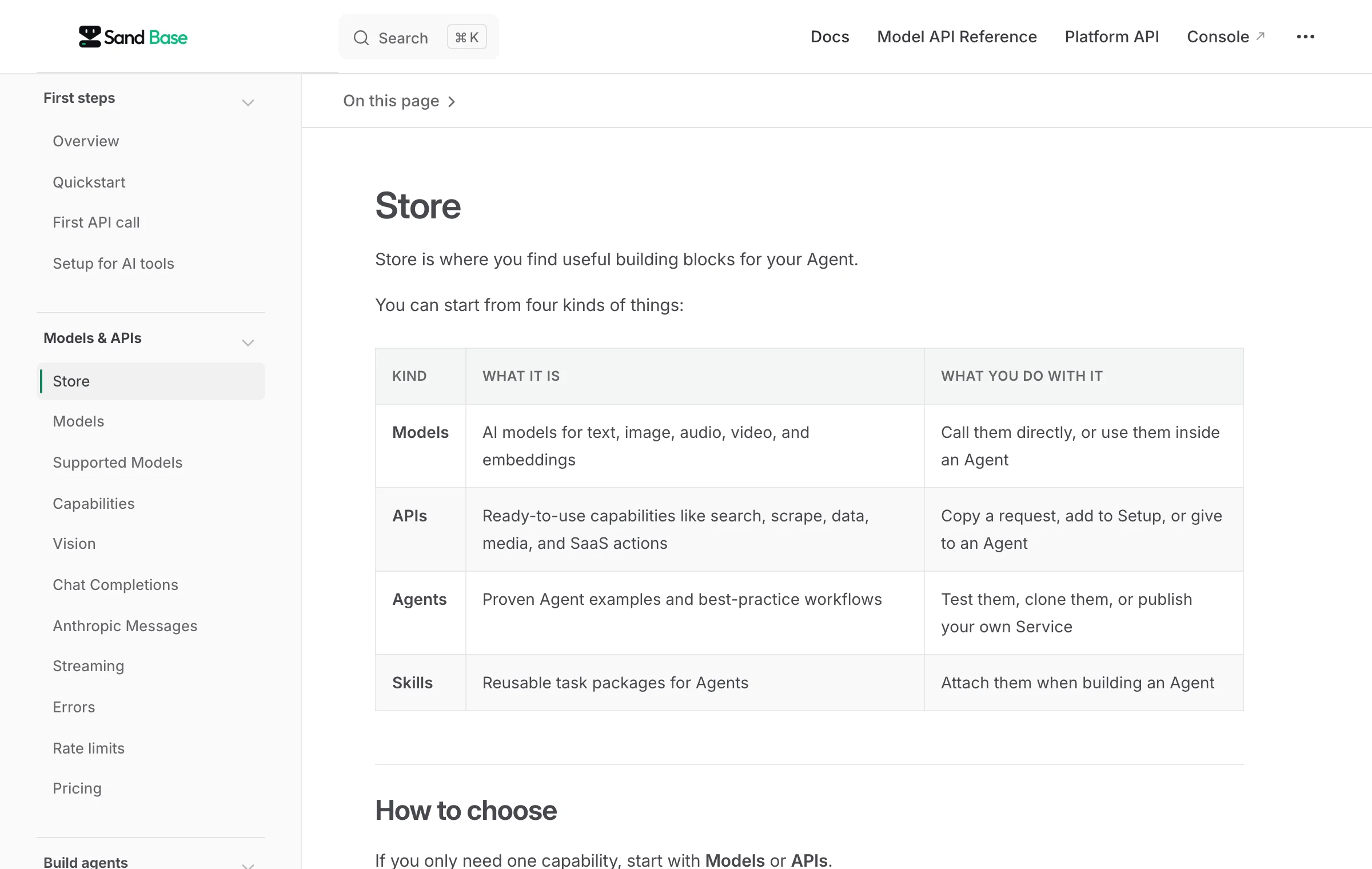 SandBase Store documentation, captured August 23, 2026. The catalog separates model inference from callable external APIs.
The LLM gateway accepts an OpenAI-compatible request:
import os
from openai import OpenAI

client = OpenAI(
    api_key=os.environ["SANDBASE_API_KEY"],
    base_url="https://api.sandbase.ai/v1",
)

response = client.chat.completions.create(
    model="YOUR_MODEL_ID",
    messages=[{"role": "user", "content": "Summarize this incident."}],
)

print(response.choices[0].message.content)
Use a current ID from the SandBase model catalog; do not guess model names. The first API call guide documents authentication, streaming, and the response shape.
Choose SandBase when:
- an agent needs text models and multimodal generation;
- the same workflow calls search, data, or other APIs;
- developers want one setup across Codex, Claude Code, Cursor, Windsurf, and other clients;
- minimizing separate vendor accounts and integration code matters more than self-hosting the gateway.
Do not choose it only because the catalog is broad. If policy requires all routing infrastructure and provider credentials to stay inside your environment, a self-hosted proxy is a better architectural match.
2. LiteLLM: best self-hosted OpenRouter alternative
LiteLLM is open-source proxy software rather than a hosted model marketplace. You deploy it, configure upstream provider credentials, and expose a normalized API to applications. That makes it the most direct choice when “OpenRouter alternative” really means “keep the gateway and data plane under our control.”
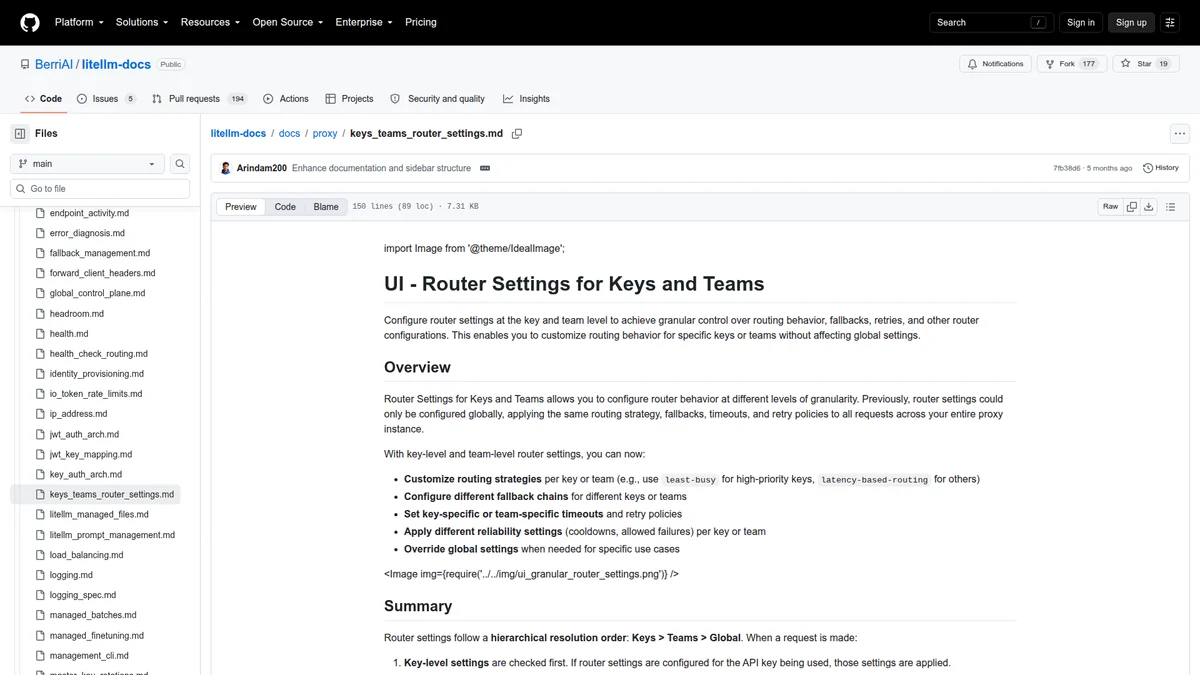 LiteLLM routing documentation, captured August 20, 2026. Self-hosting exposes routing controls while transferring operational responsibility to your team.
LiteLLM can provide virtual keys, budgets, rate limits, routing, retries, and fallbacks. Its flexibility comes with an operational cost: the team owns availability, state, upgrades, provider changes, and routing regressions.
Choose LiteLLM when:
- bring-your-own-provider-key is the default model;
- self-hosting or data residency is mandatory;
- platform engineers need custom routing policies;
- the organization already operates reliable internal services.
Read the LiteLLM vs OpenRouter comparison for the build-versus-buy trade-off, or the LiteLLM gateway guide for deployment concepts.
3. Portkey: best for gateway controls and guardrails
Portkey combines a universal gateway with observability and policy controls. Its documented gateway capabilities include retries, fallbacks, conditional routing, load balancing, budgets, rate limits, caching, and circuit breaking. It also supports input and output guardrails that can deny, log, transform, retry, or route a request based on a check.
That makes Portkey a good fit when the problem is no longer model access alone. Teams often adopt it after discovering that they need to explain which prompt version ran, why a route changed, how much a tenant spent, or why an unsafe response was blocked.
Choose Portkey when:
- request-level observability is a primary requirement;
- input/output guardrails belong at the gateway boundary;
- routing policies depend on metadata or request fields;
- teams need budgets and controls without building the control plane from scratch.
The trade-off is conceptual weight. For a prototype that only needs one key and a few models, the additional gateway policy surface may be unnecessary.
4. Cloudflare AI Gateway: best for Cloudflare-native stacks
Cloudflare AI Gateway is a natural candidate when an application already uses Cloudflare for edge traffic, Workers, logging, or security controls. It places model requests behind a managed gateway and can centralize analytics, caching, rate controls, retries, fallbacks, and upstream-provider configuration.
Cloudflare supports both provider-native proxy routes and a unified REST API. Depending on the route and billing mode, teams can use upstream credentials or let Cloudflare handle authentication and billing for supported third-party models. Evaluate which mode, providers, and modalities your deployment needs, where credentials live, and whether provider-specific capabilities survive the gateway interface.
Choose Cloudflare when:
- the application and operations team already standardize on Cloudflare;
- edge placement and unified traffic controls matter;
- model traffic should share an existing operational surface.
When OpenRouter is still the right choice
An alternative article should also say when not to switch. OpenRouter remains a strong option when the requirement is a managed LLM marketplace with one API and unified billing. Its provider routing can consider price and recent availability, apply fallbacks, require parameter support, and filter provider handling preferences.
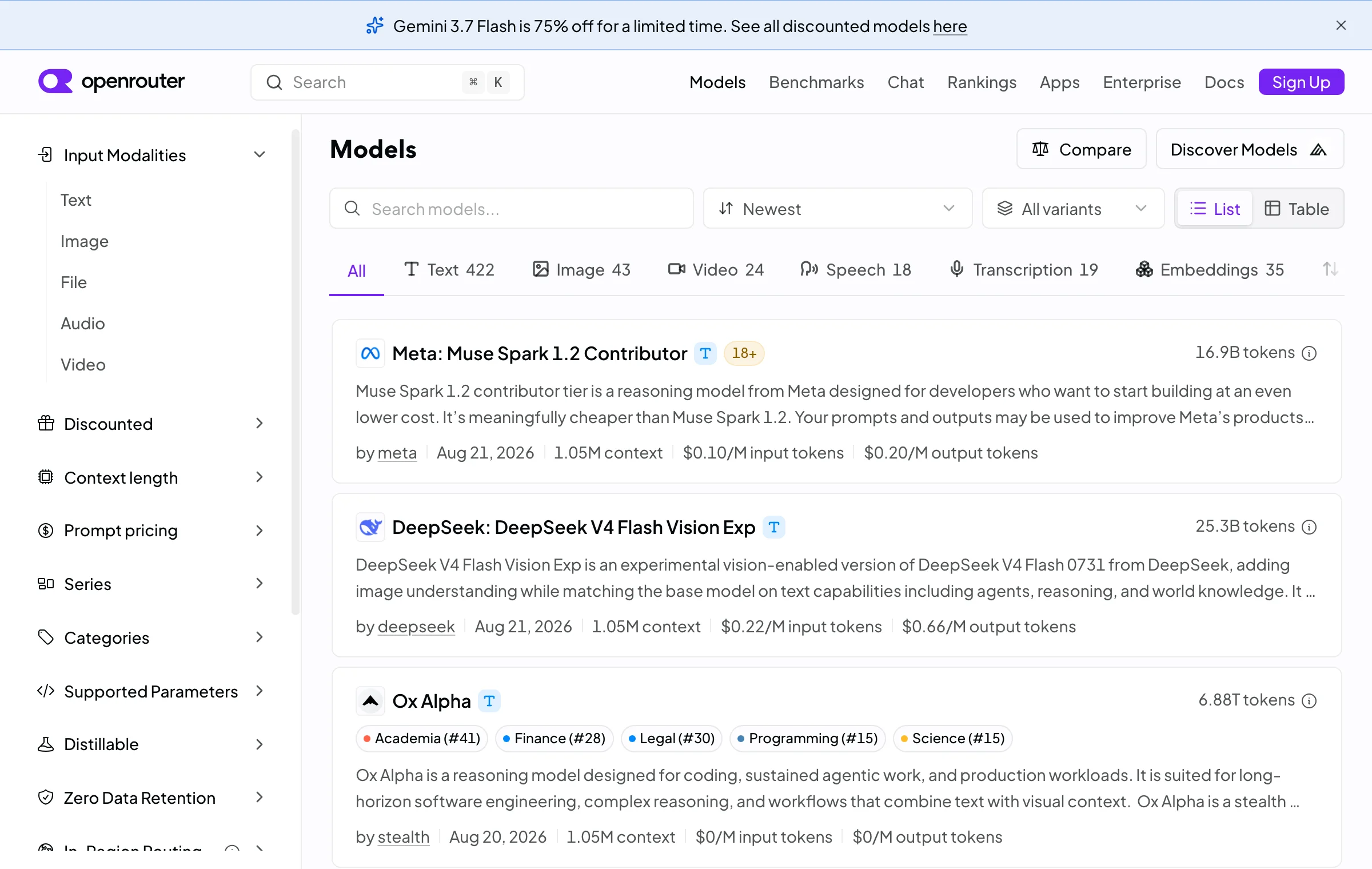 OpenRouter model catalog, captured August 23, 2026. The live catalog demonstrates breadth, not a permanent guarantee of any individual route.
Stay with OpenRouter when:
- broad hosted LLM access is the main job;
- zero gateway operations is more valuable than self-hosting;
- the team is satisfied with its routing and data boundary;
- non-LLM tools and broader agent infrastructure are separate concerns.
Migration has a cost. A nominally OpenAI-compatible endpoint does not guarantee identical streaming, tool calling, reasoning fields, error mapping, or provider-specific parameters. Test behavior, not just a basic chat completion.
Decision checklist
Before moving production traffic, answer these questions:
- Do we need LLMs only, or image, video, audio, search, and data tools too?
- Who owns provider accounts and API keys?
- Must the gateway be self-hosted?
- What happens after a partial streaming failure?
- Which tool-calling and structured-output fields must survive routing?
- Do we need per-user or per-team budgets?
- Where are prompts and responses logged, and for how long?
- Can we export usage and traces?
- What is the fallback behavior when a provider is unavailable?
- Can one SDK and one integration test suite exercise every required model?
A safe migration test
Run a shadow test before changing the production base URL. Use a representative set of prompts and compare:
- response schema and error codes;
- time to first token and total latency;
- tool-call arguments;
- structured JSON validity;
- token accounting and cost;
- provider-specific reasoning or multimodal fields;
- behavior during timeouts and rate limits.
Start with a small traffic percentage and keep the old route available until the new gateway passes both normal and failure-path tests.
FAQ
Is there an open-source OpenRouter alternative?
LiteLLM is the clearest option in this comparison when you want to operate an open-source multi-provider proxy. Portkey also publishes an open-source gateway. Self-hosting changes the cost from a service fee into infrastructure and operational ownership.
Which alternative supports the OpenAI SDK?
SandBase, LiteLLM, Portkey, Cloudflare AI Gateway, and OpenRouter all provide OpenAI-compatible paths in some form. Compatibility is not binary: test streaming, tools, structured output, files, images, and error behavior used by your application.
Which option is best for image and video APIs?
SandBase is the most direct fit among these options when a single platform must expose LLM, image, and video models alongside callable APIs. Confirm the exact model schema and price in the current catalog before implementation.
Which option is best for strict infrastructure control?
A self-hosted LiteLLM deployment is the most natural fit when the gateway process, configuration, and upstream credentials must remain under your control.