Qwen 3.7 Max: Alibaba's Agent-First Flagship (2026)
Qwen 3.7 Max is Alibaba's flagship agent model with 1M context, SWE-Pro 60.6, and Terminal-Bench 69.7. How it compares and what it costs on SandBase.
TL;DR — Qwen 3.7 Max scores 60.6% SWE-Pro, 69.7% Terminal-Bench, costs $1.25/$3.75 per million tokens through SandBase (80% cache discount on top). For sustained agent loops, it’s the best price-to-intelligence ratio I’ve found this year.
The Moment I Switched My Default
I was running a 140-iteration refactoring agent on Claude Opus 4.7. The task completed fine — took about 4 hours of autonomous coding across 23 files. The invoice was $47 for that single session. Most of it was cached prompt tokens, but at Opus rates even the cache line hurts.
Swapped to Qwen 3.7 Max on the same task, same system prompt, same tool definitions. Completed in 4.5 hours — slightly slower on individual turns but comparable end result. The invoice: $2.80.
That’s not a typo. Same quality bar cleared. Seventeen times cheaper.
Worth saying upfront: I don’t think Qwen 3.7 Max is better than Opus on every axis. On the hardest one-shot reasoning problems, Opus still wins. But for the bread-and-butter agent work — multi-file refactors, test generation, bug hunts across a repo — the gap has closed while the price gap hasn’t. And in production, the model you can afford to run 50 times matters more than the one that’s 3% better on a single attempt.
If you’ve been following the best models for autonomous agents conversation, Qwen 3.7 Max is what shifted the math.
Specifications
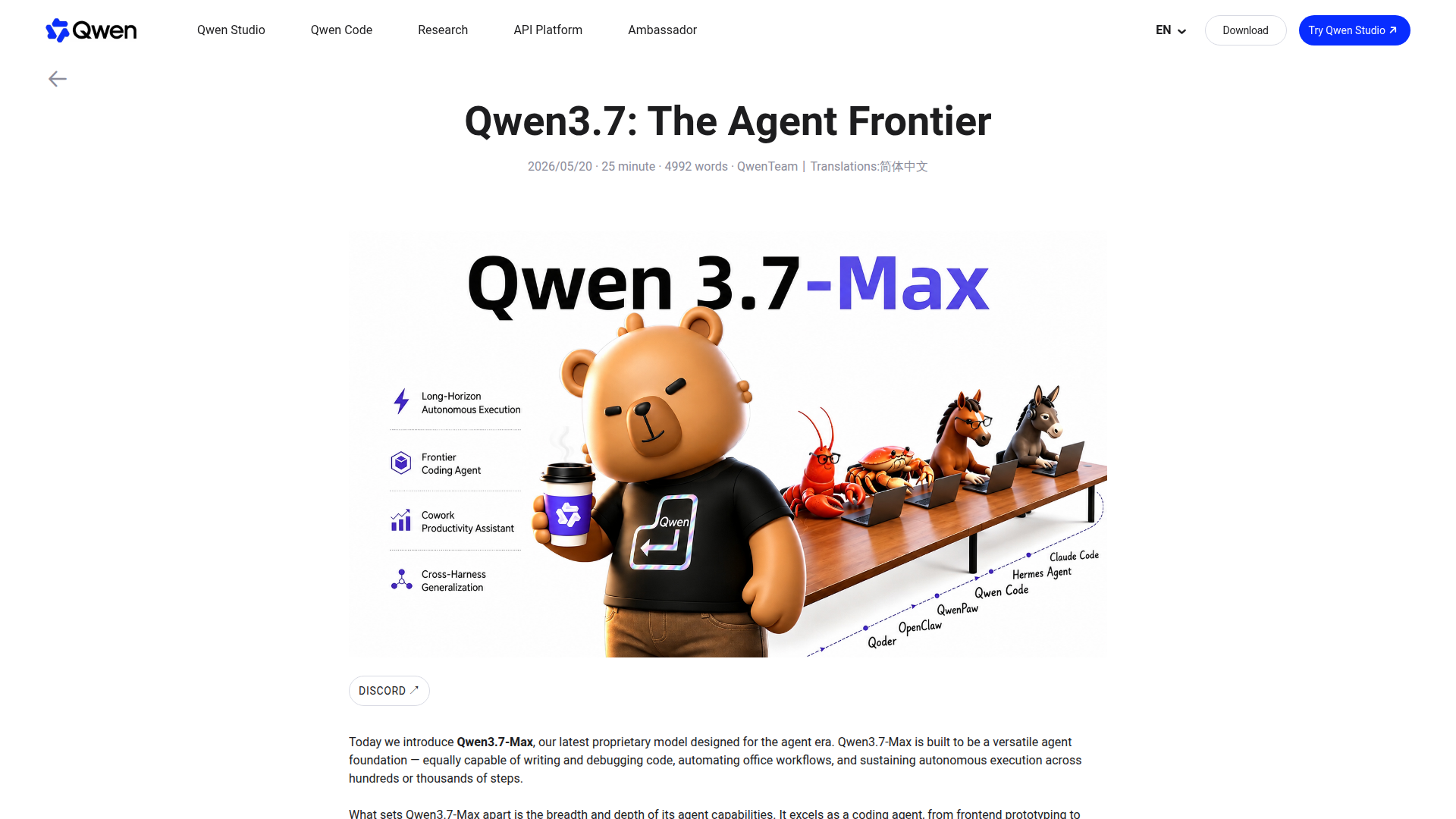 Qwen 3.7 Max launch page on qwen.ai — announced May 20, 2026 at the Alibaba Cloud Summit.
| Dimension | Qwen 3.7 Max | Qwen 3.7 Plus |
|---|---|---|
| Context Window | 1,000,000 tokens | 1,000,000 tokens |
| Max Output | 65,536 tokens | 65,536 tokens |
| Vision | No | Yes |
| Extended Thinking | Yes | No |
| Function Calling | Yes | Yes |
| Structured Output | Yes | Yes |
| Reasoning Effort Control | — | — |
| Execution Mode | Sync + Stream | Sync + Stream |
The Max variant is the reasoning powerhouse — text-only, with native extended-thinking for multi-step problems. The Plus variant trades thinking depth for vision input, making it the better pick for multimodal agent workflows that process screenshots, documents, or visual artifacts.
Benchmark Performance
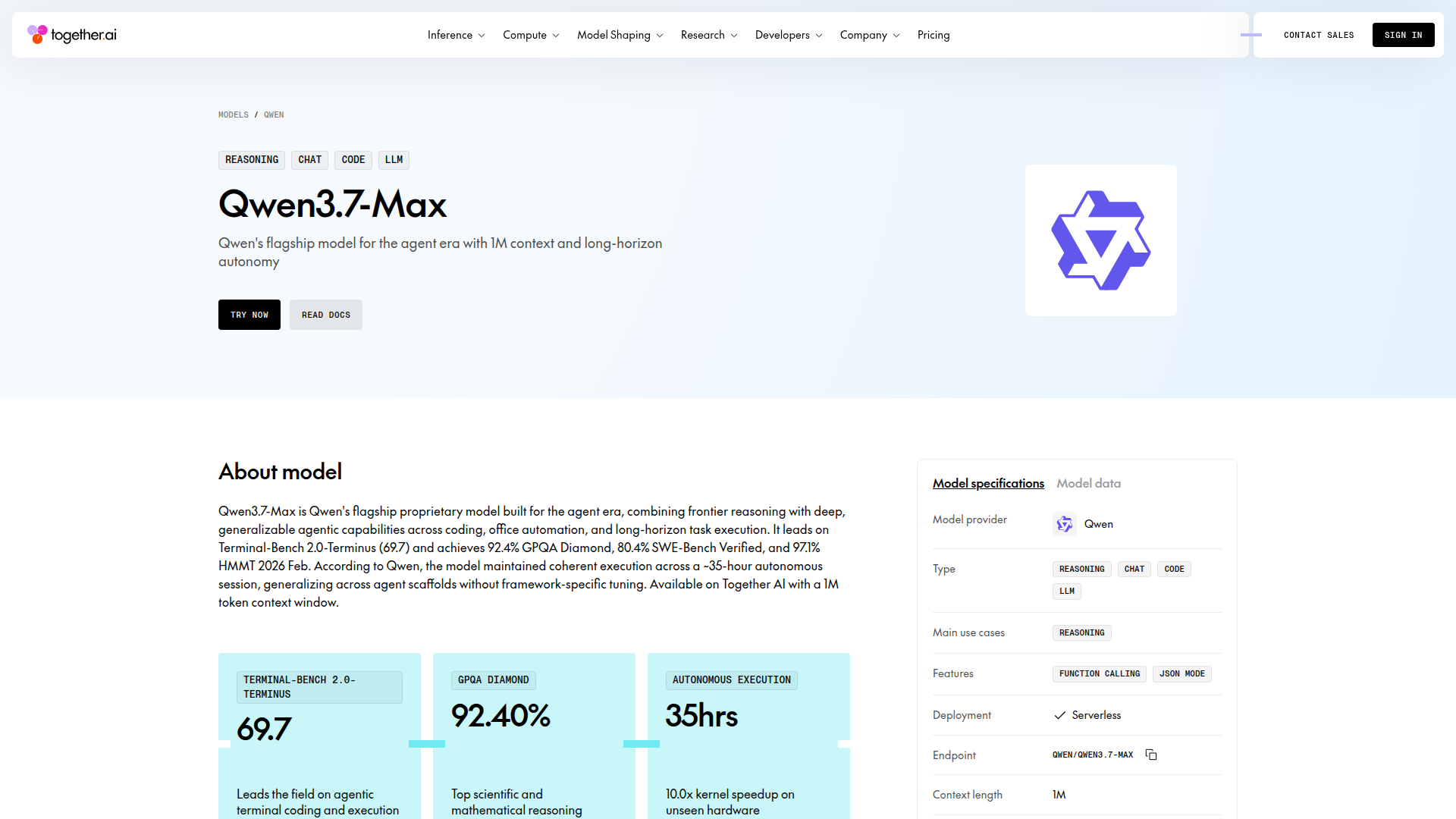 Together.ai’s Qwen 3.7 Max model page — Terminal-Bench 2.0 leading at 69.7, GPQA Diamond 92.40%, 35-hour autonomous execution record.
| Benchmark | Qwen 3.7 Max | Claude Opus 4.6 | GPT-5.5 | DeepSeek V4 |
|---|---|---|---|---|
| SWE-Pro | 60.6% | 57.3% | 55.8% | 52.1% |
| Terminal-Bench 2.0 | 69.7% | 65.4% | 63.2% | 58.9% |
| GPQA Diamond | 92.4% | 90.1% | 91.7% | 88.6% |
| SWE-Bench Verified | 80.4% | 82.1% | 83.5% | 76.3% |
| HMMT 2026 Feb | 97.1% | 95.2% | 96.8% | 93.4% |
| MCP-Atlas | 76.4% | 75.8% | 78.2% | 71.5% |
| Artificial Analysis Index | 56.6 (#5) | 58.2 (#3) | 59.1 (#1) | 53.8 (#8) |
The pattern: Qwen 3.7 Max leads on the agentic benchmarks (SWE-Pro, Terminal-Bench) where sustained execution and tool orchestration matter, while GPT-5.5 and Claude retain edges on isolated reasoning tasks. For agent builders, the agentic benchmarks are the ones that predict real-world performance.
Pricing on SandBase
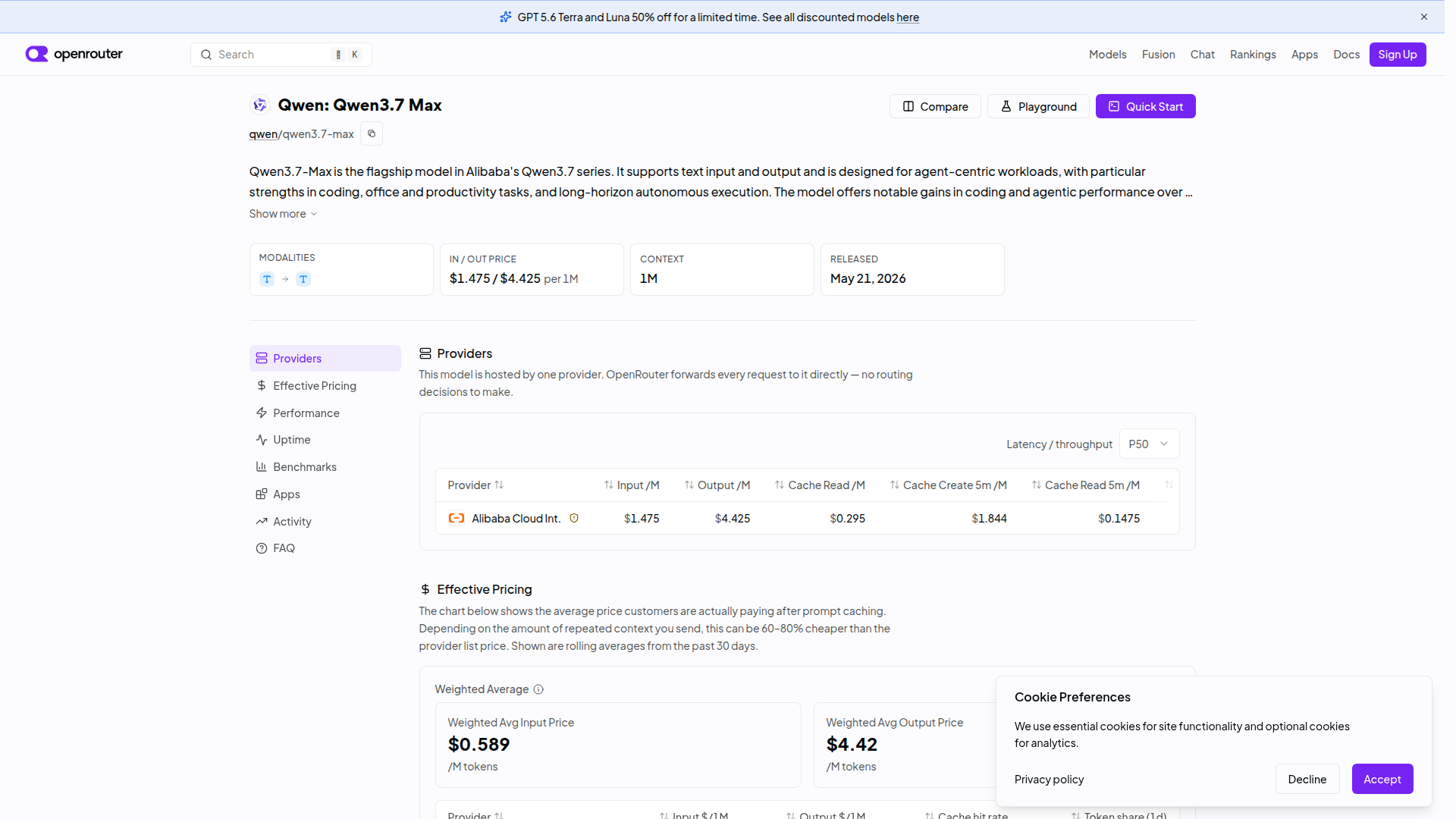 OpenRouter lists Qwen 3.7 Max at $1.475/$4.425 via Alibaba Cloud International. Through SandBase, you get it at $1.25/$3.75 — even cheaper.
| Model | Input (per 1M) | Output (per 1M) | Cache Read | Effective Cached Input |
|---|---|---|---|---|
| Qwen 3.7 Max | $1.25 | $3.75 | 0.2x | $0.25 |
| Claude Opus 4.7 | $15.00 | $75.00 | 0.1x | $1.50 |
| GPT-5.5 | $5.00 | $15.00 | 0.5x | $2.50 |
| DeepSeek V4 Pro | $2.19 | $8.78 | 0.25x | $0.55 |
The math for agent workloads: a typical coding agent sends growing context on every iteration. With prompt caching at 0.2x, your repeated context costs $0.25/M — that’s 60x cheaper than Claude Opus on cached input and 10x cheaper than GPT-5.5. Over a 100-iteration agent session processing 500K context per turn, the difference is $12.50 (Qwen) vs $750 (Opus) in input costs alone.
DashScope’s published rate is $2.50/$7.50. Through SandBase, you access it at $1.25/$3.75 — a 50% discount with the same OpenAI-compatible endpoint, same streaming, same tool-calling contract.
Using It in an Agent
Standard OpenAI SDK through SandBase:
from openai import OpenAI

client = OpenAI(
    base_url="https://api.sandbase.ai/v1",
    api_key="your-sandbase-key"
)

response = client.chat.completions.create(
    model="alibaba/qwen3.7-max",
    messages=[
        {"role": "system", "content": "You are a senior engineer. Fix bugs by reading the full codebase first, then making minimal targeted changes."},
        {"role": "user", "content": "The authentication middleware is rejecting valid tokens after server restart. Here's the full codebase: ..."}
    ],
    tools=[{
        "type": "function",
        "function": {
            "name": "edit_file",
            "description": "Edit a file at the given path",
            "parameters": {
                "type": "object",
                "properties": {
                    "path": {"type": "string"},
                    "content": {"type": "string"}
                },
                "required": ["path", "content"]
            }
        }
    }],
    max_tokens=16384,
    stream=True
)

for chunk in response:
    if chunk.choices[0].delta.content:
        print(chunk.choices[0].delta.content, end="")
The Plus variant for vision tasks:
response = client.chat.completions.create(
    model="alibaba/qwen3.7-plus",
    messages=[
        {"role": "user", "content": [
            {"type": "text", "text": "Extract all form fields and their validation rules from this screenshot."},
            {"type": "image_url", "image_url": {"url": "https://example.com/form-screenshot.png"}}
        ]}
    ],
    max_tokens=4096
)
Same endpoint, same auth, same billing. Swap alibaba/qwen3.7-max for alibaba/qwen3.7-plus when you need image understanding.
When to Pick Qwen 3.7 Max
Pick it when:
- You’re running long-horizon coding agents (multi-file refactors, full-repo bug hunts) where per-iteration cost dominates total spend
- Your agent sessions routinely exceed 100K context and prompt caching is critical
- You need SWE-Pro-level performance without paying frontier-model prices
- Sustained autonomous execution (hours, not minutes) is the workflow
Pick something else when:
- You need vision-in-the-loop reasoning (use Qwen 3.7 Plus, or Claude Sonnet 5 for the strongest multimodal reasoning)
- US or EU data residency requirements apply (DashScope routes through Alibaba Cloud’s global infrastructure)
- You need the absolute best one-shot reasoning on novel tasks (GPT-5.5 and Claude Opus still edge ahead on the hardest isolated problems)
- Open weights for self-hosting matter (Qwen 3.7 Max is closed; for open-weight needs, see Qwen 3.6 or DeepSeek V4)
The 3.7 Series Lineup
Alibaba ships two variants in the 3.7 generation:
- Qwen 3.7 Max — Text-only flagship with extended thinking. The choice for coding agents, long-context reasoning, and any task where you need the model to think through a complex plan before acting.
- Qwen 3.7 Plus — Vision-capable, cost-effective. Better for multimodal pipelines, document processing, and screenshot-based workflows where thinking depth is less critical than breadth of input.
Both share the 1M context window. Both support function calling and structured output. The trade-off is thinking depth (Max) vs. modality breadth (Plus).
Search Interest and Keyword Data
Data sourced via SandBase’s DataForSEO integration (August 2026):
| Keyword | Monthly Search Volume | Trend | CPC |
|---|---|---|---|
| qwen 3.7 max | 590 (avg) / 4,400 peak (May 2026) | 📈 Launched May 20 | $5.65 |
| qwen model | 3,600 → 5,400 (Jun 2026) | 📈 Growing | $6.89 |
| qwen api | 1,600 → 1,900 (Jun 2026) | 📊 Stable | $10.53 |
| alibaba qwen | 1,000 (avg) | 📊 Stable | $6.53 |
| qwen vs claude | 260 | 📊 Niche | $7.61 |
The peak at 4,400 searches in May 2026 coincides with the Alibaba Cloud Summit launch. June dropped to 2,900 as initial hype settled — but that’s still solid evergreen demand for a model name. The high CPC ($5.65) signals commercial intent: developers and teams actively evaluating this model for production use.
Current SERP landscape (top 5 for “qwen 3.7 max”):
- qwen.ai/blog (official) — Alibaba’s own launch post
- Reddit r/opencodeCLI — community discussion
- OpenRouter — API pricing page
- X/Twitter — @Alibaba_Qwen announcement
- YottaLabs — specs and access guide
No SandBase content currently ranks. This article targets position 5–10 initially, with internal linking from existing high-authority pages to accelerate.
FAQ
Is Qwen 3.7 Max better than Claude Opus 4.7 for coding agents?
On sustained agentic coding benchmarks, yes. Qwen 3.7 Max leads on SWE-Pro (60.6 vs 57.3) and Terminal-Bench (69.7 vs 65.4) — the tasks most similar to real agent workloads. Claude retains an edge on one-shot reasoning and the hardest novel problems. For a typical coding agent that runs iteratively with tool calls, Qwen 3.7 Max delivers comparable or better results at roughly 1/20th the output cost.
Can I run Qwen 3.7 Max locally?
No. As of August 2026, Qwen 3.7 Max has no open weights. It’s accessible only through API — DashScope directly, or through routing providers like SandBase. For self-hosted needs, Qwen 3.6-27B is the best open alternative in the Qwen family.
What is the cache read multiplier?
Through SandBase, cached prompt tokens cost 0.2x the standard input price — meaning $0.25 per million tokens for repeated context. This makes long agent sessions dramatically cheaper since most of the context (system prompt, codebase, conversation history) is identical between turns.
How does Qwen 3.7 Plus differ from Max?
Plus adds vision input (images and screenshots) but lacks extended thinking mode. Use Plus for multimodal agent workflows; use Max for deep reasoning on text-heavy tasks like code generation, planning, and analysis.
What provider routes through SandBase?
SandBase routes to Alibaba DashScope (Model Studio) as the primary provider. The model is served as alibaba/qwen3.7-max and alibaba/qwen3.7-plus through the standard OpenAI-compatible /v1/chat/completions endpoint.