Gemini 4 Neon vs Carbon vs Hydrogen vs Argon: How to Choose Work You Can Actually Route
Google places Gemini 4 Neon between Hydrogen and Carbon. Here is the official family map, labeled community routing color from X, and the SandBase cards you can actually call today.
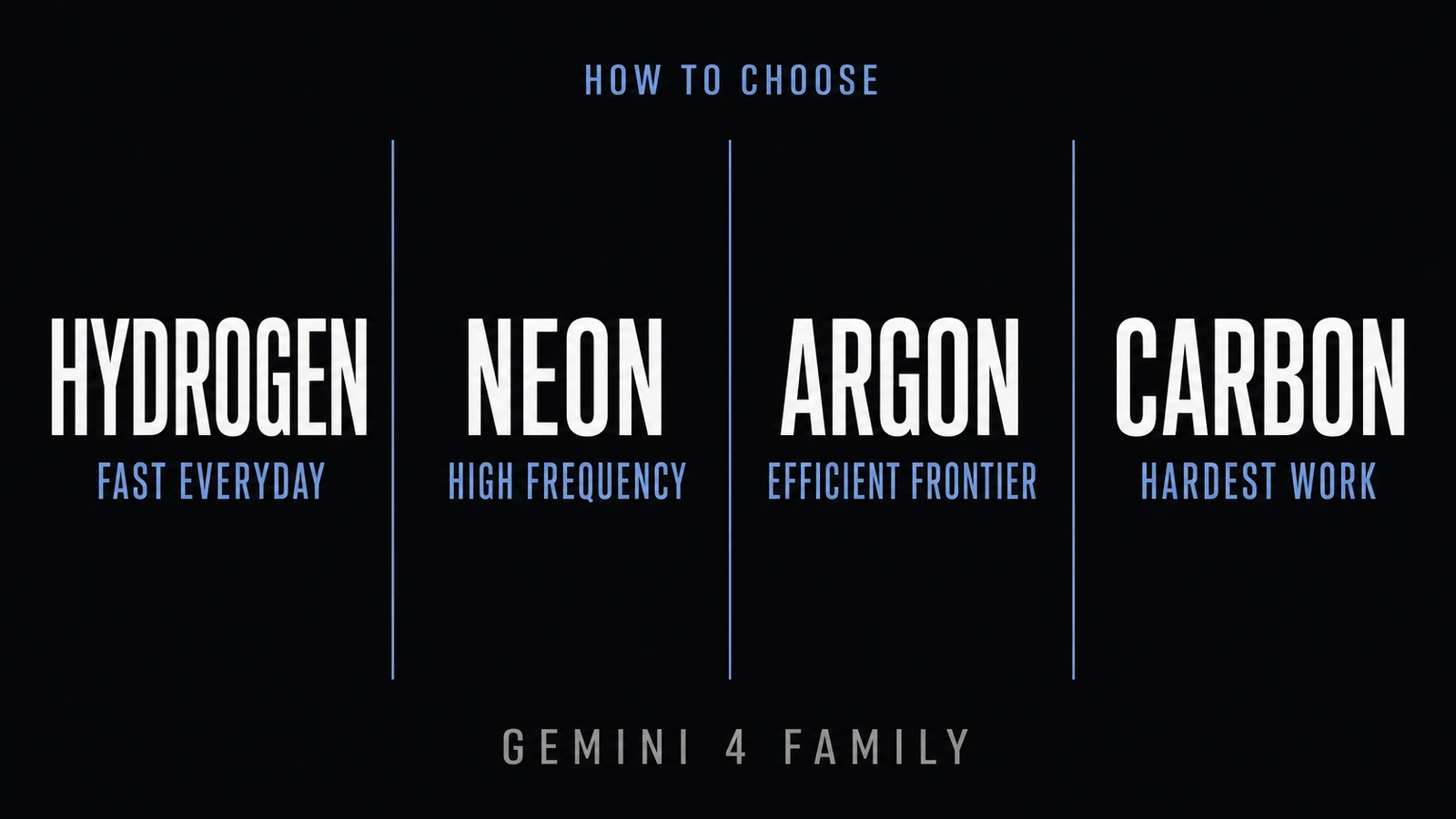
Quick verdict: Route bounded everyday work to Gemini 4 Hydrogen. Route high-frequency complex coding and knowledge work to Gemini 4 Neon. Reserve Gemini 4 Carbon for the hardest long-horizon cases, and budget more tokens, not a lower unit price. Keep Gemini 4 Argon where you already prefer that card. On SandBase all four IDs are callable today. Google’s map decides the split. A social-media ranking does not.
You do not have to guess where Neon sits. Google already said it. Gemini 4 Neon is the mid-tier between Hydrogen and Carbon, and the SandBase card is live at google/gemini-4-neon, $3.00 / $15.00 / $0.15 per million tokens, 1M context, 65.5K max output. Hydrogen, Carbon, and Argon are live too. The job is to pick work you can actually route.
IDs, the launch clock, and the paid-only rule are in the Neon confirmation. This page is the routing decision. I did not run the same task on all four models. Nothing below is a measured ranking.
Key takeaway
- Google’s map: Hydrogen for fast everyday execution, Neon between Hydrogen and Carbon for high-frequency complex work, Carbon for the hardest long-horizon work. Argon remains a published Gemini 4 model. Neon does not retire it.
- Thinking levels are official and uneven. Neon and Hydrogen default to
highand includexhigh. Carbon and Argon default tomediumand cap athigh. “Extra” is not one of those levels.- SandBase heroes, per million tokens: Hydrogen $1.50 / $7.50 / $0.08 cache read. Neon $3.00 / $15.00 / $0.15. Carbon and Argon $4.00 / $20.00 / $0.20. Google’s Carbon and Argon intro is still $2 / $10 through 30 November 2026. SandBase is not billing that intro.
- Neon’s $3 / $15 is above the Carbon intro and below the Carbon list. The same token counts can cost less on Neon than on the SandBase Carbon hero, and more than on Google’s intro Carbon. Unit price is not task cost.
- Community notes from X are labeled personal experience. They do not replace the model card, which says Neon is adapted from Carbon.
The official map, including the thinking split
The what’s-new choosing section is the route I would actually use. Hydrogen is the default for everyday coding and agentic workflows. Neon is for high-frequency complex software engineering, knowledge work, and science, with the launch post’s line about frontier-level intelligence and faster end-to-end completion. Carbon is for the hardest architecture, debugging, science, and security problems. The model card compresses it: Carbon tackles the hardest long-horizon projects, Hydrogen handles fast everyday execution, Neon balances depth and efficiency, and Neon is adapted from Carbon.
Argon is the piece people are tempted to drop. Its model page is still gemini-4-argon. The Neon choosing section does not declare it retired. The Carbon now-available post, quoted in the 11 November confirmation, called Argon the model for most software engineering and knowledge work, and Carbon the model that spends more tokens on the limit case. That sentence is older than Neon. It is still the last official Argon-versus-Carbon split I am willing to repeat. I am not renaming Argon.
The thinking-level difference is an official migration note, not a community nickname. Neon defaults to high and supports xhigh, like Hydrogen. Carbon and Argon default to medium and cap at high. If you move a Carbon prompt onto Neon and do nothing else, you also move the default effort from medium to high. That can change the output-token bill before the unit price does. On SandBase, the published Neon example does not include a thinking_level field. Do not invent one. Google’s control is documented on the what’s-new page. The SandBase body is whatever the live card’s example shows.
| Hydrogen | Neon | Argon | Carbon | |
|---|---|---|---|---|
| SandBase ID | google/gemini-4-hydrogen | google/gemini-4-neon | google/gemini-4-argon | google/gemini-4-carbon |
| Google’s job | Everyday execution | High-frequency complex work | Still published. Not retired by Neon | Hardest long-horizon work |
| Default thinking | high | high | medium | medium |
| Top thinking level | xhigh | xhigh | high | high |
| SandBase hero, per 1M | $1.50 / $7.50 / $0.08 | $3.00 / $15.00 / $0.15 | $4.00 / $20.00 / $0.20 | $4.00 / $20.00 / $0.20 |
| Context / max output | 1M / 65.5K | 1M / 65.5K | 1M / 65.5K | 1M / 65.5K |
| Callable on SandBase | Yes | Yes | Yes | Yes |
All four share Google’s unified 1,048,576-token window and implicit-only caching, with a 4,096-token floor for the implicit hit. The SandBase heroes cap visible max output at 65.5K. Google’s long decode, up to the rest of the window, is a Google API feature. I am not claiming these cards expose it.
Prices you will actually pay
Read the two columns before you pick a winner on cost. Google’s Standard row and the SandBase hero are the same for Neon and for Hydrogen’s input and output. They are not the same for Hydrogen’s cache, and they are not the same for Carbon or Argon during the intro window.
| Model | Google Standard, per 1M | SandBase hero, per 1M |
|---|---|---|
| Hydrogen | $1.50 / $7.50 / $0.075 cached. Free of charge on Google’s Gemini API free tier | $1.50 / $7.50 / $0.08 cache read. A paid catalog rate |
| Neon | $3.00 / $15.00 / $0.15 cached. Not on the free tier | $3.00 / $15.00 / $0.15 cache read |
| Argon | $2 / $10 / $0.10 through 30 Nov 2026, then $4 / $20 / $0.20 | $4.00 / $20.00 / $0.20. No intro on the hero |
| Carbon | Same intro, then the same list | $4.00 / $20.00 / $0.20. No intro on the hero |
A 100,000-token uncached input and a 10,000-token output is arithmetic, not a measured task. Hydrogen is $0.225. Neon is $0.45. Google’s intro Carbon or Argon is $0.30. The SandBase Carbon or Argon hero is $0.60. So Neon is more expensive than intro Carbon on Google’s API today, and less expensive than the Carbon card on SandBase, for this exact mix. Move the output to 40,000 tokens and those totals become $0.45, $0.90, $0.60, and $1.20. Thinking tokens are already inside the output price. A model that thinks longer can lose a unit-price advantage without changing the rate card.
Hydrogen’s cache mismatch is $0.08 on SandBase versus $0.075 at Google. On 100,000 cached tokens that is $0.008 versus $0.0075. Quote the card you will call. The full launch arithmetic, including the 95 percent cached-input discount, is in the confirmation post.
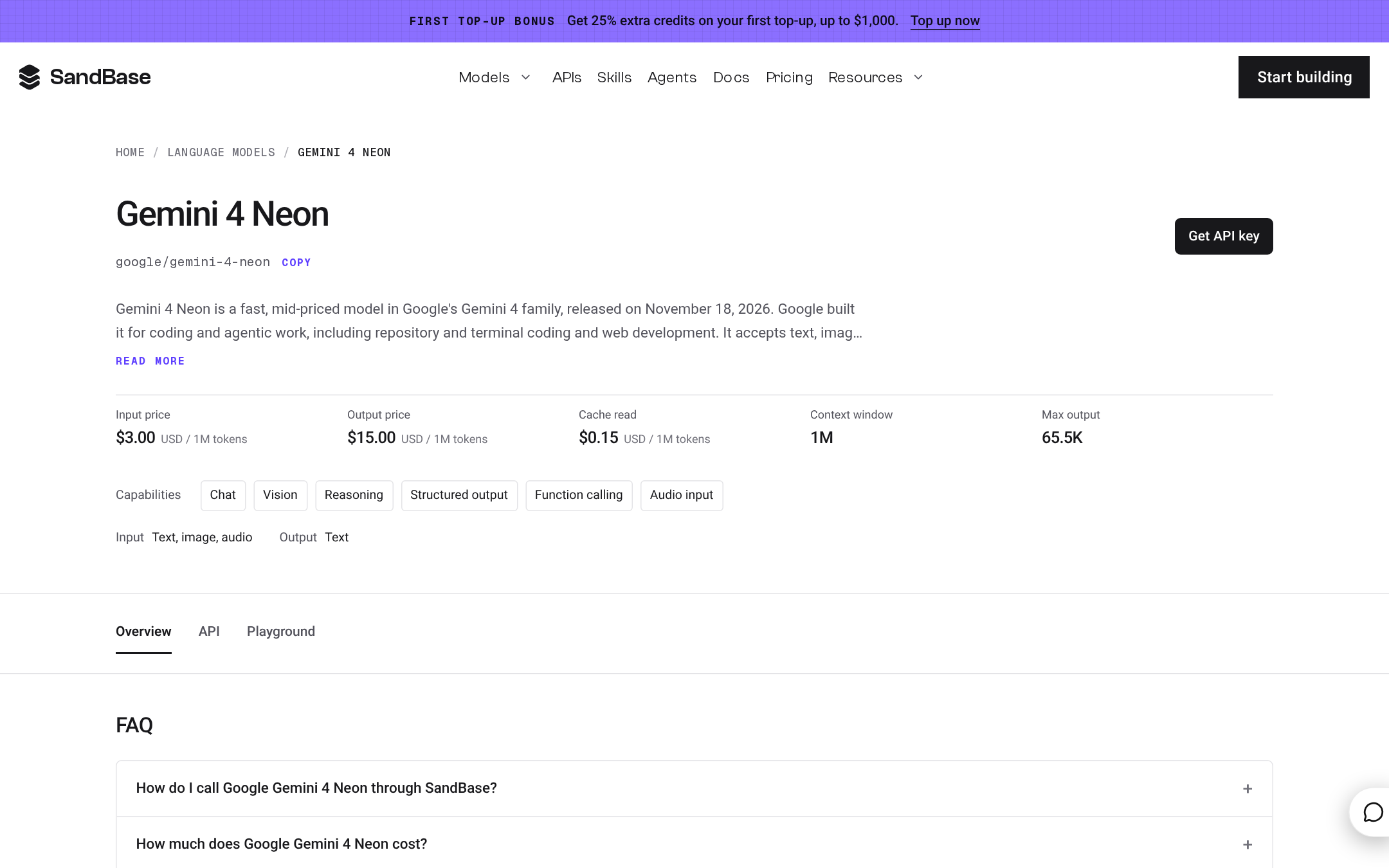
Neon on SandBase, 20 November 2026. The hero matches Google’s Standard $3 / $15 / $0.15. Context is 1M. There is no green Available badge on this card, and no Benchmarks block. The page is still a priced catalog card with Get API key and a playground.
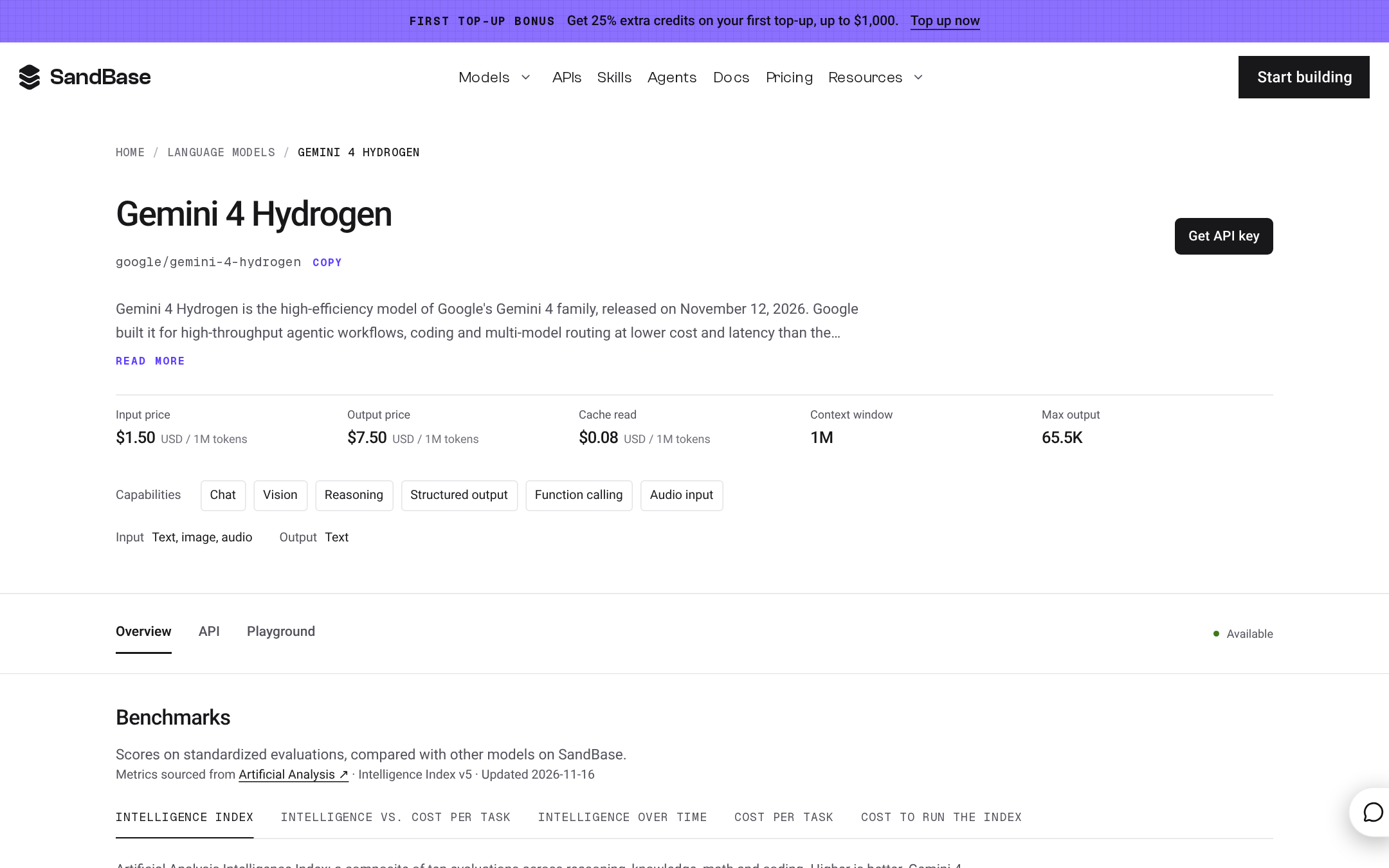
Hydrogen on SandBase. Input and output match Google’s paid rates. Cache read is $0.08, not Google’s $0.075. The playground is marked Available. This is a paid catalog price, not Google’s free tier.
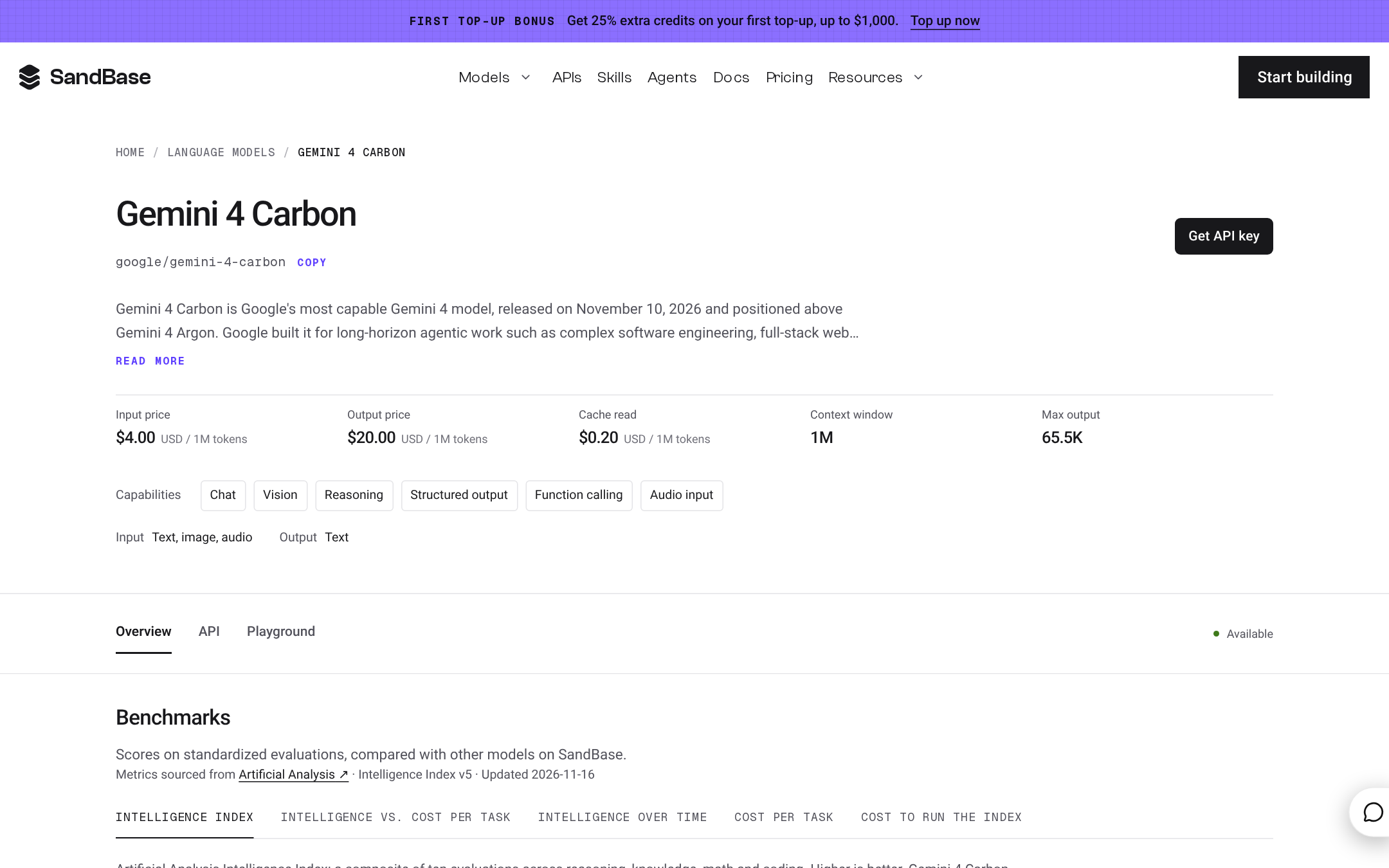
Carbon on SandBase. The hero is the list rate, $4 / $20 / $0.20. Google’s $2 / $10 intro, still in effect through 30 November 2026, is not on this card.
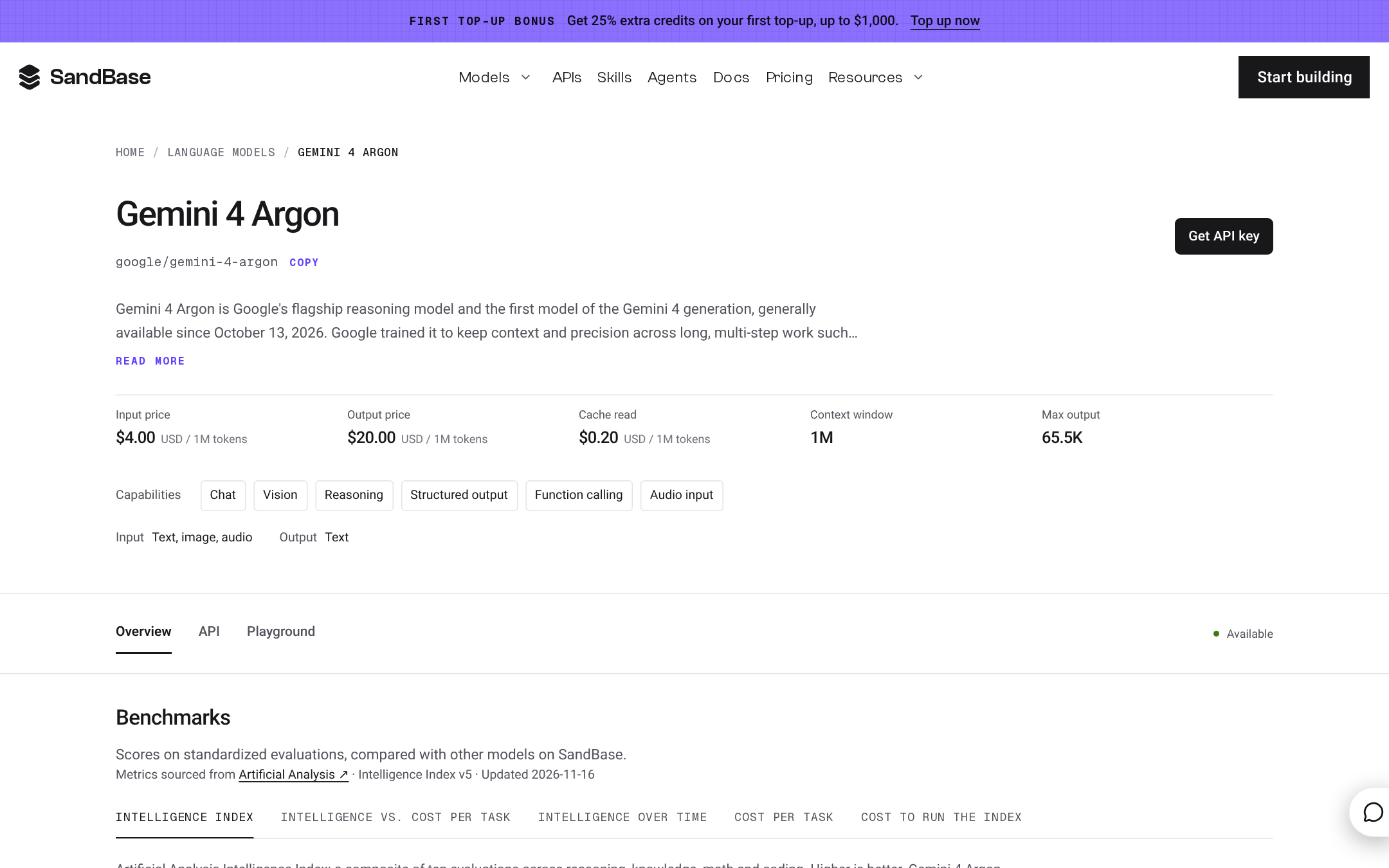
Argon on SandBase, same hero unit price as Carbon, also marked Available. Switching the model string between these two IDs does not change the SandBase unit price.
The 13 November Hydrogen post still says that day’s catalog check did not find Hydrogen. The card above is live. Use the post for the feature discussion and the card for the route. The October Argon pricing guide still carries a 50 percent off title. Today’s hero does not.
Community routing, labeled as personal
Community notes are useful color. They are not a substitute for Google’s map, and they are not SandBase measurements.
In FeiZ’s Gemini 4 routing notes, posted 19 November 2026 at 06:34 UTC (14:34 Asia/Shanghai), Hydrogen reads to him like a light, Flash-class model for most work. Neon is the new mid-tier he would already give most tasks, and he prefers its language style to the other Gemini 4 models he has used. Argon is an older frontier model he still uses for some design work. Carbon is the top of the official line, and he personally finds it a bit more coding-specialized, with Argon more divergent when he wants design. He also noted that Neon’s API unit price sits above Carbon’s promotional rate and below list. That price sentence matches the official schedule. His origin sentence does not. He described Neon as based on Hydrogen and Carbon. The model card says Neon is adapted from Gemini 4 Carbon.
The same post says Neon in Antigravity had a serious cache problem that made the effective quota feel very low, and that he hoped the teams would fix it. That is a complaint about Google Antigravity. It is not a SandBase measurement, and it is not an official outage notice.
Two shorter posts from the same account, the same morning, stay in the personal column. FeiZ’s first language-style impression (19 November 2026, 11:23 Asia/Shanghai) praises the prose. FeiZ’s early ranking impression (09:54 Asia/Shanghai) calls Neon a mid-tier model he already believed was ahead of Carbon and Argon. That is a belief. It is not a benchmark table.
FeiZ’s PR-report comparison with GPT-6.2 Sol (19 November 2026, 17:53 Asia/Shanghai) is one hands-on example: a “what PRs are open” report where he strongly preferred Neon’s write-up. One preferred report is not a general quality claim, and this page does not invent a score for it.
FeiZ’s follow-up after a day of real work (19 November 2026, 23:26 Asia/Shanghai) says he spent the day working with Neon rather than running 3D tests, and that ordinary cybersecurity requests were completed. The work-preference sentence is his. The cybersecurity impression stays his too. Google’s published cyber path is the gated Fairwind Program, not a public promise about refusals, and not a model ID on SandBase. The Carbon cybersecurity note is the earlier Fairwind context for Carbon, with the date caution on that page.
fanxing321’s Antigravity routing practice (19 November 2026, 13:18 Asia/Shanghai) says they used “Neon Extra” instead of Carbon medium, because Carbon high felt too slow, and “Neon High” instead of “Hydrogen Extra.” “Extra” is not an official Gemini API thinking level. The documented values are low, medium, high, and xhigh. Treat that post as one person’s practice inside Antigravity, not as a request field.
leo114119’s zodiac SVG comparison and rainy convenience-store 3D comparison are community demos against Hydrogen. The author also wrote that the two models share a training baseline, so he thinks the essential gap is limited. Demos are not benchmarks, and the shared-baseline line is his. The official card’s line is that Neon is adapted from Carbon. niumoney’s personal ranking puts Neon first on a list he posted after his own use. It is a preference order, not a leaderboard.
Official Google and Sundar Pichai posts are cited in the launch confirmation. They confirm the announcement. They are not a second spec source for this routing page.
A plan you can run on SandBase today
This is an evaluation plan. It is not a result.
- Replay a set of bounded tasks you already accept on Gemini 4 Hydrogen: a narrow edit, a test failure with the log in the prompt, a tool error, and a case where the right answer is to report missing information. Keep the prompt, the repo state, and the acceptance check fixed.
- Put high-frequency complex coding and knowledge-work jobs on Gemini 4 Neon. Read completion tokens, not just the final paragraph. Default effort on Google’s side is
high. If the SandBase usage block shows a long reasoning share, the $15 output rate is the bill that matters. - Reserve Gemini 4 Carbon for the hardest long-horizon cases: architecture, multi-step debugging, and open-ended science. Google says that class of work spends more tokens. The SandBase unit price is already the $4 / $20 list, not the $2 / $10 intro.
- Keep Gemini 4 Argon only where you already like it, or where you want that card specifically. On SandBase the hero unit price matches Carbon. You are not saving the rate by picking Argon. You are picking the model.
Record usage on every attempt, including retries. A lower unit price loses if the route loops. Do not change a production default from one pleasant paragraph.
The call shape is Chat Completions. The first API call docs show the URL. The Carbon try-today note shows the pattern in more detail. Swap the model string. Do not post these models to /v1/run.
curl -X POST https://api.sandbase.ai/v1/chat/completions \
  -H "Authorization: Bearer $SANDBASE_API_KEY" \
  -H "Content-Type: application/json" \
  -d '{
  "model": "google/gemini-4-neon",
  "messages": [
    {
      "role": "user",
      "content": "Summarize the failing test in the conversation. Name the file, the assertion, and one minimal change. Do not claim you ran the test."
    }
  ],
  "max_tokens": 2048
}'
That body was not executed for this article. max_tokens 2048 is the value on the Neon card’s published example, under the 65.5K cap. To try Hydrogen or Carbon, change only the model string to google/gemini-4-hydrogen or google/gemini-4-carbon, then compare usage on your own run. Sign in at the SandBase sign-in page if you still need a key. The public signup path redirects there.
What not to assume
Antigravity’s orchestrator is Google’s product. It is not a SandBase feature. A prompt that depends on /swarm or on an Antigravity quota will not mean the same thing on POST https://api.sandbase.ai/v1/chat/completions.
“Extra” is not a thinking level. Fewer refusals is not an official Neon property. A public Neon-for-cyber ID was not on the SandBase card or on the open model page. Fairwind is the gated path.
The cross-vendor routing post still covers Carbon, Argon, GPT-6 Astra, and Claude Opus 5.5. It predates Neon. Use it when the choice leaves the Gemini 4 family. Do not treat its prices or its “Argon for most work” line as the current four-model map. An October head-to-head of Argon, Opus 5.5, and Astra is the measured one from that month. Its discount lines are from October.
No SandBase latency, throughput, or cache-hit figure for Neon is included here. A later measured note can exist only after a real run.
FAQ
Which is cheaper, Neon or Carbon?
On the unit rate, it depends which Carbon bill you mean. Google’s intro through 30 November 2026 is $2 / $10, below Neon’s $3 / $15. The SandBase Carbon hero is $4 / $20, above Neon. Hydrogen is lower than all of them at $1.50 / $7.50, and only Hydrogen is free of charge on Google’s Gemini API free tier. Task cost still depends on thinking tokens and retries.
Should I replace Carbon with Neon?
Not as a global swap. Google still points Carbon at the hardest long-horizon work, and Neon at high-frequency complex work. The defaults differ: Carbon medium, Neon high. Replay the hard cases before you retire Carbon. On SandBase the Carbon unit price is higher, which is not the same statement as “Neon is cheaper on your repo.”
Does SandBase expose thinking_level?
Unknown. The Neon card says the model supports adjustable reasoning effort. The published curl shows model, messages, and max_tokens only. Do not add thinking_level, xhigh, or “Extra” until that example includes a field you can actually send.
Can I call all four through one API?
Yes, on SandBase, as four model strings on POST https://api.sandbase.ai/v1/chat/completions: google/gemini-4-hydrogen, google/gemini-4-neon, google/gemini-4-argon, and google/gemini-4-carbon. One key does not make the prices, the thinking defaults, or the free-tier rules the same.
Is Argon deprecated now that Neon exists?
No. Argon’s model page and SandBase card are both live. Neon’s choosing section does not retire it. If you do not already have a reason to prefer Argon, Google’s current split is Hydrogen, Neon, and Carbon.
Where to go next
Start with the card for the job you are about to send: Gemini 4 Neon for the high-frequency path, Hydrogen for everyday runs, Carbon for the limit case, and Argon when that card is the one you meant. Prices, the launch clock, and Fairwind are in the confirmation post. The request shape starts at the first API call docs.
Sources: Google’s Neon what’s-new page, pricing page, model card, and model pages; the Carbon now-available post as quoted in the 11 November confirmation; live SandBase cards on 20 November 2026, Asia/Shanghai; FeiZ, fanxing321, leo114119, and niumoney on X, labeled as personal experience. Community posts are not a source for official IDs, prices, or thinking levels.
Found this useful? Share it