Gemini 4 Neon Is Official: ID, Pricing, and What You Can Call Today
Gemini 4 Neon is official. The API ID is gemini-4-neon, priced at $3 / $15 per 1M tokens on Google's paid API. Here is what is confirmed, and which Gemini 4 IDs you can already call on SandBase.
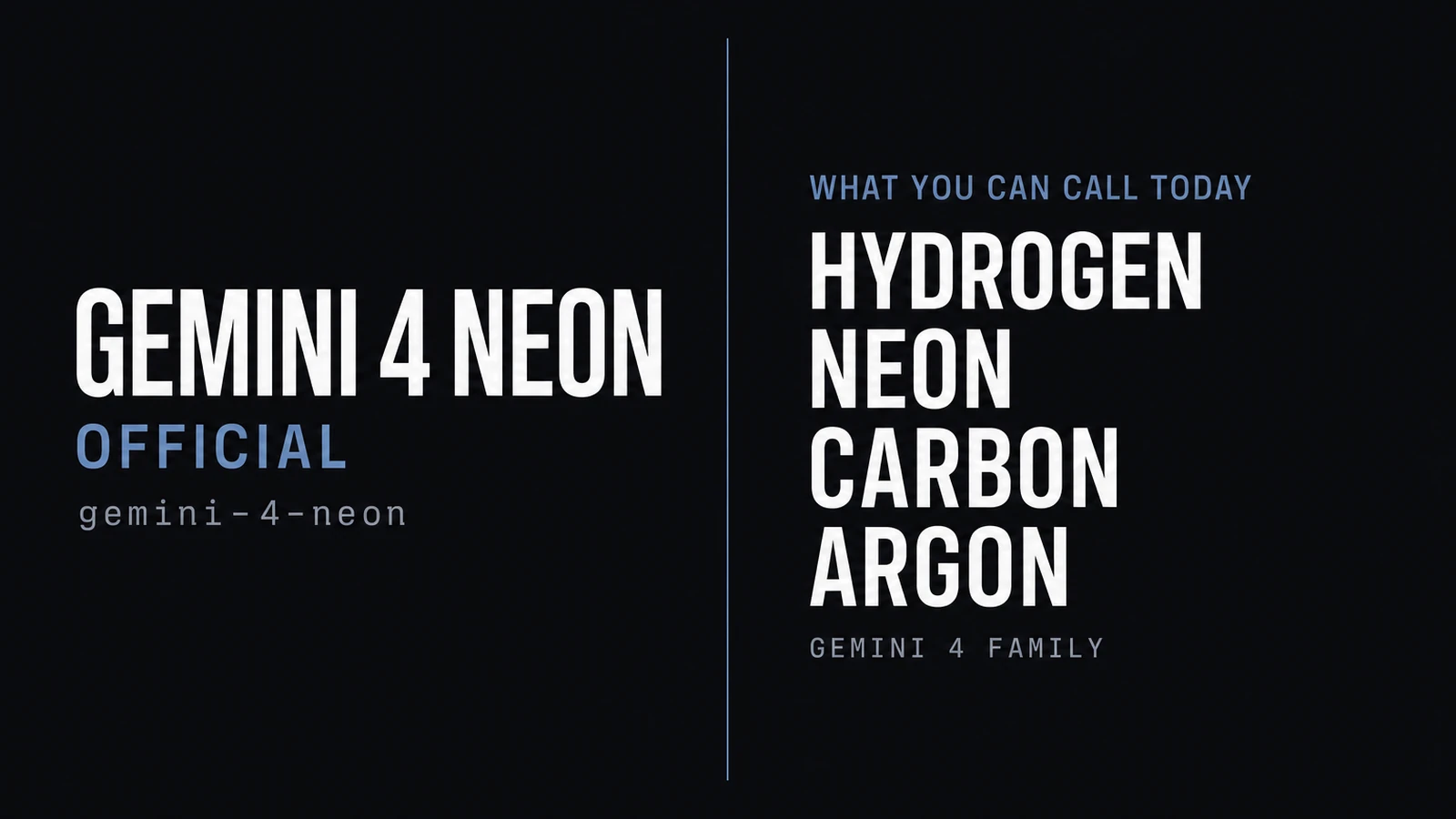
The string to paste is google/gemini-4-neon. Google published Introducing Gemini 4 Neon with datePublished 18 November 2026, 21:00 UTC, which is 19 November 2026, 05:00 in Asia/Shanghai. The marketing name has spaces. The public API ID is gemini-4-neon. Official Standard pricing on the paid Gemini API is $3 per million input tokens, $15 per million output tokens, and $0.15 for cached input. Neon is not on Google’s free tier.
Gemini 4 Neon on SandBase is a live card with that same trio of rates, a 1M context window, and a 65.5K max output. If the job is everyday execution, the cheaper live card is Gemini 4 Hydrogen. If the job is the hardest long-horizon work, the other live card is Gemini 4 Carbon, and its SandBase hero is not Google’s introductory price.
Key takeaway
- Official name: Gemini 4 Neon. Google API ID:
gemini-4-neon. SandBase ID:google/gemini-4-neon. Launch clock: 18 November 2026, 21:00 UTC, which is 19 November 2026, 05:00 Asia/Shanghai.- Official Standard price: $3 / $15 / $0.15 cached input per million tokens, paid Gemini API only. The SandBase hero matches those three numbers. Context on the hero is 1M. Max output on the hero is 65.5K.
- Google places Neon between Hydrogen (everyday execution) and Carbon (hardest long-horizon work). The model card says Neon is adapted from Carbon. Argon is still a published Gemini 4 model. It is not retired by this launch.
- Unit price is not task cost. Through 30 November 2026, Google’s Carbon and Argon intro ($2 / $10) is below Neon’s $3 / $15. SandBase lists Carbon and Argon at the later list rate, $4 / $20, today. Hydrogen’s SandBase cache read is $0.08. Google’s cached input for Hydrogen is $0.075.
- Language models on SandBase use
POST https://api.sandbase.ai/v1/chat/completions. There is no SandBase latency figure in this note, and no public Neon-for-cyber ID. The official cyber path is the gated Fairwind Program.
What Google actually shipped
Koray Kavukcuoglu’s launch post is the announcement. The page’s dateModified is 19 November 2026, 14:03:59 UTC, which is 22:03:59 the same calendar day in Asia/Shanghai. That is an edit to the launch post, not a second model. The stable version string on the AI Studio model page is gemini-4-neon.
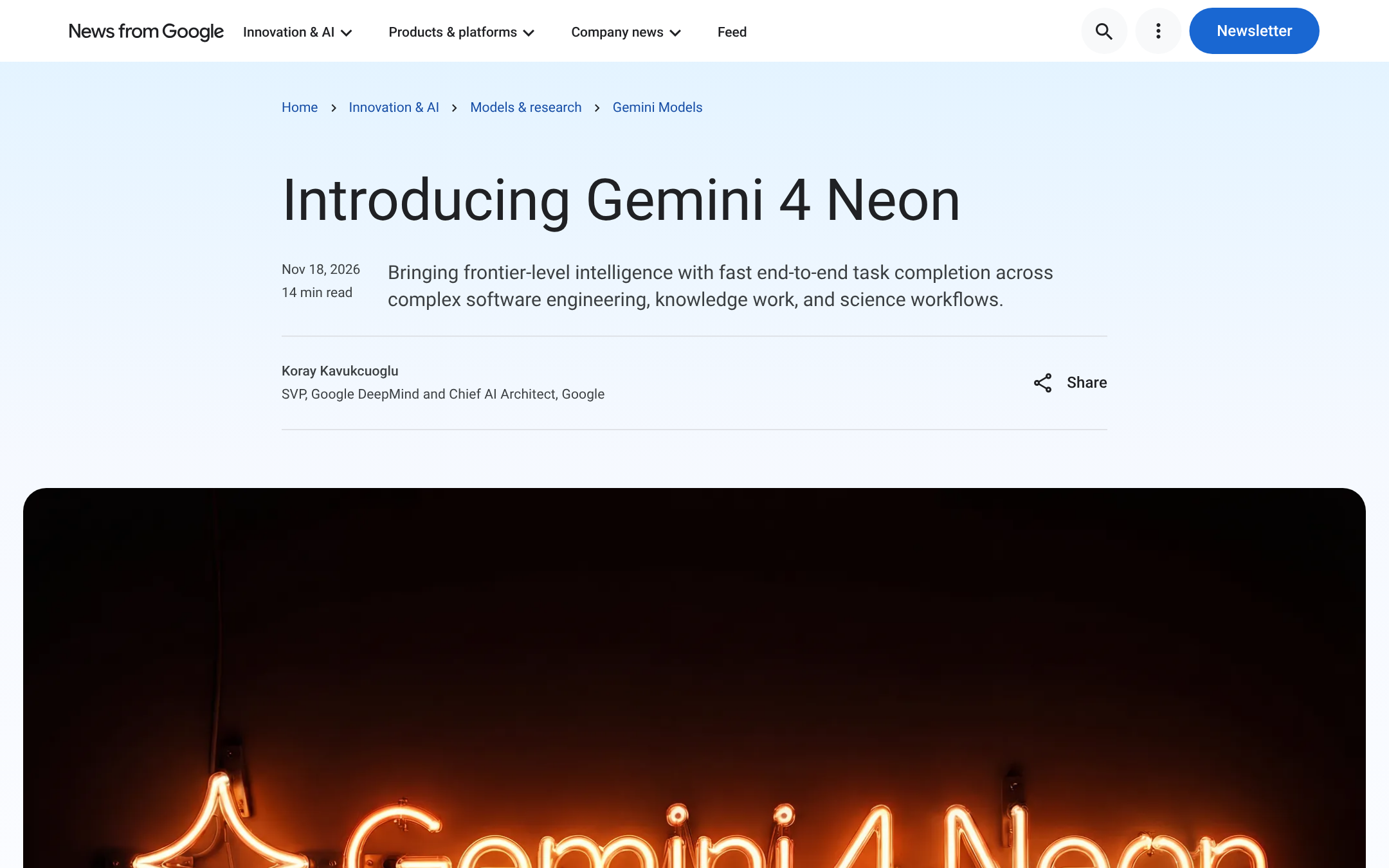
Google’s launch post, dated Nov 18, 2026. That stamp is the UTC calendar day. In Asia/Shanghai the same timestamp is 19 November 2026, 05:00. Source: blog.google.
Google’s choosing section, on the what’s-new page, puts Neon between Hydrogen and Carbon for high-frequency complex software engineering, knowledge work, and science. Hydrogen stays the default for everyday coding and agentic workflows. Carbon stays the model for the hardest architecture, debugging, science, and security problems. The model card PDF says the same split in one sentence: Carbon for the hardest long-horizon projects, Hydrogen for fast everyday execution, Neon for depth and efficiency. It also says Gemini 4 Neon is adapted from Gemini 4 Carbon.
Argon is still in the family. Its model page is live at gemini-4-argon. The Neon choosing section does not say Argon is deprecated. Earlier Carbon launch language, which the 11 November confirmation quotes, still called Argon the model for most software engineering and knowledge work. I am not inventing a new official nickname on top of that sentence.
Sibling clocks, so the family does not collapse into one date: Hydrogen’s announcement is 12 November 2026. Carbon’s public now-available post is datePublished 10 November 2026, 16:00 UTC, which is 11 November 2026, 00:00 Asia/Shanghai. Neon is the 19 November Asia/Shanghai launch.
Google’s Gemini 4 Neon launch post repeats the product line: frontier-level intelligence with faster end-to-end task completion, aimed at complex coding, knowledge work, and science. The same thread claims benchmark placements, including the Artificial Analysis Intelligence Index at the xhigh thinking level and the Vals Index. Those are Google’s claims. This page does not rerun them, and they are not SandBase measurements. Sundar Pichai’s teaser, posted 18 November 2026 at 19:58 UTC (19 November 2026, 03:58 Asia/Shanghai), is a “Happy WedNEsday!” ahead of that thread. It is color, not a spec.
ID, window, thinking, and cache
| Gemini 4 Neon | Gemini 4 Hydrogen | Gemini 4 Argon | Gemini 4 Carbon | |
|---|---|---|---|---|
| Google ID | gemini-4-neon | gemini-4-hydrogen | gemini-4-argon | gemini-4-carbon |
| SandBase ID | google/gemini-4-neon | google/gemini-4-hydrogen | google/gemini-4-argon | google/gemini-4-carbon |
| Google Standard, per 1M | $3.00 / $15.00 / $0.15 cached | $1.50 / $7.50 / $0.075 cached | Intro $2 / $10 / $0.10 through 30 Nov 2026, then $4 / $20 / $0.20 | Same intro, then the same list |
| SandBase hero, per 1M | $3.00 / $15.00 / $0.15 cache read | $1.50 / $7.50 / $0.08 cache read | $4.00 / $20.00 / $0.20 cache read | $4.00 / $20.00 / $0.20 cache read |
| Google thinking levels | low, medium, high (default), xhigh | Same as Neon | low, medium (default), high. No xhigh | Same cap as Argon |
| Official window | Unified 1,048,576 | Unified 1,048,576 | Unified 1,048,576 | Unified 1,048,576 |
| SandBase context / max output | 1M / 65.5K | 1M / 65.5K | 1M / 65.5K | 1M / 65.5K |
| Google free tier | No | Yes, for input, output, and context caching | No | No |
Sources for the Google columns are the pricing page, the Neon what’s-new migration notes, and the four model pages, read 19 November 2026 in the evening, Asia/Shanghai. The SandBase column is the live cards on 20 November 2026. Output prices include thinking tokens. Do not add a thinking line on top of the output line.
A few limits are easy to miss because the headline number is 1M.
The window is unified. Input, thinking, and output share 1,048,576 tokens on Google’s API. It is not 1M of input plus a separate 1M of answer. Default synchronous output is 65,536 tokens. Google documents long decode up to the rest of that window, with background execution or continuation. The SandBase heroes print max output as 65.5K. Plan a SandBase request against 65.5K unless a later card says the long-decode path is exposed.
Caching is implicit only. Explicit cachedContents is not supported. Implicit cache runs by default on prompts of at least 4,096 tokens, and a hit discounts cached input by 95 percent. That is why $0.15 is 5 percent of $3, and why $0.075 is 5 percent of $1.50. A short prompt under the 4,096-token floor does not get that discount. A cache-hit rate was not measured here.
Thinking levels are a Google API control. Neon and Hydrogen default to high and include xhigh. Carbon and Argon default to medium and cap at high. The SandBase card copy for Neon says the model supports adjustable reasoning effort. The curl published on that card does not include a thinking_level field. I am not adding one. Use the official Gemini docs for Google’s control, and the live card’s request example for the SandBase body.
Two bills, and one arithmetic example
Neon’s official $3 / $15 sits above Carbon and Argon’s introductory $2 / $10, which Google still lists through 30 November 2026, and below the $4 / $20 list that starts 1 December 2026. The SandBase Carbon and Argon cards already show that list: $4.00 / $20.00 / $0.20, with no intro on the hero. Neon on SandBase matches Google’s Standard row exactly.
That is a unit-price comparison. It is not a slogan that Neon is the cheaper Carbon. Task cost moves with thinking tokens, retries, and tool traffic.
Take 100,000 uncached input tokens and 10,000 output tokens. Arithmetic only. Not a measured Neon job. If those 10,000 output tokens already include thinking, do not add thinking again.
| Bill for that mix | Input | Output | Total |
|---|---|---|---|
| Hydrogen, Google paid tier or SandBase input/output | $0.150 | $0.075 | $0.225 |
| Neon, Google Standard and the SandBase hero | $0.300 | $0.150 | $0.450 |
| Carbon or Argon, Google intro through 30 Nov 2026 | $0.200 | $0.100 | $0.300 |
| Carbon or Argon, SandBase hero, and Google’s list from 1 Dec 2026 | $0.400 | $0.200 | $0.600 |
On Google’s Standard price today, the intro Carbon mix is $0.30 and Neon is $0.45. On SandBase today, the same token counts are $0.45 on Neon and $0.60 on Carbon. Stretch the output to 40,000 tokens, still uncached input of 100,000, and the SandBase arithmetic becomes $0.90 on Neon and $1.20 on Carbon, while Google’s intro Carbon mix is $0.60. A harder turn that emits more thinking tokens can reorder the bill even when the per-token rate does not change. Hydrogen remains the low unit rate, at $0.225 and $0.45 for those two mixes, and it is the only one of the four that Google prices at no charge on the Gemini API free tier. SandBase’s Hydrogen card is a paid catalog rate, not that free tier.
Hydrogen’s cache line is the other mismatch. Google’s cached input is $0.075 per million. The SandBase hero says cache read $0.08. On 100,000 cached input tokens that is $0.0075 versus $0.008. Small, and still two numbers. Attribute the $0.08 to the SandBase card and the $0.075 to Google. Neon’s cache read matches on both sides at $0.15. None of these rows is a measured cache hit.
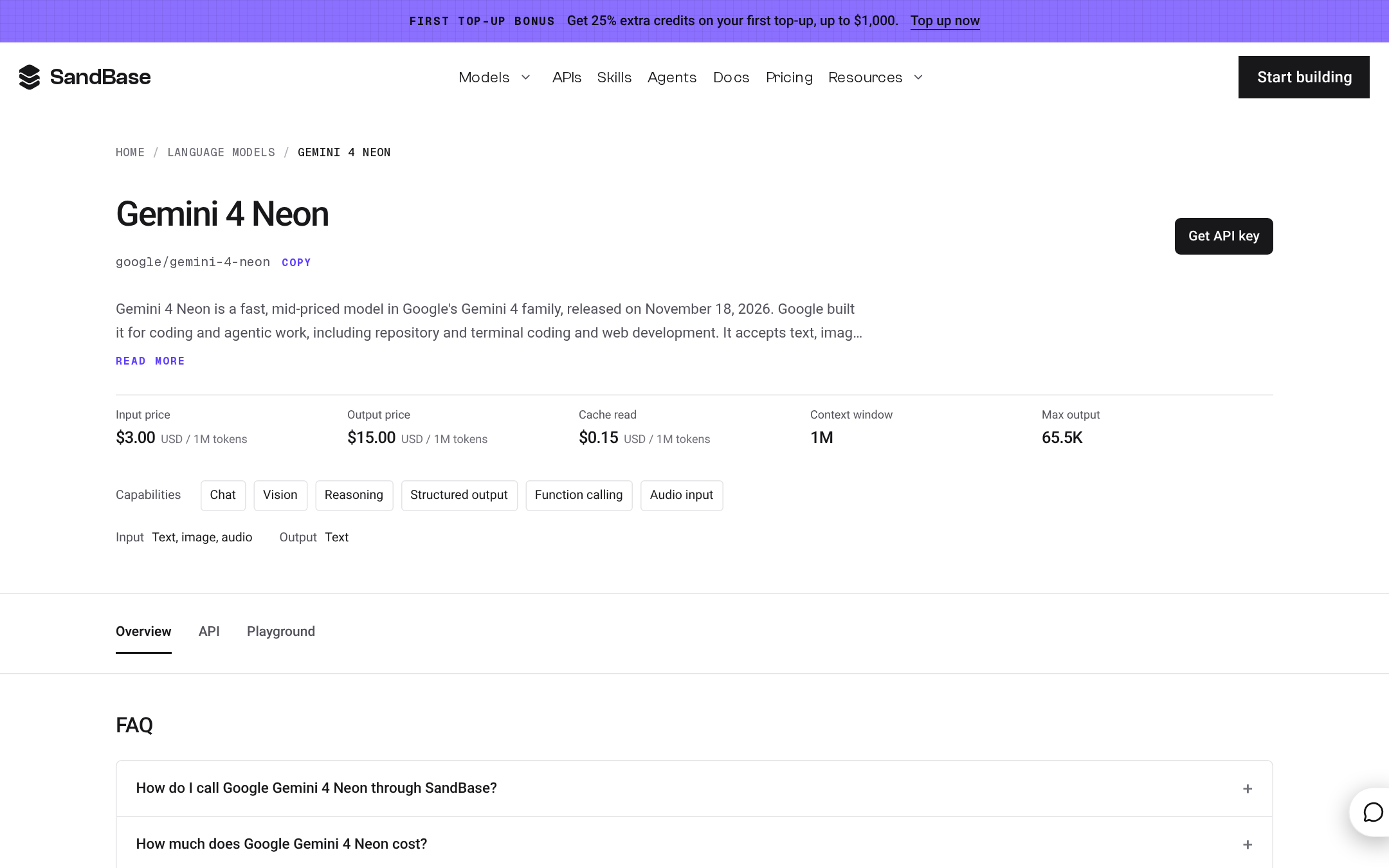
Live SandBase card for Gemini 4 Neon on 20 November 2026. Hero rates match Google’s Standard row. Context window reads 1M. Max output reads 65.5K. The card has Get API key, plus Overview, API, and Playground. It does not show the green Available badge that the Hydrogen, Carbon, and Argon cards show beside Playground, and it does not yet show a Benchmarks block.
The card’s own description calls Neon a fast, mid-priced Gemini 4 model for coding and agentic work, and it dates the release 18 November 2026. That date matches the UTC calendar day of Google’s post. The body copy says text, image, video, audio, and PDF input. The hero chips are Text, image, and audio, with text output. I would not promise a video or PDF input from the chip row alone. The same split already shows up on the Carbon card, documented in the try-today note.
Open Gemini 4 Neon on SandBase for the rate you will actually be billed if you call it here. Google’s pricing page remains the source for the intro that SandBase is not displaying on Carbon or Argon.
Where Google says you can use it
On Google’s side, from the launch post, the what’s-new page, and the model card: the paid Gemini API, Google AI Studio for Google AI Pro and Ultra, Gemini for business via the API and the model dropdown, Google Antigravity for paid Pro and Ultra, and the Gemini app for Pro and Ultra. Google’s rollout follow-up says the same rollout in short form and also names Android Studio for the paid API. If a later edit of the blog disagrees with that post, keep the blog.
Google’s follow-up on steerability and thinking levels restates four thinking levels and a 1M-token context, which the docs already specify, and adds a Google claim: the lowest fabrication rate yet in internal Antigravity testing. That testing claim belongs to Google. It is not a number from a SandBase run.
Sundar Pichai’s Antigravity demo shows Neon 3D-modeling a photorealistic lab simulation in Antigravity via Blender MCP. That is a demo on Google’s product. It is not a result from the SandBase playground. Antigravity’s orchestrator, which can direct other Gemini 4 models inside that product, is also Google’s surface. There is no SandBase swarm parameter to copy from it.
Google AI Studio’s launch article is a reasonable pointer to the what’s-new page, the model card, and Fairwind. IDs and prices in this note come from those pages and from the pricing doc, not from the body of the X article.
Fairwind is a gate, not a refusal policy
The launch post says Gemini 4 Neon for cyber is rolling out to trusted defenders as part of the Fairwind Program. The Fairwind Program page says access is for approved trusted partners, arranged through a Cloud account team, and that partners may not share or resell it. Dual-use work is restricted to authorized defensive and academic use. That is the official cyber track.
It is not a public toggle on gemini-4-neon. It is not a promise of fewer refusals. It is not a SandBase model ID. Do not invent google/gemini-4-neon-cyber or any sibling cyber slug. The older Carbon cybersecurity note is about Carbon’s Fairwind-era access, and some of its launch-date sentences were later corrected on the 11 November confirmation. Use it for that history, not as a Neon cyber guide.
Fairwind Program hero on deepmind.google. Access is a gated partner program. It is not the public SandBase card and not a general refusal-rate claim.
Community impressions of cybersecurity requests belong in the routing note. They stay labeled as personal experience there. They do not rewrite this section.
What you can call today
All four official Gemini 4 IDs have live SandBase cards on 20 November 2026.
| Card | What the hero shows | What it is for, in Google’s map |
|---|---|---|
| Gemini 4 Neon | $3.00 / $15.00 / $0.15, 1M, 65.5K | High-frequency complex coding, knowledge work, and science |
| Gemini 4 Hydrogen | $1.50 / $7.50 / $0.08, 1M, 65.5K, Available | Everyday coding and agentic execution |
| Gemini 4 Carbon | $4.00 / $20.00 / $0.20, 1M, 65.5K, Available | Hardest long-horizon work |
| Gemini 4 Argon | $4.00 / $20.00 / $0.20, 1M, 65.5K, Available | Still the published Argon card. Same SandBase unit price as Carbon |
The 13 November Hydrogen features post still records that day’s catalog check, which did not find a Hydrogen listing. Hydrogen is listed now. Read that post for the feature framing. Do not copy its availability line onto today. An October Argon pricing post still says 50 percent off in the title. Today’s Argon hero is $4 / $20 / $0.20. The October discount is history.
The Google provider index at /models/google, opened the same day, included Hydrogen, Carbon, and Argon in its model list and did not include Neon. The direct Neon URL returned the card above, and the SandBase sitemap contained the Neon card URL. Use the direct card. A missing row on the provider index is not a 404.
The endpoint on the card, and in the first API call docs, is Chat Completions. /v1/run is the media route. Do not send Neon there.
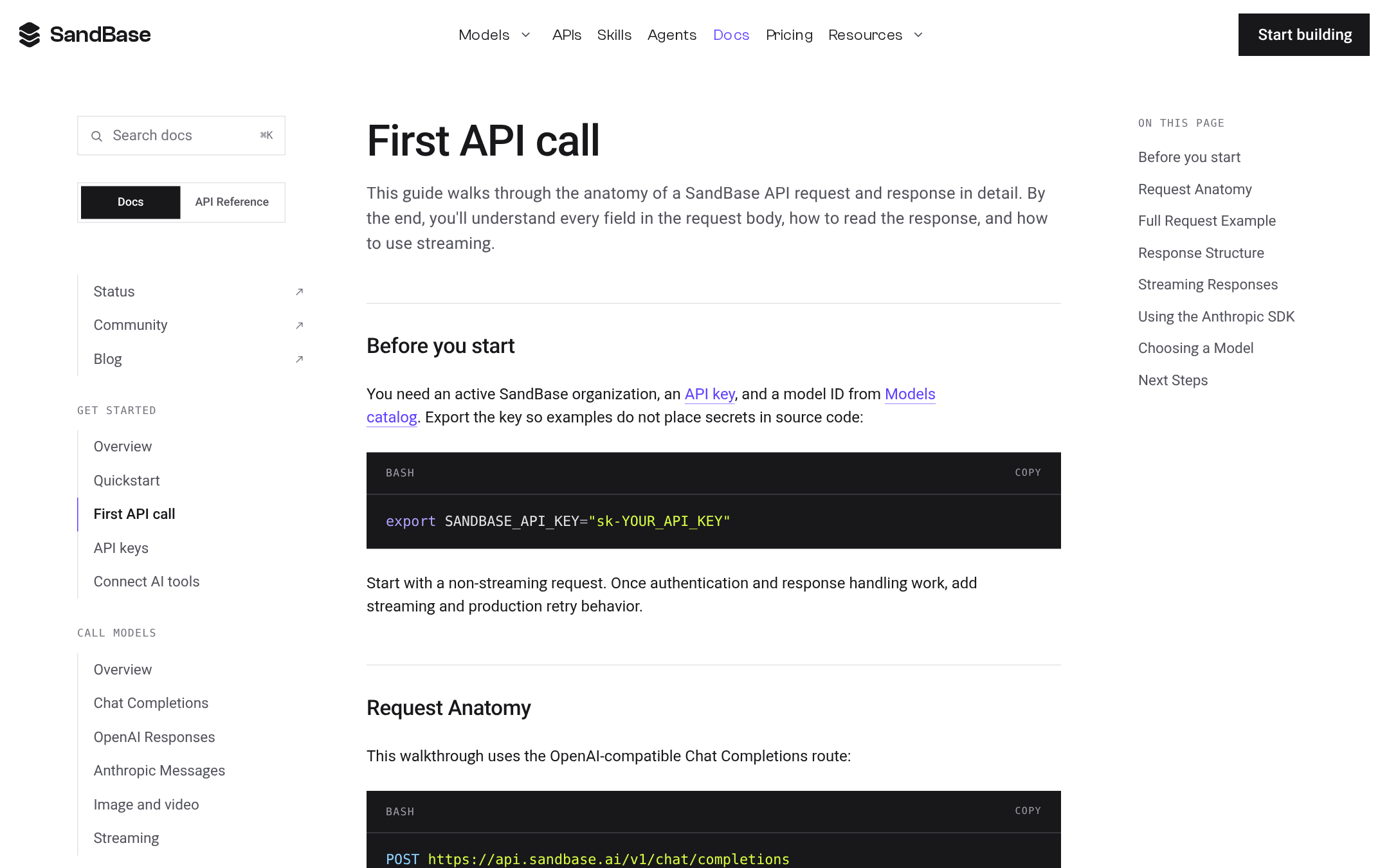
First API call docs. Language models use POST https://api.sandbase.ai/v1/chat/completions. The HTML docs URL is the one that resolves. A .md suffix on that path does not.
The card’s published example uses model, messages, and max_tokens 2048. This body matches those fields. It was not executed for this article. No latency, token usage, or quality result is implied.
curl -X POST https://api.sandbase.ai/v1/chat/completions \
  -H "Authorization: Bearer $SANDBASE_API_KEY" \
  -H "Content-Type: application/json" \
  -d '{
  "model": "google/gemini-4-neon",
  "messages": [
    {
      "role": "user",
      "content": "Hello"
    }
  ],
  "max_tokens": 2048
}'
max_tokens 2048 sits under the 65.5K hero cap. Raising it is a client choice up to that cap. Setting it to 1,048,576 would be copying Google’s long-decode ceiling onto a card that prints 65.5K. Leave temperature, top_p, top_k, and thinking_level out until the card’s own example includes them. Google’s Gemini 4 notes say custom sampling values are ignored on Google’s API. That note is not a SandBase field list.
The public start URL on the marketing site redirects to sign-in. Use Sign in, or the Get API key button on the Neon card, and keep the key out of the request you paste into a ticket. The docs show the SANDBASE_API_KEY placeholder.
Confirmed, and still unknown
| Item | Status on 20 Nov 2026 |
|---|---|
Name, public ID, paid-only access at Google, $3 / $15 / $0.15, implicit cache only, 1,048,576 window, thinking levels, default high | Confirmed, Google first-party |
| Family placement between Hydrogen and Carbon, adapted from Carbon | Confirmed, what’s-new page and model card |
| SandBase card, ID, hero $3 / $15 / $0.15, context 1M, max output 65.5K, Chat Completions | Confirmed on the live card. No Available badge and no Benchmarks block on that page |
| Hydrogen cache read $0.08 on SandBase versus $0.075 at Google | Confirmed as two displayed numbers |
| Carbon and Argon at $4 / $20 / $0.20 on SandBase, while Google’s intro is still $2 / $10 through 30 Nov 2026 | Confirmed as two bills |
| SandBase latency, quality, or cache-hit rate for Neon | Unknown. Not invented here |
Whether SandBase accepts Google’s thinking_level values, including xhigh, under that field name | Unknown. The published curl does not show the field |
| A public Neon-for-cyber ID on SandBase or on the open Gemini API | Not found. Official access is Fairwind |
FAQ
Is Gemini 4 Neon free?
No. Google’s pricing page says it is not on the free tier, and that every token is billed, including thinking tokens. Hydrogen is the Gemini 4 model Google prices at no charge on the Gemini API free tier. SandBase catalog rates are paid rates for all four cards, including Hydrogen.
What ID do I send?
gemini-4-neon on Google’s Developer API. google/gemini-4-neon on SandBase. The vendor prefix is required on SandBase. The display name on the card is not the JSON string.
Is the context window 1M?
Yes on the sources that matter for a request. Google documents a unified 1,048,576-token window. The SandBase hero, the overview, and the playground all show 1M context, with max output 65.5K. Plan SandBase calls against that 65.5K cap.
Why is Neon more expensive than Carbon in one place and cheaper in another?
Because the Carbon number you are looking at may be Google’s intro or the list rate. Neon is $3 / $15 in both places. Carbon’s intro, through 30 November 2026, is $2 / $10 at Google. Carbon’s list, and the SandBase hero today, is $4 / $20. Compare the bill you will actually pay, then compare token counts. The unit rate is not the task cost.
Can I call “Neon for cyber” on SandBase?
Not as a public model. The official path is the gated Fairwind Program. The callable SandBase ID in this note is google/gemini-4-neon only.
Where to go next
Call Gemini 4 Neon on a representative paid task and read the usage block before you change a default. Keep Gemini 4 Hydrogen for cheaper everyday runs. Keep Gemini 4 Carbon for the hardest long-horizon cases. Gemini 4 Argon stays available at the same SandBase unit price as Carbon.
The routing note is the family decision, including labeled community notes that are not specs. The Carbon versus Argon, Astra, and Opus 5.5 piece is the earlier cross-vendor route. It predates Neon. The shape of a Chat Completions call is the Carbon try-today note, with today’s model string swapped in. Start from the first API call docs if the client is new.
Sources: Google’s Neon launch post (datePublished 18 Nov 2026, 21:00 UTC; dateModified 19 Nov 2026, 14:03:59 UTC), AI Studio what’s-new, pricing, and model pages, the Gemini 4 Neon model card PDF, the Fairwind Program page, official Google and Sundar Pichai posts on X, and the live SandBase cards for Neon, Hydrogen, Carbon, and Argon on 20 November 2026, Asia/Shanghai. Community posts are not a source for IDs or prices.
Found this useful? Share it