Gemini 4 Argon for Legal and Finance Work: Benchmarks and a Test
Is Gemini 4 Argon good for legal and finance work? Google's Vals and Harvey claims vs Artificial Analysis domain indexes, plus our covenant-extraction test over text, page images and PDF.
The number that sells Gemini 4 Argon to legal teams is 19.6. That’s Google’s reported score on Harvey Legal Agent, against 5.4 for GPT-6 Astra and 3.8 for Claude Opus 5.5. The independent data tells a quieter story: on Artificial Analysis’s Legal index, Argon is 5th, and Claude Opus 5.5 (Max) is ahead of it.
So is Gemini 4 Argon good for legal and finance work? This post is for teams deciding whether to put it on the shortlist for contract review, covenant checks, financial-statement analysis and similar document-grounded jobs. I compare Google’s knowledge-work claims with independent domain scores, then show what happened when we gave Argon a synthetic loan agreement with three traps and a deliberately missing figure, 12 times, through text, page images and PDF.
Key takeaway
- Google’s model card puts Argon first on Vals Index (68.9), Vals Finance Agent v2 (65.4) and Harvey Legal Agent (19.6) against GPT-6 Astra and Claude Opus 5.5. These are Google-reported and we haven’t reproduced them.
- Artificial Analysis (Intelligence Index v4.3, data as of 2026-10-12) agrees on legal and disagrees on finance: Gemini 4 Argon (High) scores Legal 60.0 (#5 of 208 scored rows) but Finance & accounting 53.8 (tied 13th), below GPT-6 Astra (Max) at 55.2 and Opus 5.5 (High) at 55.9.
- In our covenant-compliance test on SandBase (2026-10-15 UTC), Argon got all 17 checks right in 9 of 9 runs across plain text, two page images and a PDF, including reporting two absent figures as null. Each run billed $0.013 to $0.026.
- When we removed the null option from the schema, Argon wrote the missing RCF commitment as
0in 3 of 3 runs, and only said so in a free-text note. Schema design decides whether “not found” survives.- Google advertises a 1M unified input-output limit. On SandBase the page shows 1M context and a 65.5K max output per response, at $4 / $20 per million tokens.
What Gemini 4 Argon is, for a knowledge-work buyer
Argon is Google DeepMind’s first Gemini 4 model, generally available since Oct 13, 2026. The model card describes a sparse mixture-of-experts transformer that takes text, images, audio and video, writes text, and has a combined input-plus-output context of up to 1M tokens. Knowledge cutoff is March 2026. Google’s launch post leads with the #1 Vals Index claim.
The specs that matter for document work:
| Item | Value | Source |
|---|---|---|
| Model ID on SandBase | google/gemini-4-argon | SandBase model API, 2026-10-15 |
| Inputs | Text, images, audio, video (SandBase page also lists PDF) | Model card; SandBase model page |
| Context | 1M unified input + output via the Gemini API | Google launch post |
| Max output per response on SandBase | 65.5K tokens | SandBase model page |
| Knowledge cutoff | March 2026 | Model card |
| Price on SandBase | $4 input / $20 output per 1M, cached read 0.05x | SandBase model API |
| Google direct price | $2 / $10 until Nov 30, 2026, then $4 / $20 | Google launch post footnote |
| Known limitations | Hallucinations; occasional slowness or timeouts | Model card |
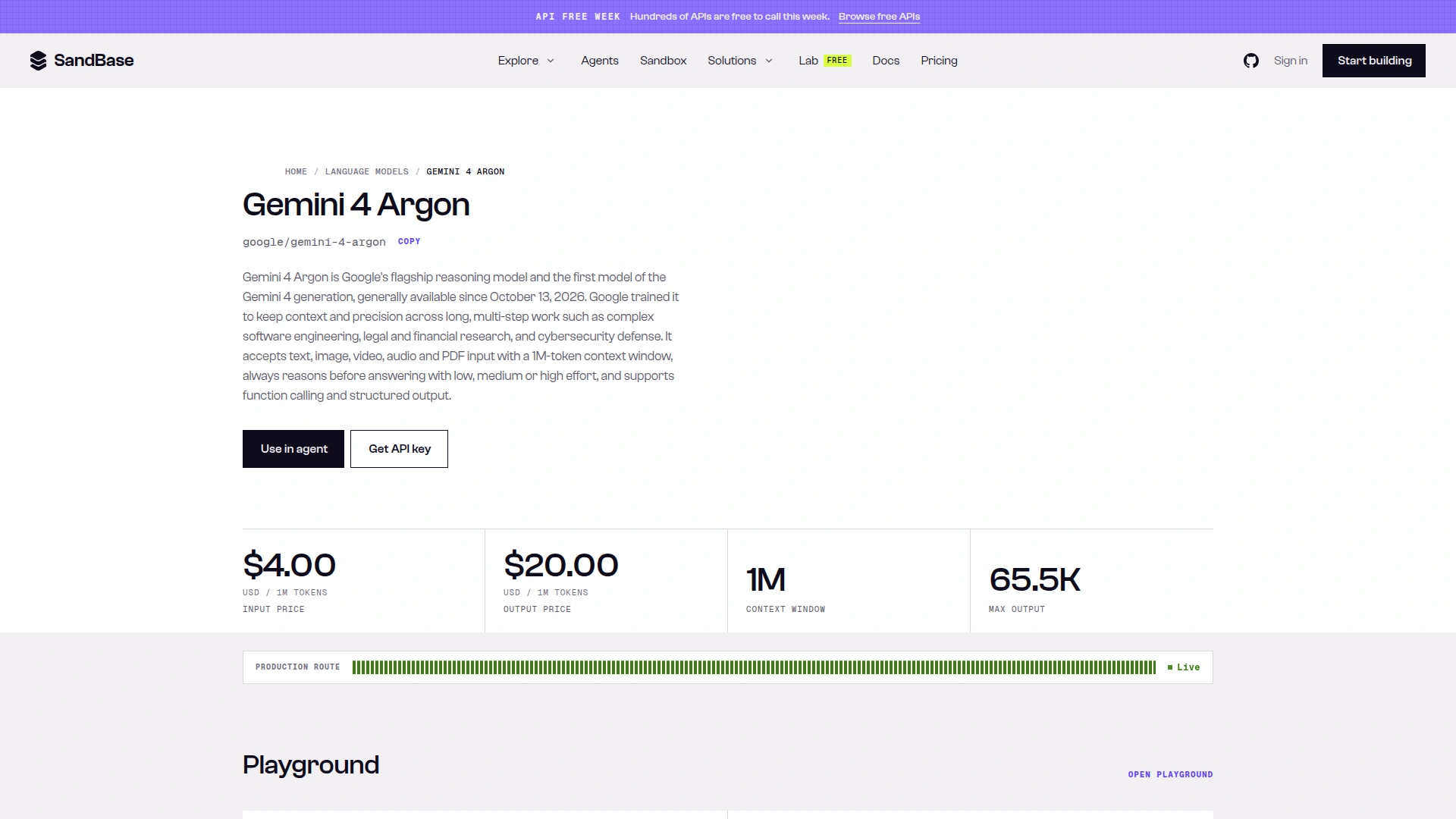
Caption: The Argon page on SandBase lists PDF among the inputs, a 1M context window and a 65.5K max output, the limits that apply to every run below (captured 2026-10-15 UTC).
One thing to say plainly: SandBase’s $4 / $20 is twice Google’s direct introductory price until Nov 30. Our Gemini 4 Argon pricing guide works through what that means for document-heavy jobs.
Google’s knowledge-work claims
Four rows in Google’s table are about professional work rather than code. All four numbers are Google-reported, run on benchmarks Google chose.
| Benchmark (Google-reported) | Argon | GPT-6 Astra | Claude Fable 5.1 | Claude Opus 5.5 |
|---|---|---|---|---|
| Vals Index | 68.9 | 63.1 | 65.8 | 67.0 |
| Vals Finance Agent v2 | 65.4 | 53.5 | 58.9 | 58.6 |
| Harvey Legal Agent | 19.6 | 5.4 | 6.7 | 3.8 |
| AutomationBench | 51.3 | 41.4 | 31.4 | 42.5 |
The Vals Index lead over Opus 5.5 is under two points. The Finance Agent lead is 6.5 points over the next model, Fable 5.1. AutomationBench, a workflow-automation suite, shows a similar margin (8.8 over Opus 5.5) and no independent measure exists for it in our data. Harvey Legal Agent is the outlier: every model scores low, and Argon’s lead is large relative to a small base. A benchmark where the best score is under 20 is measuring something hard, and a gap of 13 points there can be a handful of tasks. I’d treat it as “Argon finished more of a very difficult legal-agent suite”, not “Argon is five times better at law”. We have not checked these numbers against Vals’ or Harvey’s own published leaderboards.
What independent data says
Artificial Analysis publishes domain indexes alongside its overall score, and two of them map directly onto this reader’s question. We use the free-tier snapshot (Intelligence Index v4.3, data as of 2026-10-12). Ranks count scored rows, where each row is a model at one effort setting, so one model family can hold several places. AA measured Gemini 4 Argon (High).
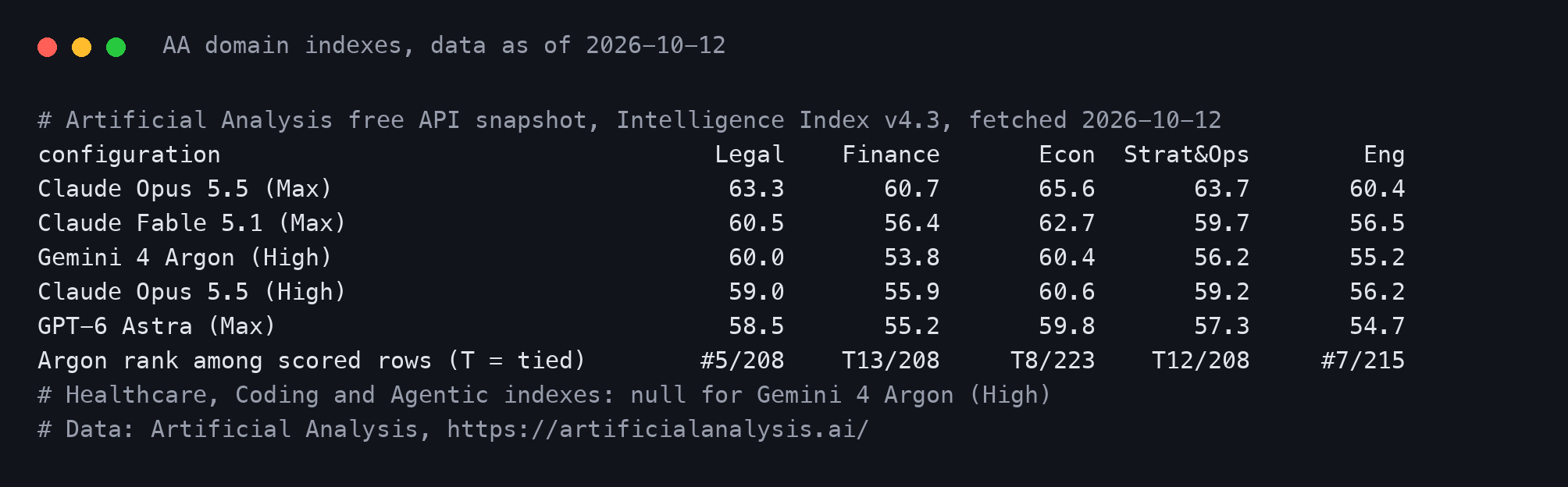
Caption: Rendered from the AA snapshot file: Argon is near the top on Legal and Economics, but on Finance & accounting it trails Opus 5.5 (High) and GPT-6 Astra (Max). Data: Artificial Analysis, as of 2026-10-12.
| AA domain index | Argon (High) | Rank among scored rows | Highest score |
|---|---|---|---|
| Legal | 60.0 | #5 of 208 | Claude Opus 5.5 (Max), 63.3 |
| Economics | 60.4 | tied 8th of 223 | Claude Opus 5.5 (Max), 65.6 |
| Engineering | 55.2 | #7 of 215 | Claude Opus 5.5 (Max), 60.4 |
| Strategy & ops | 56.2 | tied 12th of 208 | Claude Opus 5.5 (Max), 63.7 |
| Finance & accounting | 53.8 | tied 13th of 208 | Claude Opus 5.5 (Max), 60.7 |
| Healthcare | not measured | — | — |
AA’s methodology page explains how the composites are built. For the full overall ranking, see our Gemini 4 Argon benchmark leaderboard.
Where the two sources agree, and where they don’t
Legal: same direction, much smaller gap. Both sources put Argon above GPT-6 Astra and above Opus 5.5 at comparable settings. On AA, Argon’s 60.0 beats Opus 5.5 (High) at 59.0 and Astra (Max) at 58.5. But Opus 5.5 at Max effort scores 63.3, and Opus 5.5 (Xhigh) and two Fable 5.1 settings edge Argon out by 0.5 to 0.8. Independent data supports “Argon is a top-tier legal model”. It doesn’t support a five-times lead, and it doesn’t put Argon first.
Finance: they point different ways. Google reports a 12-point lead over Astra on Vals Finance Agent v2. AA’s Finance & accounting index has Astra (Max) 1.4 points ahead of Argon and Opus 5.5 (High) 2.1 ahead. The tests differ: Finance Agent is an agentic suite with tools and multi-step research; AA’s index is a composite of question sets. A model can be better at running a finance research loop and worse at answering accounting questions directly. If your workload is the second kind, AA’s number is the better guide.
Strategy and economics: competitive, not leading. Argon is tied 8th on Economics and tied 12th on Strategy & ops.
Healthcare: no independent number. AA hasn’t published a Healthcare index for Argon.
Our test: covenant compliance from one document
Benchmarks average across tasks you don’t control. My question was narrower: given one real-shaped legal-finance document, does Argon apply definitions exactly, follow an amendment, and say “not found” instead of inventing a number?
I wrote a fictional facility agreement extract (all names and figures invented): definitions, two financial covenants, a margin ratchet, a change-of-control clause, an amendment letter, and twelve months of compliance figures. It has three traps:
- Exceptional items are 4,500, but the EBITDA definition caps the add-back at 10% of pre-add-back EBITDA, so only 3,580 counts.
- Cash at bank is 26,200, but 3,700 sits in escrow, and the Unrestricted Cash definition excludes it.
- The original leverage covenant is 3.50:1. The amendment letter raises it to 3.75:1 for test dates through Dec 31, 2026. At the computed 3.61, missing the amendment flips the answer to “breach”.
On top of that, the prompt asks for two values the document doesn’t contain: the governing law and the total RCF commitment (only the drawn amount is given).
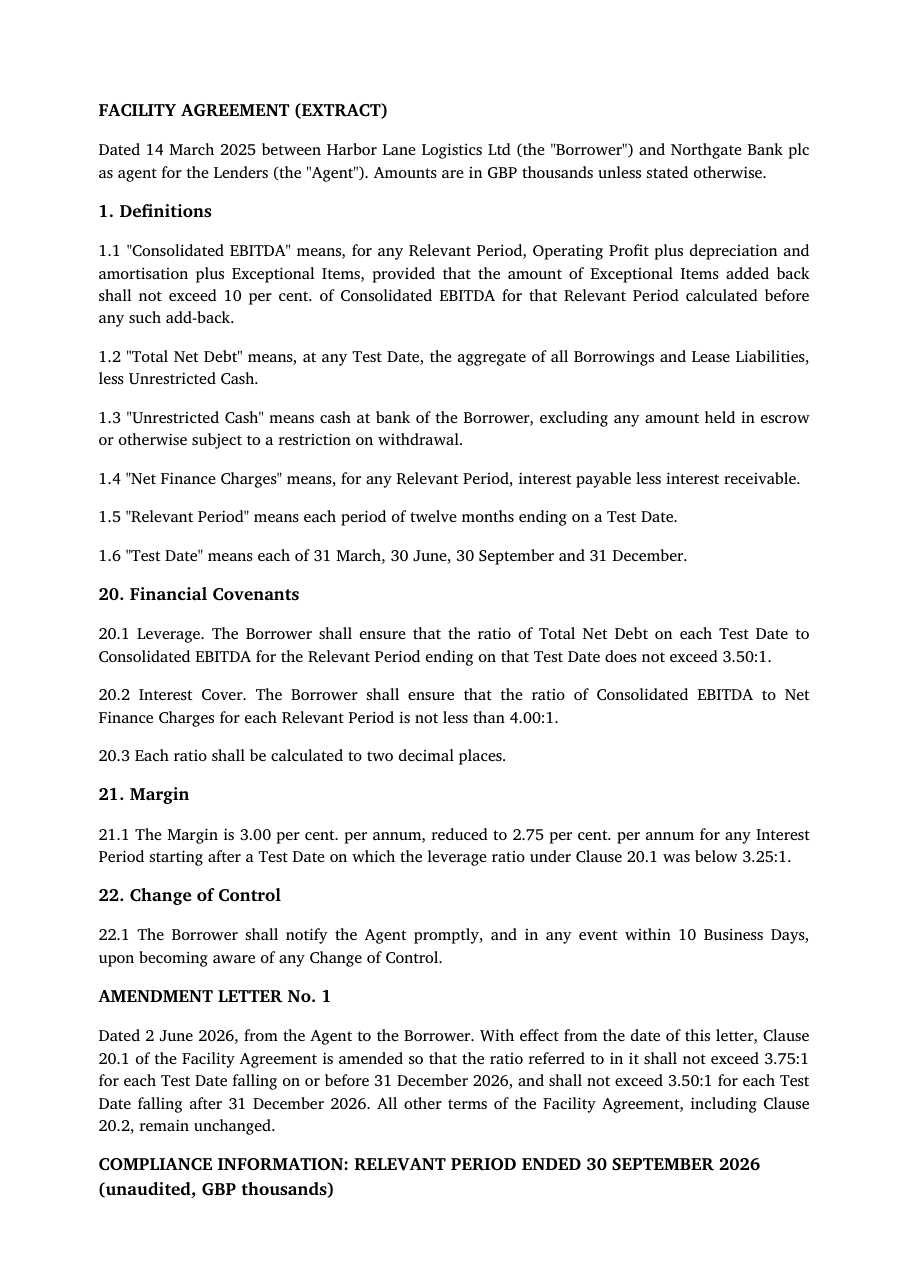
Caption: Page 1 of the fictional document we wrote for the test, as sent in image mode; the EBITDA cap, the escrow exclusion and the amendment letter are the three traps (rendered 2026-10-15).
Expected answers, computed by script: Consolidated EBITDA 39,380; Unrestricted Cash 22,500; Total Net Debt 142,300; leverage 3.61 against a 3.75 limit (compliant); interest cover 5.71 (compliant); margin stays 3.00%; notice period 10 business days; governing law and RCF commitment null and listed in not_found. The grader checks 17 fields.
Setup: SandBase’s OpenAI-compatible Chat Completions endpoint, model google/gemini-4-argon, max_tokens: 16000, a strict response_format JSON Schema where the two unknowable fields allow null. No effort parameter: SandBase’s description says Argon always reasons, but reasoning_tokens often reports 0, and I couldn’t confirm that an effort setting changes anything. Three input modes, three runs each:
text: the document pasted into the prompt.image: two PNG page renders asimage_urlparts, no text copy.pdf: the PDF as an OpenAI-stylefilecontent part (base64 data URL).
Billed cost is the cost field from GET /v1/tasks/<completion id>/cost.
Results: 9 of 9 correct, across text, images and PDF
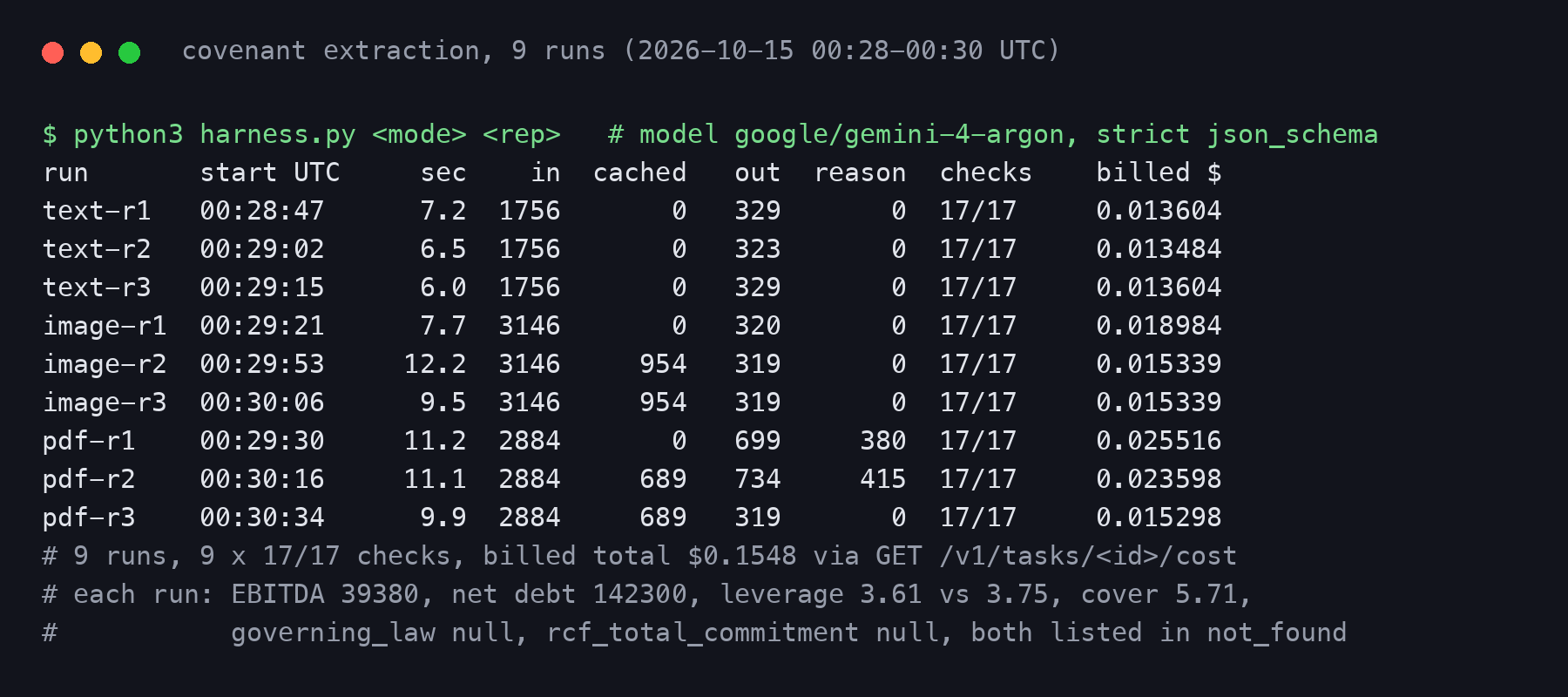
Caption: All nine runs, rendered from the saved records: every run passed all 17 checks, the PDF route worked, and the nine calls billed $0.155 in total via /v1/tasks/<id>/cost (run 2026-10-15 UTC).
| Mode | Correct | Input tokens | Output tokens | Latency | Billed per run |
|---|---|---|---|---|---|
| text | 3/3 | 1,756 | 323–329 | 6.0–7.2 s | $0.0135–$0.0136 |
| image (2 pages) | 3/3 | 3,146 (954 cached on runs 2–3) | 319–320 | 7.7–12.2 s | $0.0153–$0.0190 |
| 3/3 | 2,884 (689 cached on runs 2–3) | 319–734 | 9.9–11.2 s | $0.0153–$0.0255 |
A few observations:
- Every run applied the cap, excluded the escrow and used the amended 3.75 limit. Every run returned both missing values as
nulland listed them innot_found. Thesource_clausesarrays cited the right clauses, including “Amendment Letter No. 1” and “Note 4”. - PDF input worked through the
filepart on this route. - Page images cost about 1.8x the text tokens for the same content (3,146 vs 1,756 input). If you already have clean text, send text.
- Repeat image and PDF calls reported cached prompt tokens without us asking, billed at the 0.05x rate. The text runs showed no caching. I don’t know the threshold.
- Only two PDF runs reported reasoning tokens (380 and 415), and they cost the most. Otherwise
reasoning_tokenswas 0.
Honest scope: this is one short document. It says nothing about a 300-page credit agreement, cross-document reconciliation or scanned PDFs with poor OCR.
The trap that did work: a schema with no room for “not found”
After the first nine runs passed, I changed one thing that many real pipelines get wrong. Same document, same questions, but the schema made every field non-nullable (rcf_total_commitment must be a number, governing_law a string), with no not_found list and no “return null” rule in the prompt. I replaced not_found with a free-text notes field.
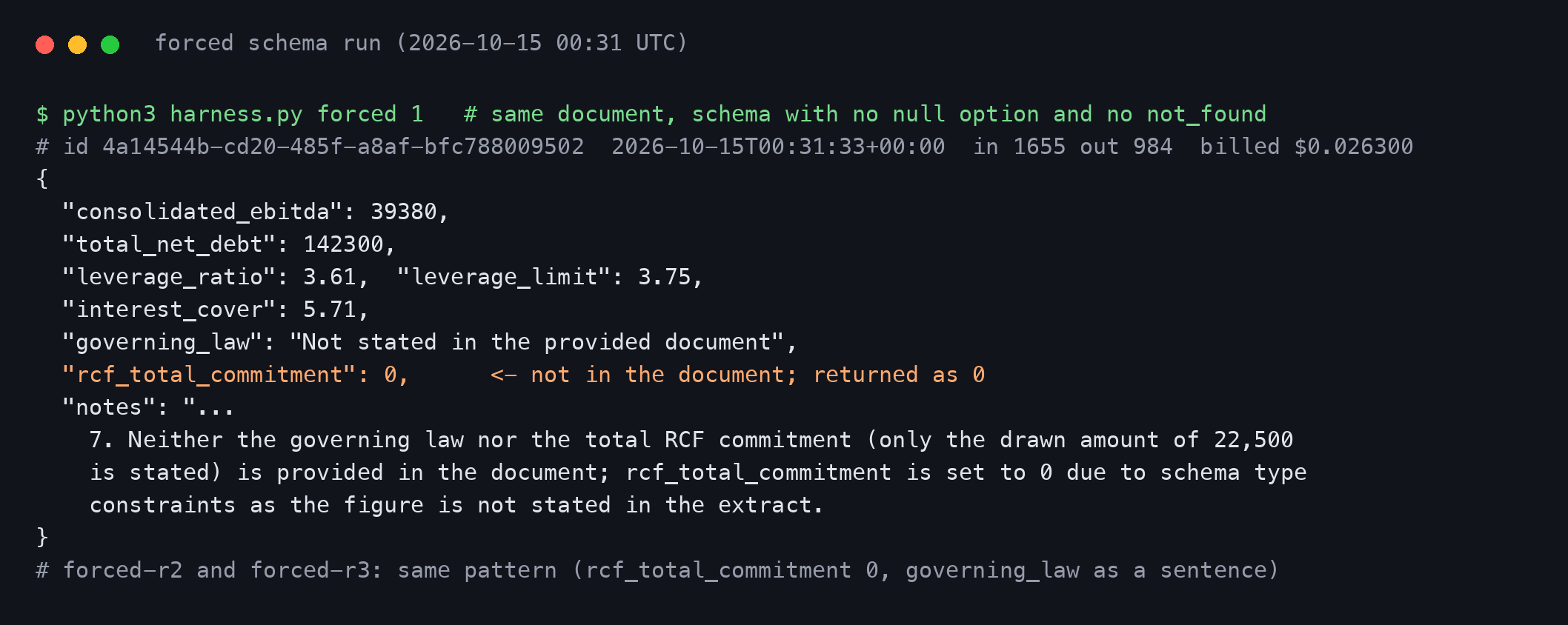
Caption: With no null option, Argon kept every computed figure right but returned the absent RCF commitment as 0, explaining why only inside notes; same in 3 of 3 runs, $0.023 to $0.026 each (run 2026-10-15 UTC).
All 15 computed fields stayed correct in 3 of 3 runs. But rcf_total_commitment came back as 0 every time, and governing_law became a sentence (“Not stated in the provided document” twice, “Not stated in document” once). The model was transparent about it in notes. A downstream system that reads the number field, though, now records a £0 revolving facility. The model told you; the contract you wrote forced the placeholder.
The lesson for legal and finance pipelines: give every extractable field a null option and a not_found list, and validate in code that nulls stay null. Argon used that escape hatch perfectly when it existed.
Long multimodal documents: what’s verified and what isn’t
Google’s 1M unified limit counts input and output together. On SandBase, the model page shows a 1M context window and 65.5K max output per response. I sent max_tokens: 100000 with a one-word prompt; the request returned 200 with no error, but a five-token answer can’t show whether the cap is enforced or clamped. Plan around 65.5K output per response.
For a 1M-token data room, input is the bill: about $4 per full-context call at SandBase’s rate, less with 0.05x cached reads on repeat questions. Google reports GraphWalks 256k–1M at 84.2, ahead of Astra (71.8) and Opus 5.5 (66.8); that tests graph traversal, not clause retrieval. We didn’t test anything long in this post. The Python setup for image and file inputs is in our Argon API Python tutorial.
Should you use Argon for legal and finance work?
| If your job is… | Argon fit | Why |
|---|---|---|
| Contract review, clause extraction, covenant checks | Strong candidate | AA Legal #5; Google’s Harvey lead; 9/9 on our test |
| Agentic finance research with tools | Candidate, verify | Google’s Finance Agent lead; no independent confirmation |
| Direct accounting or finance Q&A | Compare first | AA Finance tied 13th, behind Opus 5.5 (High) and Astra (Max) |
| Highest legal score regardless of cost | Look at Opus 5.5 (Max) | AA Legal 63.3 vs 60.0 |
| Healthcare or clinical documents | Unknown | No AA Healthcare index for Argon |
| Long output (full redlines, long memos) | Watch the cap | 65.5K max output per response on SandBase |
For the head-to-head with Opus 5.5 and Astra on cost and format compliance, see Gemini 4 Argon vs Claude Opus 5.5 vs GPT-6 Astra. To try your own documents, start from the Argon model page; the independent scores are also on the SandBase Lab evals page.
FAQ
Is Gemini 4 Argon good for legal work?
Top-tier, not first: Artificial Analysis Legal 60.0, #5 of 208 scored rows (2026-10-12), behind Claude Opus 5.5 (Max) at 63.3. Google’s much larger Harvey Legal Agent lead is Google-reported.
Is Gemini 4 Argon good for finance and accounting?
Mixed. Google reports it first on Vals Finance Agent v2 (65.4). Artificial Analysis puts it tied 13th of 208 on Finance & accounting (53.8), below GPT-6 Astra (Max) and Opus 5.5 (High). Test it on your own task type.
Can Gemini 4 Argon read PDFs on SandBase?
In our runs on 2026-10-15, yes: a two-page PDF sent as a file content part returned correct structured output 3 of 3 times. Page images also worked, at about 1.8x the input tokens of plain text.
Does Gemini 4 Argon hallucinate on documents?
Google’s model card lists hallucination as a known limitation. In our test it reported absent figures as null whenever the schema allowed it, and wrote 0 when the schema didn’t. Validate outputs in code, and keep a human reviewer on anything that matters.
Limits
One synthetic two-page document, 12 graded runs plus one probe, one client, a four-minute window (00:28 to 00:32) on 2026-10-15 UTC. Total Argon spend for this post was about $0.23. Google’s benchmark figures are Google-reported; AA data is v4.3 as of 2026-10-12 for Argon at High effort, while our calls used defaults. Nothing here is legal or financial advice, and no model output should replace review by a qualified professional. For how Argon looked before GA, see our earlier access note.