Gemini 4 Argon Benchmark: Where It Ranks Independently
Gemini 4 Argon benchmark results from Artificial Analysis v4.3: #8 of 687 scored rows, domain index ranks, what is not measured yet, and cost per task vs Google's own numbers.
Three numbers were going around for the same model this week. Google’s launch post says Gemini 4 Argon is #1 on the Vals Index. Artificial Analysis lists Gemini 4 Argon (High) at #8. The leaderboard in SandBase Lab shows it at #5. None of them is wrong. They count different things, and if you’re picking a model for real work, the difference matters more than the headline.
This post answers one question: where does the Gemini 4 Argon benchmark picture land once you set Google’s own table aside? It uses the Artificial Analysis (AA) Intelligence Index v4.3, data as of 2026-10-12, from AA’s free API. It’s for developers and buyers who’ve seen the launch numbers and want an independent reference point before they spend a week of evaluation on it.
Key takeaway
- On the Artificial Analysis Intelligence Index v4.3 (data as of 2026-10-12), Gemini 4 Argon (High) scores 52.6, #8 of 687 scored rows. Rows are model × effort settings, so counting one row per model it sits behind four families: Claude Opus 5.5, Claude Sonnet 5.5, Claude Fable 5.1 and GPT-6 Astra.
- Its strongest AA domain index is Legal: 60.0, #5 of 208 scored rows. Engineering is #7 of 215. Finance & accounting is its weakest at 53.8, tied with two other rows for 13th.
- AA has not yet published Coding, Agentic, Healthcare, output speed or time-to-first-token numbers for Argon. Those fields are empty in the snapshot, so any “independent” coding claim today isn’t from AA.
- Running the full index cost $1.99 per task at Google’s $2 / $10 intro price. At the $4 / $20 rate that applies after Nov 30 (and that SandBase lists today), the same tokens would cost about $3.98.
- Google’s model card puts Argon first on 14 of its 19 rows, but those are Google-run results on Google-chosen benchmarks. AA’s composite agrees Argon is frontier-class; it doesn’t agree it leads.
Gemini 4 Argon benchmark rank on Artificial Analysis
Here are the top 12 rows of the Intelligence Index, straight from the snapshot AA’s free API returned on 2026-10-12 (meta.fetched_at 07:34 UTC). Cost per task is AA’s figure for running the whole index at the list price AA had on file for each model. Data: Artificial Analysis.
| # | Configuration measured by AA | Creator | Intelligence Index v4.3 | Cost per index task |
|---|---|---|---|---|
| 1 | Claude Opus 5.5 (Max, Default Fallback) | Anthropic | 57.6 | $5.98 |
| 2 | Claude Opus 5.5 (Xhigh, Default Fallback) | Anthropic | 56.0 | $3.46 |
| 3 | Claude Sonnet 5.5 (Max, Default Fallback) | Anthropic | 56.0 | $5.46 |
| 4 | Claude Opus 5.5 (High, Default Fallback) | Anthropic | 53.6 | $1.82 |
| 5 | Claude Fable 5.1 (Max, Default Fallback) | Anthropic | 53.4 | $7.63 |
| 6 | Claude Fable 5.1 (Xhigh, Default Fallback) | Anthropic | 53.2 | $5.98 |
| 7 | GPT-6 Astra (Max) | OpenAI | 52.7 | $3.26 |
| 8 | Gemini 4 Argon (High) | 52.6 | $1.99 | |
| 9 | GPT-6 Astra (Xhigh) | OpenAI | 52.4 | $2.31 |
| 10 | Claude Sonnet 5.5 (Xhigh, Default Fallback) | Anthropic | 51.9 | $2.01 |
| 11 | GPT-6.1 Sol (Max) | OpenAI | 51.8 | $0.72 |
| 12 | Claude Fable 5.1 (High, Default Fallback) | Anthropic | 51.2 | $3.91 |
Opus 5.5 (Xhigh) and Sonnet 5.5 (Max) are tied at 56.0; the order between them is the snapshot’s. Row 12 is also tied, with Claude Opus 5.5 (Medium) at 51.2.
Two things jump out. First, the band from #5 to #10 is 1.5 points wide. Argon sits 0.1 behind GPT-6 Astra (Max) and 0.2 ahead of Astra (Xhigh). AA doesn’t publish a confidence interval in the free data, so I’d treat Argon and Astra as a tie on this index, not as an ordering. Second, of the seven rows above Argon, only one costs less per task: Claude Opus 5.5 at High effort, 53.6 at $1.82, against Argon’s 52.6 at $1.99. On AA’s own pricing, Argon isn’t the value pick at the top. It’s in the same price bracket as Opus 5.5 (High) and Sonnet 5.5 (Xhigh), with a score between them.
For context inside Google’s lineup: the next-highest Google row in the snapshot is Gemini 3.8 Flash (High) at 40.9, 11.7 points lower. Argon is a big step for Google on this index, even though it doesn’t take the top spot.
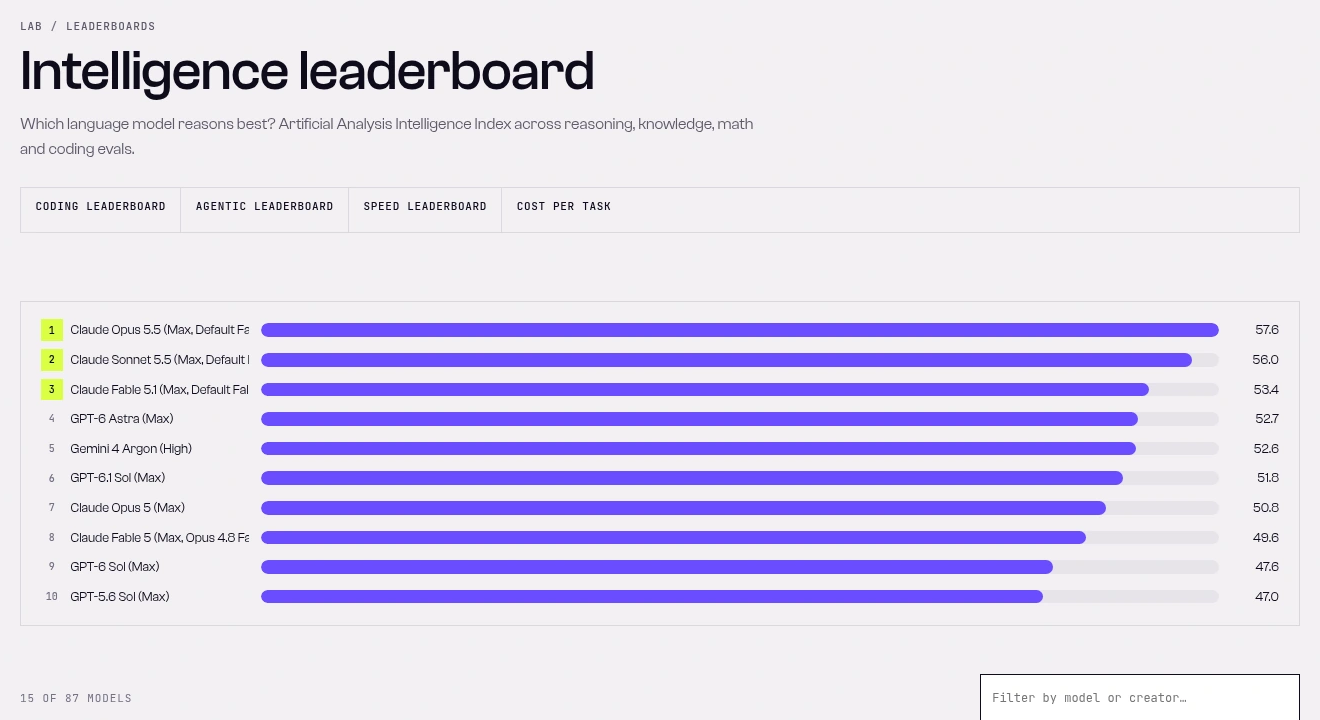
SandBase Lab’s Intelligence leaderboard shows the same AA score (52.6) but ranks Argon 5th, because it keeps one row per model among the 87 SandBase catalog models AA tracks (captured 2026-10-15).
Why the same model is #8, #5 and “behind four families”
The ranks differ because the sets differ. Worth getting straight before you quote one:
| Where you read it | What is ranked | Argon’s position |
|---|---|---|
| AA snapshot, all rows | 687 rows with an Intelligence score; each row is a model at one effort setting | #8 |
| By model family (best row per model) | Same data, one row per model | 5th, behind Opus 5.5, Sonnet 5.5, Fable 5.1, GPT-6 Astra |
| SandBase Lab Intelligence board | One row per model, only the 87 SandBase catalog models AA tracks | #5 |
| Google launch post | Vals Index, a different benchmark run and reported by Google | #1 (Google-reported) |
(AA’s own model page shows “#8 / 216”, a class-based set I can’t reproduce from the free data.) Also note what AA measured: “Gemini 4 Argon (High)”. It’s the only Argon row in the snapshot. There’s no Low or Medium row yet, so you can’t read a cost-vs-effort curve for Argon the way you can for Opus 5.5, where Medium (51.2, $1.34) and High (53.6, $1.82) sit far apart in cost. If you plan to run Argon at a lower effort setting, this score doesn’t describe that configuration.
Domain indexes: Legal is the standout
AA’s free data also carries six domain indexes. Argon has scores in five of them. Ranks below are among rows that have a score for that index; ties are shown as ties rather than broken by list order. Data: Artificial Analysis, v4.3, as of 2026-10-12.
| Domain index | Argon (High) | Rank among scored rows | Rows scored | Top row in that index |
|---|---|---|---|---|
| Legal | 60.0 | #5 | 208 | Claude Opus 5.5 (Max), 63.3 |
| Engineering | 55.2 | #7 | 215 | Claude Opus 5.5 (Max), 60.4 |
| Economics | 60.4 | tied 8th (with Claude Fable 5 Max) | 223 | Claude Opus 5.5 (Max), 65.6 |
| Strategy & ops | 56.2 | tied 12th (with Claude Sonnet 5.5 Xhigh) | 208 | Claude Opus 5.5 (Max), 63.7 |
| Finance & accounting | 53.8 | tied 13th (with Claude Fable 5 Max and Fable 5.1 High) | 208 | Claude Opus 5.5 (Max), 60.7 |
| Healthcare & medical | not measured | — | 81 | Claude Opus 5.5 (Max), 60.5 |
The ranking by domain isn’t the same shape as the overall ranking. In Legal, Argon is only 0.5 behind Claude Fable 5.1 (Max) and 0.8 behind Fable 5.1 (Xhigh) and Opus 5.5 (Xhigh), so it’s competitive with the top Anthropic configurations at a lower per-task cost than any of them ($1.99 against $3.46 to $7.63). In Finance & accounting it drops to a tie for 13th, behind GPT-6 Astra (Max) at 55.2 and GPT-6.1 Sol (Max) at 54.0.
That second point is where the independent data and Google’s story pull apart. Google’s model card reports Vals Finance Agent v2 at 65.4% for Argon against 53.5% for GPT-6 Astra, a 12-point lead. AA’s finance index has Astra (Max) 1.4 points ahead. They’re different tests: one is an agentic finance task suite, the other a composite AA built for its index. But if finance is your use case, don’t let the 12-point gap set your expectations. Our legal and finance article goes deeper on that comparison.
What Artificial Analysis hasn’t measured yet
This is the part most launch-week coverage skips. In the 2026-10-12 snapshot these Argon fields are null:
artificial_analysis_coding_indexartificial_analysis_agentic_indexartificial_analysis_healthcare_and_medical_indexmedian_output_tokens_per_second,median_time_to_first_token_secondsand the other speed fields
So as of that date there’s no AA coding score, no AA agentic score and no AA speed number for Argon. That’s less damning than it sounds. Claude Opus 5.5 and Sonnet 5.5, both released in late September, have no Coding or Agentic index in the snapshot either. The current AA coding top three are all Claude Fable 5.1 rows (81.6, 80.7, 79.1), and GPT-6 Astra (Max) has 76.9. Argon may simply not have been run on those suites yet.
So if someone says Argon “beats Opus on coding”, the source is Google’s table or their own testing, not AA. And Google’s table has Argon behind on two of its four agentic-coding rows.
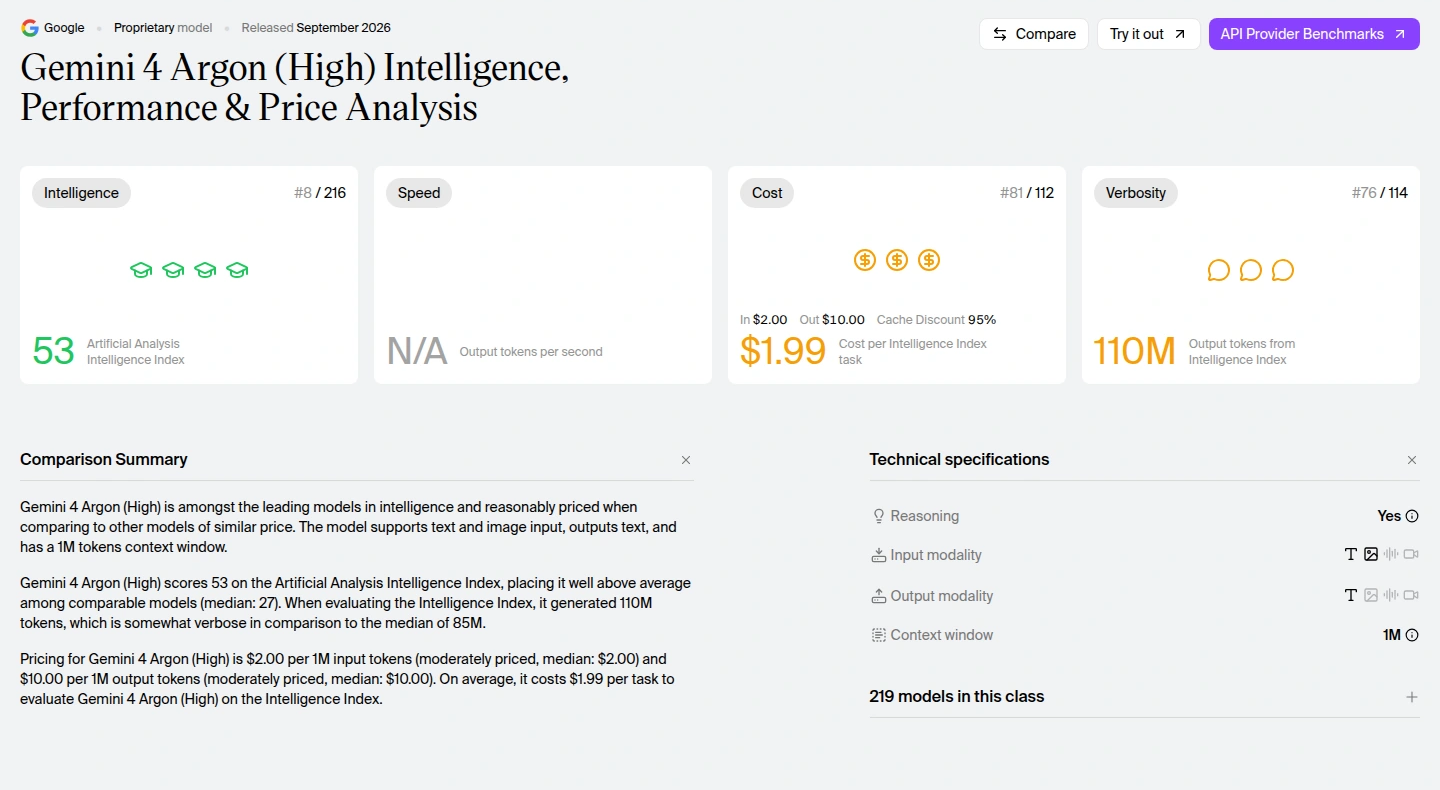
Artificial Analysis’s own page for Gemini 4 Argon (High) shows the Intelligence score rounded to 53, $1.99 per index task at the $2 / $10 intro price, and Speed “N/A”, matching the empty speed fields in the snapshot (captured 2026-10-15).
Speed deserves one more sentence. AA’s speed numbers, when they arrive, are medians across the API providers AA measures. They aren’t SandBase routing latency, and Google’s model card itself lists “occasional slowness or timeout issues” as a known limitation. Measure latency on the route you’ll actually use.
Cost to run the index: $1.99 now, about $3.98 later
AA prices every model at its list price when it runs the index. For Argon that was Google’s introductory $2 per million input tokens and $10 per million output, with cache hits at $0.10. Result: $2,407.24 for the whole index, or $1.99 per task.
That intro rate ends on Nov 30, 2026. Google’s blog and Google Cloud both say $4 / $20 applies after that. Every price component doubles, so the same token usage would cost about $3.98 per task, roughly $4,814 for the full index. That’s my arithmetic on AA’s numbers, not an AA figure.
| Configuration | Intelligence | AA cost per task | Notes |
|---|---|---|---|
| Gemini 4 Argon (High), intro price | 52.6 | $1.99 | $2 / $10 |
| Gemini 4 Argon (High), at $4 / $20 | 52.6 | ~$3.98 (estimate) | Same tokens, standard rate |
| Claude Opus 5.5 (High) | 53.6 | $1.82 | $4 / $20 |
| Claude Sonnet 5.5 (Xhigh) | 51.9 | $2.01 | $2 / $10 |
| GPT-6 Astra (Xhigh) | 52.4 | $2.31 | $10 / $50 |
| GPT-6 Astra (Max) | 52.7 | $3.26 | $10 / $50 |
| GPT-6.1 Sol (Max) | 51.8 | $0.72 | $2 / $10 |
At the intro price, Argon is in the middle of the pack. At $4 / $20 it would be close to GPT-6 Astra (Max), which scores about the same, and more expensive per task than Opus 5.5 (High), which scores a point higher. GPT-6.1 Sol (Max) gets within 0.8 points for about a third of the intro cost. The Argon pricing guide works through what the Dec 1 change does to real workloads.
On SandBase, Argon lists at $4 input and $20 output per million tokens today, with cached reads at $0.20. That’s Google’s post-Nov-30 standard rate and twice Google’s direct intro price until then. If you’re running a large evaluation this month and only care about price, Google direct is cheaper; SandBase’s case is one key and one API across Argon and the models it’s competing with.
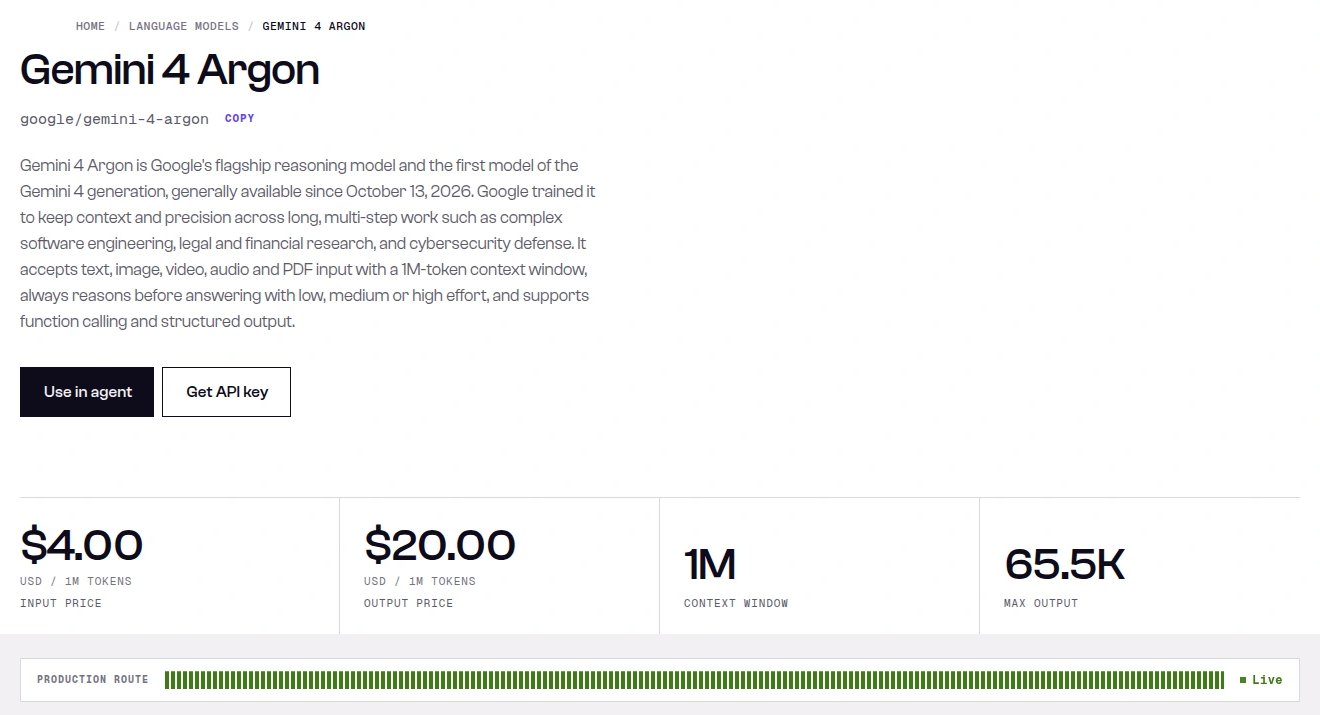
The SandBase model page for google/gemini-4-argon lists $4 / $20 per million tokens, 1M context and 65.5K max output, the price used for the “about $3.98” estimate above (captured 2026-10-15).
Google-reported vs independent: where they agree
Google’s DeepMind model card compares Argon with GPT-6 Astra, Claude Fable 5.1 and Claude Opus 5.5 on 19 rows. Argon has the top score on 14 of them, including a tie with Astra on CWE-bench v1. Where it trails, it trails visibly:
| Benchmark (Google-reported) | Argon | Best other | Leader |
|---|---|---|---|
| Vals Index | 68.9 | 67.0 | Argon |
| Harvey Legal Agent | 19.6 | 6.7 | Argon |
| DeepSWE v1.1 | 77.9 | 74.2 | Argon |
| FrontierSWE v2 | 55.0 | 65.5 | GPT-6 Astra |
| Terminal-bench 4.0 | 57.4 | 66.4 | Claude Opus 5.5 |
| PostTrainBench | 45.3 | 49.3 | Claude Opus 5.5 |
| Terminal-Bench Science 0.1 | 57.6 | 68.1 | GPT-6 Astra |
| OSWorld-2.0 (offline subset) | 69.2 | 72.6 | GPT-6 Astra |
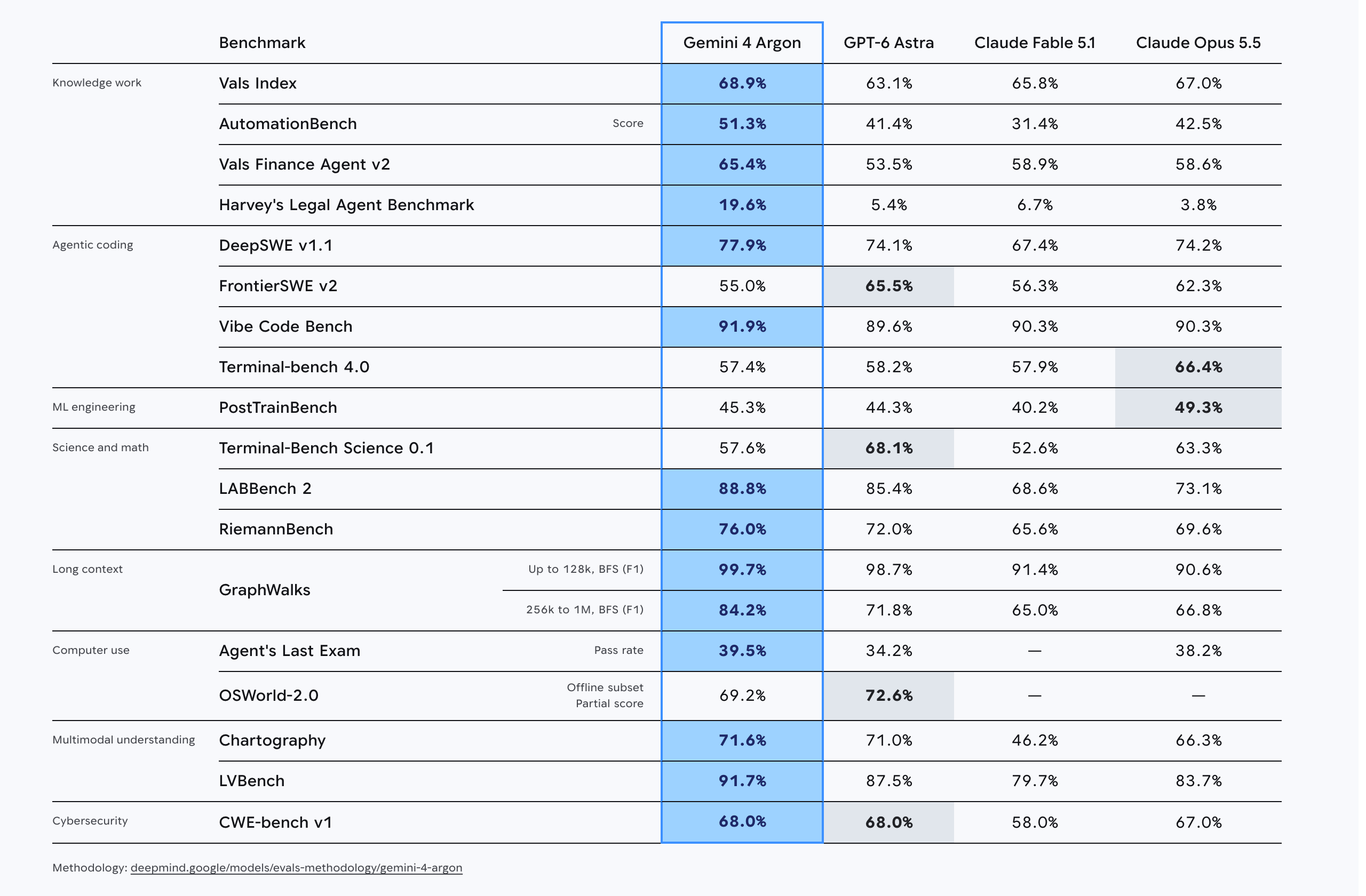
Google’s model card table (published 13 Oct 2026): Argon is highlighted on most rows but trails on FrontierSWE v2, Terminal-bench 4.0, PostTrainBench, Terminal-Bench Science and OSWorld-2.0; every number here is Google-reported (captured 2026-10-15).
I don’t think the two views contradict each other. Google picked benchmarks that track the long-horizon knowledge work it built Argon for, and on those Argon leads. AA’s composite is broader, and there Argon lands behind the best Anthropic configurations. The table names models, not effort settings; Google describes its setup on its methodology page, which I haven’t reviewed for this post. We haven’t reproduced any of Google’s numbers.
Where they agree: Argon is frontier-class, it’s strong on legal and long-document work, and it isn’t the leader on terminal-style agentic coding. Where they disagree: whether it’s the best model overall. On independent data as of 2026-10-12, it isn’t.
How I’d use these numbers
For legal review or long-document analysis, the independent Legal index and Google’s Harvey result point the same way: Argon belongs on your shortlist, and it’s cheapest to test before Dec 1.
For a coding agent, AA has nothing on Argon yet and Google’s table is split. Run your own repo tasks. Our three-way comparison with Claude Opus 5.5 and GPT-6 Astra has a small same-prompt run on SandBase.
If cost per unit of index score is the metric, GPT-6.1 Sol (Max) and Claude Opus 5.5 (High) both beat Argon on AA’s numbers, and the gap widens after Nov 30.
To test Argon next to the models in the table with one key, start from the Gemini 4 Argon model page or the Python API tutorial. For background from before GA, see our earlier Argon access and Gemini test post.
FAQ
Where does Gemini 4 Argon rank on Artificial Analysis?
Gemini 4 Argon (High) scores 52.6 on the Artificial Analysis Intelligence Index v4.3, #8 of 687 scored rows, data as of 2026-10-12. Counting one row per model, it’s fifth, behind Claude Opus 5.5, Claude Sonnet 5.5, Claude Fable 5.1 and GPT-6 Astra.
Is Gemini 4 Argon better than Claude Opus 5.5?
Not on AA’s composite: Opus 5.5 (Max) scores 57.6 and even Opus 5.5 (High) scores 53.6. Google’s model card shows Argon ahead of Opus 5.5 on most of its rows but behind on Terminal-bench 4.0 and PostTrainBench. Which matters depends on your task.
Does Artificial Analysis have a coding score for Gemini 4 Argon?
Not as of 2026-10-12. The Coding, Agentic and Healthcare indexes and all speed fields are empty for Argon in the snapshot. Opus 5.5 and Sonnet 5.5 have no Coding or Agentic index there either.
How much does it cost to run the Intelligence Index on Argon?
$1.99 per task ($2,407 total) at Google’s $2 / $10 intro price. At the $4 / $20 rate after Nov 30, the same tokens would cost about $3.98 per task by our calculation.
Limits of this analysis
This is one snapshot of one composite index, data as of 2026-10-12 and measured at one Argon configuration (High). AA’s methodology is on its intelligence benchmarking page; the free API we use has no per-benchmark scores and no error bars, so sub-point gaps shouldn’t be read as orderings. Scores can move as AA reruns models, and the empty Coding, Agentic and speed fields may be filled in later snapshots. We ran no Argon requests for this post; the $3.98 figure is arithmetic on AA’s token costs, not a measurement. Data: Artificial Analysis (Argon model page). Google’s figures come from its launch post, the Google Cloud announcement and the DeepMind model card, all retrieved 2026-10-15.