Best Exa Alternatives in 2027
Best Exa alternatives in 2027: SandBase lists Exa Search, Contents, and Answer. Official Deep Search, Monitors, Agent, and Websets stay on Exa's own pricing.
An agent that already gets useful pages from Exa Search has a narrow decision. The question is whether the next feature you need is still Search, Contents, or Answer, or whether it is Deep Search, Monitors, Agent, or Websets. SandBase listed the first three on one key on 18 Nov 2026, beside Tavily and Firecrawl. Official Exa sells the wider set, with its own monthly credits and per-1,000 rates. Move the three shared calls when one balance with your other data APIs matters. Keep the official Exa account when the job is a product that hub does not list, or when you need Exa’s credit math and client libraries to stay intact.
Key takeaway
- Official Exa, checked via the pricing Markdown on 18 Nov 2026, is pay as you go: no subscription and no minimum spend. Search starts at $4 per 1,000 requests. Contents is $1 per 1,000 pages. Answer is $5 per 1,000 requests.
- The same page prices Deep Search at $12 to $15 per 1,000, Monitors at $2 per 1,000, Agent at $0.012 to $1.00 per fixed-effort run or usage-based, and Websets at $0.10 per ACU plus $5 per 1,000 searches. None of those four were on the SandBase Exa hub.
- SandBase list prices that day were $0.0105 per call for Search, $0.0045 for Contents, and $0.0075 for Answer. Those are per-call figures. They are not a 1:1 reading of the official per-1,000 rates.
- Official free credits are $10 (up to 2,500 Lite searches) on signup day, reset to $10 on the first of each month, with a one-time $10 onboarding bonus and no payment method required. That is separate from SandBase’s shared 100 eligible calls per UTC day.
- Enterprise on the official page is an annual $12,000 paid upfront, with $12,000 in API credits, 25 QPS, and Zero Data Retention as that Markdown states it. SandBase speed is Unknown.
What official Exa sells
exa.ai returned HTTP 200 with the title “Exa | Search API for AI Agents — Real-Time Web Data.” The docs and the pricing page were also up. The numbers below come from exa.ai/docs/admin/pricing.md, not from a screenshot guess.
Search: lite is $4 per 1,000 requests for up to 10 results, extra results are $1 per 1,000, and auto/fast is $7 per 1,000. Summaries are $1 per 1,000 pages. Deep Search is $12 to $15 per 1,000. Contents is $1 per 1,000 pages. Answer is $5 per 1,000 requests. Monitors are $2 per 1,000. Agent is $0.012 to $1.00 per fixed-effort run, or usage-based. Websets are $0.10 per ACU plus $5 per 1,000 searches.
The free tier is $10 in credits, described as up to 2,500 Lite searches, granted the day you sign up. The free balance resets to $10 on the first of every month. No payment method is required. A one-time $10 bonus follows onboarding. Enterprise is an annual plan at $12,000 paid upfront, including $12,000 of API credits, 25 QPS, and Zero Data Retention as stated in that Markdown.
What the SandBase hub lists
The Exa hub title was “Exa API: Discover Relevant Sources with Semantic Web Search.” The blurb mentions semantic search, grounded answers, similar-page discovery, and optional content extraction. Three cards were listed:
| Card | SandBase list price, 18 Nov 2026 | Official unit on the same date | On the hub? |
|---|---|---|---|
| Exa Search | $0.0105 per call | From $4 / 1,000 requests. Lite $4 / 1k up to 10 results. Extra results $1 / 1k. Auto/fast $7 / 1k. Summaries $1 / 1k pages. | Yes. Title: “Exa Search API: Find Web Pages with Natural-Language Queries.” |
| Exa Contents | $0.0045 per call | $1 / 1,000 pages | Yes. Title: “Exa Contents API: Extract Page Text, Highlights and Summaries.” |
| Exa Answer | $0.0075 per call | $5 / 1,000 requests | Yes. Title: “Exa Answer API: Get Query Answers with Cited Web Sources.” |
| Deep Search | Not a SandBase list price | $12 to $15 / 1,000 | No |
| Monitors | Not a SandBase list price | $2 / 1,000 | No |
| Agent | Not a SandBase list price | $0.012 to $1.00 per fixed-effort run, or usage-based | No |
| Websets | Not a SandBase list price | $0.10 / ACU + $5 / 1,000 searches | No |
Dividing an official per-1,000 rate into a single-request figure is not a valid comparison with these per-call list prices. Result caps, extra-result fees, and summary add-ons change the official bill. A SandBase call’s result count was not re-measured for this article.
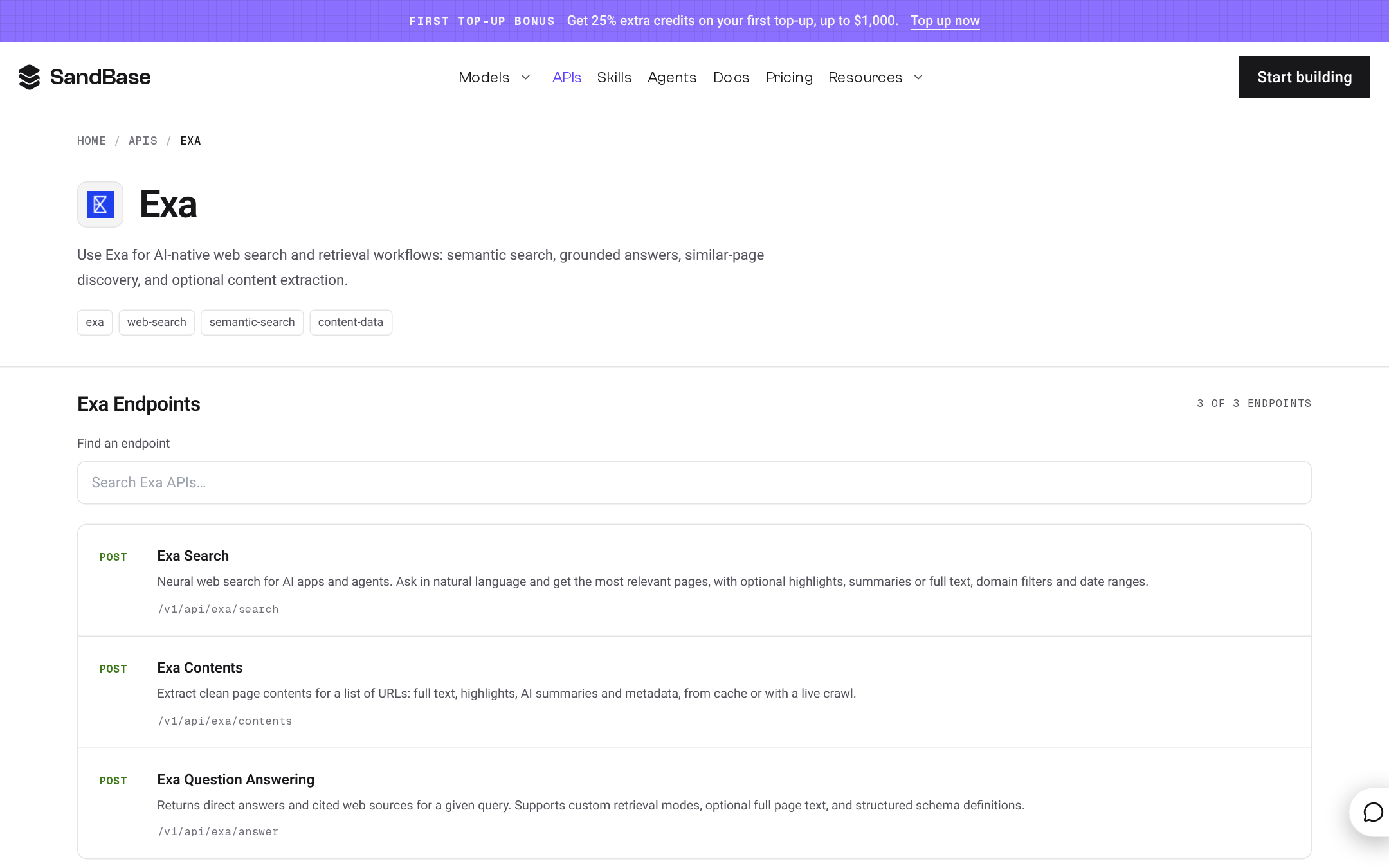
SandBase Exa hub, logged out, light theme, 18 Nov 2026, Asia/Shanghai, with the banner “FIRST TOP-UP BONUS Get 25% extra credits on your first top-up, up to $1,000.” Confirm that promotion on the pricing page. The hub lists Search, Contents, and Answer.
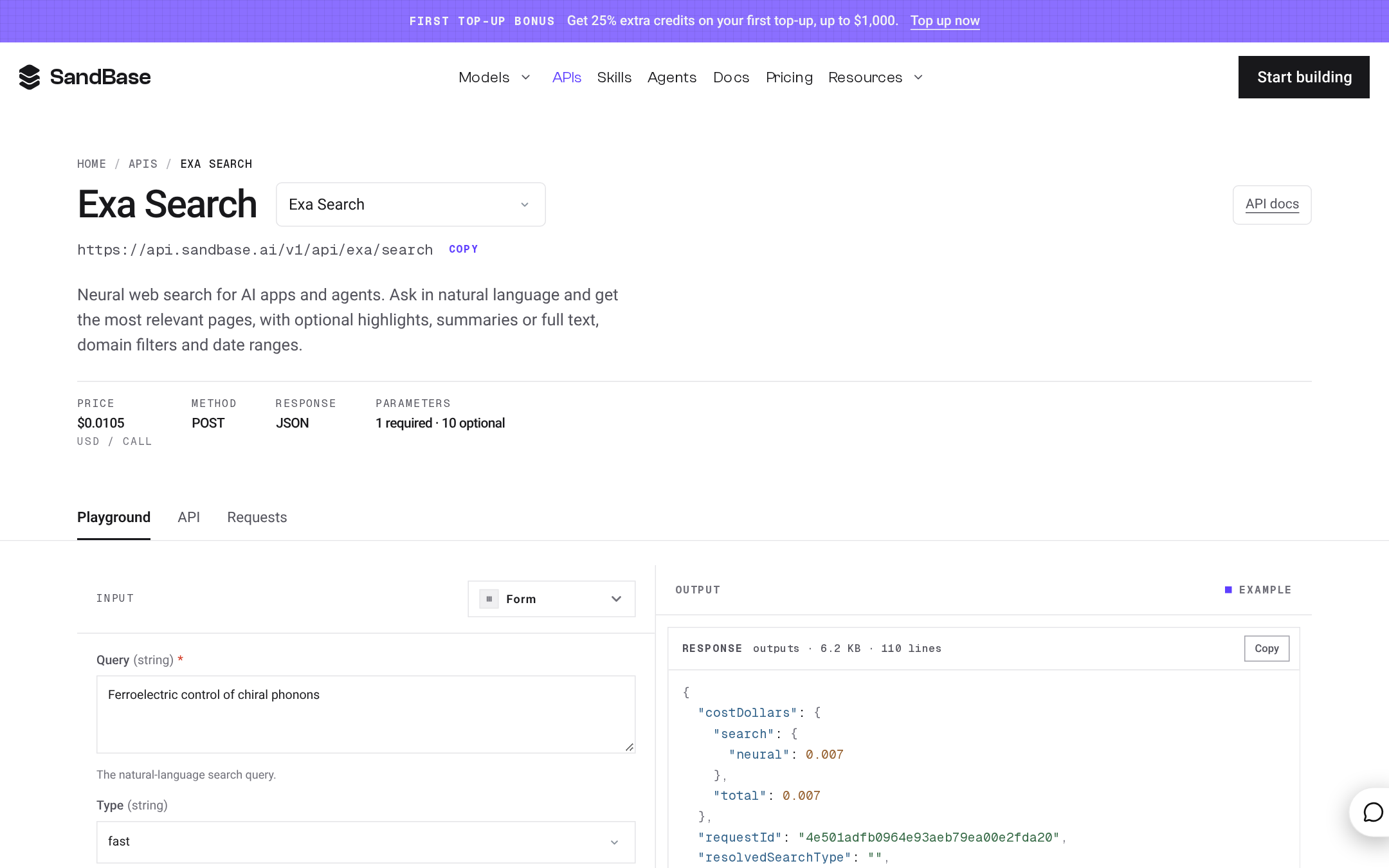
Exa Search card, logged out, light theme, 18 Nov 2026, Asia/Shanghai, with the first-top-up banner. SandBase list price on the catalog check was $0.0105 per call. Confirm promotions on the pricing page, and read the live fields before sending a body.
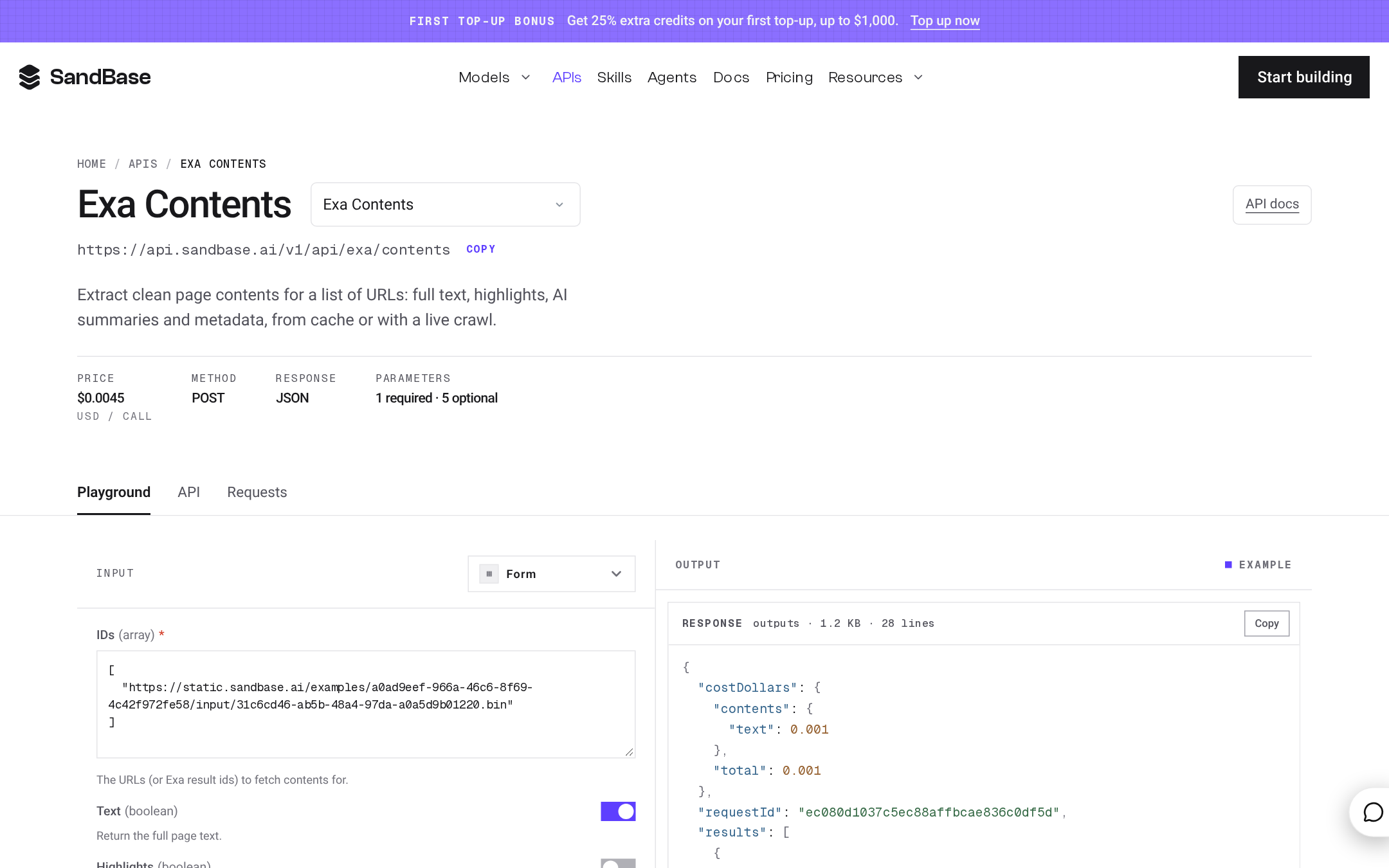
Exa Contents card, logged out, light theme, 18 Nov 2026, Asia/Shanghai, with the first-top-up banner. SandBase list price on the catalog check was $0.0045 per call. Confirm promotions on the pricing page.
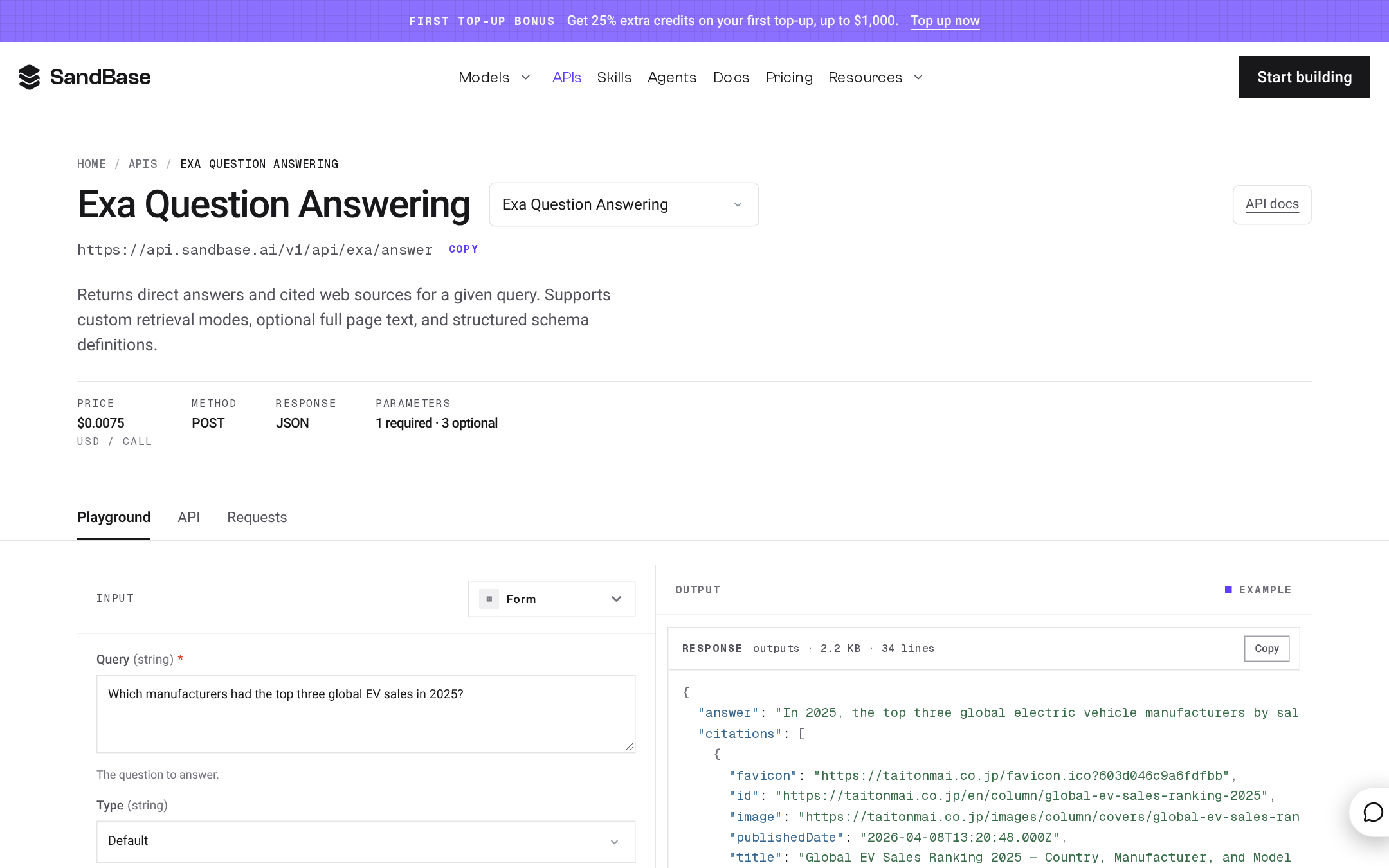
Exa Answer card, logged out, light theme, 18 Nov 2026, Asia/Shanghai, with the first-top-up banner. SandBase list price on the catalog check was $0.0075 per call. Confirm promotions on the pricing page.
Neighbors on the same key
Tavily on SandBase, in Best Tavily Alternatives in 2027, listed Search, Map, and Extract. Tavily Crawl and Tavily Research were not on that hub. This article does not copy Tavily prices. Read them on the Tavily hub or in Tavily Search API.
Firecrawl on SandBase, in Best Firecrawl Alternatives in 2027, listed five endpoints: scrape, crawl, batch scrape, map, and search. Official Agent and Interact products sit outside that hub. Crawl and batch routes may fall outside the free allowance. Check the card. Prices are not copied here. The category page is web scraping. A Cloudsway hub was reachable. Endpoint counts and prices for it are left to Cloudsway versus Exa.
SERP-shaped retrieval is a different job. The SerpAPI alternatives note uses the SERP hub. The lane map is Best Data API Providers in 2027.
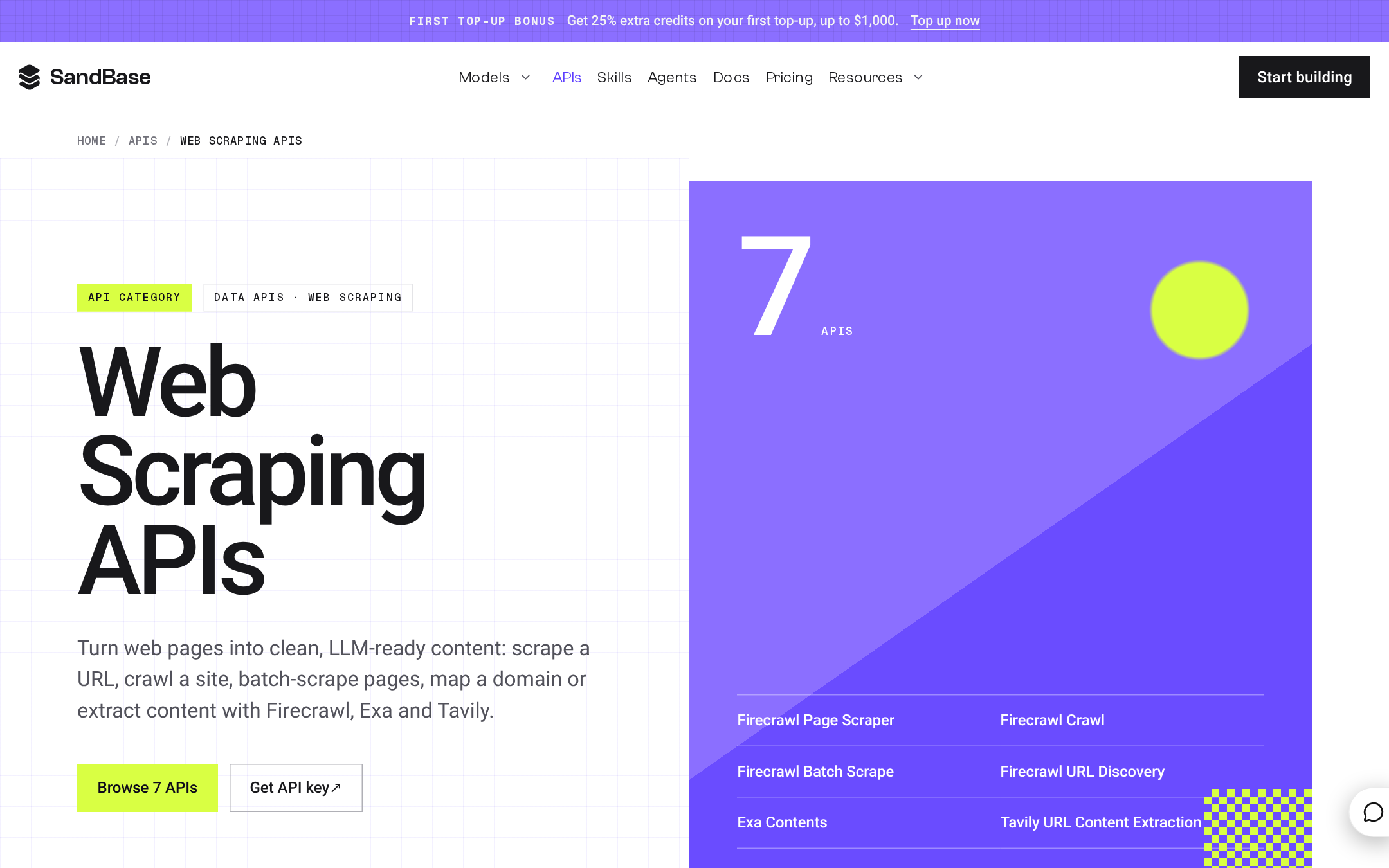
SandBase web scraping category, logged out, light theme, 18 Nov 2026, Asia/Shanghai, with the first-top-up banner. Exa sits here beside Tavily and Firecrawl. The page is a category, not a ranking. Confirm promotions on the pricing page.
Which Exa product to keep where
Use the SandBase Search card when the agent needs natural-language page discovery and the rest of the stack already uses a SandBase key. Use Contents when you already have URLs and want text, highlights, or summaries through that same key. Use Answer when you want a query response with cited sources and you accept the $0.0075 list price as a per-call charge.
Keep official Exa when the workflow is Deep Search, a Monitor, the Agent product, or Websets. Keep it when you are billing against the $10 monthly free credit, the onboarding bonus, or the $12,000 enterprise plan with the stated 25 QPS and Zero Data Retention. Keep it when exa-py or exa-js and official support are the client you already run. The 2026 posts compare behavior in more detail and are not rewritten here: Exa versus Tavily versus Firecrawl, when to chain them, the research-agent benchmark, and the monthly search test. Those posts are prior measurements. This 2027 note did not run a new speed test, so latency here is Unknown.
How to call Search
Open the Exa hub, then a card such as Exa Search or Exa Answer, and read the fields next to the API passthrough doc. Data APIs use POST /v1/api/exa/... with a Bearer key. Do not send them to POST /v1/run. Omit model. The URL is the identity. If the call is asynchronous, GET /v1/run/{id} is only a poll.
This comparison did not run a new paid call, so business fields are not listed. An empty object is what the passthrough page allows when you are inspecting the route. A useful call uses the live card. Read outputs[0].data and treat those names as undocumented until your own response shows them.
import os
import requests

payload = {}  # replace with the fields shown on the live tool card before sending
response = requests.post(
    "https://api.sandbase.ai/v1/api/exa/search",
    headers={
        "Authorization": f"Bearer {os.environ['SANDBASE_API_KEY']}",
        "Content-Type": "application/json",
    },
    json=payload,
    timeout=90,
)
response.raise_for_status()
body = response.json()
outputs = body.get("outputs") or []
if body.get("status") != "completed" or not outputs or not isinstance(outputs[0], dict):
    raise RuntimeError(f"SandBase call did not complete: {body.get('status')} {body.get('error')}")
data = outputs[0].get("data")
Contents is https://api.sandbase.ai/v1/api/exa/contents. Answer is https://api.sandbase.ai/v1/api/exa/answer. Same rule for the body. Bill the calls on pricing, where you can also compare the Tavily and Firecrawl cards on the same key before you sign up. Signup currently redirects to sign-in.
The daily free allowance, once
As of the 18 Nov 2026 billing page and pricing page, every organization gets 100 free data API calls per UTC day for eligible search, social, scraping, e-commerce, and finance tools. All eligible data APIs and all keys in the org share that pool. It resets at 00:00 UTC. Unused calls do not carry over. Language models and media models are not eligible. Pricier or formula-priced tools, including some batch endpoints, crawl endpoints, Xiaohongshu Pugongying (PGY), and the Douyin Xingtu kol-* routes, are billed from the first call. Eligible tools carry pricing.free_quota on the live card (sandbase_inspect). Tools without it are always billed. The card is the source of truth. After the 100th eligible call, calls keep working and are billed. They are not rejected. A zero balance can still use remaining free allowance. The pricing sample is not a complete roster. Absence from the sample is not proof of ineligibility. Plans are pay per call, with no subscription: Start ($0), Build (Metered), Scale (Custom). Catalog search and reading a schema or price is $0. Failed calls are not charged. Agent sandboxes are free for now. Fair-use caps may apply, and pricing will be announced before that changes.
Exa’s official $10 credit is a different program. Do not subtract it from the SandBase allowance or add the two together.
When not to switch: stay on official Exa
Stay when you need Deep Search, Monitors, Agent, Websets, the enterprise Zero Data Retention terms, the 25 QPS figure, or the $10 monthly free credits as Exa sells them. Stay when the integration is exa-py or exa-js and you want Exa’s own support and index. Stay when the cost model has to match per-1,000 billing plus extra results and summaries. Stay when an official SLA or contract is the requirement. Speed on SandBase is Unknown.
Catalog gaps and Unknowns
The SandBase Exa hub had three endpoints on 18 Nov 2026. Deep Search, Monitors, Agent, and Websets were absent. Per-call list prices and per-1,000 official rates answer different questions. This article did not record how many results one SandBase Search call returns, so no converted unit price is offered. Tavily and Firecrawl dollar figures are not copied here. Latency is Unknown.
FAQ
Can I treat $0.0105 as Exa’s lite search divided by 1,000?
No safe reading does that. Official lite search is $4 per 1,000 requests for up to 10 results, with separate charges for extra results and summaries. The SandBase Search card is $0.0105 per call. The units differ, and this article did not measure result counts.
Are Deep Search and Websets on the SandBase hub?
They were not listed on 18 Nov 2026. The hub showed Search, Contents, and Answer. Buy Deep Search, Monitors, Agent, and Websets from Exa if those products are the job.
Does SandBase include Exa’s $10 monthly credit?
The SandBase allowance is 100 shared eligible data API calls per organization per UTC day, with the exceptions on the billing page. Exa’s $10 credit, the monthly reset, and the onboarding bonus are official Exa terms.
Related reading
Call shapes from 2026: Exa Search API and Exa on SandBase. Comparisons already published: Exa versus Tavily versus Firecrawl, chaining for agents, research-agent benchmark, Cloudsway versus Exa, and the monthly web search test. Cluster notes: Tavily, Firecrawl, SerpAPI, and the provider map.
Found this useful? Share it