Exa vs Tavily vs Firecrawl: Search APIs (2026)
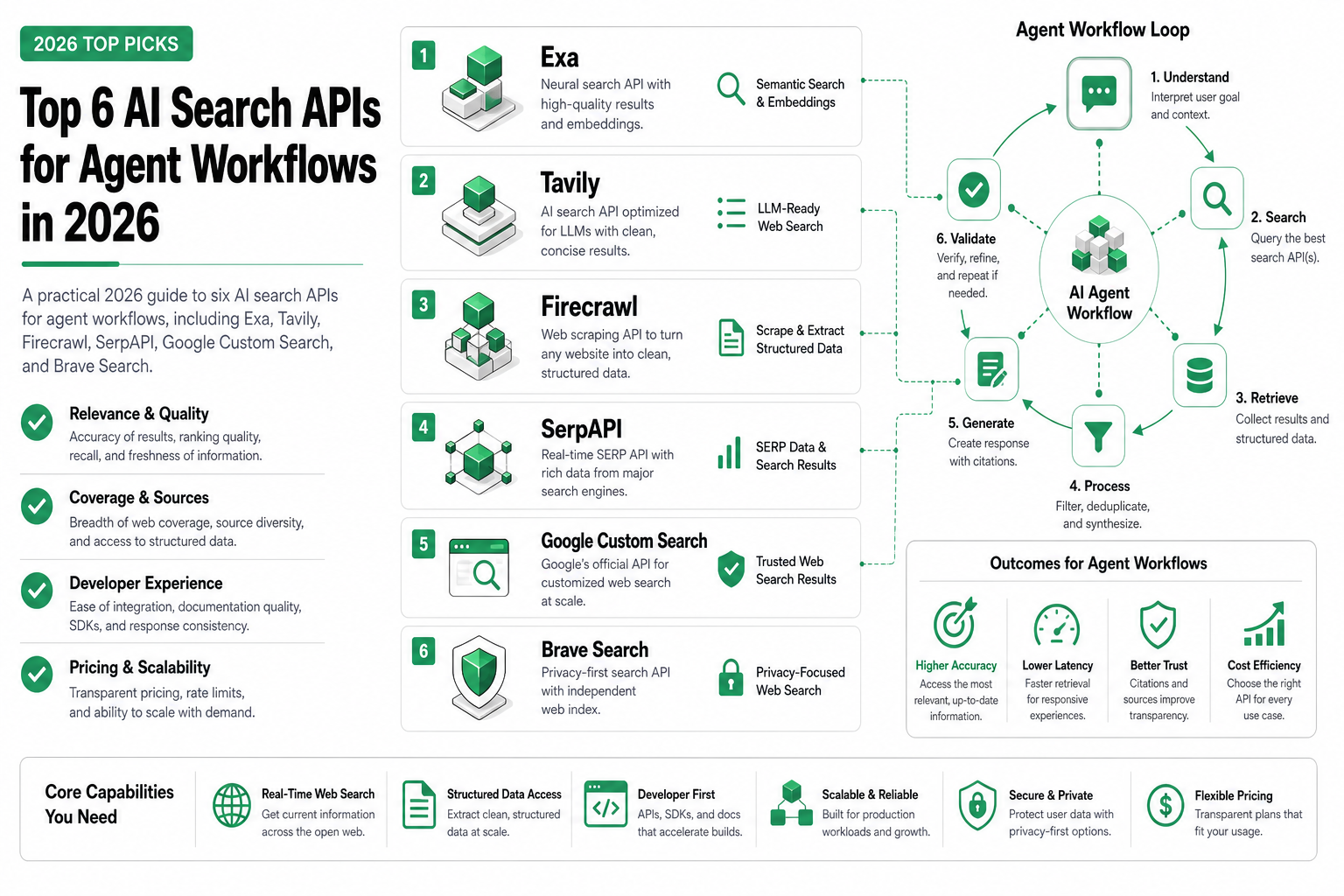
A practical comparison of Exa Search, Tavily, Firecrawl, SerpAPI, and Google Custom Search for AI agent workflows in 2026.
Exa Search vs Tavily vs Firecrawl vs SerpAPI: Search APIs for AI Agents in 2026
TL;DR — Exa Search is strongest when an agent needs semantic web discovery plus extracted content, highlights, and summaries. Tavily is a good fit for agent-oriented search and research workflows. Firecrawl is better when the core job is crawling, scraping, and converting websites into clean markdown or structured data. SerpAPI and Google Custom Search remain useful when you need classic search engine results or SERP features. SandBase helps agents connect these external capabilities into reusable Agent Services with workflows, sessions, artifacts, and delivery context.
Search is becoming one of the first infrastructure choices for AI agents.
Not because search APIs are new. They are not. But agents use search differently from normal applications. A normal application often asks for a list of URLs. An agent usually needs to discover sources, read pages, extract evidence, summarize context, cite results, remember what happened, and pass structured output to the next step.
That changes the evaluation criteria.
For an agent workflow, the question is not only “which API returns search results?” The better question is: which capability gives the agent the right context, in the right format, with the least glue code?
What the current search results tell us
This is a selection guide, not a benchmark. On July 31, 2026, we sampled Google US English results for AI search API for agents through DataForSEO’s Google Organic SERP Live API. The results included provider pages from Exa, Firecrawl, and Parallel, alongside an OpenAI developer guide, a Cloudflare product post, and community discussions.
That mix matters: people searching this topic are not looking for one generic “AI search” category. They are choosing between semantic discovery, web research, deep extraction, and search-engine-shaped data. The comparisons below are organized around that decision. The SERP sample is evidence of search intent on that date and market, not a claim about traffic, demand, or a universal ranking.
Quick comparison table
| Tool | Best for | Strength | Trade-off |
|---|---|---|---|
| Exa Search | Semantic web research for agents | Finds content by meaning and can return extracted text, highlights, and summaries | Not a full browser automation or crawling platform |
| Tavily | Agent-oriented search and research | Search, extract, crawl, map, and research APIs designed for AI workflows | Less focused on being a broad scraping infrastructure layer |
| Firecrawl | Website scraping and crawling | Scrape, crawl, map, search, and extract web pages into LLM-ready formats | Search is part of a scraping/crawling product, not the whole product |
| SerpAPI | Structured SERP data | Mature access to search engine result pages and vertical SERP features | The result is still search-engine-shaped, not agent-task-shaped |
| Google Custom Search JSON API | Programmable Google search | Official programmable search for sites or configured web search experiences | Requires setup and is not designed as an agent workflow layer |
What Exa Search does best
According to the Exa documentation, Exa is built around AI-native semantic search. Instead of only matching keywords, it is designed to find exact content using meaning. That matters for agent workflows because user tasks are often fuzzy.
A founder may ask: “Find companies building local-first agent runtime infrastructure.” A sales team may ask: “Find companies recently hiring FDEs for AI infrastructure.” An investor may ask: “Map teams working on enterprise agent tooling with recent product launches.”
These are not clean keyword searches. They are intent searches.
Exa also supports content extraction options such as full text, highlights, and summaries. That moves the agent one step closer to a usable artifact. The agent does not have to stop at a URL list; it can begin with sources that already include context.
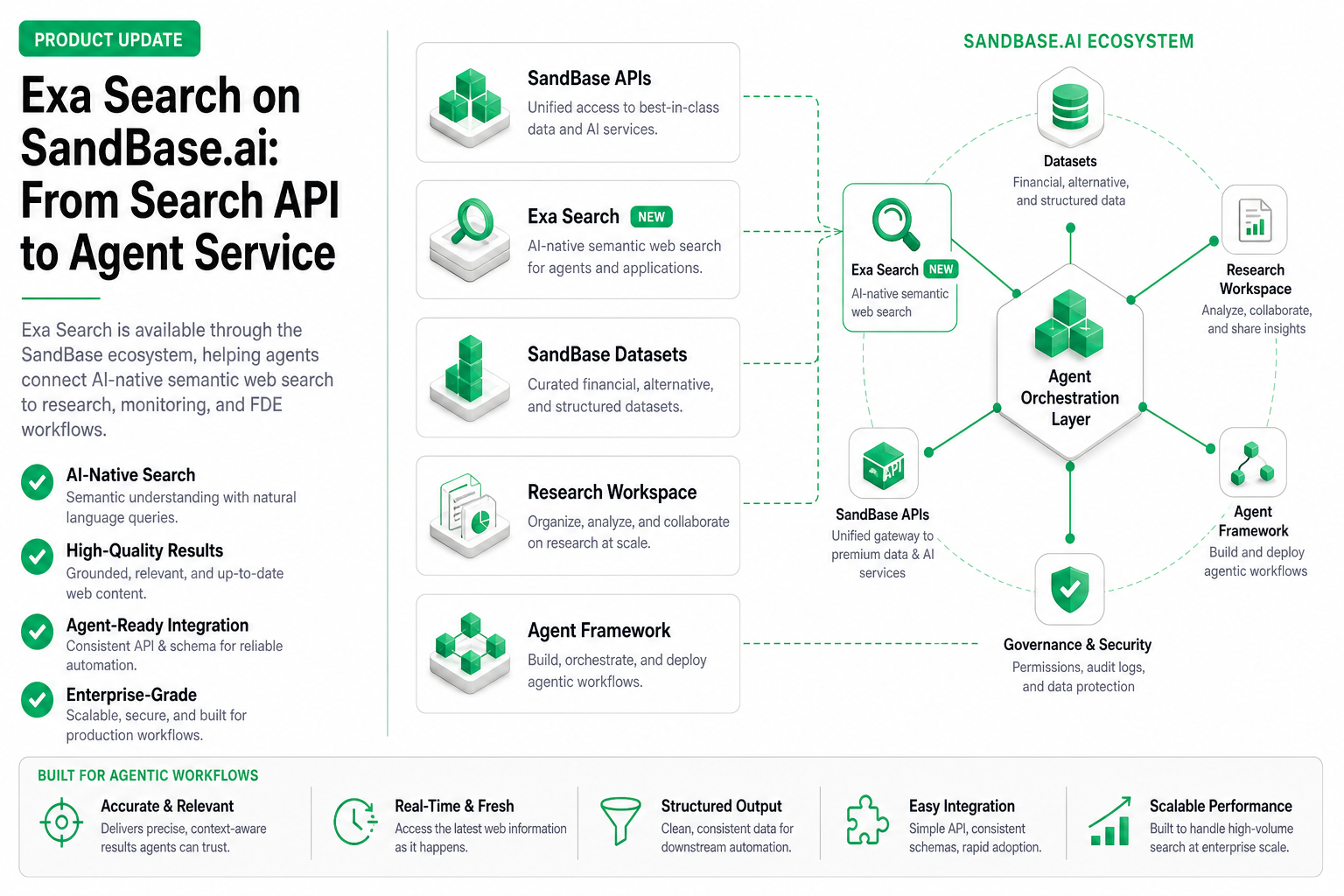
Inside SandBase, this is why Exa Search is useful as an Agent Service:
- Company Research: find pages, extract context, produce a short company brief.
- Competitor Monitor: search product pages, blogs, docs, and launch updates.
- Lead Research: gather company context and generate outreach angles.
- Market Map: find similar companies and categorize them by capability.
- FDE Prep: prepare a first meeting brief from public sources.
The provider gives the search capability. SandBase adds the workflow layer.
Where Tavily is a strong fit
Tavily is also designed for AI applications and agents. Its API surface covers search, extract, crawl, map, and research-style use cases. That makes it useful when the agent needs a more bundled research experience instead of only one search call.
The decision between Exa and Tavily is often about the shape of the task.
If the task is “find semantically relevant content and return rich page context,” Exa is a strong fit. If the task is “give my agent a broad research/search toolkit with multiple web operations,” Tavily is worth testing.
For many teams, the answer may not be one or the other. A production agent stack can use different tools for different steps, as long as the runtime can keep state, control permissions, and write consistent artifacts.
Where Firecrawl is better
Firecrawl is strongest when the problem is not search itself but web data extraction. Its documentation centers on scraping, crawling, mapping, searching, and extracting websites into model-ready formats.
If you already know a target site and need to scrape pages, crawl a documentation tree, convert pages to markdown, or extract structured data, Firecrawl is often the more natural tool. It is close to the “web data ingestion” layer.
This distinction matters.
Search helps an agent discover where to look. Scraping and crawling help an agent turn known web surfaces into clean input. In a real workflow, you may use Exa Search to discover relevant pages, then Firecrawl-style capabilities to deeply process a selected website.
Where SerpAPI and Google Custom Search still matter
SerpAPI and Google Custom Search are more traditional search infrastructure. SerpAPI exposes structured search-engine result data, while Google Custom Search JSON API is designed for programmable Google-powered search experiences.
SerpAPI is useful when you need structured search engine result data, including SERP features and vertical search outputs. Google Custom Search is useful when you want programmable access to Google-powered search over configured sites or search experiences.
These tools are not obsolete. They are just shaped differently.
For agents, traditional SERP output is often one layer too raw. The agent still has to decide which result matters, fetch pages, extract content, summarize, and produce an artifact. That is why a runtime layer becomes important.
The real question: API or Agent Service?
Most comparison articles stop at API features. For agents, that is not enough.
An API answers:
Can I call this capability?
An Agent Service answers:
Can my agent use this capability repeatedly, safely, and produce a useful output?
That second question includes session history, retries, tool permissions, artifact formats, observability, and handoff to the next workflow.
This is where SandBase sits. Exa Search on SandBase.ai is not positioned as “another search API.” It is a way to package search into reusable agent workflows.
How to choose
Do not start by connecting five providers. Start with the first deliverable your agent must produce, then add another capability only when it addresses a distinct next step.
Pick Exa Search when:
- Your agent needs semantic discovery rather than only keyword matching.
- You want extracted text, highlights, or summaries close to the search step.
- Your workflow is research-heavy: company research, lead research, market maps, competitor discovery.
Pick Tavily when:
- You want an AI-oriented web search and research toolkit.
- You need search plus adjacent operations such as extract, crawl, map, or research.
Pick Firecrawl when:
- You need to scrape, crawl, and extract from known websites.
- Your main bottleneck is converting web pages into LLM-ready data.
Pick SerpAPI or Google Custom Search when:
- You need classic search engine result data.
- You care about SERP features, Google-backed search configuration, or familiar search ranking surfaces.
Pick SandBase when:
- You want these capabilities packaged into reusable Agent Services.
- You need workflow state, artifacts, and repeatable delivery.
- You are building for FDE, research, sales, investment, or operational workflows.
FAQ
Is Exa Search a replacement for Firecrawl?
No. Exa is a strong choice for semantic discovery and getting useful context close to the search step. Firecrawl is more natural when you already know the target website and need to crawl or deeply extract it. In a real workflow, they can be complementary.
Should an agent use one search provider or several?
Start with one provider that matches the primary task. Add a second only when the workflow has a clear second job, such as deep website ingestion after semantic discovery. Multiple providers without routing rules usually create more debugging work than value.
What does SandBase add if I already call a search API directly?
It adds the operating layer around the call: reusable workflow structure, sessions, artifacts, skills, and delivery context. The search provider remains the capability layer; SandBase makes it repeatable inside an agent workflow.
Bottom line
The search API market is splitting into layers.
Exa and Tavily are closer to AI-native search and research. Firecrawl is closer to web data extraction. SerpAPI and Google Custom Search are closer to traditional search result infrastructure.
For AI agents, the winning pattern is not just picking a single API. It is turning the right capability into a reusable workflow.
That is the shift SandBase is building toward: from APIs to Agent Services.