Cloudsway vs Exa: Which Search API for Your Agent
Detailed comparison of Cloudsway Search and Exa Search for AI agent workflows — ranked results vs semantic matching, when to use each, and how to combine them for maximum coverage.
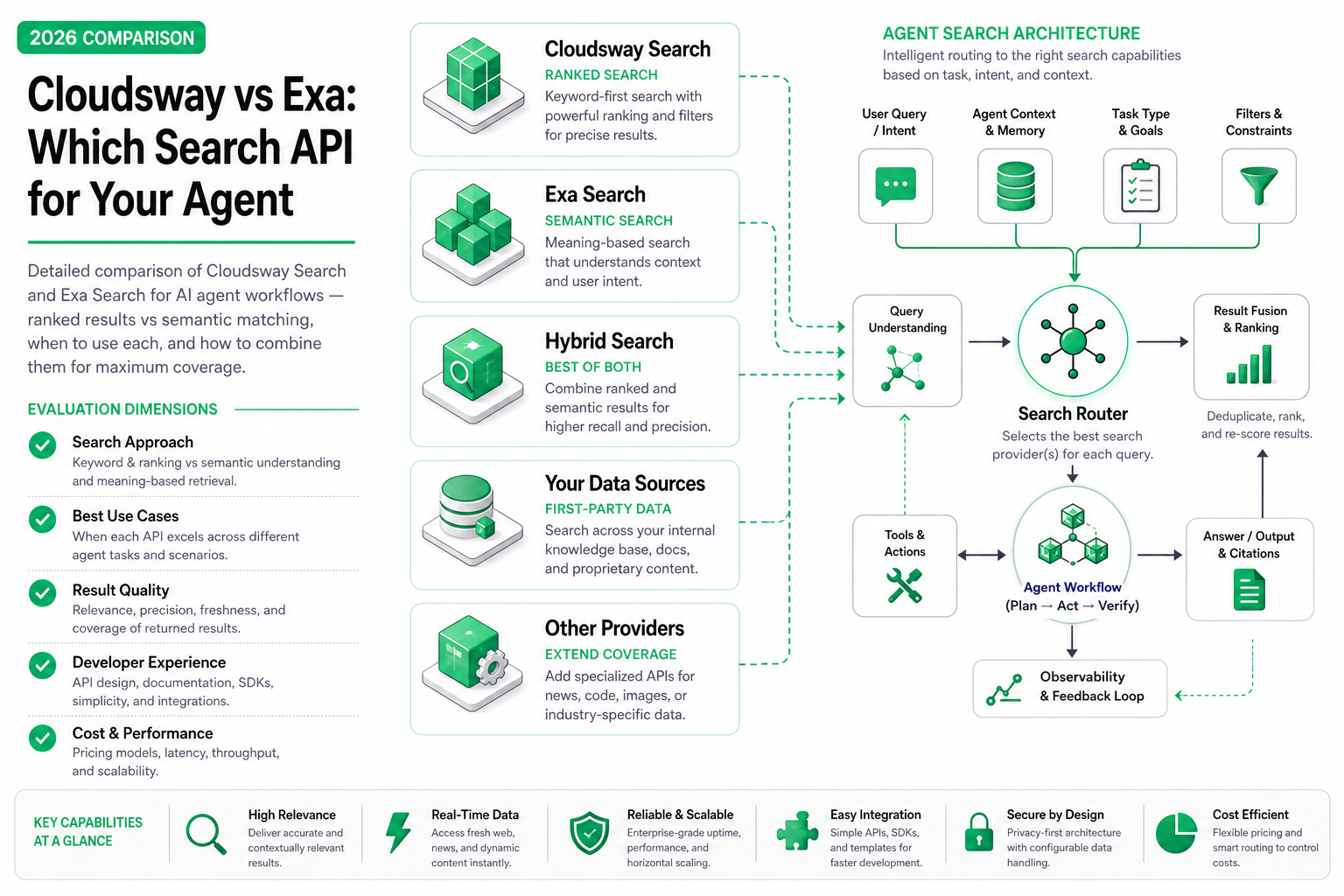
TL;DR — Cloudsway Search delivers ranked web results with summaries (think “Google for agents”). Exa Search delivers semantic content matching (think “find pages by meaning”). Different search intents, different agent patterns. Use Cloudsway for research, monitoring, and fact-checking. Use Exa for content discovery, RAG augmentation, and similarity-based retrieval. Best strategy: use both for different stages of the same workflow.
Two search paradigms in one ecosystem
SandBase provides access to both Cloudsway Search and Exa Search through the same API infrastructure. They solve fundamentally different problems:
Cloudsway Search answers: “What does the web say about X?”
- Returns ranked results like a traditional search engine
- Optimized for breadth, freshness, and authority
- Adds dynamic summaries to each result
Exa Search answers: “Find content that matches this concept/meaning”
- Returns content by semantic similarity
- Optimized for precision and conceptual matching
- Highlights relevant passages within documents
For a deep dive into Cloudsway’s capabilities, see our Cloudsway Search guide. For Exa’s comparison with other search tools, see our Exa vs Tavily vs Firecrawl comparison.
Head-to-head comparison
| Dimension | Cloudsway Search | Exa Search |
|---|---|---|
| Search paradigm | Ranked relevance | Semantic similarity |
| Best query type | Keywords / natural questions | Descriptive content statements |
| Index source | Live web (broad) | Curated web content (deep) |
| Freshness | Real-time | Crawl-dependent (hours-days) |
| Result format | Title + URL + snippet + summary | Content + highlights + score |
| Full text access | Optional (per-result) | Built-in (content extraction) |
| Authority signals | Yes (domain authority, freshness) | No (pure content matching) |
| Language support | Multi-language | Primarily English |
| Operations | 1 (search) | Multiple (search, find_similar, contents) |
| Price point | Per query | Per query |
| On SandBase | Yes | Yes |
Query style differences
The same information need expressed differently for each API:
| Intent | Cloudsway query | Exa query |
|---|---|---|
| Learn about a topic | ”AI agent memory architecture guide 2026" | "technical explanation of how AI agents store and retrieve memories across sessions” |
| Find competitors | ”alternatives to LangChain for agent building" | "open source framework for building AI agents with tool use and memory, similar to LangChain” |
| Get latest news | ”OpenAI product announcement July 2026” | N/A (Exa isn’t ideal for recency) |
| Find similar content | N/A (Cloudsway isn’t similarity-based) | “content similar to: [paste your article URL]“ |
| Research pricing | ”AI image generation API pricing comparison" | "detailed breakdown of costs per image for different AI generation services” |
| Technical deep dive | ”vector database indexing performance benchmarks" | "content that explains HNSW index tuning parameters and their effect on recall” |
When to use Cloudsway
Pattern 1: Current events and monitoring
from openai import OpenAI

client = OpenAI(base_url="https://api.sandbase.ai/v1", api_key="your-key")

# Cloudsway excels at: "What's happening right now?"
response = client.post("/v1/run", body={
    "model": "cloudsway/search",
    "operation": "search",
    "input": {
        "query": "AI regulation updates European Union August 2026",
        "num_results": 10,
        "freshness": "week",
        "include_summary": True
    }
})

# Returns: latest news articles, official announcements, analysis pieces
# Ranked by relevance and authority
Pattern 2: Market research
# Finding what competitors are doing
response = client.post("/v1/run", body={
    "model": "cloudsway/search",
    "operation": "search",
    "input": {
        "query": "enterprise AI agent platform market share 2026 report",
        "num_results": 15,
        "include_summary": True,
        "include_full_text": True
    }
})

# Returns: analyst reports, blog posts, market studies — ranked by authority
Pattern 3: Fact verification
# Checking if a claim is supported by authoritative sources
def verify_with_cloudsway(claim: str) -> list:
    response = client.post("/v1/run", body={
        "model": "cloudsway/search",
        "operation": "search",
        "input": {
            "query": claim,
            "num_results": 10,
            "include_summary": True
        }
    })
    return response.json()["output"]["results"]

# Authority signals in ranking help identify credible sources
When to use Exa
Pattern 1: Content discovery by meaning
# Exa excels at: "Find content that discusses this concept"
response = client.post("/v1/run", body={
    "model": "exa/search",
    "operation": "search",
    "input": {
        "query": "technical blog posts explaining how to implement "
                 "tool selection algorithms in autonomous agents "
                 "using reward-based approaches",
        "num_results": 10,
        "type": "neural"
    }
})

# Returns: highly relevant technical content that matches the *concept*
# even if they don't use the exact keywords
Pattern 2: Similar content discovery
# Find pages similar to a known good resource
response = client.post("/v1/run", body={
    "model": "exa/search",
    "operation": "find_similar",
    "input": {
        "url": "https://example.com/great-article-about-agent-memory",
        "num_results": 10
    }
})

# Returns: semantically similar pages — great for building reading lists
Pattern 3: RAG augmentation
# Finding precise content to add to a RAG context window
response = client.post("/v1/run", body={
    "model": "exa/search",
    "operation": "search",
    "input": {
        "query": "step-by-step implementation of hierarchical planning "
                 "in multi-agent systems with Python code examples",
        "num_results": 5,
        "type": "neural",
        "contents": {"text": True}  # Get full text for RAG
    }
})

# Returns: precise, relevant content ready to inject into LLM context
Decision framework
Choose Cloudsway when:
| Signal | Example |
|---|---|
| You need recency | ”What happened with X this week?” |
| Authority matters | ”Official documentation for Y” |
| Broad coverage needed | ”All perspectives on Z” |
| News/events | ”Latest announcements from competitor” |
| Verification | ”Is this claim supported by sources?” |
| Quantity over precision | ”Give me 20 sources about this topic” |
Choose Exa when:
| Signal | Example |
|---|---|
| Conceptual matching | ”Content that explains X in way Y” |
| Precision over quantity | ”The 3 most relevant technical deep dives” |
| Similarity search | ”Pages like this one” |
| RAG context | ”Precise content to feed into an LLM” |
| Niche topics | ”Specific technical implementation details” |
| Content quality focus | ”Well-written explanations” (Exa’s index is curated) |
Combining both: the power pattern
The most effective agent search strategy uses both APIs at different stages:
class DualSearchAgent:
    """Use Cloudsway for breadth, Exa for depth."""

    def __init__(self, api_key: str):
        self.client = OpenAI(
            base_url="https://api.sandbase.ai/v1",
            api_key=api_key
        )

    def deep_research(self, topic: str) -> dict:
        """Research using both search paradigms for maximum coverage."""

        # Stage 1: Cloudsway for broad landscape
        # "What's out there about this topic?"
        landscape = self._cloudsway_search(
            f"{topic} overview guide analysis 2026",
            num_results=15
        )

        # Stage 2: Identify the most interesting angles from results
        angles = self._extract_angles(landscape, topic)

        # Stage 3: Exa for precise deep content on each angle
        # "Find the best content that deeply explains each subtopic"
        deep_content = {}
        for angle in angles[:3]:
            deep_content[angle] = self._exa_search(
                f"detailed technical explanation of {angle} in context of {topic}",
                num_results=3
            )

        # Stage 4: Cloudsway for latest developments
        latest = self._cloudsway_search(
            f"{topic} latest news developments",
            num_results=5,
            freshness="week"
        )

        return {
            "landscape": landscape,
            "deep_dives": deep_content,
            "latest_developments": latest,
            "total_sources": len(landscape) + sum(len(v) for v in deep_content.values()) + len(latest)
        }

    def _cloudsway_search(self, query: str, num_results: int = 10, freshness: str = None):
        input_params = {
            "query": query,
            "num_results": num_results,
            "include_summary": True
        }
        if freshness:
            input_params["freshness"] = freshness

        response = self.client.post("/v1/run", body={
            "model": "cloudsway/search",
            "operation": "search",
            "input": input_params
        })
        return response.json()["output"]["results"]

    def _exa_search(self, query: str, num_results: int = 5):
        response = self.client.post("/v1/run", body={
            "model": "exa/search",
            "operation": "search",
            "input": {
                "query": query,
                "num_results": num_results,
                "type": "neural",
                "contents": {"text": True}
            }
        })
        return response.json()["output"]["results"]

    def _extract_angles(self, results: list, topic: str) -> list[str]:
        summaries = "\n".join(r.get("summary", r.get("snippet", "")) for r in results[:10])
        response = self.client.chat.completions.create(
            model="openai/gpt-4o-mini",
            messages=[{
                "role": "user",
                "content": f"Based on these search results about '{topic}', "
                          f"what are the 5 most interesting angles to explore deeper?\n\n"
                          f"{summaries}\n\nList 5 angles, one per line."
            }],
            max_tokens=200
        )
        return [line.strip() for line in response.choices[0].message.content.strip().split("\n") if line.strip()]
Performance comparison
| Metric | Cloudsway | Exa |
|---|---|---|
| Typical latency | 1–3s | 1–4s |
| Results freshness | Minutes | Hours–days |
| Relevance for broad queries | 9/10 | 7/10 |
| Relevance for specific concepts | 7/10 | 9/10 |
| Content extraction quality | Good (optional full text) | Excellent (built-in) |
| Multi-language queries | Strong | Moderate |
| API simplicity | Very simple (1 operation) | Multiple operations |
Cost comparison
| Usage | Cloudsway monthly | Exa monthly | Combined |
|---|---|---|---|
| 50 queries/day | ~$30–50 | ~$30–50 | ~$60–100 |
| 200 queries/day | ~$80–150 | ~$80–150 | ~$160–300 |
| 1000 queries/day | ~$300–500 | ~$200–400 | ~$500–900 |
Both are priced per-query through SandBase. The combined cost of using both strategically is often less than doubling, because you use each where it’s most effective — reducing wasted queries.
Agent architecture recommendations
For a research agent
User question → Cloudsway (broad search, 10 results)
             → LLM identifies knowledge gaps
             → Exa (precise content for gaps, 3 results each)
             → LLM synthesizes final answer with citations
For a RAG augmentation agent
User query → Exa (find semantically relevant content, 5 results)
          → Inject as context into LLM
          → If LLM confidence is low:
            → Cloudsway (broaden search, verify facts)
            → Re-generate answer
For a monitoring/alerting agent
Scheduled: Cloudsway (daily search for competitor news)
         → LLM classifies: signal vs noise
         → If signal detected:
           → Exa (find similar analysis/commentary)
           → Generate alert with context
Related Reading
- Cloudsway Search: Ranked Results + Summaries
- Exa Search vs Tavily vs Firecrawl vs SerpAPI: Search APIs for AI Agents in 2026
- Exa Search on SandBase.ai: From Search API to Agent Service
- Top 6 AI Search APIs for Agent Workflows in 2026
- Social Data API vs Web Scraping for Agents (2026)
- AI Agent Infrastructure Stack 2026
Summary
Cloudsway and Exa are complementary, not competing. Think of them as two lenses:
- Cloudsway = wide-angle lens. See the full landscape, find what’s happening now, rank by authority.
- Exa = macro lens. Zoom into exactly the content that matches your specific concept, with precision.
The best agent search architectures use both. Cloudsway for breadth and freshness, Exa for precision and depth. The unified SandBase API makes switching between them trivial — same client, same authentication, same billing.
Your agent’s search quality directly determines its output quality. Investing in the right search strategy — choosing the right API for each query type — is one of the highest-leverage improvements you can make to any agent system.