Claude Sonnet 5: The Agent Workhorse Model (2026)
Claude Sonnet 5 is a practical 2026 starting point for many AI agents: 1M context, strong coding and reasoning, and a listed $2/$10 per MTok price. When to upgrade to Opus 5.
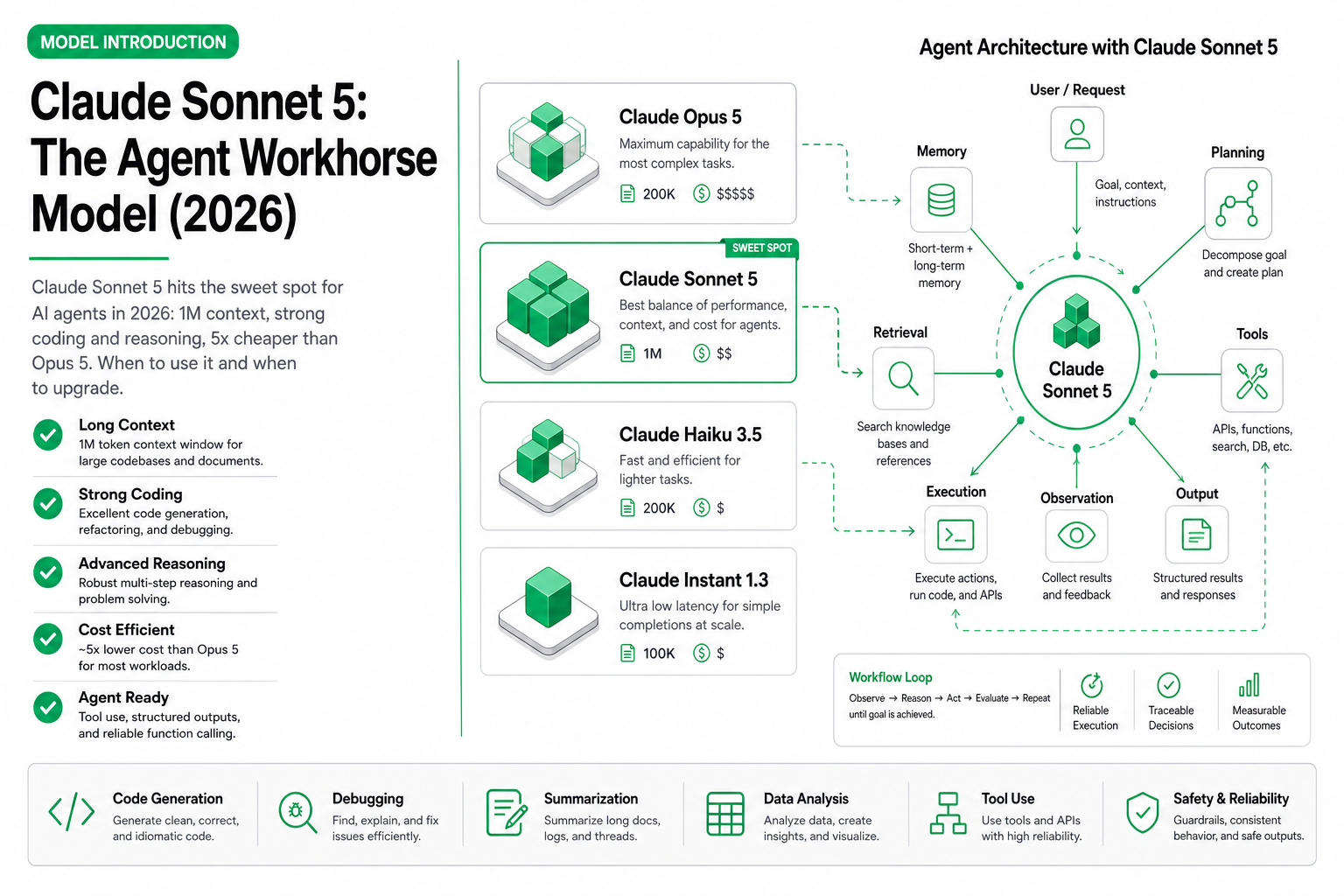
TL;DR — Claude Sonnet 5 is a practical starting point for many production agents. It offers 1M token context (matching Opus 5), strong coding and reasoning capabilities, and a listed price of $2/M input and $10/M output. Opus 5 is listed at $5/$25 per MTok, so the ratio is 2.5×, not 5×. Route up when evaluation shows a meaningful gain.
If Opus 5 is the specialist you call for the hardest problems, Sonnet 5 is the faster, lower-cost starting point for many other workloads — without billing the Opus $25/M output rate.
The positioning
| Dimension | Sonnet 5 | Opus 5 | GPT-4o |
|---|---|---|---|
| Context | 1M tokens | 1M tokens | 128K tokens |
| Reasoning | High | Highest | High |
| Coding | Excellent | Excellent+ | Excellent |
| Speed | Medium | Slow | Medium-fast |
| Input price | $2/M | $5/M | $2.50/M |
| Output price | $10/M | $25/M | $10/M |
| Best for | Default agent model | Hard reasoning only | General, vision |
Sonnet 5 is not a compromise. It is the intended production model for most workloads, with Opus reserved for escalation.
What makes Sonnet 5 the agent default
1. 1M context without Opus pricing
The same 1,000,000 token window as Opus 5, but at Sonnet pricing. This means you can feed a 200K-token codebase to Sonnet 5 for ~$0.60 input instead of $3.00 on Opus. For most code review, refactoring, and analysis tasks, Sonnet’s reasoning quality at this context length is more than sufficient.
2. Strong tool use and function calling
Agents live on tool use. Sonnet 5 handles multi-step tool calls reliably: selecting the right tool, structuring arguments correctly, interpreting results, and deciding the next action. In our experience, tool-calling accuracy on Sonnet 5 matches or approaches Opus for most workflows.
3. Excellent coding
Sonnet 5 is built for agentic coding workflows — the same model class that powers coding assistants. It generates, reviews, debugs, and refactors code with high accuracy. For agents that write and execute code (via sandboxes), Sonnet 5 is the natural fit.
4. Consistent output structure
When you ask Sonnet 5 to output JSON, follow a schema, or produce structured reports, it does so consistently. Structured output reliability is critical for agents that parse LLM responses programmatically.
Real-world agent cost comparison
A daily monitoring agent that runs 50 turns/day, each with 2,000 input + 500 output tokens:
| Model | Daily cost | Monthly cost | Quality |
|---|---|---|---|
| Claude Sonnet 5 | $0.68 | $20.25 | High (sufficient for 95% of turns) |
| Claude Opus 5 | $3.38 | $101.25 | Highest (marginal improvement for most turns) |
| GPT-4o | $0.50 | $15.00 | High (slightly cheaper, 128K limit) |
| GPT-4o-mini | $0.03 | $0.90 | Medium (may miss nuance) |
Sonnet 5 at $20/month is the “right” choice for agents where quality matters but Opus-level depth is overkill.
When to upgrade to Opus
Use Sonnet 5 as default. Escalate to Opus when:
- The task involves evaluating multiple valid approaches and choosing the best one
- Cross-document reasoning over 500K+ tokens where subtle connections matter
- Planning complex multi-agent workflows with failure mode anticipation
- The stakes of a wrong answer are very high (legal, financial, security)
Use a simple escalation pattern:
def select_model(task):
    if task.complexity_score > 0.85 or task.stakes == "critical":
        return "anthropic/claude-opus-5"
    return "anthropic/claude-sonnet-5"  # Default
When to downgrade to cheaper models
Sonnet 5 is overkill for:
- Simple classification (→ Claude Haiku 3.5 or GPT-4o-mini)
- Embedding generation (→ dedicated embedding models)
- Template-based generation (→ GPT-4o-mini)
- High-volume, low-stakes tasks (→ Gemini Flash or DeepSeek V4)
The model cascade pattern: Haiku/mini for 70% of calls → Sonnet for 25% → Opus for 5%.
Sonnet 5 on SandBase
from openai import OpenAI

client = OpenAI(base_url="https://api.sandbase.ai/v1", api_key="sk-...")

# Standard agent call
response = client.chat.completions.create(
    model="anthropic/claude-sonnet-5",
    messages=[
        {"role": "system", "content": "You are a coding agent. Write clean, tested Python."},
        {"role": "user", "content": "Implement a rate limiter using Redis with sliding window."}
    ],
    max_tokens=4000
)
Available today via SandBase’s unified endpoint. Same contract as every other model.
Cache optimization for Sonnet 5
With Anthropic’s 5-minute cache, a typical agent with a 2,000-token system prompt:
| Calls within 5 min | Without cache | With cache | Savings |
|---|---|---|---|
| 1 | $0.006 | $0.006 | 0% (first call writes cache) |
| 5 | $0.030 | $0.009 | 70% |
| 20 | $0.120 | $0.018 | 85% |
| 50 | $0.300 | $0.033 | 89% |
For conversational agents making rapid turns, cache is the difference between $0.30 and $0.03 for 50 turns. Enable it by default.
Limitations
- Not the cheapest: At $3/M input, it’s 20× more expensive than GPT-4o-mini. For high-volume, low-complexity tasks, cheaper models win on cost.
- Not the fastest: Medium speed. For latency-critical paths (real-time user interaction), consider Haiku 3.5 for initial responses.
- 1M context ≠ free: Filling the full 1M window costs $3 per call in input alone. Most tasks should target 10K-100K tokens for cost efficiency.
- Output limits: Max output is bounded. Very long generation (full reports, long code files) may need multiple calls.
FAQ
Is Sonnet 5 better than GPT-4o?
For coding and structured tool use: generally yes. For vision tasks: comparable. For cost: Sonnet is slightly more expensive ($3 vs $2.50 input) but offers 1M context vs 128K. If you need >128K context, Sonnet 5 wins by default.
Should I use Sonnet 5 or Sonnet 4 (the previous version)?
Sonnet 5 is the newer model with 1M context (vs 200K on Sonnet 4). If you are already on Sonnet 4, upgrade — the context expansion alone justifies it for agents that accumulate context over multi-turn conversations.
How does Sonnet 5 compare to Kimi K3?
Both offer 1M context. Kimi K3 is emerging as a strong alternative with competitive pricing. Sonnet 5 has the maturity of the Claude family (robust tool use, extensive documentation). Kimi K3 may offer better value for specific use cases. We recommend testing both on your actual workloads.
Can I use Sonnet 5 for all agent tasks?
Almost. The 5% where Opus is notably better: complex multi-document reasoning, nuanced judgment calls, and tasks where a single wrong inference cascades. For the other 95%: Sonnet 5 is the right default.
For comparison with other 1M-context models, see our upcoming best 1M-context models. For pricing details across all models, see LLM pricing guide.
Related Reading
- Claude Opus 5 vs Sonnet 5: Price, Context & Evaluation Guide
- Claude Opus 5: What 1M Context Changes for Agents
- Claude Opus 4.7 for Agents: Why It’s the Coding King in 2026
- Claude Sonnet 4 vs GPT-4o: Best LLM for AI Agents?
- GPT-5.6 vs Claude 5 for Agent Workloads
- Best Models for Autonomous Agents (2026)
Key takeaways
- Sonnet 5 is the default production agent model: 1M context, strong coding/reasoning, Sonnet-tier pricing
- Cost-wise it is listed below Opus 5 ($5/$25 per MTok) — a practical starting point for quality-conscious but budget-aware teams
- Use the escalation pattern: Sonnet default → Opus for the hardest 5% → Haiku/mini for the simplest 70%
- Cache system prompts: 85-89% savings on rapid conversational turns
- The 1M context matches Opus 5, while the listed input/output prices are 2.5× lower