Claude for Science: Venus Maps, Protein Design and GPUs
Examine Fable 5.1 and Mythos 5.1 research cases: Venus mapping, lab-tested protein binders, and GPU kernel speedups, with methods and evidence limits.
Key takeaway
The strongest evidence in Anthropic’s Fable 5.1 story is not a claim that the model “became a scientist.” It is that a capable agent can connect observation, tool selection, computation, debugging, and candidate generation into a research workflow.
For researchers and research-software engineers considering Claude, the first question is whether the job is reconstruction, candidate design, or cheaper computation. Anthropic’s Fable 5.1 / Mythos 5.1 release illustrates all three. The cases below separate inputs, outputs, and remaining checks; they are vendor-reported work, not experiments independently reproduced for this article.
Three different kinds of scientific work
The reported examples are easy to bundle into “AI does science.” They actually test different capabilities.
1. Fable 5.1 reconstructs Venus topography
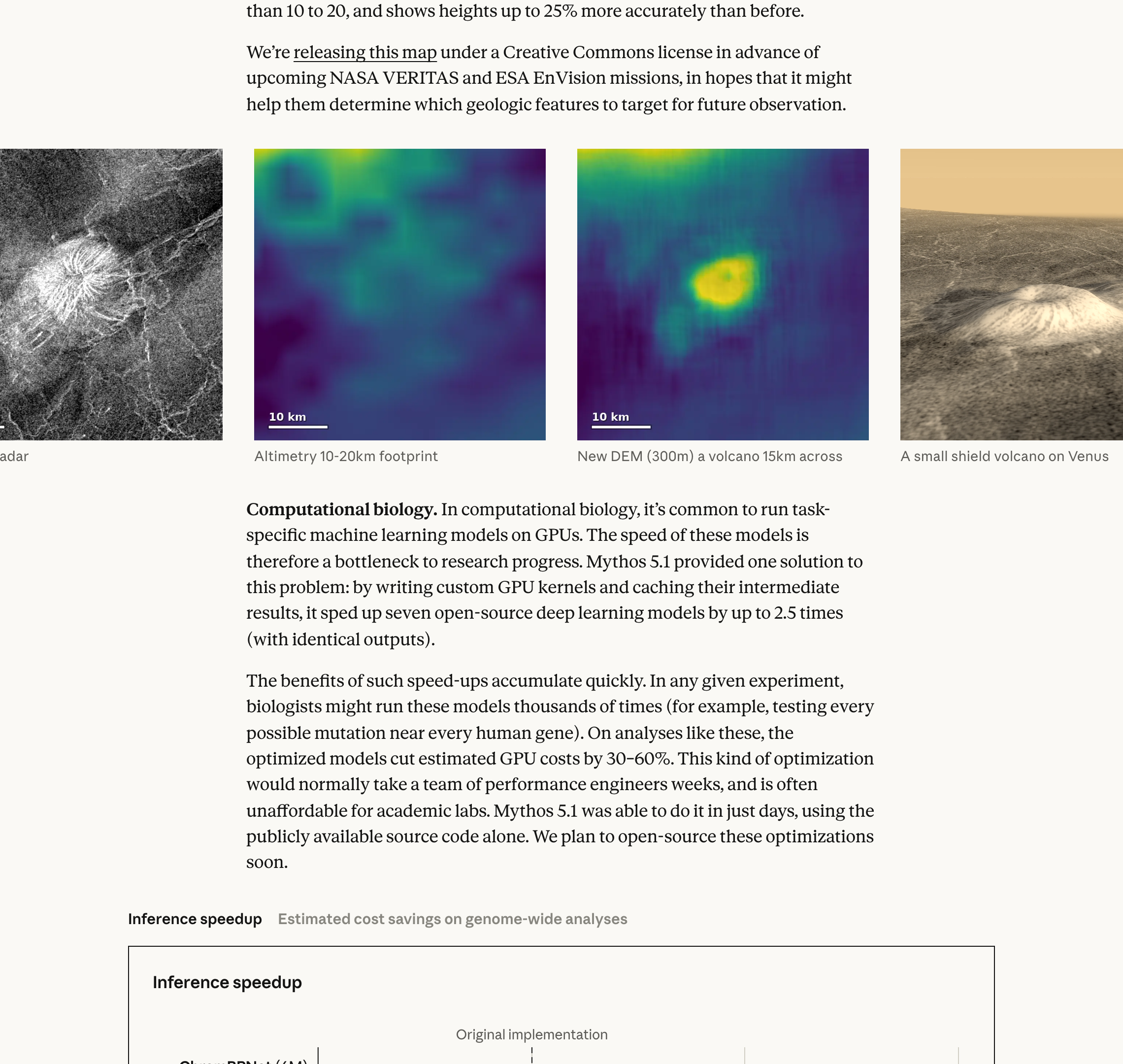 The Venus section compares Magellan radar, legacy altimetry, a new DEM, and a reference view of the volcano.
The reported input was historical NASA Magellan radar imagery and an existing map covering about one-fifth of Venus. Fable 5.1 trained a neural network to produce an elevation map covering about one-third of the planet. Anthropic reports detail at 2–3 km instead of 10–20 km and up to 25% more accurate height estimates. The image labels a 300 m DEM, or digital elevation model; grid spacing is not the same as independently resolved terrain detail. That is a demanding inverse problem: the model must learn a relationship between incomplete measurements and plausible terrain, then produce outputs that can be compared with held-out or higher-quality observations.
The scientific question is not whether the generated image looks detailed. It is whether the reconstruction improves measurable estimates without inventing structure that the data cannot support. A useful evaluation should report the training split, spatial resolution, baseline method, error metric, and uncertainty—not only a visual before-and-after.
2. Designing protein candidates
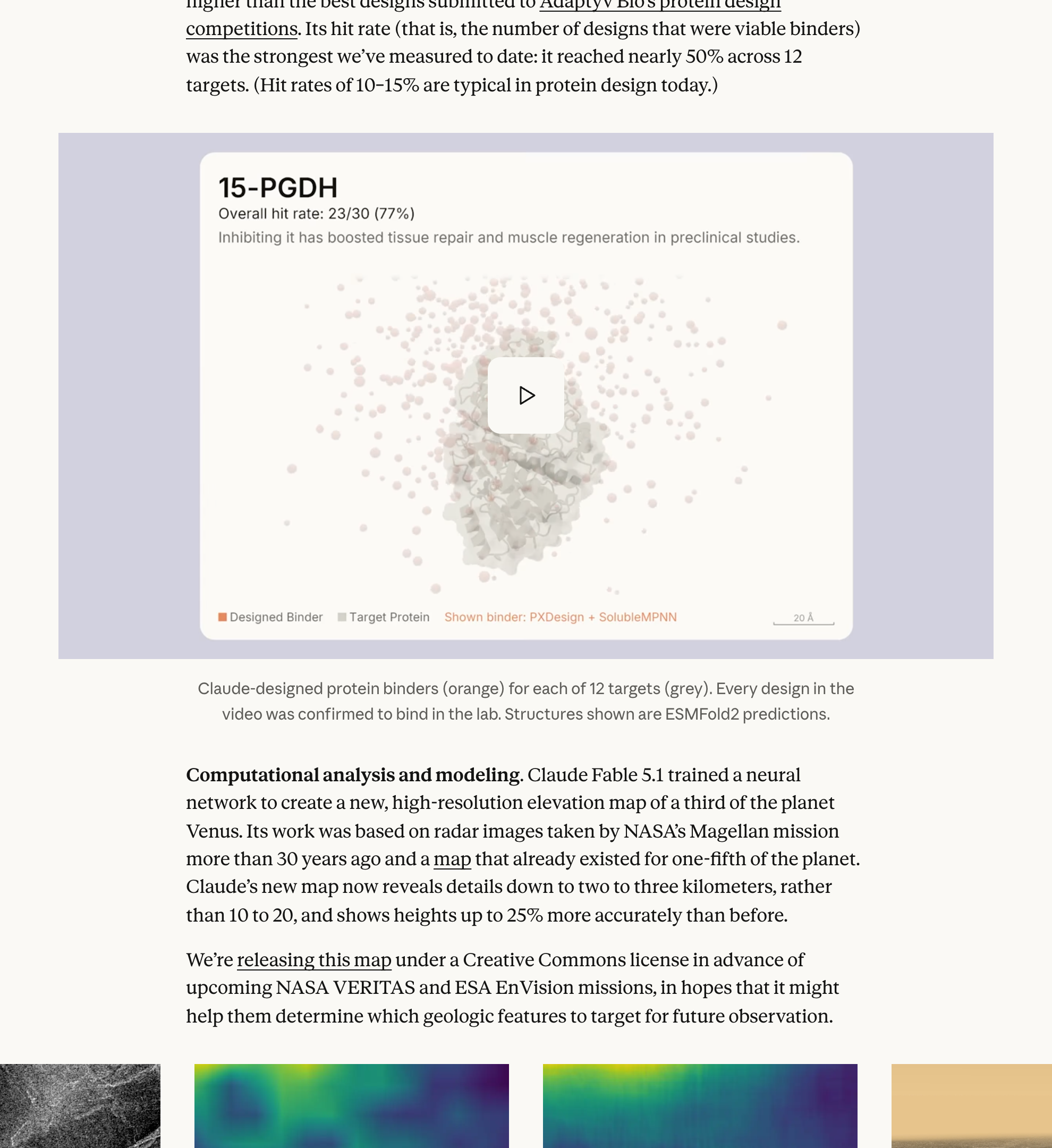 Anthropic’s release page shows a lab-confirmed binder example and places it inside a larger tool-mediated protein-design workflow.
Protein design is an even clearer example of a workflow rather than a single answer. The agent can choose binding sites, call public design tools, recover from failed runs, and propose candidates for external testing. In this release’s case study, Mythos 5.1 used open-source tools and sent candidates to two external organizations for testing. Anthropic reports nearly 50% viable binders across 12 targets. This is a binder hit rate, not a drug approval rate.
That is impressive because the bottleneck is often orchestration: selecting the next experiment, translating between tools, and keeping constraints intact. But a generated structure is not a drug. Binding affinity, specificity, stability, toxicity, manufacturability, and in-vivo behavior still require experimental validation.
3. Mythos 5.1 optimizes GPU kernels
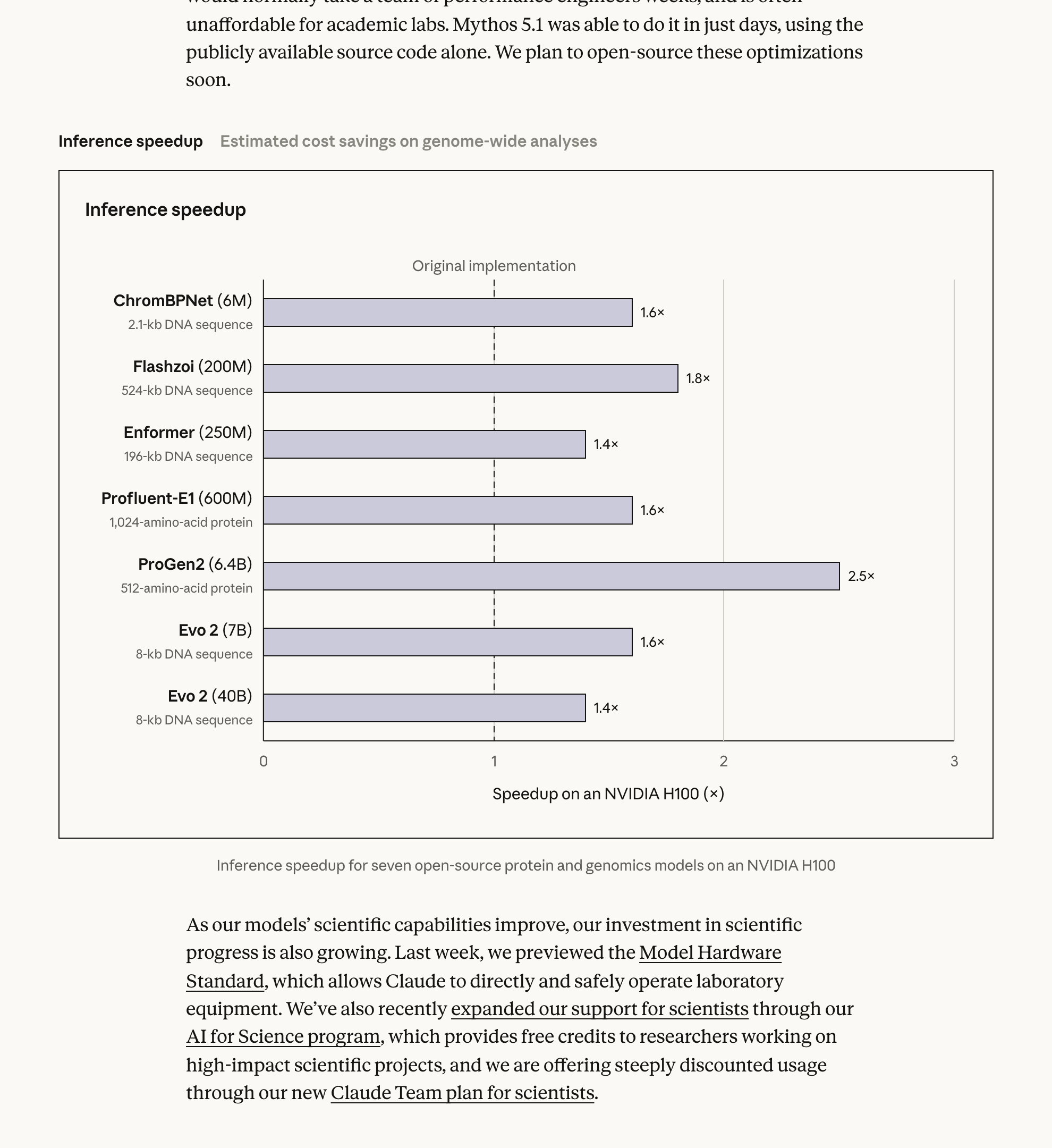 The official chart reports inference speedups across seven open-source protein and genomics models.
A GPU kernel is a program that performs a computation on the graphics processor. Anthropic reports approximately 1.4–2.5× speedups across seven open models on an NVIDIA H100. ProGen2 reaches 2.5× in the shown configuration; Evo 2 40B’s per-forward result is about 1.4×. The target is not a new hypothesis but a faster, equivalent computation. Here the acceptance test is unusually concrete: compare outputs against the reference implementation, test edge cases, measure performance across realistic shapes, and inspect numerical error.
This is where an agent can create immediate operational value. A small speedup multiplied across millions of inferences changes a lab’s cost and throughput. Yet “faster” only counts if the result remains scientifically equivalent and the benchmark includes compilation, memory movement, and production-shaped inputs.
The common pattern is tool-mediated reasoning
These cases share a loop:
question -> inspect data -> choose tool -> run experiment -> check result -> reviseThe model contributes planning and adaptation. The tools contribute domain operations. The evaluator contributes the definition of success. Removing any one of the three makes the headline weaker.
For a lab building this workflow, every run should preserve the prompt, tool versions, parameters, intermediate artifacts, failures, and final decision. A result without provenance is a demo; a result with provenance can become a research input.
What to measure before claiming discovery
Start with four layers of evidence:
- Reproducibility: Can another team rerun the workflow from the recorded inputs?
- Validity: Does the result survive domain-specific checks and external experiments?
- Novelty: Is the candidate genuinely new, or merely a rediscovery from the tool and training distribution?
- Efficiency: How much expert time, compute, and iteration did the agent save?
These questions prevent a common category error. A model that finds a known bug, accelerates a known kernel, or generates a testable protein candidate may be extremely useful without having independently established a scientific theory.
Why Mythos access changes the research design
Anthropic says Fable 5.1 and Mythos 5.1 share an underlying model, while Mythos has a more permissive access policy for vetted cybersecurity and life-science organizations. That matters for experiments: a public Fable session may fall back on biology requests, while an approved Mythos workflow may execute more of the domain-specific tool chain.
Record the requested model and any fallback information the service actually exposes; mark undisclosed internal models or safety routing as unknown. Otherwise a lab may compare a direct Mythos run with a Fable fallback and incorrectly attribute the difference to prompting or tool choice.
The near-term role for research teams
The practical opportunity is not to remove scientists from the loop. It is to move experts toward problem selection, protocol design, review, and interpretation while an agent handles repetitive search, tool glue, implementation, and recovery.
That division can compress the time between an idea and a validated candidate. It can also multiply mistakes if the lab treats a fluent report as evidence. The winning architecture is therefore an evidence ledger around the model, not a chat window with a science-themed prompt.
Fable 5.1’s scientific significance is best stated carefully: it demonstrates a more complete research assistant loop. Whether that loop produces durable discoveries depends on the instruments, controls, and experts around it.
Comparing the three research contributions
| Work | What the agent contributes | What must still be verified | Useful success metric |
|---|---|---|---|
| Planetary reconstruction | Model selection, preprocessing, reconstruction | Held-out error and uncertainty | Improvement over the baseline map |
| Protein design | Candidate search and tool orchestration | Wet-lab binding, stability, and safety | Validated candidates per experiment |
| GPU optimization | Kernel implementation and profiling | Numerical equivalence and edge cases | Throughput at the same output |
This is a more honest comparison than placing all three under a single “discovery” score. The first is an inference problem, the second is a hypothesis-generation problem, and the third is a systems-engineering problem. The evidence required for each is different.
These figures come from the official release, not an independent experiment for this article. Reproduction still requires the data, methods, and conditions; a launch page cannot replace a methods section or complete experimental record.
FAQ
Did Fable 5.1 independently discover new science?
The public evidence supports AI-assisted research workflows, not a blanket claim of independent discovery. A scientific claim needs reproducible inputs, a method, uncertainty, and domain validation.
Why are biology examples associated with Mythos rather than ordinary Fable?
Anthropic uses additional safeguards for biology and chemistry. Some Fable requests may fall back to Opus, while organizations invited into LSVP use Mythos under that program’s research safeguards; general identity verification does not establish eligibility.
What should a lab save from an Agent run?
Save the prompt, source data hashes, tool and model versions, parameters, intermediate files, failures, generated candidates, and the human decision. Without provenance, a fluent result is difficult to reproduce or challenge.
Is a faster GPU kernel automatically a better scientific result?
No. It must produce equivalent outputs within an agreed numerical tolerance, cover realistic input shapes, and remain faster after compilation and memory-transfer costs are included.
Per-forward speed and whole-analysis savings differ
For an Evo 2 40B analysis of three million ClinVar variants, Anthropic estimates GPU cost falling from $18,000 to $8,000 at H100 cloud list prices. The roughly 2.3× whole-job improvement exceeds the 1.4× per-forward speedup because some cached intermediate results pay off across many sequences. This is a specified analysis estimate, not an invoice or a promise for every genomics task.
With only a few dozen samples, compilation and data movement may dominate. Different GPUs and sequence lengths require new measurements. Check numerical error on identical inputs first, then end-to-end runtime, then estimate cost using the machines you actually pay for.
What an ordinary API user can try
Mythos research access still requires official approval. LSVP is an invite-only life-sciences beta; the CVP announcement says Mythos access will be added later. Neither should be described as an unrestricted public API. See the Fable and Mythos access comparison.
For code and verification tasks with public models, start with the small Claude / Lean test and check current models on SandBase’s Anthropic page. A model request does not include wet-lab services or grant Mythos research access.
Sources checked September 8, 2026: Fable 5.1 / Mythos 5.1 research and cost details, Claude Fable, and Claude Mythos.