Gemini 3.8 Flash Coding Costs: When Cheap Retries Pay Off
Calculate Gemini 3.8 Flash coding costs including thinking tokens, compare provider rates, and cap retries at two before escalating a failed patch.
A coding agent produces a patch, but the regression test still fails. Is another Gemini 3.8 Flash attempt cheaper than escalating immediately? The answer depends on the cost of an accepted patch, not just its token price. Count thinking tokens, failed attempts, and test execution, then stop when another attempt brings no new evidence.
The Gemini 3.8 Flash launch provides the context: introductory input/output rates of $0.75/$3.75 per million tokens, a reported 73.7% on DeepSWE v1.1, and third-party output throughput near 300 tokens per second. This article keeps the fast-versus-deep comparison focused on one decision: an initial patch and at most two retries for a reproducible coding failure.
Key takeaway
- Gemini 3.8 Flash matters less as a “cheap flagship” than as a model whose price and throughput make parallel candidates, rapid retries, and continuous verification practical.
- Google’s 73.7% DeepSWE result shows that it can complete long repository tasks, but the score uses a specific harness and high-thinking setting. It does not establish an uncontested overall lead.
- More attempts do not automatically produce more intelligence. The strategy works only when independent checks such as unit tests, schemas, and permission rules can reject bad results.
- Fable 5.1 fits better as an escalation path for ambiguous or high-risk work; both models can belong in the same router.
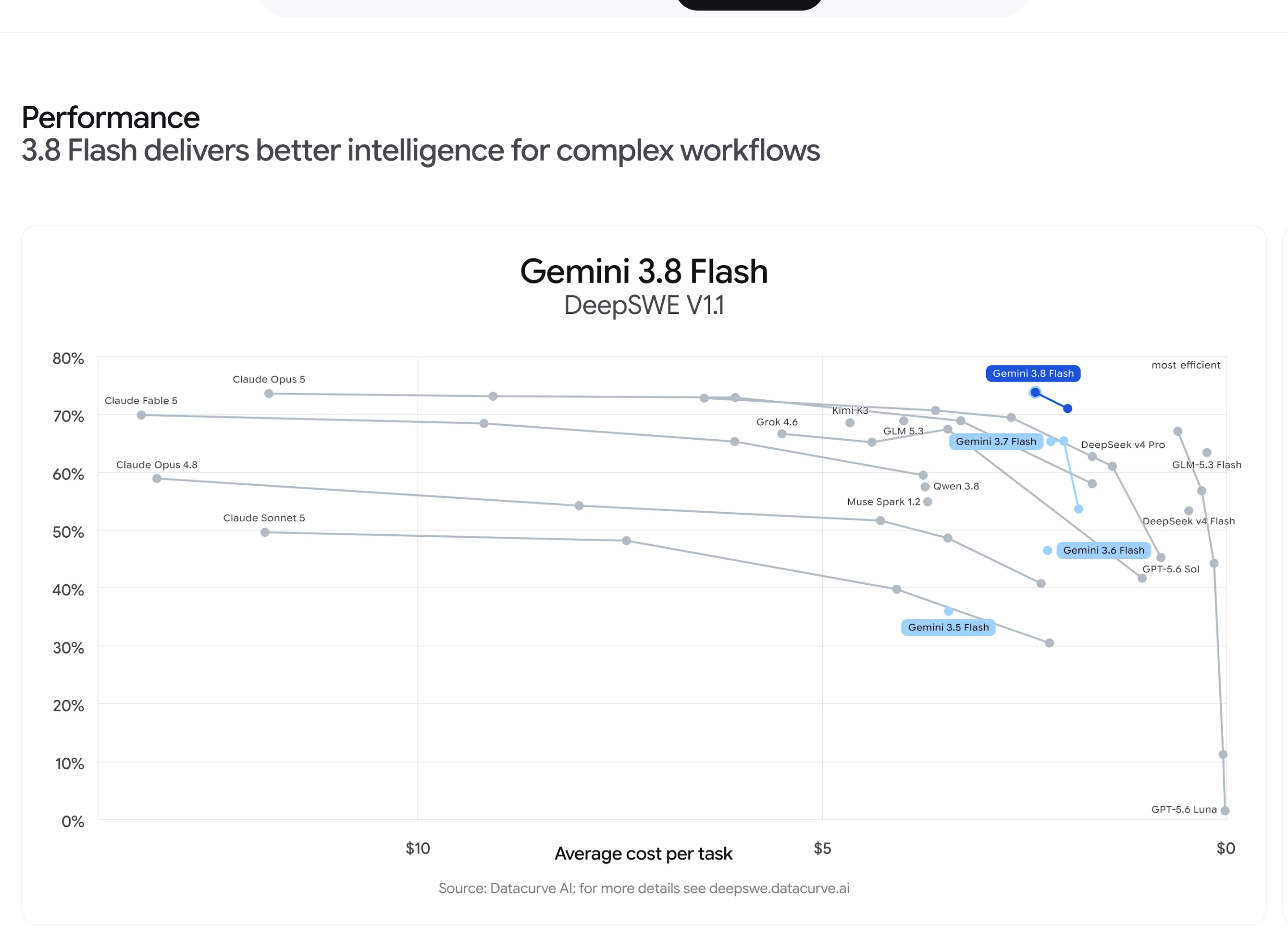 Google’s official performance panel places the 73.7% DeepSWE v1.1 result against average cost per task; cross-model points still inherit the evaluation settings described in Google’s methodology.
What Gemini 3.8 Flash really sells is the next attempt
Google announced Gemini 3.8 Flash on September 2 UTC—September 3 in China. The Gemini 3.8 Flash model page says the model is generally available, accepts up to one million input tokens, produces up to 64K output tokens, and exposes adjustable reasoning levels. Its introductory 2026 price is $0.75 per million input tokens and $3.75 per million output tokens. Those rates move a coding attempt into a price range where repeated use becomes part of the design rather than a costly exception.
 Google’s official product page positions Gemini 3.8 Flash for coding and agent work.
That changes how an agent can behave. When each call is expensive, the system tends to ask for one patch and hope that it is correct. With Flash economics, the same budget can buy two candidate fixes and run the test suite against both. If neither passes, the agent can use two different failure reports to choose its next move. Throughput matters for the same reason: at roughly 300 output tokens per second, another attempt does not automatically introduce a long wait.
The rate card is not the final bill. Output length, high-thinking token use, tool calls, failed retries, and eventual success rate all affect the cost of a completed task. The point is not that Flash remains cheap under unlimited use. It is that the system can replace a single wager with a bounded set of experiments. That is why Gemini 3.8 Flash is more consequential inside an agent loop than inside a chat box.
What a 73.7% DeepSWE result proves—and what it does not
Google reports 73.7% for Gemini 3.8 Flash on DeepSWE v1.1. DeepSWE evaluates long-horizon software-engineering work: entering a repository, understanding context, changing files, and surviving tests. The result therefore places Flash well beyond the usual role of a low-cost model used only for classification, extraction, or autocomplete. Under the published configuration, it completed a substantial share of long repository tasks.
The evaluation methodology cannot be separated from the score. Google says its Gemini result was computed with a mini-swe-agent harness at high thinking. Values for other models in the same table may come from public leaderboards or provider reports. The tasks, harnesses, reasoning settings, and score provenance were not held constant across every row, so this was not a controlled head-to-head experiment.
That is also why DeepSWE 73.7%, Fable’s CursorBench 73.4%, and various Terminal-Bench results cannot be sorted into one universal league table. Their numbers look comparable while their exams are not. The defensible interpretation is narrower and more useful: Gemini 3.8 Flash belongs on the shortlist for long-running coding work, and its price and speed make large internal evaluations easier to afford. A real decision still requires holding the prompt, permissions, repository commit, timeout, verifier, and agent harness constant.
The two demo videos make the intended workflow visible. The DOS-style map and looping-instruction game are not code snippets; they are running, interactive artifacts with test information. They are also demonstrations rather than benchmarks. There is no baseline, repeated-trial count, or independent acceptance report. Even so, they show the unit of work Google wants Flash to handle: generate, execute, inspect, and revise.
The DOS-style Maps demo shows generated code, an interactive artifact, and a summary of 27 automated tests.
The looping-instruction game is a larger interactive build, but it does not establish maintainability, repeatability, or the hidden failure rate.
How speed and price become a system capability
A same-day Artificial Analysis snapshot gives the Flash strategy a clearer coordinate. On September 3, Gemini 3.8 Flash at “high” had an Intelligence Index of 59, output throughput of about 299 tokens per second, and a cost of $0.58 per index task. Fable 5.1 at “max with fallback” scored 66, produced about 66 tokens per second, and cost $3.69 per task.
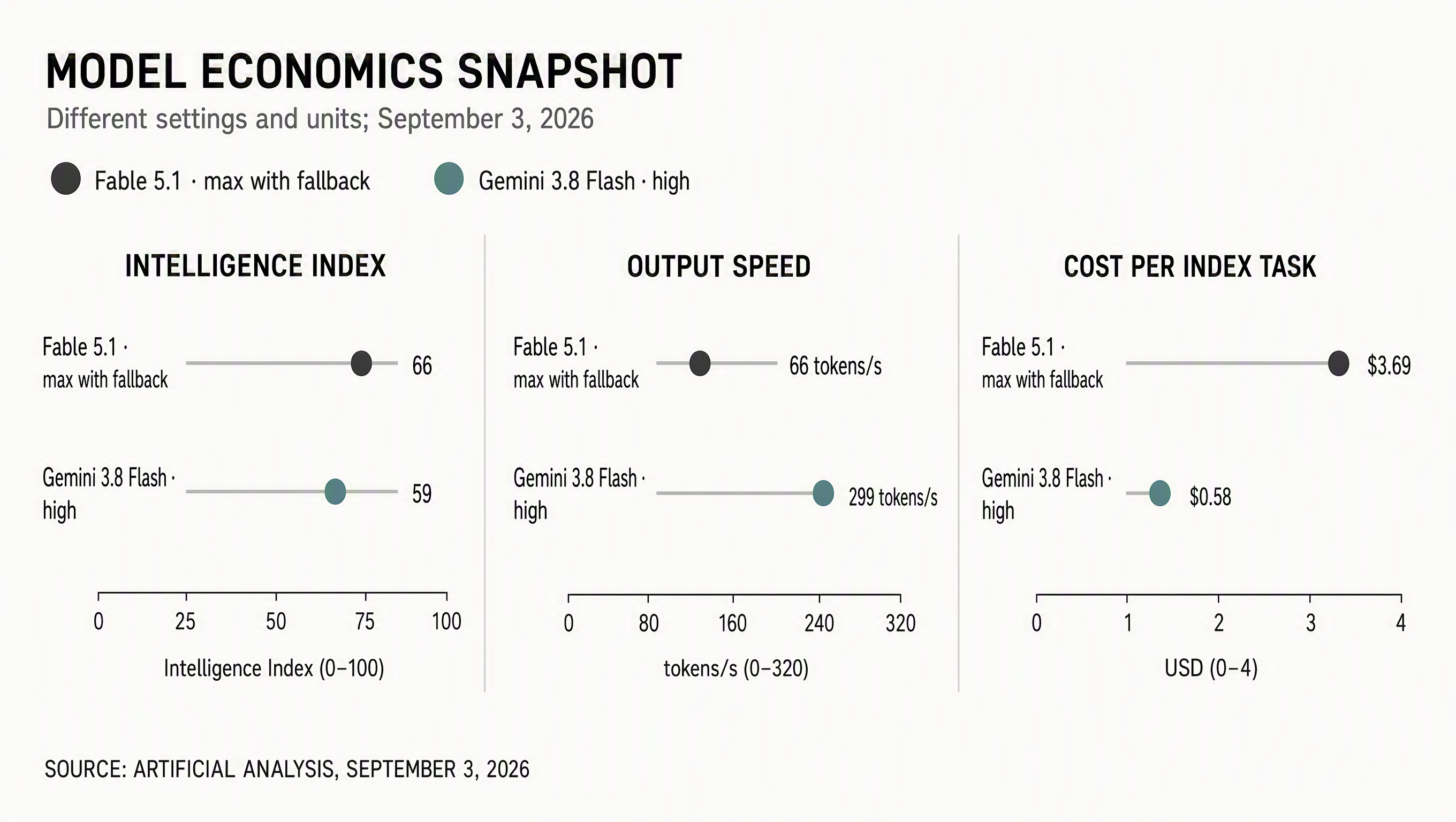
GPT Image 2 visualization: Gemini uses “high” and Fable uses “max with fallback.” The index mixes nine evaluations, and cost per task refers only to the evaluator’s workload. Point positions are illustrative; use the numeric labels and data table above for exact values.
Fable leads the composite by seven points. Gemini produces output more than four times as quickly, while costing roughly one-sixth as much on the evaluator’s task. That does not make Gemini the smarter model. It means the same budget can buy more attempts. If a task has only a subjective answer, extra samples may add little. If it has a unit test, response schema, compiler error, or reproducible calculation, the agent can explore several candidates and let deterministic checks reject failures.
The common mistake is to assume that running a cheap model several times automatically increases correctness. If the model produces the answers and then grades itself, repetition only creates more plausible-looking options. An external verifier turns throughput into engineering value: did the tests pass, does the JSON match the schema, did the action cross a permission boundary, can the result be recomputed? Without those checks, 299 tokens per second simply produces mistakes faster.
Retries also need a firm limit. When two candidates fail in different ways, several rounds make no progress, or the requirement cannot be expressed as a pass condition, another call to the same model is usually wasted spend. The system should escalate to a stronger model or a human reviewer instead of treating a low unit price as permission for an endless loop.
Gemini 3.8 Flash coding costs: price one accepted patch
The Google API pricing table, checked September 8, 2026, labels Standard input at $0.75 and output, including thinking, at $3.75 per million tokens through December 31, 2026. The listed rates from January 1, 2027 are $1.50/$7.50. Google’s thinking documentation bills the generated thinking tokens, not merely the visible thought summary.
Here is a hypothetical calculation, not a measured coding run. Each attempt uses 20,000 input tokens and 8,000 billed output tokens, including thinking. Assume no cache hits, no grounding charges, and identical usage on retries.
| Attempt budget | Total input / billed output | Google Standard 2026 model cost | SandBase listed model cost |
|---|---|---|---|
| Initial attempt | 20,000 / 8,000 | $0.045 | $0.090 |
| Initial attempt + one retry | 40,000 / 16,000 | $0.090 | $0.180 |
| Initial attempt + two retries | 60,000 / 24,000 | $0.135 | $0.270 |
For Google’s first row: 20,000 ÷ 1,000,000 × $0.75 + 8,000 ÷ 1,000,000 × $3.75 = $0.045. If the visible answer uses 2,000 tokens and thinking uses 6,000, the billed output is 8,000—not 2,000 and not 14,000.
The specific Gemini 3.8 Flash page on SandBase lists $1.50 input and $7.50 output per million tokens as of September 8. The table deliberately keeps those rates separate from Google’s introductory offer. The page documents model ID google/gemini-3.8-flash and the Chat Completions route; this is a catalog/documentation check, not a completed API test or a claim that Google’s promotion applies there.
Now add the verifier. If each isolated test run costs an assumed $0.02, the three-attempt Google example totals $0.195 before human review. If all three fail, it bought zero accepted patches. For a batch, divide all model and test spend, including failures, by the number of accepted patches. Keep review time separately in minutes or convert it using an explicit hourly rate. An expanding transcript, slower CI, or repeated long reasoning can easily outweigh the headline token discount.
Flash Cyber’s restricted security tests do not establish the economics of this ordinary coding example. Its separate access rules and results belong in the three-model comparison.
Why Fable 5.1 remains a necessary comparison
The Millennium customer account in Anthropic’s release describes a rare crash traced into a third-party binary. It is a useful contrast, not an independently reproduced test: when the failure is intermittent and nobody knows what to verify, generating more patches is premature. The first job is to establish a reproducible explanation.
Fable remains one escalation option for ambiguous investigations. Its benchmark table uses different tasks from DeepSWE and cannot tell you how many Gemini retries equal one Fable investigation.
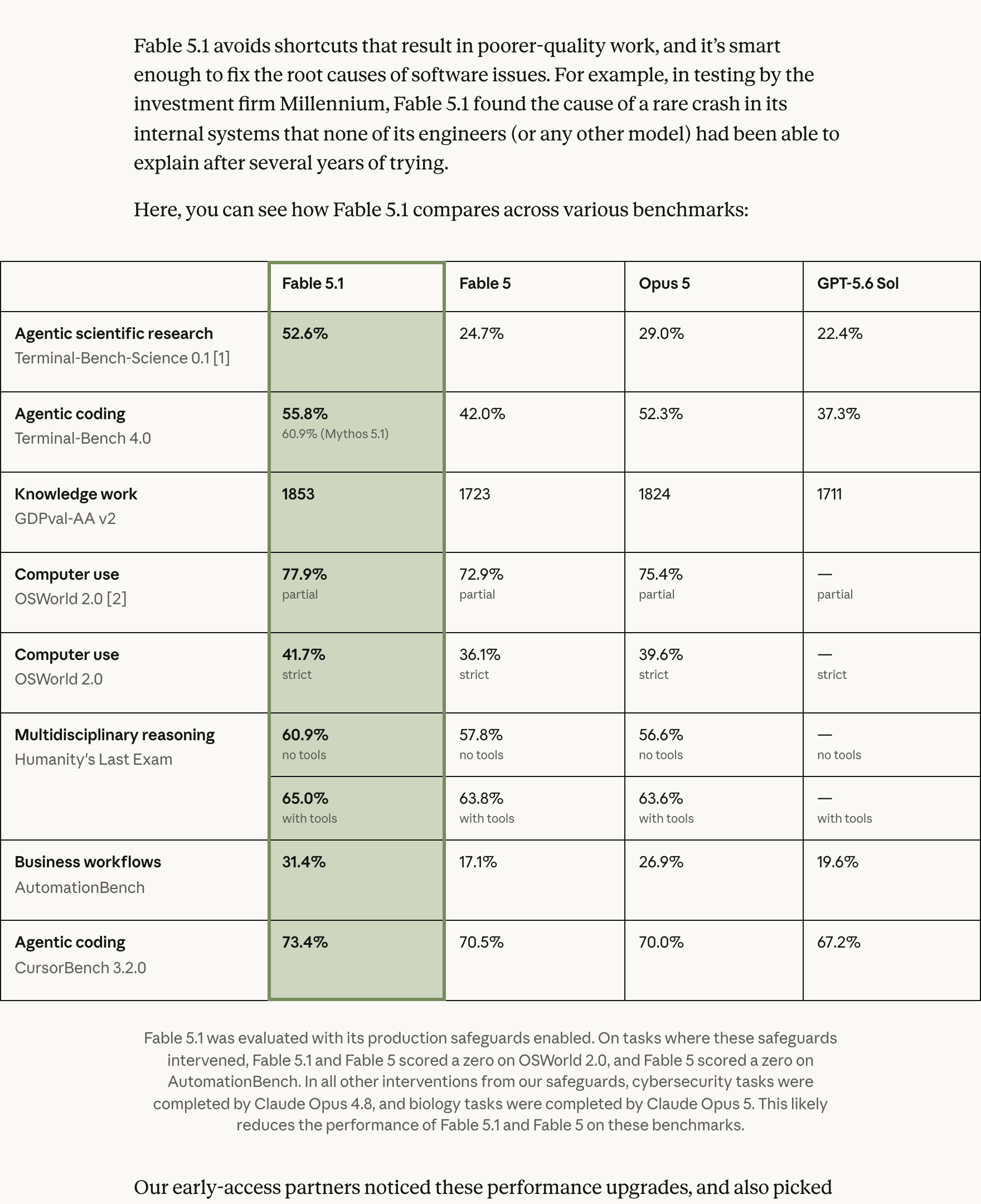 Anthropic’s release page reports Fable 5.1 and Mythos 5.1 results across scientific, coding, knowledge-work, and business-workflow evaluations.
For Fable’s API rates, cache-write charges, and the distinction between cheaper cache reads and cheaper tasks, see the Fable pricing section. Its higher uncached rate is a reason to measure accepted-result cost, not to assume every difficult task belongs on either model.
A failed patch gets at most two retries
Use a small, reversible task before a production incident. The following illustrative exercise assumes a repository already has a date parser and a regression-test command; the paths and command are placeholders to replace with your real ones.
Give the agent a brief such as:
Fix
src/date-parser.tsso invalid calendar dates return an error instead of being normalized. Add tests intests/date-parser.test.tsfor 2026-02-29 (invalid), 2028-02-29 (valid), and an empty string (invalid). Preserve the public return type. Do not change dependencies or production configuration. Run the existing date-parser test command, then the normal regression suite. Stop after the initial attempt and at most two retries; do not publish or deploy.
Before execution, record the repository commit, test command, expected outcomes, and a model-spend cap. Use an isolated working copy without production credentials. A retry is a new patch attempt—not every tool call used to inspect a file.
| Stage | Give the agent | Accept or stop |
|---|---|---|
| Initial attempt | Brief, relevant files, fixed tests | Accept only after targeted tests, regression tests, and diff review |
| Retry 1 | Failed test name, actual/expected value, current diff | Continue only if the next change addresses that failure without weakening tests |
| Retry 2 | New failure evidence and previous unsuccessful fix | Stop if it fails again, exceeds budget, or repeats the same explanation |
| Escalation | Original brief, three diffs, logs, token totals | Human or deeper investigation; no automatic merge |
If the tests go green because the agent deleted the failing assertion, that is a failed attempt. If the same parser fix causes an authentication regression, stop early; two retries are a maximum, not an entitlement. An untrusted repository’s test scripts can also execute code, so review the command and run it in isolation before treating “run tests” as low risk.
Across a sample of tasks, record accepted patches, rejected patches, attempts, billed input/output, test costs, and review minutes. Compare with the current model on the same commits and tests. Do not turn a three-attempt budget into a promised success rate. The broader model-routing comparison covers how to choose escalation models; this exercise answers whether another cheap attempt is worth buying.
Gemini 3.8 Flash changes budget allocation, not just rankings
The most consequential part of Gemini 3.8 Flash is not whether it outranks every flagship on one table. It lowers both the price and the waiting time for another attempt. Coding agents can move from single-shot generation toward parallel candidates, automated checks, and bounded retries. Google’s “long-running agentic loops” need not consist of one enormous reasoning pass; they can be assembled from many fast steps whose results are inspected along the way.
The boundary is equally clear. Objectively testable, safely reversible work can trade lower model cost for more attempts. Vague requirements, scattered evidence, and failures with severe consequences should escalate early. Fable marks the edge of the Gemini strategy: when the verifier stops working and retries stop producing new information, the system needs a deeper investigation rather than a faster next round.
For more context, read how the agent harness changes benchmark outcomes and Fable 5.1’s science and cache claims. Check the Gemini 3.8 Flash route and its own prices before a controlled comparison; use the price for the provider you actually call.
FAQ
Why is Gemini 3.8 Flash a strong fit for coding agents?
It combines a substantial long-horizon benchmark result, third-party throughput close to 300 tokens per second, and low introductory prices. That gives an agent room to generate candidates, run tests, and retry within a controlled budget.
Does 73.7% on DeepSWE mean Gemini 3.8 Flash is the overall leader?
Not by itself. Google’s result uses mini-swe-agent at high thinking, while the comparison table draws other scores from mixed sources. It demonstrates strong performance under that configuration, but does not replace a controlled internal evaluation.
Can several Gemini attempts replace a stronger model?
Only when an independent verifier can identify the correct result. Unit tests, schemas, deterministic calculations, and permission rules fit this pattern. Vague requirements and complex incident investigations do not.
Are thinking tokens included in Gemini coding costs?
Yes. Google’s output price includes thinking tokens. The hypothetical $0.045 attempt above counts 8,000 billed output tokens in total, not just the visible patch. Provider prices can differ: the SandBase model page currently lists different rates from Google’s 2026 Standard promotion.
When should a system escalate from Gemini to Fable 5.1?
Escalate when the fast lane reaches its retry cap, different candidates fail in different ways, the task lacks a reliable acceptance condition, or one mistake could affect money, permissions, or irreversible operations.