Beyond OpenRouter: When an AI API Gateway Is Not Enough for Agents (2026)
OpenRouter alternatives 2026: a gateway routes models. Tool-using agents also need data APIs, a sandbox, and often a managed host on one key.
OpenRouter alternatives 2026 mostly returns another gateway. OpenRouter, LiteLLM, Vercel AI Gateway, Portkey, Cloudflare AI Gateway, and a membership shop such as Bearer Club all answer one question: many models, one OpenAI-shaped client. A tool-using agent asks the next one. It also needs live data APIs, a place to run the code it just wrote, and often a host for the loop, on a key and a bill you can audit. SandBase is the path that crosses that line. Shopping only for a gateway stays on Best OpenRouter Alternatives (2026). The migration detail, once you have decided to collapse the stack, stays on the one-key agent stack.
Key takeaway
- An OpenRouter-class gateway solves multi-model routing. It stops at the model hop.
- Tool-using agents still need catalog data APIs, a code sandbox, and often a managed Agents API host.
- On 2026-11-08 one SandBase key covered those layers. Eligible data APIs shared 100 free calls per organization per UTC day. Sandboxes were $0 for now. Build was pay per call, with no subscription.
- Keep a pure gateway when routing is the whole job. Name the split if you keep the gateway and add SandBase for tools.
- This page did not run a live call, did not measure search volume, and does not rank anyone first.
What an OpenRouter-class gateway actually solves
An OpenRouter-class gateway owns the model hop. OpenRouter is a managed marketplace. LiteLLM is a proxy you run. Vercel AI Gateway, Portkey, and Cloudflare AI Gateway are managed gateways with different control planes. Bearer Club is a membership shop for listed models. They are the right buy for the jobs below, and the wrong shopping list once the loop needs tools and a runtime.
| Job | What “done” looks like |
|---|---|
| Many models, one client | Change the model id. Keep the client. |
| Failover | Another provider or model still answers. |
| No proxy to operate | Sign up and call. |
| Logs and guardrails | The request is visible, and you can constrain it. |
| A lower model bill | Pass-through rates, or a member discount. |
Vercel’s 7 best AI gateways in 2026 is that scorecard genre. Fees below are from each vendor’s own page on 2026-11-08.
LiteLLM vs OpenRouter, in one screen
LiteLLM’s getting started, read that day, describes an open-source library and a self-hosted proxy: an OpenAI-format interface for 100+ LLMs, plus a Router with retry and fallback. The same page describes an MCP and A2A gateway for tools and agents you connect. You bring the provider keys and you run the process.
OpenRouter pricing is the other side. Standard listed a 5.5% platform fee on credit purchases, and 8% on Business. The FAQ says inference is billed at the provider list price, not marked up per request. Paid plans listed 600+ models, and auto-routing is a paid-plan feature. A tool call passed through to a model is not a catalog of priced data APIs.
Build versus buy is LiteLLM vs OpenRouter. The proxy’s shape is LiteLLM, explained. Google’s router against both is Google Model Routing vs LiteLLM vs OpenRouter.
Managed gateways, still on the model hop
Vercel AI Gateway pricing charges no markup and no platform fee on tokens, including BYOK, at the provider list price. A team-wide provider allowlist was listed at $0.10 per 1,000 successful requests. That page does not describe a public data-API catalog or a sandbox lifecycle.
Portkey pricing leads with observability, a universal API, fallbacks, and guardrails. Developer was free, at 10k recorded logs a month. Production was $49 a month, at 100k logs. The site also lists Agents and an MCP Gateway, which this page did not audit.
Cloudflare AI Gateway pricing, dated 2 Nov 2026 on the doc, includes analytics, caching, and rate limiting for free. Unified Billing adds 5% on credit purchases and passes inference through. Bearer Club is membership access to 69 models on one OpenAI-compatible key, base_url https://api.bearer.club/v1: Guest free, Member $199 a year, Executive $1,999 a year, with discounts capped as “up to.” Neither page is a code sandbox.
The agent gap those pages leave open
After the model answers, a tool-using agent still has work the gateway does not sell.
| Layer | What the loop needs | What a model gateway ships |
|---|---|---|
| Model | An id, a price, a failover story | This is the gateway |
| Data / tool APIs | A schema, a listed price, a result the model did not invent | Usually a second vendor, unless you attached the tool |
| Code sandbox | Create, run, collect, stop | Not the gateway’s job |
| Managed agent host | A stored agent, a session, a trail of the run | Optional. Many teams keep the loop in their own process |
LiteLLM’s MCP gateway and Portkey’s MCP product attach tools you already operate. They are not a hosted catalog with a public price on each data API. OpenRouter and Bearer Club pass through model tool calls. The model may emit the call. Something else still implements the tool.
One model key still leaves three bills
The model key, the data key, and the sandbox key fail differently. A 402, a 401, and an empty search look alike inside the loop, and the invoices do not share a unit. Changing base_url does not delete that glue. Whether to collapse the three, and what to keep split, is the one-key agent stack. How token-or-media cards, per-call data APIs, and sandbox runtime share a balance is per-call pricing and budget control.
When a gateway is enough, and when it is not
Enough. Every step is a model call. You need failover, a token budget, or a proxy inside your own network. OpenRouter’s marketplace or Bearer Club’s member prices are the whole pain, and the product does not fetch live data you do not already hold. A compliance rule that the gateway process and the provider keys stay on your machines points to LiteLLM or another self-hosted proxy, not to a hosted agent platform.
Not enough. The same loop must call a priced data API, run generated code, and show one trail for the model call, the API call, and the agent run. You want an OpenAI Agents API–compatible host for a documented subset of resources. Three vendors can each behave correctly while the agent does not.
You can still compose on purpose: OpenRouter or LiteLLM for some model traffic, SandBase for tools, the sandbox, and the hosted agent. Write that split down.
What one SandBase key published on the other side
Claims in this section were read from SandBase pages on 2026-11-08. The homepage phrase “2,000+ models and APIs across 100+ platforms” is the site’s wording, not an independent count. This page did not execute a call.
The homepage offers one key for models, real-world data APIs, and a sandbox. Its FAQ says listed models and APIs do not need a separate provider key. The OpenAI-shaped client uses base_url https://api.sandbase.ai/v1. Read the card in the model catalog before you call. DeepSeek V4 Flash is the model id in the Agents compatibility example. Discounts move. Pricing says selected models show up to 35% off, and the card price is the price you pay.
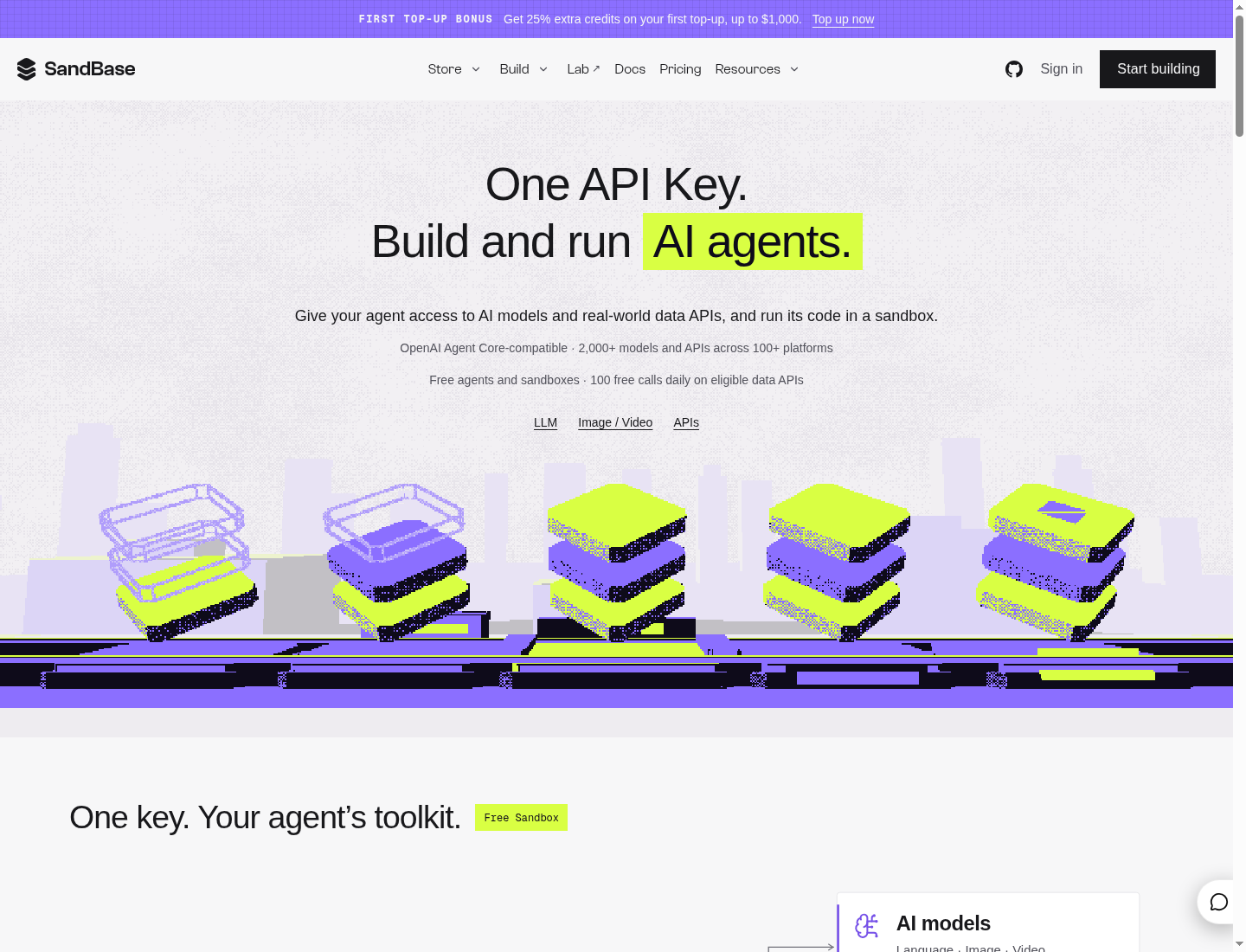 SandBase homepage — one API key for models, data APIs, and sandboxes, with free agents/sandboxes and 100 free eligible data calls daily.
Eligible data APIs share 100 free calls per organization per day, resetting at 00:00 UTC. Past that, you pay the listed price. Model calls are outside those 100. The homepage FAQ states that split. Discovery — catalog search, plus reading a schema and a price — is $0. A failed model or API call is not charged. The homepage’s illustrative call is POST /v1/api/twitter/web/search-timeline. Fields and price belong on the Twitter/X API page. This article did not send it.
The sandbox page is an E2B-compatible gateway on the same key: create, run, collect, stop. Its pricing answer says creating, running, and stopping do not touch the balance for now. Fair-use caps may apply. A price change is announced first. Models and APIs called from inside the sandbox still bill. Isolation, networking, and pause/resume depend on the provider and template. A working directory is not a security boundary. Which sandbox to keep is the sandbox comparison.
The homepage says agents run on OpenAgentCore through the OpenAI Agents API, with SandBase hosting that runtime. The compatibility doc limits the match to Agents, Sessions, events, items, turns, and Skills, so the official SDK can use https://api.sandbase.ai/v1 and a SandBase key. Inline MCP tools return 400; register the connection over HTTP. environment must be openai_hosted. self_hosted returns 400. multi_agent, computer use, and vaults are rejected. “Free agents and sandboxes” on the homepage sits beside the 100 free data calls and is not a second price list: model and API usage still leaves the balance, and an agent run is a trace of those calls. The split against OpenAI-hosted sandboxes and a self-hosted executor is the Agents API path.
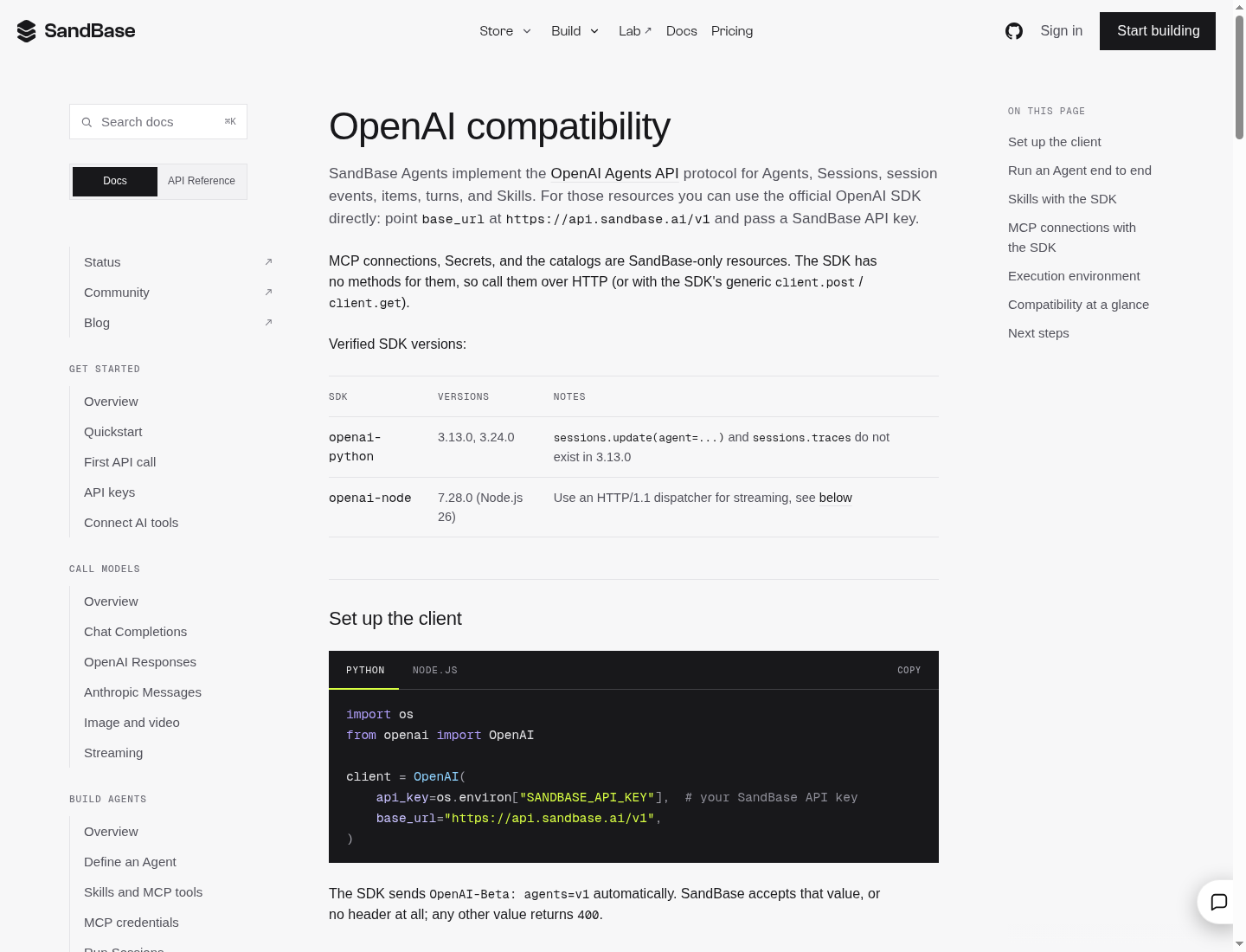 OpenAI Agents API compatibility docs — supported Agents/Sessions surface with
base_url https://api.sandbase.ai/v1.
Inside Claude Code, Cursor, or Codex, paste set up plus SKILL.md and approve the browser sign-in. That path is not a server-side key.
Pricing puts models, APIs, and runtimes on one balance: pay per call, no subscription. Start is $0 with starter credits. Build is metered. Scale is custom, with no dollar amount on the page. “No subscription” describes Build. Activities shows status and cost for model work, data APIs, and agent runs. When a subscription you already pay is the better buy, that arithmetic stays on the budget article.
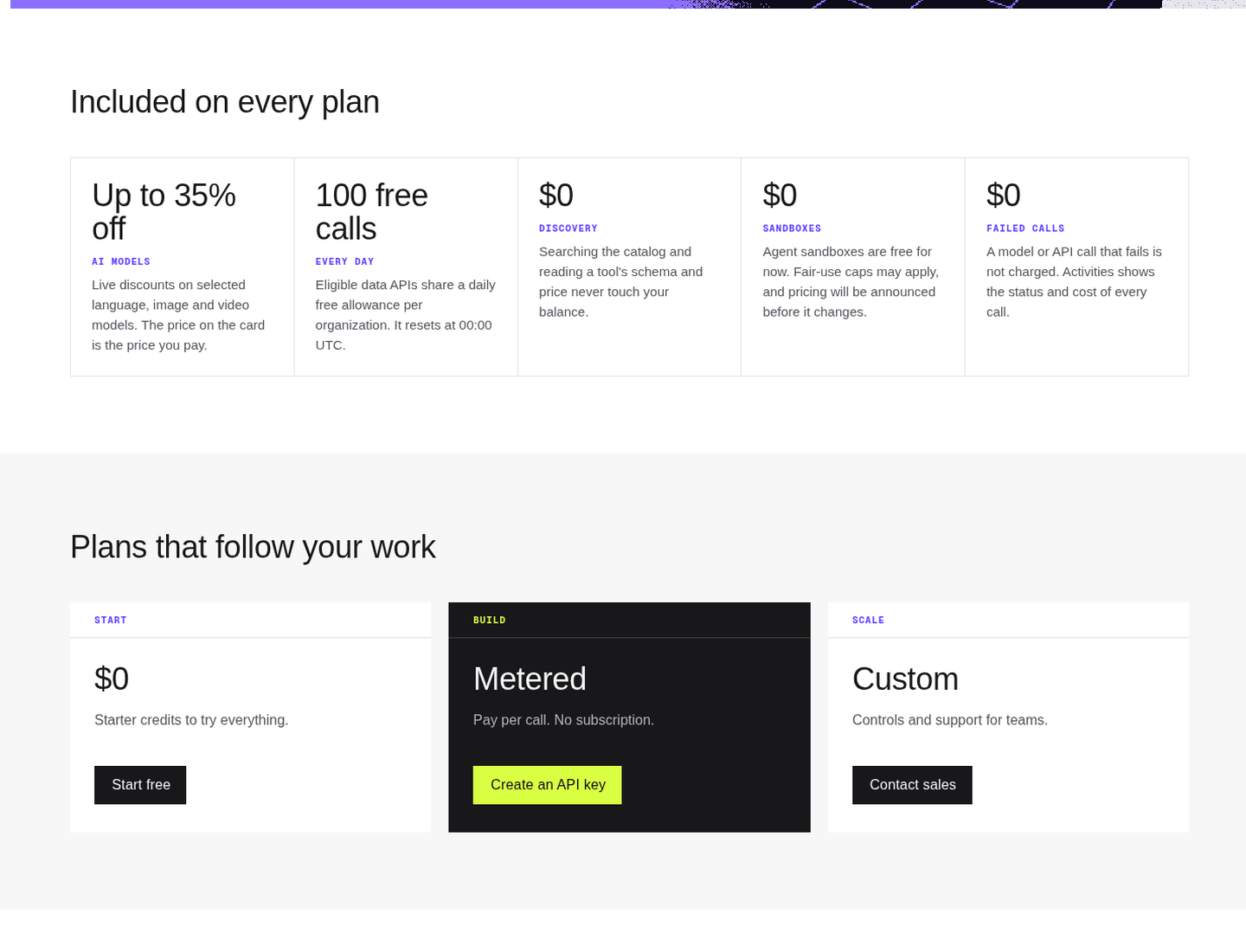 Pricing inclusions — 100 free eligible data calls/day, $0 Discovery, sandboxes free for now, failed calls $0, plus Build Metered (“Pay per call. No subscription.”).
SandBase beside the gateways
Cells record what each product’s own page described on 2026-11-08. N/A means that page did not describe the job. It is not a score, and it is not a promise the vendor will never ship it.
| Model routing | Priced data APIs | Sandbox | Agent host | Billing that day | Self-host | |
|---|---|---|---|---|---|---|
| OpenRouter | Managed. Paid plans: auto-routing, 600+ models | Tool calls pass through only | N/A | N/A | List price. 5.5% Standard / 8% Business on credits | No |
| LiteLLM | Self-hosted Router. Docs: 100+ LLMs | MCP/A2A for tools you connect | N/A | Agents you connect, on infra you run | Your provider bill, plus infra | Yes |
| Vercel AI Gateway | Managed same-model failover | N/A | N/A | N/A | No token markup or platform fee. Some add-ons cost extra | No |
| Portkey | Fallbacks and load balancing | N/A | N/A | Agents is listed. Not audited here | Developer free. Production $49/month | Yes |
| Cloudflare AI Gateway | Analytics, cache, rate limits | N/A | N/A | N/A | Core free. 5% on Unified Billing credits | No |
| Bearer Club | 69 models, one compatible key | Tool calls pass through | N/A | N/A | Guest $0. Member $199/year. Executive $1,999/year | No |
| SandBase | One key, OpenAI-shaped calls | Eligible APIs share 100 free calls per org per UTC day | E2B-compatible. $0 for now | Documented Agents API subset | Build: pay per call, no subscription | No |
SandBase is a poor fit when the proxy must stay on your network (LiteLLM), when the purchase is observability on model traffic you already have (Portkey), when the workload already sits on Cloudflare’s edge, or when the only pain is model access (OpenRouter or Bearer Club).
Which page to open
| Question | Open this |
|---|---|
| Which gateway or marketplace | OpenRouter alternatives |
| Self-host the proxy, or buy the marketplace | LiteLLM vs OpenRouter |
| How that proxy is shaped | LiteLLM explained |
| Google routing versus those two | Google Model Routing |
| Collapse models, data APIs, and a sandbox | One-key agent stack |
| Sandbox products, and “free for now” | Free E2B alternative |
| Token, per-call, and sandbox meters | Per-call budget |
| Agents API host versus OpenAI or your own executor | Compatible path |
FAQ
When is an OpenRouter-class AI API gateway not enough?
When the agent needs more than multi-model access. OpenRouter, LiteLLM, Vercel AI Gateway, Portkey, and Cloudflare AI Gateway give you an OpenAI-shaped model hop, routing or failover, and a model bill. LiteLLM and Portkey can also front MCP tools you connect. That stops being enough when the loop needs hosted data APIs with a schema and a price, a sandbox for generated code, or a managed Agents API under the same key and the same activity trail.
What are the best OpenRouter alternatives if I only need another model gateway?
Stay in the gateway category. LiteLLM when you must self-host and bring provider keys. Portkey when logs, guardrails, and gateway policy are the purchase. Vercel AI Gateway when you want managed failover and list-price tokens with no token markup. Cloudflare AI Gateway when the traffic is already on Cloudflare. OpenRouter when a broad managed catalog is the whole job. Bearer Club when the job is member pricing on its listed models. The longer guide is Best OpenRouter Alternatives (2026). The self-host split is LiteLLM vs OpenRouter.
When should I pick SandBase instead of, or beside, a model gateway?
When one key should cover models, catalog data APIs (read the schema and price first; eligible endpoints share 100 free calls per organization per UTC day), E2B-compatible sandboxes that are free for now, and the OpenAI Agents API resources the compatibility doc lists. Build bills that usage from one balance, pay per call, no subscription. Keep a pure gateway when you only route models, or when the proxy must run on your machines. Compose when both are true, and write down which traffic stays on the gateway. Consolidation is the one-key stack. The meters are the budget guide.
What to do after the decision
Create a key from the SandBase login. Open one model card and one data API page and read the price before you call either. If the loop runs code, follow the sandbox quickstart and treat “free for now” as the current price. Then open Activities and look for the model call, the API call, and the agent run on one trail. If that list is larger than the job, stop. A gateway you already trust is the right buy. Figures above were taken from those vendors’ public pages on 2026-11-08.