One-Key Agent Stack: An OpenRouter Alternative with a Sandbox
An OpenRouter alternative with a sandbox: one SandBase key for models, data APIs, and a free E2B-compatible sandbox, plus when to keep the separate vendors.
A research agent that searches live posts, drops duplicate rows, and writes a brief is three products before it is one loop. The model route is an OpenRouter-class gateway. The post search is a second key. The cleanup script needs an E2B-class sandbox. “OpenRouter or E2B” is the wrong question. They do different jobs. The question is how to get a model, a data API, and a code sandbox on one key, and when that is a bad trade.
SandBase is that stack: one API key for the model catalog, catalog data APIs, and an E2B-compatible sandbox, plus the OpenAI Agents API for a documented subset of resources. It is a poor swap for a self-hosted gateway, a GPU sandbox, or E2B plan limits this gateway does not claim to copy.
Key takeaway
- OpenRouter is a model gateway. E2B is a code sandbox. A data marketplace is a third bill.
- On 2026-11-07 one SandBase key covered models, catalog APIs, and sandboxes. Sandboxes were $0 for now. Eligible data APIs shared 100 free calls per organization per day. Build was metered, with no subscription.
- Keep OpenRouter for a model marketplace alone. Keep E2B for its Pro or Enterprise limits. The sandbox here is a gateway over a provider and a template.
- The code is the documented setup. This article did not execute it, and it reports no latency, bill, or success rate.
The stack most teams actually assemble
Three layers:
| Layer | What it does in the loop | What teams usually buy |
|---|---|---|
| Model gateway | One OpenAI-shaped client, many model IDs, one credit balance | OpenRouter, or a self-hosted proxy such as LiteLLM |
| Data / tool APIs | Search posts, catalogs, or the web, with a schema and a price | A marketplace or a pile of vendor keys |
| Code sandbox | Create a workspace, run a command, read a file, then stop it | E2B, or another agent sandbox |
OpenRouter’s FAQ, retrieved 2026-11-07, describes a unified LLM API with provider prices passed through. It does not describe a code sandbox or a data-API catalog. E2B’s billing docs describe per-second CPU and RAM while a sandbox runs. “OpenRouter vs E2B” mostly warns you that you will buy both, then still need the data layer.
For the gateway alone, read Best OpenRouter Alternatives (2026). For the sandbox alone, read Best AI Sandboxes for Agents in 2026. This page asks whether the three layers stay three vendors.
What breaks when the stack is three vendors
The failure is rarely a missing feature on day one. It is the glue.
Three keys, three failure modes. A 402 from OpenRouter, a 401 from the E2B key checked into the wrong CI project, and a data-vendor error the agent treats as an empty search. Each vendor is behaving. The loop cannot tell a billing problem from an empty topic.
The bill does not match one agent run. On 2026-11-07, OpenRouter charged 5.5% ($0.80 minimum) when you bought credits, and did not mark up inference. Crypto purchases were 5%. E2B Hobby was $0 per month plus a one-time $100 credit, 20 concurrent sandboxes, and a one-hour continuous runtime. Pro was $150 per month plus usage, 100 concurrent sandboxes, and a 24-hour continuous runtime. The pricing page billed running sandboxes at $0.000014 per vCPU-second and $0.0000045 per GiB-second. A data vendor sends a third invoice. Those are different units. They do not collapse into one monthly dollar figure without your token mix and your sandbox-seconds, which this article did not measure.
You maintain the loop. Tool schemas, sandbox create/kill, and the model base URL are your code. That glue rots: a hardcoded E2B host, a template name from the other account, a retry that fires the data call twice. Moving the base URL does not delete it. It stops you from keeping three accounts in sync.
What one SandBase key actually unlocks
The homepage, docs, pricing page, and sandbox docs agreed on four surfaces on 2026-11-07. They did not agree on every price detail, so the claims below stay attached to the page that stated them.
Models and APIs. The homepage and SKILL.md (version 0.3.9 that day) both say “2,000+ models and APIs across 100+ platforms.” That is the site’s wording, not an independent count. Discovery is free. The card price is the price you pay, and selected cards showed a live discount up to 35% off. One checked card, Claude Sonnet 5.5, was $1.70 / $8.50 per 1M tokens, 15% under a $2 / $10 list, with a 1M context window. Discounts move.
Data APIs, with a daily free pool. Eligible data APIs share 100 free calls per organization per day, resetting at 00:00 UTC. Past that, you pay the listed price. Model calls are outside the 100. The homepage’s illustrative step is a POST to /v1/api/twitter/web/search-timeline. Confirm fields and price on the Twitter/X API catalog. There is no sample response body here, because this article did not run the call.
Sandboxes, E2B SDK, same key. The sandbox page calls it an E2B-compatible gateway: create a workspace, run commands, collect files, stop it. Creating, running, and stopping does not touch the balance for now. Fair-use caps may apply, and pricing will be announced before it changes. Model and API calls are still billed. Isolation, networking, and pause/resume depend on the provider and template. A working directory is not a security boundary. The quickstart targets E2B SDK 2.51.0 and says to set both E2B_API_URL and E2B_DOMAIN. The domain alone makes 2.51.0 invent an extra api. host. Do not assume the upstream template name base exists. List templates and pick buildStatus: "ready".
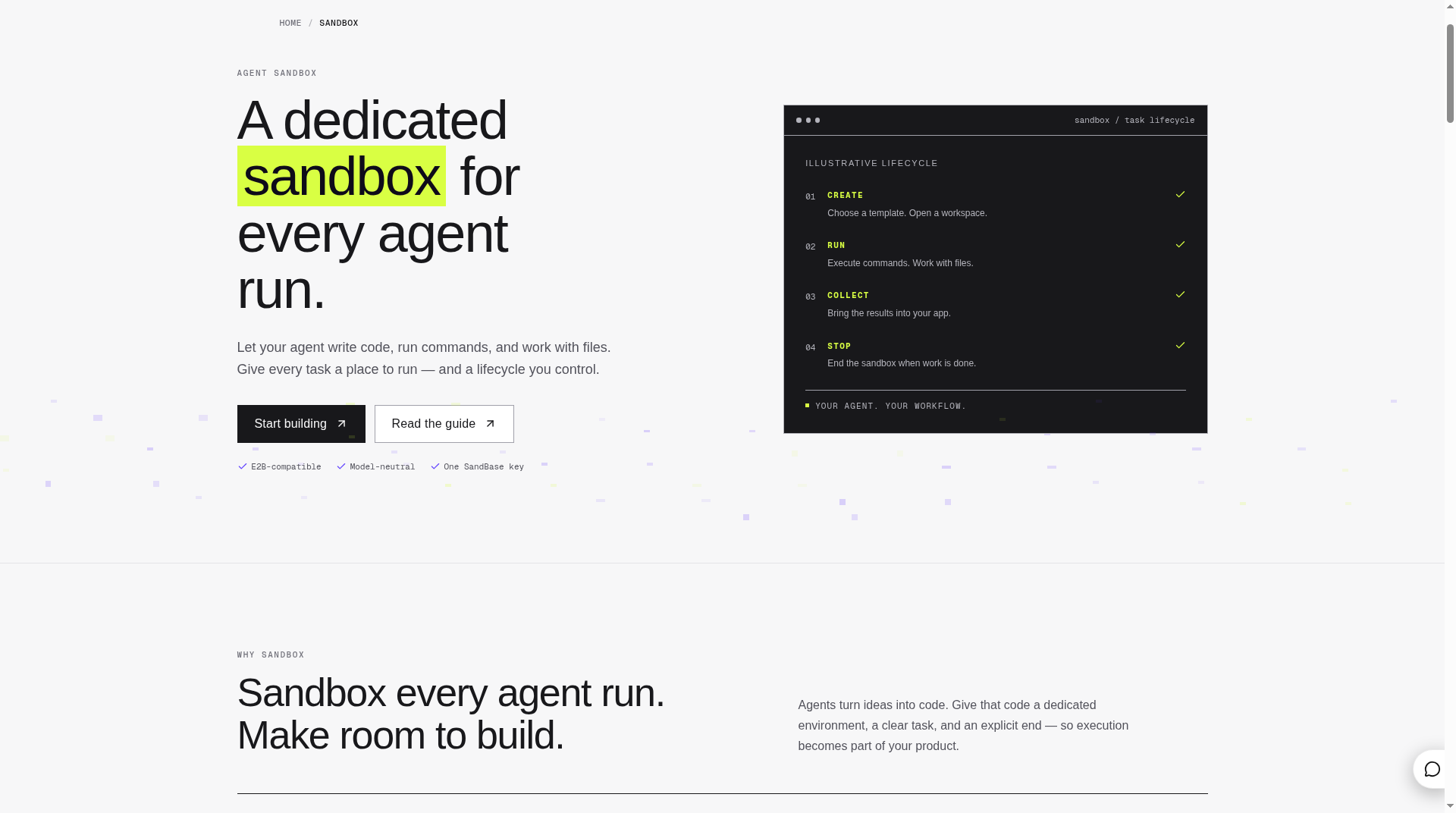 SandBase sandbox page: E2B-compatible, one SandBase key, and an illustrative create, run, collect, and stop lifecycle.
Managed agents, with a rejection list. Build Agent stores a versioned model, instructions, Skills, and MCP connections. A Session runs one version. The OpenAI compatibility guide says Agents, Sessions, events, items, turns, and Skills follow the OpenAI Agents API, so the official SDK can set base_url to https://api.sandbase.ai/v1. Inline MCP tools return 400. environment must be openai_hosted. multi_agent, computer use, and vaults are rejected. MCP connections and Secrets are HTTP, not SDK methods. The homepage says SandBase hosts the OpenAgentCore runtime. That is the agent service, not a claim that SandBase trains anyone else’s model.
The coding-tools page is the Claude Code, Codex, and Cursor door. The open-source page is the SDK, CLI, and examples. Use those for discovery inside an assistant. Use the snippets below when the loop lives in your service.
SandBase beside OpenRouter, E2B, and a data marketplace
Prices in this table are what those vendors published on 2026-11-07.
| Need | OpenRouter + E2B + a data vendor | SandBase, as published 2026-11-07 |
|---|---|---|
| Model access | OpenRouter unified LLM API. Inference at provider prices. 5.5% fee ($0.80 minimum) on credit purchases | One key. Card price, with selected discounts up to 35%. Sonnet 5.5 card: $1.70 / $8.50 per 1M |
| Data APIs | Separate marketplace or vendor keys. No shared daily pool is claimed here | Catalog APIs on the same key. 100 free eligible calls per org per day, reset 00:00 UTC. Model calls excluded |
| Code execution | E2B. Hobby $0/month, one-time $100 credit, 20 concurrent, 1 hour continuous. Pro $150/month plus per-second CPU and RAM. Pricing page: CPU-only, no GPU sandboxes | E2B-compatible gateway. Sandboxes $0 for now, fair-use, price announced before any change. Provider and template decide isolation |
| Managed agent host | Your process, or another product | OpenAI Agents API for the resources listed above. No self-hosted session environment |
| How the bill looks | OpenRouter credits, an E2B plan plus usage, and data-vendor invoices | One balance. Build is pay per call, no subscription. Start is $0 with starter credits. Scale is custom |
When to keep OpenRouter or E2B
Stay on OpenRouter when a managed LLM marketplace is the whole job. Stay on E2B when you need E2B’s own limits: Pro’s 100 concurrent sandboxes and 24-hour continuous runtime are on the billing page, and the SandBase sandbox page does not republish them. The E2B pricing page said sandboxes are CPU-only and that Enterprise usage had a $3,000 monthly minimum. The billing doc listed Enterprise as custom and did not restate that minimum. Neither page offered a GPU sandbox on 2026-11-07. Stay on self-hosted LiteLLM when the gateway, the provider keys, and the logs must stay on your network.
Also hold off if the template is missing from your org, if you need pause/resume or a network policy the provider does not support, or if you need self_hosted sessions, inline MCP tools, computer use, multi-agent, vaults, template builds, or snapshots. Several of those return 400. Installing the SDK is not provider parity.
A first run, without a fake benchmark
The homepage labels its sample job as illustrative. Checked on 2026-11-07: the docs and catalog pages, not a timed run.
Create the key and keep it on the server. Read the data API schema first. For the X example, POST with the SandBase key and read only outputs[0].data. Fail if that field is missing. Do not invent pagination a live response never showed. Point the E2B SDK at SandBase, run a command you can check, and kill the sandbox in finally. A timed-out create can still leave an instance. For a hosted loop, use openai-python 3.13.0 or 3.24.0, or openai-node 7.28.0. Open the event stream before input. On Node, force HTTP/1.1 or a shared HTTP/2 connection can stall.
Environment for the official E2B SDK:
export E2B_API_URL="https://sandbox.sandbase.ai"
export E2B_DOMAIN="sandbox.sandbase.ai"
export E2B_DEBUG="false"
unset E2B_SANDBOX_URL
export E2B_API_KEY="$SANDBASE_API_KEY"
Install the pin from the quickstart, e2b==2.51.0, list templates, and export SANDBASE_TEMPLATE_ID. This Python file follows that quickstart: two-minute lifetime, an explicit kill, no logging of the SDK object.
import os
import sys
import uuid
from e2b import Sandbox

options = {"request_timeout": 30}
template = os.environ["SANDBASE_TEMPLATE_ID"]
run_id = str(uuid.uuid4())
sandbox = None
failed = False

print("Run ID:", run_id)
try:
    sandbox = Sandbox.create(
        template,
        timeout=120,
        metadata={"quickstartRunId": run_id},
        **options,
    )
    result = sandbox.commands.run("printf hello-sandbase", timeout=15)
    if result.exit_code != 0 or result.stdout != "hello-sandbase":
        raise RuntimeError("Command verification failed")
    print("Sandbox ID:", sandbox.sandbox_id)
except Exception:
    print("Sandbox example failed; retain the run ID")
    failed = True
finally:
    if sandbox is not None:
        try:
            Sandbox.kill(sandbox.sandbox_id, **options)
        except Exception:
            print("Cleanup failed; delete the recorded Sandbox ID")
            failed = True

sys.exit(1 if failed else 0)
The agent client is the compatibility guide’s setup. The model id is the one in that guide, DeepSeek V4 Flash. Creating the agent does not run it. You still open a Session, and the SDK requires environment={"type": "openai_hosted"} even though SandBase only runs its hosted cloud.
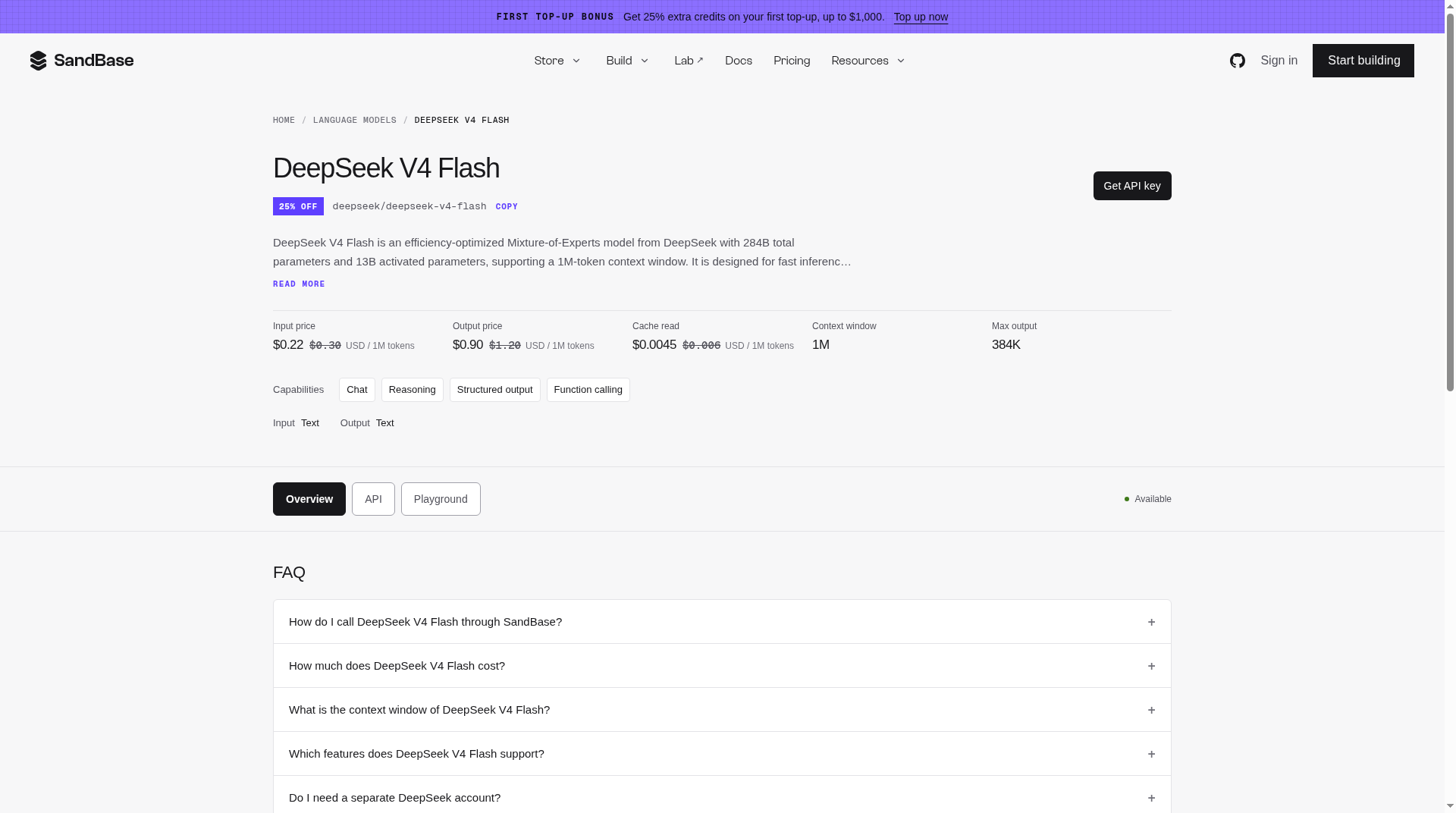 DeepSeek V4 Flash model card on SandBase, the Agents API example model linked from this article.
import os
from openai import OpenAI

client = OpenAI(
    api_key=os.environ["SANDBASE_API_KEY"],
    base_url="https://api.sandbase.ai/v1",
)

agent = client.beta.agents.create(
    model="deepseek/deepseek-v4-flash",
    name="Research assistant",
    instructions="Keep output brief.",
)
print(agent.id)
For the data call, the homepage’s illustrative request was:
curl --fail-with-body \
  -X POST "https://api.sandbase.ai/v1/api/twitter/web/search-timeline" \
  -H "Authorization: Bearer $SANDBASE_API_KEY" \
  -H "Content-Type: application/json" \
  -d '{"keyword": "AI agents", "search_type": "Top"}'
Confirm keyword and search_type on the API page the day you ship. A homepage example can lag a schema change. If you would rather not own this loop yet, paste set up plus the SKILL.md address into Claude Code, Codex, or Cursor, and approve the browser sign-in. That path is for discovery inside the coding tool. It is not a substitute for server-side keys in your product.
A hands-on sibling, with a recorded X / YouTube / search run rather than this comparison, is Build a Personal Research Assistant with X, YouTube, Exa and Firecrawl.
Pricing on the Build plan
Pricing, retrieved 2026-11-07: Start is $0 with starter credits, Build is pay per call with no subscription, and Scale is custom. “No subscription” is a Build fact, not a Scale fact.
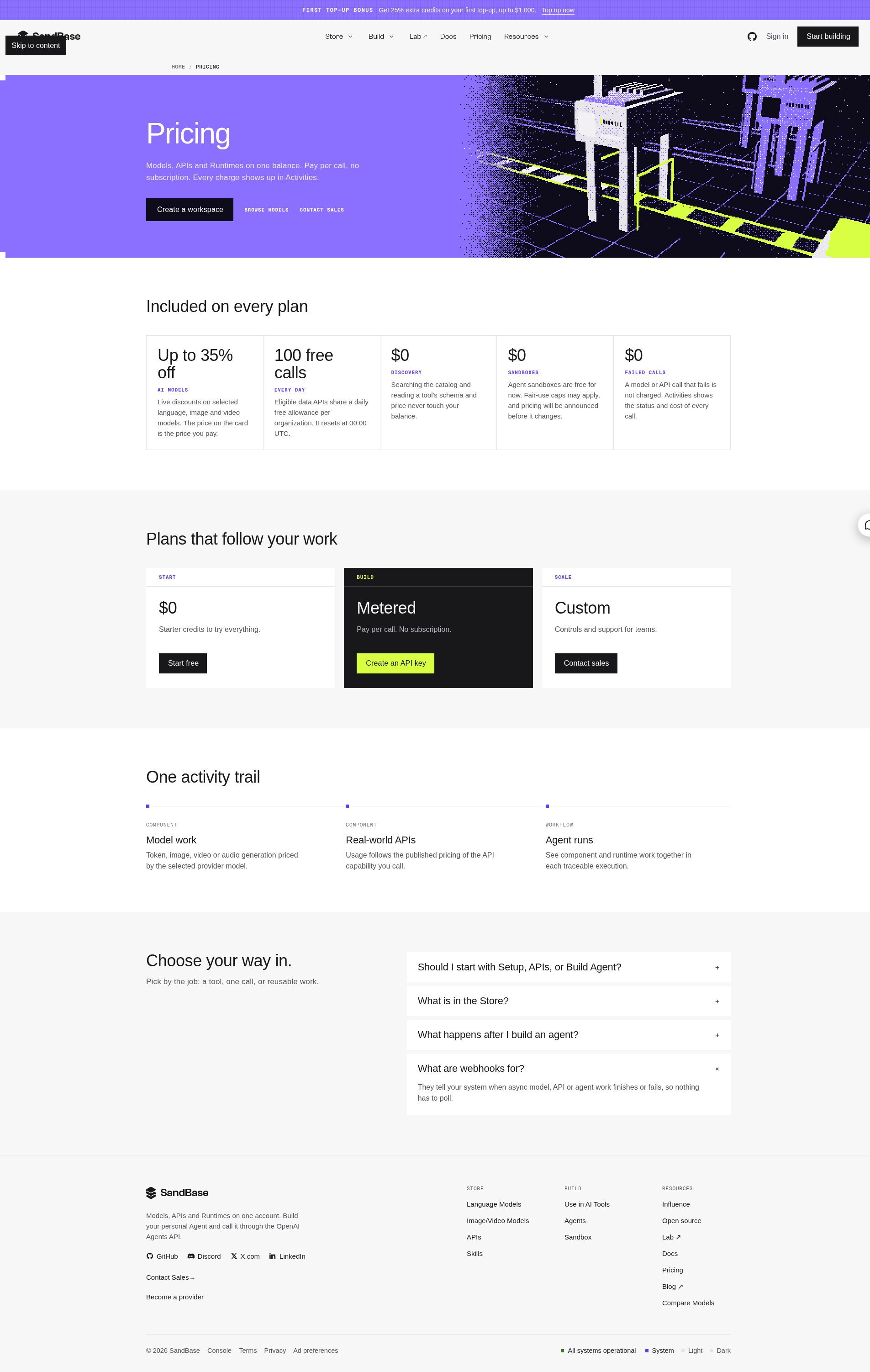 SandBase pricing page on 2026-11-08: Start, Build, and Scale, with 100 free eligible data-API calls per day and sandboxes listed as free for now.
On every plan that day: up to 35% off selected models, card price as the price you pay, 100 free eligible data-API calls per organization per day resetting at 00:00 UTC, discovery at $0, sandboxes at $0 for now, and failed model or API calls not charged. Activities shows status and cost. An agent trace groups those component calls. It is not a separate quoted unit price. Subtracting OpenRouter’s 5.5% and E2B’s $150 from a hypothetical month would be fiction without your token mix and sandbox-seconds.
FAQ
What is the simplest way to get models, data APIs, and a code sandbox under one key?
Use one key for all three. On SandBase that key calls the catalog, opens sandboxes with the E2B SDK pointed at sandbox.sandbase.ai, and can create Agents API agents inside the compatibility list above. Build is pay per call, no subscription. Read the card price first.
Is this an OpenRouter alternative, an E2B alternative, or both?
Both layers, plus data APIs. Buy OpenRouter alone for a model marketplace. Buy E2B alone for a sandbox with E2B’s plan limits. Move when you are tired of holding those plus a data vendor.
How does the price compare with a gateway plus a sandbox?
Build has no subscription. On 2026-11-07 sandboxes were $0 for now, eligible data APIs included 100 free calls per organization per day, failed calls were free, and discovery was free. OpenRouter’s published fee was on buying credits. E2B’s was a plan plus per-second CPU and RAM. Recheck pricing the week you decide.
Can existing E2B code stay?
For quickstart operations, if the app already reads the host from the environment and the template exists on SandBase. Change the key, E2B_API_URL, and E2B_DOMAIN. Delete hardcoded hosts. List templates instead of assuming base. A successful create does not prove every provider feature.
Does one key replace an Anthropic or OpenAI account?
For a listed model, the catalog says you call it with the SandBase key and skip a separate lab signup. You still use SandBase’s hosted path. You do not get that lab’s console, or the OpenAI features the compatibility table rejects.
Key takeaway
Consolidate when the pain is three accounts and SandBase’s published limits cover the run: card-priced models, 100 free eligible data-API calls per organization per day, E2B SDK 2.51.0 against sandbox.sandbase.ai, and an Agents API with a rejection list. Keep OpenRouter for a pure model marketplace, E2B for its Pro or Enterprise limits, and a self-hosted gateway when prompts cannot leave your network.
Create the key from the SandBase login. Run the quickstart before you port a production loop. The snippets are the docs, not a measured run.