Free E2B Alternative for AI Agents: SandBase vs E2B, Daytona, and Blaxel
A free E2B alternative for AI agents: SandBase runs E2B-compatible sandboxes free for now on the same key as models and data APIs. See when E2B, Daytona, or Blaxel fits.
If you already call Sandbox.create from the E2B SDK, a free E2B alternative is a config change, not a rewrite, and only when the replacement still speaks that SDK. On 2026-11-07, SandBase documented an E2B-compatible sandbox gateway that is free for now: creating, running, and stopping a sandbox does not touch the SandBase balance. Fair-use caps may apply, and no numeric cap was published. Models and data APIs on that same key are billed as usual. Keep E2B when you need its plan limits, Firecracker isolation, or Enterprise BYOC. Keep Daytona when you need a documented GPU or Windows sandbox. Keep Blaxel when idle time should stop compute billing and resume from standby.
Key takeaway
- A free E2B alternative, here, means the official E2B SDK pointed at SandBase, not a second sandbox SDK.
- Sandboxes are free for now. The sandbox page says fair-use caps may apply and that pricing will be announced before it changes. It does not publish the cap.
- Model and data API calls on the same key are billed. This article did not run a sandbox, and it has no screenshot of an unchanged balance.
- E2B, Daytona, and Blaxel stay the better fit for published plan limits, GPUs, Windows, or standby billing. SandBase does not claim those.
Choose by the job
The older roundup, Best AI Sandboxes for Agents in 2026, maps the category. This page answers a narrower question: can the E2B SDK stay, and can the sandbox be free for now on the same key as the model?
| If you need | Start with | Why, from pages checked 2026-11-07 |
|---|---|---|
| The E2B SDK, and sandbox create/run/stop at $0 for now | SandBase | E2B-compatible gateway. One SandBase key. Models and data APIs bill separately |
| Hobby or Pro limits, Firecracker microVMs, or Enterprise BYOC | E2B | Published plan table, per-second CPU and RAM, Apache-2.0 runtime, SOC 2 Type II |
| A documented GPU or Windows sandbox | Daytona | GPU and Windows docs, plus per-second compute and $200 free compute on the pricing page |
| Compute that stops when the sandbox is idle, with standby storage | Blaxel | Active RAM-seconds, snapshot storage while standby, up to $200 in credits |
| The model, the data API, and the sandbox on one bill | SandBase, then read the stack piece | One-Key Agent Stack |
Why people search for a free E2B alternative
E2B’s billing page, retrieved 2026-11-07, is usage-based. New users get $100 in free credits. Hobby is $0 per month, 20 concurrent sandboxes, and a one-hour maximum continuous runtime. Pro is $150 per month and does not add credits. It raises the ceiling: 100 concurrent sandboxes, expandable with add-ons, and 24 hours of continuous runtime. Continuous runtime is how long a sandbox can run without being paused, not how long it can exist. Pausing resets that clock. You pay per second while a sandbox is running.
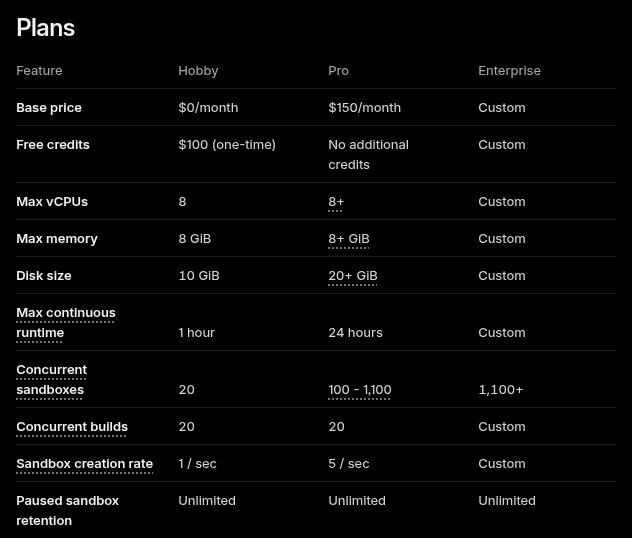 E2B docs billing table comparing Hobby and Pro plans (checked 2026-11-08). The pricing page that day listed Hobby and Pro CPU at $0.000014 per vCPU-second for 1 vCPU, and memory at $0.0000045 per GiB-second for 1 GiB. Its default column marked 2 vCPU and 4 GiB. The billing FAQ separately says to start from 2 vCPU and 512 MiB. Those two pages do not describe the same default. Use the calculator on the pricing page for a quote.
The credit is the part that runs out. After it, a sandbox bill sits next to the model bill and the data-API bill. That split is the actual annoyance. A gateway comparison does not fix it, and a sandbox-only roundup does not either.
What the SandBase sandbox is
The sandbox page calls it an E2B-compatible gateway. Your app creates a workspace, runs commands, collects files, and stops the sandbox. The lifecycle on the page is create, run, collect, stop. Pause and resume exist where the selected provider supports them. SandBase does not publish a continuous-runtime hour or a concurrency cap for that gateway. Do not copy E2B’s 1 hour or 20 concurrent sandboxes onto it.
Pricing, in the sandbox FAQ: sandboxes are free for now. Creating, running, and stopping them does not touch the SandBase balance. Fair-use caps may apply. Pricing will be announced before it changes. Models and APIs the agent calls are billed as usual. The same sentence is the whole free claim. There is no balance screenshot in this article, so “does not touch the balance” is the vendor’s statement, not a run recorded for this article.
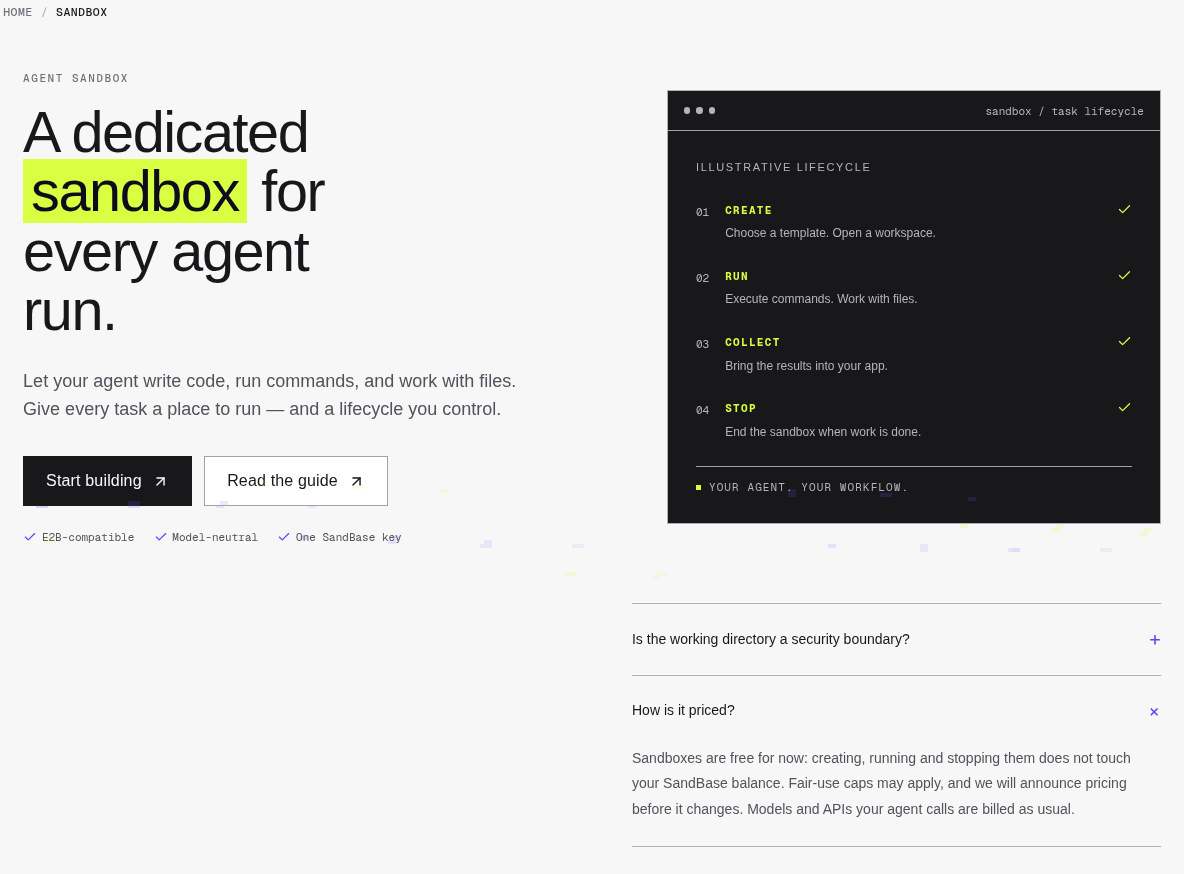 SandBase sandbox product page showing E2B-compatible badges and free-for-now pricing FAQ.
Isolation, networking, and persistence depend on the selected provider and template. A working directory is not a security boundary. The page says to check the provider’s runtime, networking, template permissions, and data handling before a sensitive workload. unsupported_operation in the quickstart means that provider does not support the call. Installing the SDK does not prove every E2B feature.
The same SandBase key is what the pricing page uses for models and data APIs. Sandbox execution is separate from model choice. A model such as DeepSeek V4 Flash is called on the model API. The sandbox only runs the command you send it. Agents is the managed-agent surface, not the sandbox runtime.
The smallest E2B SDK change
The quickstart targets E2B JavaScript and Python SDK 2.51.0. It says existing code can stay when the app already reads connection settings from the environment and the template exists for your organization. Hardcoded hosts win over environment variables, so those have to go. Set both URL and domain. SDK 2.51.0, given only a domain, adds an api. prefix and misses the host. Leave E2B_SANDBOX_URL unset. Keep E2B_DEBUG false.
export E2B_API_URL="https://sandbox.sandbase.ai"
export E2B_DOMAIN="sandbox.sandbase.ai"
export E2B_DEBUG="false"
unset E2B_SANDBOX_URL
export E2B_API_KEY="$SANDBASE_API_KEY"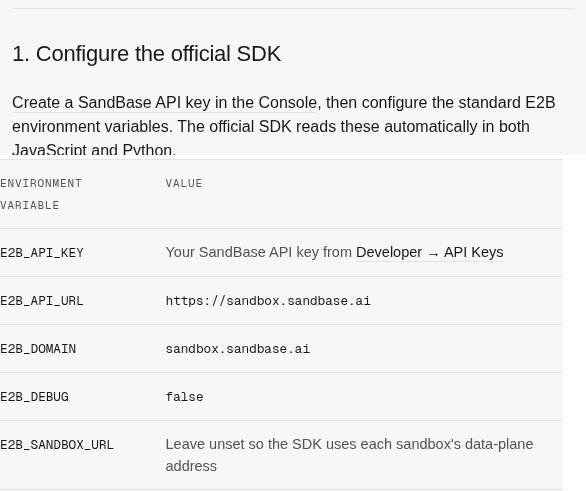 Official SandBase sandbox quickstart environment variables for the E2B SDK.
Do not assume the upstream template name base. List templates with the SandBase key and pick one whose buildStatus is ready. SANDBASE_TEMPLATE_ID is only a name the quickstart uses. It is not an E2B setting.
curl --fail --silent --show-error 'https://sandbox.sandbase.ai/v2/templates?limit=100' \
  -H "X-API-Key: $E2B_API_KEY"
The Python below is the quickstart’s create, check, and kill pattern, pinned to e2b==2.51.0. It creates a real sandbox if you run it. This article did not run it. A create that times out can still leave an instance. Keep the run id. Do not log the SDK object.
import os
import sys
import uuid
from e2b import Sandbox

options = {"request_timeout": 30}
template = os.environ["SANDBASE_TEMPLATE_ID"]
run_id = str(uuid.uuid4())
sandbox = None
failed = False

print("Run ID:", run_id)
try:
    sandbox = Sandbox.create(
        template,
        timeout=120,
        metadata={"quickstartRunId": run_id},
        **options,
    )
    result = sandbox.commands.run("printf hello-sandbase", timeout=15)
    if result.exit_code != 0 or result.stdout != "hello-sandbase":
        raise RuntimeError("Command verification failed")
    print("Sandbox ID:", sandbox.sandbox_id)
except Exception:
    print("Sandbox example failed; retain the run ID")
    failed = True
finally:
    if sandbox is not None:
        try:
            Sandbox.kill(sandbox.sandbox_id, **options)
        except Exception:
            print("Cleanup failed; delete the recorded Sandbox ID")
            failed = True

sys.exit(1 if failed else 0)
Pause and reconnect are in the same quickstart, and only where the provider supports them. A successful create does not prove pause, ports, or snapshots.
SandBase, E2B, Daytona, and Blaxel
Checked 2026-11-07. Empty cells are “not published on the page cited,” not a hidden no.
| SandBase sandbox | E2B | Daytona | Blaxel | |
|---|---|---|---|---|
| How you pay | Sandbox lifecycle $0 for now. Models and data APIs billed | Per second while running, plus a plan | Per second for reserved resources | Active RAM-seconds. Standby pays snapshot storage |
| Free start | Free for now. Fair-use may apply. No cap number published | $100 one-time credits. Hobby is $0/month | $200 free compute on the pricing page. No card required for the trial | Up to $200 in credits |
| E2B SDK | Documented for SDK 2.51.0 if the template exists | The vendor’s own SDK | Not claimed in the pages read here | Not claimed in the pages read here |
| Session shape | Timeout you set. Pause only where supported. No published hour cap | Hobby 1 hour continuous. Pro 24 hours. Pause resets the clock | Started sandboxes bill CPU, RAM, and disk. Stopped or paused VM billing is disk, per the billing doc | Active while connected. Standby after idle. Their docs say resume in under 25 ms |
| GPU | Not offered on the sandbox page | No GPU rate on the pricing page checked | Linux GPU sandboxes, ephemeral, types listed in the GPU doc | Not part of this check |
| Windows | Not offered on the sandbox page | Not part of this check | Documented. Tier 3 and higher | Not part of this check |
| Run it yourself | Not a self-host offer. Provider and template sit under the gateway | E2B Embed, Apache-2.0, one machine. Enterprise BYOC on AWS, GCP, or Azure | Pricing page lists Enterprise BYOC | Not part of this check |
| Same key for models and data APIs | Yes | No. E2B is the sandbox | No | No |
E2B is the reference implementation of this SDK. The enterprise page says each session is its own Firecracker microVM, and the company states SOC 2 Type II. BYOC is Enterprise, and the BYOC doc is explicit that it is not self-hosting: E2B operates the cluster in your VPC. Self-hosting is E2B Embed on one machine you operate. If the security review needs that runtime, or you need the published Hobby and Pro ceilings, stay on E2B. SandBase’s compatibility note does not transfer those ceilings.
Daytona, on its pricing page, bills per second and includes $200 of free compute. The same page lists compute at $0.0504 per vCPU-hour, memory at $0.0162 per GiB-hour, and storage at $0.000108 per GiB-hour. Windows is listed at $0.0858 per vCPU-hour. The Windows doc says each Windows sandbox has its own kernel, and that Windows is for Tier 3 and higher. The GPU doc describes Linux GPU sandboxes that are deleted when they stop. A separate host, daytona.com/pricing, was also HTTP 200 that day and presents a different plan table. This article quotes daytona.io and the docs linked above, not a blend of the two. Enterprise on the io pricing page includes larger limits, SSO, audit logs, or BYOC.
Blaxel, on its pricing page, charges active sandbox CPU by allocated memory at $0.0000115 per GB-RAM-second, and snapshot storage at $0.20 per GB-month. Standby is not charged as compute. The sandbox docs say a sandbox without an active connection moves to standby in about 15 seconds, and that reconnect restores it in under 25 ms. That 25 ms figure is Blaxel’s published number, not a measurement from this article. Credits on the pricing page go up to $200.
Modal, Vercel Sandbox, and Cloudflare also host agent execution. This article does not price them. Self-hosted sandboxes are a different job: you operate the machine.
When SandBase is the wrong sandbox
Skip it when the requirement is a GPU. The SandBase sandbox page does not offer one. Daytona documents GPU sandboxes.
Skip it when you need Windows. The SandBase page does not offer Windows sandboxes. Daytona’s Windows doc does.
Skip it when the sandbox must run in your VPC or on a machine you patch. E2B documents Embed and Enterprise BYOC. SandBase documents a hosted gateway over a provider and a template.
Skip it when you need a number E2B prints and SandBase does not: 20 or 100 concurrent sandboxes, a 1-hour or 24-hour continuous runtime, a Firecracker kernel per session, or a SOC 2 report for the sandbox runtime. None of those appear on the SandBase sandbox page.
Skip it when pause, a network policy, or a port must work and you have not checked the template. The quickstart tells you to treat unsupported_operation as a provider limit.
And skip the “free” reading if the cost you care about is the model. A free sandbox with a billed model call is still a billed run.
FAQ
What is a free E2B alternative if I want to keep the SDK?
SandBase, on the pages above: an E2B-compatible gateway, free for now for create, run, and stop, on the same key as models and data APIs. Fair-use caps may apply, and the cap is not a published number. GPUs, self-hosting, and long published session limits point back to E2B, Daytona, or Blaxel.
Can the E2B SDK talk to SandBase?
Yes, for the quickstart’s supported operations, with SDK 2.51.0, both E2B_API_URL and E2B_DOMAIN set to sandbox.sandbase.ai, and a template your organization can see. Isolation, networking, and persistence still depend on the provider and template.
Is the sandbox actually free?
The sandbox FAQ says creating, running, and stopping does not touch the SandBase balance for now, fair-use caps may apply, and pricing will be announced before a change. Models and APIs are billed as usual. This article does not include a balance screenshot.
Is the working directory a security boundary?
No. The sandbox page says a directory path or a prompt does not enforce isolation. Read the provider’s runtime, networking, template permissions, and data handling.
Does one key replace an E2B account and a model account?
For the sandbox and for models SandBase lists, the documented path is one SandBase key. You still do not get E2B’s plan limits or E2B’s cloud account by changing the base URL.
Key takeaway
Point the E2B SDK at SandBase when you want the same create/run/kill calls, a sandbox that the vendor prices at $0 for now, and the model and data APIs on that key. Read the quickstart before you delete the old host. Stay on E2B for its published limits and isolation story, on Daytona for GPU or Windows, and on Blaxel when standby pricing is the point. The code above is the documented pattern. It is not a measured run. For an Agents API Session rather than the E2B SDK, see OpenAI Agents API Compatible Platform.