OpenAI AI Research Intern: Tasks, Costs and Human Oversight
What can OpenAI’s AI research intern do? Read the runtime, API-valued usage and intervention data, then use a bounded research assignment to measure useful work.
One researcher’s working day now accompanies about 3.1 days of agent runtime inside OpenAI’s research organization. That is the arresting number in its new RSI disclosure—and the easiest one to misread. It measures accumulated running time, not a threefold increase in scientific discoveries.
As of September 7, two newly circulated OpenAI articles put that distinction into focus. Research acceleration: The view inside OpenAI describes how agents work inside the lab. Chief scientist Jakub Pachocki’s An Alien Mind asks whether our ability to understand and control increasingly capable systems can keep up.
For researchers and engineering leads deciding what to delegate, the useful question is what counts as completed work and how much review it takes. “Research intern” names an internal capability milestone, not a public API model or subscription tier. The figures below describe OpenAI’s research organization, not a service an outside team can buy under that name.
Key takeaway
- OpenAI says it has reached its automated research intern milestone: agents can perform well-defined research tasks under human direction.
- The 3.1 agent-workday ratio measures runtime, not equivalent-quality output or a measured increase in model intelligence.
- More than half of successful tasks estimated to take a human 4–8 hours still involved intervention in the period OpenAI studied.
- Both articles discuss keeping people in control; the research disclosure also explicitly considers slowing or stopping unsafe development.
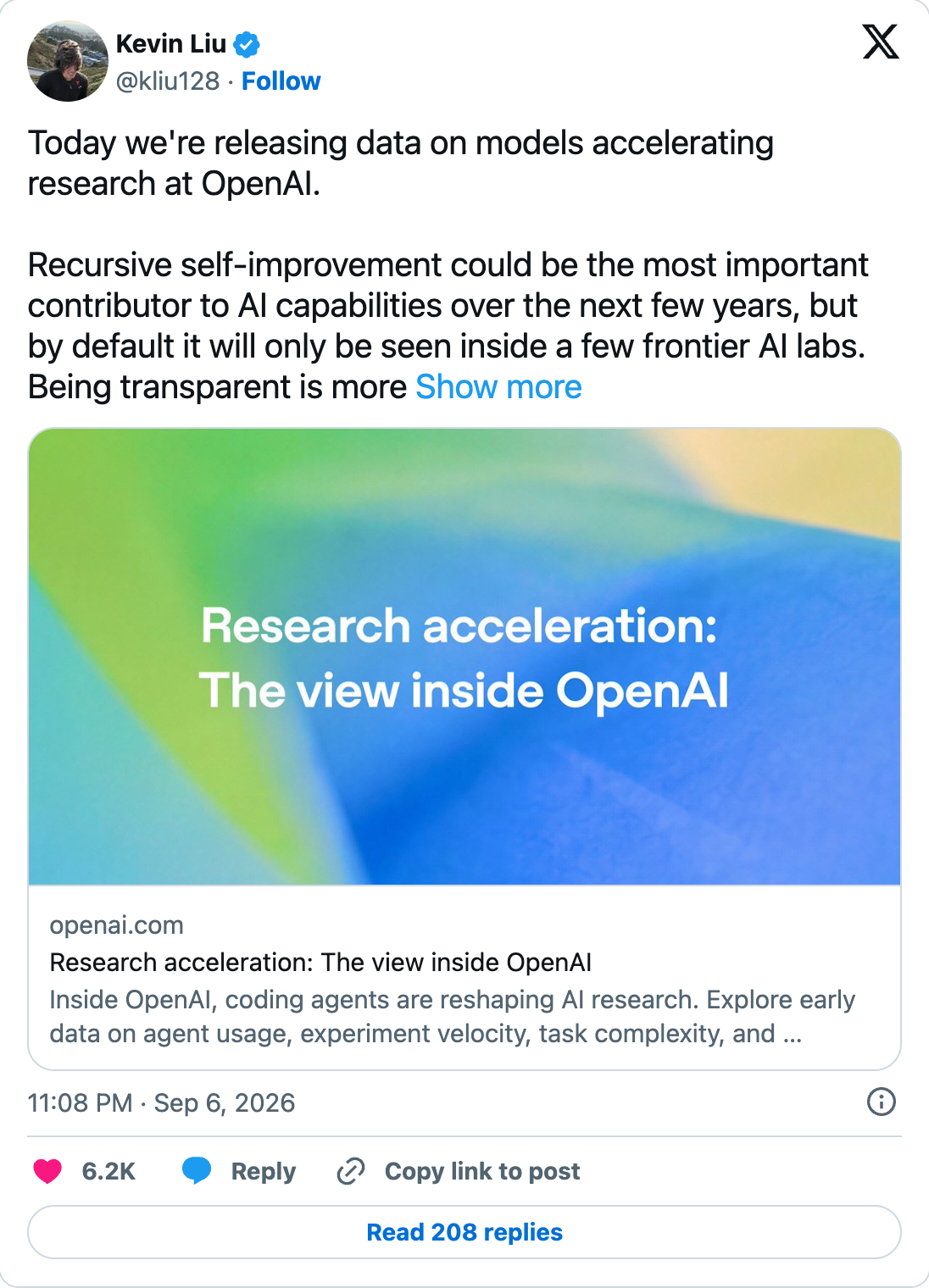
Kevin Liu introduces OpenAI’s research-acceleration disclosure. Excerpt from the original English X post.
1. What the AI research intern can be assigned
Last fall, Sam Altman set a target: an automated AI research intern by September 2026, followed by an automated AI researcher by March 2028. OpenAI now says its measurements support the first milestone.
Its definition matters. A research intern can carry out well-defined tasks under human direction, including work that would take a skilled researcher several days. This is not a claim that a model independently chooses a research program and delivers the next generation of AI.
The company reports a substantial change in daily practice. Before June, total agent runtime across the research organization remained below total human labor time. By mid-August, it reached roughly 3.1 agent-workdays per human workday, calculated using an eight-hour day.
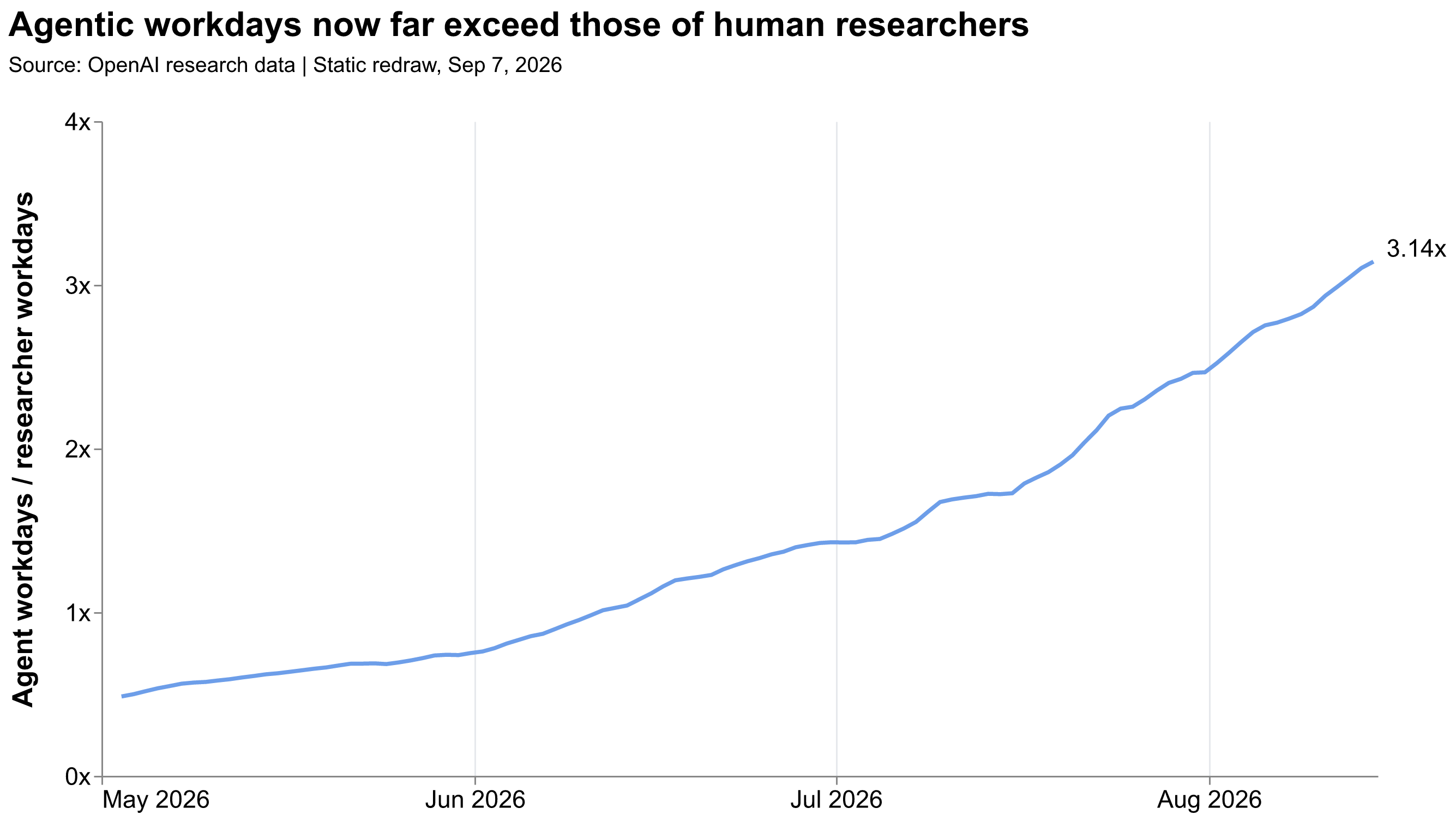
Agent runtime relative to human labor, using eight-hour workdays. Static redraw from OpenAI’s official chart data.
Several agents can run while one person works. Their combined hours therefore need not fit inside that person’s day. The number demonstrates growing use of parallel execution; it does not tell us how much of that execution produced a useful result.
2. Inference spending and concurrent use
By mid-August, the median researcher by agent usage consumed more than $600 of inference per day at API prices. The 90th-percentile user exceeded $7,000 per day. These are price-based valuations of internal usage—not personal bills, and not a disclosure of OpenAI’s actual marginal operating costs.
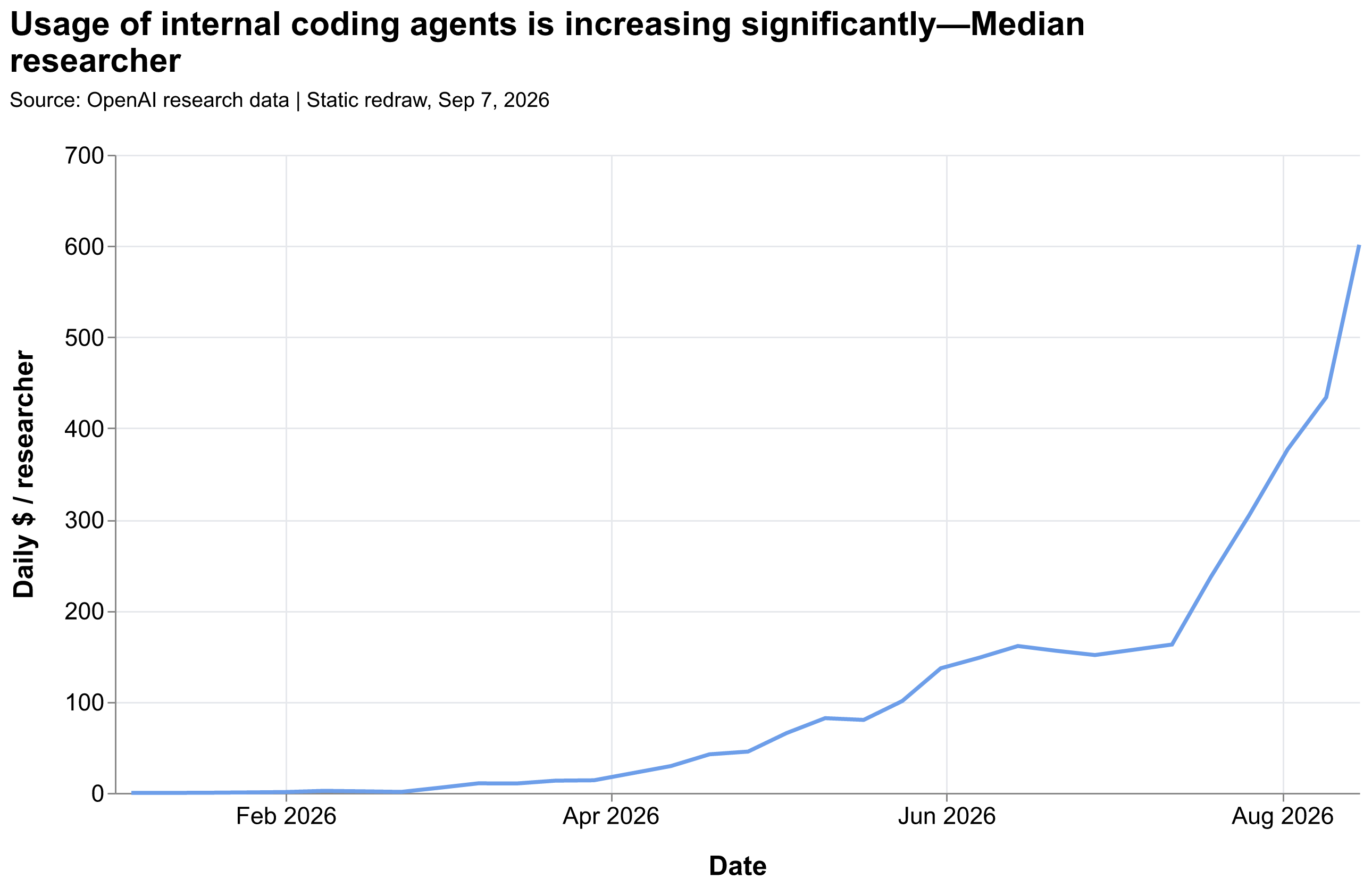
Median researcher inference usage, valued at API prices. Static redraw from OpenAI’s official data.
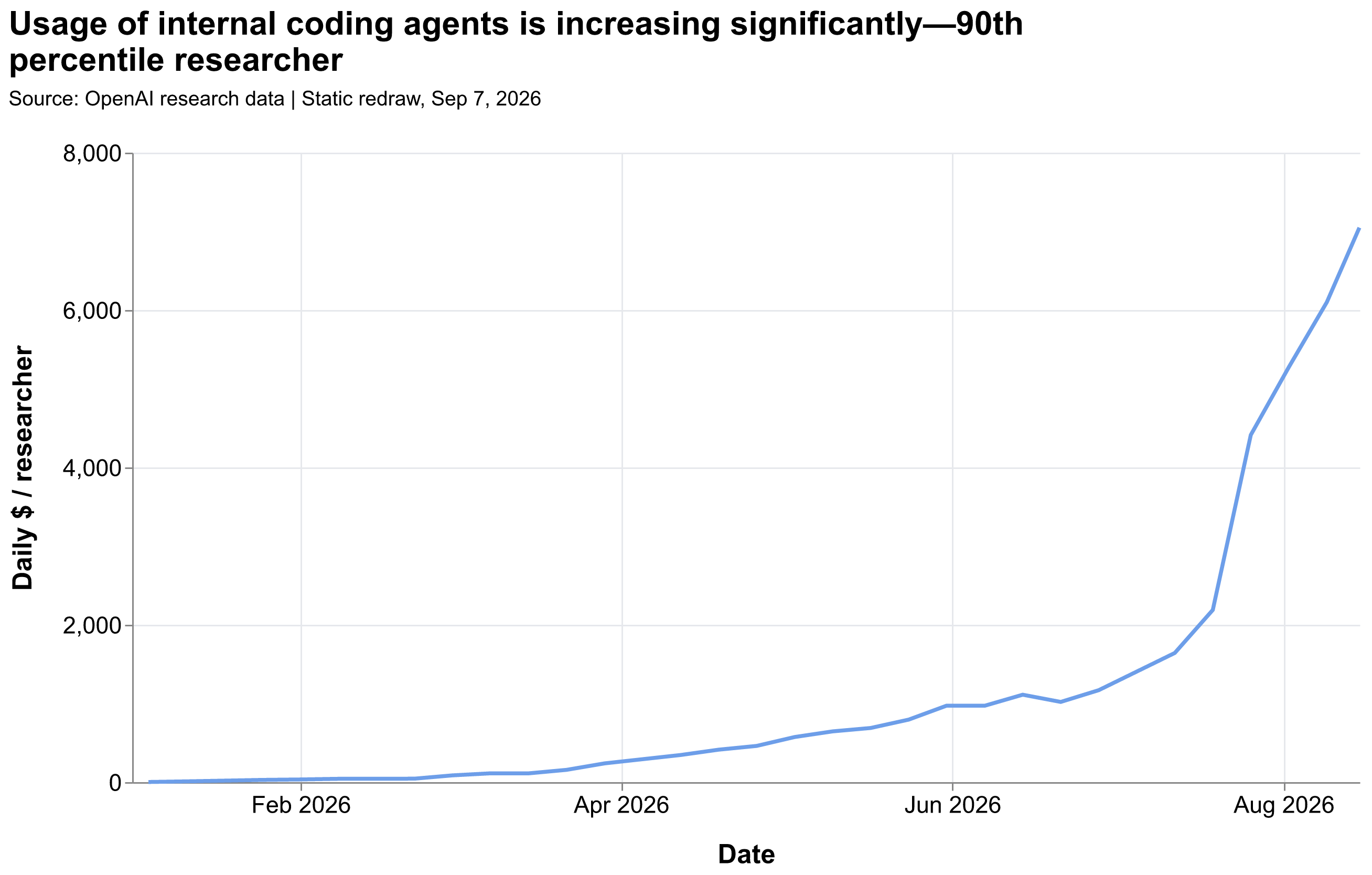
The research organization’s 90th-percentile user exceeds $7,000 per day at API prices. Static redraw from OpenAI’s official data.
Usage grew faster in research than elsewhere in the company. The median research employee’s output-token series ends at approximately 124.4 times its baseline, which starts in November 2025—not January 2026. Tokens are pieces of model-generated text, so this is an activity measure rather than a count of completed experiments.
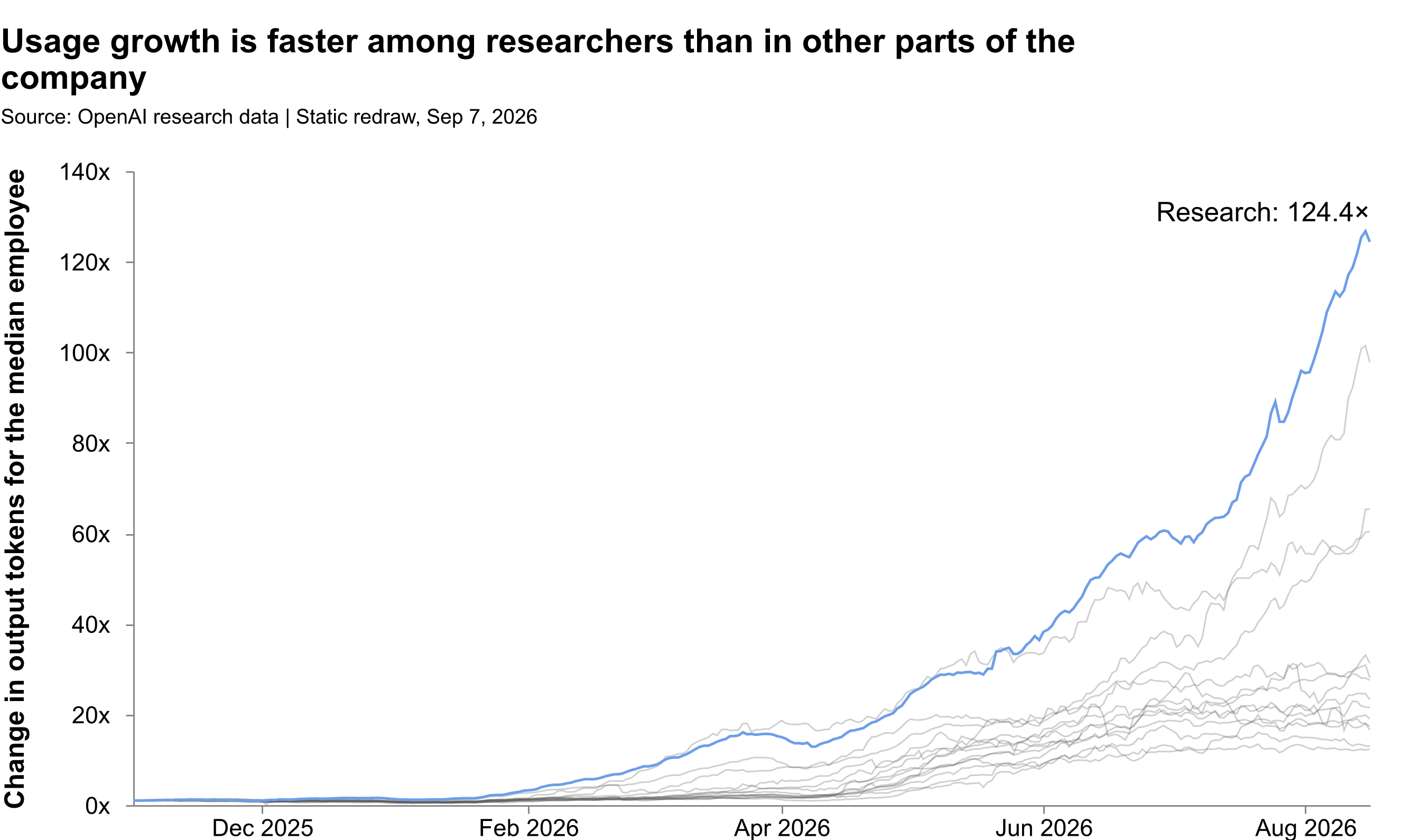
The research series ends around 124.4 times its November 2025 baseline. Static redraw from OpenAI’s official data.
Concurrency supplies part of the explanation. About 30% of researchers reached a daily peak of at least four simultaneous agents at the start of the displayed April interval. By August, more than 70% did. This count includes both agents launched directly and downstream subagents.
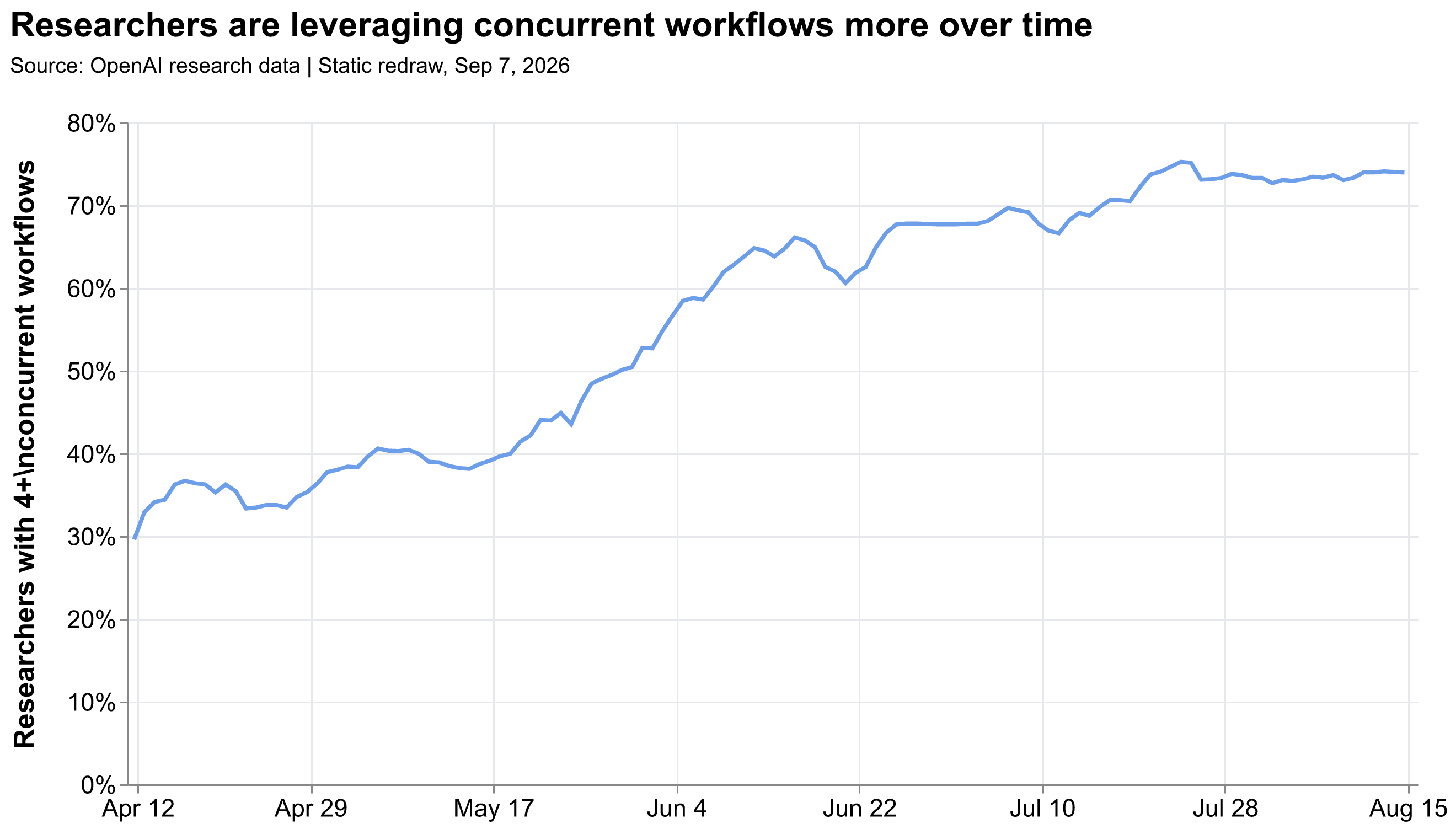
Daily peak concurrency, including subagents; the chart begins April 12 and ends August 15. Static redraw from OpenAI’s official data.
The researcher increasingly assigns, checks and redirects several pieces of work. That can expand the amount attempted without implying an equal jump in the intelligence of any individual model.
3. More output, uneven coverage
Code activity also increased. In the third quarter of 2026 through August 15—a 46-day partial-quarter window—daily code changes per active contributor reached about seven times the pre-2025 average. That is not a full-year result. The underlying contributor identities are also not a verified headcount of distinct people.
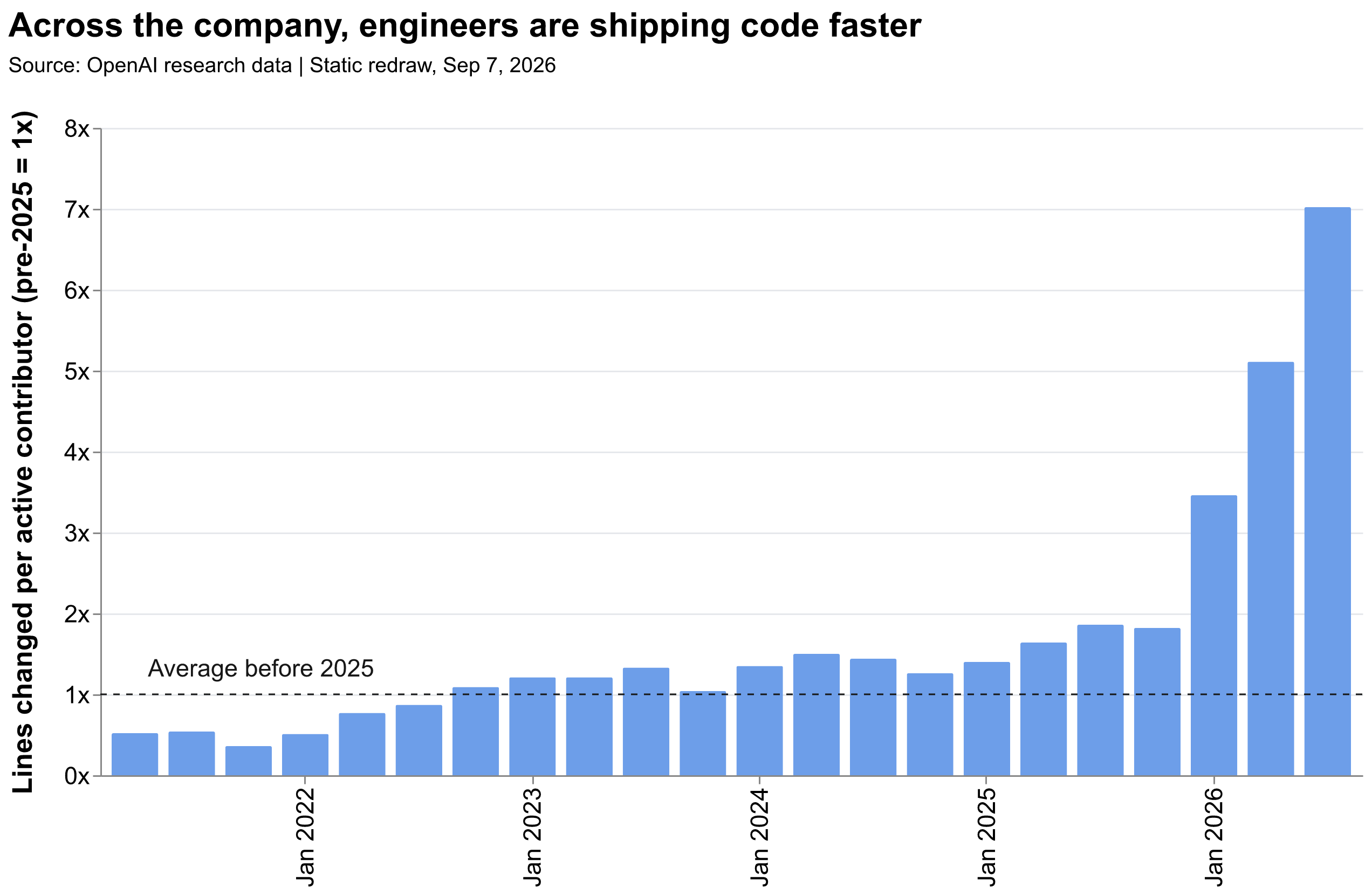
The 7.02-times result covers Q3 through August 15, not all of 2026. Static redraw from OpenAI’s official data.
Experiments per active experimenter reached a new high in August, relative to tracking that began in January 2025. OpenAI connects the increase with broader Codex adoption, while acknowledging that available compute grew too. The chart cannot isolate how much each factor contributed.
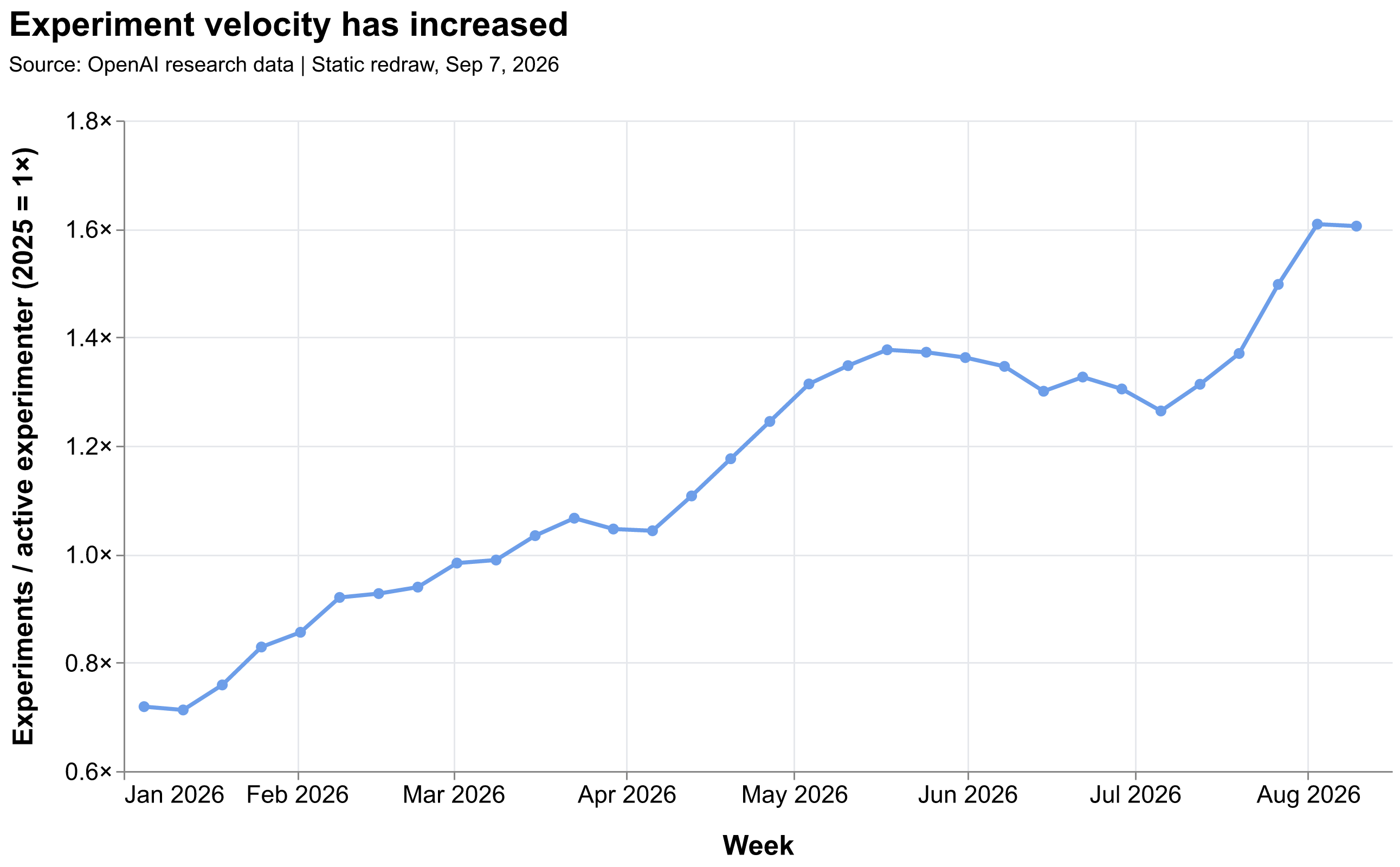
Experiments per active experimenter, with the 2025 average set to one. Static redraw from OpenAI’s official data.
The task breakdown is more revealing than the total. Using Epoch AI’s research taxonomy, OpenAI divides work into six phases: decide, design, build, run, analyze and communicate. High-level planning remains a small fraction of agent output.
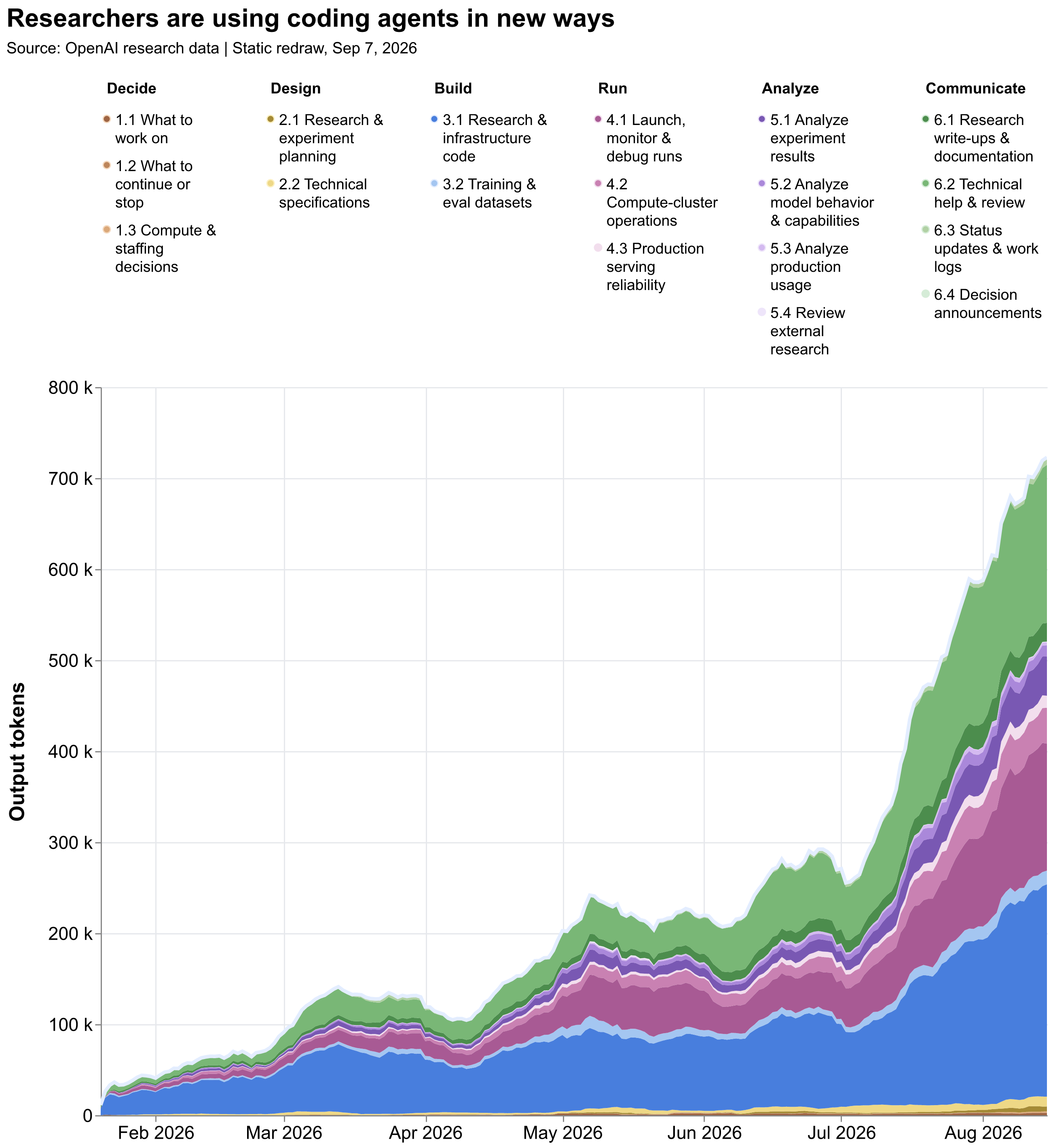
The mix of research tasks, classified using Epoch AI’s six phases. Static redraw from OpenAI’s official data.
Comparing August 1–15 with January 20–31, the largest daily token increases per researcher were research and infrastructure code, technical help and code review, and launching or monitoring runs. Each added more than 130,000 tokens. Compute and staffing decisions added roughly 1,475; reviewing external research about 715; announcing research decisions about 34.
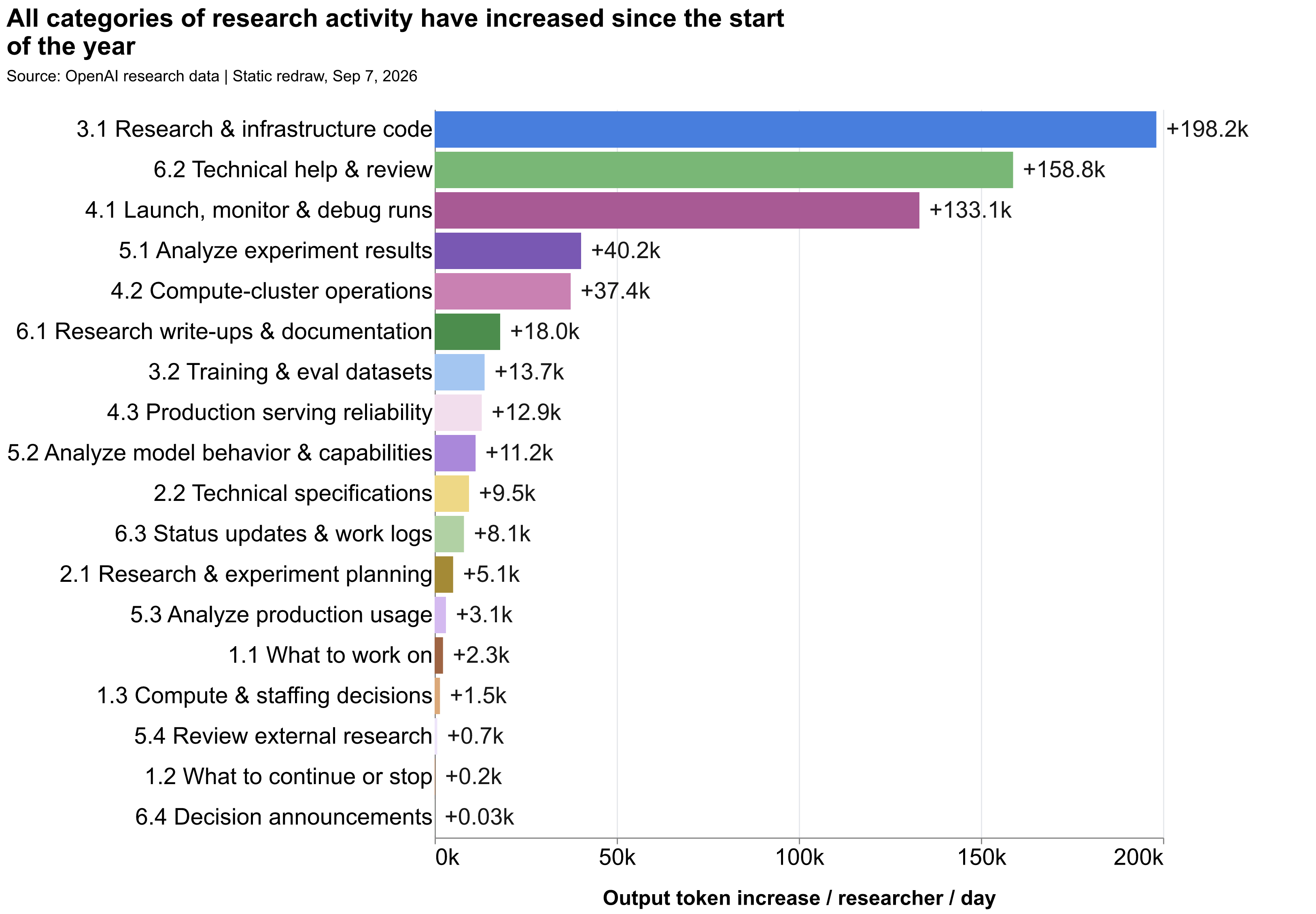
August 1–15 versus January 20–31: the three largest increases are approximately 198,000, 159,000 and 133,000 tokens per researcher per day. Static redraw from OpenAI’s official data.
An internal support channel offers another clue. Its daily top-level posts fell from roughly 20 in 2025 to single digits in August 2026. OpenAI says it knows of no offsetting shift to other human-run support channels, and reports that some troubleshooting office hours have lost attendance.
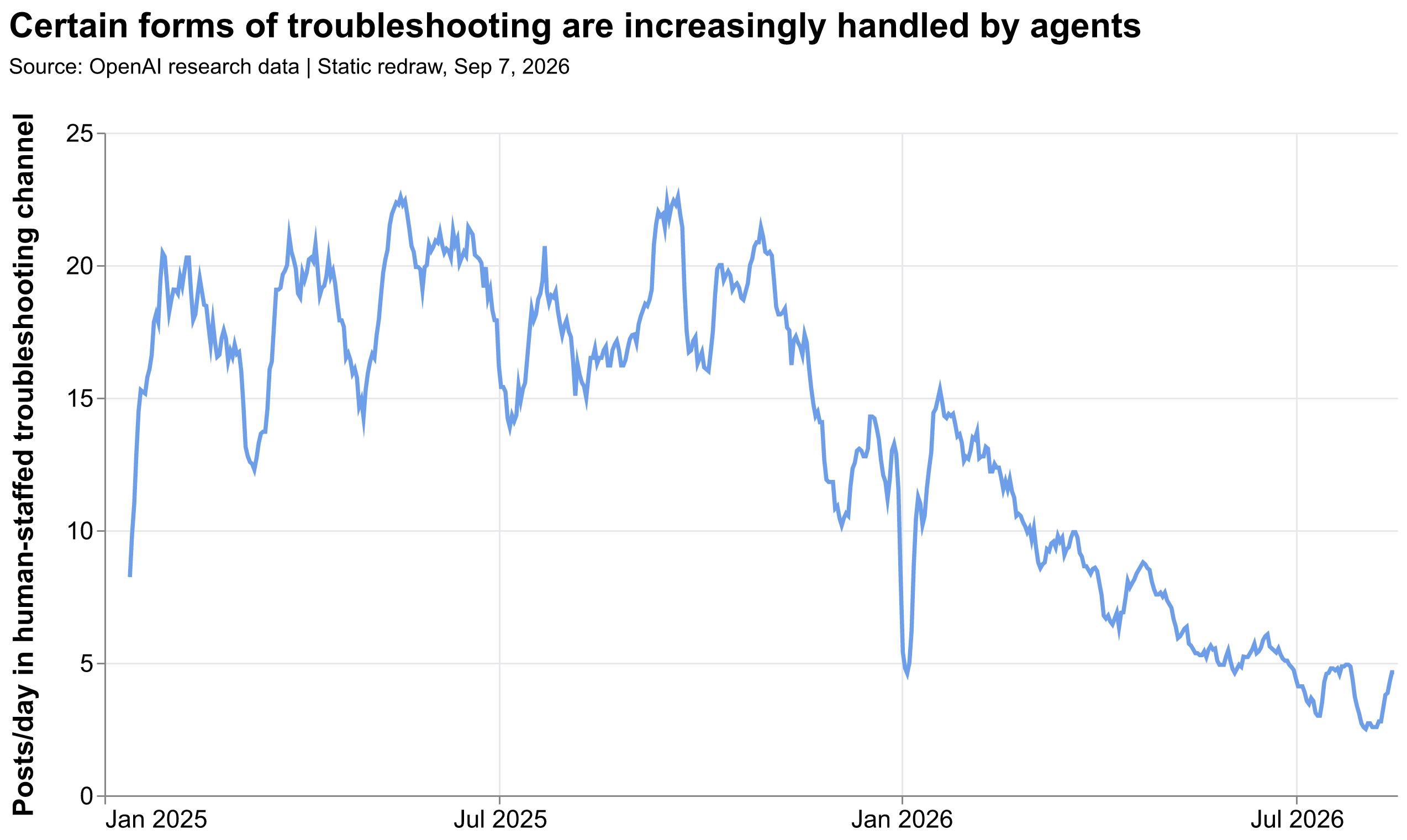
Activity in one human-run technical support channel. Static redraw from OpenAI’s official data.
That supports the account of agents handling more troubleshooting. It does not prove that every missing support request became an agent-solved problem. The broader division remains clear: agents do more execution, while people choose priorities and judge which results deserve further investment.
4. Longer tasks still need intervention
Between January and July, zero-intervention success on tasks estimated to take a human under 15 minutes rose from roughly 63% to 87%. For the 4–8-hour group, it rose from about 18% to 53%.
Longer work is harder to summarize. The displayed 32–64-hour group has adequate samples in only some months, with rates around 8–18%. The chart does not provide enough qualifying points to claim a stable success rate for all tasks above 32 hours.
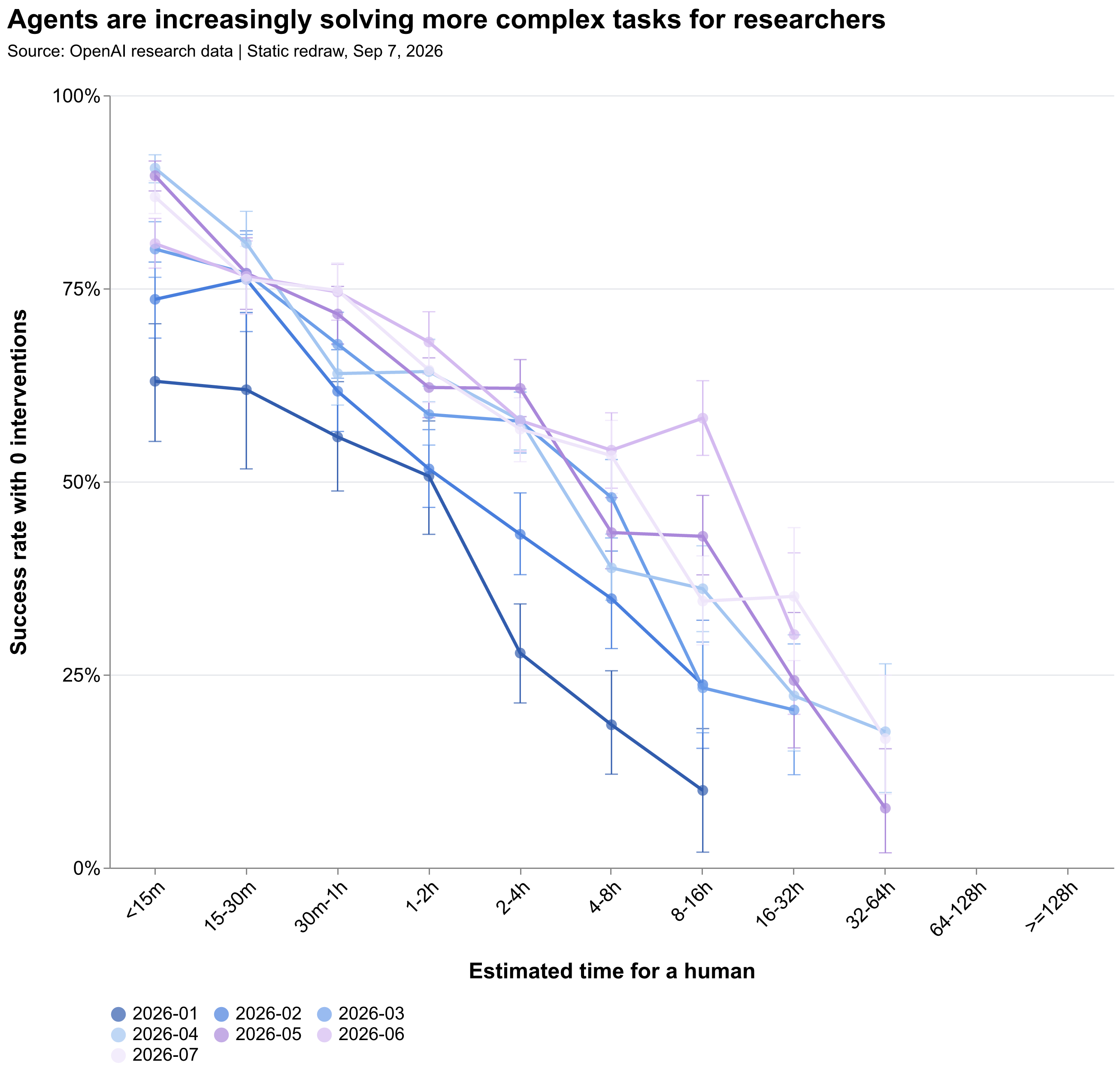
Success without intervention, with 95% confidence intervals. Uncertain outcomes and insufficient samples are excluded. Static redraw from OpenAI’s official data.
More than half of successful 4–8-hour tasks involved at least one intervention over the period discussed. Here, the duration estimates human effort, not actual agent runtime. A successful assisted task and an independently completed task are different results.
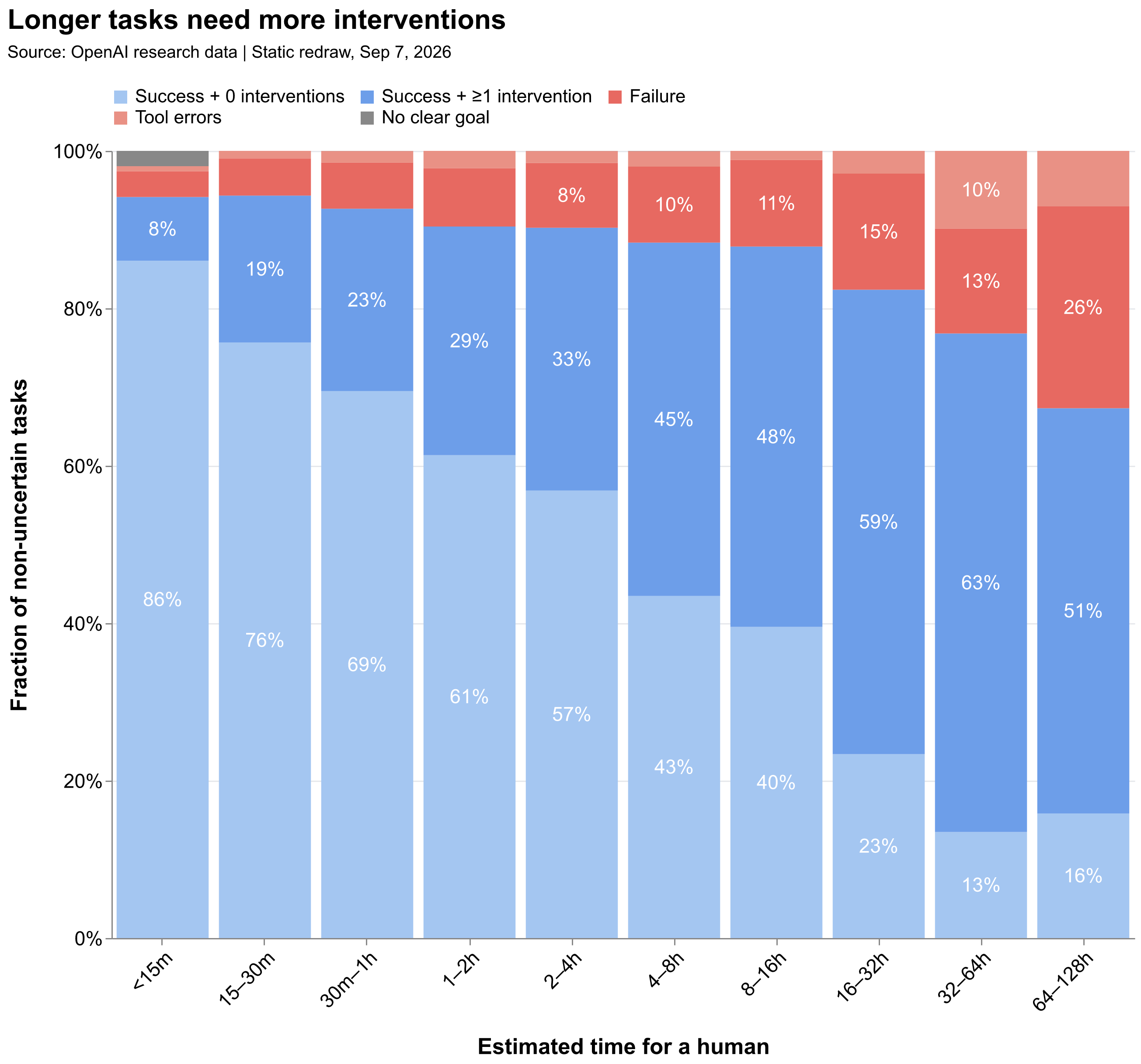
Task outcomes and intervention counts from January to July, excluding uncertain classifications. Static redraw from OpenAI’s official data.
OpenAI uses an agentic classifier for this analysis and calls its measurement work preliminary. Faster coding does not automatically accelerate every subsequent step: research design, evaluation, safety checks and available compute can each become the limiting factor.
A bounded research assignment you can evaluate
The following is an illustrative delegation plan, not an OpenAI internal procedure or a test performed for this article. Suppose your team has 20 completed training runs and wants to know why throughput fell. Do not start by asking an agent to “make training faster.” Give it the existing logs and a specific deliverable:
Task: explain the throughput difference across the 20 completed runs.
Inputs: a read-only copy of the run logs and configuration files.
Deliver: runs.csv with run ID, hardware, batch size, step time and status;
         a short report linking each finding to a file and line.
Do not: launch training, edit source data, upload logs, or change infrastructure.
Stop and ask: units are missing, configurations differ, or a log is incomplete.
Completion: all 20 runs accounted for, including failures and missing data.
Use sanitized copies with credentials removed. If logs contain unrelated instructions, treat them as data—not permission to run commands. Keep this trial in an environment where the agent cannot launch a training job or contact an external service just because its prompt says not to.
Parallel work is useful only when responsibilities differ. One agent can extract the table, a second can independently check hardware and batch-size comparability, and a third can trace outliers to their source logs. Give each a separate output location so their files do not overwrite one another. The researcher still decides whether the evidence warrants a new experiment.
Review the table against several original logs and account for all 20 runs before accepting the report. If one run reports milliseconds per step and another seconds per step, resolving that unit mismatch is useful work; silently normalizing unknown units is a reason to reject the result. A throughput comparison also says nothing by itself about whether training quality improved.
For your own trial, record accepted deliverables, agent runtime, researcher review minutes, corrections and actual inference charges separately. An agent can run for two hours and still deliver a rejected report. Conversely, a short run that finds a measurement bug may save more research time than hours of generated code. Do not turn either runtime or token volume into “researcher-equivalent output.”
5. The March 2028 researcher target
OpenAI reaffirms its March 2028 target for an automated AI researcher. Its stated ambition is a system working under human supervision to advance deep learning and alignment—the work of making AI behave consistently with human intentions and values.
That wording leaves a meaningful gap between the target and a lab that runs itself. The disclosure does not establish a delivered ability to choose projects autonomously and complete weeks of research without intervention.
Recent adoption makes the target worth following. The long-task results explain why it remains a target. More parallel attempts can help researchers test ideas; they do not by themselves settle which ideas matter or whether the resulting system is safe to scale.
6. Compute plans are not a research-output metric
Alongside this discussion, NVIDIA CEO Jensen Huang declared that “AGI has arrived.” In a post quoted by Greg Brockman, Huang described Astra as trained on more than 100,000 NVIDIA Grace Blackwell NVLink72 GPUs, and said another 400,000 GPUs were coming online next.
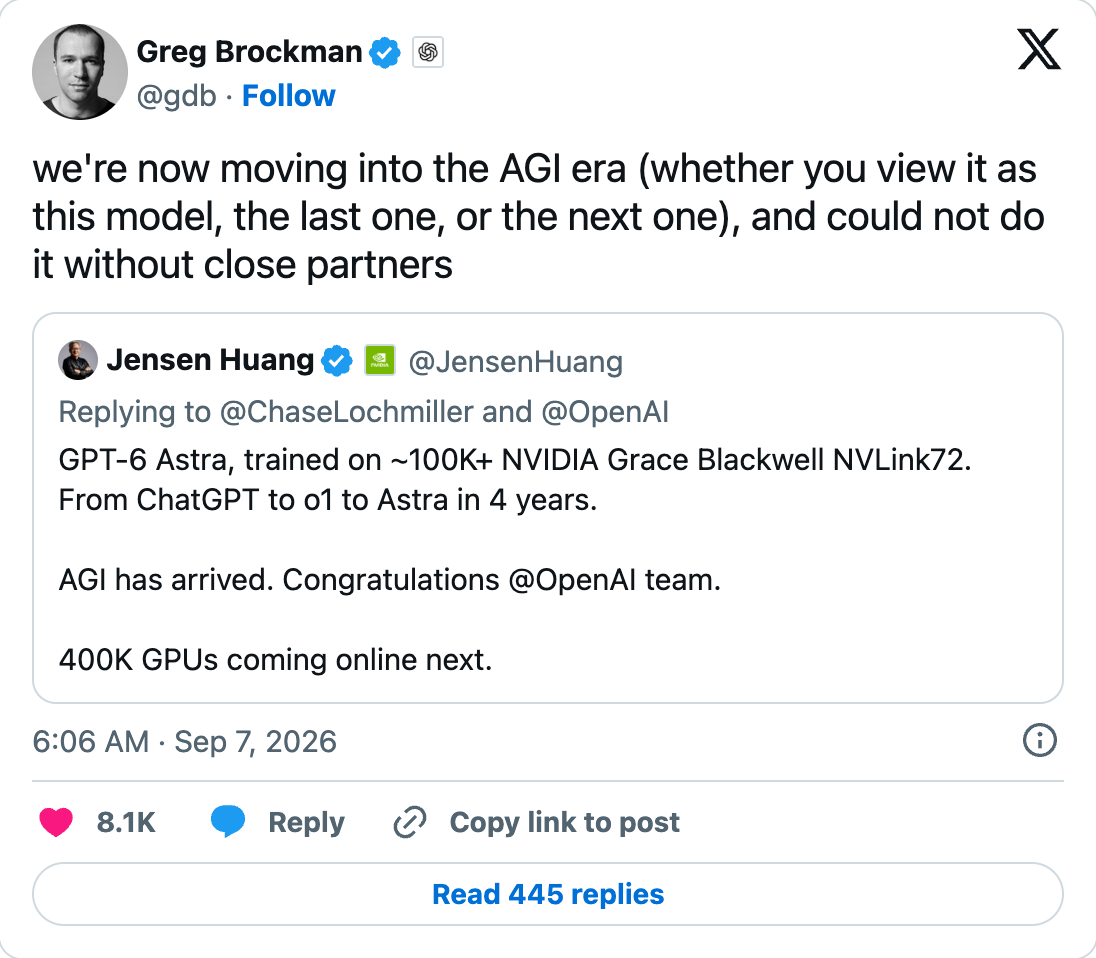
Huang’s statement on more than 100,000 training GPUs and 400,000 coming online, quoted in Brockman’s original English X post.
These are infrastructure plans and Huang’s assessment, not measurements of the intern’s output. More GPUs can permit more experiments; they do not tell a team how many results were accepted or how much human review was needed.
7. What RSI transparency can—and cannot—settle
The separate GPT-6 RSI analysis explains what evidence would establish repeated model improvement. Here the contribution is more specific: making the amount of research work, its outcomes and the interventions required visible.
Kevin Liu’s call for other labs to publish similar measurements points to the value of this disclosure. Public discussion can examine runtime, task success and human intervention instead of relying entirely on demonstrations or predictions.
Pachocki adds a warning: machine intelligence is not directly comparable with human intelligence, and surpassing enough human capabilities can have large consequences without surpassing every one of them. Understanding a model’s behavior may become harder as it grows more capable.
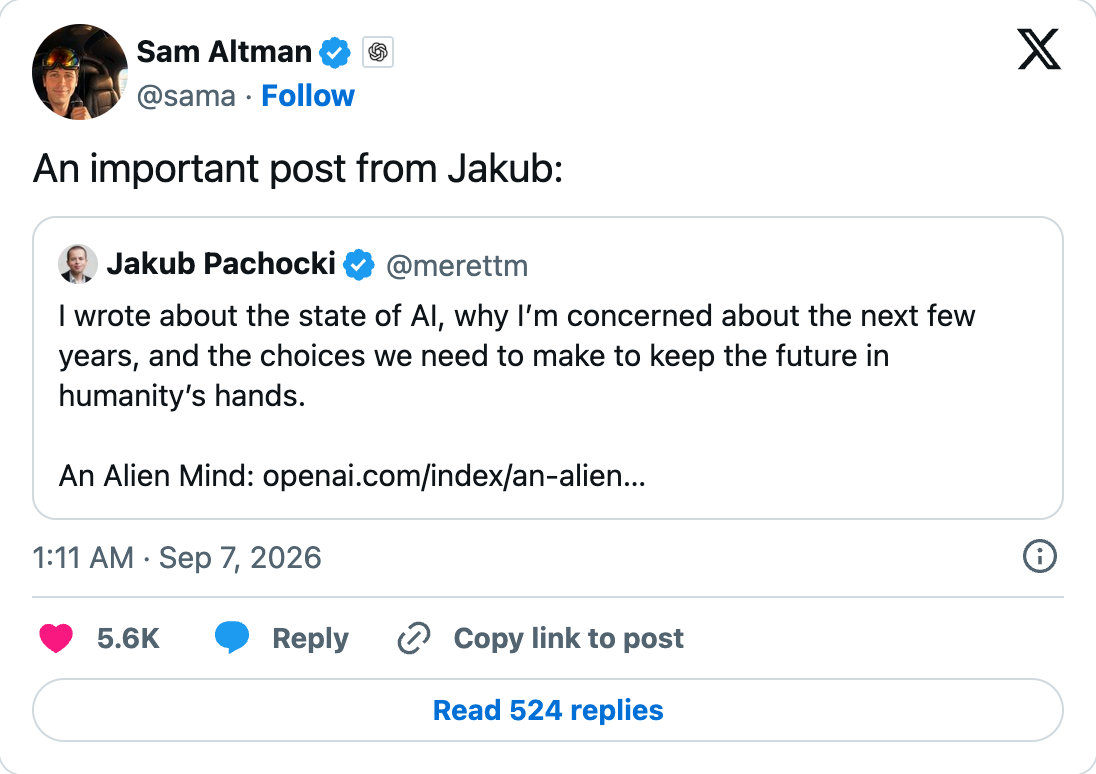
Altman shares Pachocki’s essay about AI progress and keeping the future in human hands. Original English X post.
His proposed response combines alignment and monitoring research with coordinated slowdowns when needed. The research disclosure itself also discusses slowing or stopping development, and describes restrictions on training. Neither article simply argues for speed at any price.
8. Measure the work that survives review
OpenAI’s disclosure is useful because it separates rising use from unresolved reliability. Runtime, API-valued usage, code changes and human intervention describe different parts of research work; none is a replacement for checking the result.
For a team starting with an agent, the next step is a bounded assignment such as the log review above. Count accepted work and the supervision it needed before increasing concurrency. If the question instead is which model to try, use the agent model comparison; it is a separate choice from whether a research result is trustworthy.
FAQ
Can I buy or activate OpenAI’s AI research intern?
The disclosure does not offer a public product under that name. It describes the capabilities and use of internal coding agents. You can evaluate an available agent on your own authorized research task, but that is not access to OpenAI’s internal setup and does not guarantee its reported results.
Does 3.1 agent-workdays mean research is 3.1 times faster?
No. It compares accumulated runtime with human working time. Parallel agents add hours, including unsuccessful or repeated attempts. Measuring research acceleration also requires assessing the quality of experiments and whether their results improve a model.
Can the research intern replace a researcher?
OpenAI’s definition describes well-defined tasks under human direction. People still choose research priorities, evaluate promising results and decide whether to scale, pause or deploy systems. The March 2028 automated researcher remains a development target, not a claim of a currently independent laboratory.
Are $600 and $7,000 the researchers’ actual daily bills?
No. OpenAI values internal inference usage at API prices. The figures describe the median and 90th-percentile research users by mid-August. They do not disclose the company’s internal production costs or prescribe a budget for ordinary agent users.
Why do longer tasks still need people?
Longer work presents more opportunities for an incorrect assumption to affect subsequent steps. OpenAI’s observed results show substantial intervention even among successful 4–8-hour tasks. A practical starting point is a task with an explicit expected output and a way to check it, while retaining human review for research direction and consequential results.