GPT-6 and RSI: Does AI-Assisted Training Count?
Does earlier AI helping train GPT-6 prove recursive self-improvement? Separate the disclosed evidence from inference and check what a repeatable improvement would require.
Does an older model helping train GPT-6 Astra mean recursive self-improvement (RSI) has arrived? It is evidence of AI-assisted model development, not proof that AI can repeatedly produce a more capable successor on its own. For engineers evaluating such claims, the missing detail is what changed in the next model and how that improvement was verified—not how many times the assistant ran.
Evidence for AI-assisted training appears in the account of how Astra was built. OpenAI vice president of research Aidan Clark told reporters that Astra was the company’s first frontier model to involve previous AI models very heavily in the training process. The earlier system was no longer merely answering researchers’ questions. It was beginning to help train its successor.
RSI describes a stronger possibility: AI helps improve a successor, and that successor becomes better at making further improvements. The distinction matters when deciding whether a faster coding or training workflow is evidence of a repeating improvement process.
Key takeaway
- The important change in GPT-6 Astra is not only higher intelligence: earlier models helped train a later one.
- Clark told CNET that Astra was pretrained on more than 100,000 GPUs and that older model generations helped train the new one.
- Shunyu Yao’s exact comment on Gemini 3.8 was: “That’s one small step for model, one giant leap for RSI :).” It is a researcher’s interpretation, not an official Google declaration that RSI has been achieved.
- OpenAI’s later research disclosure says people still choose priorities and decide whether to scale, pause or deploy. It explicitly says the path to safe, aligned full RSI is not yet known.
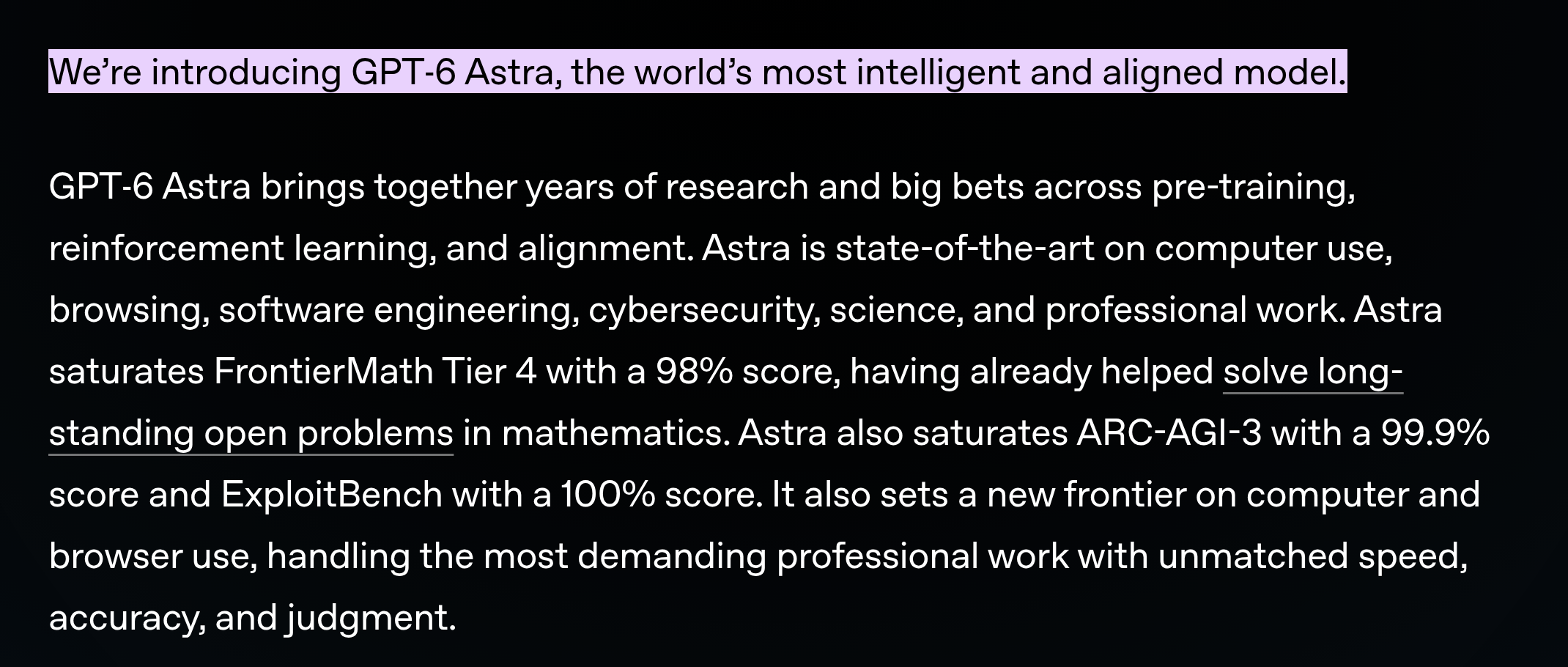 OpenAI describes GPT-6 Astra as its most intelligent and aligned model and lists mathematics, interactive reasoning, cybersecurity, and computer use among its core capabilities. Source: OpenAI
The training process changed, not just the size of the cluster
Astra’s capability increase rests partly on an enormous expansion of infrastructure. Clark told CNET that OpenAI used more than 100,000 GPUs for pretraining. A cluster at that scale can process larger data batches, run more experiments in parallel, and supply the compute demanded by increasingly elaborate post-training.
Compute is not the most interesting part of the story, though. Clark told reporters that Astra was OpenAI’s first model to involve previous AI models very heavily in the training process, with “older generations helping train the new one.” CNET records that statement in the same paragraph as the 100,000-GPU figure.
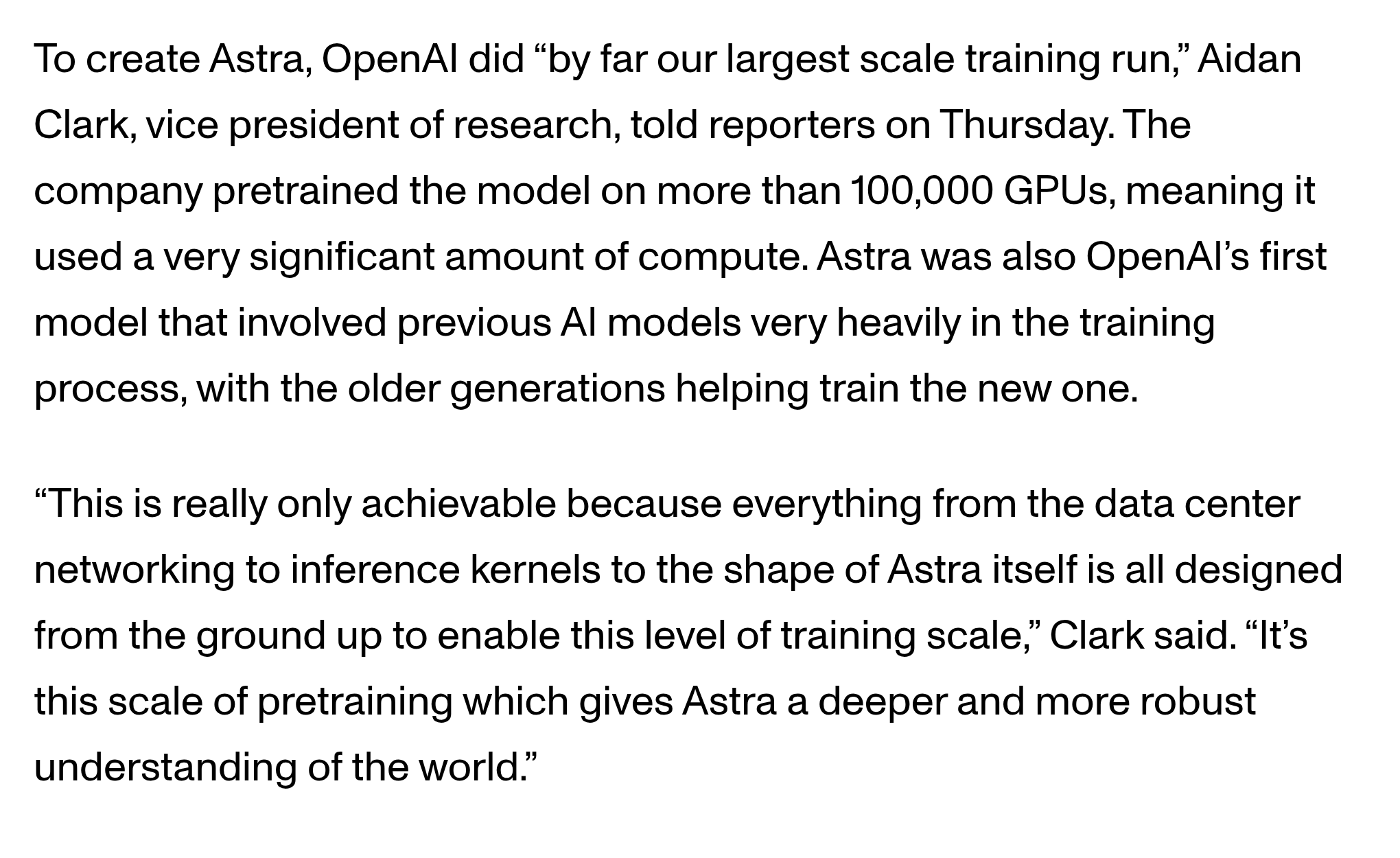 CNET records Clark saying Astra was pretrained on more than 100,000 GPUs and was OpenAI’s first model to involve older AI generations heavily in the training process. Source: CNET
Previous frontier-model training often resembled an enormous experiment under constant human watch. One group monitored loss curves, another dealt with failing nodes, another investigated data jobs, and senior researchers decided whether to roll back to an earlier checkpoint. Runs could last for weeks, and an unexpected failure could pull an engineering team into an overnight incident.
The public account does not say exactly where the older models entered the process. It therefore cannot support specific claims about diagnosing gradients, isolating bad nodes, or restoring checkpoints. What it does establish is narrower and still significant: a previous model generation participated directly in training the next one. Whether that contribution involved data selection, supervision signals, evaluation, operations, or some combination remains undisclosed.
How to check an RSI claim against a concrete experiment
A useful check starts with the artifact the AI changed. These are illustrative examples, not disclosed Astra training procedures:
| Observed activity | What it establishes | What it does not establish |
|---|---|---|
| An agent retries a failing application test | More attempts at one task | A better underlying model |
| An agent writes a parser for training-failure logs | Research engineering assistance | That a successor is more capable |
| An AI-proposed data filter is used to train a successor that improves on held-out tests | Evidence of a model-development contribution, if the comparison is controlled | That the successor can repeat the improvement or that the process is safe |
For the third case, a small research team could use this check. Suppose the proposal is to remove duplicated training samples. Keep the unmodified dataset as the baseline; put the proposed filter in a separate code revision. Before running either version, record the dataset versions, model configuration, training-token budget and evaluation set. The evaluation set should be held out—excluded from training and from the agent’s optimization feedback.
Run each version with the same three chosen random seeds and the same compute allowance. Three seeds is a small illustrative starting point, not a statistical guarantee. Keep all six results, including failed runs; do not publish only the strongest one. Check whether any gain survives the different seeds, whether another task gets worse, and whether the filter accidentally removes a type of input the model still needs to handle.
A review record can be this specific:
Question: Does duplicate filtering improve the successor?
Changed artifact: data filter only; separate code and dataset versions
Fixed inputs: model configuration, token budget, evaluation set, seed list
Required output: all baseline/candidate results and failure logs
Human decision: accept, reject, or request another experiment
Next evidence needed: can the successor improve the research process again?
This record is not a hidden OpenAI procedure or a switch that activates RSI. It exposes the evidence a claim would need. Even a positive first comparison supports one improvement, not an indefinitely accelerating series. A repeated process also needs an independent evaluator and people with authority to stop it; allowing the agent to rewrite its own pass criteria would make the result uninterpretable.
Google’s parallel signal: Gemini 3.8 and “one giant leap for RSI”
OpenAI is not alone in pursuing this direction. Around the Astra launch, Google introduced Gemini 3.8 Flash as a low-cost, high-throughput model for coding and agent workloads. Lower per-attempt cost and shorter wait times make additional tool calls, checks, and retries easier to budget. That is an engineering implication of the positioning, not evidence that extra attempts automatically produce better answers.
Google DeepMind researcher Shunyu Yao reposted Google’s Gemini 3.8 announcement with a compact verdict: “That’s one small step for model, one giant leap for RSI :).”
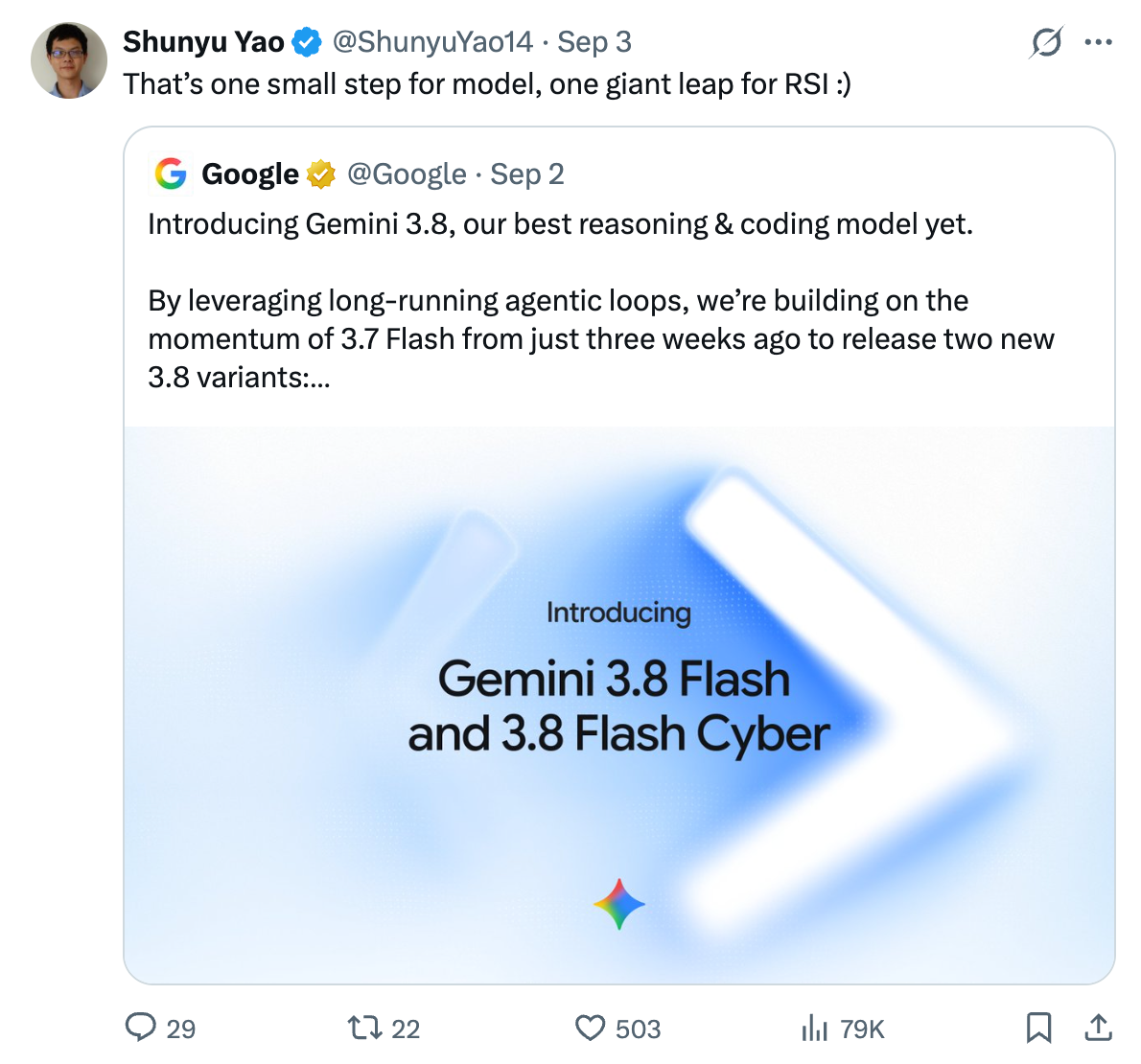 Shunyu Yao reposted Google’s Gemini 3.8 announcement and added the comment above. The post documents one researcher’s interpretation of the release; it is not an official Google claim that RSI has already been achieved. View the original post
Yao’s comment expresses a research direction, not a measured causal result. More tool calls at inference time—while a model is answering a task—do not themselves change that model. They contribute to RSI only if their outputs help improve a later system and that improvement is demonstrated. The separate Gemini coding-cost analysis covers when additional attempts are affordable; affordability is not evidence of recursive improvement.
Near-perfect benchmarks do not mean RSI is complete
Astra’s 99.9% ARC-AGI-3 and 97.6% FrontierMath Tier 4 v2 results create an easy misconception: once model intelligence reaches a benchmark ceiling, self-improvement must follow automatically. The engineering gap between those two ideas remains large.
The ARC-AGI-3 result was produced with OpenAI’s specified Responses API harness and two adjusted settings intended to reflect real use. It shows near-saturation under those conditions. It does not establish that Astra can solve every unfamiliar task without equivalent tools or scaffolding.
More importantly, robust recursive improvement requires more than noticing a failed job. A system must formulate better training objectives, design informative experiments, decide whether results reproduce, and prevent optimization from crossing safety boundaries. People still own those decisions today.
Automated recovery is also different from autonomous model design. The former makes a predefined experiment more reliable; the latter changes the experiment itself. Clark’s reported statement does not disclose a recovery implementation, so it cannot establish that Astra crossed either threshold autonomously.
What the next disclosure would need to show
The Astra report makes the participation of older models concrete. The next question is narrower than “has AGI arrived?”: which AI-generated changes were adopted, which comparisons showed a benefit, and did the resulting model help produce another improvement? Without that record, faster development is plausible but the strength and repeatability of the recursive effect remain unknown.
OpenAI’s research-acceleration disclosure adds an important limit: “We do not yet know how to safely get all the way to aligned, full RSI.” Its internal usage and intervention figures are covered in our AI research intern analysis. Those figures describe how researchers work; they should not be substituted for measurements of successive model improvements.
An API purchase does not provide access to OpenAI’s training process or an “RSI mode.” What an outside team can do is evaluate a bounded proposal on its own authorized experiment and retain the baseline, failures and human review. That produces something more informative than another confident headline: a comparison another researcher can check.
Frequently asked questions
What is recursive self-improvement?
Recursive self-improvement describes an AI system contributing to the creation of a better AI system, which may then become more capable of improving the generation after it. Data cleaning, training monitoring and debugging can contribute to that process. But activity alone is insufficient: the successor must actually improve, and the claim of recursion needs evidence of further improvements. Astra’s reported AI assistance is a contribution toward that possibility, not a demonstrated autonomous intelligence explosion.
Does a previous model helping train Astra mean people have left the training loop?
No. Human teams still decide research objectives, training configurations, compute allocation, safety thresholds, and whether a model is released. The cited Astra report does not specify which of those training tasks older models performed; it should not be expanded into an undocumented operations feature list.
Is Shunyu Yao’s “one giant leap for RSI” an official Google conclusion?
No. It is Yao’s own comment on X when reposting Google’s Gemini 3.8 announcement. The original post proves that he made that assessment; it does not support wording such as “Google announced that RSI has been achieved.”
Do Astra’s near-perfect benchmark scores prove that it is AGI?
No single benchmark can establish that. Evaluations cover specific capabilities, and their scores depend on the harness, tools, and rules used during testing. OpenAI may frame Astra as the beginning of an AGI era, but broader scientific agreement would require much more reproducible evidence.