GPT-6 Astra vs Fable 5.1 vs Gemini 3.8 Flash
Compare GPT-6 Astra, Claude Fable 5.1, and Gemini 3.8 Flash for agents: task fit, retry budgets, escalation rules, and limits of cross-benchmark rankings.
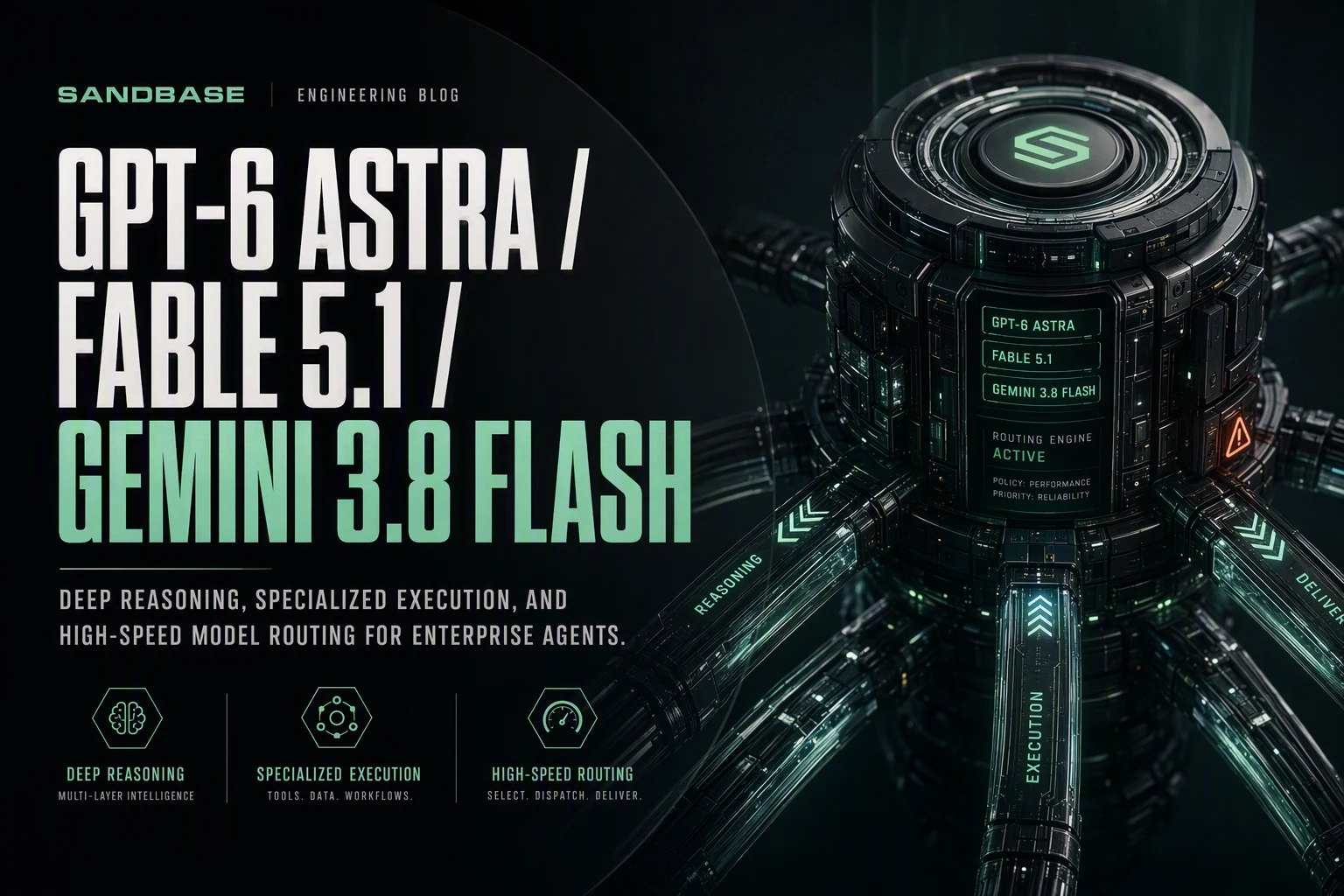
A batch of tested function edits and an intermittent production crash should not receive the same model budget. To choose between GPT-6 Astra, Claude Fable 5.1, and Gemini 3.8 Flash, first ask whether failure can be detected automatically, then decide who gets the first attempt and when to switch.
For developers configuring coding agents, model routing means assigning requests by task conditions. The recommendations below are starting hypotheses based on published capabilities, prices, and cases—not a controlled three-model ranking or a claim that any capability belongs exclusively to one provider.
Key takeaway
- Use Gemini 3.8 Flash first when work is reversible and a test, schema, compiler, or policy rule can reject bad output.
- Escalate to Claude Fable 5.1 when debugging or research must continue across a long chain of evidence.
- Escalate to GPT-6 Astra when the task spans professional desktop software, long-lived context, and strict authorization boundaries.
- Price and benchmark scores are inputs to routing. The real production metric is the cost and failure rate of an accepted result.
Route by failure mode, not vendor loyalty
Use this table to choose evaluation candidates. These are not exclusive capabilities: Fable can operate software and Astra can investigate dependencies. Your task results must decide the final route.
| Task condition | First route | Escalation trigger |
|---|---|---|
| Reversible task with unit tests, schema checks, or a compiler | Gemini 3.8 Flash | Retry cap reached or candidates disagree |
| Long debugging or research investigation | Claude Fable 5.1 | External action, disputed evidence, or missing acceptance criteria |
| Professional desktop software or strict authorization boundary | GPT-6 Astra | Irreversible action or policy uncertainty requires human approval |
| Financial, security-sensitive, or otherwise irreversible write | Human approval before execution | No model may bypass the approval |
A practical router records five fields before dispatch: whether the action is reversible, which independent verifier exists, the maximum number of attempts, the model’s tool and data permissions, and the exact escalation condition. “This looks complex” is not a routing rule.
The cost calculation should also use completed work rather than token price. If Flash needs three attempts and Astra needs one, compare the total model spend, tool time, test time, and review cost for an accepted result. Cheap tokens are valuable only when they reduce that total.
A concrete example: rename an export field, cap attempts at three
This is a suggested evaluation configuration, not a measured result. Suppose a CSV export must rename customer_id to account_id while keeping an old importer compatible:
- Freeze the repository and acceptance tests: new field present, old files still importable, column order unchanged. Restrict writes to an isolated workspace.
- An independent runner tests Flash’s first patch. Return original errors for at most two repairs; do not permit changing expected values to hide a failure.
- If three attempts fail or the fault enters an external parser, hand Fable or Astra the original requirement, interface samples, patches, and failed tests—not just “the previous model failed.”
- If removing the old field was never authorized, ask the user instead of paying a larger model to guess. Keep deployment and external writes behind approval.
Stop earlier when another attempt adds no information. Compare the total cost of passing the same checks, not the length of the final answer.
Gemini 3.8 Flash makes the next attempt cheap
Google’s 2026 introductory API rate places Gemini 3.8 Flash in a different operating range from a premium frontier model. At $0.75 input and $3.75 output per million tokens, a system can buy several bounded attempts instead of treating one generated patch as the final answer.
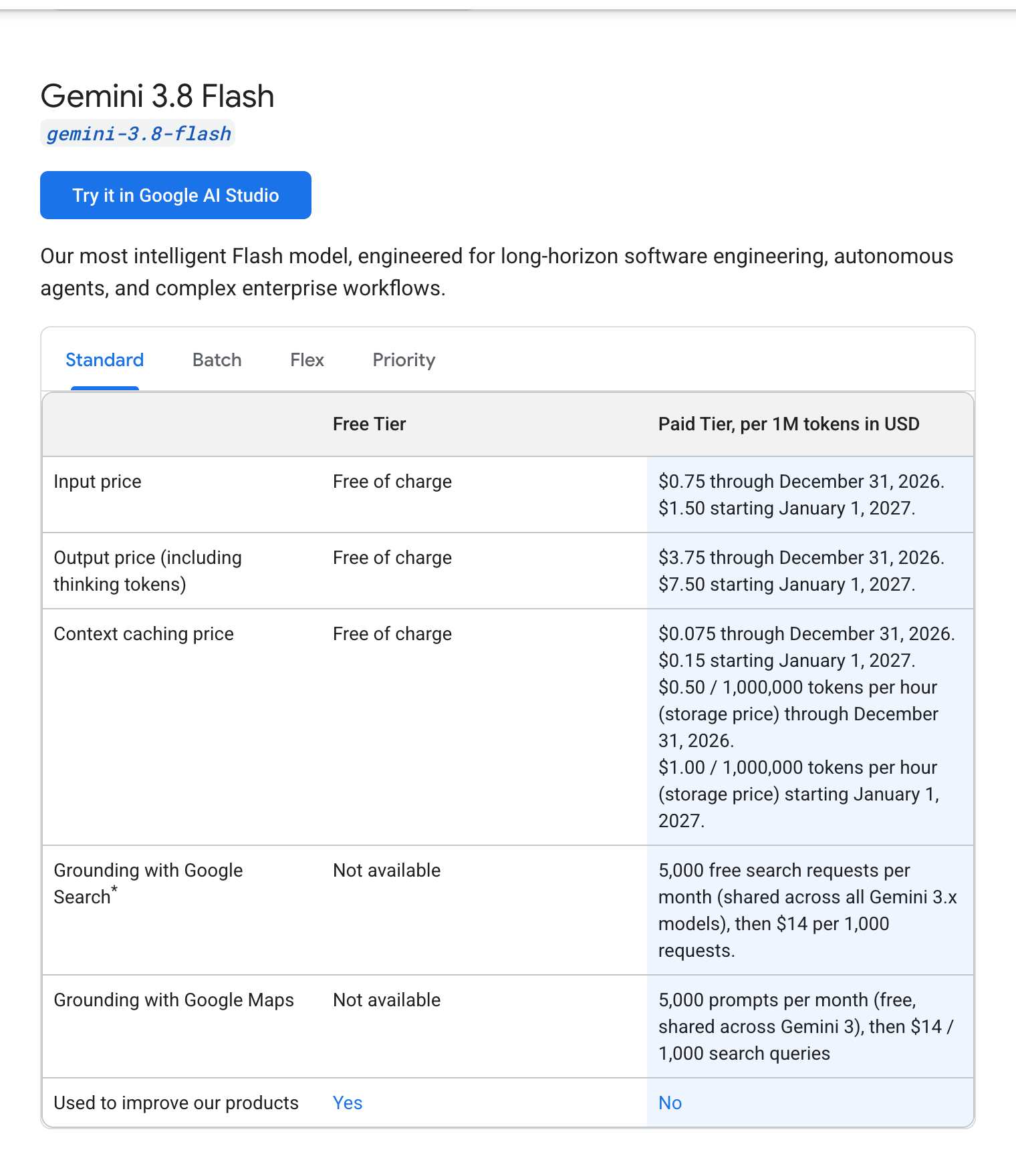
Google’s official pricing page lists $0.75 input and $3.75 output per million tokens through December 31, 2026. Source: Google AI for Developers.
The speed matters for the same reason. A September 4 snapshot from Artificial Analysis measured 326.9 output tokens per second for Gemini 3.8 Flash at the high reasoning setting, with an Intelligence Index of 59 and a cost of $0.58 per evaluation task. Those figures can move as providers and evaluators update their systems, so they should be read as a dated snapshot rather than permanent specifications.
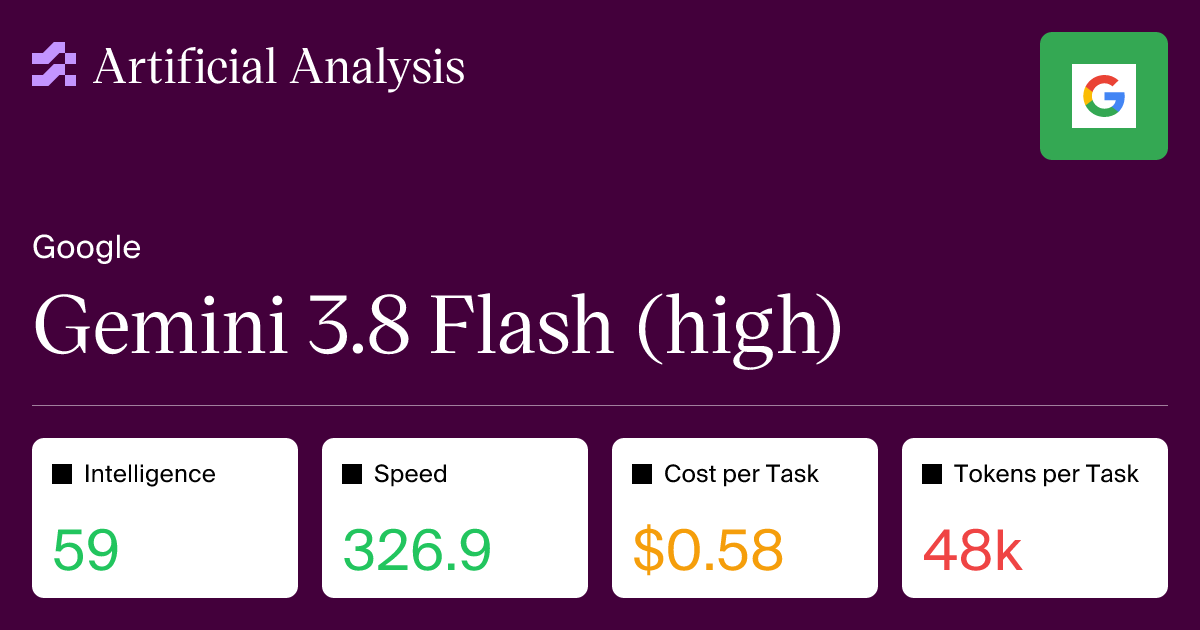
The September 4 Artificial Analysis panel reports index 59, 326.9 tokens/s, and $0.58 per evaluation task for Gemini 3.8 Flash at high reasoning. Source: Artificial Analysis.
Consider a narrow repository change. Instead of asking one expensive model for a patch and hoping it works, an agent can ask Flash for two candidates, run the same tests against both, keep a candidate for further investigation, and use the failure logs for one final repair attempt. A candidate that fails any required check is still not ready to deliver.
This strategy has a hard condition: the verifier must be independent of the generating model. Unit tests, JSON Schema, a compiler, a reproducible calculation, or a permission engine can reject a result. If the model writes a subjective answer and then grades it itself, five fast attempts may only create five plausible mistakes. Retries need a fixed cap, after which the task moves to a stronger model or a person.
What DeepSWE 73.7% does—and does not—prove
Google reports 73.7% for Gemini 3.8 Flash on DeepSWE v1.1. DeepSWE evaluates long-horizon software work: understanding a repository, modifying files, and surviving automated checks. The score is important because it puts Flash beyond the old role of a cheap classifier or autocomplete model.
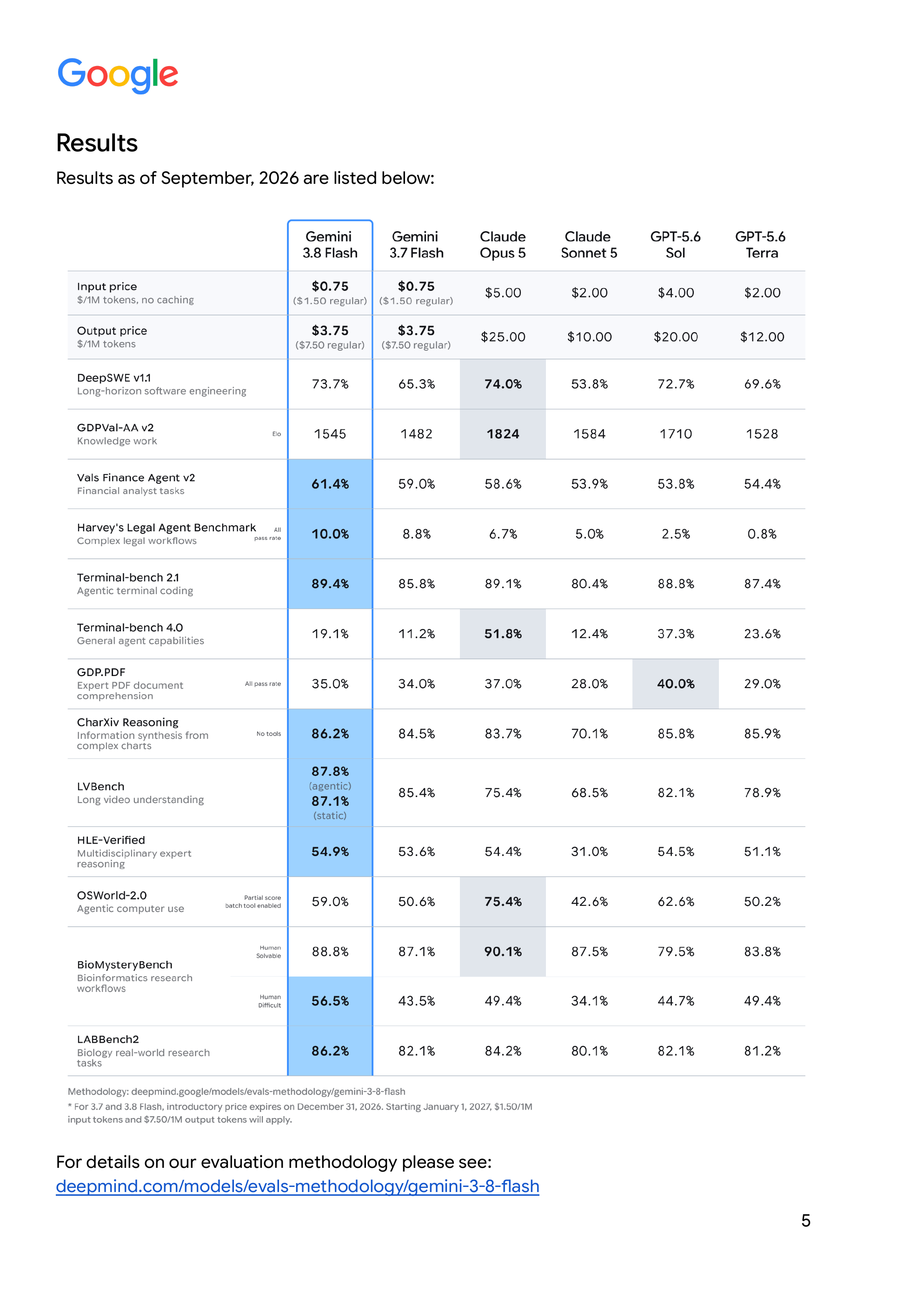
Google DeepMind’s model card lists 73.7% for Gemini 3.8 Flash on DeepSWE v1.1 alongside the introductory API rates. Source: Google DeepMind.
The score is not a universal league table. Google says its result used the mini-swe-agent harness with high thinking. Other published rows may use different harnesses, tool budgets, or reporting sources. DeepSWE 73.7%, Fable’s Terminal-Bench score, and Astra’s professional-computer-use results measure different things. A production evaluation still has to hold the repository commit, prompt, tools, timeout, permissions, and acceptance tests constant.
Flash Cyber applies the same economics to defensive security
Gemini 3.8 Flash Cyber shows how Google expects the strategy to scale. Google reports 86.2% pass@1 on CyberGym. Chrome obtained 2.6 times more correct patches than with its previous best commercial models, and a Google Cloud team found a critical foundational vulnerability in under two hours. Access is restricted to trusted defenders through the Fairwind program; this is not a generally available offensive-security endpoint.
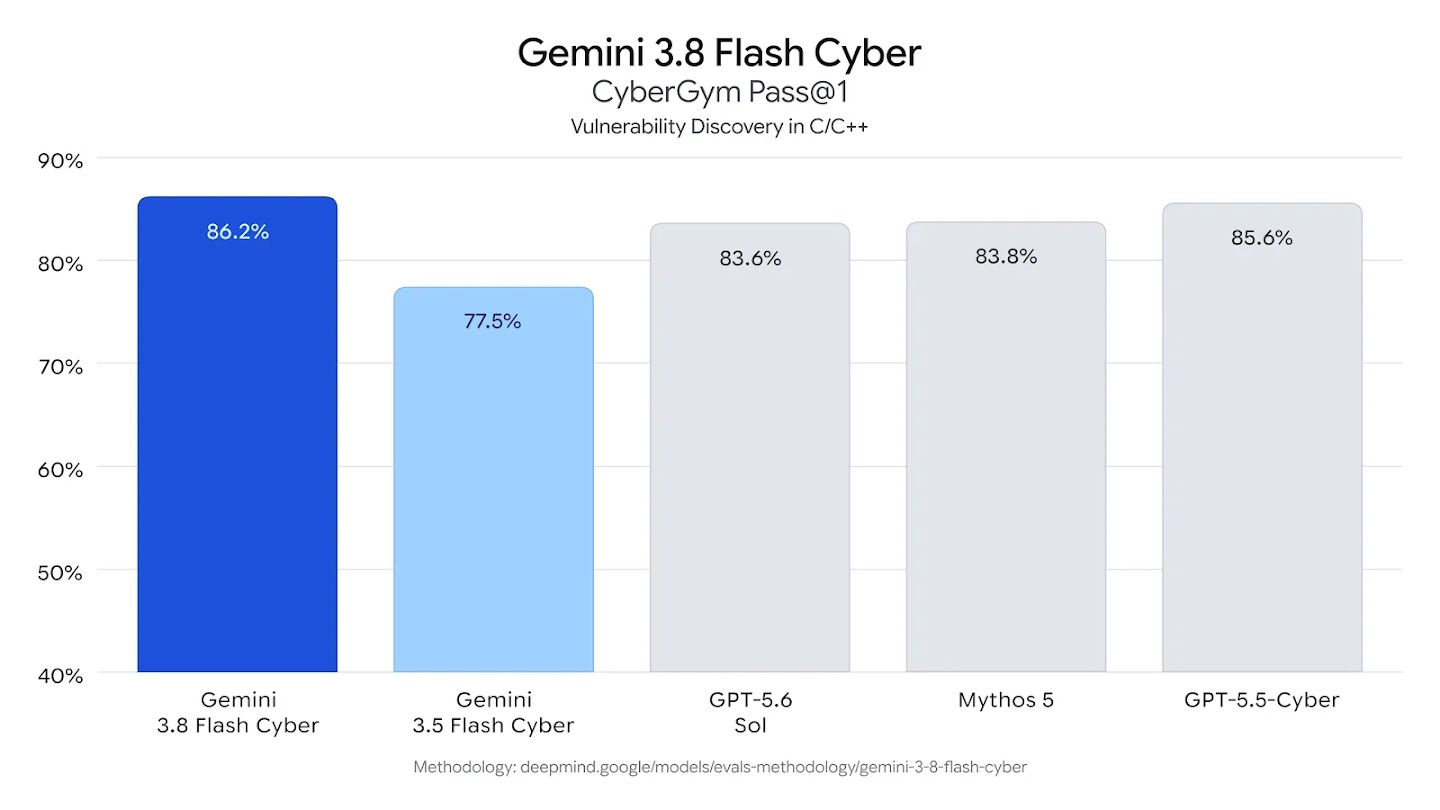
Google DeepMind reports 86.2% pass@1 for Gemini 3.8 Flash Cyber on CyberGym. Source: Google DeepMind.
The security example also exposes the limit of “cheap retries.” A patch can pass tests and still introduce a new vulnerability. High-frequency generation is useful only when the acceptance system includes security scanners, regression tests, and human review for sensitive changes.
GPT-6 Astra is the controlled deep-work route
Flash is attractive when failure is cheap and visible. GPT-6 Astra becomes more attractive when an agent must operate a complex application, preserve the reason behind earlier decisions, and stay inside a narrow permission boundary.
On Agents’ Last Exam, which covers work inside professional software, OpenAI reports 59.3% for Astra at its highest configuration. The same chart lists Claude Opus 5 at 55.5% and GPT-5.6 Sol at 53.6%. OpenAI also says Astra used roughly 65% fewer output tokens than Opus 5 at the top-scoring setting. In an OSWorld 2.0 latency simulation, Astra completed 72.6% of tasks in about forty minutes per task, compared with GPT-5.6 Sol’s 65.7% in about seventy-five minutes.
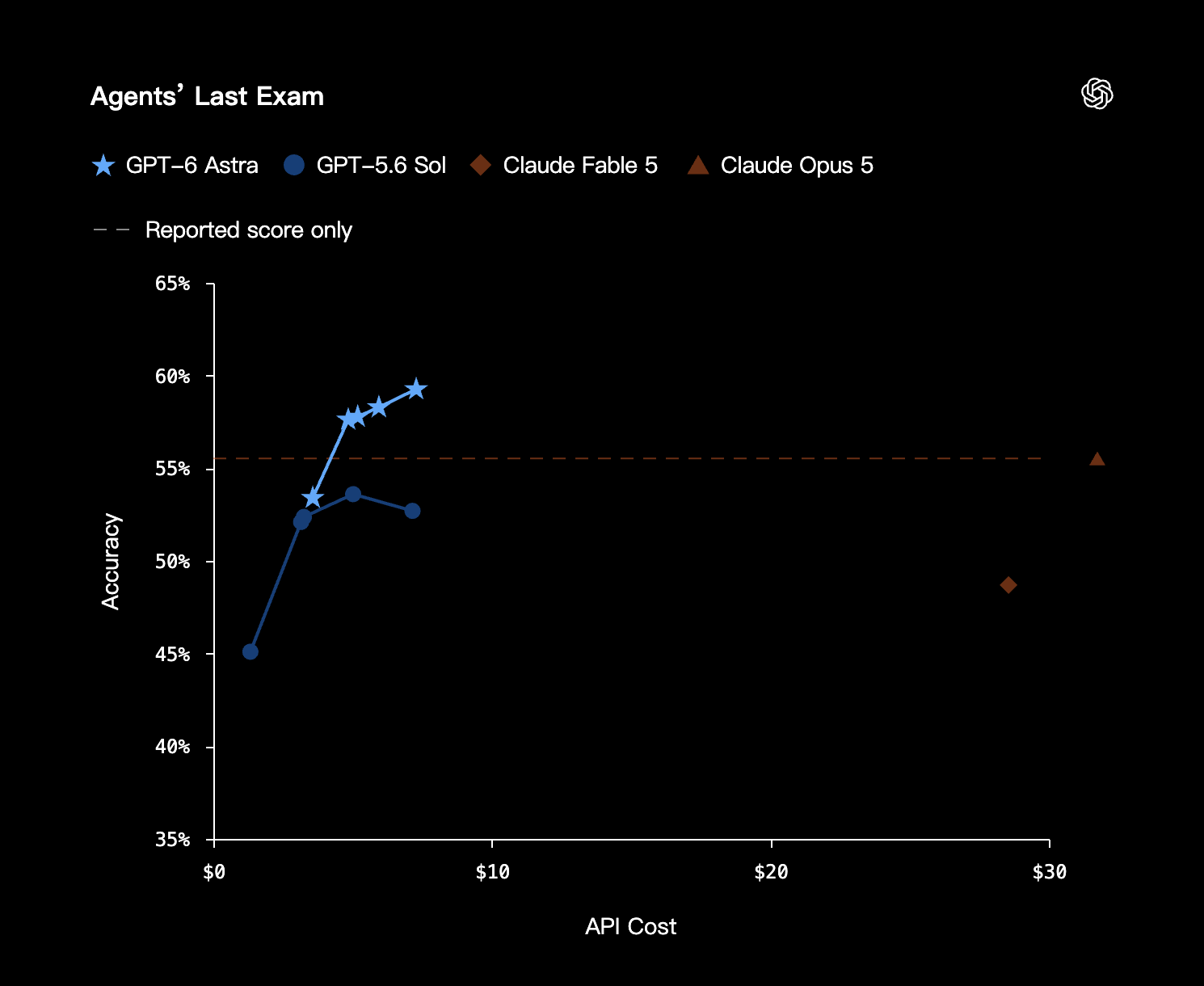
OpenAI’s chart reports 59.3% for GPT-6 Astra at its highest configuration, versus 55.5% for Claude Opus 5 and 53.6% for GPT-5.6 Sol. Source: OpenAI.
OpenAI’s demos include routing a PCB in KiCad, moving Blender assets into Unreal Engine 5, building Power BI reports, and completing complex forms. These are stateful workflows: one wrong action can corrupt later steps, and “undo” may not restore an external system.
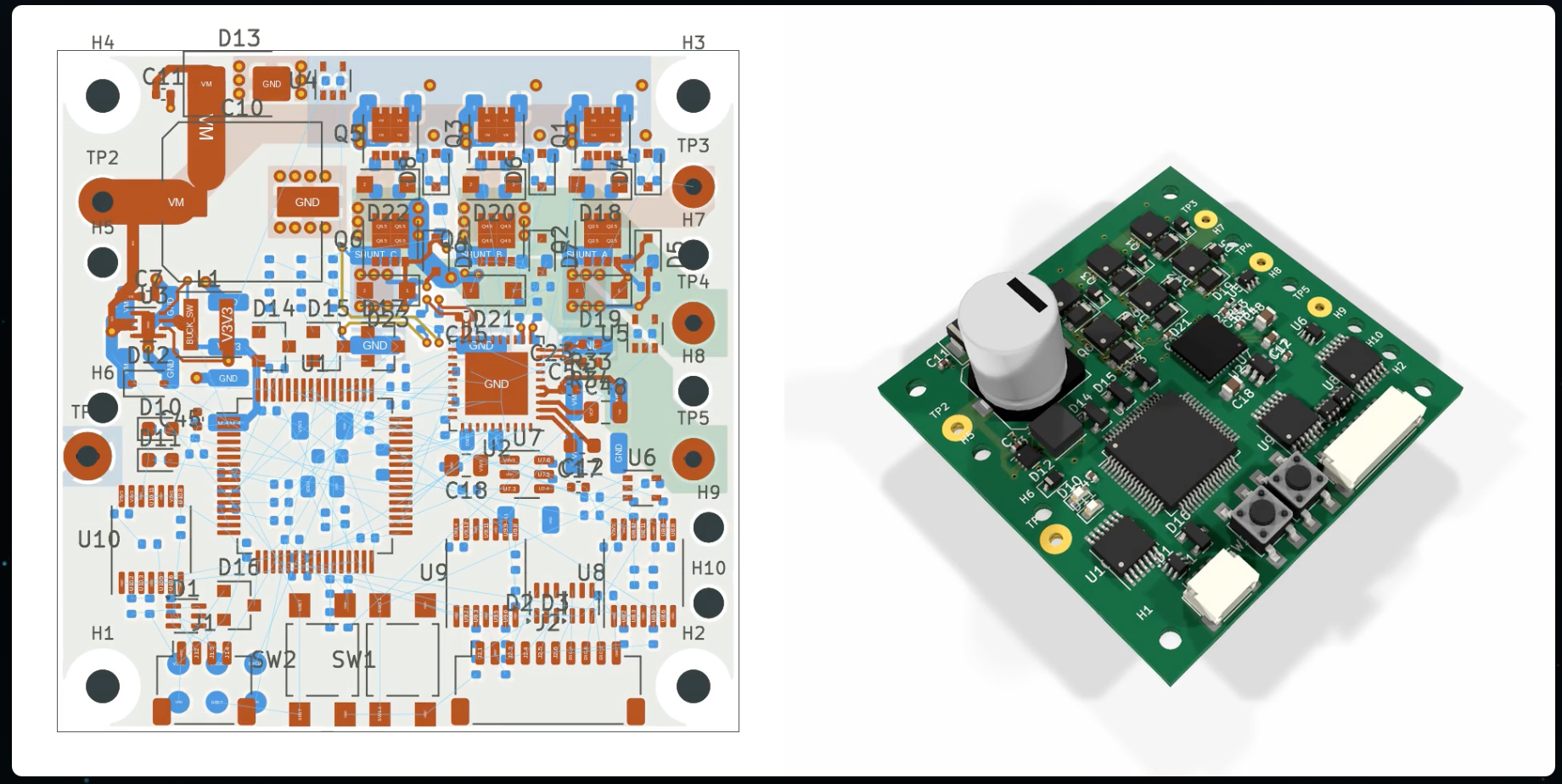
OpenAI’s KiCad demonstration shows the generated PCB layout and corresponding rendered board. Source: OpenAI.
The notes-across-context-windows workflow shown in Codex also matters, but it is a model-and-tool-environment combination, not something to assume every plain API call supplies. Instead of compressing an entire investigation into one summary, Codex can retain structured notes about requirements and failed attempts while keeping earlier windows searchable. OpenAI reports 57.9% for Astra on Terminal-Bench 4.0, compared with 55.8% for Fable 5.1 and 37.3% for GPT-5.6 Sol under the published configurations.
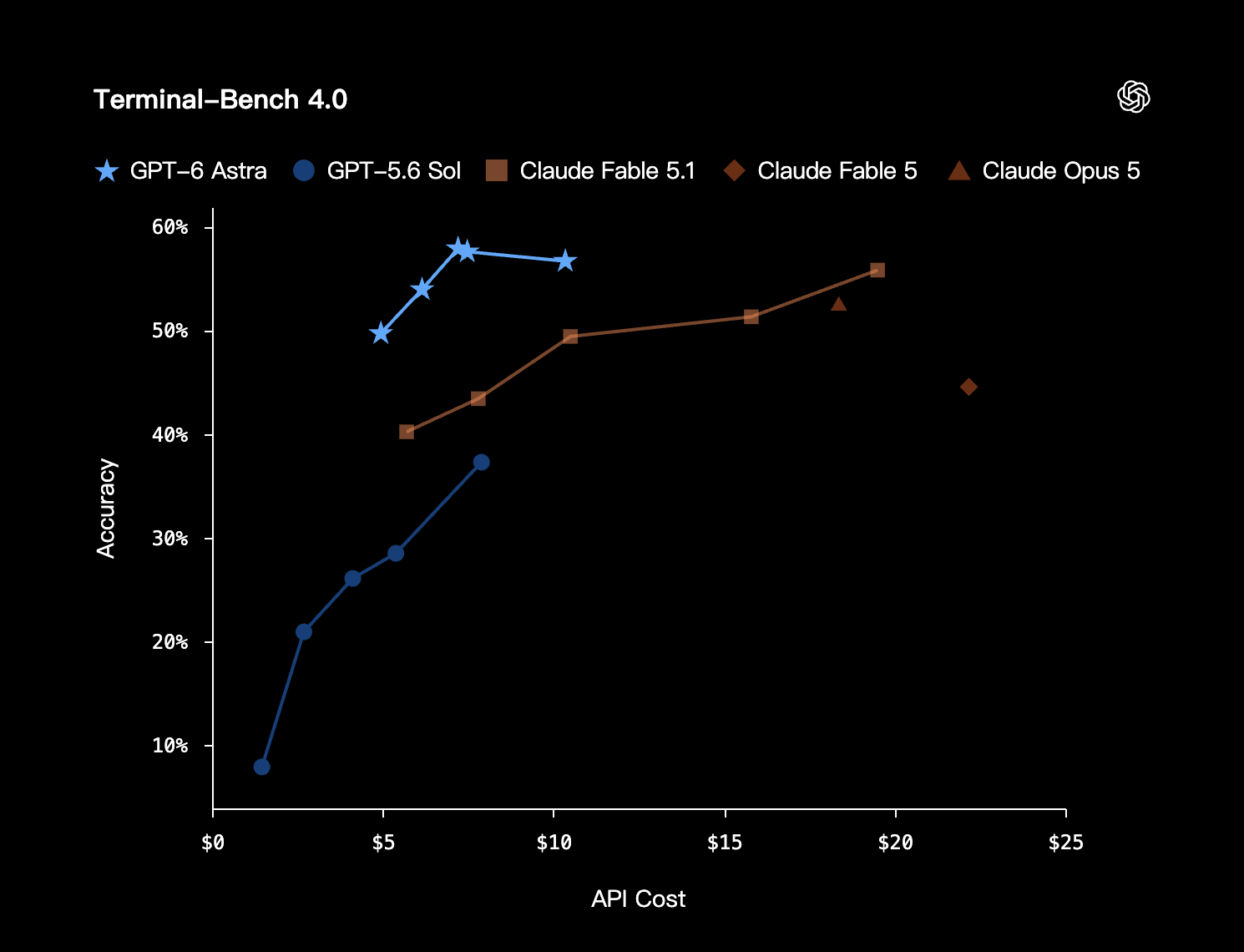
OpenAI’s Terminal-Bench 4.0 chart displays accuracy together with API cost at multiple reasoning settings. Source: OpenAI.
The reason not to make Astra the default for every request is straightforward: fixed-field extraction, formatting, or a narrow patch with complete tests may not gain enough from premium reasoning to justify the latency and cost. Astra belongs where control and depth change the acceptance rate.
Claude Fable 5.1 is the sustained-investigation route
Claude Fable 5.1 and the restricted-access Mythos 5.1 emphasize another kind of work: staying with a technical or scientific investigation until the evidence reaches a lower layer.
Anthropic’s Millennium case is a useful example. A crash occurred about once in a million runs and had resisted explanation for four to five years. Fable 5.1 followed the path into an external dependency, disassembled the vendor library, and identified the underlying bug. A shallow repair might have swallowed the exception; this investigation changed the diagnosis.
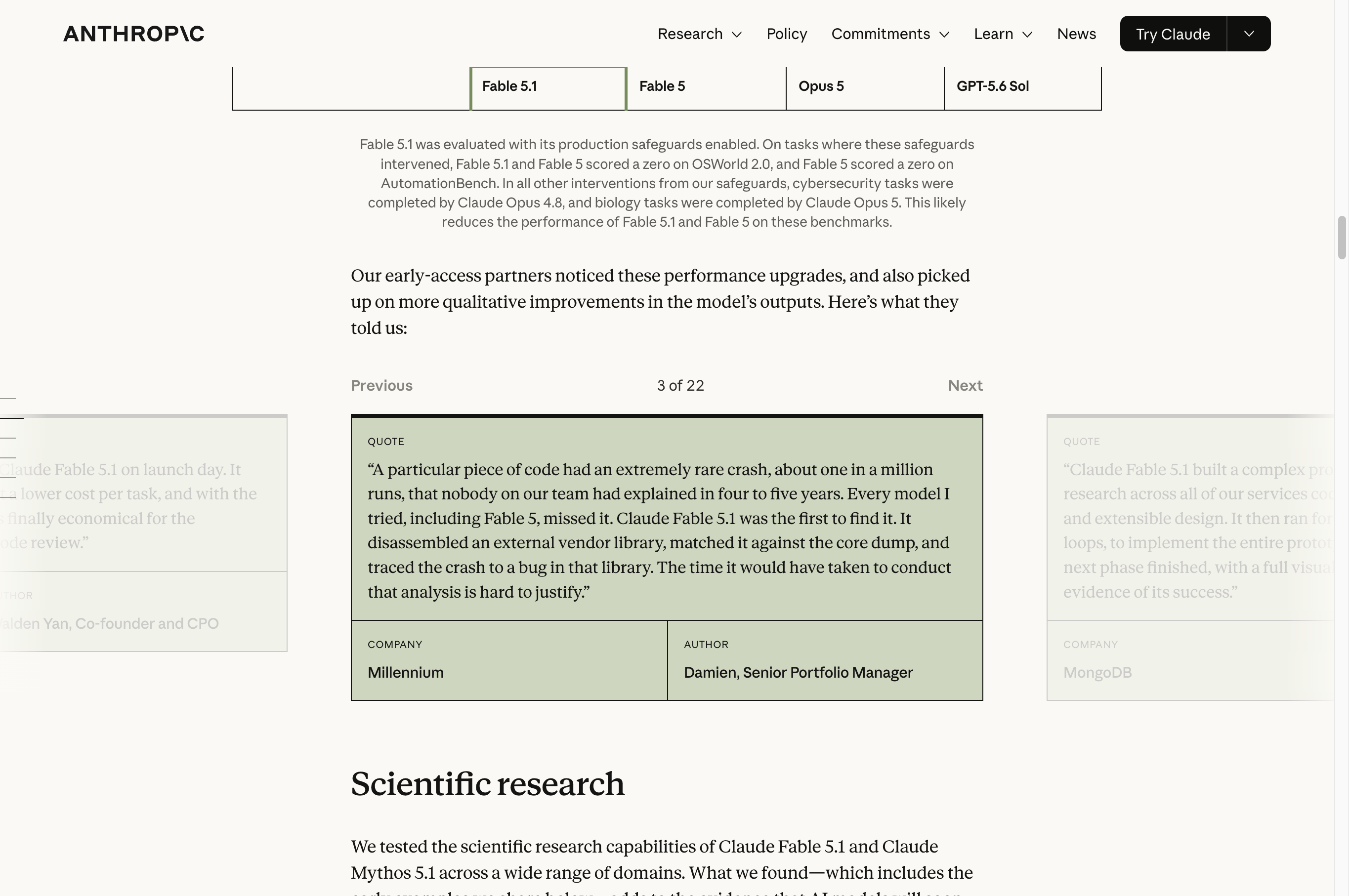
A Millennium portfolio manager describes the once-per-million-run crash and says Fable 5.1 found the vendor-library bug through disassembly. Source: Anthropic.
The scientific cases make the same point with external checks. Anthropic says Fable trained a neural network on Magellan radar data to produce a new Venus elevation map with useful detail improving from 10–20 kilometres to 2–3 kilometres. In protein design, Mythos-generated candidates went to an external laboratory; Anthropic reports a hit rate near 50% across twelve targets. These are stronger signals than a model grading its own answer, although they remain provider-published case studies rather than independent model rankings.
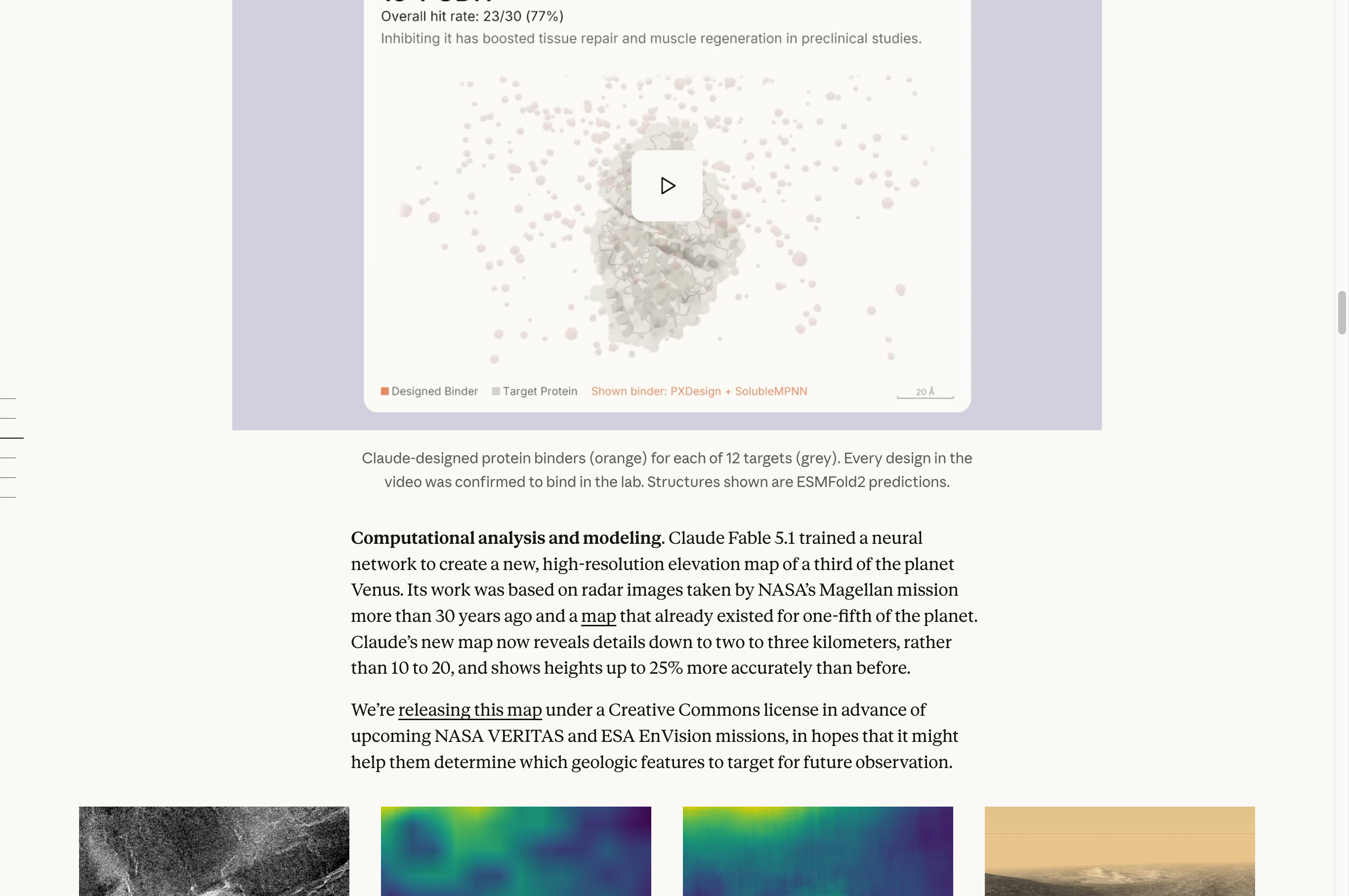
Anthropic states the mapped area, the 10–20 km to 2–3 km detail improvement, and the elevation-accuracy gain. Source: Anthropic.
Anthropic reports 55.8% for Fable 5.1 on Terminal-Bench 4.0 and 60.9% for Mythos 5.1. Cache reads fell from $1.00 to $0.25 per million tokens—a 75% reduction. Anthropic estimates roughly 25% lower cost for typical workloads and as much as 45% for highly agentic work.
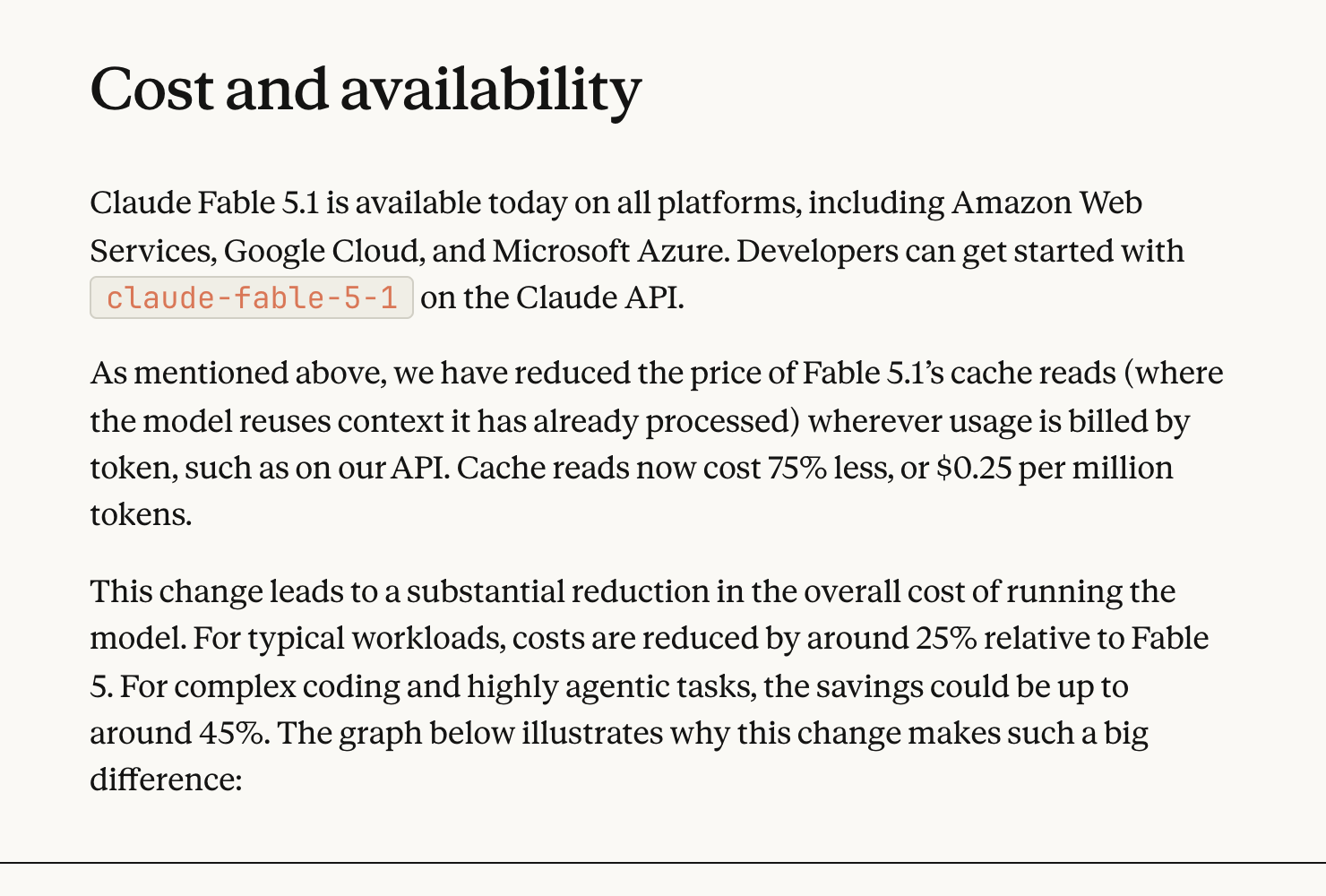
Anthropic lists the $0.25 cache-read price and its estimated 25% to 45% workload savings. Source: Anthropic.
Verify the actual interface before a SandBase trial
Check current model names, input limits, and request prices on the Gemini 3.8 Flash model page, Anthropic listing, and model catalog, then use the integration documentation. Vendor benchmarks, official list prices, and a SandBase bill are different evidence.
A plain model interface does not automatically supply a professional desktop environment, Mythos eligibility, or Flash Cyber access. Validate a small request with the exact model before connecting a repository and test tools.
The same-task Astra / Fable test compares concrete outputs and costs. The Gemini low-cost coding analysis focuses on Flash’s own retry economics. This page’s distinct question is how to assign the next attempt after a task fails.
Frequently asked questions
Which model should an enterprise agent use by default?
Use Gemini 3.8 Flash first only when the task is reversible and an independent automated check can reject failure. Otherwise begin with a deeper model or human approval.
Why not send every task to GPT-6 Astra?
Many tasks are limited by throughput and cost rather than deep reasoning. Extraction, formatting, and narrow tested edits may not gain enough to justify a premium route.
When should Flash escalate to Fable 5.1?
Escalate when repeated candidates fail differently, the root cause lies in an external dependency, or the investigation lacks a short deterministic acceptance test.
Can benchmark scores determine the route?
No. Harnesses, tools, time limits, reasoning settings, and repositories differ. Use published scores to form a shortlist, then test the models with the same internal tasks and acceptance rules.
How should retry limits be set?
Set them before execution using task cost and risk. Two or three attempts may be reasonable for a reversible tested change; an external financial or security-sensitive write requires authorization and an operation ID or state check to avoid duplicate execution.