Can Cursor Still Use OpenAI? Alternatives and BYOK
Can Cursor still use OpenAI? Check GPT-6 Astra support, why an API key can work outside Cursor but fail inside it, BYOK limits, and replacement models.
An OpenAI key can work in your own API client without making the same model available in Cursor. For developers choosing whether to keep their current editor setup, two checks come first: the exact model in Cursor’s picker and the feature that will use it. GPT-6 Astra needs that check too; a working provider key is not proof of Cursor support. Separately, OpenAI’s August 28 announcement proposes ending direct model supply on November 12, 2026, not an immediate shutdown of every existing GPT option.
Key takeaway
- November 12 is the proposed shutoff date in OpenAI’s announcement, not an outage that has already happened.
- A platform-wide 5% traffic share does not describe the exposure of a team that runs long GPT-based agent tasks.
- Claude is a candidate for complex engineering; Gemini offers a different-provider candidate; GLM-5.3 is relevant for cost, self-hosting, and external API workflows, but direct Cursor availability must be confirmed in the current model picker.
- BYOK means bringing your own provider API key, not replacing every Cursor feature: custom keys support chat models, while Tab stays on Cursor’s built-in models.
Can GPT-6 Astra run in Cursor?
Do not assume it is supported just because your OpenAI API key works. The Cursor BYOK page, checked September 10, 2026, lists OpenAI support as “Standard, non-reasoning chat models” and directs users to the model picker for availability. That page does not establish GPT-6 Astra support. This update is a documentation-based check, not a successful Astra-in-Cursor test.
Open Cursor Settings → Models, find the OpenAI provider, and check the model picker in the feature you intend to use. If the exact model is absent, do not plan a migration around it. If it appears, test that feature in a disposable repository before moving company work; the label alone does not prove that tool calls and multi-file edits work.
Keep three routes separate: a model supplied through Cursor, an official provider key entered through BYOK, and a third-party relay that translates requests. A relay is another service that may receive your key or code; a community report about one is not evidence of official Cursor support. This article has not tested a relay and does not recommend handing credentials to one. The November cutoff is a separate contract question, not a promise that Astra will become available before it.
This is a countdown, not an immediate GPT outage
OpenAI’s announcement is specific. The company says it notified SpaceX that it intends to wind down the contract that provides OpenAI models to Cursor, with a proposed shutoff date of November 12, 2026. It describes that date as the maximum notice period allowed by the contract, giving developers time to migrate.
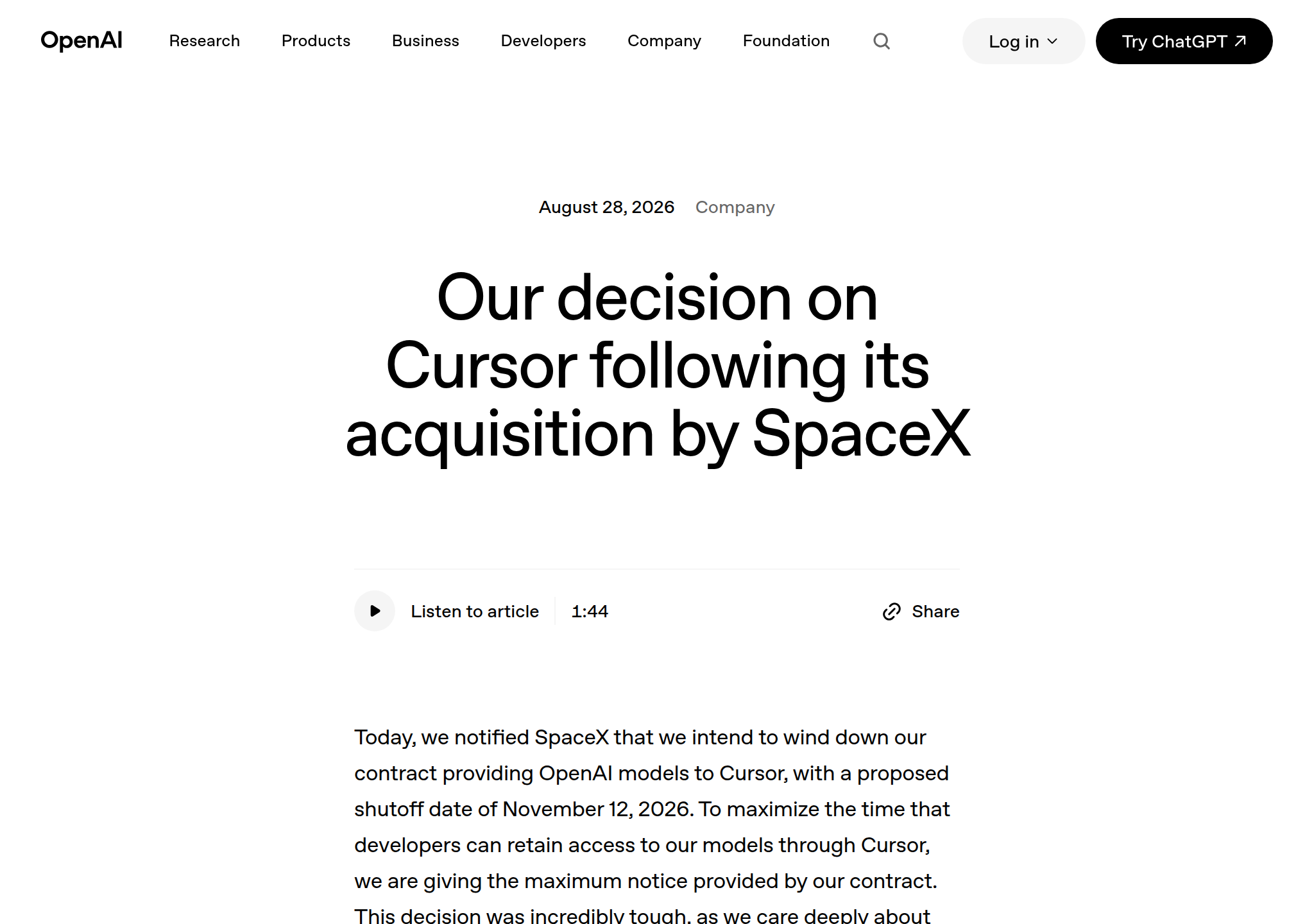
OpenAI’s announcement states the proposed shutoff date of November 12, 2026.
The trigger is Cursor parent Anysphere’s acquisition by SpaceX and the change-of-control provision in the contract. OpenAI also says Astra, described as upcoming in the August announcement, requires a “new level of accountability” around compliance with its terms.
That wording does not mean every OpenAI key stops working on November 12, nor does it promise that Astra will ever appear in Cursor. The bounded conclusion is narrower: direct OpenAI supply inside the Cursor subscription is on a clock, while bring-your-own-key access remains subject to later clarification.
That distinction matters. Describing the announcement as “Cursor can no longer use OpenAI” makes the deadline sound immediate. Treating BYOK as a guaranteed loophole is equally premature.
Separate three model-access paths in Cursor
| What you use | What to check | What not to assume |
|---|---|---|
| OpenAI models bundled in Cursor | Proposed cutoff and current model picker | Every new GPT model will arrive before the cutoff |
| An official provider key, or BYOK | Supported provider, account access, provider bill | Guaranteed access after November 12 |
| A CLI or custom agent outside Cursor | Client protocol, route, tool permissions | Any compatible endpoint can be pasted into Cursor |
The Cursor BYOK documentation, checked September 10, still lists OpenAI, Anthropic, Google, Azure, and AWS Bedrock. Use the exact supported model, not the provider name alone, when choosing a replacement.
What a working API key does—and does not—confirm
A key that works in a provider’s own client proves neither that Cursor offers the same model nor that every editor feature can use it. Check the official BYOK limits before comparing model quality.
| Question | Current documented limit | What to verify before switching |
|---|---|---|
| Can I use any OpenAI model? | The OpenAI entry specifies standard non-reasoning chat models | The exact model must appear in your account’s supported picker |
| Does my key replace Tab completion? | No; Tab continues to use Cursor’s built-in models | Test chat and Tab separately |
| Does Cursor pay for my provider usage? | BYOK usage is billed through your provider account | Check that account’s billing; do not assume a Cursor subscription covers it |
| Does Cursor’s zero-data-retention policy cover BYOK? | No; the chosen provider’s privacy terms apply | Confirm those terms before sending company code |
The API works, but Cursor fails: what should I check?
Use this order to separate account access from editor compatibility. These are diagnostic steps, not recorded test results or a guaranteed fix.
- Compare the actual requests. Record the model ID, provider, and API endpoint from the successful request, then the model selected in Cursor. A successful request to a different GPT model or through a different gateway does not validate the Cursor combination.
- Check the saved provider key. Go to Cursor Settings → Models → OpenAI. Cursor’s instructions say to enter the provider key and click Save. An invalid or provider-rejected key makes that provider’s requests fail until it is updated or removed. A ChatGPT subscription does not by itself demonstrate that this API account has the required access. Check the provider account rather than repeatedly changing the prompt.
- Separate chat from Agent edits and Tab. In a disposable repository with no secrets, first request a short text answer, then a small file edit. If text works but an Agent action fails, save the error and selected feature for support; a chat success does not validate tool-call handling. Tab is a separate check because custom keys do not replace its built-in models.
- Keep a useful, redacted error record. Note the Cursor version, time, model ID, feature, error text and request ID if shown. Remove API keys, authorization headers and private code before sharing it. For a missing model, use a supported option; for a rejected key, resolve provider access; for an Agent-only failure, report the specific tool step instead of claiming the entire API is down.
If a proposed workaround adds a local proxy or remote relay, check who receives credentials and whether it changes the request format. Do not disable approvals or send company code through an unreviewed service merely to make one demo succeed.
Why “5% of traffic” may not describe your exposure
Truell’s response provides the most useful number from Cursor itself: OpenAI models serve about 5% of Cursor user traffic, and the company is talking with OpenAI about the decision.
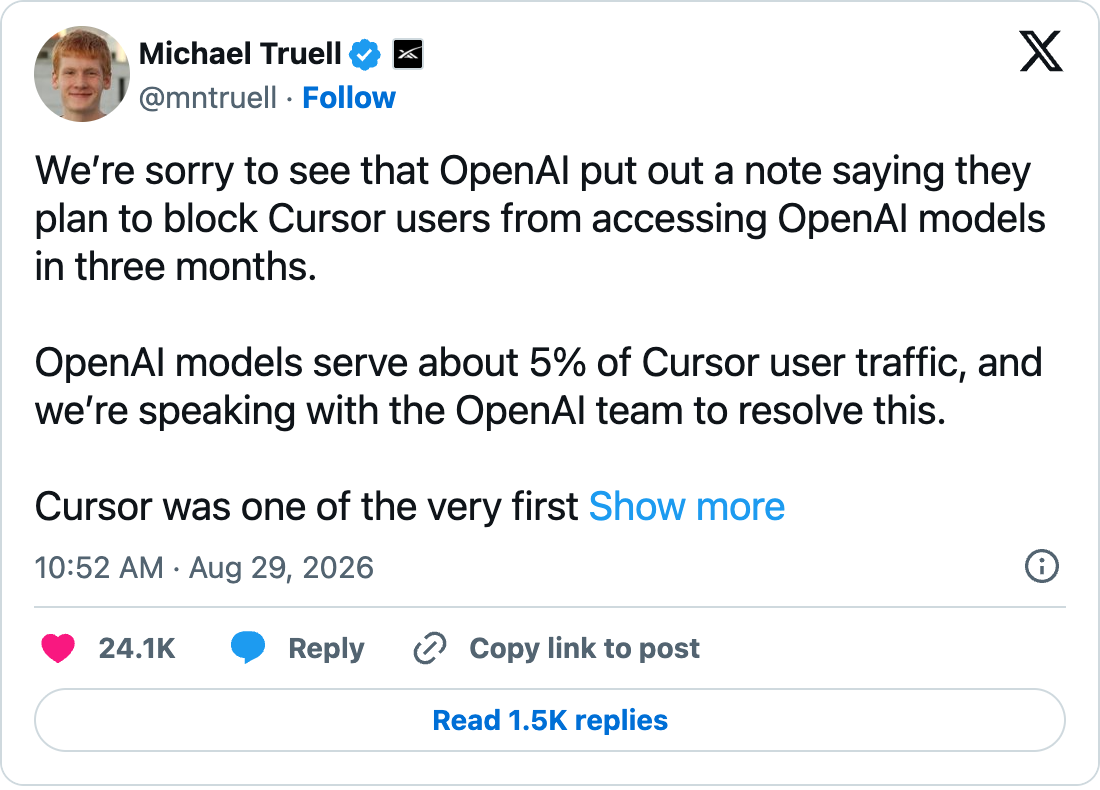
Michael Truell says OpenAI models serve about 5% of Cursor user traffic.
The number shows that Cursor’s multi-model strategy has already diversified some supply risk. It does not answer how exposed a particular team is.
A developer who mainly accepts Tab completions and occasionally asks for an error explanation may barely notice the change. A team that runs long GPT-based agent jobs, code review, or internal automation can have a small number of requests with a much larger token bill and much higher retry cost. For that team, 5% is not a useful risk ceiling.
Audit three things instead: whether a default model is hardcoded in team rules, whether automation expects a specific model name or response format, and whether procurement assumes that OpenAI access is bundled with Cursor.
Three questions matter more than a leaderboard position
First, does the model finish your actual tasks reliably? Public leaderboards are useful for filtering candidates, but they are not your repository. Single-file repair, cross-repository refactoring, design-to-code, and terminal work stress different capabilities.
Second, is the backup supply path genuinely independent? If both the primary and fallback depend on the same provider, contract, or platform route, a multi-model menu does not remove the underlying concentration risk.
Third, what does one failure cost? An agent run costs more than its API line item. Count retries, review time, and rework after a plausible but incorrect patch. A cheaper model that repeatedly stalls at 80% may be the more expensive choice.
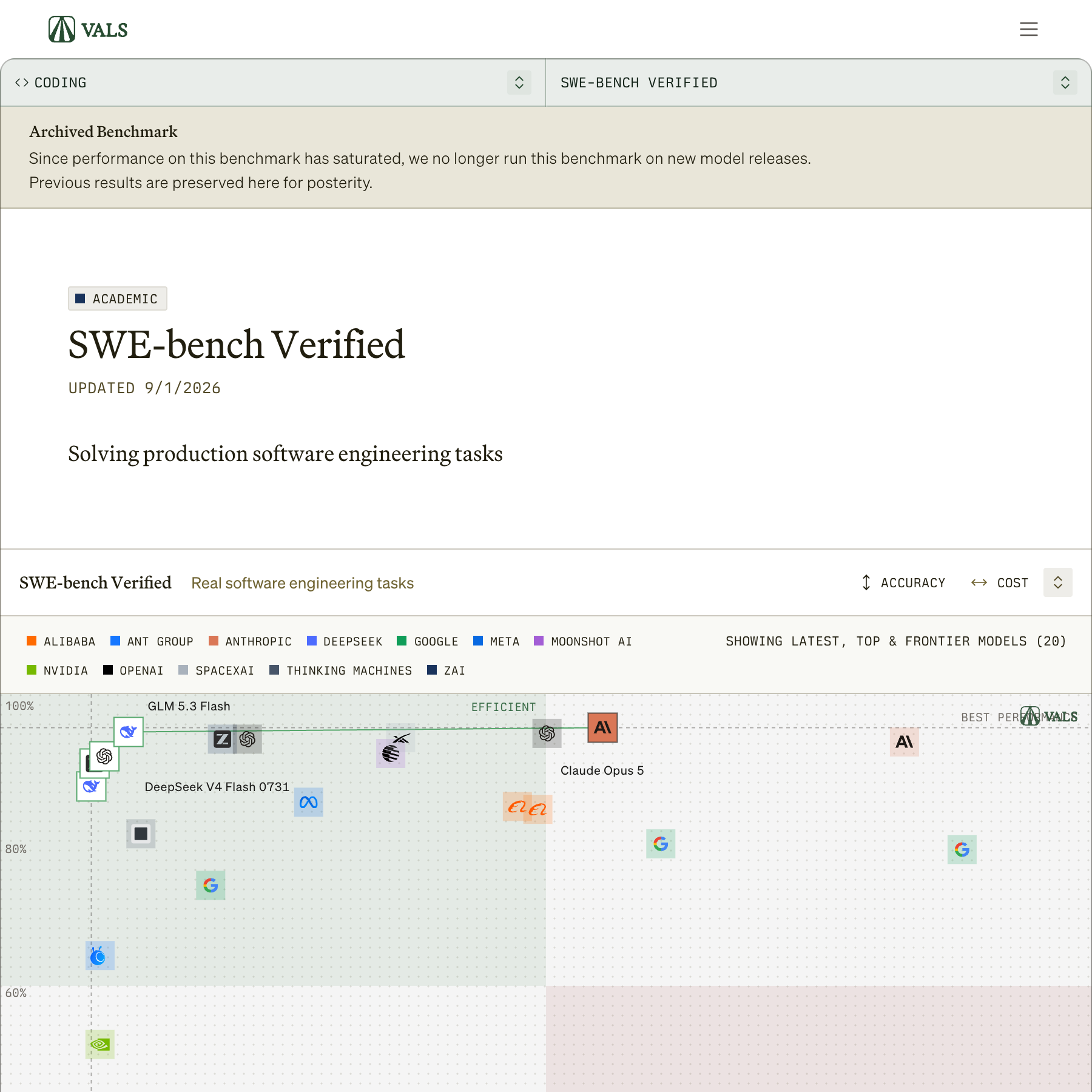
Vals AI’s SWE-bench Verified page is marked as updated September 1, 2026 and archived: it no longer tests new model releases. These historical results do not replace tests on your current repository.
This is also why this guide does not convert one public score into a “real engineering success rate.” Benchmark harnesses, tool permissions, sampling parameters, and model versions differ. Read the methodology before treating two percentages as directly comparable.
Which option fits which workload?
Claude: check available versions, then test complex work
For cross-file changes and long debugging, start with a Claude version your account can actually select. Opus 4.6 was the original comparison candidate, not a claim to represent September’s newest model ranking. Anthropic’s official announcement positions coding and agent work as core use cases, and Cursor officially supports Anthropic API keys.
Fable 5.1 launched September 1 and can be added to the evaluation shortlist; see the Fable 5.1 capabilities and pricing review. Availability through Anthropic’s API does not mean this article has verified every feature in your current Cursor account.
The trade-off is straightforward: flagship models are not the low-cost option. Do not route every completion, explanation, and formatting request through the same flagship. Reserve it for work where failure is expensive.
GLM-5.3: relevant when cost and autonomy matter
GLM-5.3 matters for more than price. Z.ai’s official documentation says it improves 50% over GLM-5.2 on the internal Z.ai Code Bench and reaches open-source SOTA on public evaluations including Terminal-Bench 3.0. It also reports a DeepSWE v1.1 increase from 46.2 to 66.9. Those numbers establish version-over-version progress; they do not remove the need to test your own tasks.
The integration boundary needs care. Cursor’s current BYOK documentation lists OpenAI, Anthropic, Google, Azure OpenAI, and AWS Bedrock. It does not promise that any OpenAI-compatible endpoint can be added as a first-class Cursor model. Confirm GLM-5.3 in the current model picker or Cursor documentation before planning an in-editor migration. Otherwise, use it in a CLI, internal agent, or self-hosted workflow outside Cursor.
Gemini: test a different provider
Gemini 3.1 Pro was the original comparison candidate and can serve as a second model: switch when Claude stalls on a repository or when a high-impact patch needs an independent pass. Google is explicitly supported by Cursor’s BYOK documentation, so the integration boundary is clearer than it is for an arbitrary compatible endpoint.
Whether Gemini should become the primary model is an empirical question. Pick five common jobs—a cross-file bug, a UI component, missing tests, an unfamiliar module explanation, and terminal debugging—and record completion, human-edit time, and wall-clock time.
Cursor’s built-in models: a practical fallback for light work
Cursor-controlled models are most useful for Tab completion, short edits, and low-risk requests. Their strategic advantage is product integration and a supply path Cursor controls more directly, not necessarily a top public benchmark score. Keep an external flagship available for complex agent work or review.
| Option | Best fit | Main boundary | Pre-migration test |
|---|---|---|---|
| Claude Opus 4.6 | Complex agents, cross-file edits, long debugging | Higher cost | Three real tasks with a high failure cost |
| GLM-5.3 | Budget-sensitive, external API, self-hosted, or compliance workflows | Direct Cursor availability must be confirmed | Check provider support, then test a CLI or internal agent |
| Gemini 3.1 Pro | Second opinion and independent review | Do not promote it from a public score alone | Run the same regression suite as Claude |
| Cursor built-in models | Tab completion, short edits, low-risk requests | Complex-task limits require testing | Measure acceptance rate and rework time |
A three-step migration before November 12
1. Inventory dependencies. Check default models, project Rules, automation, and procurement. Do not stop at “who uses GPT?” Ask which tasks will change format, latency, or failure rate when the model changes.
2. Build a small regression suite. Choose three to five tasks that actually happened in your repositories. Freeze the prompt, code revision, and acceptance criteria. Run each candidate at least twice, then record first-pass completion, human edits, total time, and approximate cost.
3. Separate primary and fallback. Use the most reliable model for complex work, a cheaper model for completion and low-risk tasks, and a backup from a different provider. Enterprise teams should also put model migration, data handling, and budget changes into the procurement plan before November 12.
Do not retire the current setup after a successful chat alone. Confirm that the replacement covers the editor features your team uses and that the separate provider bill and data terms are acceptable.
Testing API alternatives outside Cursor
If your team also runs a separate CLI, batch job, or custom agent, check candidates in SandBase’s model catalog and use the documentation to verify the client protocol, model ID, billing, and tool-call support. Validate a small request before reconnecting the original regression tasks.
This is a candidate path outside Cursor, not a claim that a SandBase key can be pasted into Cursor’s official-provider field. Switching an API also does not transfer Cursor Rules, Tab completion, or account-level privacy arrangements.
Bottom line
The lesson is not “never use OpenAI.” It is that a development workflow should not depend on one direct-supply contract. OpenAI’s proposed November 12 deadline leaves enough time for a measured migration rather than a last-week leaderboard bet.
Start with a currently available Claude model for heavy agent work, consider GLM-5.3 for cost, autonomy, and external workflows, use Gemini 3.1 Pro as a second model, and leave completion or low-risk tasks to Cursor’s built-in models. The final choice should be driven by your repository, failure cost, and supply path.
FAQ
Can I still use GPT models in Cursor now?
The announcement is not an immediate shutdown notice; its proposed date is November 12, 2026. Check your account’s current model picker for specific GPT availability rather than assuming every model is supported. BYOK access after the deadline remains subject to later OpenAI and Cursor clarification.
Why is OpenAI ending direct supply to Cursor?
Anysphere, Cursor’s parent company, was acquired by SpaceX, triggering a change-of-control provision. OpenAI also cites past contract and terms-of-service disputes involving Musk companies.
Does the 5% traffic share mean the impact is small?
It may be small for light users, but a platform request share does not describe one team’s token consumption, long-running agent dependence, or retry cost. Audit your own workload.
Can GLM-5.3 be added through any OpenAI-compatible endpoint?
Do not assume so. Cursor’s current BYOK page lists OpenAI, Anthropic, Google, Azure OpenAI, and AWS Bedrock. Confirm GLM-5.3 in the current model picker and official documentation before planning a direct Cursor integration.
Will BYOK keep OpenAI working after November 12?
That is not established by the current support page. It documents an access method, not an exemption from the proposed direct-supply cutoff or a guarantee of future model support. Keep a tested alternative and follow subsequent OpenAI and Cursor announcements.
Can a SandBase key replace an official provider key in Cursor?
This article has not verified that integration. The SandBase links in this article concern a separate CLI or custom API application, not a promise of direct Cursor support. Protocol compatibility alone does not establish editor, model, or tool support.
What should a migration test first?
Use three to five tasks that previously caused real rework, such as a cross-file bug, terminal debugging, or missing tests. Track first-pass completion, human-edit time, total time, and cost.
Sources
- OpenAI: Our decision on Cursor following its acquisition by SpaceX
- Michael Truell’s response on X
- Cursor: Bring your own API key
- Vals AI: SWE-bench Verified
- Z.ai: GLM-5.3 documentation
- Anthropic: Claude Opus 4.6
Related: Cursor vs Windsurf vs Claude Code and GLM-5.3 release date, API pricing, and benchmarks.