Hy4 preview for AI4Science: from molecular dynamics to quantum transport
How to read Tencent's Hy4 preview science examples as reproducible research workflows rather than headline claims.

The most misleading way to describe an AI-for-science system is “the model solved a hard problem.” Tencent’s Hy4 preview announcement is more interesting when read as a workflow: the model identifies bottlenecks, organizes experiments, runs code, compares results, and packages an artifact for review.
Tencent reports a 2× speed-up for a 32,512-atom molecular-dynamics system, reaching 54.9 ms per step, and says one high-end GPU can hold 300,000 atoms. The important question is whether the optimization preserves trajectories, energy behavior, and numerical accuracy across hardware—not just whether one timing number improved.
For a low-temperature quantum-transport design, Tencent reports reducing average high-energy leakage from 48.2% to 4.8% while producing an interactive solver. That result depends on boundary conditions, potential barriers, grid resolution, and solver settings. Without the full configuration and an independent implementation, it remains a promising reported result.
The announcement also cites progress on the 3D Blaschke–Lebesgue problem and links a proof PDF. The responsible next step is to inspect definitions and assumptions and ask a domain expert to review the derivation. A model-assisted proof is not automatically an independently verified theorem.
Key takeaway
- Read Hy4’s science examples as reported workflows and hypotheses, not finished discoveries.
- Preserve code, parameters, seeds, hardware, and logs so another researcher can replay the run.
- Validate speedups against numerical correctness, boundary conditions, and independent implementations.
- Human experts still own the decision to publish a result or use it in a laboratory.
Evaluate the research process
Scientific tasks rarely end after one prompt. Ask whether each hypothesis has an experiment, whether the experiment changes one clear variable, whether an independent script recomputes the result, and whether the conclusion distinguishes correlation from causation. Preserve code commits, dependencies, random seeds, hardware, and run logs.
Use least-privilege access for clusters, datasets, and network calls. Record request IDs, model versions, tokens, latency, and retries through a gateway when appropriate. The model can accelerate exploration, but researchers remain responsible for validation and publication claims.
Bottom line: Hy4 preview’s science examples show a model participating in experimental work, not replacing scientific review. Treat each headline result as a reproducible hypothesis with independent checks and expert oversight.
What a reproducible run should contain
For molecular dynamics, preserve the force-field version, integrator, timestep, temperature control, initial coordinates, and hardware details. A faster step is useful only if the trajectory remains stable and the measured quantities agree with a trusted baseline. Report warm-up and measurement windows separately; otherwise compilation and cache effects can dominate the comparison.
For quantum transport, keep the potential profile, boundary conditions, discretization, solver tolerances, and incoming wave packet in the fixture. Re-run the calculation with perturbed grid resolution and a second numerical method. If the leakage reduction disappears under a small change, the result is a sensitivity finding, not yet a robust design.
From model suggestion to lab decision
Hy4 can be useful as a research coordinator: it can split a question into experiments, call a notebook or simulator, inspect plots, and propose the next run. The hand-off between those steps is where most of the scientific risk lives. Require typed parameters, bounded compute budgets, and an immutable run record. A reviewer should be able to reproduce the claim without trusting the model’s narrative.
For the geometry result, the linked proof artifact is the right starting point for independent review. Check whether the definitions match the stated problem, whether every numerical bound is justified, and whether the result has been accepted by the relevant mathematical community. Keep “model-assisted derivation,” “machine-checked proof,” and “peer-reviewed result” as separate labels in the article and in any downstream press copy.
The same discipline applies to the model’s own infrastructure work. Tencent reports a 31.8% end-to-end throughput improvement after Hy4 analyzed operator fusion and communication bottlenecks. That claim is most useful when the baseline, context lengths, concurrency, hardware topology, and measurement window are published alongside the optimized run. A researcher can then distinguish a general systems insight from a configuration-specific win.
In practice, I would use Hy4 as an accelerator for experiment bookkeeping and hypothesis generation, with a human owning the final interpretation. Let the model prepare a run matrix, summarize failed trials, and draft the next experiment. Keep the acceptance decision outside the model loop, especially when a result could influence a safety, medical, financial, or publication claim.
Evidence screenshots
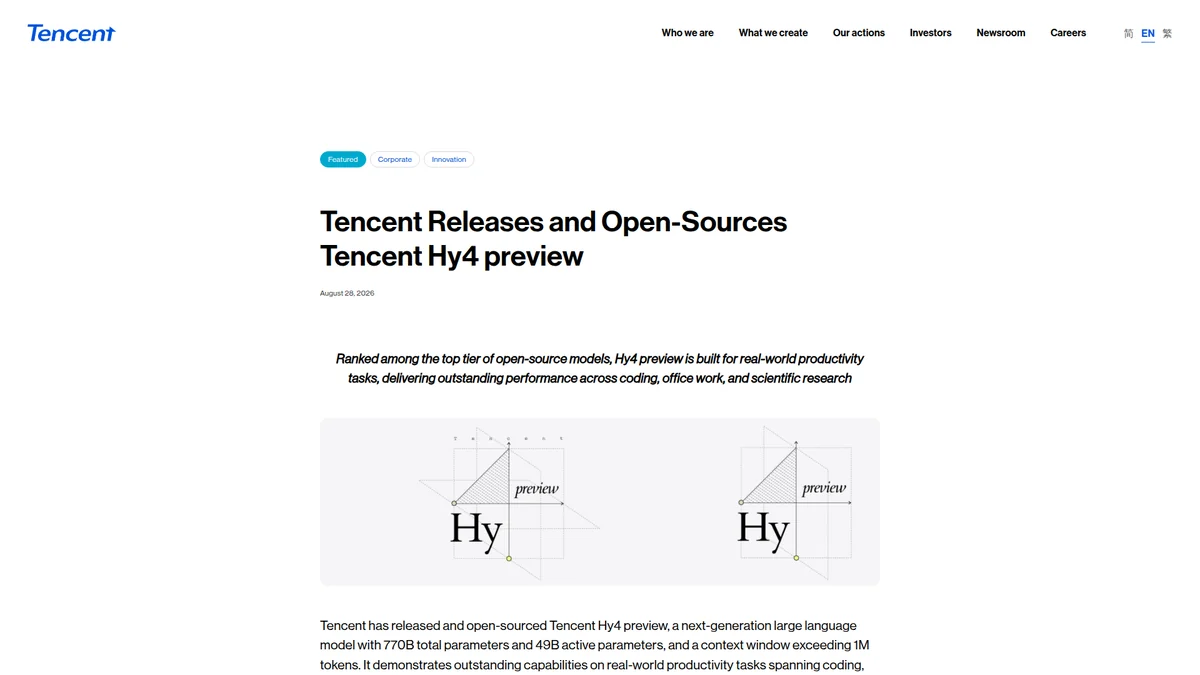
Figure 1. Tencent’s announcement describes the model’s science and infrastructure examples.
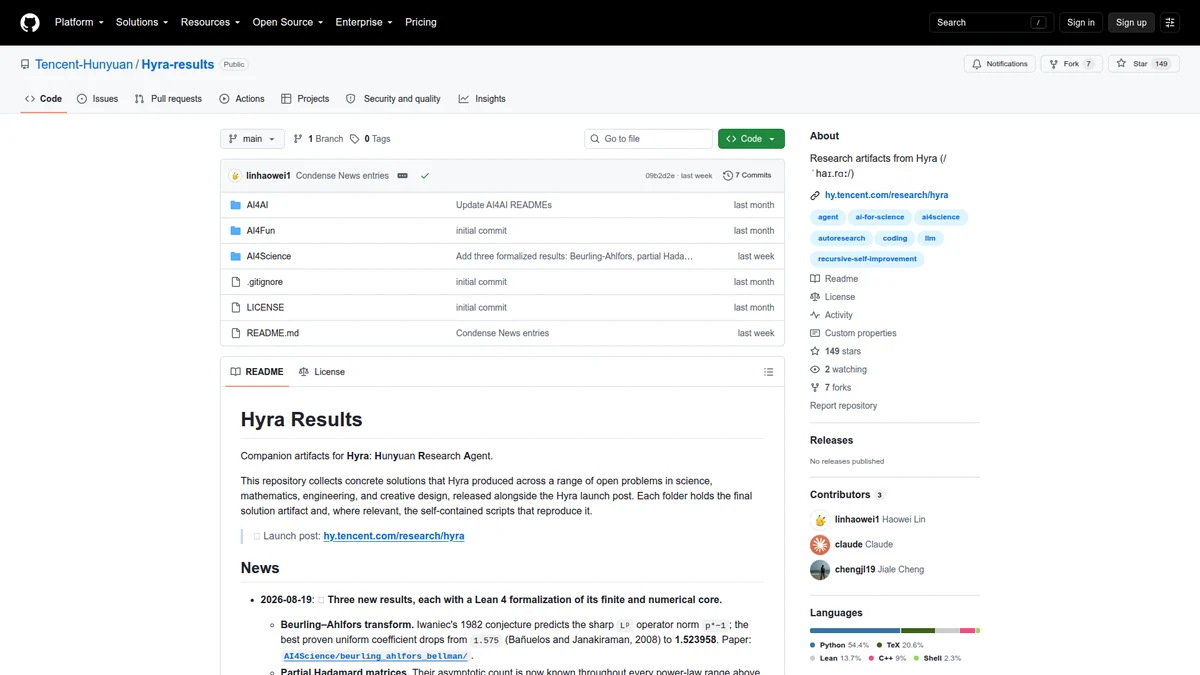
Figure 2. The linked Hyra results repository is the artifact trail for the reported experiments.
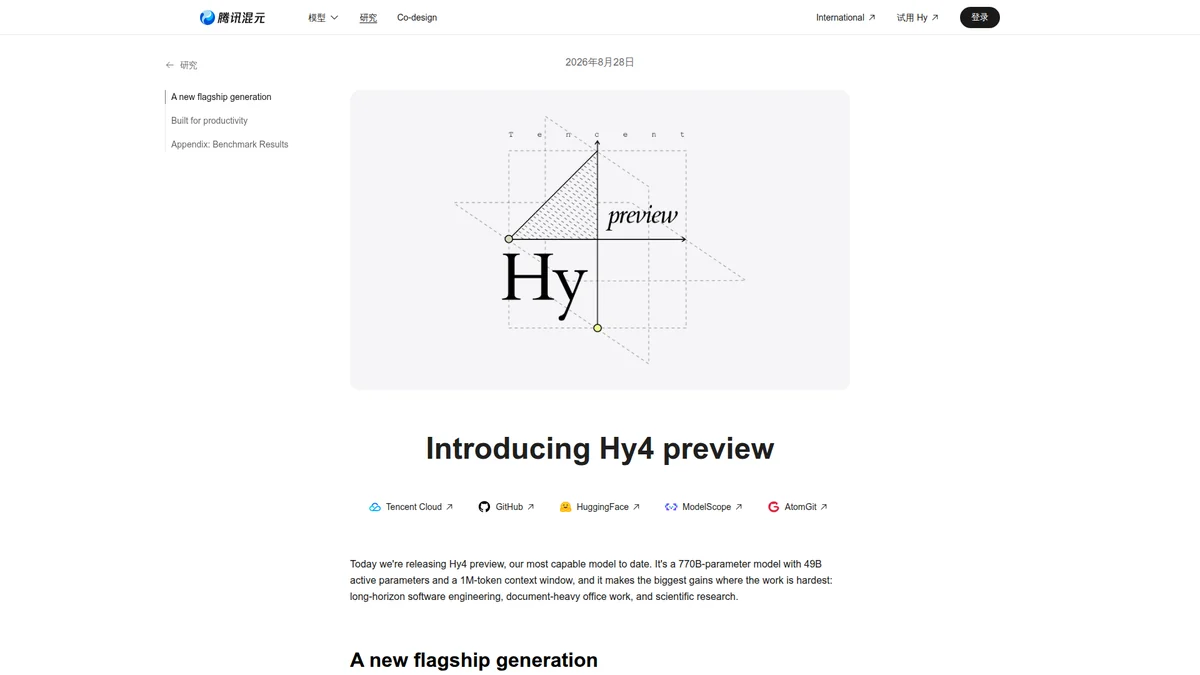
Figure 3. The research page provides the provider-level context for the reported science work.