Claude Code With Other Models: 11-Model Benchmark (2026)
Claude Code with other models benchmark: 11 models on SandBase, 6 Python repo tasks, 2 runs each, hidden tests. Pass rate, turns, time and list-price cost.
GPT-6 Luna fixed our pagination bug in 22 turns; Claude Opus 5.5 needed 5. Claude Code’s own JSON said the Luna run cost $0.33. At SandBase’s list price it was under a cent. Both numbers came out of the same run, and the gap between them is most of what this test is about.
We pointed Claude Code 2.1.246 at SandBase and swapped the model underneath it: 10 models from the brief, plus one substitute, each on 6 small Python repo tasks, twice, graded by hidden tests the agent never saw. This Claude Code with other models benchmark ran on 2026-10-03 (UTC) between 13:40 and 14:15. It answers two practical questions: which models actually work as Claude Code’s engine, and what a task really costs when Claude Code’s cost counter doesn’t know the model.
Key takeaway
- Six models passed 12/12: GPT-6.1 Sol, GLM-5.3 Prime, Claude Sonnet 5.5, Kimi K3, Qwen3.8 Max 0902 and Claude Opus 5.5. GPT-6 Luna and Grok 4.7 passed 11/12; DeepSeek V4 Pro and MiniMax M3 passed 10/12.
- GLM-5.3 never started: SandBase’s
/v1/messagesreturned HTTP 400, “does not support api_format ‘anthropic’”. GLM-5.3 Prime, which does accept that format, stood in and passed 12/12.- Median list-price cost per task ran from $0.0071 (GPT-6 Luna) to $0.54 (Claude Opus 5.5). Most models landed between $0.10 and $0.18.
- Claude Code’s
total_cost_usdpriced every non-Anthropic model at $5/$25 per million tokens. It reported $44.55 for the whole study; the list-price estimate is $17.16.- Scope: 6 small stdlib Python tasks, N=2, default settings, one day, one machine. It shows which models work as Claude Code’s engine on tasks like these. It is not a general coding ranking.
How to point Claude Code at SandBase
Claude Code talks the Anthropic Messages protocol. SandBase exposes an Anthropic-compatible POST /v1/messages and maps the model field to the provider, so the setup is all environment variables:
ANTHROPIC_BASE_URL=https://api.sandbase.aiANTHROPIC_AUTH_TOKEN=$SANDBASE_API_KEY(sent as a Bearer token; unsetANTHROPIC_API_KEYso it doesn’t take over)ANTHROPIC_MODEL=<SandBase model id>, plus the same id inANTHROPIC_SMALL_FAST_MODELand theANTHROPIC_DEFAULT_HAIKU/SONNET/OPUS_MODELaliases, so background calls and subagents use the same model (we set all of them; we didn’t test what happens if you don’t)CLAUDE_CONFIG_DIR=<a fresh temp dir>, so the run doesn’t touch your normal Claude Code login, history or settings
The key lives only in the environment; it is never written into the repo or the config dir. For the general Claude Code workflow (permissions, CLAUDE.md, subagents) see our Claude Code complete guide.
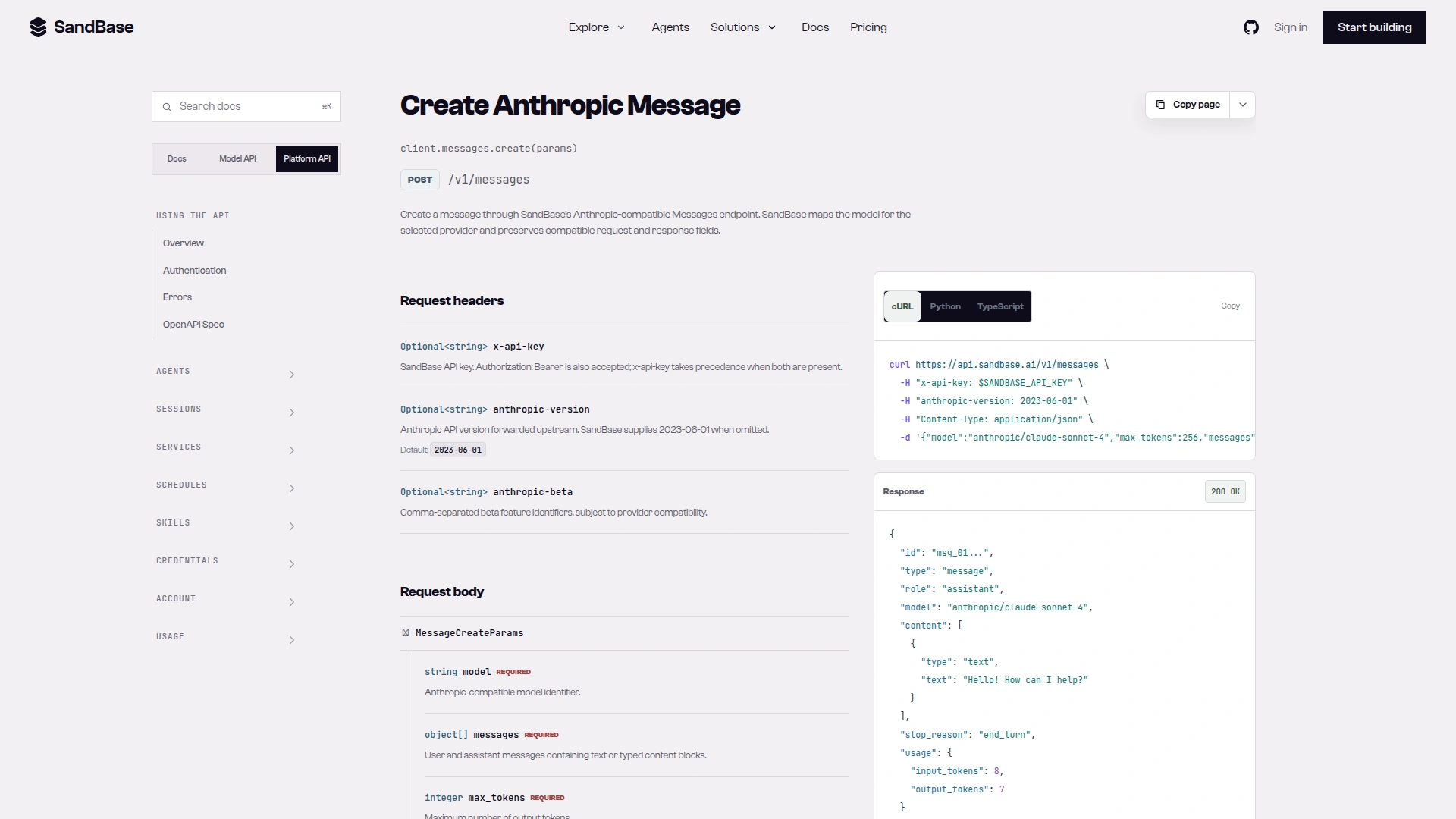
Caption: SandBase’s Anthropic-compatible Messages reference documents POST /v1/messages, Bearer or x-api-key auth and the forwarded anthropic-version header, which is the contract Claude Code ran on in this test (captured 2026-10-03).
On 2026-10-03 we found no SandBase docs page about routing Claude Code’s model. The Setup guide connects Claude Code to SandBase tools, which is a different job, so the Messages reference is the contract we relied on.
Two side effects showed up. For every non-Anthropic id, Claude Code printed [claude-code:unrecognized_model] on stderr (all 108 such runs). The runs still worked; the only harm we measured was the cost figure. And not every model accepts the Anthropic format: GLM-5.3 failed all 12 runs in about 2 seconds with HTTP 400. Send one /v1/messages request before you commit. We pinged nine non-Anthropic ids that way, and only GLM-5.3 refused.
The six tasks
Each task is a tiny repo (1 to 4 source files, stdlib only) with a README spec and a visible failing test. Every model got the same prompt:
Read README.md. Run the tests with `python3 -m pytest -q`, change the code so it meets the spec in README.md and the tests pass, then rerun the tests. Do not edit files under tests/.| Task | What the agent has to do | Hidden tests check |
|---|---|---|
| T1 pagination | Fix 0-indexed slicing, floor page count, has_prev | Past-end page, invalid args, page_count(0), page_info |
| T2 date range | Rewrite a naive --range parser | Whitespace, open ends, Feb 30, leap day, 20260101 rejected, stderr + exit code 2 |
| T3 LRU cache | Implement from a stub | in doesn’t refresh recency, update doesn’t evict, on_evict, pop, falsy values |
| T4 counter | Make a racy counter thread-safe | Atomic reset() under load, ValueError without leaving the lock held, read-only value |
| T5 refactor | Extract money.py from two drifted copies | Half-up rounding for negatives, both files import it, private copies gone, 5 old tests pass |
| T6 CSV export | Implement to_csv from a quoting spec | Formula guard on strings only, quoting rules, header quoting, empty string |
Pass means the full suite passed after the run: the original visible tests (restored from our copy in case the agent touched them) plus the hidden file, copied in only after Claude Code exited. Each run got a fresh temp dir and config dir, --max-turns 40, a 600 s timeout and --dangerously-skip-permissions, with up to 5 runs in parallel and a pytest 8.3.3 virtualenv first on PATH. Beforehand we checked that every visible suite failed on the starting code and that our reference solutions passed every hidden test.
Results
Prices are SandBase list prices on 2026-10-03, read from prompt_token_price and completion_token_price in GET https://api.sandbase.ai/v1/models/<id>, in dollars per million tokens. That endpoint (and GET /v1/tasks/<id>/cost) needs the same Bearer key; the public model pages show the same prices.
| Model (SandBase id) | $/M in / out | Pass (12) | Median turns | Median time | Median cost / task | Claude Code reported (12 runs) |
|---|---|---|---|---|---|---|
openai/gpt-6.1-sol | $2 / $10 | 12 | 23.5 | 114 s | $0.117 | $4.55 |
z-ai/glm-5.3-prime | $2.80 / $8.80 | 12 | 8.5 | 37 s | $0.106 | $1.93 |
anthropic/claude-sonnet-5.5 | $2 / $10 | 12 | 9 | 109 s | $0.124 | $1.56 |
moonshotai/kimi-k3 | $3 / $15 | 12 | 10 | 51 s | $0.136 | $2.75 |
alibaba/qwen3.8-max-0902 | $2 / $6 | 12 | 11.5 | 90 s | $0.181 | $6.12 |
anthropic/claude-opus-5.5 | $4 / $20 | 12 | 5 | 44 s | $0.540 | $7.64 |
openai/gpt-6-luna | $0.10 / $0.50 | 11 | 22 | 100 s | $0.0071 | $4.33 |
x-ai/grok-4.7 | $2 / $6 | 11 | 8 | 31 s | $0.128 | $3.31 |
deepseek/deepseek-v4-pro-0813 | $1.32 / $3.96 | 10 | 8.5 | 114 s | $0.046 | $2.90 |
minimax/minimax-m3 | $0.30 / $1.20 | 10 | 10.5 | 45 s | $0.044 | $9.46 |
z-ai/glm-5.3 | $1.40 / $4.40 | 0 | n/a | n/a | n/a | $0 (HTTP 400) |
Of the 120 runs that actually started (nine lineup models plus GLM-5.3 Prime), 114 passed. Nobody timed out, nobody hit the turn cap, and no run edited a test file. T1 to T4 were passed by every model that ran. All six misses came from T5 and T6.
Turn counts show two styles. Opus 5.5 worked in large steps, a median 5 turns. GPT-6.1 Sol and GPT-6 Luna took 22 to 24 small ones. Both passed. Time didn’t track turns: Sonnet 5.5 needed 109 s for 9 turns, probably in part because its upstream was slow that afternoon. A bare “Say OK.” to it through /v1/messages, sent during our pilot, took 26 s, while the other models answered in 2 to 4 s; a re-ping at 14:26 UTC took 5.6 s.
Where models failed
T5 refactor: copied the bug along with the code (4 runs). DeepSeek V4 Pro and MiniMax M3 both failed T5 twice, the same way. The spec says tax rounds half up, “away from zero”. The orders.py copy rounded halves up toward positive infinity, which is right for positive amounts and wrong for negative ones. Both models moved that logic into money.py unchanged and wrote a docstring above it promising “away from zero”, so apply_tax(-200, 25) returned 0 instead of -1. The visible tests had no negative amounts, so both agents saw green and stopped. Every other model handled the negative case.
T6 CSV: one edge in the formula guard (2 runs). GPT-6 Luna once applied the leading - guard to the integer -5, writing '-5, although the spec limits the guard to strings. Grok 4.7 once checked text[:1] in "=+-@", and in Python the empty string is “in” every string, so an empty cell came out as '. Each model passed T6 on its other run.
GLM-5.3: protocol, not coding (12 runs). HTTP 400 on the first request, “Model ‘glm-5.3’ does not support api_format ‘anthropic’”, 0 tokens, about 2 seconds. For it, the test measured nothing about coding.
No miss was a tool-format error, a timeout or a mid-run API error. Each was an untested branch of the spec the agent never checked. With a cheaper model, put the spec’s edge cases into the visible tests, or have a stronger model review the diff. Our strong pass vs cheap loops piece covers that retry-or-escalate trade-off.
Cost: Claude Code’s number vs the list price
Claude Code’s JSON reports total_cost_usd from its own price table. For Claude Sonnet 5.5, it matched our list-price estimate to the cent: SandBase lists Sonnet at $2/$10, and so does Claude Code. For every other model it was wrong. Recomputing all 96 non-Anthropic runs that made requests (GLM-5.3’s errors had zero usage) showed Claude Code priced each one at $5 input / $25 output per million, 1.25x for cache writes, 0.1x for cache reads. That’s an Opus-class rate. It also priced Opus 5.5 at $5/$25 against SandBase’s $4/$20 list.
So we computed cost ourselves from the cumulative usage block in Claude Code’s JSON. Input tokens and output tokens are priced at list. Cache writes get the model card’s cache_write_multiplier, and cache reads get its cache_read_multiplier. Five models (Kimi K3, Grok 4.7, DeepSeek V4 Pro, MiniMax M3, GLM-5.3 Prime) have no cache-write multiplier on their cards. Those five reported zero cache-write tokens anyway, so that choice changes nothing. These are estimates: SandBase’s GET /v1/tasks/<id>/cost doesn’t resolve /v1/messages ids, so we couldn’t reconcile billing per run.
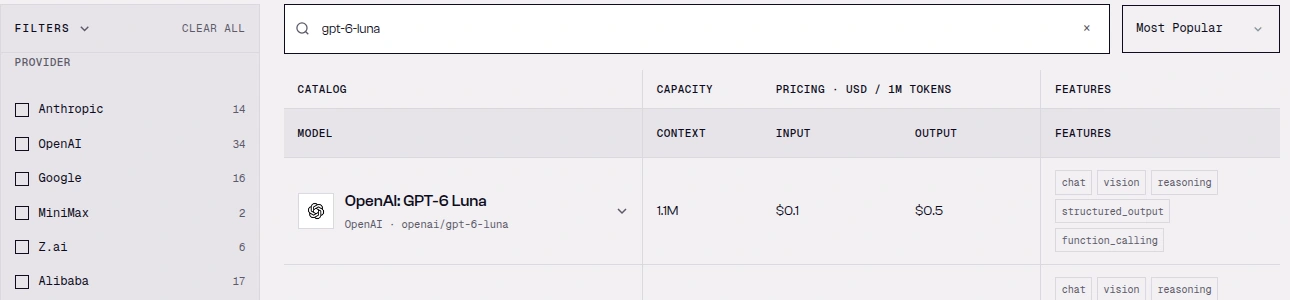
Caption: GPT-6 Luna is listed at $0.10 input and $0.50 output per million tokens, which is why its 22-turn runs still came to under a cent each (captured 2026-10-03).
Claude Code re-sends its system prompt and tool definitions every turn, so input dominates, and where the route caches, most of it comes back as cache reads. Cache reads were 92% to 94% of all tokens for GPT-6.1 Sol, GPT-6 Luna, Sonnet 5.5 and GLM-5.3 Prime. MiniMax M3 is the exception at 11%: a median 134,604 uncached input tokens per run against 16,580 cache reads. At $0.30 per million that barely matters. On a pricier model without caching it would.
GPT-6 Luna costs about 1/16 as much per task as GPT-6.1 Sol here ($0.0071 vs $0.117), for 11/12 vs 12/12. That’s in line with our Pro vs Flash tier benchmark, where Luna matched Sol on short tool tasks at about 1/20 of the cost.
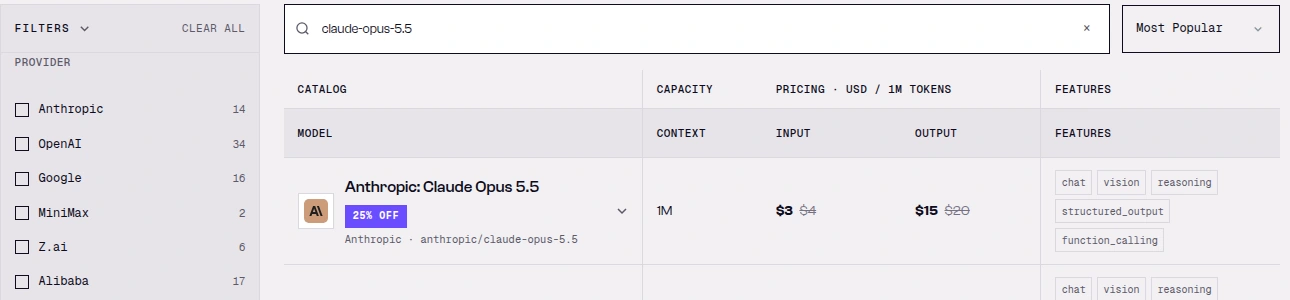
Caption: On 2026-10-03 the catalog showed Claude Opus 5.5 at 25% off ($3 / $15 instead of $4 / $20), while its model card still listed $4 / $20; the cost table uses the card (captured 2026-10-03).
Opus 5.5 is the expensive one: $6.01 for 12 runs at list price, $0.54 median per task. Its median run wrote 94,059 tokens to cache and read back only 37,598; with 5 turns, little of what it cached got reused. If the 25% promotion applied, its median would be about $0.41, which we didn’t verify. The page’s “API Free Week” banner reads as covering data APIs; model token prices in the table are unchanged by it.
Whole study: $17.16 at list price for 132 runs (Claude Code reported $44.55). A 2-run pilot before it ($0.24) and one run of the script below afterwards ($0.0069) aren’t counted in the tables.
How to choose
| If you want | Use | But |
|---|---|---|
| Lowest cost that still passes nearly everything | GPT-6 Luna: 11/12, $0.0071 per task | Many small turns (median 22); spell out edge cases |
| No misses, moderate cost | GPT-6.1 Sol, GLM-5.3 Prime, Sonnet 5.5 or Kimi K3: 12/12, $0.10 to $0.14 | Sol and Sonnet took 109 to 114 s at the median; Prime and Kimi under a minute |
| Fastest wall time | Grok 4.7 (31 s median) or GLM-5.3 Prime (37 s) | Grok missed one CSV edge case |
| Fewest turns, biggest steps | Claude Opus 5.5: median 5 turns | 4x to 5x the cost per task of the $0.10 to $0.14 group at list price |
| Cheap models that aren’t Luna | DeepSeek V4 Pro or MiniMax M3, about $0.045 | Both copied a rounding bug in the refactor task twice |
| The original GLM-5.3 | Not through Claude Code on SandBase today | /v1/messages returns 400; use GLM-5.3 Prime |
Run it yourself
This is the script we ran on 2026-10-03 for the summary below. It copies a repo into a temp dir, runs Claude Code against SandBase with an isolated config, and prices the run from the live model card. The key comes only from SANDBASE_API_KEY.
#!/usr/bin/env bash
# Run Claude Code headless against SandBase on a throwaway copy of a repo,
# then price the run at the SandBase list price of the model.
# Usage: SANDBASE_API_KEY=... ./cc_sandbase.sh <sandbase-model-id> <repo-dir> "<prompt>"
set -euo pipefail
MODEL="$1"; SRC="$2"; PROMPT="$3"
: "${SANDBASE_API_KEY:?set SANDBASE_API_KEY in the environment}"

WORK="$(mktemp -d)"   # throwaway copy: the agent may run any command here
CFG="$(mktemp -d)"    # isolated Claude Code config, so your normal login is untouched
cp -R "$SRC"/. "$WORK"/
cd "$WORK"

env -u ANTHROPIC_API_KEY \
  CLAUDE_CONFIG_DIR="$CFG" \
  ANTHROPIC_BASE_URL="https://api.sandbase.ai" \
  ANTHROPIC_AUTH_TOKEN="$SANDBASE_API_KEY" \
  ANTHROPIC_MODEL="$MODEL" ANTHROPIC_SMALL_FAST_MODEL="$MODEL" \
  ANTHROPIC_DEFAULT_HAIKU_MODEL="$MODEL" ANTHROPIC_DEFAULT_SONNET_MODEL="$MODEL" \
  ANTHROPIC_DEFAULT_OPUS_MODEL="$MODEL" \
  DISABLE_TELEMETRY=1 DISABLE_ERROR_REPORTING=1 CLAUDE_CODE_DISABLE_NONESSENTIAL_TRAFFIC=1 \
  perl -e 'alarm shift; exec @ARGV' 600 \
  claude -p "$PROMPT" --model "$MODEL" --output-format json --max-turns 40 \
    --dangerously-skip-permissions > "$CFG/result.json" 2> "$CFG/stderr.txt" || true

echo "work dir: $WORK"
python3 - "$MODEL" "$CFG/result.json" <<'EOF'
import json, os, sys, urllib.request
model, path = sys.argv[1], sys.argv[2]
run = json.load(open(path))
u = run.get("usage") or {}
req = urllib.request.Request(f"https://api.sandbase.ai/v1/models/{model}",
                             headers={"Authorization": f"Bearer {os.environ['SANDBASE_API_KEY']}"})
card = json.load(urllib.request.urlopen(req, timeout=60))["model_card"]
p_in, p_out = float(card["prompt_token_price"]), float(card["completion_token_price"])
read_mult = float(card.get("cache_read_multiplier") or 1)    # missing -> priced as normal input
write_mult = float(card.get("cache_write_multiplier") or 1)  # missing -> priced as normal input
cost = (u.get("input_tokens", 0) * p_in
        + u.get("cache_creation_input_tokens", 0) * p_in * write_mult
        + u.get("cache_read_input_tokens", 0) * p_in * read_mult
        + u.get("output_tokens", 0) * p_out) / 1e6
print(json.dumps({"model": model, "is_error": run.get("is_error"), "num_turns": run.get("num_turns"),
                  "duration_ms": run.get("duration_ms"),
                  "claude_code_reported_usd": run.get("total_cost_usd"),
                  "sandbase_list_price_usd": round(cost, 4),
                  "usage": {k: u.get(k, 0) for k in ("input_tokens", "cache_creation_input_tokens",
                                                     "cache_read_input_tokens", "output_tokens")},
                  "result": (run.get("result") or "")[:200]}, indent=1))
EOF
--dangerously-skip-permissions lets the agent run any shell command without asking. Use it only in a throwaway directory like this one, never in a checkout with credentials, and never with a key that has a high spending limit.
Tested on 2026-10-03 (UTC). At 14:17:01 we ran the script on the T1 pagination repo with openai/gpt-6-luna and the prompt above. It finished at 14:18:41 and printed this object (complete as printed; the script itself cuts result to 200 characters):
{
 "model": "openai/gpt-6-luna",
 "is_error": false,
 "num_turns": 20,
 "duration_ms": 97428,
 "claude_code_reported_usd": 0.34457125000000005,
 "sandbase_list_price_usd": 0.0069,
 "usage": {
  "input_tokens": 1879,
  "cache_creation_input_tokens": 19629,
  "cache_read_input_tokens": 342890,
  "output_tokens": 1642
 },
 "result": "Updated `pager.py` to use 1-indexed pagination, validate invalid inputs, calculate partial pages correctly, and set `page_info` flags according to the README spec. I did not edit anything under `tests"
}
Afterwards we copied the hidden T1 tests into its work dir: 10 passed. num_turns, usage, total_cost_usd and result are fields we observed in Claude Code 2.1.246’s --output-format json, not a documented schema, so read them defensively. Next steps: the Anthropic Messages API reference for the contract, and get a SandBase API key to run it on your own repo.
About the test material: the tasks are toy repos we wrote for this test, with no third-party code or personal data. The task specs, prompt, grading rule and aggregates are all in this article. Per-run logs and transcripts are kept internally.
FAQ
What is the best model for Claude Code besides Claude?
GPT-6.1 Sol, GLM-5.3 Prime, Kimi K3 and Qwen3.8 Max 0902 passed 12/12 here at $0.10 to $0.18 per task; GPT-6 Luna passed 11/12 at $0.0071. With 6 tasks and 2 runs each, treat that as a shortlist.
Can Claude Code use GPT, Kimi, DeepSeek or Qwen models?
Yes, through an Anthropic-compatible endpoint like SandBase’s /v1/messages. Set ANTHROPIC_BASE_URL and ANTHROPIC_AUTH_TOKEN, and set ANTHROPIC_MODEL to the SandBase id. Eight of the nine non-Anthropic ids we tried worked; GLM-5.3 returned HTTP 400 for the Anthropic format.
Why is Claude Code’s cost wrong for non-Anthropic models?
It doesn’t know their prices. In every non-Anthropic run, its total_cost_usd matched a $5/$25 per million rate exactly. Across the study it reported $44.55 against a $17.16 list-price estimate, and for MiniMax M3 alone, $9.46 against $0.56. Price runs from the usage block instead.
Is GPT-6 Luna good enough for Claude Code?
For small, well-specified tasks, mostly: 11/12, one miss on a spec edge case, under a cent per task. It takes many small steps (median 22 turns, about 100 s). Put edge cases in visible tests or have a stronger model review its diffs.
Does prompt caching matter when Claude Code runs other models?
A lot. Claude Code re-sends a large system prompt every turn. For GPT-6.1 Sol, Luna, Sonnet 5.5 and GLM-5.3 Prime, 92% to 94% of tokens were cache reads, listed at 0.05x to 0.2x the input price. MiniMax M3 reported few cache reads, so most of its input was priced at the full input rate.
Limitations
Six small stdlib Python tasks with clear specs are not a real codebase, and two runs per task can’t separate models one miss apart. Settings were defaults: no reasoning-effort tuning, no CLAUDE.md. Timing came from one machine through a local proxy, up to five runs in parallel, one afternoon, so it’s rough. Costs are list-price estimates from reported usage, not reconciled bills, and we didn’t confirm the Opus promotion. GLM-5.3 Prime was added after GLM-5.3 failed. Models and routes change; rerun the script on your own repo before you choose.