China Hot Search Tool: Five Live Trend Lists in One View
See how the SandBase China Hot Search tool combines Weibo, Douyin, Kuaishou, Zhihu, and Pipixia rankings, and which APIs power every list.

A breaking story can look enormous on Weibo, barely register on Zhihu, and surface on Douyin under a completely different phrase. That is the practical problem with “what is trending in China?”: there is no single Chinese internet. There are several platforms, each with its own audience behavior and ranking logic.
The SandBase China Hot Search tool puts five live lists—Weibo, Douyin, Kuaishou, Zhihu, and Pipixia—on one page and adds a bilingual AI summary of stories that appear across them. It is useful for researchers, editorial teams, brand monitors, and builders who need a fast first scan before opening the original entries or moving to a repeatable API workflow.
Key takeaway
- One page brings together five different signals: search and discussion on Weibo, short-video momentum on Douyin and Kuaishou, question interest on Zhihu, and played posts on Pipixia.
- The AI summary groups similar titles in Chinese and English; it does not read the full posts and should not be treated as verification.
- Each list is backed by a separate SandBase public-data endpoint, so the visual tool can become an automated monitoring input without maintaining five scrapers.
- The page requires a SandBase sign-in, and every refresh runs on the signed-in account.
What the tool actually does
The page solves a narrow but expensive task: collecting the current ranking from several Chinese content platforms and presenting the boards side by side. It is not a universal social-listening suite, nor does it claim to explain why a topic is rising. It gives you a current cross-platform map from which to decide what deserves investigation.
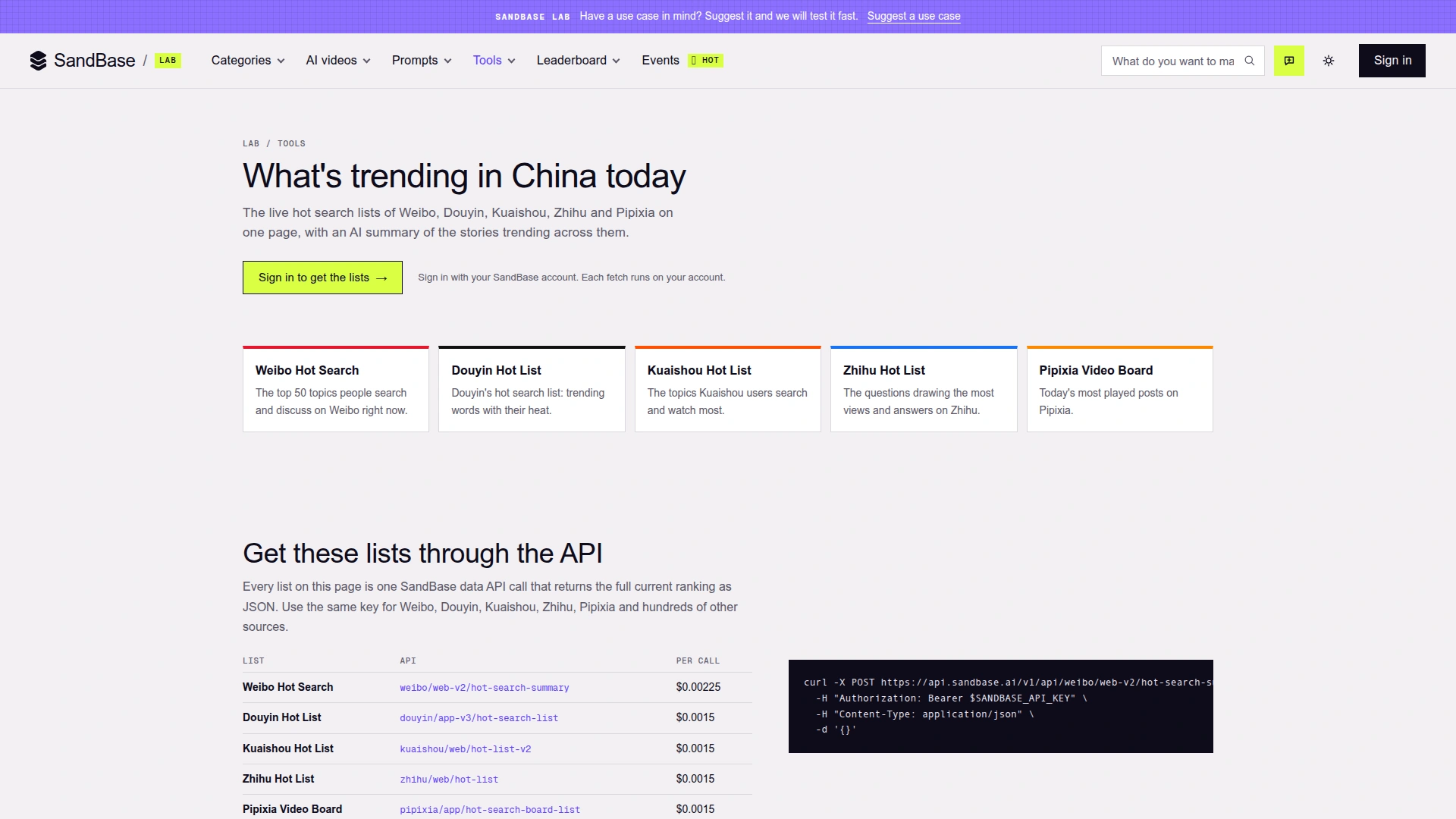 The tool names the five signals up front and keeps the API path visible on the same page. Screenshot captured on 2026-10-30.
The five boards answer different questions:
| List | Signal represented | Best first use |
|---|---|---|
| Weibo Hot Search | Topics people are searching and discussing | Breaking news, public conversation, brand or celebrity spikes |
| Douyin Hot List | Trending words and their platform heat | Short-video narratives, consumer attention, fast-moving memes |
| Kuaishou Hot List | Topics users search and watch | Mass-market and regional short-video momentum |
| Zhihu Hot List | Questions attracting views and answers | Explanatory demand, expert discussion, “why” and “how” angles |
| Pipixia Video Board | Posts receiving the most plays | Entertainment and community-video momentum |
That difference is the main feature, not a nuisance to normalize away. If the same story appears on several boards, you have evidence of cross-platform reach. If it appears on only one, the mismatch can be more informative than a blended score: perhaps the story is native to one format, one audience, or one stage of the news cycle.
The highlight: a useful first pass, not false precision
The page adds an AI summary that reads titles from all five lists and groups the same story into a few points in Chinese and English. This is a smart compression layer for scanning. It is also deliberately bounded.
The summary sees titles only. It can merge unrelated stories with similar wording, miss a connection expressed with different phrases, or lose the context that makes a trend important. The page itself advises opening the original entry before relying on the summary. Platform-pinned announcements or promoted topics are shown as pinned and excluded from the AI summary, which prevents an editorial placement from quietly becoming a cross-platform “trend” in the recap.
This boundary matters. A trend dashboard should help you decide where to look next; it should not manufacture certainty from five volatile ranking systems.
Where it is genuinely useful
1. The morning editorial scan
An editor can scan five boards in one pass, identify stories repeated across platforms, and assign follow-up research. Weibo may reveal the breaking phrase, Zhihu the explanatory question, and Douyin the visual framing. The tool shortens discovery; journalists still verify the underlying claims and sources.
2. Brand and reputation triage
For brand teams, the page is a quick way to answer: is this spike isolated, or is it crossing platforms? A product complaint that moves from a Weibo search term to a Zhihu question and a Douyin phrase deserves a different response from a one-board fluctuation. The tool does not perform sentiment analysis, but it helps prioritize where deeper monitoring should begin.
3. Content planning without copying the leaderboard
Creators and marketing teams can compare the type of demand on each platform. A Zhihu question may suggest an explainer; a Douyin or Kuaishou phrase may call for a short demonstration; a repeated topic may justify a larger editorial package. The useful move is to translate the signal into audience intent, not to reproduce whatever is ranked first.
4. Research and event monitoring
Researchers following a launch, sports event, policy announcement, or cultural moment can use the combined page as a time-stamped observation point. Repeated checks show how attention migrates between discussion, questions, and video. For a defensible study, archive the API results and document the sampling cadence; a screenshot of one moment is not a longitudinal dataset.
5. Prototype before building an automated pipeline
The visual page is an efficient way to validate whether these five inputs fit your problem. If they do, the underlying endpoints provide a path to scheduled collection, deduplication, alerts, or an agent workflow. That progression—from human scan to API automation—is the tool’s strongest product design choice.
The five API dependencies
Every board on the page maps to one SandBase data API call. The dependency table below links both the platform catalog, where you can browse related capabilities, and the exact endpoint reference used by this tool.
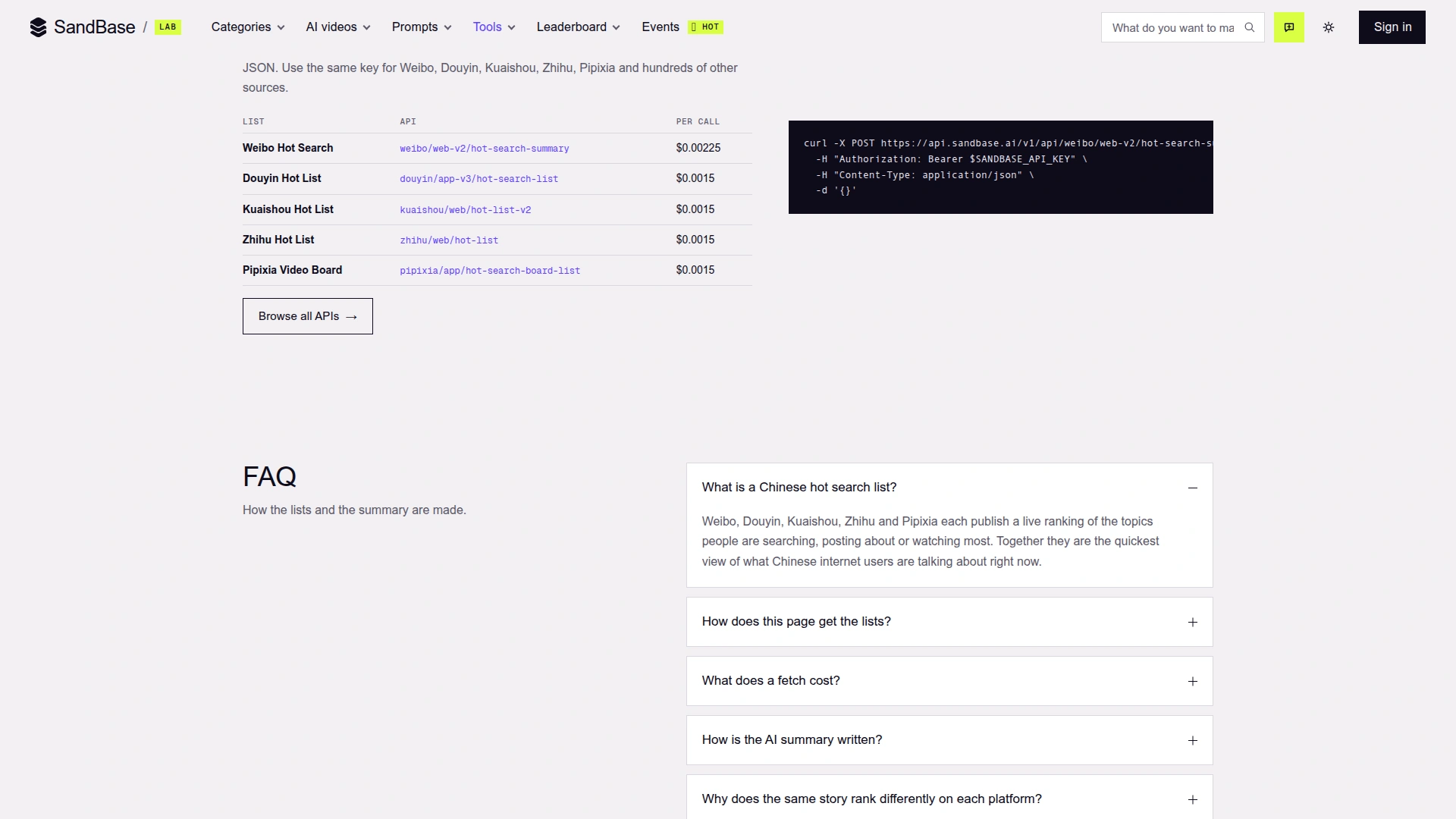 The live page exposes the endpoint behind each board and the per-call price visible on 2026-10-30. Prices can change; check the current page before budgeting.
| Board | Platform API catalog | Endpoint used by the tool | Price shown on 2026-10-30 |
|---|---|---|---|
| Weibo Hot Search | Weibo APIs | weibo/web-v2/hot-search-summary | $0.00225/call |
| Douyin Hot List | Douyin APIs | douyin/app-v3/hot-search-list | $0.0015/call |
| Kuaishou Hot List | Kuaishou APIs | kuaishou/web/hot-list-v2 | $0.0015/call |
| Zhihu Hot List | Zhihu APIs | zhihu/web/hot-list | $0.0015/call |
| Pipixia Video Board | Pipixia APIs | pipixia/app/hot-search-board-list | $0.0015/call |
The visual tool runs those dependencies for you. When building directly, public-data endpoints use the vendor-qualified POST /v1/api/<vendor>/<path> route documented on each reference page. The completed response envelope contains id, status, model, and outputs[0].data. Business payload fields inside data are endpoint-specific and should be read defensively rather than assumed to share a universal schema.
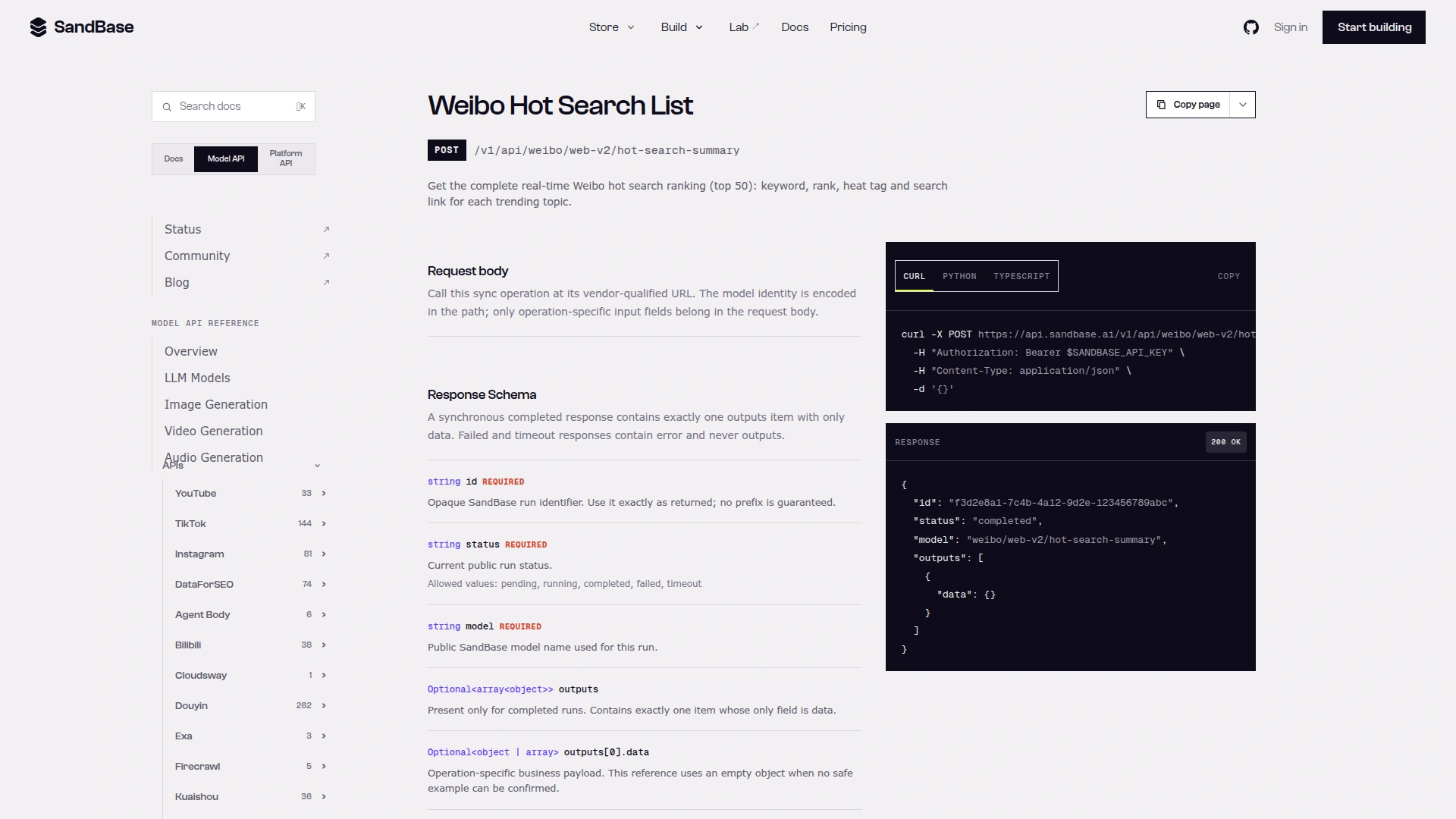 The endpoint reference is the contract for the POST path and response envelope. Its empty
data example does not promise business-field names.
The price shown for one complete five-board refresh on 2026-10-30 adds up to $0.00825. Treat that as a dated snapshot, not a permanent quote. A scheduled monitor also needs a sensible cadence, retries for transient failures, and storage if you want to measure movement rather than view a single instant.
What makes the tool stand out
First, it preserves platform context. The boards sit next to one another instead of being collapsed into an unexplained “China trend score.” That avoids comparing unlike heat metrics as if they were on the same scale.
Second, it exposes the machinery. The API table and request example are not hidden in a separate developer portal. A user can understand the visual product and immediately see how to reproduce each source in an application.
Third, it puts the AI summary in the correct place: after collection and before verification. The summary reduces reading load, while the visible list boundaries keep the source signal inspectable.
Finally, the tool covers both human and machine workflows. A researcher can use the page manually; an engineering team can use the same five dependencies for a scheduled dashboard, alerting system, or agent input.
Limits to keep in view
- Rankings are snapshots. A topic can move or disappear between refreshes. Store timestamped results if change matters.
- Heat is platform-specific. Do not compare raw numbers across Weibo, Douyin, Kuaishou, Zhihu, and Pipixia as if they share one unit.
- The summary reads titles, not full context. Open the original entries before making editorial, financial, legal, or safety-sensitive decisions.
- Public data is not the whole population. A leaderboard reflects one platform’s product design and audience, not all Chinese internet users.
- Sign-in and billing apply. Each fetch runs on the signed-in SandBase account, and the displayed per-call prices should be rechecked when planning sustained collection.
For a deeper engineering pattern—normalizing boards, storing snapshots, and comparing rank movement—see the cross-platform trend dashboard tutorial. For a focused single-platform workflow, the Weibo hot-search monitoring guide shows how to move from a board to topic research.
FAQ
Does the tool show real-time Chinese hot searches?
It fetches the current public ranking exposed by each of the five underlying APIs. “Current” is more accurate than promising zero-delay real time: ranking systems update on their own cadence, and the page reflects the result of the latest fetch.
Do I need accounts for all five Chinese platforms?
No platform login is required on the user side. You sign in to SandBase, and each fetch runs on that SandBase account.
Can the AI summary verify whether a trending claim is true?
No. It groups list titles into a shorter bilingual overview. Because it sees only titles, you should open the original entry and verify claims with primary sources.
Can I build my own monitor from the same data?
Yes. Use the five endpoint references in the dependency table. Keep one adapter per platform, persist timestamped snapshots, and compare rank movement within each board instead of blending raw heat values.
Bottom line
The China Hot Search tool is most valuable as a decision surface: one place to see whether attention is isolated, repeated, or changing shape across five Chinese content platforms. Its best feature is not the number of lists. It is the clean path from a quick human scan to explicit API dependencies, with enough visible boundaries to remind you that rankings and AI summaries are signals—not conclusions.