Best Web Search & Scraping APIs for AI Agents (2026)
Compare Exa, Tavily, and Firecrawl for AI agents and RAG — neural search, cited answers, and scraping — all through one SandBase key. A neutral 2026 guide.
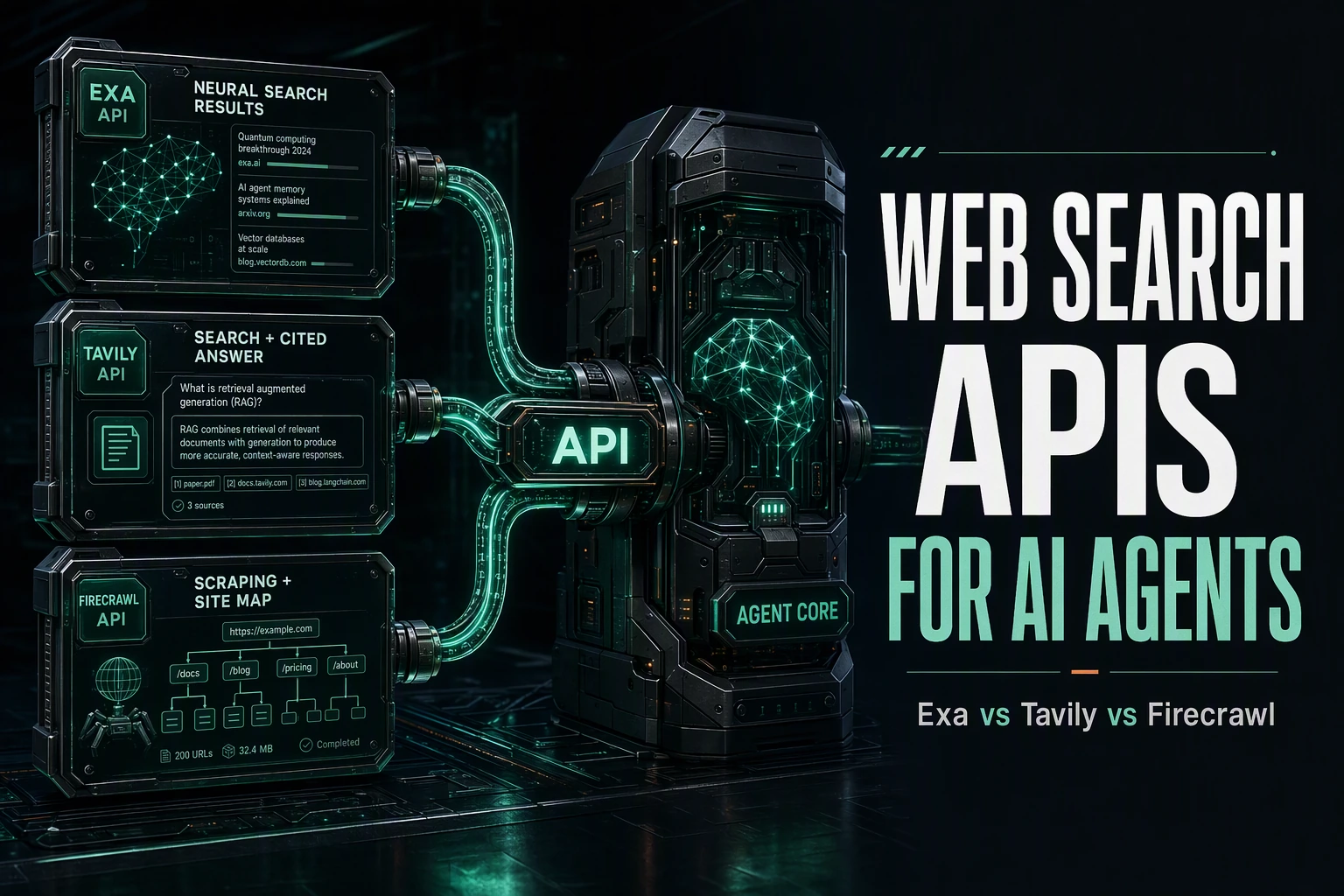
If you are building a retrieval-augmented generation (RAG) pipeline or a research agent, you eventually need the same thing: a way to pull real, current information off the web and feed it to a model. Three providers cover that ground well — Exa (neural search built for AI), Tavily (agent search with a synthesized answer), and Firecrawl (scraping and site discovery). This guide compares them neutrally for 2026, and each is reachable through one SandBase API key so you can try all three without three separate integrations.
The field names and behaviors below come from calls I ran through SandBase (tested on 2026-09-27, UTC) and are observed-only — confirm them against each endpoint’s live reference before you build.
Key takeaway (TL;DR)
- Exa — neural (meaning-based) search plus
contentsand a citedanswer; strongest when relevance-by-intent matters.- Tavily — search that returns ranked results and a synthesized
answerin one call, plusextractand sitemap; a fast default for grounded responses.- Firecrawl — built for scraping and site structure (
search,map); reach for it when you need page content and crawl-style coverage.- All three run through
POST /v1/api/<vendor>/<path>with oneSANDBASE_API_KEYand the same response envelope, so switching is a one-line change.
Which one should you use?
| Your need | Best fit | Why |
|---|---|---|
| Find pages by meaning, not keywords | Exa | Neural retrieval ranks by intent |
| One call that returns results and an answer | Tavily | search returns results plus a synthesized answer |
| Pull page text or map a site’s structure | Firecrawl or Tavily | Firecrawl map/search; Tavily extract/map |
| A direct cited answer to a question | Exa answer or Tavily search | Both synthesize with citations/sources |
| Try several without multiple integrations | Any, via SandBase | One key, one envelope across all three |
The shared shape
All three are called the same way — POST https://api.sandbase.ai/v1/api/<vendor>/<path> with a Bearer key. Each returns id, status, model, and, on a completed run, the payload. The envelope can vary: in my calls the payload often arrived under a top-level output object, while the endpoint references document outputs[0].data. Read either shape:
import os
import requests

def call(vendor_path: str, payload: dict) -> dict:
    resp = requests.post(
        f"https://api.sandbase.ai/v1/api/{vendor_path}",
        headers={
            "Authorization": f"Bearer {os.environ['SANDBASE_API_KEY']}",
            "Content-Type": "application/json",
        },
        json=payload,
        timeout=120,
    )
    resp.raise_for_status()
    body = resp.json()
    if body.get("status") != "completed":
        raise RuntimeError(body.get("error", {}).get("message", "did not complete"))
    output = body.get("output")
    if output is None and body.get("outputs"):
        output = body["outputs"][0].get("data", {})
    return output or {}

exa = call("exa/search", {"query": "vector database benchmarks"})
tavily = call("tavily/search", {"query": "vector database benchmarks"})
firecrawl = call("firecrawl/search", {"query": "vector database benchmarks"})
Because the call shape is identical, swapping providers — or calling all three and merging — is a one-line change. That is the practical reason to go through one API layer: your retrieval code does not fork per vendor.
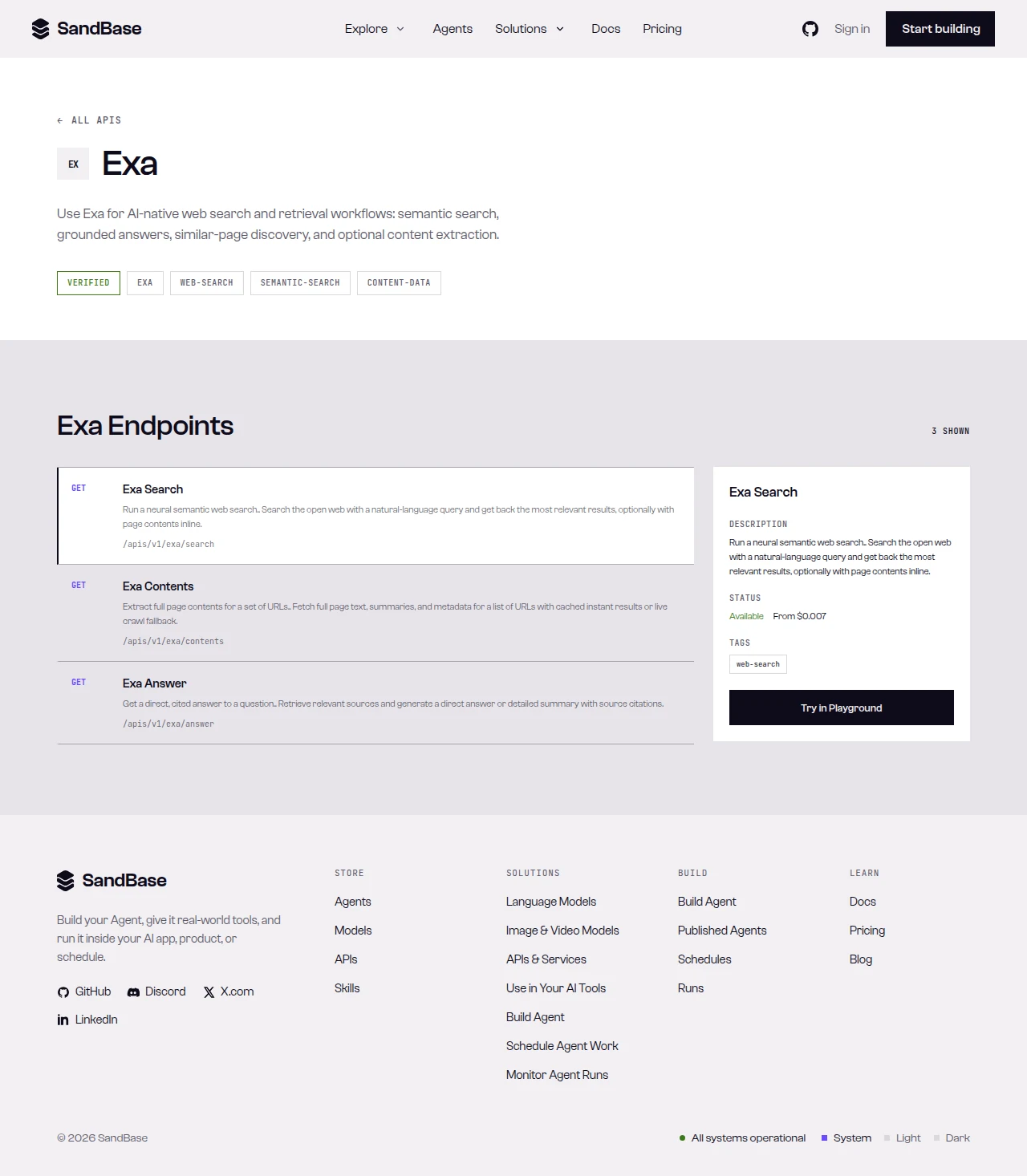 Exa, Tavily, and Firecrawl — one key, one envelope, one code path.
Exa — neural search + cited answers
Exa does meaning-based retrieval, so a query like “papers challenging scaling laws” surfaces conceptually related pages rather than keyword matches. In my run, exa/search returned ranked results (each with a url, title, and publishedDate); exa/contents pulled page text by URL/ID; and exa/answer returned a synthesized answer with citations.
Choose Exa when relevance-by-intent is the priority — research agents, literature discovery, or any case where keyword search misses the point. See the Exa search API hub for the full endpoint tour.
Tavily — search with a built-in answer
Tavily’s search returns ranked results and a synthesized answer in a single call, which makes it a fast default for grounded responses. It also offers extract (pull raw_content for a set of URLs) and map (discover a site’s structure).
Choose Tavily when you want one call to both find sources and draft a grounded answer, or when your agent needs extraction and site mapping alongside search. See the Tavily search API hub.
Firecrawl — scraping and site structure
Firecrawl is oriented around getting content off pages and understanding site structure. In my testing, firecrawl/search returned web results and firecrawl/map returned a site’s links. Its scraping-first design fits crawl-style coverage and content extraction workflows.
Choose Firecrawl when your job is closer to “get the content and the shape of a site” than “answer a question.” Availability varies by endpoint, so confirm each against its live reference before you build.
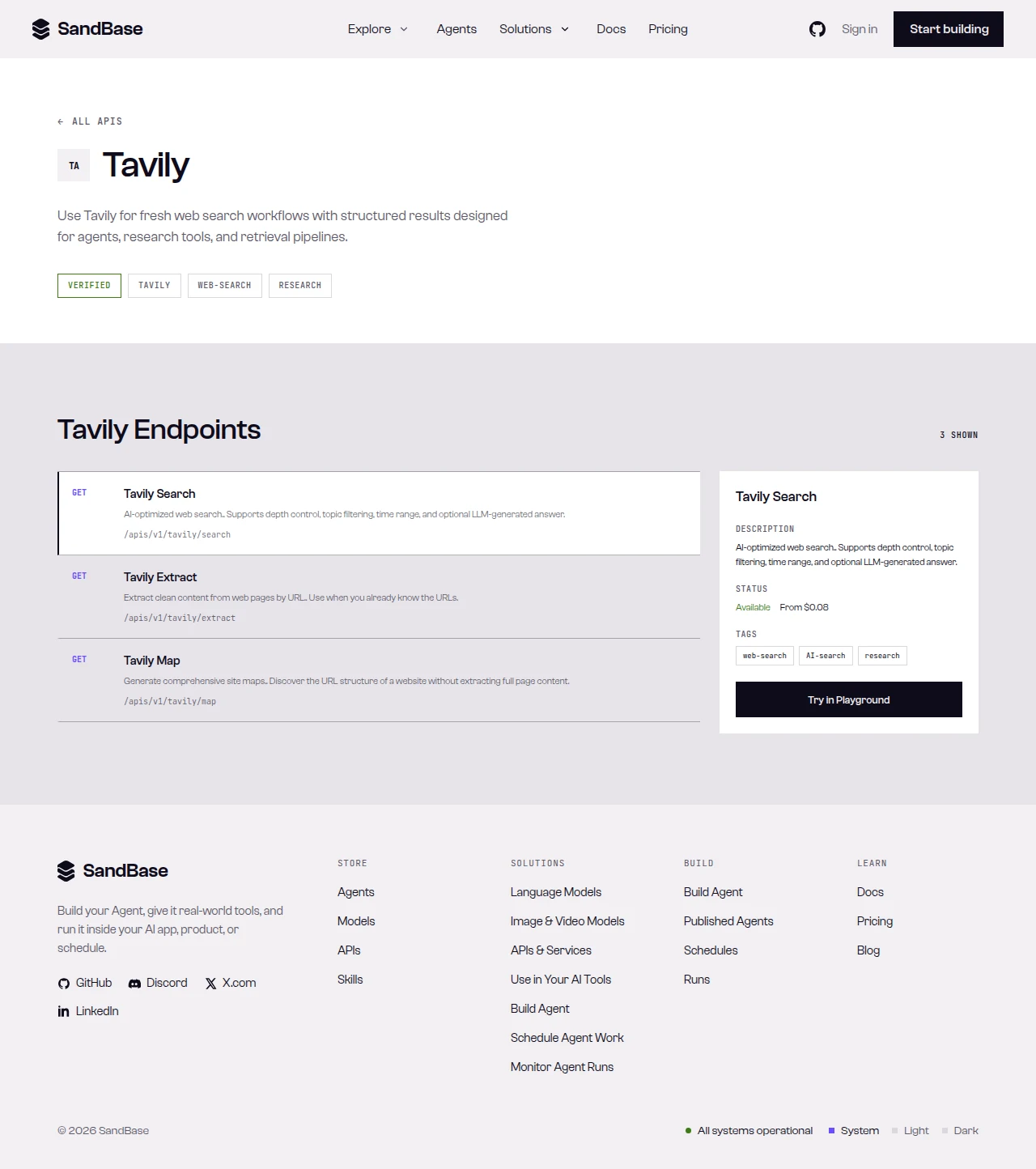 Different strengths: intent-ranked results, a synthesized answer, and site structure.
Feature comparison
| Capability | Exa | Tavily | Firecrawl |
|---|---|---|---|
| Keyword/neural search | Neural | Ranked + answer | Web search |
| Synthesized answer | answer | in search | — |
| Page content | contents | extract | scrape-oriented |
| Site mapping | — | map | map |
Single SANDBASE_API_KEY | Yes | Yes | Yes |
Treat this as a starting map, not a spec — capabilities and response fields evolve, so confirm each endpoint against its live reference.
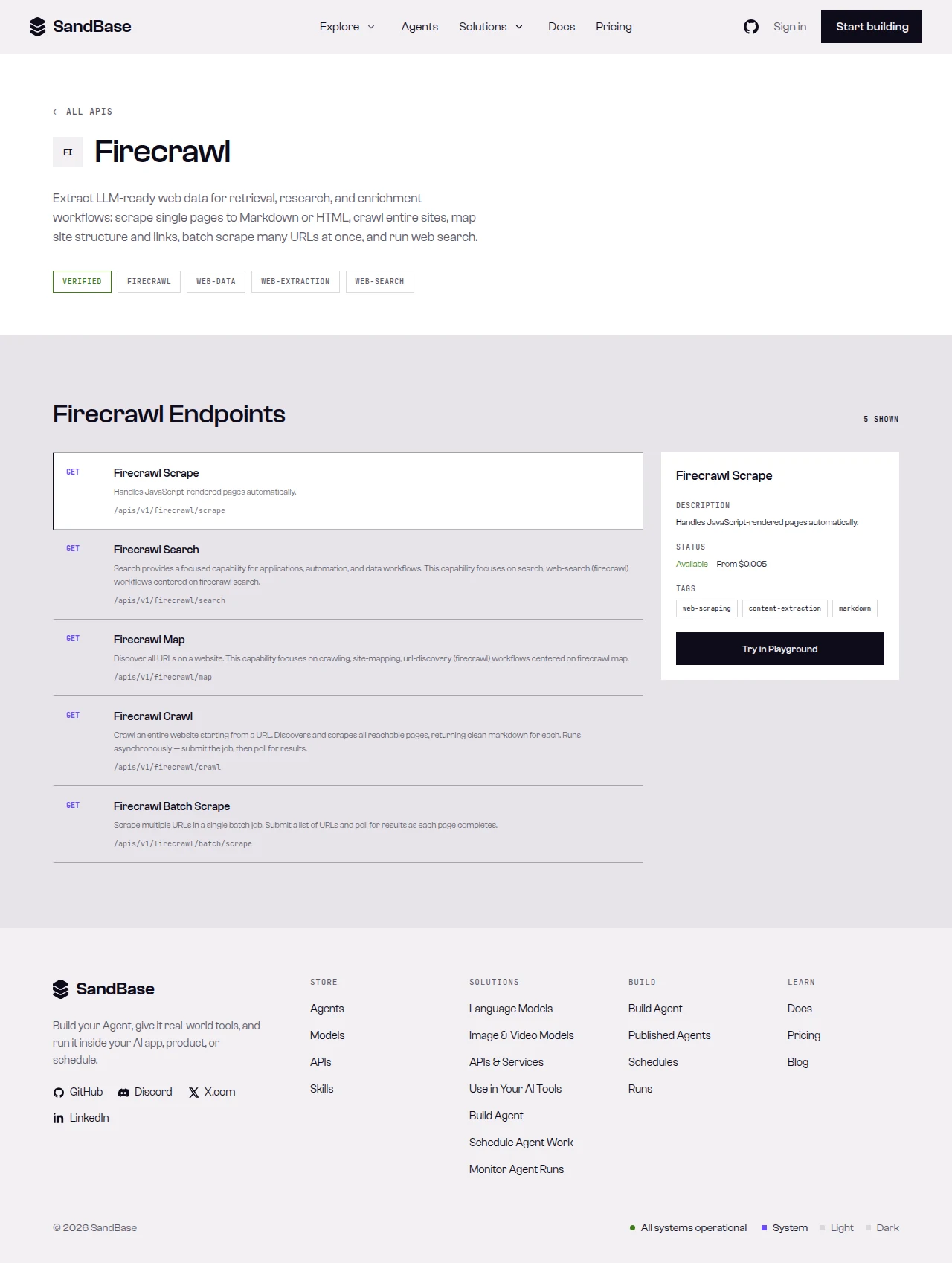 All three vendors live in the same catalog, reachable with one key.
A common RAG pattern across all three
Whichever you pick, the retrieval step looks the same: find candidate pages, pull their text, and feed your model. With Exa it’s search → contents; with Tavily it’s search → extract (or just search for the built-in answer); with Firecrawl it’s search/map for coverage. Because the SandBase envelope is shared, you can even fan out to two providers and merge results behind the same helper — useful when you want both neural relevance and a synthesized answer.
FAQ
Do I need three separate API keys?
No. All three run through SandBase with one SANDBASE_API_KEY. That’s the point of comparing them here — you can try each without three integrations.
Which is best for RAG? There’s no single winner. Exa is strong for intent-based retrieval, Tavily for a one-call search-plus-answer, and Firecrawl for content and site coverage. Many pipelines combine them.
Do these return public data only? These are read/retrieval APIs over public web content. Respect each provider’s terms and robots policies for your use case, and confirm behavior against the live reference.
Why does the response sometimes use output and sometimes outputs?
The envelope can vary by endpoint and over time. Read either shape — prefer a top-level output, fall back to outputs[0].data — as shown in the shared helper above.
Bottom line
For 2026, pick by job: Exa for meaning-based retrieval and cited answers, Tavily for one-call search-plus-answer with extraction, and Firecrawl for scraping and site structure. Because all three are reachable through one SandBase key with the same envelope, the low-risk move is to wire the shared helper once and try each on your own queries.