RAG Cost Structure: Embedding + Search + LLM
A tutorial-style cost breakdown of RAG pipelines: embedding, search, and LLM components. Real numbers for 1M documents, optimization strategies, and when RAG beats long-context (and when it doesn't).
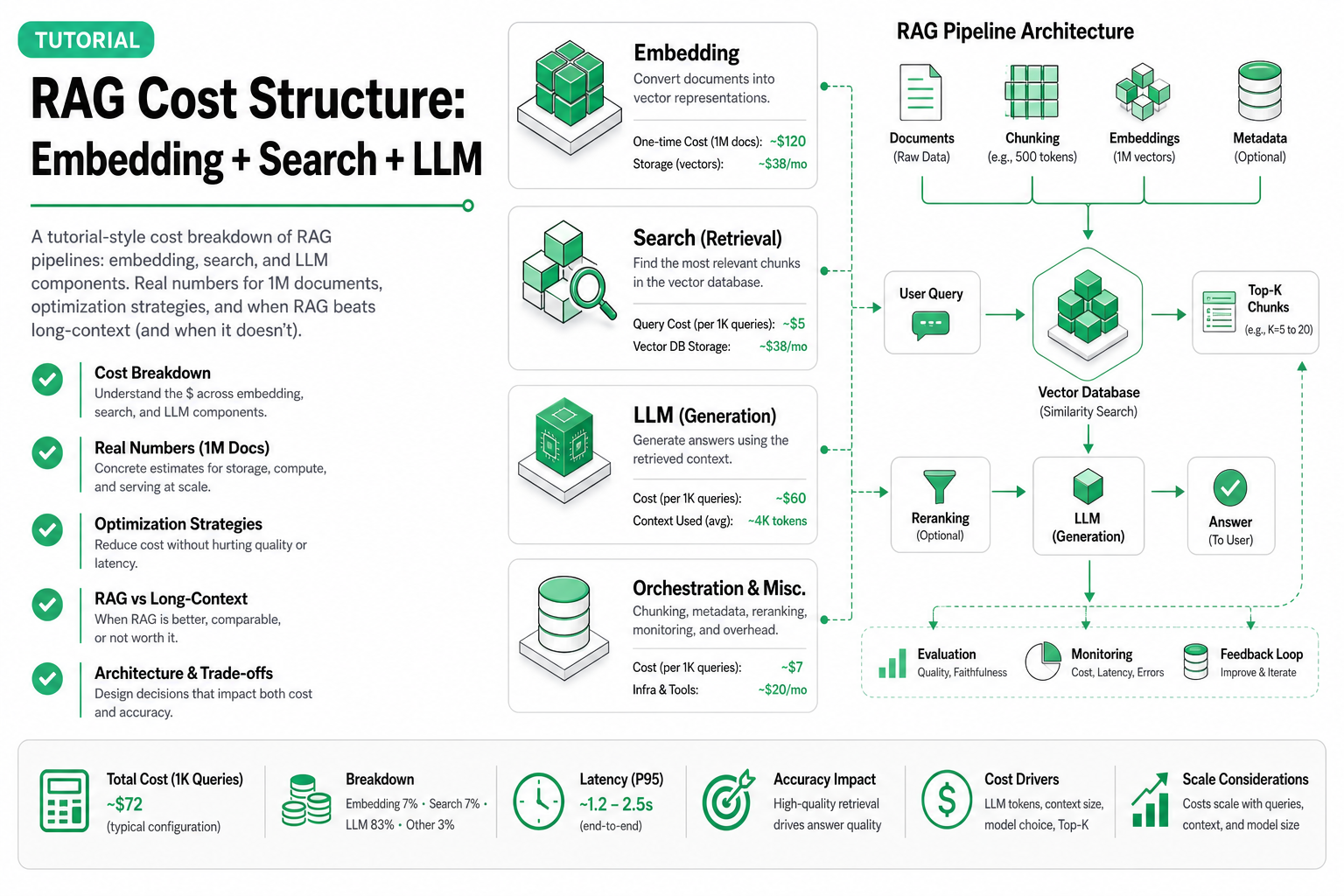
TL;DR — A RAG pipeline has three cost components: embedding (one-time, ~$1.30 per million chunks with text-embedding-v4), search ($0.001–0.02 per query), and LLM generation ($0.01–0.15 per answer). For most knowledge bases, RAG costs $0.02–0.05 per question. Long-context models win below ~50 pages but lose badly above ~200 pages. This guide provides exact calculations for planning.
The three cost layers
Every RAG (Retrieval-Augmented Generation) pipeline has the same fundamental cost structure:
Total cost per answer = Embedding (amortized) + Search + LLM generationEach layer has different characteristics:
- Embedding — mostly one-time, amortized across all queries
- Search — per-query, usually the cheapest component
- LLM generation — per-query, usually the most expensive component
Let’s break each down with real 2026 pricing.
Layer 1: Embedding cost
Embedding converts your documents into vectors for similarity search. This is primarily a one-time cost when you ingest documents, plus incremental cost for updates.
Pricing landscape (2026)
| Model | Provider | Price per 1M tokens | Dimensions | Notes |
|---|---|---|---|---|
| text-embedding-v4 | Alibaba/SandBase | $0.0015/1K tokens | 1024/2048 | Latest, high quality |
| text-embedding-3-large | OpenAI | $0.00013/1K tokens | 3072 | Most cost-effective |
| text-embedding-3-small | OpenAI | $0.00002/1K tokens | 1536 | Budget option |
| embed-v4 | Cohere | $0.0001/1K tokens | 1024 | Good multilingual |
| Voyage-3-large | Voyage AI | $0.00018/1K tokens | 1024 | Specialized for code |
Calculating embedding cost for 1M documents
Assumptions:
- Average document: 500 words ≈ 650 tokens
- Chunking strategy: 512 tokens per chunk with 64 token overlap
- Average chunks per document: 1.5 (accounting for short docs)
- Total chunks: 1,500,000
With text-embedding-v4 ($0.0015/1K tokens):
  Total tokens: 1,500,000 chunks × 512 tokens = 768,000,000 tokens
  Cost: 768,000 × $0.0015 = $1,152

With text-embedding-3-large ($0.00013/1K tokens):
  Cost: 768,000 × $0.00013 = $99.84

With text-embedding-3-small ($0.00002/1K tokens):
  Cost: 768,000 × $0.00002 = $15.36
Amortization
Embedding is a one-time cost (per document version). If your knowledge base is queried 100,000 times before the next full re-embed:
Amortized embedding cost per query:
  text-embedding-v4: $1,152 / 100,000 = $0.01152
  text-embedding-3-large: $99.84 / 100,000 = $0.001
  text-embedding-3-small: $15.36 / 100,000 = $0.00015
For most applications, amortized embedding cost is negligible — a fraction of a cent per query.
Re-embedding triggers
You’ll need to re-embed when:
- Documents are updated (re-embed changed docs only)
- You switch embedding models (full re-embed)
- You change chunk size strategy (full re-embed)
- New documents are added (embed new only)
Budget for monthly incremental embedding based on your update frequency:
| Update pattern | Monthly embedding cost (1M doc base) |
|---|---|
| Static (no updates) | $0 |
| 1% updated/month | ~$12 (text-embedding-v4) |
| 10% updated/month | ~$115 |
| Full monthly refresh | ~$1,152 |
Layer 2: Search cost
Search finds relevant chunks for a query. This has two sub-components: query embedding and vector similarity search.
Query embedding
Every query must be embedded using the same model as your documents:
Query embedding cost per search:
  Average query: 20 tokens
  text-embedding-v4: 20/1000 × $0.0015 = $0.00003
  text-embedding-3-large: 20/1000 × $0.00013 = $0.0000026
Effectively free at per-query level.
Vector database costs
The significant search cost is the vector database hosting:
| Solution | Monthly cost (1.5M vectors, 1024 dims) | Per-query cost at 10K queries/day |
|---|---|---|
| Pinecone (Starter) | $70/month | $0.00023 |
| Pinecone (Standard) | $200/month | $0.00067 |
| Weaviate Cloud | $150/month | $0.0005 |
| Qdrant Cloud | $100/month | $0.00033 |
| pgvector (self-hosted) | $50–100/month (VM cost) | $0.00017–0.00033 |
| ChromaDB (self-hosted) | $30–80/month (VM cost) | $0.0001–0.00027 |
Search API services
Alternatively, use a search API that handles embedding + vector search:
SandBase search APIs (e.g., Cloudsway):
  $0.001–0.02 per search query
  Includes: query embedding + retrieval + re-ranking
  No infrastructure to manage
Total search cost per query
Self-managed (Pinecone Standard + text-embedding-3-large):
  Query embedding: $0.0000026
  Vector search: $0.00067
  Total: ~$0.0007/query

Managed search API:
  $0.001–0.02/query (all-inclusive)
Layer 3: LLM generation cost
The most expensive and most variable component. This is where the retrieved context gets sent to an LLM along with the user’s question.
Token math
A typical RAG prompt includes:
- System prompt: ~200 tokens
- Retrieved context: 5 chunks × 512 tokens = 2,560 tokens
- User question: ~50 tokens
- Total input: ~2,810 tokens
- Generated answer: ~300–500 tokens
LLM pricing comparison (2026)
| Model | Input $/1M tokens | Output $/1M tokens | Cost per RAG answer |
|---|---|---|---|
| GPT-4.1 | $2.00 | $8.00 | $0.0096 |
| GPT-4.1-mini | $0.40 | $1.60 | $0.0019 |
| Claude Sonnet 5 | $3.00 | $15.00 | $0.0159 |
| Claude Haiku 4 | $0.80 | $4.00 | $0.0042 |
| Kimi K3 | $1.50 | $6.00 | $0.0072 |
| DeepSeek V4 | $0.50 | $2.00 | $0.0024 |
| Qwen 3.6 | $0.30 | $1.20 | $0.0015 |
Cost per RAG answer assumes 2,810 input tokens + 400 output tokens
Context window optimization
More retrieved chunks = better answers but higher cost:
| Chunks retrieved | Input tokens | GPT-4.1 cost | Claude Sonnet 5 cost |
|---|---|---|---|
| 3 chunks | 1,786 tokens | $0.0068 | $0.0113 |
| 5 chunks | 2,810 tokens | $0.0096 | $0.0159 |
| 10 chunks | 5,370 tokens | $0.0167 | $0.0281 |
| 20 chunks | 10,490 tokens | $0.0310 | $0.0525 |
The sweet spot for most applications is 5–10 chunks. Beyond 10, you get diminishing returns on answer quality while costs scale linearly.
Total RAG cost per answer
Combining all three layers for a typical setup:
Budget configuration
Embedding: text-embedding-3-large (amortized ~$0.001/query)
Search: Self-managed Pinecone ($0.0007/query)
LLM: GPT-4.1-mini with 5 chunks ($0.0019/query)

Total: $0.0036/query (~$0.004)
Mid-range configuration
Embedding: text-embedding-v4 (amortized ~$0.012/query)
Search: Managed API ($0.005/query)
LLM: GPT-4.1 with 5 chunks ($0.0096/query)

Total: $0.0266/query (~$0.03)
Premium configuration
Embedding: text-embedding-v4 (amortized ~$0.012/query)
Search: Managed API with re-ranking ($0.02/query)
LLM: Claude Sonnet 5 with 10 chunks ($0.0281/query)

Total: $0.0601/query (~$0.06)
Monthly cost projections
| Daily queries | Budget ($0.004) | Mid-range ($0.03) | Premium ($0.06) |
|---|---|---|---|
| 100 | $12/month | $90/month | $180/month |
| 1,000 | $120/month | $900/month | $1,800/month |
| 10,000 | $1,200/month | $9,000/month | $18,000/month |
| 100,000 | $12,000/month | $90,000/month | $180,000/month |
Optimization strategies
1. Chunk size tuning
Larger chunks mean fewer chunks needed but more tokens per chunk:
| Chunk size | Chunks for same coverage | Tokens per RAG call | Trade-off |
|---|---|---|---|
| 256 tokens | 10 chunks | 2,810 | More precision, more search cost |
| 512 tokens | 5 chunks | 2,810 | Balanced |
| 1024 tokens | 3 chunks | 3,322 | Less precision, fewer searches |
Recommendation: Start with 512 tokens, 64 token overlap. Adjust based on answer quality evaluation.
2. Two-stage retrieval
# Stage 1: Fast, cheap retrieval (get 20 candidates)
candidates = vector_db.search(query_embedding, top_k=20)

# Stage 2: Re-rank with a cross-encoder (keep top 5)
reranked = reranker.rank(query, candidates, top_k=5)

# Only send top 5 to LLM
answer = llm.generate(context=reranked, question=query)
Re-ranking costs ~$0.001–0.005 per query but significantly improves which chunks reach the LLM, reducing the need for large context windows.
3. Caching
import hashlib

def get_cached_answer(query: str, cache: dict) -> str | None:
    # Exact match cache
    key = hashlib.sha256(query.encode()).hexdigest()
    return cache.get(key)

def get_semantic_cache(query_embedding, cache_embeddings, threshold=0.95):
    # Semantic similarity cache
    similarities = cosine_similarity(query_embedding, cache_embeddings)
    if max(similarities) > threshold:
        return cached_answers[argmax(similarities)]
    return None
Cache hit rates depend on query repetition:
- Customer support: 40–60% cache hit rate (many repeated questions)
- Research/analysis: 5–15% cache hit rate (unique questions)
- Internal knowledge base: 20–40% cache hit rate
A 40% cache hit rate reduces effective per-query cost by 40%.
4. Model routing
Use a cheaper model for simple questions, premium model for complex ones:
def route_query(query: str, context_chunks: list) -> str:
    # Simple heuristic: short answers likely simple
    if len(context_chunks) <= 3 and len(query.split()) < 15:
        return "gpt-4.1-mini"  # $0.0019/answer
    else:
        return "claude-sonnet-5"  # $0.0159/answer
With 60% simple / 40% complex split:
Blended cost: 0.6 × $0.0019 + 0.4 × $0.0159 = $0.0075/answer
vs. always using premium: $0.0159/answer
Savings: 53%
5. Embedding model selection by use case
For deeper analysis of embedding model options including text-embedding-v4, consider:
- English-only knowledge base: text-embedding-3-large (cheapest, excellent quality)
- Multilingual (including Chinese): text-embedding-v4 (best CJK performance)
- Code repositories: Voyage-3-large (specialized)
- Budget-constrained: text-embedding-3-small (20x cheaper, 90% quality)
See also our comprehensive embedding model comparison for benchmark data.
RAG vs Long-Context: When to use which
The advent of 1M-token context windows raises the question: when is RAG still worth the complexity?
Cost comparison by document size
Assume: Answering questions about a document collection.
| Collection size | RAG cost/query | Long-context cost/query (GPT-4.1) | Winner |
|---|---|---|---|
| 10 pages (~5K tokens) | $0.03 | $0.012 | Long-context |
| 50 pages (~25K tokens) | $0.03 | $0.054 | RAG |
| 200 pages (~100K tokens) | $0.03 | $0.204 | RAG (7x cheaper) |
| 1000 pages (~500K tokens) | $0.03 | $1.004 | RAG (33x cheaper) |
| 10,000 pages (~5M tokens) | $0.03 | Impossible (exceeds context) | RAG (only option) |
The crossover point
RAG becomes cheaper than long-context when your source material exceeds approximately 15,000–25,000 tokens (~8-12 pages), depending on model pricing.
When long-context wins
- Small document sets (< 50 pages): Cheaper and simpler to stuff everything in context
- Questions requiring holistic understanding: “Summarize the main themes across all documents”
- Sequential reasoning: When the answer requires following a thread across the full document
- One-off analysis: No need to build embedding infrastructure for a single use
When RAG wins
- Large knowledge bases (> 100 pages): Cost scales with retrieved chunks, not total collection
- Frequently queried: Amortized embedding cost approaches zero
- Precise retrieval needed: Questions about specific facts in large collections
- Multi-source: Combining data from different document types/sources
- Dynamic content: New documents added regularly without re-processing everything
Implementation: Minimal RAG pipeline
from openai import OpenAI
import numpy as np

client = OpenAI(base_url="https://api.sandbase.ai/v1", api_key="...")

# Step 1: Embed documents (one-time)
def embed_chunks(chunks: list[str]) -> list[list[float]]:
    response = client.embeddings.create(
        model="text-embedding-v4",
        input=chunks
    )
    return [item.embedding for item in response.data]

# Step 2: Search (per query)
def search(query: str, chunk_embeddings: np.ndarray, chunks: list[str], top_k=5):
    query_resp = client.embeddings.create(model="text-embedding-v4", input=[query])
    query_vec = np.array(query_resp.data[0].embedding)

    similarities = np.dot(chunk_embeddings, query_vec)
    top_indices = np.argsort(similarities)[-top_k:][::-1]
    return [chunks[i] for i in top_indices]

# Step 3: Generate answer (per query)
def answer(query: str, context_chunks: list[str]) -> str:
    context = "\n\n---\n\n".join(context_chunks)
    response = client.chat.completions.create(
        model="gpt-4.1-mini",
        messages=[
            {"role": "system", "content": f"Answer based on this context:\n\n{context}"},
            {"role": "user", "content": query}
        ]
    )
    return response.choices[0].message.content

# Full pipeline
chunks = load_and_chunk_documents("./docs/")
embeddings = np.array(embed_chunks(chunks))

# Per-query cost: ~$0.004
query = "What is the refund policy?"
relevant = search(query, embeddings, chunks)
result = answer(query, relevant)
Cost monitoring for RAG agents
For agents using RAG pipelines, track these metrics:
class RAGCostTracker:
    def __init__(self):
        self.embedding_tokens = 0
        self.search_queries = 0
        self.llm_input_tokens = 0
        self.llm_output_tokens = 0

    def log_query(self, input_tokens: int, output_tokens: int):
        self.search_queries += 1
        self.llm_input_tokens += input_tokens
        self.llm_output_tokens += output_tokens

    @property
    def total_cost(self):
        embedding_cost = self.embedding_tokens / 1000 * 0.0015
        search_cost = self.search_queries * 0.001
        llm_input_cost = self.llm_input_tokens / 1_000_000 * 2.00
        llm_output_cost = self.llm_output_tokens / 1_000_000 * 8.00
        return embedding_cost + search_cost + llm_input_cost + llm_output_cost
For a deeper dive on API pricing models and budget controls, see LLM API pricing guide.
Related Reading
- Best Embedding Models for RAG Agents (2026)
- Alibaba text-embedding-v4: The Bilingual Embedding Model Your CJK Pipeline Actually Needs
- LLM API Pricing in 2026: The Complete Guide
- Per-Call vs Token Pricing: Which Works for Agents
- Top 6 AI Search APIs for Agent Workflows in 2026
- Anthropic Prompt Caching: 5min vs 1hr Pricing
Conclusion
RAG cost structure is predictable and optimizable:
- Embedding: One-time cost, amortizes to near-zero per query. Choose model based on language needs and quality requirements.
- Search: Cheapest component. Self-hosted vector DB or managed API, either way it’s < $0.01/query.
- LLM generation: Dominant cost. Optimize by routing models, tuning chunk count, and caching.
The total: $0.004–0.06 per answer depending on configuration. At 1,000 queries/day, that’s $120–1,800/month — a fraction of what a human analyst costs for the same knowledge retrieval task.
RAG remains the economically correct choice for any knowledge base exceeding ~25K tokens where questions are frequent and answers require precision. Below that threshold, long-context is simpler and often cheaper. Above it, RAG’s fixed-cost-per-query regardless of collection size makes it the clear winner.