KeywordScout Guide: Turn a Topic into Measured Content Priorities
How SandBase KeywordScout combines model brainstorming, Google Ads data and DataForSEO difficulty to rank keywords without inventing demand.

The fastest way to ruin a content plan is to let a language model invent both the keyword and its demand. The phrase may sound plausible, the volume may look precise, and neither may reflect what people search.
SandBase KeywordScout separates those jobs. A model proposes queries and clusters; Google Ads supplies related ideas, monthly volume, CPC and ad competition; DataForSEO Labs supplies SEO difficulty. A final model pass removes noise and recommends what to publish first. It is for editors, founders and SEO teams that need a measured shortlist, not a hundred unranked ideas.
Key takeaway
- One run returns up to 100 keywords and 12 months of trend context.
- The tool distinguishes four intents and offers 11 market/language presets.
- Search volume and CPC come from Google Ads through DataForSEO.
- Difficulty is a separate DataForSEO Labs metric; it is not ad competition.
- Missing measured data is labelled as an AI estimate rather than presented as fact.
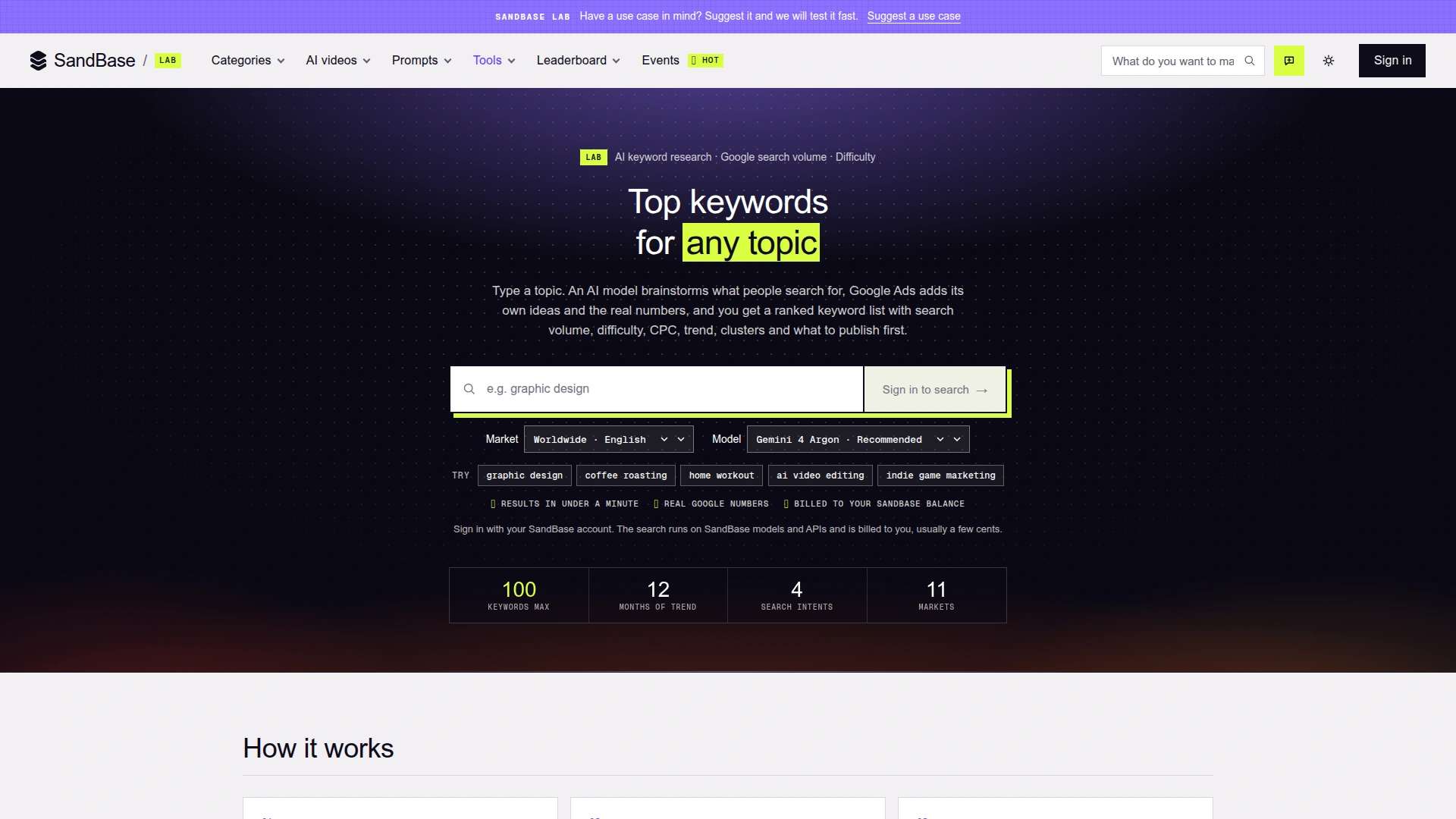 The public page reviewed on 2026-11-02 exposes the topic, market and model choices before running research. It also states that results are billed to the signed-in SandBase balance.
Why three stages matter
Brainstorming finds language; measurement tests whether the language has observed demand; editorial judgment decides whether a keyword deserves a page. Mixing the stages produces bad shortcuts. High volume alone can hide the wrong audience. Low difficulty can describe a query with no conversion path. A model’s “opportunity” score is only useful when the underlying columns remain visible.
| Stage | Source | Contribution |
|---|---|---|
| Brainstorm | Selected SandBase model + Google Ads ideas | Queries, clusters and intent candidates |
| Measure | Google Ads via DataForSEO | 12-month average volume, CPC, competition and trend |
| Measure | DataForSEO Labs | Organic keyword difficulty |
| Pick | Selected model | Deduplication, prioritised titles and angles |
KeywordScout supports Gemini 4 Argon, GPT-6.1 Sol, Claude Sonnet 5.5 and GPT-6 Luna on the reviewed page. Those are execution choices, not benchmark winners. A cheaper or faster model may be enough when the measured columns do most of the filtering.
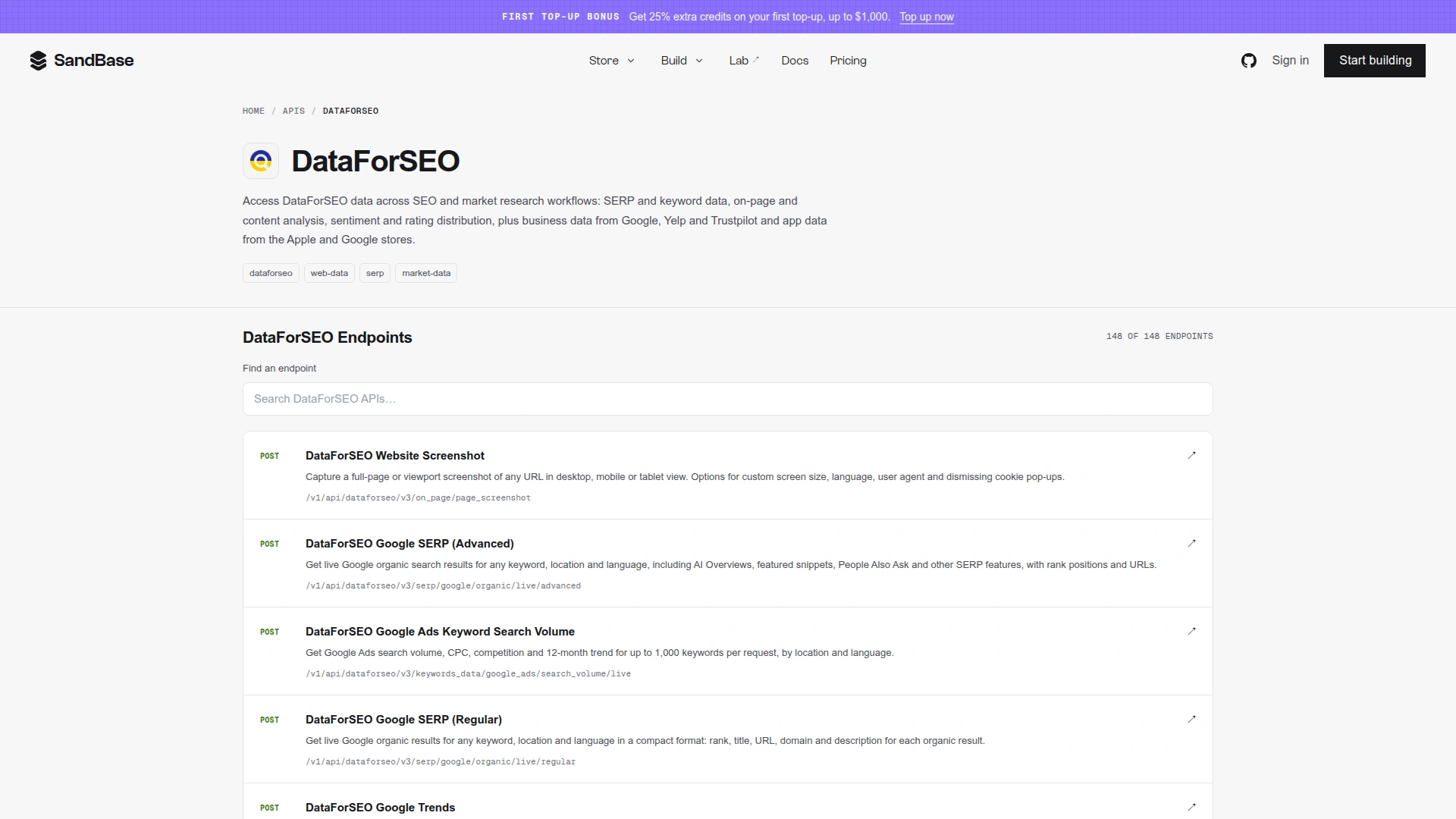 The DataForSEO catalog is the reusable API layer. KeywordScout calls three endpoints; the wider catalog contains many unrelated SEO capabilities.
The three API dependencies
| Endpoint | Role |
|---|---|
dataforseo/v3/keywords_data/google_ads/keywords_for_keywords/live | Related keyword ideas with measured fields |
dataforseo/v3/keywords_data/google_ads/search_volume/live | Volume, CPC, ad competition and monthly trend |
dataforseo/v3/dataforseo_labs/google/bulk_keyword_difficulty/live | Organic difficulty for a batch |
Developers can call the same family through POST /v1/api/<model>. Completed SandBase responses place the business payload at outputs[0].data; production code should stop if that path is missing. Nested DataForSEO fields remain provider-shaped and should be validated against a dated response before being hard-coded.
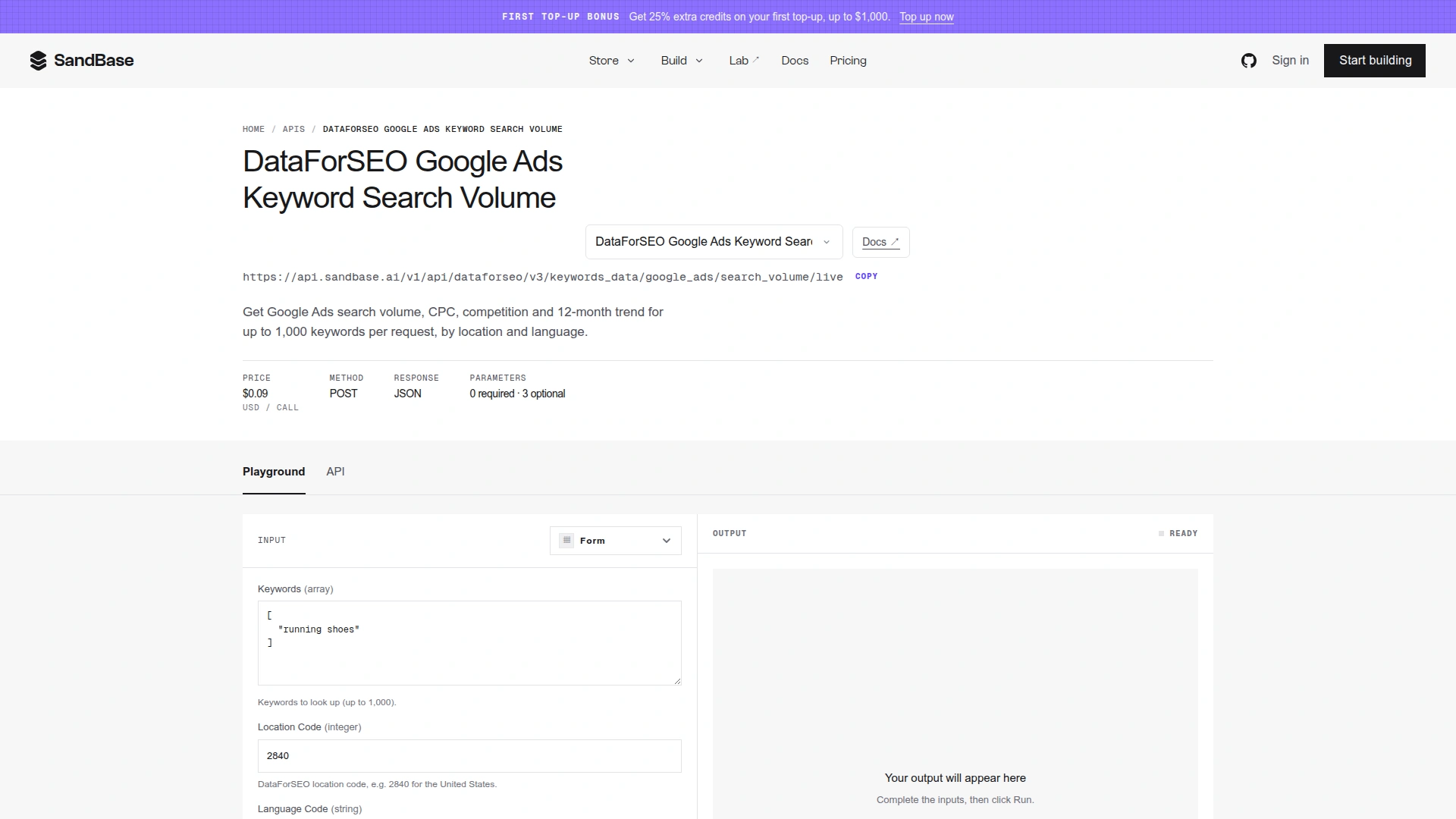 The direct endpoint page documents the production route and request schema. Use it when research needs to be scheduled or stored, rather than repeated manually in the Lab.
How to choose a real opportunity
Start by deleting anything that does not match the reader or product. Then compare intent: a broad informational phrase and a purchase-oriented comparison are not interchangeable even if volume is equal. Inspect the trend—an annual average can hide a one-month spike. Compare difficulty with the site’s current authority and existing coverage. Finally, identify a specific SandBase destination or useful next action before approving the brief.
A good shortlist records the market, language, retrieval date and data source. Do not write “12,100 searches” as if it were a census. Google Ads figures are rounded estimates. CPC reflects advertising auctions, not guaranteed commercial value. Difficulty is a modelled competition score, not a promise that a page will or will not rank.
For a practical follow-on, use the DataForSEO keyword-research agent workflow and compare the discovery layer in the web-search API guide.
Production checklist
- Fix the market and language before comparing rows.
- Export the raw measured columns with a retrieval date.
- Preserve the distinction between measured values and AI estimates.
- Deduplicate by reader task, not merely exact string.
- Reject keywords already served by a canonical page.
- Write one brief per distinct intent and link it to a product destination.
- Recheck the live SERP before publication; the table is evidence, not the whole market.
FAQ
Is search volume exact?
No. The page describes it as Google Ads average monthly searches over 12 months, with Google’s rounding.
Are ad competition and SEO difficulty the same?
No. Ad competition reflects advertiser activity; the Labs difficulty score estimates organic competition.
Does KeywordScout guarantee traffic?
No. It helps prioritise research. Rankings and traffic depend on the page, site, competitors and time.
Bottom line
KeywordScout is useful because it does not ask one model to pretend it knows demand. It keeps ideation, measured data and editorial selection distinct. Use the resulting table to make fewer, better briefs—and keep every number attached to its market, date and source.