AEO Check: See Whether AI Assistants Recommend Your Brand
How SandBase AEO Check measures AI visibility, competitor mentions, answer position and site readiness—and how to turn the report into useful work.
A site can rank for its own name and still disappear when a buyer asks an AI assistant which product to choose. That gap is hard to diagnose with ordinary SEO tools: a blue-link position does not tell you whether a model names the brand, which competitor it prefers, or where the recommendation appears.
SandBase AEO Check turns one public website into a bounded answer-engine visibility audit. It derives six buyer questions, asks four named models each question in a fresh chat, reads all 24 answers, and combines those observations with nine checks of the public site. Use it to find missing comparisons, weak category language and crawler problems. Do not treat one run as a permanent ranking.
Key takeaway
- One run asks 4 models 6 buyer questions, producing 24 answers to inspect.
- The report separates visibility, share of voice, average position, sentiment and site readiness.
- Nine readiness checks cover the home page,
robots.txtandllms.txt.- Models answer without live web search, so search-enabled consumer products may behave differently.
- The report is a dated experiment, not proof of future recommendations.
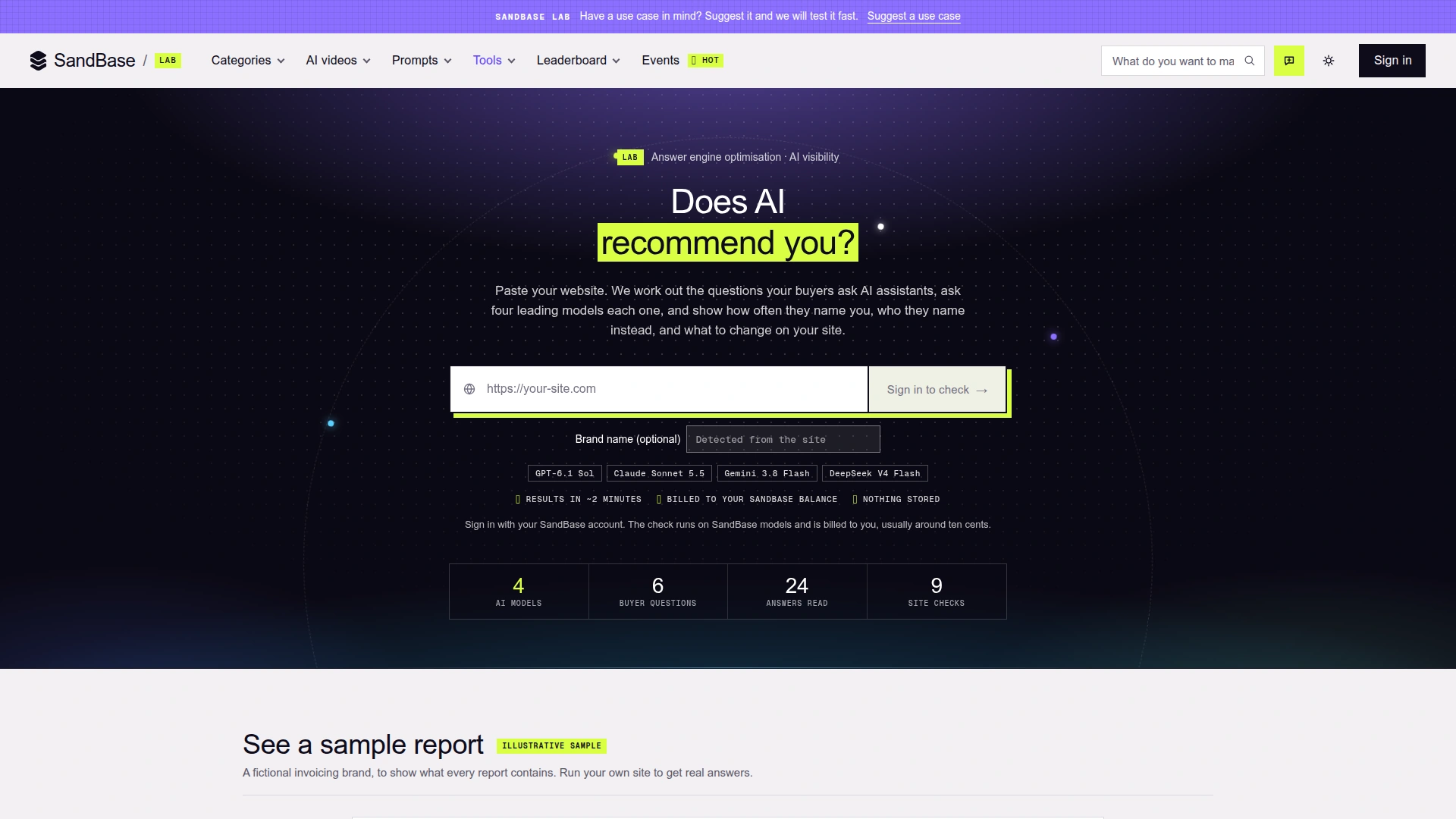 The public AEO Check entry page reviewed on 2026-11-02. It states the 4-model, 6-question and 9-site-check scope before a user runs anything.
What the report measures
The useful part is not the headline score. It is the evidence beneath it.
| Signal | What it answers | Important limit |
|---|---|---|
| AI visibility | In how many answers was the brand named? | Depends on these questions and model versions |
| Share of voice | What share of all brand mentions belonged to the target? | A mention is not a purchase or click |
| Average position | Where did the target appear among brands named? | Position extraction can miss unusual prose |
| Sentiment | How positively was the target described? | Model interpretation, not customer research |
| Site readiness | Can public pages be indexed and parsed cleanly? | Technical readiness does not cause a recommendation by itself |
The illustrative report keeps every model answer available. That is the right design. If a score says a competitor dominates, the reader can open the six questions and see whether the competitor was recommended for price, workflow fit, brand familiarity or simply because the question was too broad.
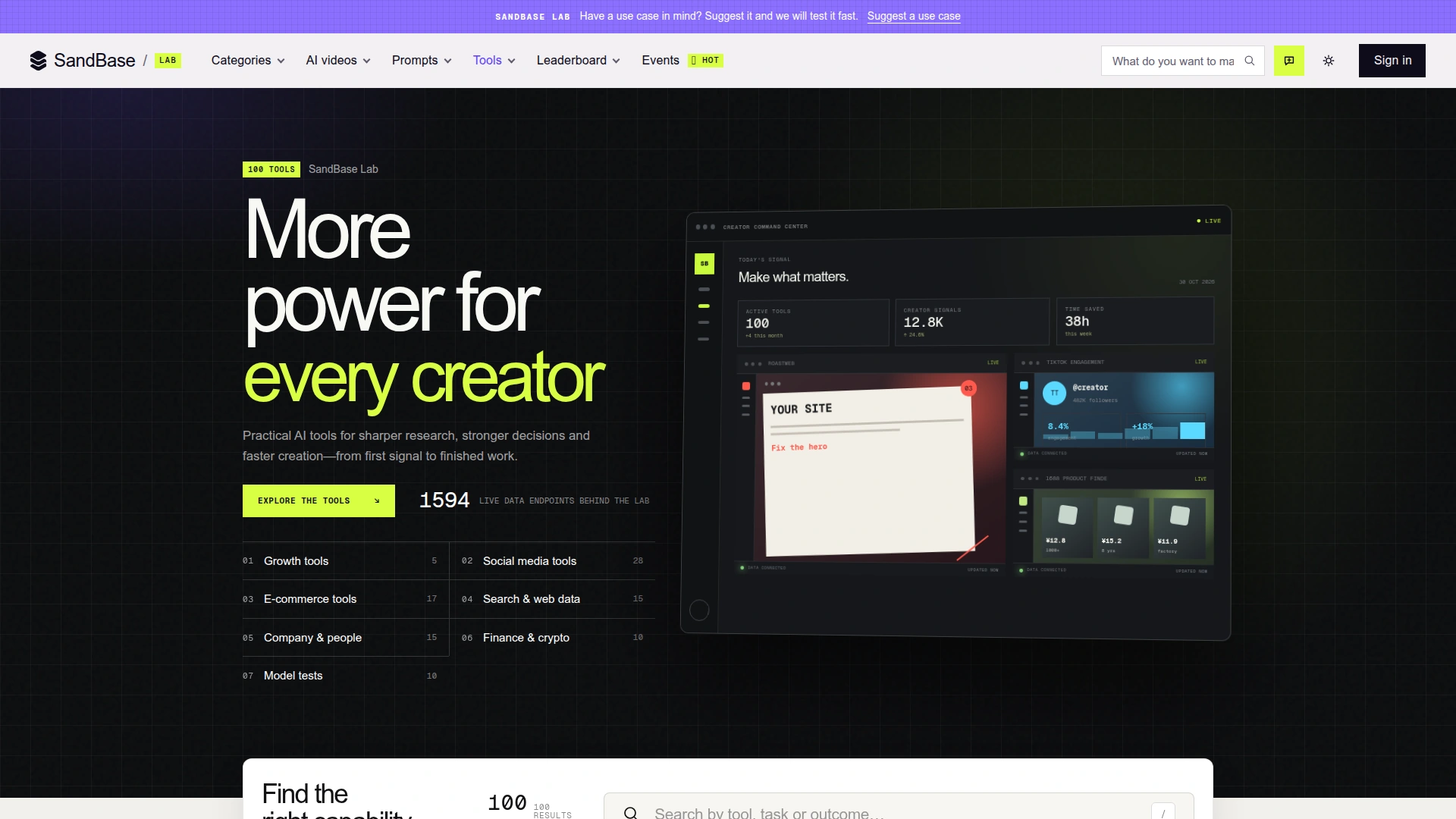 The directory marks AEO Check as a new growth tool and describes its narrow task: test whether AI assistants recommend a site. Captured 2026-11-02.
How the check works
First, a Lab worker reads the public home page, robots.txt and llms.txt. It checks crawler access, indexability, structured data, question-oriented content, headings, description length, freshness and readable word count.
Second, a SandBase model infers the category, likely competitors and six buyer questions that do not name the target brand. GPT-6.1 Sol, Claude Sonnet 5.5, Gemini 3.8 Flash and DeepSeek V4 Flash then answer every question in fresh conversations. Those model names were displayed by the live tool on 2026-11-02 and can change.
Third, the tool counts mentions and positions, analyses tone and ranks recommended actions. The page says a typical run takes about two minutes, is billed to the user’s SandBase balance, usually costs around ten cents, and is not stored. Check the live page before relying on current price or retention wording.
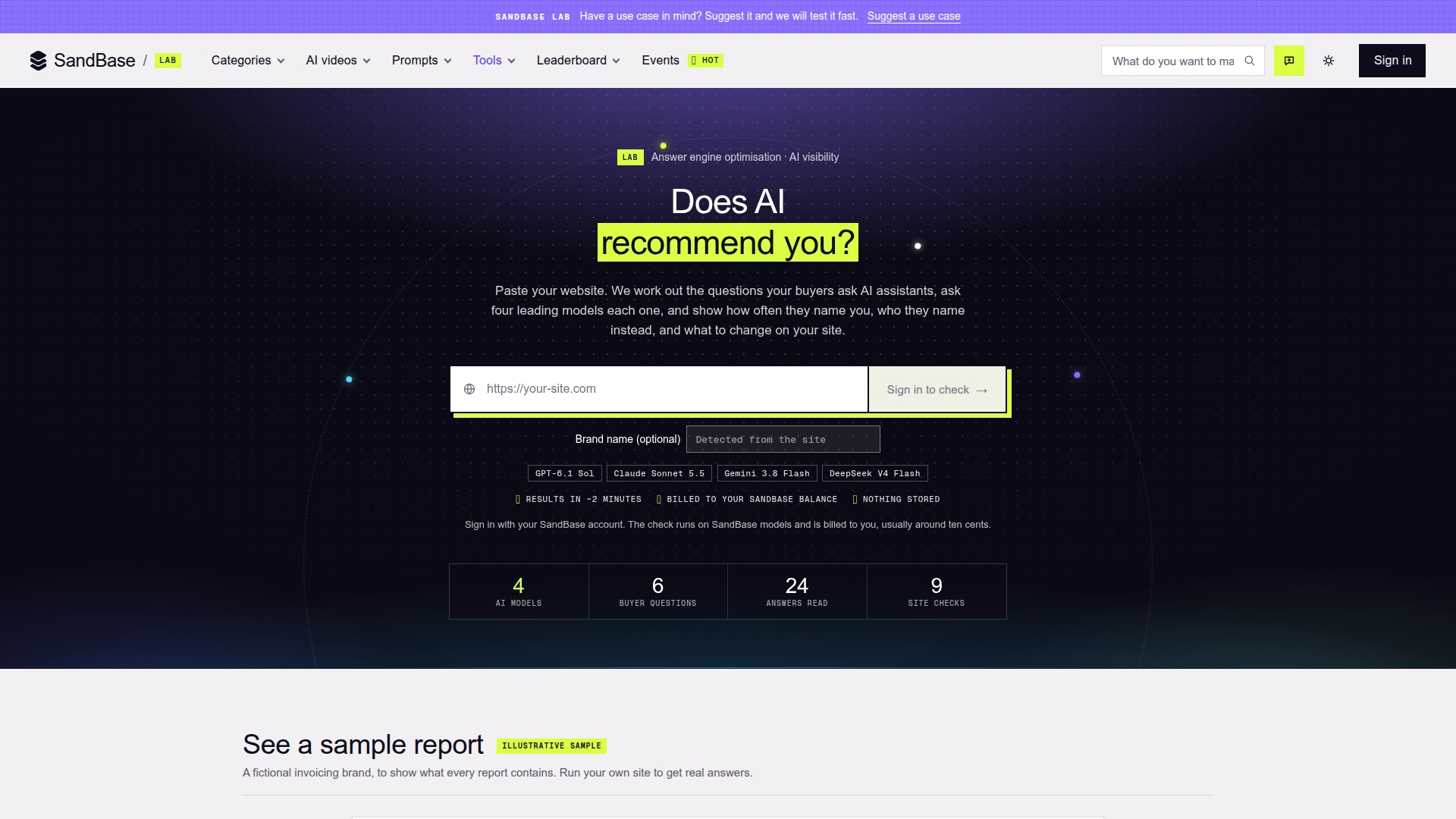 The methodology makes the three stages visible: read the site, ask the models, then score and prioritise. The score is derived from this run rather than an external universal index.
What to fix first
Start with failures that make content unavailable: accidental noindex, blocked relevant crawlers, broken canonical tags or unreadable pages. Then fix the information architecture. A clear product category, explicit audience, concrete use cases, dated facts and answer-first comparison pages give both people and retrieval systems something precise to quote.
Do not add an FAQ or llms.txt merely to collect a green check. Each page still needs a real reader task. If the model repeatedly chooses a competitor in an “alternatives” question, the better response may be a fair comparison that names where each product wins—not six near-duplicate pages built around the same keyword.
For the technical foundation, pair the report with the Website Traffic Checker guide and the DataForSEO research-agent workflow rather than collapsing traffic, rankings and model mentions into one metric.
A repeatable monthly workflow
- Save the date, model set, six questions and full answers.
- Separate technical failures from content gaps and authority gaps.
- Choose one high-impact change whose success can be checked.
- Publish or repair the relevant page; keep the claim specific and sourced.
- Rerun after the change has had time to be crawled or learned.
- Compare question by question, not only the composite score.
The temptation is to chase the number. Resist it. If the questions or models change, a score movement may reflect the experiment rather than the site.
FAQ
Is AEO the same as SEO?
No. SEO commonly measures visibility in search results; this check measures whether selected models name a brand in generated answers. The disciplines overlap because accessible, specific and authoritative pages help both.
Does this reproduce ChatGPT with web search?
No. The tool states that the four models answer from their training without live web search. Search-enabled products can return different answers.
Does a high score guarantee recommendations?
No. It describes one dated run across 24 answers and nine site checks.
Bottom line
AEO Check is most useful as a diagnostic notebook: it preserves the buyer questions, answers, competitors and technical checks behind the score. Run it to decide what to investigate next, then judge progress with the same questions and a recorded model set. Treat the full answers as evidence and the composite score as a summary—not the other way around.