GPT-6.2 Astra and Sol Are Officially Out: Confirmed IDs, Official Pricing, and What You Can Call Today
GPT-6.2 Astra (gpt-6.2-astra) and Sol (gpt-6.2-sol) launched 17 Nov 2026. Official short-context prices are $8/$40 and $2/$10. SandBase has no 6.2 card.
OpenAI has shipped two new API models, and neither of them is a bare gpt-6.2 string. On 17 November 2026 the changelog lists gpt-6.2-astra and gpt-6.2-sol. The community post is timestamped 17 November 2026, 18:00 UTC, which is 18 November 2026, 02:00 in Asia/Shanghai. This note uses the Shanghai clock for “today.” SandBase still has no card for either ID.
The 12 November status note, Is GPT-6.2 Out?, stays the record of what was true that evening: no changelog row, no model page, no SandBase card. It is not a launch article. Whether the new flagship is worth leaving GPT-6 Astra or GPT-6.1 Sol is GPT-6.2 vs GPT-6 Astra and GPT-6.1 Sol. Access, context, and price next to Gemini 4 Carbon and Claude Fable 5.2, without a quality ranking, is the flagship comparison.
Key takeaway
- Official as of 17 Nov 2026 (18:00 UTC / 18 Nov 2026 02:00 Asia/Shanghai). Product names are GPT-6.2 Astra and GPT-6.2 Sol. API IDs are
gpt-6.2-astraandgpt-6.2-sol. There is no shipping SKUgpt-6.2.- Official Standard, short context, per 1M tokens: Astra $8 input / $0.40 cached / $10 cache write (30 minutes) / $40 output. Sol $2 / $0.10 / $2.50 / $10. A 12-hour cache write is $20 on Astra and $5 on Sol.
- Both: text and image in, text out, 1,050,000 context, 922,000 max input, 128,000 max output. The API rejects reasoning effort
none. Tool calling requires the Responses API.- ChatGPT Work and Codex, not regular Chat, per the 17 Nov announcement. API access is on for both IDs.
- SandBase, morning of 18 Nov 2026: HTML and
.md404 forgpt-6.2,gpt-6.2-astra,gpt-6.2-sol, and the hyphenated variants.llms-full.txthas zerogpt-6.2hits. Call GPT-6 Astra or GPT-6.1 Sol today. Do not send a 6.2 string to SandBase.
What the 18 November check actually found
The API changelog is the page a client has to match. The published markdown at https://developers.openai.com/api/docs/changelog.md was fetched 18 November 2026, Asia/Shanghai. It has two 17 November rows. The first names gpt-6.2-astra and gpt-6.2-sol on v1/responses and v1/chat/completions. The sentence under it says to use Astra for demanding reasoning and coding, and Sol for everyday coding and agent workflows, and that tool calling requires the Responses API. The second 17 November row names those two models plus gpt-6.1-terra and gpt-6-luna for discounted background completion windows. That feature is not unique to 6.2.
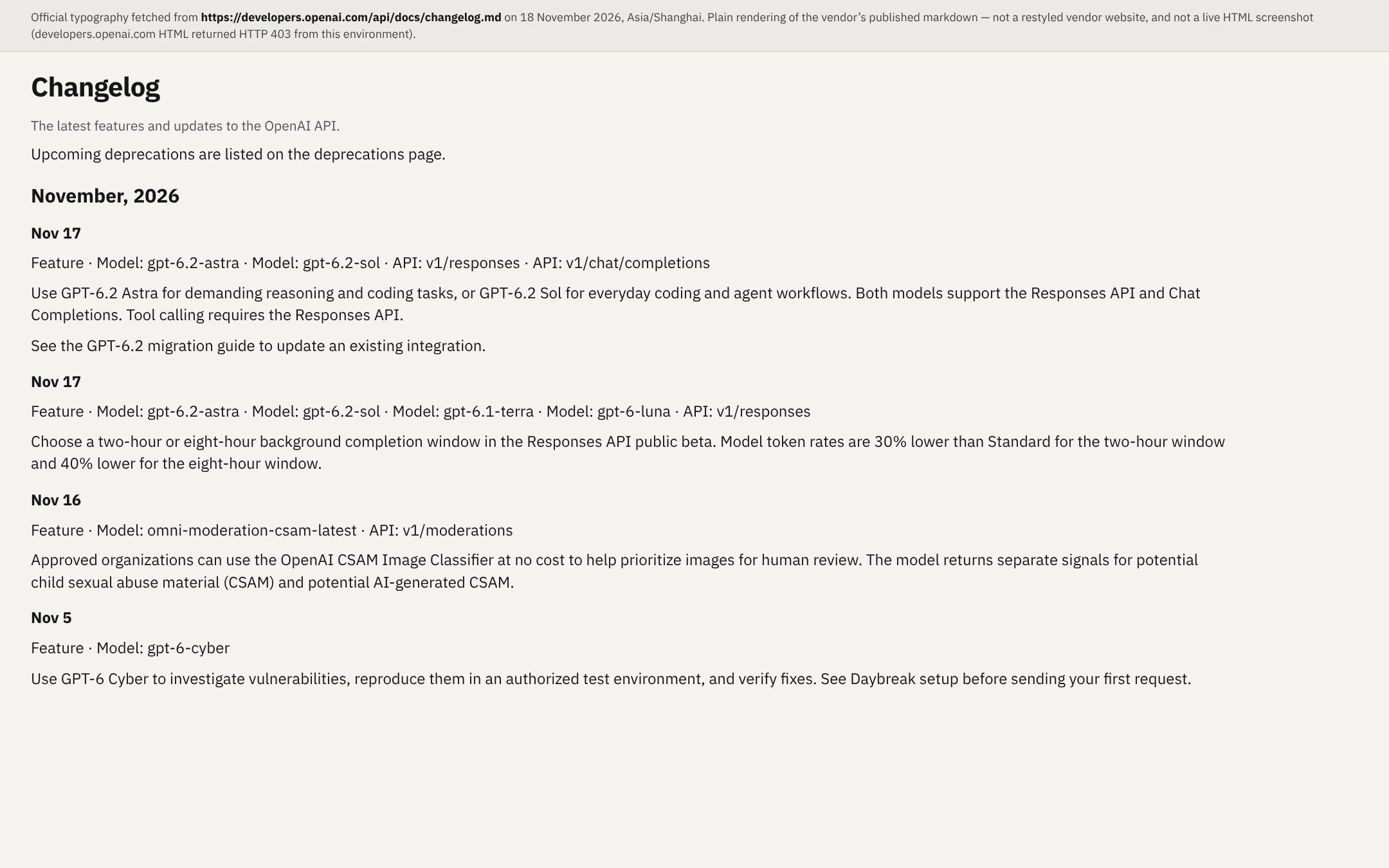
Official API changelog typography from https://developers.openai.com/api/docs/changelog.md, fetched 18 November 2026, Asia/Shanghai. This is a plain rendering of the vendor’s published markdown — not a restyled vendor website, and not a live HTML screenshot (developers.openai.com HTML returned HTTP 403 from this environment). The top November rows are dated Nov 17 and name gpt-6.2-astra and gpt-6.2-sol on v1/responses and v1/chat/completions. The second Nov 17 row also names gpt-6.1-terra and gpt-6-luna for background completion windows (30% / 40% lower than Standard). Later November rows on this crop (Nov 16, Nov 5) are not 6.2 claims.
The published model markdown was fetched the same morning: GPT-6.2 Astra and GPT-6.2 Sol. Live HTML on developers.openai.com and platform.openai.com returned HTTP 403 from this environment, so the frames below are plain renderings of that markdown, not screenshots of the vendor site. Bare https://developers.openai.com/api/docs/models/gpt-6.2 and https://platform.openai.com/docs/models/gpt-6.2 were previously 404 and were not screenshotted. Do not invent gpt-6.2-terra. Astra for Law, mentioned in the launch post, is a configuration of GPT-6.2 Astra. It is not a separate model ID in the catalog this check fetched.
The launch essay at https://openai.com/index/introducing-gpt-6-2-astra-sol/ was not screenshotted. openai.com HTML sat behind a Cloudflare interstitial, the same class of block as the HTTP 403 on a plain fetch of the docs HTML. Claims that come only from that essay are labeled as the 18 November reading of the 17 November post, not as a screenshot. The changelog, the model pages, and the Using GPT-6.2 guide were read from the published markdown (changelog.md, gpt-6.2-astra.md, gpt-6.2-sol.md, guides/latest-model.md).
Names, IDs, and the specs on the model pages
Product spelling is “GPT-6.2 Astra” and “GPT-6.2 Sol”: a space, and a point in 6.2. “GPT-6.2-Astra” and “GPT-6-2 Astra” are not the product names. The catalog line on the Astra page is “Our most capable model for your hardest projects, from start to finish.” Sol’s line is “Our go-to model for everyday work, from coding to powering agents at scale.”
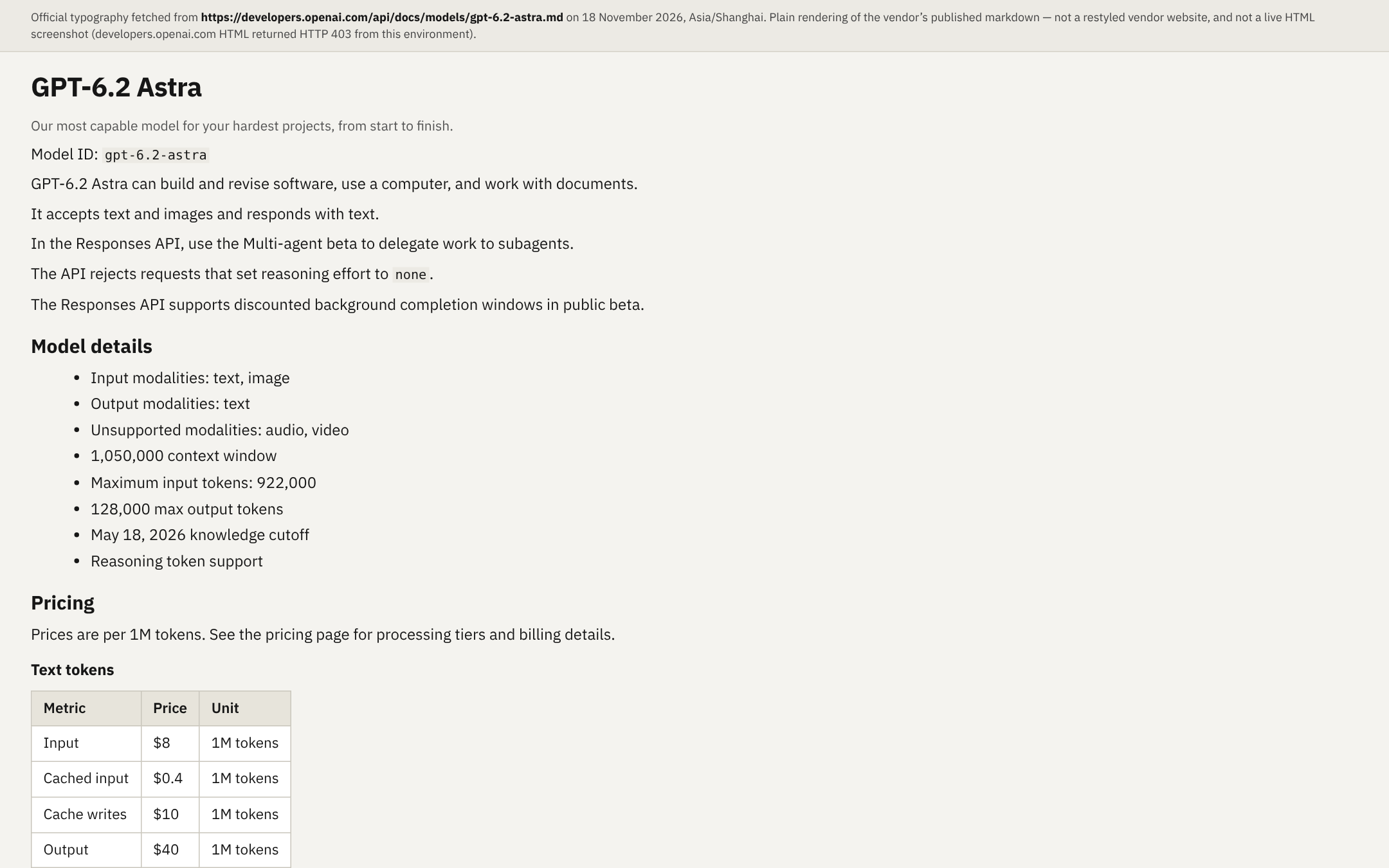
Official GPT-6.2 Astra typography from https://developers.openai.com/api/docs/models/gpt-6.2-astra.md, fetched 18 November 2026, Asia/Shanghai. Plain rendering of published official markdown, not a live HTML screenshot (HTML 403 from this environment). The frame prints model ID gpt-6.2-astra, “Our most capable model for your hardest projects, from start to finish,” context 1,050,000 / max input 922,000 / max output 128,000, knowledge cutoff May 18, 2026, and the short-context Standard table $8 / $0.4 cached input / $10 cache writes / $40 output per 1M tokens. Long-context, batch, Fast, and Ultrafast rules are cropped off this frame; the dedicated price typography is in the flagship comparison. The API rejects reasoning effort none.
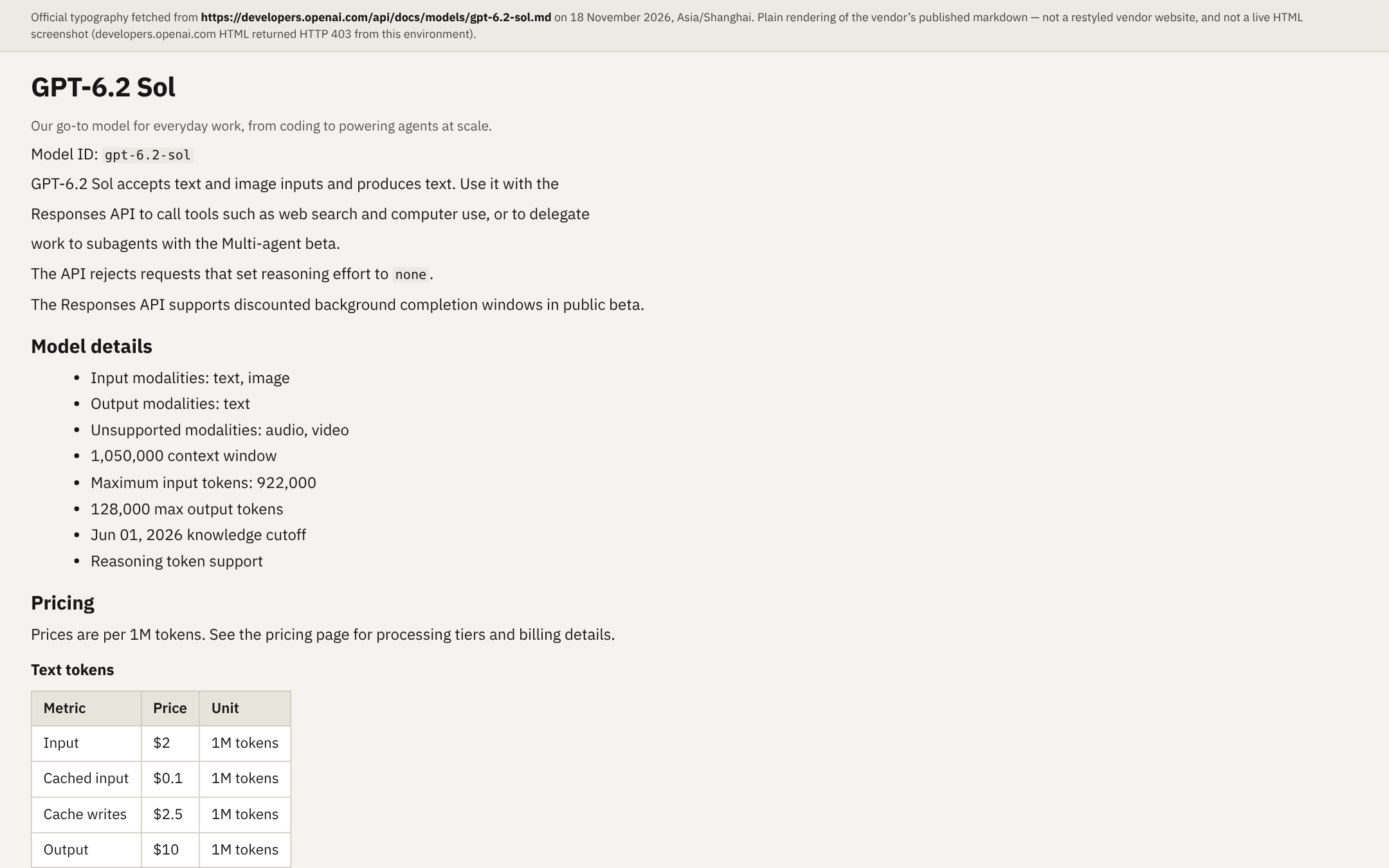
Official GPT-6.2 Sol typography from https://developers.openai.com/api/docs/models/gpt-6.2-sol.md, fetched 18 November 2026, Asia/Shanghai. Plain rendering of published official markdown, not a live HTML screenshot (HTML 403 from this environment). The frame prints model ID gpt-6.2-sol, context 1,050,000 / max input 922,000 / max output 128,000, knowledge cutoff Jun 01, 2026, and the short-context Standard table $2 / $0.1 cached input / $2.5 cache writes / $10 output per 1M tokens. The API rejects reasoning effort none.
| GPT-6.2 Astra | GPT-6.2 Sol | |
|---|---|---|
| API ID | gpt-6.2-astra | gpt-6.2-sol |
| Knowledge cutoff | May 18, 2026 | Jun 01, 2026 |
| Input / output | Text, image / text | Text, image / text |
| Not supported as modalities | Audio, video | Audio, video |
| Context / max input / max output | 1,050,000 / 922,000 / 128,000 | Same |
| Endpoints supported | Chat Completions, Responses, Batch | Same |
| Endpoints not supported | Realtime, Assistants, fine-tuning, image generation, videos, image edit, speech, transcription, translation | Same |
| Responses tools listed | web search, file search, image generation, code interpreter, hosted shell, apply patch, skills, computer use, MCP, tool search | Same |
| Unsupported features | Fine-tuning, predicted outputs | Same |
| Standard rate limits | Build 5,000 RPM / 1,000,000 TPM; Launch 10,000 / 4,000,000; Grow 15,000 / 40,000,000 | Same |
Those rate limits are OpenAI platform tiers. They are not SandBase limits. Chat Completions is supported, and tool calling still requires the Responses API. The image-generation endpoint is not supported. The Responses tool list includes image_generation. Those are different rows. Do not collapse them.
The API rejects reasoning effort none. The migration guide says to start a new integration at medium, and to use low if the current client sends none or minimal. The field is reasoning.effort on Responses and reasoning_effort on Chat Completions. This check did not find a printed enum of every other effort name on the model markdown, so this page does not invent one.
Official Standard prices
Prices below are per 1M tokens, from the published markdown rendered above. The frames print cached input as $0.4 and Sol’s cache-write cell as $2.5; the table reports those same Standard rates as $0.40 and $2.50. Short context means 272K input tokens or fewer. Above that, the page says input and cache rates double and output costs 1.5 times the short-context rate for the full request.
| Astra short | Sol short | |
|---|---|---|
| Input | $8.00 | $2.00 |
| Cached input | $0.40 | $0.10 |
| Cache write, 30 minutes | $10.00 | $2.50 |
| Cache write, 12 hours | $20.00 | $5.00 |
| Output | $40.00 | $10.00 |
Batch is 50% of Standard. Fast is 2× Standard for the same context length. Ultrafast is 3× Standard through 28 February 2027, and 6× Standard starting 1 March 2027, Pacific time. Applying the long-context rule to the short row gives Astra $16 input / $0.80 cached / $20 for a 30-minute write / $40 for a 12-hour write / $60 output, and Sol $4 / $0.20 / $5 / $10 / $15. That is the rule on the page, not a second tariff this check measured.
Arithmetic only, not a measured job. 100,000 uncached input tokens and 10,000 output tokens at short-context Standard: Astra $1.20, Sol $0.30. The same shape on official GPT-6 Astra list ($10 / $50) is $1.50. If the turn thinks far past 10,000 output tokens, this understates the bill. A cache hit is not assumed. There is no SandBase cache-hit rate for these models, and this page does not invent one.
When you migrate from GPT-5.5 or earlier, the guide says to replace prompt_cache_retention with prompt_cache_options.ttl set to "30m".
Who can use it, and where SandBase is not in that list
From the 17 November announcement, as recorded on the morning of 18 November:
- ChatGPT Work and Codex: Plus, Pro, Enterprise, and Edu.
- The rollout does not add either model to regular Chat.
- Pro 500: Ultrafast with either model.
- Pro 200: Ultrafast for the first time, starting with GPT-6.2 Sol.
- Enterprise and Edu: eligible users get access once a workspace admin enables it.
- API:
gpt-6.2-astraandgpt-6.2-sol, with Ultrafast available for both at launch.
Zero Data Retention is supported for approved organizations on eligible endpoints. That is not a statement about every account. Data residency: both support US and EU with Standard, Fast, and Batch. Ultrafast supports US data residency only.
SandBase is a separate catalog. On the morning of 18 November 2026 these paths returned HTTP 404 on HTML and on .md: /models/openai/gpt-6.2, gpt-6.2-astra, gpt-6.2-sol, gpt-6-2, gpt-6-2-astra, and gpt-6-2-sol, on both www.sandbase.ai and the apex host. The HTML for /models/openai/gpt-6.2-astra is a 404, Model Not Found. There is no screenshot of that page. llms-full.txt was HTTP 200 and contained zero gpt-6.2 or gpt-6-2 hits. There is no SandBase model ID to publish, and no request body on this page sends one.
What you can call on SandBase today is the previous flagship. GPT-6 Astra is openai/gpt-6-astra, hero $9 / $45 per 1M (10% off list $10 / $50), cache read $0.90, cache write $11.25, card context 1.1M, max output 128K. GPT-6.1 Sol is openai/gpt-6.1-sol at $2 / $10, cache read $0.10, cache write $2.50, with no discount badge on the hero. Official context for those older models remains 1,050,000. Cite 1.1M only for the SandBase card.
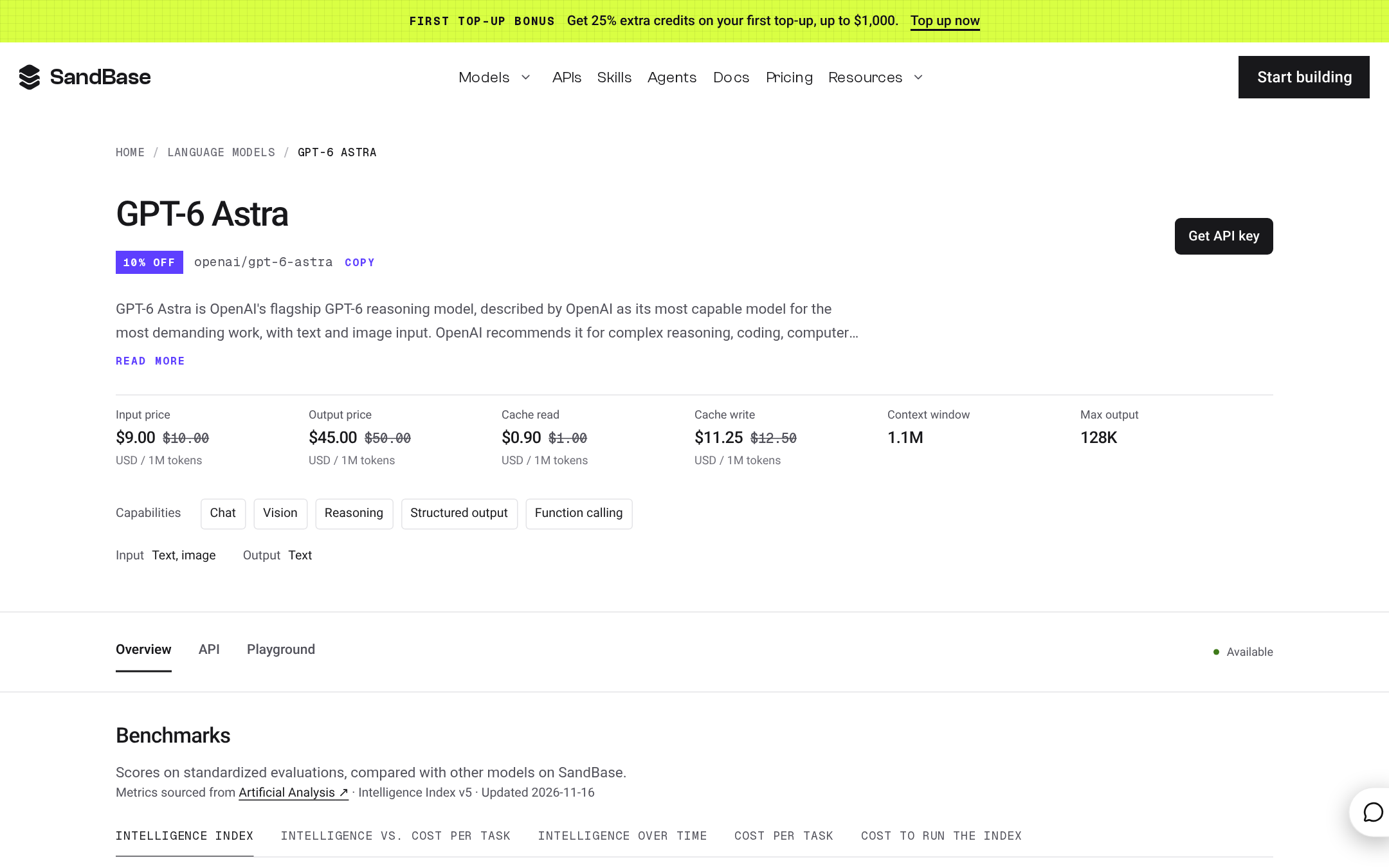
Live SandBase GPT-6 Astra card at /models/openai/gpt-6-astra, captured 18 November 2026, Asia/Shanghai (HTTP 200). Hero is $9.00 / $45.00 (10% off the $10.00 / $50.00 list), with cache read $0.90 and cache write $11.25 per 1M tokens, 1.1M context, 128K max output. This is a predecessor listing, not a GPT-6.2 card. A site-wide first-top-up bonus banner is visible at the top; it is not a model discount. Only the Astra card carries a 10% OFF badge.
curl -X POST https://api.sandbase.ai/v1/chat/completions \
  -H "Authorization: Bearer $SANDBASE_API_KEY" \
  -H "Content-Type: application/json" \
  -d '{
  "model": "openai/gpt-6-astra",
  "messages": [
    {"role": "user", "content": "Name the official GPT-6.2 API IDs, and say which SandBase ID this request is actually using."}
  ]
}'
The model string is openai/gpt-6-astra. Swap in openai/gpt-6.1-sol when that card is the one you mean. Sign in is where a new key starts. The first API call doc is the request shape. There is no 6.2 model string in the body. The card also lists POST https://api.sandbase.ai/v1/responses for Astra. /v1/run is the media route. Do not send these models there.
Older cost notes for the card you can still call are in GPT-6 Astra usage limits and API cost.
Two integration facts that change a client
Starting with GPT-6.2, the API drops reasoning items when it detects a mid-conversation prefix edit, a model downgrade, an end-user change, or an organization change. Quality can decline, and the model may spend more tokens repeating earlier work. Keep the prefix unchanged and append new instructions.
The launch post, read on 18 November and not re-screenshot here, says both models did better on demanding tasks with fewer output tokens, and it prints vendor evals against GPT-6 Astra and Claude Fable 5.2. Those numbers are OpenAI’s. They are not SandBase measurements, and this page does not rerun them. The attributed list, including the Fable footnote and the “Astra for Law is not an API ID” limit, is in the comparison. One limit from that same post belongs here because it changes a prompt: on two alignment tests the new models were more likely to omit obstacles that blocked the work, such as a missing file or an unavailable search tool. OpenAI says it added Codex instructions that substantially reduce those omissions.
Preparedness, stated narrowly: OpenAI says both models meet the Critical threshold for cybersecurity, like GPT-6 Astra, and are launching with tighter safeguards for higher-risk cybersecurity assistance. The system card, published 17 November 2026, says both meet Critical for cybersecurity and High for biological and chemical capability. Astra meets High for AI self-improvement. Sol falls below that bar. Daybreak currently has GPT-6 Sol (Blue), an alpha for GPT-6 Astra, and GPT-6 Cyber (Red). OpenAI says it will work to bring GPT-6.2 models to Daybreak. That is not a claim that 6.2 is on Daybreak today. This page does not describe an exploit or a lab procedure.
Confirmed versus unknown
| Confirmed on 18 Nov 2026 | Still unknown, or not for this page |
|---|---|
| Changelog row, model pages, IDs, official short-context prices | A bare gpt-6.2 SKU, or gpt-6.2-terra |
SandBase 404 on the 6.2 paths, and zero hits in llms-full.txt | A SandBase ID, SandBase price, or SandBase TTFT / TPOT / throughput / cache-hit rate |
Tool calling requires Responses; none is rejected | Every ChatGPT surface beyond the announcement’s Work / Codex / regular-Chat split |
| Live SandBase prices for GPT-6 Astra and GPT-6.1 Sol | A date when a SandBase 6.2 card will exist |
A later update can add a card if the HTML and the .md both return HTTP 200. Until then the follow-up for latency is the same shape as the Qwen4-Max measurement post: one box, one day, after a live card exists. It is not written here.
FAQ
Is GPT-6.2 out?
The models OpenAI shipped are GPT-6.2 Astra and GPT-6.2 Sol, announced 17 November 2026. gpt-6.2 by itself is not a model page. The 12 November answer, that nothing in that family was official yet, described that evening. It is preserved on the status note.
What is the API model ID?
gpt-6.2-astra or gpt-6.2-sol on OpenAI’s API. On SandBase, as of the morning of 18 November 2026, there is no ID. Use openai/gpt-6-astra or openai/gpt-6.1-sol.
Can I call GPT-6.2 on SandBase today?
No. The candidate cards 404. The models you can call are the ones with live cards, starting with GPT-6 Astra at $9 / $45.
Why is Sol’s knowledge cutoff later than Astra’s?
The Sol page prints Jun 01, 2026. The Astra page prints May 18, 2026. This note does not explain the gap. It only reports the two lines.
Does the 30% background discount apply only to 6.2?
No. The 17 November changelog row lists gpt-6.2-astra, gpt-6.2-sol, gpt-6.1-terra, and gpt-6-luna. Two hours is 30% below Standard. Eight hours is 40% below. It is a Responses API public beta.
What to open
For a SandBase call today, open GPT-6 Astra or GPT-6.1 Sol. For the new IDs, use OpenAI’s API and the model pages linked above. Re-check SandBase before you put gpt-6.2-astra in a client that only has a SandBase key.
Sources checked 18 November 2026, Asia/Shanghai. Changelog, both model pages, and the Using GPT-6.2 guide were fetched as published markdown and rendered as plain typography, not as live HTML screenshots (HTML returned HTTP 403 from this environment). SandBase HTML, .md, and llms-full.txt were fetched. The openai.com launch essay was not screenshotted, so those claims stay attributed. No SandBase latency run was attempted, because there is no live 6.2 card.
Found this useful? Share it