Doubao Xiaodou vs Qianwen: Two Chinese “Get Things Done” Assistants (2026)
Doubao Xiaodou and Qianwen both officially emphasize getting things done. Official scenes and access differ. This is not a quality bake-off or a merged price comparison.
Doubao Xiaodou and Qianwen both officially say they can get things done, not only return a chat reply. That shared sentence is not a reason to treat them as the same product, and it is not a license to invent a quality ranking. The useful difference, on official pages checked on 26 November 2026, Asia/Shanghai, is which scenes each page actually names, and how you get in: Xiaodou is an invite-only Doubao-family assistant confirmed on a China App Store iOS listing; Qianwen is publicly listed as Alibaba’s AI assistant, with a consumer site at qianwen.com and a China App Store app.
This article keeps the two official scene lists separate. A capability written on one page is not copied onto the other. The pinyin Xiaodou is a pronunciation aid, not a confirmed official English brand name. For Xiaodou’s official definition, see What Is Doubao Xiaodou?. A China-available, still unscored view of both is in Personal AI Assistants Available in China.
Key takeaway
- Official Xiaodou positioning, from the product page and Doubao’s 24 November 2026 announcement: a Doubao that understands you and can take the initiative to get things done. Public beta is invite-only. The confirmed client is the China App Store listing for iOS and iPadOS 15.0 or later.
- Official Qianwen positioning, from qianwen.com and the China App Store listing: Qianwen is Alibaba’s AI assistant, described on the store page as answering smartly and helping you get things done. The site presents it as a first entry for Qwen, covering work, study, and life.
- Official scenes are listed separately below. Xiaodou names proactive messages, follow-up, and connections such as Douyin, Feishu, Calendar, Health, and Location. Qianwen’s store copy names a work assistant that can deliver finished web, app, PPT, Word, Excel, and image work, scheduled tasks, voice calls, an agent plaza, and life help such as takeaway, hotel booking, restaurant search, and government errands. Neither list is used to fill the other.
- Access differs. Xiaodou’s public beta requires an invite. Qianwen is publicly listed on iOS, with a consumer site at qianwen.com. Site metadata also refers to Windows and macOS PC clients; those names are recorded as official site language, not as a tested install.
- Prices are named only as each page names them. There is no merged “which plan is better value” table. Xiaodou still has two official number sets that do not fully match; that stays in Doubao Xiaodou Pricing in 2026.
Official positioning
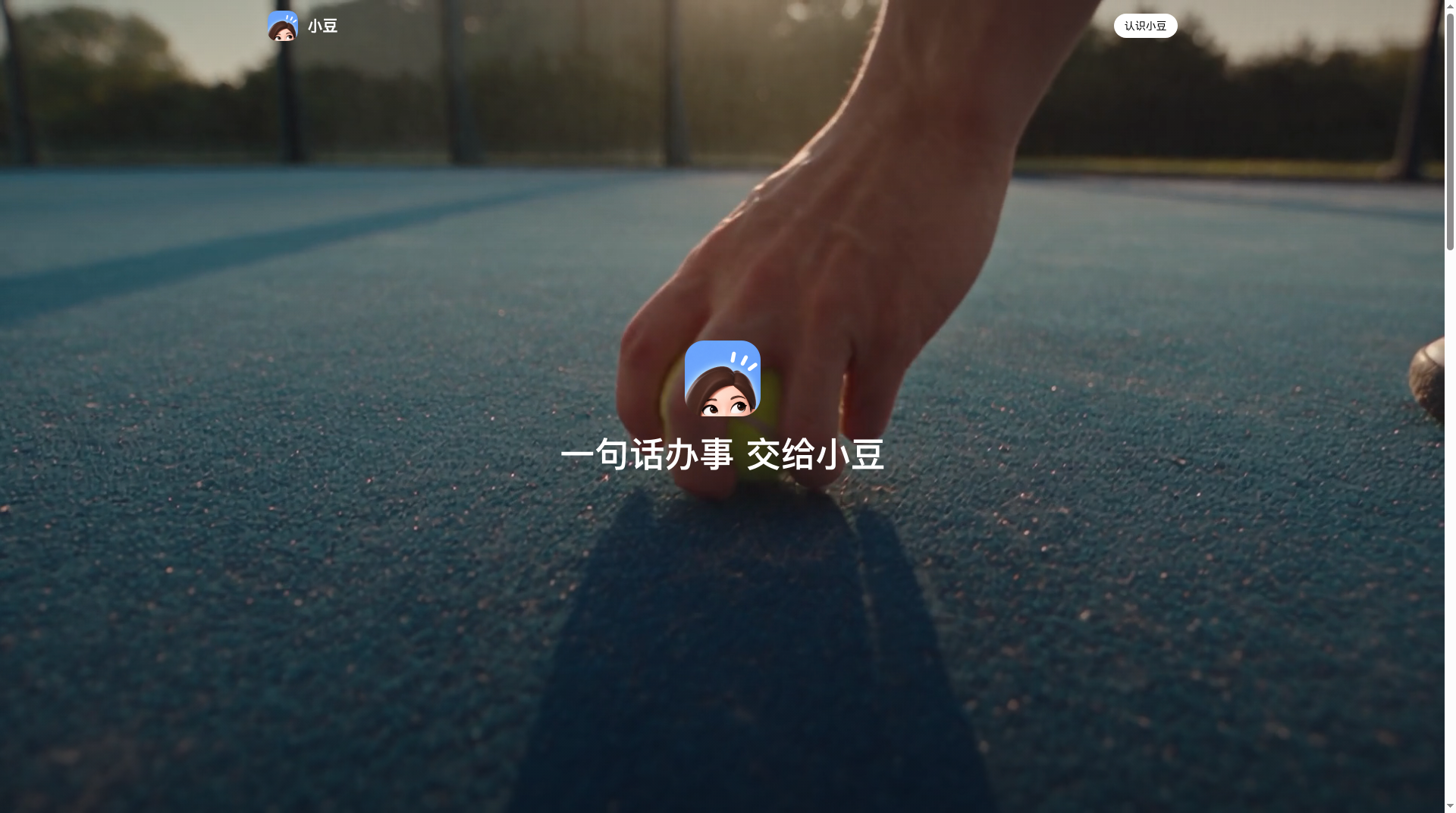
Xiaodou product page, captured 26 November 2026. The hero reads 一句话办事 交给小豆.
The Xiaodou product page headlines a Doubao that understands you and can take the initiative to get things done. Invite-page metadata calls it a personal AI assistant that remembers preferences, connects commonly used apps, and helps proactively with work and life. Doubao’s official account, on 24 November 2026 at 10:21:53 Asia/Shanghai, said Xiaodou is Doubao’s AI personal assistant product, that public beta is invite-only, that an invite code opens the trial with a free quota of unpublished size, and that Xiaodou’s capabilities and experience will gradually go live in the Doubao app. The relationship with that main app is a separate comparison: Xiaodou vs the Doubao App.
Qianwen’s official site titles the product 千问-阿里 AI 助手. Recovered site language presents it as a first entry for Qwen, covering work, study, and life, with named site capabilities that include AI search, web summary, AI PPT, image generation, and recording notes. The China App Store listing uses the name 千问 - 阿里AI助手, is offered by 上海智信普惠科技有限公司, is listed 13+, and requires iOS or iPadOS 15.0 or later. The store subtitle and body emphasize answering smartly and helping you get things done.
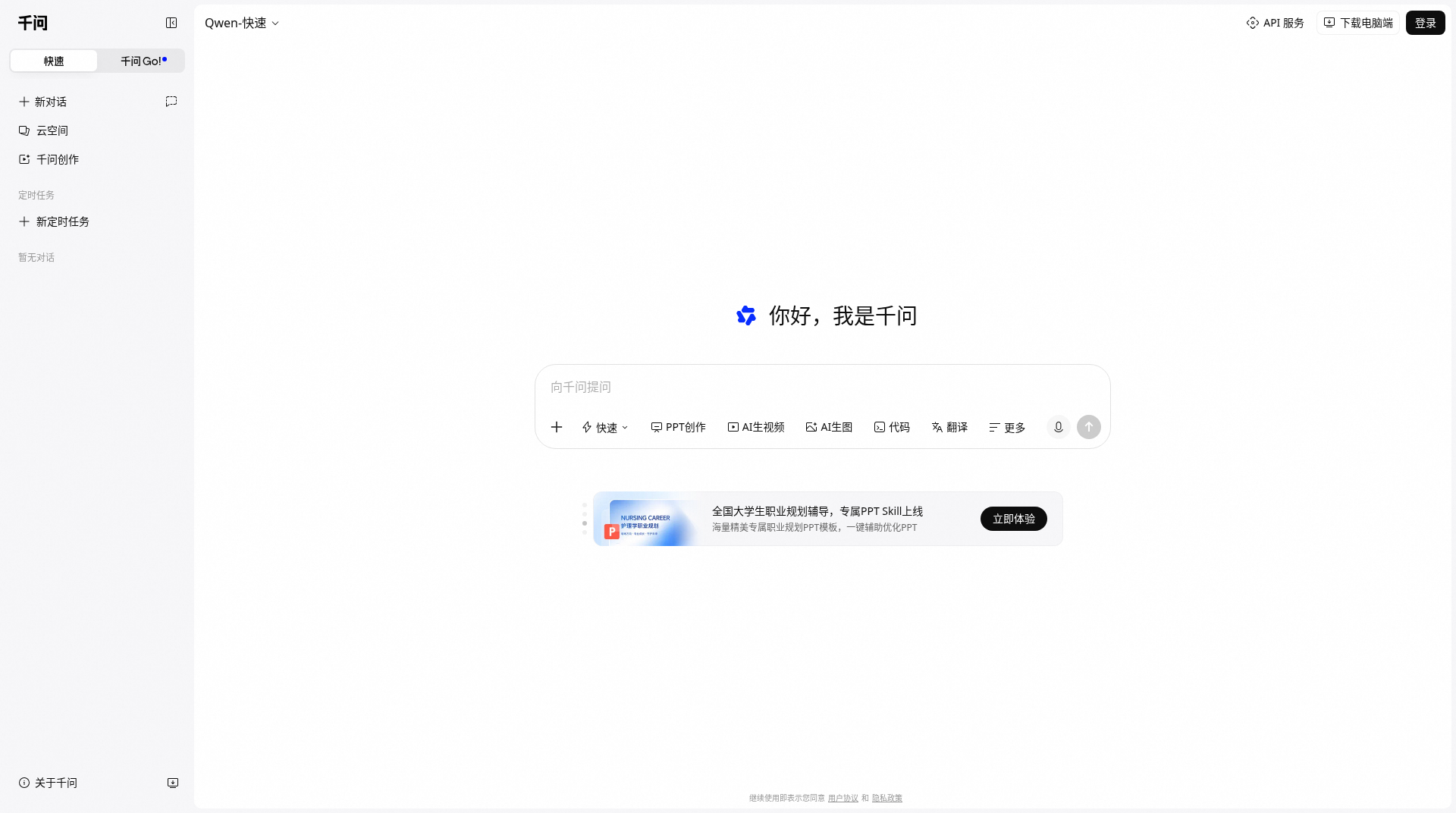
qianwen.com, captured 26 November 2026. The greeting is 你好,我是千问. The sidebar includes 定时任务 and 新定时任务.
Both products therefore officially occupy the “can get things done” sentence. The official rooms under that sentence are not the same, which is why the next section keeps two lists.
Official scenes, listed separately
What the Xiaodou pages name. Official behaviors are proactive messages, “guess what you want,” and task follow-up. Proactive messages use what you have already discussed and the apps you have connected, then remind you when needed. “Guess what you want” uses your interests and some of your memory in Doubao. Follow-up examples are a daily brief, a price-drop reminder, and an exercise goal, handed over in one sentence and changeable or stoppable later. Named connections are Douyin, Feishu, Calendar, Health, and Location, plus “other apps,” under your authorization. Closing examples include placing a reservation by phone, organizing Feishu to-dos, and following long-term goals. The App Store listing adds a catalog used under explicit instructions and authorization: information queries, calendars and to-dos by text or voice, daily services such as package tracking and nearby search, shopping after-sales, health reminders, and office writing.
What the Qianwen pages name. The App Store listing describes a work assistant that can deliver finished web, app, PPT, Word, Excel, and image work. It describes scheduled tasks, both periodic and one-off. It describes voice calls, an agent plaza, and a life helper for takeaway, hotel booking, restaurant search, and government errands, plus shopping advice. Other named areas include writing, PPT, documents, code, Wan 3.0 video, and learning tools. The consumer site’s recovered labels add AI search, web summary, AI PPT, image generation, and recording notes.
Those are two official inventories. This article does not infer that Xiaodou can export a finished Excel file because Qianwen’s store page says that Qianwen can, or that Qianwen places a reservation by phone because Xiaodou’s product page uses that example. “Life help” on the Qianwen listing and “proactive follow-up” on the Xiaodou product page also stay attached to the pages that wrote them. A wider official look at who claims to come back later is in Assistants That Follow Up for You in 2026.
Platform, access, and named prices
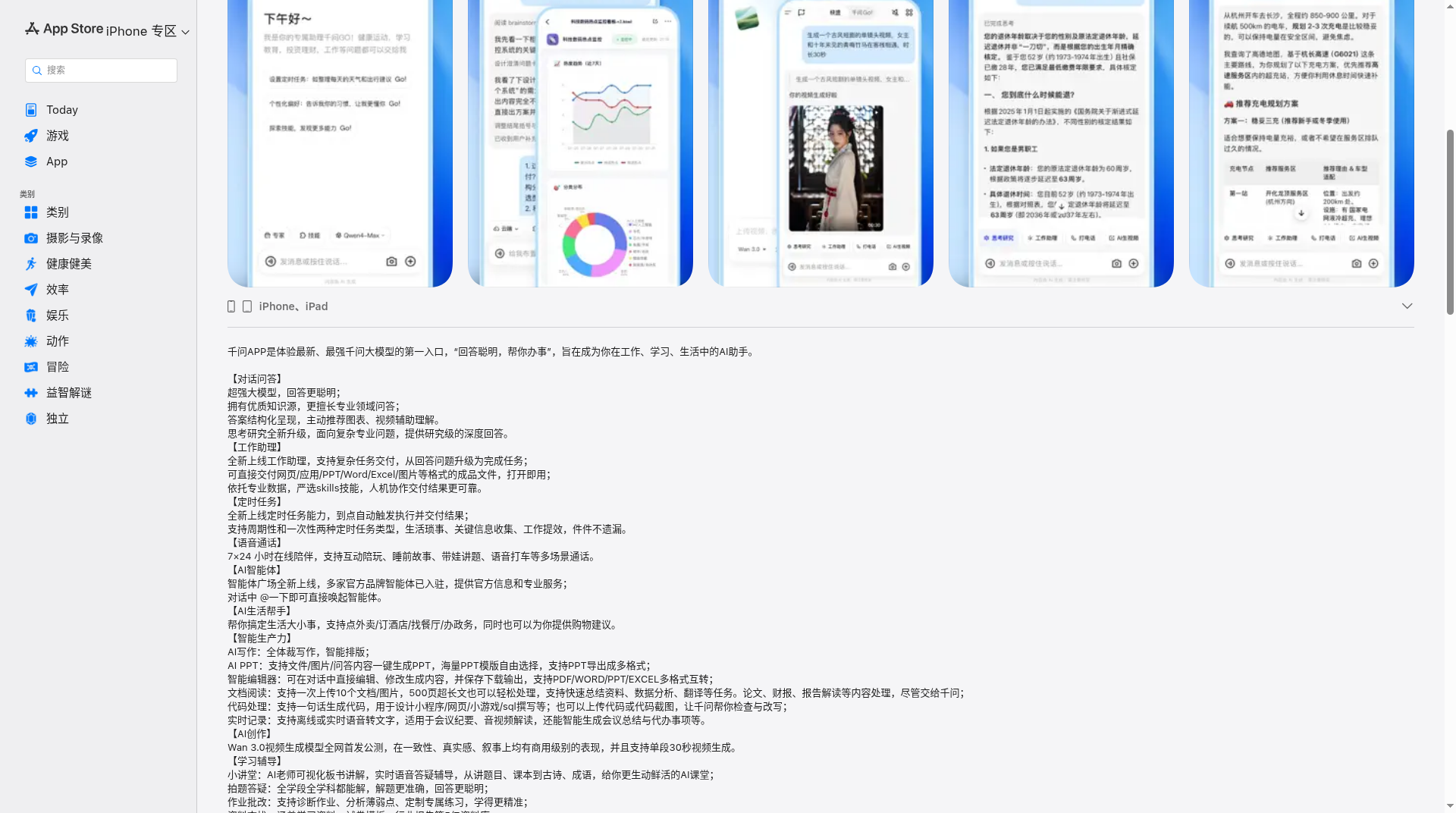
Qianwen China App Store listing id 6466733523, description viewport, captured 26 November 2026. Visible section labels include 对话问答, 工作助理, 定时任务, and 生活帮手.
Xiaodou’s confirmed client in this check is the China App Store app, listed as 小豆 - 豆包旗下 AI 个人助理, free with in-app purchases, in Simplified Chinese, with an 18+ age rating on the store page, requiring iOS or iPadOS 15.0 or later. Official announcement copy still requires an invite code. A logged-in Xiaodou web app was not confirmed. An official Android store listing was not opened.
Qianwen is publicly listed on the China App Store, requiring iOS or iPadOS 15.0 or later, and has a consumer site at qianwen.com. Recovered site metadata also refers to Windows and macOS PC clients. Those client names are official site language from this check. They are not a report that a desktop install was completed here. Official Android details for Qianwen were not opened as a separate store listing in this check, so they stay out of the confirmed column.
Prices are recorded only as names or figures printed on each product’s own pages, not as a value comparison. Xiaodou’s App Store description still names a free plan plus recurring 标准, 加强, and 高级 monthly and annual prices (68/688, 200/2,048, and 500/5,088 yuan). The in-app purchase module recovered on 26 November 2026 still showed ten SKUs, including higher “1 month” and “1 year” amounts, and still did not include the description’s recurring annual 加强 and 高级 rows. Those two sets remain side by side in the pricing article. Qianwen’s App Store listing includes in-app purchase names such as 千问Go! 高级, 精英, and 旗舰, and 千问创作会员, at various yuan prices printed on that listing. Those names are noted so a reader knows official paid options exist. They are not lined up against Xiaodou’s 标准, 加强, or 高级 rows, and this article draws no “better value” conclusion.
What cannot be compared yet
- Which assistant is more accurate, faster, or more reliable at “getting things done.”
- Whether a Xiaodou reservation call, a Qianwen hotel booking, or a finished PPT actually completes as the store or product copy suggests.
- The size of Xiaodou’s public-beta free quota, or any like-for-like quota comparison.
- Official Android details that were not opened for either product in this check.
- A merged price table, or a conclusion that one membership is a better deal.
- Whether the two products share account, data, or ecosystem rules. They are officially in different company families: Doubao / ByteDance, and Alibaba / Qianwen.
How to choose, with the information that exists
If you already live in Doubao, can obtain an invite, and want the assistant whose own page emphasizes proactive messages, follow-up reminders, and authorized connections to Douyin, Feishu, Calendar, Health, and Location, Xiaodou is the official product for that framing. The confirmed download path in this check is the China App Store listing cited above.
If you want a publicly listed Alibaba assistant whose official store and site copy emphasizes finished work files, scheduled tasks, voice calls, an agent plaza, and life errands such as takeaway, hotels, restaurants, and government services, Qianwen’s official surfaces are qianwen.com and the App Store listing. You do not need a Xiaodou invite to use a publicly listed Qianwen app.
If your question is “which Chinese assistant is better at getting things done,” official pages do not answer it. If your question is which official scene list you actually need — Doubao-ecosystem follow-up, or Qianwen’s work-and-life inventory — the two lists already diverge.
Nearby official-claim comparisons include Xiaodou vs Kimi and Xiaodou vs ChatGPT. An iOS-only, still unscored slice is in iOS Personal AI Assistants in 2026.
If you are building your own assistant rather than choosing a consumer app, that is a different job. SandBase has no Xiaodou card. The live model-family card is Seed 2.1 Pro (bytedance/seed-2.1-pro), listed at $0.89 input, $4.45 output, and $0.18 cache read per million tokens, with a 1M context window, and described as Doubao-Seed-2.1-Pro through Doubao and Volcano Engine. Related catalogs: ByteDance models and Chinese LLM APIs. Those links are for the model family. They are not a way to call Xiaodou, and they are not a Qianwen API card invented for this article.
Sources
- Official Xiaodou product page: doubao.com/xiaodou. Checked 26 November 2026, Asia/Shanghai.
- China App Store listing for Xiaodou, id 6815582077, same day.
- Doubao official announcement, 24 November 2026, 10:21:53 Asia/Shanghai, as cited in What Is Doubao Xiaodou?.
- Official Qianwen site: qianwen.com, same day, including recovered title, meta, and PC-client language.
- China App Store listing for Qianwen, id 6466733523, same day.
- SandBase cards linked above, confirmed live the same day. There is still no Xiaodou catalog card.
Found this useful? Share it